STATISTICAL PROCESS CONTROL WITH
SPECIAL REFERENCE TO MULTIVARIABLE
PROCESSES AND SHORT RUNS
Pak Fai Tang
A thesis submitted in fialfilment of the requirements for the degree of Doctor of Philosophy
Department of Computer and Mathematical Sciences Faculty of Science
Victoria University of Technology
FTS THESIS
658.562015195 TAN
30001005084969
Tang, Pak Fai
CONTENTS
Chapter Page
Acknowledgments i
Declaration ii Abstract iii List of Figures vii List of Tables x
1. Introduction
1.1 Introduction to SPC 1 1.2 Problems of Traditional SPC for Short Production Runs 4
1.3 Multivariate Quality Control 6
1.4 Thesis Objectives 7
2. Literature Review
2.1 Introduction 9 2.2 Adjusting Control Limits Based on The Number of Subgroups or
Observations 9 2.3 Control Charts Based on Individual Measurements 12
2.4 Mixing Production Lots and Normalizing Output Data 15 2.5 Setup Variation and Measurement Error Considerations 19 2.6 'Self-Starting' Procedures Based on 'Running' Estimates of the
Process Parameters 21 2.7 Control Based on Exponentially Weighted Moving Averages
(EWMA) 29 2.8 Deriving'Control'Limits From Specifications 35
2.9 Adjusting Set-up Continuously Based on Process Output 37
2.10 Monitoring Process Input Parameters 39 2.11 Economically Optimal Control Procedures 40
3. Mean Control for Multivariate Normal Processes
3.1 Introduction 45 3.2 Methodological Basis 46
3.3 Monitoring the Mean of Multivariate Normal Processes 53 3.3.1 Control Charts Based on Individual Measurements 54
3.3.2 Control Charts Based on Subgroup Data 57
3.4 Example 63 3.5 Control Performance 79
3.6 Detecting Step Shifl:s and Linear Trends Using A Robust Estimator
of Z andEWMA 85 3.7 Computational Requirements 102
4. Dispersion Control for Multivariate Normal Processes
4.4 Rank-Deficient Problem 129
4.5 Comparisons 131 4.6 An Example 149 4.7 Effect of Aggregation on Control Performance 154
5. Capability Indices for Multivariate Processes
5.1 Introduction 158 5.2 A Review of Multivariate Capability Indices 160
5.3 Constructing a Multivariate Capability Index 166
5.4 Three Bivariate Capability Indices 168 5.4.1 Projection of Exact Ellipsoid Containing a Specified Proportion
of Products 169 5.4.2 Bonferroni-Type Process Rectangular Region 171
5.4.3 Process Rectangular Region Based on Sidak's Probability
Inequality 172 5.5 Some Comparisons of The Projected, Bonferroni and Sidak-Type
Capability Indices 174 5.6 Testing The Capability of a Bivariate Process 176
5.7 Robustness to Departures From Normality - Some Consideration 180
6. A Comparison of Mean and Range Charts With The Method of Pre-Control
6.1 Introduction 185 6.2 A Review of Pre-Control 186
6.3 The Practical Merits of Pre-Control 190
6.4 Short Runs and Pre-Control 192 6.5 A Statistical Comparison Between Pre-Control and X-bar and R
Charts 193 6.6 Equating Sampling Effort 203
6.7 Concluding Remarks 208
7. Conclusions and Some Suggestions for Future Investigation
7.1 Summary and Conclusions 210 7.2 Suggestions for Future Work 213
ACKNOWLEDGMENTS
I wish to express my sincere gratitude to my principal supervisor, Associate
Professor Neil Bamett and co-supervisor. Associate Professor Peter Cerone for helpfiil
suggestions, advice, guidance and encouragement throughout this project.
Special thanks are also due to Associate Professor Ian Murray and his wife
Glenice for their warm hospitality during my stay in AustraUa, Dr. Ng Lay Swee, the
principal of Tunku Abdul Rahman College, Malaysia for her advice and encouragement,
the Department of Computer and Mathematical Sciences, Victoria University of
Technology for the financial support given to me, and Tunku Abdul Rahman College for
the study leave period granted.
I am also indebted to the staff of the Department, particularly, Tom Peachey, Neil
Diamond, Alan Glasson, Ian Gomm, Ted Alwast, P.Rajendran (Raj) and Damon
Burgess, and my fellow colleagues, particularly, Mehmet Tat, Gregory Simmons,
Violetta Misiorek, Kevin Liu, Fred Liu, Rafyul Fatri, Phillip Tse and Simon So, who
have, in one way or another, rendered their kind assistance.
DECLARATION
I hereby declare that:
(i) the following thesis contains only my original work which has not been
submitted previously, in whole or in part, in respect of any other academic
award, and
(ii) due acknowledgment has been made in the text of the thesis to all other material
used.
CpakFSr^g
ABSTRACT
The quest for control and the subsequent pursuit of continuous quality
improvement in the manufacturing sector, due to mcreasingly keen competition, has
stimulated interest in statistical process control (SPC). Whilst traditional SPC techniques
are well suited to the mass production industries, their usefiilness in short run or low
volume manufacturing environments is questionable. The major problem with short-run
SPC is lack of data for estimation of the control parameters. In view of this limitation,
many alternatives and adaptations of existing techniques have been devised. However,
these efforts have largely been devoted to monitoring and controlling univariate
processes.
In practice, the quality of manufactured products is oflien determined by reference
to several quality characteristics which are correlated. Under these circumstances, it is
necessary to use multivariate quality control procedures which take the correlational
structure into consideration. Although this area has received considerable attention in the
literature, most of the published work assumes that prior information about the process
parameters is available. This assumption is rarely the case in the short run environment.
production, whether or or not prior information about the process parameters is
available.
The techniques presented for controlling the mean vector of multivariate
processes utiUze the probability integral transformation technique in order to produce
sequences of independent or approximately independent standard normal variables. This
offers greater flexibility than the 2-stage procedures recommended by some authors in
the design of control charts for the unknown parameter case. Apart fi-om the
conventional rule that signals when a plotted value exceeds either of the 3-sigma limits,
run tests as well as the methods of Cumulative Sum (CUSUM) and Exponentially
Weighted Moving Average (EWMA) can be used. A simulation study indicates that the
techniques, with the usual decision rule imposed, are particularly usefiil for 'picking up' a
persistent change in the process mean vector when subgroup data are used, even if prior
information about the process parameters is not available. For detecting step shifts and
linear trends based on individual observations, two specifically designed EWMA charts
based on similarly transformed variables but which use a different estimator of the
process variance-covariance matrix are found to be much more effective than other
competing procedures.
control chart, for the known parameters case, is more sensitive to certain shifts than that
which involves separate charting of the standardized variances of the principal
components or the individual variables resuhing from the partitioning of the
variance-covariance matrices. The proposed techniques also possess some practical advantages
over existing procedures. In particular, better control over the false signal rate, ease of
locating control limits and identification of the nature of process changes.
To satisfactorily describe the capability of multivariate processes, a multivariate
capability index is required. This thesis describes three approaches to designing capability
indices for multivariate normal processes. Three process capability indices are presented
and some simple rules provided for interpreting the ranges of values they take. The
development of one index involves the projection of a process ellipse, containing at least
a specified proportion of products, on to its component axes. The other two are based on
Bonferroni and Sidak's multivariate normal probability inequalities in their constructions.
A comparison indicates that the latter two are superior to the former and that the
Sidak-type capability index is marginally better than that based on the Bonferroni Inequality. An
approximate test is developed for the Sidak-type capability index. A possible method of
forming robust multivariate capability indices based on multivariate Chebyshev-type
inequalities is also considered.
List of Figures
1.1 A Typical Control Chart 2
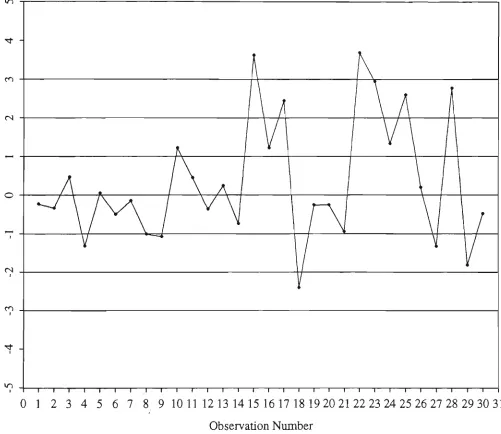
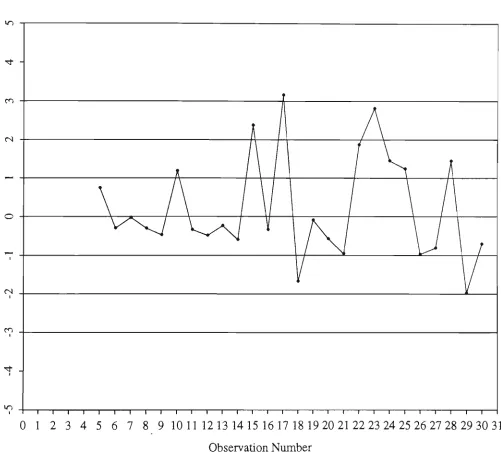
3.1 Multivariate Control Charts for Example 3.4.1 66
3.2 Multivariate Control Charts for Example 3.4.2 68
3.3 Multivariate Control Charts for Example 3.4.3 70
(a) Known Parameters
(b) Unknown Parameters
3.4 Multivariate Control Chart for Example 3.4.4
(a) Known Parameters 72
(b) Unknown Parameters 73
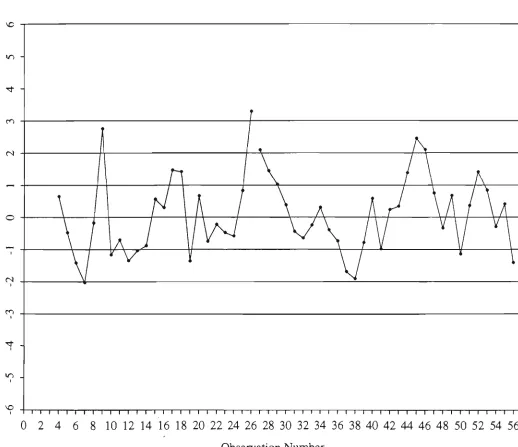
3.5 Multivariate Control Chart for Holmes and Mergen' s (1993) Data 77
3.6 EWMAZIU Chart for Holmes and Mergen's (1993) Data 90
3.7 EWMAZ1, EWMAZ1U and M Charts for Bivariate Data with Linear
Trend 92
3.8 Run Length Probabilities of EWMAZ 1, EWMAZ2, EWMAZ3 and
MCHARTforLinearTrend,/? = 2, <af=7, a = 0.03 95
(a) Trend Parameter = 0
(b) Trend Parameter = 0.1
(c) Trend Parameter = 0.2
(d) Trend Parameter = 0.5
3.9 Run Length Probabilities of EWMAZ 1, EWMAZ2, EWMAZ3 and
MCHARTforLinearTrend,/7 = 3, af=8, a = 0.02 96
(a) Trend Parameter = 0
(b) Trend Parameter = 0.1
(c) Trend Parameter = 0.2
(d) Trend Parameter = 0.5
3.10 Run Length Probabilities of EWMAZ 1, EWMAZ2, EWMAZ3 and
MCHARTforLinearTrend,/? = 5, i/= 10, a = 0.005 97
(a) Trend Parameter = 0
(b) Trend Parameter = 0.1
(c) Trend Parameter = 0.2
(d) Trend Parameter = 0.5
3.11 Run Length Probabilities of EWMAZ lU, EWMAZ2U and MCHARTU
for Linear Trend,/? = 2, <i= 7, a = 0.02 98
(a) Trend Parameter = 0
(b) Trend Parameter = 0.1
(c) Trend Parameter = 0.2
(d) Trend Parameter = 0.5
3.12 Run Length Probabilities of EWMAZIU, EWMAZ2U and MCHARTU
for Linear Trend,/? = 3, <af= 8, a = 0.01 99
(a) Trend Parameter = 0
for Linear Trend,/? = 5, <i= 10, a = 0.005 100 (a) Trend Parameter = 0
(b) Trend Parameter = 0.1 (c) Trend Parameter = 0.2 (d) Trend Parameter = 0.5
3.14 Run Length Probabilities of EWMAZl, EWMAZ2 and EWMAZ3 for
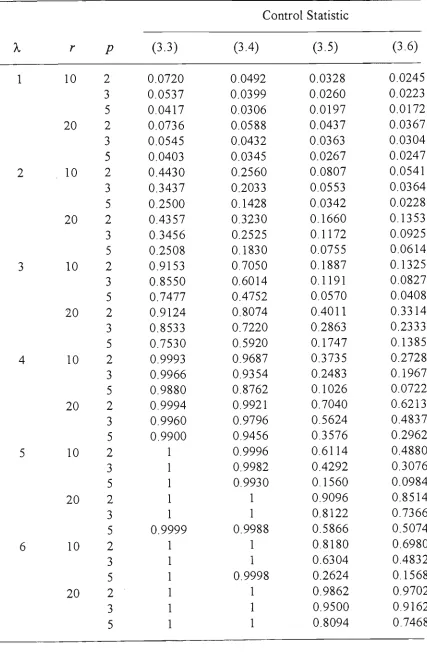
StepShift,/> = 2 104 (a) r= 10, noncentrality parameter = 1
(b) r = 10, noncentrality parameter = 2 (c) r = 10, noncentrality parameter = 3 (d) r = 20, noncentrality parameter = 1 (e) r = 20, noncentrality parameter = 2 (f) r = 20, noncentrality parameter = 3
3.15 Run Length Probabilities of EWMAZl, EWMAZ2 and EWMAZ3 for
Step Shift,/? = 3 105 (a) r= 10, noncentrality parameter = 1
(b) r = 10, noncentrality parameter = 2 (c) r= \0, noncentrality parameter = 3 (d) r = 20, noncentrality parameter = 1 (e) r = 20, noncentrality parameter = 2 (f) r = 20, noncentrality parameter = 3
3.16 Run Length Probabilities of EWMAZl, EWMAZ2 and EWMAZ3 for
Step Shift,/? = 5 106 (a) r= 10, noncentrality parameter = 1
(b) r = 10, noncentrality parameter = 2 (c) r = 10, noncentrality parameter = 3 (d) r = 20, noncentrality parameter = 1 (e) r = 20, noncentrality parameter = 2 (f) A* = 20, noncentrality parameter = 3
3.17 Run Length Probabilities of EWMAZIU and EWMAZ2U for Step Shift,
p = 2 107 (a) A* = 10, noncentrality parameter = 1
(b) r = 10, noncentrality parameter = 2 (c) r = 10, noncentrality parameter = 3 (d) r = 20, noncentrality parameter = 1 (e) r = 20, noncentrality parameter = 2 (f) r = 20, noncentrality parameter = 3
3.18 Run Length Probabilities of EWMAZIU and EWMAZ2U for Step Shift,
p = 3 108 (a) r = 10, noncentrality parameter = 1
3.19 Run Length Probabilities of EWMAZIU and EWMAZ2U for Step Shift,
p = 5 109
(a) r = 10, noncentrality parameter = 1
(b) r = 10, noncentrality parameter = 2
(c) r = 10, noncentrality parameter = 3
(d) r = 20, noncentrality parameter = 1
(e) r = 20, noncentraUty parameter = 2
(f) r = 20, noncentrahty parameter = 3
4.1 Dispersion Control Charts for Alt and Bedewi(l986)'s Data 154
(a) Known Variance-Covariance Matrix
(b) Unknown Variance-Covariance Matrix
5.1 Graphical Illustration of An Incapable Bivariate Normal Process with
MCp^ = \ 166
6.1 Pre-Control Scheme 187
6.2 Probability of Detection Within 5 Successive Samples (P) vs Mean Shift
in Multiples of Standard Deviation (k). A, B and C Denote Respectively
List of Tables
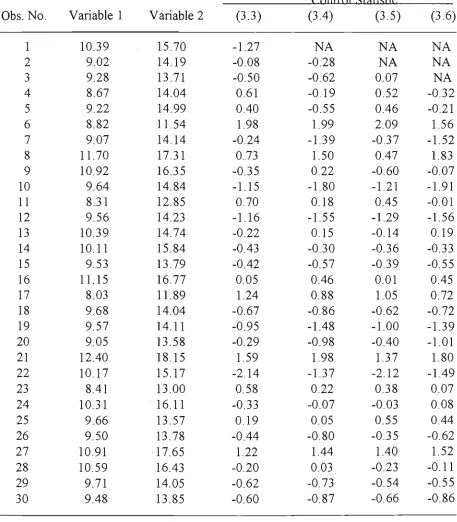
3.1 Probability of A False Signal from Any One of the First 50 Subgroups 63 3.2 Simulated Data and Values of The Control Statistics Based on
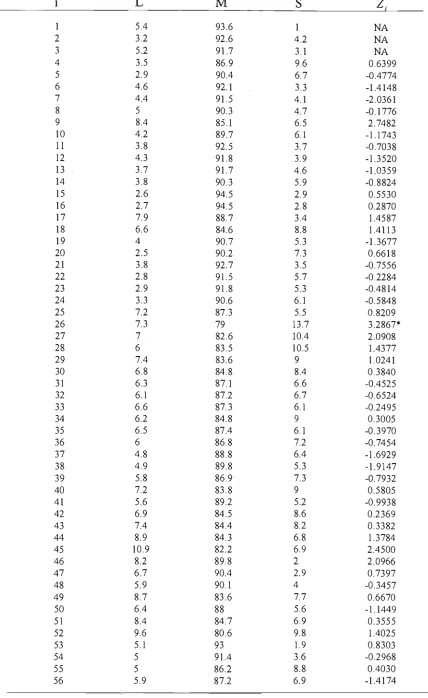
IndividualMeasurements for Example 3.4.1 65 3.3 Holmes and Mergen (1993)'s Data and Values of Statistic (3.6) 76
3.4 Values of Alt et al.(1976)'s Test Statistic, Small Sample Probability
Limits and Control Statistic (3.11) for Example 3.4.6 79 3.5 Probability of Detection Within m = 5 Subsequent Observations 84
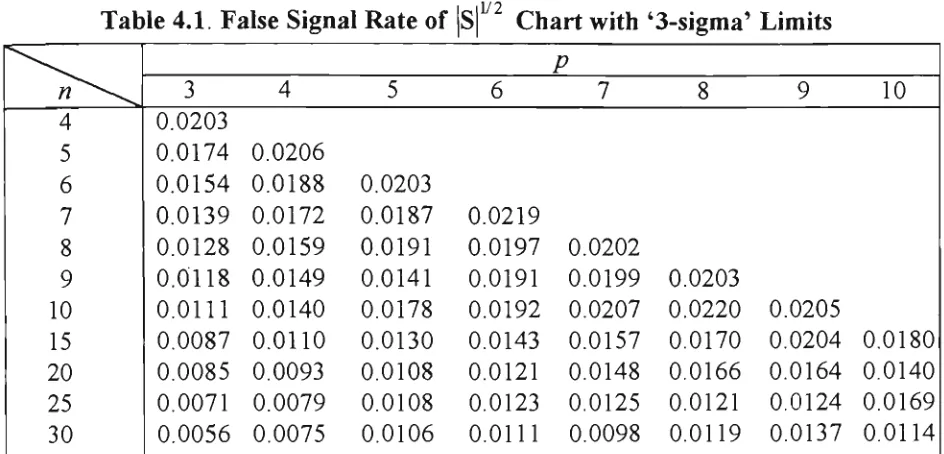
3.6 Probability of Detection Within m = 5 Subsequent Subgroups 85 4.1 False Signal Rate of |S|^^ Chart with'3-sigma'Limits 135
I i l / 2
4.2 |S| Control Chart Factor, k^ 137 4.3 Power Comparison of MLRT, |S| , SSVPC and Decomposition (Proposed,
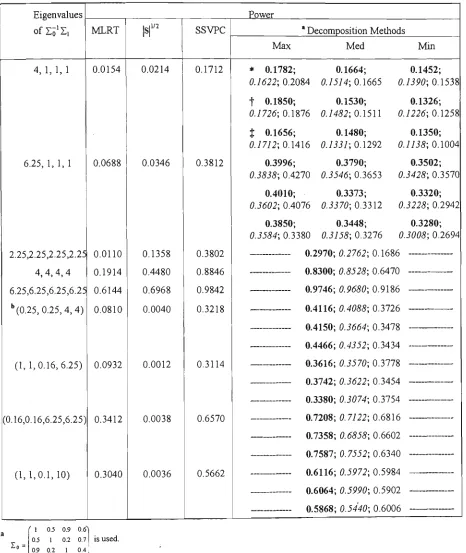
Fisher and Tippett) Techniques for/? = 3, « = 4 and a = 0.0027 142 4.4 Power Comparison of MLRT, |S| , SSVPC and Decomposition (Proposed,
Fisher and Tippett) Techniques for/? = 4, « = 5 and a = 0.0027 143 4.5 Power Comparison of MLRT, |S| , SSVPC and Decomposition (Proposed,
Fisher and Tippett) Techniques for/? = 5, « = 8 and a = 0.0027 144 4.6 Vx{RL < k) for a Change in S After the rth Subgroup, by MLRTECM and
Decomposition (Proposed, Fisher and Tippett) Techniques for/? = 2, « = 3 and
a = 0.0027 145 4.7 ¥r{RL < k) for a Change in E After the Ath Subgroup, by MLRTECM and
Decomposition (Proposed, Fisher and Tippett) Techniques for/? = 3, « = 4 and
a = 0.0027 146 4.8 ¥r{RL < k) for a Change in E After the rth Subgroup, by MLRTECM and
Decomposition (Proposed, Fisher and Tippett) Techniques for/? = 4, « = 5 and
a = 0.0027 147 4.9 Alt and Bedewi (1986)'s Data and Values of Control Statistic (4.14),
(4.15), MLRT Statistic (Unknown S ) a n d |S| 153 4.10 Power Comparison of Proposed, IC and ISVPC Charting Techniques for
Shifts in the Form of Zi = A,Zo 158 5.1 Relative Conservativeness of Projected, Bonferroni and Sidak-Type
Capability Indices 176 5.2 Critical Values for Testing ^Cf^ 180
6.1 Probability of Set-up Approval for Pre-Control 188
6.2 Power of Pre-Control - Mean Shift 196 6.3 Power of X Chart with 3a Limits (assumed C^ = 1) 196
6.4 Power of X Chart with Adjusted Limits (assumed C^ = l ) 197
6.7 Power of 7? Chart-Adjusted Limits (assumed Cp = 1) 198
6.8 Average Run Lengths for Pre-Control 199 6.9 Average Run Lengths for X Chart - Adjusted Limits (assumed C^ = 1) 199
6.10 Powerof X Chart (assumed C^ = 0.75) 200 6.11 Powerof ^ Chart (assumed C^ = 1.25 ) 200 6.12 Powerof X Chart (assumed C^ = 1.50 ) 201 6.13 Power ofi? Chart (assumed C^=1.25) 201 6.14 Power ofi? Chart (assumed C^=1.50) 201
6.15 A N I I M S ( P C ) 205
6.16 ANII(X) (sample size 4, control based on C^ = 1) 205
6.17 TMS 206
6.18 ANIIvi(PC) 207 6.19 ANII(i?) (sample size 4, control based on C^ = l ) 207
6.20 /vi 207 6.21 ANII(JL') (sample size 4, adjusted limits, control based on C^ = 1) 209
CHAPTER 1
INTRODUCTION
1.1 Introduction to SPC
Dr. Walter Shewhart (1931) introduced the notion of statistical process control
(SPC), and in particular control charts, as a means of monitoring industrial processes and
controlling the quality of manufactured products. These and other statistical tools have
proven usefiil in many industries.
Regardless of the nature and the state of an industrial process, any measurable
characteristics of the process or the manufactured product exhibit a certain amount of
variability. In SPC, a distinction is often made between two types of variability : one due
to common causes and the other that results from special or assignable causes.
Examples of common causes are machining operations, setting-up methods,
measurement systems and atmospheric conditions. Variability due to these factors is
either non-controllable or cannot be reduced or eliminated economically. On the other
hand, special causes include, amongst others, machine failure, tool wear, defective
material and operator error, which are preventable or at least correctable or controllable.
The primary objective of SPC is to help detect the presence of these extraneous sources
of variability so that timely corrective actions can be taken. In this manner, it is hoped
that the production process will be capable of meeting given product specifications
consistently and economically.
Once the common-cause or inherent variability has been quantified, control charts
can be used to determine when and whether or not special causes affecting the process
simply in control if it is free from the influence of such factors. Otherwise, it is said to be
out of control. In statistical terms, this means an in-control process variable has a
constant distribution. In applications, however, it is generally considered sufficient for
the process parameters such as the mean, \x and the standard deviation, a to remain
constant.
A control chart portrays the values of some chosen statistic in chronological
order and provides graphical evidence of when and whether or not process troubles
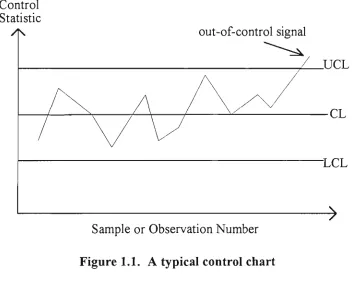
occur. As shown in Figure 1.1, a typical control chart is a plot of a control statistic
against the sample number and consists of a center line (CL), a lower control limit (LCL)
and an upper control limit (UCL).
Control Statistic
out-of-control signal
UCL
Sample or Observation Number
Figure 1.1. A typical control chart
Common examples of a control statistic are the individual observations of a quality
characteristic {X}, sample mean {X), sample range {R), sample standard deviation {S),
control Umits, which depend on the process or control parameters, act as the thresholds
for the plotted values beyond which out of control conditions are indicated. These limits
may or may not be symmetric and it is also possible that only a single control limit is used
under certain circumstances. In any event, the control Umits are usually determined such
that the resulting_^t/5e signal rate can be tolerated. A false signal occurs when the value
of the control statistic plots outside the control limits whilst in fact the process under
consideration is in control.
In practice, the control parameters are estimated based on data collected from a
process assumed to have been in control. Certain rules of thumb or practical experience
are often employed to determine the necessary amount of calibration data. The
commonly recommended approach is then to 'plug in' these sample estimates to the
formulae for the control limits. Thus, unless the set of calibration data is reasonably
large, there is often no assurance that the resulting estimated control limits will behave
essentially like the known limits (see Quesenberry (1993)).
The effectiveness of a control procedure is often determined based on its
associated run length (RL) distribution. RL refers to the number of samples taken (since
the last signal) before a signal is triggered. As a summary measure of sensitivity, the
average number of samples required for the detection of a change in the control
parameters, termed the average run length (ARL), has commonly been used. Using a
simplified ecomonic model. Ghost, Reynolds and Hui (1981) showed that ARL is the
most important measure associated with the RL distribution that determines the
effectiveness of a control procedure. They also noted that other measures may be of
interest for some applications. Quesenberry (1995d) demonstrated that for comparison of
after a shift in the process parameters, ARL is an appropriate performance criterion
because the run length distribution ftinction, 'PT[RL < k] at any fixed value k is a strictly
monotonic ftinction of ARL irrespective of shift size. On the other hand, if some of the
RL distributions are not geometric or unknown, even combining information on the
standard deviation of run length (SDRL) with ARL, as considered by some authors, may
lead to misleading conclusions about their relative performance. This issue has either
been dismissed or overlooked by numerous authors.
The idea of SPC can be extended to a more practical situation in which several
correlated quality characteristics are monitored simultaneously. Under these
circumstances, procedures which take into account the correlational structure of the
individual variables are required in order to correctly reflect the process status.
1.2 Problems of Traditional SPC for Short Production Runs
Shewhart control charts have enjoyed considerable popularity as control and
monitoring tools. These and more recent variations of them, enable production operators
to detect process troubles or out-of-control situations before they become critical.
Appropriate corrective action can then be initiated to prevent farther deterioration in
process operation and so avoid a negative impact on product quality. While these
techniques are well suited to the mass production industries, their usefiilness in low
volume manufacturing environments is subject to debate.
Besides the continuance of traditional small job shops, there has been, even in the
mass production industries, an increased demand for more frequent production changes
and a consequential proliferation of short runs. Attempts made to apply traditional
essential problems facing those seeking to provide usefiil statistical tools for application
in the short production run environment are those of machine 'warm up', control
parameter estimation and parameter changes between the manufacture of different
product types.
In short-run environments, the control limits for traditional control charts, such as
X and R charts, often cannot be located in the usual manner due to insufficient data.
Thus, one might consider estimating the control limits based on a much smaller number
of samples or subgroups than usually recommended. However, it has been adequately
demonstrated in the literature that this practice is not reliable. Amongst others,
Quesenberry (1993) provided a most reasonable evaluation of the effect of estimated
control limits on the overall run length performance for conventional X and X charts.
He showed by means of simulation, that the rate of false alarms after short runs,
increases, and much larger sets of calibration data are required so that the resulting
estimates of the control limits for these charts are practically the same as their true
values. However, these requirements can rarely be met for small batch manufacturing.
The problems of lack of process performance data are fiirther aggravated by
process 'warm up', which is perhaps the most important and yet least considered obstacle
to meaningfiil and successftil application of traditional control charts in small lot
production. This phenomenon is a common and dominant feature of short-run processes,
as instability after set-up or reset often constitutes a large proportion of production run
time. Neglecting this fact and using sample data from such a period to obtain control
limits will often lead to erroneous conclusions regarding past, current and fiiture states of
the process. Murray and Oakland (1988) demonstrated this using simulation, specifically,
will often appear to be in control, as reflected by either a standard deviation or range
chart with the usual decision rules imposed.
Another practical reality that characterizes short run environments, is the
diversity of products made. If separate control charts are maintained for each type of
product, the system becomes unwieldy.
1.3 Multivariate Quality Control
Due to the rapid development of data-acquisition and computer technology, it is
not uncommon in many industrial situations to monitor on-going performance of a
manufacturing process with respect to more than one process or product characteristics.
If the product characteristics are correlated and no consideration is made of their joint
distribution, the use of separate control charts for each of them can be misleading.
Specifically, the related variables, when studied separately, may appear to be in statistical
control but appear out of control when considered in a multivariate context.
Montgomery and Wadsworth (1972) and Alt and Smith (1990) illustrated this for the
case of /? = 2 variables. Under these circumstances, it seems necessary to consider the
use of multivariate quality control procedures which take into account the covariance
structure of the quality characteristics.
Over the last 2 decades, the problem of multivariate quality control has received
considerable attention in the literature. A review of this work can be found in Alt et
al.(1990) and Jackson (1985) and this has been updated recently by Wierda (1994) and
Lowry and Montgomery (1995). Besides the problem of lack of data for parameter
estimation in low volume and short-run environments, multivariate SPC procedures
interpreting the out-of-control signals. Other issues include use and understanding,
complexity of the distribution theory involved and statistical efficiency. Some previously
proposed procedures such as the dispersion control technique based on generalized
variance of Alt et al.(1990) are fiindamentally flawed because they are unlikely to 'pick
up' certain shifts in the dispersion parameters. The computational aspect of multivariate
control procedures can be handled by computers but other problems remain and need
fiirther investigation.
1.4 Thesis Objectives
The main thrust of this thesis is to present some multivariate quality control
procedures that can be effectively used in situations where prior estimates of the process
parameters are unavailable. For completeness, some better alternatives to existing
multivariate SPC procedures are also provided for known parameter situations. The
types of process change considered include step shift in both the process mean vector
and the variance-covariance matrix and linear trend. Some simulations, as well as
previously published data, are used to assess the practicality of the models and the
methods. Where appropriate, the relative control performance of proposed and currently
existing procedures are also evaluated.
Statistical process control is often considered with no reference to product
specifications. It merely ensures that the process under focus is in a state of statistical
control so that its behaviour is predictable under normal operating conditions. In
practice, however, the quality and the 'acceptability' of the products is determined by
conformance to given specifications. Having confirmed that the process is in control, the
conveniently summarized by an index. Whilst substantial efforts have been devoted to the
development of capability indices for univariate situations in the literature, the work on
multivariate process capability study is at a relatively rudimentary stage. In order to
satisfactorily describe the capability of multivariate processes, some indices are therefore
presented.
In addition to the above, the relative merits of the adjusted X and R charting
technique and Pre-control are provided for the univariate situation. These tools are
attractive for application in short-run environments since they do not require
accumulation of process data for computation of the control limits but instead determines
CHAPTER 2
LITERATURE REVIEW
2.1 Introduction
In view of the limitations of traditional SPC techniques, many alternatives and
adaptations of them have been devised for the express purpose of removing the barriers
between SPC and short production runs. Recently, a review of the literature on the use
of SPC in batch production has been presented by Al-Salti and Statham (1994). Much of
their article is devoted to a particular aspect of short-run SPC, namely, the use of data
transformation techniques. This chapter, however, gives a more comprehensive review of
techniques proposed for short runs along with some possible methods and provides its
own contribution to the debate. Whilst the focus is on univariate processes, wherever
appropriate consideration is also given to the multivariate environment for which little
has appeared in the literature.
It should be pointed out that process monitoring in the chemical industries (eg.
Nomikos and MacGregor (1995), Doganaksoy, Schmee and Vandeven (1996)) are, in
most cases, not applicable to short-run SPC which assumes small production volume of
the monitored product. In chemical or continuous process industries, various products or
grades of the same product are manufactured in lots or batches and production of the
same product continues, although intermittently, followed by batches of other products
or grades and so forth. Thus, adequate historical data from past succesfiil batches are
usually available for calibrating the in-control behaviour of the quality/product variables
which are usually measured once at the end of each batch run and the process variables
For ease of presentation, the techniques to be reviewed are grouped into several
general approaches and discussed under appropriate headings although there is, of
course, inevitable overlap between the groups.
2.2 Adjusting Control Limits Based On The Number of Suberoups or
Observations
In the event of only a small number of subgroups being available yet where early
control of the process is still desirable, Hillier (1964,1967,1969) and Yang and HilHer
(1970) proposed adjusting the control limits for Shewhart-type variable control charts,
both for retrospective (stage I) testing and for fiiture (stage II) control in such a way that
the predetermined probability of a type I error is preserved. A similar approach, based on
individual observations, has also been presented by Roes, Does and Schurink (1993). It
should be pointed out, however, that the limits so adjusted do not always ensure that the
resulting probability of a type I error for each fiiture subgroup is as desired. In fact, this
probability, as well as the adjusted limits, vary stochastically with the mean and the
dispersion of the calibration sample. As such, the resulting control procedure may either
be too conservative, causing delay in reacting to process troubles, or too stringent,
giving rise to too many false alarms. Note also that, as opposed to setting the limits by
the conventional method, even if the estimates of the process parameters are accurate,
the resulting control limits are wider than necessary ! Furthermore, since the estimated
control limits may not be close to the nominal values, additional run rules such as those
discussed by Nelson (1984) cannot be used indiscriminately. Other drawbacks are the
number of calculations required and the likelihood of misinterpreting the information
and stage II, as well as changing control Umits after every couple of subgroups (Ermer
and Born (1989)).
A generalization of this approach to the control of the mean vector of a
multivariate normal process, based on the well known Hotelling T^ statistic, was
presented by Alt, Goode and Wadsworth (1976) and Tracy, Young and Mason (1992)
for the cases when subgroup data and individual measurements are used respectively.
Some issues of importance regarding the use of such a composite measure to monitor the
stability of multivariate processes were raised, for example, in Hawkins (1991,1993).
More recently, Scholz and Tosch (1994) proposed updating the parameter
estimates and the stage II control Umits for the individual values charts based on the
student-t statistic and T^ charts respectively after every fiiture observation. In order to
reduce the effect of any systematic process behaviour on the estimates of the dispersion
parameters, they suggested using a moving variance of successive observations for the
individual values chart and an analogous procedure for estimating the in-control process
variance-covariance matrix, E that is required for computing the value of the T^
statistic. The latter procedure uses vector differences of successive observations to form
the estimator of S as foUows
;-1 " "
^" ~ 2(n I) ^ '^^'^^ ~ ^/)(^/+i ~ ^ / )
2(«-l)t,
where X, and n denote respectively the /th observation vector and the number of
previous observation vectors. This estimator was considered by Holmes and Mergen
(1993) and compared to other estimators including the usual sample covariance matrix
demonstrated that, step shifts in the mean vector and linear trends are more likely to be
detected with the use of this estimator.
King (1954) has also presented a similar approach for analysis of past data or
retrospective testing using X charts with control limits based on average subgroup
range except that the control chart factors are derived in such a way that the joint
probability of a false alarm, y is as required instead of the individual probability of a
false signal for each initial subgroup. He gave a nomogram for a selected range of
common subgroup sizes and numbers of subgroups from which an appropriate value of
the control chart factor can be obtained for the case where y = 0.05. Except when limits
are constructed based on 3 or 4 subgroups, the given factors were obtained through
simulation by ignoring the random fluctuations of the average subgroup range R. As
such, the validity of the given factors is questionable. Furthermore, this method can only
be usefiil if nomograms or tables for other values of y , which might be preferable in
practice, are widely available.
2.3 Control Charts Based On Individual Measurements
If the problem is one of short production runs and lack of data, a possible
solution might be use of individual readings in place of averages. The use of individual
readings is natural anyway if there is no natural subgrouping of the observed data. Two
basic types of chart employing individual measurements are:
(i) Individual values and Moving Range (I-MR) charts or X-MR charts.
These charts attempt to maximise the information obtained from the limited amount of
available data. Apart from being suitable for processes with limited output within a single
set-up, they can be used in situations where :
• processing time per unit item is long or the data accumulation rate is slow,
• testing or measurement is expensive or time consuming,
• testing is destructive.
The first of these two charting methods has been around for many years and is
weU documented (see for eg., Grant and Leavenworth (1980)). Burr (1954) suggested
this as one of the possible methods which can cater for short production runs. In his
proposal, he advocates use of 2-cr control Umits rather than the conventional 3-cr limits
for the individual values chart to compensate for its lack of sensitivity to mean shifts. The
method has also been considered by Nugent (1990) for use in short-run manufacturing
environments.
The second, as its name implies, differs slightly from the first in that the target or
the nominal specification is subtracted from the measurements before they are plotted.
Ermer et al.(1989) highlighted some practical merits of this charting method in
comparison to other existing 'short-run' techniques. However, this method will not work
in circumstances where no target is available as often occurs with products having a
one-sided specification.
The fiindamental problem of lack of data has not been adequately addressed by
the above authors, except for the indication that estimation of the process parameters
and subsequent computation of the control limits should be based on data from either the
guidelines are provided as to how many observations are sufficient for the purpose of
estimating the control limits.
For both types of chart, the control Umits may be determined based on successive
moving ranges of size 2. Several other estimators of process spread such as that given by
Roes et al.(1993) can also be used for this purpose. Although it is weU known that the
sample standard deviation provides the most efficient estimate of the inherent process
variability for a stable normal process, the average moving range is used because it is not
only computationaUy simpler but it can also safeguard against the likely events of trends,
cycles or other irregular patterns in the calibration data (i.e it minimizes the inflationary
effects from these conditions and hence the inherent process variability will not be
overestimated). However, besides re-emphasizing the fact that displaying a moving range
chart will only cause confiision due to correlation between consecutive moving ranges.
Roes et al.(1993) substantiated Nelson's (1982) view that doing so has no real added
value because the chart of individual values contains almost all the information available.
If the process measurements are known to be independently normally distributed and a
state of statistical control has been achieved, as demonstrated by the retrospective use of
I-MR or Target I-MR charts, Cryer and Ryan (1990) suggested that, for fixture process
monitoring, control Umits for individual values charts should be estimated based on the
sample standard deviation instead of the average moving range, due to its relatively
superior efficiency.
As for X charts, additional run rules can be effectively applied to the individual
values charts to identify non-random variations or systematic process changes, hence
providing better protection against potential process problems, provided the estimated
increased false alarm rate associated with these additional control rules but if power of
the charts is of paramount importance and outweighs the costs of searching needlessly
for non-existing assignable causes, the use of these rules can be usefiil.
The major practical benefits that can be gained by using individual readings
instead of averages are :
• Measurements can be seen, compared to specification limits and easily
understood.
• Substantial savings in time and cost may be accrued as a result of less sampling,
testing or measurement.
• Improved employee involvement in decision making and problem solving which
could be catalytic in bringing about quality and productivity improvements, as a
result of operators having better appreciation of the techniques in use.
Individual values charts with conventional control limits should, however, be
considered with reference to statistical efficiency. First, and most importantly, their
sensitivity to substantial shifts in process average is less than that of the usual X charts.
Although greater sensitivity may be gained by the use of narrower limits or additional
warning lines, such sensitivity is gained at the expense of increasing the chance of false
lack of control indications.
The second problem with individual values charts centres around the normality
assumption of the process distribution. If the underlying distribution is not normal, this
will tend to distort the interpretation of the control limits. On the other hand, X values
will tend to normality fairly rapidly by virtue of the Central Limit Theorem, provided the
2.4 Mixing Production Lots and Normalizing Process Output Data
Recent developments in the use of statistical process control in multi-component
and low-volume manufacturing environments have focussed mainly on studying and
monitoring the process irrespective of the type of parts or products being manufactured.
The basic idea with this approach is that values for different products or components
being assessed on the basis of the same quality characteristic but with different design
specifications can be plotted together on the same chart, provided that they are the
output of a homogeneous process. Homogeneity means that the components should,
technically, be machined under similar conditions, for example, in terms of cutting tools,
tool holders, component holding methods and setting-up methods etc (Al-Salti and
AspinwaU (1991)). The same principle applies to chemical manufacturing processes
where similar chemicals are produced in smaU batches on an, 'as needed' basis. Emphasis
on process homogeneity is important in order to reduce or eliminate the effect of
variability due to extraneous sources, thus ensuring only inherent variation exists. This
avoids erroneous appraisal of the process and any process irregularities can be more
readily detected. In addition, the measurement process should be adequate enough, in
terms of accuracy, and carried out in a consistent manner for every measured
component.
Several papers (Al-Salti et al.(1991), Armitage and Wilharm (1988), Bothe
(1989), Burr (1989), Crichton (1988), Nugent (1990), Thompson (1989)) have given
accounts of this approach. It is accomplished by means of data transformations which
effectively eliminate the differences between the types of products or components. A list
of possible transformation techniques that cover a claimed majority of manufacturing
(1992). A comparison of control charts based on the given techniques for a set of
industrial data is also provided in the same paper. Koons and Luner (1991) outlined a
related approach and illustrated the technique with a case study. Al-Salti et al.(1991)
investigated the appropriateness of the moving average, moving range and cusum control
charting techniques using transformed individual observations.
This approach of mixing production lots and normalizing process output data has
been highlighted by many authors as an integral part of quality assurance and
improvement strategies for two main reasons :
(a) Reduction of the number of control charts and charting effort required which results
in time and cost savings as well as higher productivity.
(b) Time-related process changes such as runs, trends and cycles can be more readily
detected since pertinent process data is not scattered over separate charts.
However, there are a number of critically important problems with this approach.
As an example of some important issues that the previous authors either overlooked or
dismissed, consider the so-called Short Run X &. R charts as proposed by Bothe
(1989,1990b), that have been extensively discussed in the literature. To 'control' the
process mean and the process dispersion, Bothe suggested use of the statistics
:r; ^ , -..^™.„«„^™ T7 A^—TARGETA^ ^_ ,^
X PLOT POE^JT = Z„„ = =— (2.1) PP TARGET/?
and R PLOT POINT = il, = = (2.2) ^P TARGET i?
respectively. The notation TARGET X and TARGET R here denote respectively the
target values of the mean and the range of the process distribution which can be
determined in a number of possible ways. A related control charting method based on the
been presented by Bothe (1990a) in another paper. This involves charting the statistic
( ^ - T A R G E T ^ ) and the usual subgroup range resulting in so-called Nominal charts.
When data are available from previous runs of identical or similar products, the author
recommends estimating TARGET X and TARGET R from these data (which wiU
usually be small data sets). Without relevant historical data, he suggests taking TARGET
X equal to nominal specification and
TARGET ^ = -^^^^—^ (2.3)
where U, L, C^(goai) ^^d ^i denote respectively the upper specification limit, lower
specification limit, the target value of the process capability index, Cp = ^ ^ and the
control chart factor (which is a fiinction of the sample size, n).
Note that when X^^ and R^^ are computed from (2.1) and (2.2), the sequences
of statistics plotted on each chart wiU be highly correlated. If TARGET R from (2.3) is
used, one cannot possibly have any reaUstic idea of how this value relates to the process
standard deviation. Even for this case, the plotted points are correlated. As a result, one
does not know what kinds of point pattern to expect for a stable process, and thus one
cannot possibly determine when a process is not stable.
As stated by Ermer et al.(1989), this normalizing approach also loses its appeal as
a quality control procedure due to practical problems :
• Although the calculations for standardized charts are not difficult, they are more
involved than traditional Shewhart charts.
• The coded data do not appear to have any physical meaning to production operators
• Since the control limits for this chart never change, process improvements that are
being implemented from time to time will not be reflected by the chart. In other
words, no visual impression is available as to how much improvement has been
made to the process.
Additionally, considerable effort and time have to be spent to obtain, review and
revise the scaling factors if necessary. Furthermore, care must be taken to ensure that
proper scaling factors are being used in each calculation to avoid misinterpretation
regarding the stability of the controlled process.
2.5 Setup Variation and Measurement Errors Considerations
In any kind of machine set-up, whether manual or automatic, there exists a
certain amount of natural variability in the setting regardless of how well it is performed.
This issue must not be overlooked and set-up acceptance should be based on sound
statistical principles. On a long term basis, for the same machine or production process,
the set-up error, which is defined as the deviation of average output from the desired
value, tends to fluctuate in a random manner around its expected value which is usually
assumed to be zero. In every set-up, therefore, as long as the set-up error is within its
natural spread, no adjustment is necessary and the production should be allowed to run
to avoid over control. The set-up method can of course be improved to reduce this
source of variation provided it is economically feasible to do so.
actually caused by the set-up variation rather than out of control conditions. To cope
with this situation, Bothe suggested that two sets of scaling factors, i.e 'set-up' and 'run'
factors should be used for each part number, he fiirther discussed how they can be
derived. Similarly, Robinson proposed that separate charts should be drawn for
monitoring between-setup and within-setup variation in isolation. He and Robinson,
Touw and Veewers (1993) illustrated this idea and exemplified how it can be achieved.
For monitoring the first source of variation, he suggested charting the average value of
the first five pieces (or the so called 'first offs') relative to nominal specification and the
control limits for the resulting chart are derived by treating this as an individual values
chart. As for control of within-setup variation, he suggested use of the traditional Range
chart or a chart for the difference in average departure from nominal between the first
five pieces and the last five pieces (or the 'last offs') for each short production run. He
also mentioned use of the more practical 'Modified' control limits on the 'Deviation' chart
to ensure that most individual items produced will conform to specifications, with the
impUcit assumption that C p > l . However, as he pointed out, this approach is not
suitable if the specification band varies between runs.
When piece-to-piece variation is confounded with set-up variation, the Nominal
and Short run charts do not provide an adequate means of reflecting the actual status of
the process. By contrast, separate monitoring of these components of variation does not
only give a real picture of the process but also provides some guidance as to what might
need to be fixed when an out-of-control signal is present (Robinson (1991)).
In statistical process control, measurement error should also be given due
consideration as this constitutes part of the inherent variation of a stable cause system.
characteristic of any industrial product is due in part to the variability of the product and
in part to the variability in the method of measurement. This latter is sometimes
negligible, but at other times cannot be ignored without risk. If the standard deviation of
measurement error varies in some systematic manner, both nominal and short run charts
will give misleading signals, especially when the measurement error is relatively
significant.
In his paper, Farnum (1992) incorporated this component of variation into some
process models having made certain reasonable assumptions. He then developed a
charting procedure for one particular model. This assumes nonconstant process and
measurement error, more specifically the short run process has constant coefficient of
variation coupled with a measurement system whose error variability is proportional to
the true reading. The resulting procedure seeks to remove the differences in average and
dispersion between various components to enable them to be monitored with the use of a
single chart. As long as subgroup size does not change, this charting method yields a
common set of control Umits for every component, irrespective of their design
specifications. Provided the appropriate model has been identified, these limits can be
established early by utilizing data from different production lots in a predetermined
manner. As with any charting method which plots different components on the same
chart, caution should be exercised when sequence rules are applied.
2.6 'Self-Starting' Procedure Based on 'Running' Estimates of the
Process Parameters
A series of articles by Quesenberry (1991a,b,c) presented an innovative approach
phase. The first paper considered independently and identically distributed (i.i.d) normal
processes whereas the foUowing two are devoted to monitoring processes with attribute
data, namely. Binomial and Poisson processes, under various assumptions about the
process parameters. Unlike the preceding approach, a non-Unear transformation
technique, specifically the 'Probability Integral Transformation' technique, in
conjunction with the usual linear transformation, was used to develop new charting
procedures. These so-caUed 'Q' charting procedures enable production operators to
begin monitoring the process essentially with the first units or samples of production
whether or not prior knowledge of the process parameters is available. Consequently, the
task of identifying and removing assignable causes, and thereby bringing the process into
control, can begin at an earlier stage. For the case where no relevant data is available in
advance of a production run, the control parameters are 'estimated' and 'updated'
sequentially from the current data stream. These 'running' estimates, together with the
immediately succeeding observations are in turn used to test whether the process remains
stable.
Since the 'Q' statistics are either standard normal variables with independent
observations or approximately so, the resulting charts can aU be constructed using the
same scale and with the same control limits irrespective of the type of product being
monitored, thus simplifying charting administration. Additional run rules can also be used
to detect any non-random patterns on such standardized charts which suggest various
process instabilities. When subgroups or sampling inspection units vary in size, it is well
understood that this situation is difficult to handle by classical methods. By contrast, the
control limits and interpretation of point patterns for 'Q' charts are not affected by a
The behaviour of these charts for particular situations was studied using
simulated data. The results show that 'Q' charts based on known and unknown
parameters, are in close agreement with each other after the first few points, for
in-control processes. As for processes with sustained shift in a parameter, the points on 'Q'
charts which update the parameter estimates progressively from the data sequence will
eventually settle into a pattern indicative of an in-control process. However, Quesenberry
(1995a) quoted standard results as saying, that under common assumptions, the
traditional 1-of-l test (i.e one point outside the 3 - a control limits) on each of the 'Q'
charts has the maximum possible detection capability on the next observation after a
shift, among all control schemes with equal probability of a false alarm. As such, these
classical 'Q' charts are recommended by some authors including Quesenberry himself for
the problem of outlier detection.
CastiUo and Montgomery (1994) showed that the strength of the signal from 'Q'
charts for variables (with unknown mean but with known standard deviation) when a
persistent step change in mean occurs depends on both the number of samples before and
after the shift. It was also demonstrated that, as a consequence of this, the ARL
performance of the 'Q' charts is poor in some cases. However, the accuracy of their
simulation results is doubted. For instance, the run length distribution of the 'Q' charts
considered in Table 1 for (5 = 0 has a known geometric distribution with mean of 370.4
and standard deviation of 369.9 but the simulated values given are 410.8 and 383.6
respectively. Another problem with this paper is the use of ARL as a performance
criterion. It was mentioned in chapter 1 that the only case where ARL is a useful
criterion is when the run length distribution is geometric. As most of the run length
the control parameters, their results are of limited usefulness in assessing the overall
performance o f ' Q ' charts.
Due to the discrete nature of Binomial and Poisson processes, some comparisons
were made between the 'Q' charts, standard normalizing charts and charts using other
transformation techniques in the goodness of their normal approximations for the known
parameter case. Generally, it is found that charts based on 'Q' transformations are
superior. As for the unknown parameter case, Quesenberry simply stated that it is
unlikely for other charts to perform as well as the proposed techniques due to their
exceUent theoretical properties.
Since no simple recursive formula is available and highly sophisticated
computations are involved, implementation of the 'Q' control scheme requires
computing facilities and complex algorithms. Fortunately, these algorithms are widely
available and have been built into most of the commercial statistical software packages
such as S-plus.
Like any other methods involving transformation, the resulting plotted points on
'Q' charts do not appear to have any physical meaning to production operators. Besides,
'Q' charts with unknown parameters fail to reflect both the process-tolerance
incompatibilities and severe off-target conditions which occur right from the beginning of
production runs. Therefore, unless close examination of the raw data is carried out,
timely corrective actions will likely not be initiated until a considerable number of defects
have been produced. This problem arises because such charts are designed to ensure that
the process under surveilance is in a state of statistical control and hence they are
place, even though the process is incapable or substantially off-target immediately after
set-up.
It is perhaps worth noting that there is an error in Quesenberry's (1991a) paper
that has not been pointed out correctly in the literature. The sequence of control statistics
given by formula (12) of this paper, i.e
a(^,)=^-'
ni+n2+...+«j« , ( ^ , - / ^ o )
•^0,,
! ««
with ' J 0,1 -^ 2 _ g=l / = !
SZK-^o)
«, + «2 +• • •+«,/ = 2,3,
where the notation used here is as defined in the original paper, is in fact not a sequence
of i.i.d standard normal variables as claimed by Quesenberry (1995a,d) because the zth
subgroup mean X^ is not independent of the standard deviation estimate ^o, and
successive arguments of the normalizing transformation are correlated. Thus, using this
formula indiscriminately can be misleading. To form a sequence of approximately i.i.d
standard normal variables, simply replace «, and SQ^ by «,_i and 5*0,_i respectively in the
above formula.
Recently, the RL properties of the 1-of-l and three tests for point patterns made
on the 'Q' charts as weU as specially designed CUSUM and EWMA charts based on the
values of'Q' statistics, for detecting a one step shift in a control parameter, were studied
by Quesenberry (1995a,b,c). The major conclusions drawn from this work are
• the classical 1-of-l test has poor sensitivity
• the test that signals when 4 out of 5 consecutive points are beyond one standard
• the EWMAQ and CUSUMQ tests are the most sensitive and are about
comparable in overall performance
In accordance with the empirical findings, he also made some recommendations for
practical application. For more insight into 'Q' charting procedures and an interesting
debate of their potential and limitations, see the discussions of these techniques by
Castillo (1995), Hawkins (1995), Farnum (1995), Woodall, Crowder and Wade (1995)
and the response from Quesenberry (1995d).
A logical extension of the 'Q' charting techniques to the control of the mean level
of a multivariate normal process when prior estimates of the process parameters are not
available has also been presented by Tang (1995). The author demonstrated that this
method is particularly useful for 'picking up' a sustained shift in the mean vector when
subgroup data are used.
In fact, this dynamic approach of charting was first perceived by Hawkins (1987).
He proposed two related CUSUM procedures based on transformed individual readings
for checking the constancy of process average and variability, along with some
implementation details and illustrative examples. These were proposed as substitutes for
the standard CUSUM procedures which generally assume known parameters. The
proposed method provides another useful alternative for controUing, particularly, short
run processes as it does not require knowledge of process parameters in advance of
production runs and eliminates the need for a separate preliminary study.
In order to effectively apply the CUSUM procedure, it is well understood that
successive values for which the sum is accumulated should be independent and
to WaUace (1959)) was suggested to obtain a sequence of independent and
approximately standard normal variables, 2^'s,
:-^ / =
8 / - 1 5
U / - 1 3 .
( 7 - 2 ) In 1+ '
2 ^
V
7 - 2 .
where T, =
0-1)
A J Aj_^J V Sj_^ J
Xj : /th individual reading
Xj : mean of the first 7 readings
5^ : standard deviation of the firsty readings
By maintaining a cumulative sum of successive Zj's, starting from the 3rd observation,
and using the established control rule, process mean stability can thus be monitored
progressively without having to wait until adequate process performance data has built
up. However, this method should not be used indiscriminately. Careful examination of
the above transformation formula reveals that the resuhing Zj 's are always positive and
can be regarded as 'folded' standard normal variables which can assume positive values
only. In fact, this normal approximation formula was originally considered by Wallace
(1959) for converting upper tail values of the student-? distribution to corresponding
standard normal deviates. Hence, the need for a modification to the formula is indicated.
The minor change necessary is simply the addition of a negative sign to the transformed
value Zj if 7] is less than zero. For purposes of controUing process dispersion,
Hawkins suggested using the scale CUSUM given in his previous paper (Hawkins
:-¥J
0.822 ^ 0.349He made some efforts to justify his recommendation for a 'self-starting' CUSUM
over the adoption of a CUSUM procedure based on some start-up calibration data.
These included consideration of the average run length properties of the two methods.
His simulation resuUs indicate that 'self-starting' CUSUM procedures are superior to
those obtained with some 25 special start-up values, not to mention the short run
situations where usually much less than this is available for initiating conventional cusum
charts.
A final concern about this approach is its likely lack of robustness to both
non-normality and to the presence of outliers in the underlying distribution of process
measurements. Without previous data, there is often no assurance that the process
output will conform reasonably to a normal distribution. The question arises, therefore,
as to what effect departures from the normality assumption wUl have upon performance.
Hawkins (1987) argued, by quoting others' resuUs, that his method works for
non-normal heavy-tailed data with little loss in ARL performance.
The latter issue is particularly pertinent as a sequence of measurements (which
might include occasional outliers) is used simuUaneously both for process control and to
refine parameter estimates. Apparently, incorporating unknowingly occasional valid
extreme observations into the estimates of the process parameters will cause inflation or
deflation of them. This can have a substantial negative impact on the performance of the
control method. To cope with this as well as to protect the CUSUM method (which is
intended primarily for 'picking up' sustained mean shifts of small magnitude) from signals
approach using 'winsorisation'. 'Winsorizing' the measurements means that any
measurement beyond a preset threshold wiU be set equal to it and used in subsequent
calculations. In this manner, 'winsorisation' reduces or limits the effect of outliers on the
parameter estimates and the properties of the control charts. This idea was further
discussed by Hawkins (1993b) who also examined the relationship between the
'winsorizing' constants for 'self-starting' CUSUM and CUSUM based on a large process
performance study. He stated that this method provides good protection against outliers
with little additional cost in computational effort. In the same paper, he also showed that,
'winsorizing' causes little loss to CUSUM procedures in responsiveness to actual mean
shifts for various sets of clean, contaminated and clean-contaminated data.
Note that, for monitoring process dispersion based on individual observations,
the Exponentially Weighted Mean Squares (EWMS) and Exponentially Weighted
Moving variance (EWMV) by MacGregor and Harris (1993) may be used following
some adaptations. The latter is particularly useful for processes with drifting means when
it is used in conjunction with the conventional EWMA. In the absence of historical data,
these monitoring procedures may be initiated at the 3rd observation where the first two
observations are used to provide some initial estimates of the mean and the standard
deviation, resuhing in some essentially 'self-starting' procedures. Approximate control
limits for the resulting techniques may either be obtained algebraically or by means of
simulation.
2.7 Control Based on Exponentially Weighted Moving Averages
CastUlo et al.(1994) proposed two aUernative methods as improvements to the
measurements where the process standard deviation is assumed unknown. These
methods are based on some exponentially weighted moving average (EWMA) type
control statistics. The first method resuUs from a straightforward adaptation of the
standard EWMA control algorithm with the smoothing factor, X chosen to be 0.1, the
initial value of the EWMA statistic ZQ equated to the specified or known target, /^g and
the unknown standard deviation, a estimated sequentially in some suggested manner.
The resuhing EWMA statistic
Z, = (1 - A.)Z,_i + AJr, ,?=1,2,...
is plotted on a control chart with limits
^° \2-X
where & - '
^ 4with S,:^X,-Mo, S,= l^j;^(X,-X,y, t = 2,3,.
1=1
C4 is a control chart factor depending on t that can be found from most of the standard
text books on SPC and L denotes a constant that is chosen to achieve specified run
length performance. The authors also noted the use of the more exact transient control
limits (for the rth observation) given by
^io ± ^ 1
A- r, / , , \ 2 f
1 - ( 1 - ^ ) ' <^t 2-?iL
:-Z,=(\-X,)Z,_i+X,X,- Zo=^o
This latter was referred to as the adaptive Kalman filtering control method since the
smoothing factors or Kalman weights, I / 5 change adaptively according to
K-ir^ (2.4)
The variance components of the model, including the process variance, <j^ and the
posterior variance of the process mean after the fth observation, q^-X^o^, are
estimated and updated from the data sequence as
follows:-o-j = i 5 i , a^ =d^ t = 2,3,...
FoUowing Crowder (1989), the control limits for this method were given as
Mo±L^ (2.5)
The initial value q^ was found to have practically no effect on the ARL performance of
the method provided it is greater than zero. A variant of this method has also been
presented by the same authors (Castillo and Montgomery (1995)) where the of in (2.4)
and L in (2.5) are respectively replaced by 1 and KG^, and K is a constant chosen to
yield specified ARL performance. In the same paper, they provided some guidelines for
the economic design of the control scheme with respect to K and the number of
observations to take in a batch. The objective of the economic model is to minimize the
expected total cost per batch (which comprises sampling/inspection cost, cost associated
with false alarms and cost of running an out-of-control process) subject to certain