Multiplicative Watermarking using 2D-DWT
Mohammad Rizwan Khan
1, Ankur Goyal
21 Research Scholar, Department of Computer Engineering,
Yagvalayka Institute of Technology, Jaipur, Rajasthan,India
2 Professor, Department of Co mputer Engineering,
Yagvalayka Institute of Technolohy , Jaipur, Rajasthan, India
Abstract: These paper agreements with by the numbers, electronic being owner with the help of by numbers, electronic watermarking getting fixed attack algorithm. For putting in any being owner information in any form inside the image or anything by which something is done like viewing part, audio, video etc, we need a by numbers, electronic watermarking getting fixed and extraction algorithm, so owner of the by numbers, electronic purpose will be able to make out and put forwards as a fact his/her rights when any illegal person put forward as a fact his/her false rights on that purpose by getting from the watermark. In this make observation paper ,we give a comparison between two watermarking algorithm based on DWT one on able to be put in addition getting fixed secret design so that substance mixed in algorithm and second one on multiplicative getting fixed secret is MULTIPLICATIVE algorithm. Being strong in limited stretch of time of Gaussian Noise attack of both the algorithm & tested in terms of PSNR and SNR and compared.
Keywords: DWT, PSNR, SNR, Watermarking, Robustness,
Additive embedding, Multiplicative embedding, Attacks, Gaussian Noise
I. INTRODUCTION
There is a strongest need for safety services in order to keep the distribution of by numbers, electronic multimedia work both profitable for the printed material owner and give authority person getting goods from store for that printed material. Watermarking technology plays an important part in getting the business as it lets placing an unmeasurable mark in the multimedia knowledge for computers to make out the safe, good, ready and within the law owner, to unbroken bands over wheels for moving over rough earth given authority user.spde ital watermarking
Is one of the methods to support the by numbers, electronic being owner business managers. . There are different ways to getting fixed the watermark by different algorithm here we have taken multiplicative algorithm as based algorithm and made a comparison this algorithm with the substance mixed in algorithm. After that we observation the being strong of multiplicative algorithm by using Gaussian Noise attack.
II.PREVIOUS WORK
Mr. Abijith [1] had Implemented Digital Watermarking using discrete 2-D wavelet transform and taking Input image is watermarked with a key having their parameters Mean = 0 & Variance = 1. The key was developed by utilizing the abstract white Gaussian noise (awgn).
So my point of view for this algorithm helps not only for embedding the watermark but also help in for improved the extraction [12].
Discrete Wavelet Transform (DWT) also use in ADDITIVE algorithm [2], and additive technology use for embedding and extracting watermark image from the host image.
MULTIPLICATIVE[11] Algorithm has provide a better results as compared with the algorithm of ADDITIVE [2] in terms of embedding strategy for watermark embedding and extraction and then analyzing the PSNR and SNR of the extracted watermark with original watermark and between uncommon, noted image and watermarked image without attack.In Proposed algorithm analysis of MULTIPLICTIVE algorithm and compare the ADDITIVE algorithm and MULTIPLICATIVE algorithm by the Gaussian Noise Attack in terms of SNR & PSNR values and check the robustness of Gaussian Noise Attack algorithm[12].
Table 1. Values of PSNR of ADDITIVE and MULTIPLICATIVE Algorithm without Attack.
Table 2. Values of SNR of ADDITIVE and MULTIPLICATIVE Algorithm without Attack
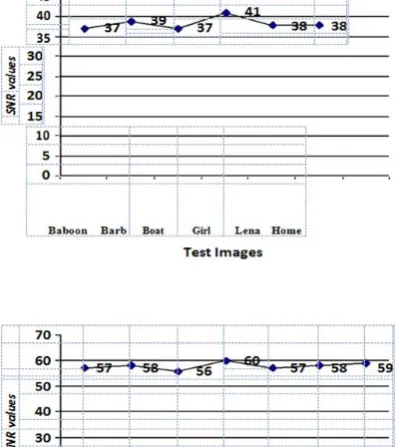
Figure 1. Upper graph shows SNR values uncommon, noted image and watermarked image for ADDITIVE Algorithm and lower graph
SNR values between uncommon, noted image and watermarked image for MULTIPLICATIVE Algorithm.
Figure 1 shows the SNR values for different test images show that SNR ratio is greater than 1:1 ratio for all tested images; that means the value of the signal is higher than the noise. Noise create difference between uncommon, noted image and watermarked image, so this difference will be the strength of watermark signal that ambiguous the original image, least the value of this watermark signal lesser the amount of ambiguous the uncommon, noted image. The different SNR values also provide less impact in uncommon, noted image. For both these MULTIPLICATIVE algorithm and ADDITIVE algorithm simulation result shows that the value of SNR is between 39 to 45 that shows degradation in uncommon, noted image test image by the watermark signal is very less [12].
The different SNR values also provide less impact in extracted watermark. For both these MULTIPLICATIVE algorithm and ADDITIVE algorithm simulation result shows that the value of SNR is between 37 to 60 that shows extracted watermark image degradation is very less after extraction process[11][12].
Image
PSNR(b/wuncommon,noted PSNR(Between original
Image and watermarked watermarked and Extracted
image in Decibal (db)) watermarked in Decibles (db))
Multiplicative Algorithm Additive Algorithm Multiplicative Algorithm Additive Algorithm
Baboon 48.34 48.32 57.82 37.78
Barb 47.89 47.88 58.76 38.72
Boat 48.64 48.61 57.22 37.18
Girl 45.65 45.62 60.64 40.59
Lena 48.83 48.81 58.01 37.97
Home 46.86 46.85 58.16 38.13
Pari 48.07 --- 59.07
---Image
SNR(b/w uncommon, noted SNR(Between original watermarked and Extracted Image and watermarked image in Decibal (db)) watermarked in Decibles (db))
Multiplicative Algorithm Additive Algorithm Multiplicative
Algorithm Additive Algorithm
Baboon 43.77 43.75 57.34 37.30
Barb 41.52 41.50 58.28 38.72
Boat 44.46 44.43 56.73 37.18
Girl 39.18 39.15 60.16 40.59
Lena 43.46 43.44 57.53 37.97
Home 41.03 41.02 57.68 38.13
---
Figure 2 Upper Graph showing SNR values between original and extracted watermark by ADDITIVE algorithm and
Lower graph by MULTIPLICATIVE algorithm.
A. SNR Result Conclusion
(i) The amount of original knowledge for computers existence in watermarked image is more than the back space noise so that got from watermark is has been seen before for mind and physical qualities fact in support of.
substance mixed in algorithm[11] [12].
(iii) Peak signal-to-noise relation, often make shorter PSNR, is a designing and making limited stretch of time for the relation between the maximum possible power of a sign and the power of having errors or changes noise that has an effect on the trueness of its pictures of. Because many signs have a very wide forceful, PSNR is usually expressed in terms of the logarithmic decibel scale [3][12].
As a measure of quality of remaking of lossy forced together codecs (e.g. for image forced together) PSNR is used. The sign in this Case is the first form facts, and the noise is the error introduced by forced together. When making a comparison forced together codecs it is used as a near to Human power being conscious of remaking quality, therefore in some cases one remaking may come into view as to be closer to the first form than another, even though it has a lower PSNR (a higher PSNR would normally give an idea of that the remaking is of higher quality). One has to be greatly careful l with the range of having good (reason, argument) of this metric; it is only firmly having force in law when it is used to make a comparison results from the same codec (or codec sort) and same what is in[3][12].
Of a certain sort values for the PSNR in lossy image and viewing part forced together are between 20 and 50 db [3][12].
IV.RESULT OBTAINED BY PROPOSED ALGORITHM In this mechanism for sending or receiving of watermarked image due to some collusion like addition of Noise, Cropping, Resizing, image get blur as well as erode which is changing the position of watermark or sometime these impact destroy the watermark which is create a problem for owners of image so it is necessary to check and analysis of robustness of watermarking algorithm [4][12].
Table 3. Gaussian Noise Attacks Values of PSNR of ADDITIVE And Proposed Algorithm using MULTIPLICATIVE algorithm.
Image
PSNR(b/w uncommon, noted PSNR(Between original
Image and watermarked watermarked and Extracted
image in Decibal (db)) watermarked in Decibles (db))
Proposed Algorithm Additive Algorithm Proposed Algorithm Additive Algorithm
Baboon 54.81 40.86 78.19 34.98
Barb 55.12 40.87 77.86 35.29
Boat 54.57 40.93 78.29 34.74
Girl 55.62 41.19 77.44 35.78
Lena 54.62 40.87 78.10 35.03
Home 54.98 41.28 77.69 35.10
Table 4. Gaussian Noise Attacks Values of SNR of ADDITIVE And Proposed Algorithm using MULTIPLICATIVE Algorithm
Result Analysis:
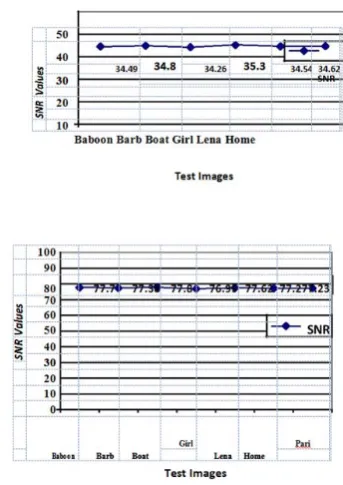
(i) SNR (a) SNR values between uncommon, noted image and watermarked image after Gaussian noise attack are made line picture in number in Figure 3 for different test images. From Table 4 mean value of SNR for different test images, between watermarked image and watermarked image after Gaussian noise attack is 37 to 39 db which middle, half way between that the quality of the watermarked image is gave lower, less important position by the attack to a very little amount.
Figure 3 upper graph viewing SNR values between uncommon, noted image and watermarked image after Gaussian Noise Attack by
substance mixed in algorithm and right graph by offered algorithm.
A. SNR Result Conclusion of Watermarked i mage withstand the Gaussian noise attack
From the graph in number in sign 3 Watermarked image put up with the Gaussian noise attack when image is watermarked by any of the algorithm either by offered
algorithm or by substance mixed in algorithm values of SNR that we are getting by offered algorithm are far better than the substance mixed in algorithm so offered algorithm is better than the substance mixed in algorithm.
(b) SNR values between original watermark image and got from watermark image after Gaussian noise attack are made line picture in number in sign 4.from Table 2 SNR for different test images between first form watermark image and extracted watermark image after attack is between 34 to 78 db which middle, half way between that the quality of the got from watermark image is.mean that the quality of the extracted watermark image is negligibly degraded due to Gaussian noise attack.
Figure 4 upper Graph showing SNR values between original watermark and extracted watermark after Gaussian Noise Attack by
ADDITIVE algorithm and lower graph by proposed algorithm.
Image
SNR(b/wuncommon,noted PSNR(Between original
Image and watermarked watermarked and Extracted
image in Decibal (db)) watermarked in Decibles (db))
Proposed Algorithm Additive Algorithm Proposed Algorithm Additive Algorithm
Baboon 54.81 38.19 77.70 34.49
Barb 55.12 37.89 77.38 34.80
Boat 54.57 38.50 77.80 34.26
Girl 55.62 37.73 76.95 35.30
Lena 54.86 38.15 77.62 34.54
Home 54.98 38.48 77.20 34.62
watermarked by any of the algorithm either by proposed algorithm or by ADDITIVE algorithm. Values of SNR that we are getting by proposed algorithm are far better than the ADDITIVE algorithm so proposed algorithm is better than the ADDITIVE algorithm.
(ii) PSNR
PSNR values between watermarked image and Gaussian noise watermarked image after Gaussian noise attack are plotted in Figure 5 for various test images.
Figure 5 Upper Graph showing PSNR values between original watermark and extracted watermark after Gaussian Noise Attack by ADDITIVE algorithm and Lower graph by
proposed algorithm
C. PS NR Result Conclusion of Watermarked image withstand the Gaussian noise attack
From the graph in number in sign 5 PSNR values shows that Watermarked image put up with the Gaussian noise attack when image is watermarked by any of the algorithm either by offered algorithm or by substance mixed in algorithm. Values of PSNR that we are getting by offered algorithm are far better than the able to be put in ADDITIVE algorithm so offered algorithm is better than the able to be put in addition algorithm.
Figure 6 Upper Graph showing PSNR values between uncommon, noted image and watermarked image after Gaussian Noise Attack by ADDITIVE algorithm and Lower
graph by proposed algorithm.
D.PSNR Result Conclusion of Extracted Watermark with Gaussian Noise attack
From the graph in number in sign 6 PSNR values shows that Watermarked image withstands the Gaussian noise attack when image is watermarked by any of the algorithm either by offered algorithm or by substance mixed in algorithm. Values of PSNR that we are getting by offered algorithm are far better than the able to be put in ADDITIVE algorithm so offered algorithm is better than the able to be put in ADDITIVE algorithm.
V.CONCLUSION
ADDITIVE algorithm as we compared original watermark and extracted watermark we get more values of PSNR and SNR after than ADDITIVE algorithm. Similarly when we compare uncommon, noted image and watermarked image after attack than ADDITIVE algorithm. So that we can say that MULTIPLICATIVE algorithm is robust for the Gaussian noise attack and imperceptible.
REFERENCES
[1] Abhijith Sreenivasan (2007 1 Feb), Simple Watermarking using Wavelet transform, (1st ed), [Online]Availiable:http://www.mathworks.com/matlabcentra l/fileexchange/13834-simple-water-marking-using-wavelet-transform. [2] ADDITIVE, “Non blind Discreet Wavelet Transformation based
Digital Watermark Embedding and Extraction Algorithm”, M aster Thesis, Dept. of Comp . Science and Information Technology, Rajasthan Technical University, Kota, Rajasthan, India, 2012. [3] Wikipedia, Peak Signal to Noise Ratio (44 ed.) [Online] Available:
http: // en. wikipedia. org /wiki/Peak_signal-to-noise_ratio.
[4] Navnidhi Chaturvedi, Dr.S.J.Basha ,“ Analysis of Image Water marking by DWT and Performance Under Attacks” International Journal of Computer Technology and Electronics Engineering
(IJCTEE) Volume 2, Issue 3, June 2012.
[5] “Digital watermarking a technology overview” Hebah H.O. Nasereddin,IJRRAS 6 (1) , January 2011
[6] Digital Watermarking Techniques: Literature Review
[7] http://www.digitavid.net/VirtualUniversity/Presentations/ImagingWate rmarking.pdf.
[8] Ingemer J.Cox, Joe Killan, Tom Leighton and Talal G. Shamoon, “Secure spread spectrum watermarking for multimedia”, IEEE proceeding International Conference on Image Processing, vol.6, pp 1673-1687 Santa Barbara, California, USA, October 1997.
[9] George Voyatzis and loannis Pitas, “Application of toral automorphisms in image watermarking”, IEEE proceeding of International Conference on Image processing, vol. 2, pp 237-240, Lausanne, Switzerland, September 1996. IEEE press.
[10] . Thesis on Digital Watermarking in the Wavelet Transform Domain by Peter M eerwald 11, January 2001.
[11] Naveen Kumar M ULTIPLICATIVE,Saroj Hirenwal,” Non Blind Digital Watermarking using 2D- DWT,June 2013”, International Journal of Emerging Technology and Advanced Engineering, Volume 3, Issue 6.