ISSN 2286-4822 www.euacademic.org
Impact Factor: 3.4546 (UIF)
DRJI Value: 5.9 (B+)
The Effect of Using Communicative language
Teaching on EFL Learner’s Speaking skill
ELAMIN AHMED M. AHMED University of Al-Butana Dr: IENAS AHMED ABDALRAHAMAN
Abstract:
This study aims at student’s views on the importance of using communicative language teaching as a method of teaching English language and to show the necessity of language function, context and authentic situations to identify The Effect of Using Communicative language Teaching on EFL Learner’s Speaking skill. To achieve the objectives, the study used a questionnaire in order to address the study questions and objectives.100 employed students participated in the questionnaire. The Study found out that the students have positive views toward the using of communicative language teaching as a method will assist the learners to use the target language in various, functions, contexts and authentic situations inside and outside the classroom so as to enhance the students fluency as well as the interaction between the learners and other people will expose the target language in societies.
Key words: communicative language teaching, EFL learner, speaking skills
INTRODUCTION
both teachers of foreign language and learners give much more importance to speaking skill as it‟s the essential pillar to build up the competence of learner in foreign language since it‟s based on communication and interaction. Speaking skill is a crucial part of foreign language teaching and learning. This actually shows the great importance of this skill on foreign language classes. Through speaking we can share our ideas and thoughts with other people; in that way a smooth interaction between People can take place. Teachers of English may experience the same situation in which students are unwilling to speak .there are of course many factors causing this problem, such as; luck of confidence; luck of vocabulary and others say that the topic of conversation is not interesting. Different languages teaching methods have been introduced in order to improve the quality of teaching and learning and achieve the desire impact on students. Among these methods: communicative language teaching (CLT) or communicative approach which has been widely accepted as an effective way of teaching language in English foreign language contexts.
and writing], speaking seems intuitively the most important: people who know a language are referred to as „speakers‟ of the language, as if speaking included all other kinds of knowing” (p.12).
In this study we are going to investigate how the communicative approach affects and develop the students‟ speaking skill and in what ways can CLT overcome the student‟s problems in the speaking skill.
This study is set to answer the following questions:
The main questions of this study are:
1) What are the students‟ problems in the speaking skill?
2) Is teaching the speaking skill by using communicative language teaching effective to overcome students‟ speaking difficulties?
3) In what ways does a communicative language teaching lead student to perform better orally?
Objectives of the study
Through this research, we aim at investigating whether teaching the speaking skill by using communicative language teaching approach is effective to overcome the students‟ problems in speaking skill, Moreover; to describe what teachers should do in applying the CLT in the classroom in teaching activity and to analyse the benefits of using CLT in teaching learning process for the teacher and students.
LITERATURE REVIEW
The History of Communicative Language Teaching
teaching.(Richard and Rodgers, 2001: 153) and it was partly in response to Chomsky‟s (1965) criticism of structural theories and British functional linguists such as Firth and Holliday, as well as American sociolinguists such as Hymes, Labrov (Brumfit, 1984 :24_25) .
Actually, communicative language teaching mainly has been influenced by the American sociolinguists Hymes. He introduced the term communicative competence which was based on the two Chomsky‟s notions competence and
performance.
According to Brown (2007: 35) competence is “a non-observable ability to do something, to perform something”. Moreover; Widdowson (1978: 26) defines competence as knowledge of how to recognize and to use sentences for the performance of communicative acts.
Principles of Communicative Language Teaching
The main characteristics of communicative language teaching are identified by Brown (2000: 46) as:
1. Classroom goals are focused on all of the components (grammatical, discourse, functional, sociolinguistic, and strategy) of communicative competence; In other words; students should not only learn the grammatical rules and memorize vocabulary but also know how to use them in a given situation.
learners meaningfully engaged in language use. In other words; teachers focus more on fluency since the primary goal of CLT is getting students to communicate meaningfully
4. Students in a communicative class ultimately have to use the language productively and receptively in unrehearsed contexts outside the classroom; classroom tasks must therefore equip students with the skill necessary for communication those contexts. In other words students must be provided with the important skills needed to communicate in real world context 5. Students are given opportunities to focus on their own learning process through an understanding of their awn styles of learning and through the development of appropriate strategies for autonomous learning.
6. The role of the teacher is that of a facilitator and a guide
These characteristics show the main focus of communicative language teaching. To sum up; CLT enables students to communicate in the foreign language using the different types of communicative competence. However; the language techniques encourage them to use the target language in different situations. In addition; communicative language teaching pays less attention to accuracy (the degree to which learners use target language is 15 remarkably free of errors, students errors are tolerated into some extent since it focuses more on meaning and fluency which helps students to communicate spontaneously, finally the teacher in CLT approach is a facilitator not a controller.
The Communicative Classroom
goal is to enable EFL learners to communicate in the target language fluently and freely and to emphasize the communicative use of language in everyday situation.
The Role of Interaction
Interaction is considered as a central part in communicative language teaching, it helps students to involve in communication using the target language. Interaction is defined as “a collaborative exchange of thoughts, feelings, or ideas between two or more people, resulting in a reciprocal effort on each other “(Brown, 2000: 165). Rivers emphasized the idea that the communicative classroom should be interactive he affirmed that: “ in interaction students can use all they possess of the language, all they have learnt or casually absorbed, in real life exchange (Rivers 1987,4-5; in Brown, 2000:165).The main principles that are identified by Brown (2000).
Activities Used in Communicative Language Teaching
Communicative activities have an important role in creating o opportunities for students to use the language for communicative purpose, generally communicative activities are “fluency based activities” (Teat, 2001, 1) which encourage students to use L2 in an interactive learning. However, for a successful implementation of communicative activities the classroom must be “students centred” and the activities must be interactive, authentic and contextualized (Richard and Rodgers, 1982, 163). According to Finocchiro and Brumfit,( 1983:141-2).students should be encouraged to work with each other as well as with their teacher specific tasks to develop their speaking skill which are listed below:
1. Responding to directions or questions given by the teacher or another students
2. Giving directions for other students
4. Answering questions asked by other students about any class or out of class experience
5. Asking the teacher or other students questions about reading or common experience
6. Describing objects from a picture or chart
7. Using their own words to tell or retell a well-known story or experience
8. Reporting a prepared topic and be ready to answer questions on it
9. Improving realistic conversations about a class shop, a library, or other appropriate resources
10. Taking a role in a communicative language game
11. Participating in some oral group activities such as, a debate, a discussion, a forum, based on research where students are forced to listen attentively to the previous speaker in order to agree, disagree, express, uncertainty, or add other relevant information
12. Giving a report in the TL about newspaper article written in the native language
Types of Communicative Language LearningActivities
2-Communicative activities: In this kind of activities, the focus is on the learners‟ abilities in communication. They include functional activities that focus on language functions; in which the learners move further to learn the different functions of language such as greeting, thanking, apologising...etc and actually use them in communication in the classroom, they also learn notions related to time, location, space...etc and use them in real conversations with each other in the classroom. Social interaction activities are such activities whose goal is to focus on the social interaction among learners. In this stage, they learn about the social rules used in the target language such as how to talk with a friend, a boss, a teacher, a higher economic or social status person...etc. Learners will be able to interact with each other about personal topics of mutual interest.
The Different Roles of the Teacher in Communicative Approach
The teacher in a communicative classroom has totally different roles from his/her Counterpart in the traditional classroom. Communicatively speaking, the teacher interacts “with students, giving feedback, offering solutions and assign speaking in collaborative way” (Gutirrez, 2005:7). The teacher is also a guide, a planner, an organizer, an inspector, an assessor, a prompter, a resource, a facilitator of learning, an instructor, a curriculum developer, a classroom manager a consultant and a monitor. (Littlewood, 1981: 92-93). Knight (2003: 158) summarizes the role of the][teacher as follows, the CLT teacher is often more autonomous than the audiolingual teacher because classroom practice are usually less predictable, and in his/her role as facilitator of communication the teacher often interacts with the learner in ways which mirror interaction outside the classroom, e.g. by asking real questions about the learners‟ back ground, opinions, etc.
Generally speaking, the communicative classroom requires fewer teachers centred instruction, However this doesn‟t mean putting away the teacher authority inside the classroom, the focus then, should be placed on providing many opportunities for the students to practice the target language and on fulfilling the teachers various roles.
The Students’ Role
of learning emerges from and interacts with the role of joint negotiator within the group and within the classroom procedures and activities which the group undertakes. The implication for the learner is that he should contribute as much as he gains and thereby learn in independent way. (1980, 110, cited in Richards and Rodgers,2001:166).
Types of Communicative Language LearningActivities
1-Pre-communicative activities: In this kind of activities, the learner will practise some activities before being able to communicate, they are a kind of preparation for communication activities, they include two kinds of activities: structural activities that are important for the correct structure of language whose goal is to enhance the learners‟ linguistic knowledge by learning grammar rules (regular/irregular verbs, tenses...etc). Quasi-communicative activities, the learner apply the grammatical rules in social contexts in the classroom. In this stage, learners have an acceptable level of communicative abilities in which they are able to arrange grammatically correct sentences in social context.
or social status person...etc. Learners will be able to interact with each other about personal topics of mutual interest.
Definition of speaking skill
what has been thought.” However, Finnocchiaro and Brumfit (1983, p. 1440) as cited in Nurkhasanah (2011, July) consider its complexity in “the knowledge of sound, vocabulary and cultural sub-system of English language that it involves.” The distinction between knowledge and skill complexity in oral expression lesson is considered as crucial in the teaching of speaking because studying knowledge of grammar, vocabulary, pronunciation, intonation…etc, is not sufficient to be a good learner of speaking, but studying the skill to apply this knowledge to communicate successfully is fundamental (Bygate, 2003, p. 3).
From those definitions, we can recognize three concepts of speaking; speaking as an action, as a process and as a skill, And this latter related to language teaching and learning will be referred to by the term „speaking‟ in this study.
The Significance of Teaching Speaking Skill
In the traditional approaches of language learning and teaching, the speaking skill was neglected in many classrooms where the emphasis was mainly on reading and writing. Reading and writing are the essential skills to be focused on however, little or no attention is paid to the skill of speaking and listening (Richards & Rodgers, 2001). In the communicative approach, speaking was given more importance since oral communication involves speech where learners are expected to interact verbally with other people.
it is the resulting job, advance education and travel opportunities. J. Baker and H. Westrup (2003, p. 5) stated that “a student who can speak English well may have greater chance for further education, of finding employment and gaining promotion.” However, the main goal of teaching speaking in a language context is to enhance (the improvement of) the learners‟ communicative skills or competencies efficiency, by helping them to be fluent, accurate and more communicatively competent in order to achieve the “four purposes for learning” according to K. M. Bailey (2002, pp. 117-118):
“1. ACCES: To gain access to information and resources” so that they “can orient themselves in the world.”
“2.VOICE: To express ideas and opinions with the confidence they will be heard and taken into account.”
“3. ACTION: To solve problems and make decisions without having to rely on others to mediate the world for them.”
“4. BRIDGE TO THE FURURE: Learning to learn” so that they “can be prepared to keep up with the world as it changes (Merrifield, 2000)” (Bailey, 2002, pp. 117-118). Capitalization is originally found in the text.
The study methodology
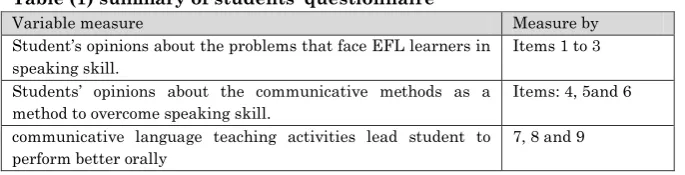
The study used a questionnaire for the purpose of data collection. The detailed of the questionnaire as follows: the students questionnaire (SsQ), consists of 9 statements, it was divided into three parts. The following table gives a brief summary about the students‟ questionnaire:
Table (1) summary of students’ questionnaire
Variable measure Measure by
Student‟s opinions about the problems that face EFL learners in speaking skill.
Items 1 to 3 Students‟ opinions about the communicative methods as a
method to overcome speaking skill.
Items: 4, 5and 6 communicative language teaching activities lead student to
perform better orally
Questionnaire sample
The sample of this study included 100 students at Al Butana University, Faculty of Education, English language Department, all the students spent more than 12 years studying English language at school and university.
Table (2) Distribution the sample according to the gender.
Gender Frequency Percents
Male 30 30%
Female 70 70%
Total 100 100%
Tables (3) Distribution of the students according to their studying grades.
Class Frequency Percents%
Semester Eight 60 60 %
Semester Seven 40 40 %
Total 100 100 %
According to the results in tables (2& 3), a number of 100 students from Al- Butana University English Language Department participated in the study,30 % were male and 70% were female as showed in table(2).More than half of the students study at semester eight 60% where as 40 % study at semester seven as shown in table (3).
Validity of the tool
The researcher deemed that the questions and the responses language to the appropriate intentionality with the flexibility in planning them within clarity about objectives and openness to various ways of achieving the responses.
The questionnaire was validated by the jury of three assistant professors specializes in English language. They based their comments on the following criteria:
(iii) The language used
Options are provided especially for sample, an aptitude for asking good questions and listening carefully to the advice given by the policy makers and the open dialogue shared with some of them with researcher‟s willingness.
Reliability of the questionnaire
In statistics, reliability is the consistency of a set of measurements often used to describe a test. For the reliability of the test, the study used the split- half method: A measure of consistency where the test is splitted in two and the score of each half of the test was compared with one another. The test was distributed to 10 students. The coefficient correlation formula was used to calculate the correlation:
(∑ ) (∑ )(∑ ) √ ∑ (∑ ) ∑ (∑ )
The analysis shows that there was strong positive correlation between the answers given to the items asked:
PsQ. =67%
Procedures
The student‟s questionnaire was distributed to them in their classes, then they were given enough time to response and fill the questionnaire.
RESULTS AND DISCUSSION
Variable: Student’s opinions about the problems that face EFL learners in speaking skill.
Table (4) Students lack the vocabularies to use the suitable oral language.
Strongly agree
Agree Not sure Disagree Strongly disagree
Total 70 (70 %) 10(10 %) 6(6%) 4(4%) 10(10%) 100(100%)
As seen in the above table 80(80%) of the respondents agree that students do not won the suitable amount of the vocabularies which enable them to use the language orally as they miss the means for that, while 14(14%) of the sample disagree that they lacks a good amount of vocabularies that make them to use the language orally.
Variable: Student’s opinions about the problems that face EFL learners in speaking skill.
Table (5) students do not know how to pronounce English word correctly.
Strongly agree
Agree Not sure Disagree Strongly disagree
Total 26 (26 %) 44(44%) 9(9%) 13(13%) 8(8%) 100(100%)
Based on the information in the above table 70(70%) of the students agree that they do not know how to pronounce English word correctly, so they are able to speak fluently, whereas 9 (9%) of the sample not sure about the above statement, the rest of the sample disagree that they do not know how to pronounce the word correctly.
Table (6) students feel ashamed to use English language out the classroom.
Strongly agree
Agree Not sure Disagree Strongly disagree
Total 41 (41 %) 29(29%) 7(7%) 13(13%) 10(10%) 100(100%)
From the above table 70 (70%) of the respondents agree that they are not able to use English language outside the classroom as they are feel a shamed, whereas 7 (7%) not sure about the statement, also 23 (23%) of the students disagree that they feel a shame to use the language outside the classroom.
According to the information shown in tables (4. 5. 6) most of the respondents agree that they lack the appropriate amount of the vocabularies that make them to use the language inside the classroom or outside the classroom, so this because the method which the teacher used for teaching inside EFL classroom learners is not satisfied the students desire for acquiring the good amount of vocabularies that enable them to use the language in different situations, also more than two thirds of the students are not able to pronounce the words correctly, because their teachers lack the best or the correct techniques to teach their students how to pronounce English words correctly as they do not give the students the chance to repeat after him or to make check for their correct pronunciation. As well as more than two thirds of the respondents agree that they feel a shame to use the language outside the classroom because they lack the amount of vocabularies and the abilities to pronounce correctly. To conclude the results of the above tables, we notice that students are taught by Grammar Translation Approach which focuses on reading and writing, and ignores listening and speaking.
Because the teacher role in this approach, who control the situations of the classroom, not as the facilitator for the teaching process.
Variable: Students’ opinions about the communicative methods as a method to overcome speaking skill.
Table (7) communicative method focuses on the four skills of English language.
Strongly agree
Agree Not sure Disagree Strongly disagree
Total 49 (49 %) 22(22%) 8(8%) 14(14%) 7(7%) 100(100%)
As seen in the above table that 71 (71%) of the respondents agree that the focus of the communicative language teaching concentrate on the using of the for skills as integrated process for teaching English language for the foreign learners, while 21 (21%) disagree with the statement.
Variable: Students’ opinions about the communicative methods as a method to overcome speaking skill.
Table (8) communicative method gives the students the opportunities to practice the language.
Strongly agree
Agree Not sure Disagree Strongly disagree
Total
46 (46 %) 29(19.3%) 6(6%) 11(11%) 8(8%) 100(100%)
According to information on the above table 75(75%) of the students agree that communicative language teaching give them the chance to practice the language inside the classroom, where 19 (19%) of the students disagree that the method gives them the opportunity to practice the language.
Variable: Students’ opinions about the communicative methods as a method to overcome speaking skill.
Table (9) communicative method changes the situation of the classroom to communicative one.
Strongly agree
Agree Not sure Disagree Strongly disagree
From the above table, 69 (69%) of the students agree that while using communicative language teaching it change the situation of the classroom from traditional to communicative on by using the suitable language according to the provided contexts and situations. Whereas 25 (25%) of the respondents disagree that communicative language teaching change the situation of the classroom.
According to the analysis of tables (7. 8. 9) they indicate that 71 (71%) of the respondents agree that communicative language teaching uses the for skills while it is used to teach English to foreign learners, as the Grammar Translation Approach focuses on reading and writing, and the Direct Approach appeared as a reaction to the and GTA and focus on listening and speaking. While communicative language teaching focuses on the four skills of English language. In addition to, 71 (71%) of the respondents agree communicative that language teaching is the chance to practice the language by many activities like the dialogues and conversations. Moreover, 69 (69%) of the students agree that while the teachers use communicative language teaching they used to have communicative classroom that enable the students to participate in the teaching process by practice stage to used the language inside the classroom.
Variable: communicative language teaching activities lead student to perform better orally
Table (10) using dialogues and conversations motivate the students to use the language.
Strongly agree
Agree Not sure Disagree Strongly disagree
Total
78 (78 %) 12(12%) 0(0%) 7(7%) 3(3%) 100(100%)
activities such and dialogues and conversations that motivates the learners to use the target language.
Variable: communicative language teaching activities lead student to perform better orally
Table (11) using communicative activities lead students to use the oral language.
Strongly agree
Agree Not sure Disagree Strongly disagree
Total
60 (60 %) 12(12%) 6(6%) 17(11%) 5(5%) 100(100%)
As seen in the above table that, 72 (72%) of the students agree that the using of communicative activities lead and enable them to use and practice the target language orally inside the classroom, whereas 22(22%) of the sample are disagree with the statement.
Variable: communicative language teaching activities lead student to perform better orally
Table (12) through using communicative language teaching students use the language appropriately in real life situations.
Strongly agree
Agree Not sure Disagree Strongly disagree
Total
80 (80 %) 2(2 %) 6(6%) 10(10%) 2(2%) 100(100%)
From the table, and from the analysis of the information above, 82 (82%) of the responses of the sample say that by using communicative language teaching, the students will practice the language appropriately in different real life contexts, and situations, so they interact using the target language to exchange their feeling and the opinions with each other.
the learners to use the target language, so one the advantage of communicative language teaching is that it motivates the learners to spend a time inside the classroom, because in the communicative approach, speaking was given more importance since oral communication involves speech where learners are expected to interact verbally with other people. Also 72 (72%) of the students agree that the using of communicative activities lead and enable them to use and practice the target language orally inside the classroom, asCommunicative activities in this kind of activities, the focus is on the learners‟ abilities in communication. They include functional activities that focus on language functions; in which the learners move further to learn the different functions of language such as greeting, thanking, apologising. As well as 82 (82%) of the responses of the sample say that by using communicative language teaching, the students will practice the language appropriately in different real life contexts, and situations, so they interact using the target language to exchange their feeling and the opinions with each other.
More and more people are using English language as a common way to communicate with each other due to the development of the technologies (the internet) and so the global economy, which lead companies and large businesses to employ people who can speak more than their own native language.
REFERENCES
1. Bailey, K. M. (2002). Issues in teaching speaking skills to adult ESOL learners. 113-164.
3. Brown, D. H. (2000). Teaching by principles – An interactive approach to language pedagogy. London: Addison Wesley Longman.
4. Brown, H. D. (2000). Principles of language learning and teaching. (4th Ed.). San Francisco: Addison Wesley Longman, Inc.
5. Brown, H. D. (2007). Principles of Language Learning and Teaching. San Francisco: Pearson Educational 6. Bygate, M. (2003). Speaking. Oxford: Oxford university
press.
7. Bygate, M. (2003). Language teaching: a scheme for teacher education, speaking. Oxford university press. 8. Chomsky, N. (1965), Aspects of the theory of syntax.
Cambridge, MA: MIT Press. Retrieved on February20,
2014, from
http://books.google.com/books?id=u0ksbFqagU8C
9. Finocchiaro, M., & Brumfit, Ch. (1983). The Functional-notional approach: From theory to practice. Oxford: Oxford University Press.
10.Gutierrez, D. G. (2005). Developing oral skills through communicative and Interactive tasks. Profile Issues in Teachers' Professional Development, ISSN 1957-0790 version impersa. Bogota: Institucion Educativa Distrital Britalia.
11.Knight, P. (2003). The development of EFL methodology. In Christopher N. Candlin and Neil Mercer (Eds.), English language teaching in its social context (pp. 147–
166). New York: Taylor &Francis Group
12.Littlewood, W. (1981).Communicative language teaching. Cambridge: CUP.
13.Richards, J. C., & Rodgers, T. S. (2001). Approaches and methods in language teaching (2nded.). Cambridge: Cambridge University Press.
15.Taylor, B. P. (1983). Teaching ESL: Incorporating a communicative, students-centered component. TESOL Quarterly, 17(1), 69–85.
16.UR, P. (2000). A course in Language Teaching: Practice and Theory. Cambridge: Cambridge University Press. 17.Widdowson, H. G. (1978). Teaching Language as