Practical Forward-Secure Range and Sort Queries
with Update-Oblivious Linked Lists
Erik-Oliver Blass
Airbus Group Innovations81663 Munich, Germany
[email protected]
Travis Mayberry
Guevara Noubir
College of Computer and Information Science Northeastern University
Boston MA-02115, USA
{travism|noubir}@ccs.neu.edu
ABSTRACT
We revisit the problem of privacy-preserving range search and sort queries on encrypted data in the face of an untrusted data store. Our new protocol RASP has several advantages over existing work. First, RASP strengthens privacy by ensuringforward security: af-ter a query for range[a,b], any new record added to the data store is indistinguishable from random, even if the new record falls within range[a,b]. We are able to accomplish this using only traditional hash and block cipher operations, abstaining from expensive asym-metric cryptography and bilinear pairings. Consequently, RASP is highly practical, even for large database sizes. Additionally, we require only cloudstorageand not a computational cloud like re-lated works, which can reduce monetary costs significantly. At the heart of RASP, we develop a newupdate-obliviousbucket-based data structure. We allow for data to be added to buckets without leaking into which bucket it has been added. As long as a bucket is not explicitly queried, the data store does not learn anything about bucket contents. Furthermore, no information is leaked about data additions following a query. Besides formally proving RASP’s pri-vacy, we also present a practical evaluation of RASP on Amazon Dynamo, demonstrating its efficiency and real world applicability.
1.
INTRODUCTION
Outsourcing data to cloud stores has become a popular strategy for businesses, as cloud properties like scalability and flexibility al-low for significant costs savings. However, cloud infrastructures cannot always be completely trusted, due to, for example, hacker and insider attacks [16, 32]. While encryption of outsourced data protects against many privacy threats in cloud scenarios, it renders subsequent operations on data (i.e., data analysis) extremely dif-ficult. Although fully homomorphic encryption (FHE) offers an elegant solution to perform operations and data analysis on en-crypted data, today’s techniques are still impractical and their use can negate any cloud cost advantages.
In this paper, we address the problem of performing privacy-preserving range search and sort queries on encrypted outsourced data with a particular focus on practicality. We envision a sce-nario where a set ofusersupload a large number of encrypted data records to an untrusted cloud store. From time to time, asurveyor
Permission to make digital or hard copies of all or part of this work for personal or classroom use is granted without fee provided that copies are not made or distributed for profit or commercial advantage and that copies bear this notice and the full citation on the first page. To copy otherwise, to republish, to post on servers or to redistribute to lists, requires prior specific permission and/or a fee.
Copyright 20XX ACM X-XXXXX-XX-X/XX/XX ...$15.00.
wants to perform data analysis operations. Specifically, the sur-veyor queries for all the records in a certain range of values (“cate-gories”). Alternatively, the surveyor may query for thetopmsorted records, i.e., themsmallest records following some order.
Although the individual data records are encrypted, an untrusted cloud could still infer information about them by observing multi-ple range and sort operations. For exammulti-ple, the cloud could learn access patterns and correlate them. Consequently, also the analy-sis operations (“queries”) need to be privacy protected. The crucial challenge here is practicality, i.e., high efficiency in terms of band-widthandmemoryrequirements as well as user/surveyor/cloud com-putations.
Related Work: Besides FHE, another approach that could ap-ply here is performing range or sort queries on top of an Oblivi-ous RAM [15]. However, withnthe total number of outsourced records in the cloud, ORAM worst-case communication complex-ity is poly-logarithmic inn[26, 31]. Thus, for largen (such as n= 230records or more), this overhead becomes unacceptably ex-pensive for sorting and range search. Along the same lines, search-able encryption techniques [8, 9, 11, 13, 14, 20, 27, 30] would ei-ther require computational and communication complexities linear innor non-trivial extensions to perform updates to stored data in a privacy-preserving fashion. Other techniques such as Order Pre-serving Encryption (OPE) [6] are highly efficient, but provide weak privacy. Finally, recent work on range search [7, 22, 25, 33] offers insufficient “selective” privacy and, being based on bilinear pair-ings, becomes impractical for, e.g., embedded devices or smart-phones and largenas targeted in this paper. None of the above related works support multiple users. Note that we discuss related work in detail at the end of the paper (Section 6).
technical highlights of this paper are:
• LL, a dynamic data structure that provably hides any infor-mation about a newly added data record until this data record is explicitly read. (Section 4)
• RASP, a protocol employing LLfor range search and sort queries on encrypted data in the cloud with support for multi-ple users. Compared to related work on range search, RASP offers stronger, forward-secure privacy. We formally prove that the cloud cannot learn any information about records added until the surveyor queries them. Details about queries are hidden, and only the overlap between queries is leaked. RASP is efficient and scales well. The users’ and surveyor’s, computational and communication complexities are constant in the total number of records. In contrast to related work, RASP seamlessly integrates into cheap storage-only, no com-putation cloud services such as Amazon S3 or Dynamo and allows for multiple different users that do not trust each other (Section 5).
• An implementation and evaluation ofLLand RASP in Ama-zon’s DynamoDB cloud. The source code is available for download [3].
2.
SCENARIOS AND APPLICATIONS
General scenario:To motivate our work, we use an example sce-nario throughout this paper. Assume a set of usersUthat continu-ously upload data records to a cloud store. Each record comprises: (1) a categoryI of some domainDwith an order relation, e.g., D={1, ... , D} ⊂N and “≤", and (2) some payload data M.
For the sake of range search and sort queries in this paper,M is not particularly interesting, and we focus only on indicesI. After some time, users have uploaded a total ofnrecords to the cloud, wherencan become very large, whileDis comparatively small, e.g.,n= 230andD= 1024. Periodically, a surveyor queries the uploaded records for those records whose indices match a certain range inD. The set of records that match this range has sizem. Alternatively, the surveyor wants to retrieve the firstmrecords ac-cording to their sorted indices.
Possible Applications:One can imagine various real world appli-cation scenarios that fall within the general setup above. For ex-ample, imagine a set of banks (“users”) that upload financial trans-actions, i.e., the amount of each transaction together with details such as sender, receiver, and date. At times, to detect fraudulent behavior and money laundering, the police queries for all transac-tions within some suspicious range or themhighest transactions of a certain time period. Alternatively, imagine a set of physicians that upload patient records, comprising the patient’s personal infor-mation and, say, the patient’s blood pressure. Once in a while, for further analysis, a health insurance wants to retrieve details about all patients with blood pressure in a critical range or the topm pa-tients with high blood pressure. In both application scenarios, the stored data is sensitive, and the underlying cloud store should not learn details about either stored data or queries performed. This im-plies encrypting uploaded data by the users and “oblivious queries” by the surveyor.
As related work [7, 22, 25, 33], this paper focuses on “append-only” storage scenarios, i.e., we do not address removal of records. Such data access schemes with data being frequently uploaded and queried rarely allows for especially cheap services. For example, Amazon’s “Glacier” offers this model of access and is significantly cheaper than regular S3 or Dynamo storage.
3.
PROBLEM STATEMENT
Trust Model: We only assume that the surveyor is trusted by the users. The cloud server is untrusted and assumed to be fully mali-cious. The individual users do not communicate or share data with each other, only with the surveyor. In this way, the problem can be seen as a two-party protocol between each user and the surveyor.
3.1
Range and Sort Queries
We now formalize privacy-preserving range andm-sort schemes. We start by introducing the functionality that each scheme should support. The main idea is that users respectively encrypt and up-load their records to the store, while the surveyor performs range search and sort operations.
DEFINITION1 (RANGESEARCH ANDm-SORTSCHEMEΠ).
LetI,0≤I≤D−1, denote a category within domainDandM a plaintext (“payload”). A Range andm-Sort search scheme Π comprises the following algorithms.
• KeyGen(s): This algorithm uses security parameters to generate secret key SK and the set of user keys{Seedi}1≤i≤|U |.
• Encrypt(I,M,Seedi): encryptsM at categoryIusing user key Seedi. The algorithm outputs ciphertextC.
• Decrypt(C,SK,i): This algorithm decrypts a ciphertextC, such thatDecrypt(Encrypt(I,M,Seedi),SK,i) =M, where SK and Seediwere generated fromKeyGen(s).
• PrepareRangeQuery(a,b,SK): uses secret key SK and a pair a,b∈Nwitha≤bto generate a range query tokenTR.
• RangeQuery(TR,{C
1, ... , Cn}): using range search token
TR=PrepareRangeQuery(a,b,
SK)and a set of ciphertexts Ci, a responseSR={Ci|Ci=Encrypt(Ii, Mi,Seedj)∀j,
1≤j≤ |U |andIi∈[a,b]}is computed.
• PrepareSortQuery(m,SK): with secret key SK and length m,1≤m≤n,outputs a sort query tokenTS
.
• SortQuery(TS,{C
1, ... , Cn}): using sort query tokenTS and ciphertextsCi, outputs a sequenceSS=< C10, C20, ... , Cm0 >withCi0∈ {C1,...,Cn}as response. Here, ciphertext
Ci0=Encrypt(Ii, Mi,Seedi) denotes the ciphertext on the
ithposition according to the order of the underlying indices I. More formally: (1) forC10: there is noCj,1≤j≤nsuch thatIj< I1, (2) for any pairCi0,C
0
i+1: eitherIi=Ii+1, or
Ii< Ii+1and there are a totaliciphertextsCj,1≤j≤iwith
Ij< Ii+1, (3) for any pairCi0,Cj0:Ci06=Cj0.
So, the surveyor executesKeyGenand receives SK and user keysSeed. Each useriis sent distinct user keySeedithat they
can use to executeEncryptfor encryption and upload of data. The surveyor can eventually perform range and sort queries. The idea is that the surveyor only prepares the range and sort queries, while the cloud performs the actual querying. In cloud settings, the main computational burden lies inRangeQuery andSortQuery, while
PrepareRangeQueryandPrepareSortQueryare lightweight.
3.2
Privacy
For example, the cloud should not learn any additional informa-tion about records that are not part of a query result – besides that these records are obviously not in the queried range or among the topmrecords. Typically, ORAM based solutions would of-fer strong protection. However, focusing on efficiency, we dismiss ORAM, because its poly-logarithmic worst-case communication complexity [26, 31] quickly becomes expensive with largensuch asn= 230. Additionally, as ORAM does not allow multiple dis-trustful users (even as few as two), a straightforward extension to range search and sort is vulnerable to collusions.
RASP targets privacy that is slightly weaker than ORAM’s pri-vacy, but still stronger than privacy provided by related work on range search. We call this privacyforward-secure. Intuitively, the cloud (now called adversaryA) should not learn any details about anewrecordRthat is added to the store, i.e.,Ashould not learn anything aboutR’s categoryI(and payloadM). Only when the surveyor executes a range search or sort query willAlearn whether Rmatches this query or not. Our goal is that any two recordsR, R0 that donotmatch a query will remain computationally indis-tinguishable forA. We formalize our privacy goal. Targeting a standard simulation-based privacy definition, the idea is that, given a well specified privacy-leakage, a polynomial-time simulator can generate a transcript of RASP which is computationally indistin-guishable from the output of the actual protocol. If this is true, then Acannot learn any information beyond the defined leakage. In summary, forward-secure privacy allowsAtoonlylearn: (1) the operation pattern, i.e., which operation (range or sort) is per-formed, (2) the data access pattern, i.e., which records are accessed during an operation, and (3) the enumeration pattern, i.e., which records are returned. As we will discuss later in Section 3.3 this forward-secure privacy is actually stronger than the privacy offered by related work on range search [7, 22, 25, 33].
We focus on key-value “(k, v)” based cloud stores/databases such as Amazon Dynamo DB or S3 in this paper, so we assume that each record is uniquely addressable by an addressk in the store. We refer to the keys in the key-value paradigm as addresses to avoid the confusion with cryptographic keys.
3.2.1
Formal Definitions
Following Curtmola et al. [13], we formalize privacy by quanti-fying the information leakage of a schemeΠ.
DEFINITION2 (OPERATION). For a range andm-sort scheme Π, an operationopis defined as either(Encrypt,I,M,Seedi)or
(RangeQuery,a,b,SK)or(SortQuery,m,SK). For ease of expo-sition, we introduce the following functions on operations:
• Type:op→ {Encrypt,RangeQuery,SortQuery}which ex-tracts the operation type from an operation.
• Execute: (op,K)→(K= (k1,...,kt),C= (c1,...,ct))which executesopusing keyKand returns the result. Depending on the operation,Kis eitherSeediorSK. The setK con-tains the sequence of addresses accessed on the cloud, and Ccontains the data, i.e., records at those addresses after the operation.
• Categories: (c1,...,ct)→ {I1,...,It} ⊂Dtwhich extracts the categoriesIiout of a sequence of recordsci.
Note that knowledge ofSKandSeedisuffices to computeTR
andTS
.
DEFINITION3 (HISTORY). Theq-query historyHis the se-quence of operationsH= (o1,...,oq), whereoi= (Encrypt,I,M),
oi= (RangeQuery,a,b)oroi= (SortQuery,m).
DEFINITION4 (OPERATIONPATTERN). An operation pattern β(H)induced by aq-query historyH is defined as the sequence β(H) = (Type(o1),...,Type(oq)).
The operation pattern is a mild leakage, only telling the adver-sary whether we are doing range search or sort queries – see our detailed discussion below.
DEFINITION5 (QUERYPATTERN). Letπbe a random per-mutation of integers{1, ... , D}. The query pattern of aq-query history is theq-length sequenceσ(H)defined as follows: first, consider the case thatType(oi) =RangeQueryor Type(oi) = SortQuery. LetExecute(oi, K) = ((k1, ... , kt),(c1, ... , ct))and Categories(c1, ... , ct) ={I1, ... , It}. Then,σ(H)[i]is the set of tuples((π(I1),χ(I1)),...(π(It),χ(It))), whereχ(I) = (e1,...,em) returns the indices such that∀j < i:oej= (Encrypt,Ij,Mj). If
Type(oi) =Encrypt, thenσ(H)[i]is⊥.
That is,σ(H)reveals whichpreviousEncryptoperations are being queried as part of thecurrentrange search or sort query operationi (as in related work) and the pattern of categories that are accessed for that operation. For any two range queries,σ(H)will tell which categories they have in common. Due to random permutationπ and the fact thatσ(H)[i]is an unordered set, no information about the ordering of the categories is leaked beyond what can be inferred by the overlap. Note that this leakage is also relatively small: all existing schemes other than Oblivious RAM leak the intersection of the results of two queries. We are, in effect, trading forward se-curity for leakage of the “width” of the query, i.e., the number of categories that fall within the requested range. While coming with many privacy disadvantages compared to RASP, this is the only leakage that OPE avoids; see also our discussion in Section 3.3.
DEFINITION6 (SORTLEAKAGE). The sort leakage from a q-query historyH is theq-length sequenceγ(H)defined as fol-lows: ifoiis a sort query, i.e.,Type(oi) =SortQuerywithExecute(oi,
K) = ((k1,...,kt),(c1,...,ct))andCategories(c1,...,ct) ={I1,..., It}, thenγ(H)[i]is the tuple(m,(π(I1),...,π(It))). IfType(oi) = EncryptorType(oi) =RangeSearch, thenγ(H)[i]is⊥.
This means that the sort leaks thetcategories which contain the firstmrecords, including their order, as well asmitself.
DEFINITION7 (TRACE). The trace induced by aq-query his-toryHis the tupleτ(H) = (σ(H),β(H),γ(H)).
DEFINITION8 (FORWARD-SECUREPRIVACY). Let Π be a Range Search andm−Sort Scheme implementingExecutefor op-erationsEncrypt,RangeQuery,SortQueryand therewith generat-ing traceτ. Lets∈Nbe the security parameter,Abe an adver-sary, andSbe a simulator. Consider the following two experiments
RealΠ
A(s)andSimΠA(s):
RealΠA(s)
K= (SK,{Seedi}1≤i≤|U |)←KeyGen(1s)
for1≤i≤q
(stA,oi)← A(stA,(K1,C1), ...,(Ki−1,Ci−1),1s) (Ki,Ci)←Execute(oi,K)
letK∗= (K
1,...,Kq) letC∗= (C
1,...,Cq)
SimΠ
A,S(s)
for1≤i≤q
(stA,oi)← A(stA,(K1,C1), ...,(Ki−1,Ci−1),1s) (Ki,Ci,stS)← S(stS,τ(o1,...,oi),1s) letK∗= (K1,...,Kq)
letC∗= (C
1,...,Cq) outputv= (K∗,C∗
)andstA
SchemeΠisforward-secure privacy-preserving,ifffor all PPT adversariesA, there exists a PPT simulatorS, such that for all PPT distinguishersD,
|P r[D(v,stA) = 1 : (v,stA)←RealΠA(s)]−
P r[D(v,stA) = 1 : (v,stA)←SimΠA,S(s)]| ≤negl(s).
3.2.2
Discussion
Our definition captures an adaptive adversary which generates the history one operation at a time, seeing the results of the previous operations. This allows for an adversary which changes his strategy depending on what the simulator has output afteri < qoperations. Consequently, the simulator calculates one step of the simulation at a time based on a partial trace generated from an adaptive history.
Definition 8 is generic in that it allows us to bound the informa-tion leaked by any protocol which uses a cloud store. If there exists a simulator, given only the trace, which can produce a sequence of “accesses” that is indistinguishable from a real execution of the protocol, then no information other than the trace can be leaked.
Note that schemes secure under the above definitions leak only the traceτ(H). Trivially, leaking patterns allows the adversary to derive additional information, e.g., the complement of a query. This leakage is problem inherent to all related work [7, 22, 25, 33]. We refer to Islam et al. [19] for a detailed discussion on implications of range search queries. Again, we stress that our goal is practi-cality, and additionally protecting patterns would require expensive ORAM-like mechanisms. From a privacy perspective, we place our definition between weaker related work [7, 22, 25, 33] and stronger ORAM [15]. Yet, as we will see later, RASP offers better efficiency than both.
We consider fully malicious adversaries that only target privacy, but not integrity. While important, attacks against the integrity of range search or sort results are out of scope of this work. One can envision extensions to RASP verifying returned data, e.g., us-ing previously computed signatures, but these deserve their own research.
3.3
Forward-Secure privacy vs. privacy of
related work
We stress that forward-secure privacy, Definition 8, is stronger than privacy models of previous work on range search [7, 22, 25, 33]. These schemes offer onlyselective security. That is, a query for a specific range[a,b]implies thatAfrom then on will be able to automatically determine whether new records added in future will also be within[a,b]or not – a major disadvantage. In contrast, our privacy definition guarantees that even a recordR∈[a, b]added afterthe range query for[a, b]is indistinguishable from random until[a,b]is queried again. Moreover, the work by Shi et al. [25] isMatch Revealing(selective-MR). This means that, if a record matches, its category is leaked toA, too. In contrast, the work by Boneh and Waters [7] and Lu [22] isMatch Concealing (selective-MC). Definition 8 never leaks the category toA, and therefore is Match Concealing. Additionally, Lu [22] requires that the adver-sary must not know the distribution of records’ categories. As the ciphertexts are stored in aB-tree, visible to the store, knowledge of
the category distribution is enough to reveal all ciphertexts, cf. Lu [22], §9. This is a rather significant drawback, as there are many useful situations where the adversary may either partially or fully know the plaintext distribution.
Besides the query width, Definition 8 offers improved privacy over Order Preserving Encryption (IND-OPE). In IND-OPE,A im-mediately learns the order of records. After a range query,Acan determine for any record added in the future whether it is in the (encrypted) range or not. Also, Alearns forany record whether it is smaller or larger than a range’s (encrypted) endpoint. In con-trast, Definition 8 only leaks membership to an encrypted range of encrypted records for those records queried at the time of the query, but not for updates (therefore called “update-oblivious”).
Targeting practicality, Definition 8 is weaker than the one of ORAM. In contrast to ORAM, Definition 8 does not protect access patterns. That is,A can observe that subsequent queries access the same records. However, as noted before, in addition to its in-efficiency ORAM is vulnerable to collusion attacks as it does not support multiple users.
4.
UPDATE-OBLIVIOUS LINKED LISTS
For its range and sort queries, RASP relies on a new kind of data type that we callupdate-oblivious add-enumeratedata type. Its purpose is to allow aWriterto add values tobuckets(the cat-egories). Also, aReader can enumerate all values of a bucket. The sole privacy goal is to hide from an adversary storing all data which bucket a new value is added to by the Writer at the least until this specific bucket is enumerated by the Reader. We will now start by describing the operations and privacy properties that update-oblivious add-enumerate data types support. Then, we will introduce an original data typeLL, a sequence of linked lists that supports update-oblivious operations, and we will prove its privacy properties.
An add-enumerate data type comprises a sequence ofDbuckets, dynamic data structures indexed byI,1≤I≤D. This data type supports adding values to the individual buckets and enumerating individual buckets, i.e., enumerating all values that have been pre-viously added to one of the buckets. Again, we assume a key-value based underlying cloud store. Each “value”vadded is uniquely addressable by an addresskin the store. More formally, an add-enumerate data type supports two algorithms:
• Add(I,v) :On input bucketI,1≤I≤D,and valuev∈ {0, 1}∗
, this algorithm addsvtoIand outputs addressk∈ {0, 1}∗. We call the pair(k,v)valid.
• Enumerate(I) :This algorithm returns the set{(k, v)|v∈ I∧(k,v)is valid}.
4.1
Update-Oblivious Privacy
Again, we use a simulation-based privacy definition for update-oblivious data types. Similarly to Definition 8,Acan learn (1) the operation pattern (which operation is performed on the data type), (2) the data access pattern (which data in the individual data struc-tures is accessed during an operation), and (3) the enumeration pat-tern (which values are returned as part of anEnumerate). However, the enumeration pattern will not reveal the indices of values enu-merated never before. Being clear from the context,we reusethe notions of histories and operations defined previously in the con-text of add-enumerate data types, with a new definition of Trace to quantify information leakage.
DEFINITION10 (ENUMERATIONPATTERN). An enumeration pattern induced by aq-query historyH is theq×qbinary matrix σ(H), where for1≤i,j≤qthe entry in the ithrow and jthcolumn is 1,iffi≤jType(oj) =EnumerateandIi=Ij. Otherwise, this entry is 0.
IfType(oi) =Add, then the ithrow of this matrix contains ones
in the columns corresponding to an enumerate that happensafter this add. Therewith, the enumeration pattern reveals which cate-gory an add corresponds to onlyafteran enumerate occurs for that same category. If the result of an add is never queried, i.e., no enumerate occurs after for that category, then the entire row in the matrix will contain only zeroes, and the category of the add is not leaked.
DEFINITION11 (ACCESSPATTERN). Letπbe a random per-mutation of the integers{1,...,D}. The access pattern of aq-query history isq-length sequenceγ(H), such that, ifoiis anEnumerate on categoryj, thenγ(H)[i] =π(j). Otherwise,γ(H)[i] = 0.
That is, access patternγwill reveal when two enumerates are on the same category. We stress that this is also revealed as part of the enu-meration pattern, and so is not additional leakage, but we include this separate notation for clarity and ease of exposition in our proof.
DEFINITION12 (TRACE). The trace induced by a q-query his-toryHis the tupleτ(H) = (σ(H),β(H),γ(H)).
DEFINITION13 (ADAPTIVE UPDATE-OBLIVIOUS). We define adaptive update-oblivious (“update-oblivious”) privacy using the same generic simulation-based experiments as above (Definition 8), but include the new Definition 12 of trace for this data structure.
4.2
The Data Type
LLWe present a new add-enumerate data typeLLwhich implements the sequence ofDbuckets aslinked listson top of any key-value based store.
Overview:The main rationale ofLLis that Reader and Writer syn-chronize their access to the same bucket/linked listIusing an array of flags. If the Writer wants to update linked listI by adding a new valuev, he verifies whether the Reader has enumeratedI af-ter the last add by checking the flag for this list. If the Reader has enumeratedI, then the Writer does not simply appendvtoI, but creates a newchainforI, addsvto this chain, and updates the flag. The Writer will continue adding values to this new chain, until the Reader enumeratesI again. Then, the Writer will create another new chain etc. On the other hand, the Reader checks a flag to un-derstand whether the Writer has created a new chain forI, thereby knowing how many chains ofIcontain values. Thesecurity ratio-nalefor starting a new chain forIafter an enumeration ofIis that Acannot determine categoryIfor a newly added value by linking to a previous enumerate ofI.
Details:Reader and Writer share a secret keyκthat, for simplicity, has been exchanged in advance.LLcomprises a total ofDlinked lists which are indexed byI,1≤I≤D. In the underlying key-value store, the head of linked listI, the start of the first chain ofI, can be accessed using addresshκ(I,1), wherehis a pseudo-random
function, and “,” is an unambiguous pairing of inputs.
Writer and reader synchronize using an encrypted array of flags ∆ = (δ1,...,δD), δi∈ {0,1}. They can save and retrieveEncκ(∆),
whereEncdenotes encryption, in the underlying key-value store using addresshκ(“delta”). Initially, all flagsδiare set to 0.
For each linked listI, the Writer stores a local counterγiWriter.
All counters are initialized to 1. The purpose of these counters is
Algorithm 1:LL-Add(I,v,κ) Input :Pair(I,v), secret key
κ, local sequences of next list pointersΨ = (ψ1,...,ψD)and
countersΓWriter= (γWriter
1 ,...,γDWriter),security parameters
Output:Addressk, ciphertexteof new record
1 C:=Get(hκ(“delta”));// C=Encκ(∆) 2 ∆ = (δ1,...,δD) :=Decκ(C);
3 ifδI= 1then
4 γWriterI :=γIWriter+1; 5 ψI:=hκ(I,γIWriter); 6 δI:= 0;
7 Put(hκ(“delta”),Encκ(∆) =Encκ(δ1,...,δD)); 8 end
9 k:=ψI; 10 ψI← {$ 0,1}s;
11 newRecorde;
12 e.value :=Encκ(v);e.ψ:=Encκ(ψI); 13 Put(k,e);
14 return(k,e);
Algorithm 2:LL-Enumerate(I,κ) Input :Category
I, secret keyκ, local countersΓReader= (γReader
1 ,...,γDReader)
Output:Set of ciphertextsS={ci|ci∈I} 1 S:=∅;
2 C:=Get(hκ(“delta”));// C=Encκ(∆) 3 ∆ = (δ1,...,δD) :=Decκ(C);
4 fori:= 1toγIReader−1do 5 start :=hκ(I,i);
6 S:=S ∪LL−Retrieve(start,κ); 7 ifδI= 0then
8 start :=hκ(I,γIReader); 9 S:=S ∪Retrieve(start,κ); 10 δI:= 1;
11 Put(hκ(“delta”),Encκ(∆) =Encκ(δ1,...,δD)); 12 γReaderI :=γIReader+1;
13 return(S);
to keep track of the number of chains that have been created per linked list. Each time the Writer starts a new chain for a linked listI, he increasesγWriter
I by one. Along the same lines, the Reader
also keeps a local sequence of countersγReaderi , initialized to 1. Each
time the Reader sees that the flag for a specific linked listIhas been changed, i.e., the Writer has created a new chain forI, the Reader will increaseγReaderI by one. Moreover, the Writer locally stores for
each linked listI anext pointerψI. This next pointer represents
the address in the underlying key-value store for the next valuevto be added to linked listI. Initially, eachψIis set tohκ(I,1), i.e.,
the start of the first chain of listI.
Add: In case the Writer wants to add a new valuevto linked listI, he executes Algorithm 1. First, he downloads and decrypts theδi.
Note that we use the standard key-value semanticGetandPutto access data in the underlying store. IfδI= 1, then the Reader has
accessed listIsince the last add, and the Writer creates a new chain forI. The Writer increases counterγIWriter, sets next pointerψIto
the start of the new chainhκ(I,γIWriter), resets flagδI, and uploads
a new encryption of all flags∆. In any case, the Writer uploads an encrypted version ofvusing the current address thatψIpoints
at. Together with the encryption ofv, the Writer also uploads a randomly chosen encrypted new next pointerψI. For convenience,
Algorithm 3:LL-Retrieve(ψ,κ) Input :Chain start pointerψ, secret keyκ
Output:Set of ciphertextsS 1 S:=∅;
2 Recorde:=Get(ψ);
3 whilee6=⊥do
4 S:=S ∪e.value; 5 ψ:=Decκ(e.ψ); 6 e:=Get(ψ);
7 returnS;
Enumerate: In case the Reader wants to retrieve all (encrypted) values of linked listI, he executes Algorithm 2. First, the Reader downloads and decrypts theδi. IfδI= 1, then the Writer has not
updatedIsince the last enumerate. Consequently, the Reader will retrieve all values of all the current(γIReader−1)chains of listI.
Otherwise, ifδI= 0, then the Writer has started a new chain for
Isince the last enumerate. So, the Reader will retrieve all records of the previous(γIReader−1)chains ofI, then retrieve all records
of chainγReader
I , set flagδI, encrypt and upload all flags∆, and
finally increase counterγIReader. Note that the Reader retrieves all
values of a chain by using Algorithm 3. There,Dis the decryption algorithm for encryptionsEnc. Using∆for synchronization be-tween Writer and Reader, the Writer will avoid putting a new value into the underlying store using an address that the Reader has pre-viously already queried for as part of an enumerate. In this case, the Writer will start a new chain and notify the Reader that a new chain is available.
4.3
Privacy Analysis
For our proof, we use the notion of IND$-CPA encryption from Rogaway [24]. Informally, this definition means that an encryption scheme(Enc,Dec)is indistinguishable from an oracle which pro-duces random strings of the same length as a ciphertext. This can be implemented, e.g., by a PRP (like AES) in CBC- or Counter-mode.
THEOREM 1. Ifhis a pseudo-random function, andEncis an IND$-CPA encryption, thenLLis update-oblivious.
PROOF. We describe a PPT simulatorLSsuch that for all PPT adversariesA, the outputs ofRealLLA(s)andSimLLA,LS(s)are in-distinguishable. Consider the simulatorLS that, given a partial trace of a historyH,τ(o1,...,oi), outputsv= (Ki,Ci)as follows.
LSkeeps as state, a vectorBof lengthDwhich contains the most recent contents of each bucket (from the simulator’s perspective). Bis initialized to all empty sequences, andLSwill updateBfor eachEnumeratewhich reveals additional bucket records. Addi-tionally,LSmanages listkwhich holds the addresses of add oper-ations and an associative arraycwhich maps addresses to values.c
represents the simulator’s view of the store’s memory. Ifcis evalu-ated on an address which is empty, it returns⊥. Ifiis the operation LSis simulating and
1)β(o1, ..., oi)[i] =Add: LS setsk[i]and c[k[i]]to uniformly
random strings and outputsKi={k[i]}andCi={c[k[j]]}.
2)β(o1,...,oi)[i] =Enumerate:LScreates the sequenceK0such
that it contains, in order, every recordk[x]whereσ(H)[x,i] = 1. LSthen setsBγ(H)[i]toBγ(H)[i]concatenated withK
0
and a uni-formly random string. This can be viewed as the simulator return-ing all the records from the previous enumerate on the same bucket, plus any additional records that have been added to the bucket since then and finally adding a random empty address on the end (repre-senting the end of a list). LSthen returnsKi=Bγ(H)[i]andCi
equal tocevaluated on every address inKi.
Since the outputs ofhandEncare indistinguishable from ran-dom, simulatorLS can put random strings inKi and Ci during
adds. Because of the enumeration pattern leakage, LScan also guarantee the correct pattern inKiduring enumerates by a simple
check ofβ(H). Future enumerates will also return, as a prefix, pre-vious enumerates which guarantees consistency.LSsimulates the end of a linked list by appending a random address and a⊥value to each enumerate.
One small detail remains: vector∆. Since it is completely down-loaded and reencrypted for each query, in effect it acts like a “triv-ial” Oblivious RAM. This access is easily simulated by writing a single random string for vector∆, which will be indistinguishable from the encrypted vector under IND$-CPA encryption.
Resiliency to Collusion Attacks: Since every user has their own key, independent of the other users, it is simple to see that users cannot collude with each other or with the cloud server to learn anything beyond their own data.
Extensions to Mitigate Consistency Attacks: Contrary to previ-ous work on range search [7, 22, 25, 33], we allowdifferententities to access data: the Reader and the Writer. As the two entities syn-chronize using∆, a fully malicious adversary could mount attacks by desynchronization, such as sending outdated versions of∆.
So far, our definitions of update-oblivious and of data typeLL
above have implicitly requiredread-after-writeconsistency. Yet, although the Reader has read bucketI and setδI:= 1,Acould
send an old version ofEnc(∆)withδI= 0to the Writer during Add. Consequently, the Writer would not create a new chain, but add a new record at an address already read by the Reader – violat-ing update-obliviousness.
Thus, we now show how we can easily extend our system to cope even with adversariesAmounting consistency attacks. Inspired by Li et al. [21], we augment∆by two additional global counters, one for the Reader, one for the Writer. Both counters will be encrypted as part of∆. For eachEnumerate, the Reader increases its counter. For eachAdd, the Writer increases its counter. Both parties keep local copies of counters, compare to ∆’s counters upon receipt, and therewith verify the freshness of∆. Even in the face of fully maliciousAmounting consistency attacks on the (augmented)∆, this approach achievesFork Consistency, the strongest consistency possible in the absence of a third trusted party [21]. In short, after such an attack, Surveyor and User will be in different “worlds”: no change performed to the data will ever be seen by the Surveyor. The surveyor remains at the state of the old, not-updated data set, however with full privacy guarantees. For more details on this tech-nique, we refer to Li et al. [21]. Note that in scenarios similar to related work with onlyoneentity to read and write to the store,LL
would not synchronize∆, making consistency attacks impossible.
Generalization: The update-oblivious property can be extended to other data types. Let a monotonically-expandingdata typeS
be any data type supporting two general operationsAdd(S,E)and
Algorithm 4: KeyGen(s) – generate keys for surveyor and users
Input:Security parameters
Output:Surveyor’s secret key SK, set of user keys{Seedi}1≤i≤|U |
1 SK← {$ 0,1}s; 2 fori:= 1to |U |do 3 Seedi:=hSK(i);
4 returnSK,{Seedi}1≤i≤|U |;
Algorithm 5: Encrypt(I, M,Seedi) – user Ui encrypts and
uploads to cloud.
Input:CategoryI, dataM, userUi’s key Seedi
Output:CiphertextCthat is uploaded to cloud
1 κ:=Seedi;
2 (k,C) :=LL-Add(I,M,κ);
3 returnC;
Enumeratelists edges (or properties of edges). Our bucket data typeLLcan be used to implement the same update-obliviousness for expanding graphs, trees, and other dynamic data types.
5.
RASP
Overview: The main rationale behind RASP is to arrange up-loaded data with categoryIusing an update-oblivious add-enumer-ate data type such asLLthat offers buckets. In RASP, each indi-vidual bucket represents a categoryIwithin domainDof uploaded
dataM. WithnD, we achieve low query complexity similar to bucket sort. Uploading new data into a bucket is realized by using
AddinLL. Similarly, range search queries and actual bucket sorts can be realized usingEnumerate. Our goal with this approach is to reduce the complexity for range search and sort queries over related work. RASP’s query complexity depends only onDandUwhich we assume to be small, but the complexity is independent ofnas in related work. To support multiple usersU, we use anLLdata type per user. Users share pairwise different keys with the surveyor.
5.1
RASP Details
We now present RASP’s details, following the notation intro-duced in Section 3.1. The system is initialized withKeyGen, pro-ducing key material for users and the surveyor. Each time, a userUi
wants to upload data to the cloud, he first usesEncryptand uploads the resulting ciphertext into the cloud’s key-value store. For a range query, the surveyor executes algorithmsPrepareRangeQueryand
RangeQueryintertwined. Similarly, for a sort query, he executes algorithmsPrepareSortQueryandSortQueryintertwined. In the algorithms below,EncandDecare IND$-CPA encryption and de-cryption (see Section 4.3) such as AES-CBC with random IVs, and his a pseudo-random function such as HMAC [4] using proper input padding.
KeyGen(k)As shown in Algorithm 4, the system is initialized by generating a secret key SK for the surveyor as well as individual user keys Seedi. A key Seediis then sent to userUi, and the
sur-veyor receives SK. Note that knowledge of SK is sufficient for the surveyor to compute users keys Seedihimself.
Encrypt(I,M,Seedi) Algorithm 5 is executed by userUithat wants
to add dataM to bucketI in the key-value store. Uisimply runs LL-Addto add dataM to category/bucketIinLL. Note thatLL
-Adduploads encrypted data to the key-value store.
Decrypt(C,SK, i)Algorithm 6 is run by the surveyor. The sur-veyor computes Seedi using his secret key SK and decrypts the
Algorithm 6:Decrypt(C,SK,i)– surveyor decrypts ciphertext Input:CiphertextC, surveyor secret key SK, user IDi
Output:DataM
1 Seedi:=hSK(i); 2 M:=DecSeedi(C);
3 returnM;
Algorithm 7: PrepareRangeQuery(a, b, SK) and
RangeQuery(TR
,{C1, ... , Cn}) – surveyor prepares and
executes range query fromatobwith cloud Input:Surveyor: Indices
aandb, surveyor’s secret key SK, Cloud: pairs(ki,Ci)
Output:Set of ciphertextSR={C i} 1 SR:=∅;
2 fori:= 1to|U |do 3 forj:=atobdo 4 Seedi:=hSK(i);
5 SR:=SR∪LL-Enumerate(π
Seedi(j),Seedi);
6 returnSR;
Algorithm 8:PrepareSortQuery(m,SK)andSortQuery(TS
, {C1,...,Cn})
Input:Surveyor: Position in sorted data
P, window lengthm, secret key SK, Cloud: pairs(ki,Ci)
Output:Set of ciphertextSS={Ci} 1 fori:= 1to|U |do
2 Seedi:=hSK(i); 3 SS:=
∅;i:= 1; pos:= 1;
4 whilem >0andpos≤Ddo
5 S0:=LL-Enumerate-UpTo(pos,Seedi,m); 6 m:=m−|S0|;
7 SS:=SS∪S0; 8 ifi=|U |then 9 i:= 1; 10 pos:=pos+1; 11 else
12 i:=i+1;
13 returnSS;
ciphertext.
PrepareRangeQuery(a,b,SK)andRangeQuery(TR,{C
1,...,Cn})
For ease of understanding, we present PrepareRangeQueryand
RangeQuerytogether in Algorithm 7. As you will see, tokenTR
ofPrepareRangeQueryis the sequence of addresseskirequired to
download ciphertextsCifrom the key-value store. The surveyor
iterates over all possible users to generate their keys Seediand
re-trieve all data for bucketsj∈[a, b]. The surveyor permutes his access to bucketsjby using permutationsπSeediwhich are random permutations over integers{a, ... , b}. To retrieve all data of user Uiin bucketπ(j)Seedi, the surveyor usesLL-Enumerate(πSeedi(j), Seedi). The rationale behind usingπSeedi to enumerate buckets is not to always access, first, bucketa, then bucketa+ 1, thena+ 2 etc. until bucketb, but to access buckets in a random order. Note thatLL-Enumerateinternally uses addresses to access data in the key-value store, representingTR
.
PrepareSortQuery(m, SK) and SortQuery(TS
, {C1, ... , Cn})
Similar to range search, we consolidate PrepareSortQuery and
over all possible buckets and therein over all possible users, starting with the lowest bucket. To retrieve data from individual buckets, the surveyor uses AlgorithmLL-Enumerate-UpTo(i,Seedj, m).
This is a slight variation of the standardLL-Enumerate(i,Seedj),
cf. Algorithm 2. We do not give details forLL-Enumerate-UpTo, because the only difference is the additional parameterm. This pa-rameter specifies that algorithmLL-Enumeratewill stop retrieving ciphertexts after findingmciphertexts (if available) while iterating over the chains of categoryi, regardless whether there might be more ciphertexts in the chains. Following the definition ofm-sort in Section 3.1, the search tokenTS in RASP is the sequence of
addresses for the key-value store.
NoteDuring range search and sort queries, when the surveyor performs multipleEnumeratesequentially for the same user, it is not necessary to download and upload∆multiple times, but only once. The same∆can be used for all categories/buckets of a single user, so this saves a factor ofDin computation and communication complexity without affecting privacy. We apply this optimization in our evaluation in Section 5.3.
5.2
Privacy Analysis
THEOREM 2. IfLLis update-oblivious, then RASP is forward-secure privacy-preserving.
PROOF. We describe a PPT simulatorS such that for all PPT adversariesA, the outputs ofRealRASPA (s)andSimRASPA,S (s)are indistinguishable. We construct a simulatorS that uses data type
LL. Given a partial trace of a historyH,τ(o1, ... , oi),S outputs v= (Ki,Ci)as follows:
Using the trace information,Swill translate the encrypt, range search, and sort operations inHintoLL’sAddandEnumerate op-erations which can be passed toLS. Skeeps, as state, sequences
b, andg, and a matrixs, representing the operation pattern, ac-cess pattern, and enumeration pattern respectively, which will be created and passed toLSas its trace. Generally speaking, encrypt operations will be translated intoAdds in a one-to-one manner, and both range searches and sort queries will be translated into one or moreEnumerateoperations. Therefore,Swill also have a counter xwhich keeps track of what location in the simulated trace it is at (initially set to 1). Ifoiis the operationSis simulating, and
1)β(H)[i] =Encrypt: Ssetsb[x]toAdd, incrementsx, and re-turnsLS(b,s,g).
2)β(H)[i] =RangeSearch: Parseσ(H)[i]as{(b1,t1), ... ,(bn, tn)}, wherebs are permuted bucket IDs andts are indices of
re-latedEncryptoperations.σ(H)[i]is an unordered set, soSorders it numerically byb`from lowest to highest. S setsKi:=∅and
Ci=∅. ∀b`,S setsb[x]toEnumerate, setsg[x]tob`,∀u∈t`
setss[x,u]to 1, appendsLS(b,s,g)toKiandCi, and increments
x. This creates a series of enumerate operations in the trace forLS which is linked to all the correct add operations throughσ(H). S returnsKiandCi.
3)β(H)[i] =SortQuery: Parseγ(H)[i]as (m,(b1, ... , bn)). S
proceeds as forRangeSearch, but instead of ordering the enumer-ates by the random permutationπ, it orders them according to the leakage fromγ(H)(i.e., in the order of the underlying categories). S, according to the algorithms for range search and sorting, em-ulates a number of add and enumerate queries which are to be done by the update-oblivious linked list data structure. Since we can translate every encrypt, range search or sort operation directly into one or more add or enumerate operations,Sreturns exactly the out-put of simulatorLS. Therefore, if the linked list data structure is secure and can be simulated by simulatorLS, the output ofSis indistinguishable from the output of the real protocol.
Multi-user privacy:As mentioned in Section 3, one goal is to obtain security against malicious user collusion, so colluding users cannot obtain any information beyond the sum of what they could obtain individually. This is relatively straightforward in RASP, be-cause users do not share any information or relationship beyond their common trust of the surveyor. Each user writes all of their data to locations generated pseudorandomly with a seed known only to them and to the surveyor. Therefore, if the address space is large enough, there will be a negligible probability that malicious users can guess any of the addresses used by other users, effectively seg-menting each user into their own pseudorandom subset of the ad-dress space that is unknown to other users.
5.3
Evaluation
We have implemented RASP in Java, and the source code is available for download [3]. As RASP does not require any compu-tation on the store, our implemencompu-tation uses the standard Amazon Dynamo DB cloud as the underlying key-value store. Dynamo DB charges based on the required Get/Put operations per second which is essentially an estimation of the load expected on the database. For our tests, we configured a database supporting 3000 Get and 1000 Puts per second andread-after-write consistency. Such a database would cost≈$680per month [2]. As encryptionEnc, we use 128 Bit AES in CBC-mode and HMAC with SHA-1 as hash functionh. As we are only interested in the additional overhead of RASP compared to a non-privacy preserving protocol, we did not encrypt and upload a real payloadd(e.g., patient data) as part of records, but only a random string of length 160 Bit. In the real world, this could be an address for a larger file in the cloud. For the user and surveyor part of RASP, we have used a laptop with 2.4 GHz i7 CPU and 8 GByte RAM.
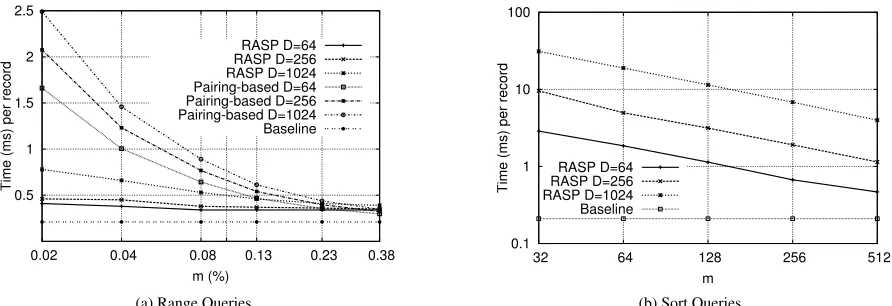
As RASP’s query performance does not depend onn, we have measured timings for Encrypt(Algorithm 5, including upload), Range Queries, and Sort Queries on a Dynamo data store with a fixed number ofn= 225records. We have set the number of users |U |to100and variedD={64,256,1024}, andmfrom.01%to .4%ofnfor range queries. Form-sort, we variedmfrom32to 512. Data is distributed into buckets according to a Gaussian dis-tribution to better represent a real world scenario. In practice, the most interesting pieces of data are usually in the tail of the distri-bution, and most data is distributed normally. However, this choice does not significantly effect the running time of our scheme as it de-pends only onmandD. The uneven values ofmfor range search are the result of querying ranges separated by one bucket when D= 64(the smallest unit of change that would be evenly divisi-ble for all values ofD). Since the data is Gaussian, increasing the range by one bucket increasesmby an uneven amount. To model interleaving client and surveyor operations (and force creating new chains), we distributed queries exponentially with n
100 average ar-rival rate. However, we measured timings only after adding alln records, representing worst case queries. We have run each sample point 20 times, and relative standard deviation was low at<5%.
0.5 1 1.5 2 2.5
0.02 0.04 0.08 0.13 0.23 0.38
Time (ms) per record
m (%)
RASP D=64 RASP D=256 RASP D=1024 Pairing-based D=64 Pairing-based D=256 Pairing-based D=1024 Baseline
(a) Range Queries
0.1 1 10 100
32 64 128 256 512
Time (ms) per record
m RASP D=64
RASP D=256 RASP D=1024 Baseline
(b) Sort Queries
Figure 1: RASP evaluation results
testing the amount of time it takes to retrieve a record from Dynamo without any encryption or secure data structure. This was done using Dynamo’s built-in range search capability and represents a lower bound for any range search algorithm. A singleEncryptof a single user in RASP takes≈64msin our configurations.
Times for single Get, Put, and Encrypt are significantly higher compared to Range and Sort queries for the surveyorper record, although the same operations (encryption, hash, network access) are required. This is due to the fact that during, e.g., a range query, RASP allows the surveyor to enumerate multipleLL-buckets inparallelwith Dynamo. Dynamo allows to issue multiple Get-requests from multiple threads in parallel, reducing the total re-sponse time significantly. We estimate the single record upload time in related work, e.g., Lu [22] to≈589msforD= 256(2+6· logDexponentiations+1 Put) which is notably higher than RASP. Timings for range queries, Fig. 1a, and sort queries, Fig. 1b, in-crease slightly withD, as∆becomes larger and needs to be down-loaded/uploaded and decrypted/encrypted by the surveyor. Simi-larly, with increasing|U |, more∆need to be downloaded and pro-cessed. Sort is more expensive than range search, because access to buckets cannot be parallelized: to find the firstmrecords, buckets need to be accessed sequentially. However, sort has an additional security property that is not present with range search. If the end of a sort query lands in a bucket which contains entries for more than one user, not all of the users’ data will be revealed (only enough to satisfy the sort query). In exchange for this additional privacy, sort queries are significantly more expensive. If this additional pri-vacy is not needed, one can accomplish the same thing by issuing sequential range queries for each bucket until enough results are re-turned to satisfy them-sort. This will achieve similar performance per record to the much faster range sort.
To put RASP’s range search into perspective, we determined the performance for Lu [22] by using JPBC [10] to find a cost for one pairing on our hardware and then multiplying by the number of pairings needed per query in their scheme. We then divided by the number of records returned to get an amortized query computation cost per record and finally added the baseline communication cost as outlined above. Note that our comparison is for RASP with 100 users and related work with just a single user. When related work is modified for multiple users, the straightforward way which al-lows for the same cross-user privacy guarantees as RASP (making a separate index for each user) imposes over a 20 times slowdown. We compare against our scheme with 100 users to show that we can scale to a multi-user setting with minimal performance degradation. In comparison with Lu [22], range search with RASP is several times faster whenDormare small, but also comes very close to the optimal baseline whenmis larger, see Fig. 1a. Additionally,
RASP is faster at adding records by an order of magnitude. As the costs for exponentiation and pairing based related work is non-negligible even on our powerful hardware, we conclude that its use in scenarios with embedded devices, smartphones, and largenis limited. On the server side, RASP does not require any compu-tation to be performed at the store and so can be run on a cloud storage service without any costly computational resources.
6.
RELATED WORK AND SUMMARY
and, consequently, deserves its own research.
In this context, we stress that the approach by Goh [14] using a PRF is fundamentally different from the one by RASP: Goh [14] uses a PRF to enumerate keywords in per-file Bloom filters for key-word search. In contrast, we use PRFs to generate pointers to the start of linked lists achieving update-obliviousness.
Range Search Some related work focuses especially on privacy-preserving range search. For example, Hacigümüs et al. [17] and Hore et al. [18] encrypt records and put ciphertexts in a set of per-muted categories. While this hides into which category a record is added, the cloud automatically learns the relationship between ci-phertexts and can determine which cici-phertexts are in the same cate-gory. Other works [7, 22, 25, 33] overcome this drawback and hide membership to a category until this particular category is queried – still, the cloud will be able to determine for any ciphertext added after the query whether it is belonging to the previously queried category or not. While [7, 22, 33] are selective match concealing (selective-MC), [25] is selective match revealing (selective-MR), i.e., the cloud will learn the category of a record that matches a range query. Moreover, these schemes make use of computation-ally expensive bilinear pairings. Similarly, recent work by Wand et al. [33] uses asymmetric cryptography to overcome a certain pri-vacy leakage in multi-dimensional range search. However, based on R-trees, its range search worst-case complexity is inO(n).
Generally, the notion of forward security for range search dif-fers from forward-security for symmetric encryption techniques by Bellare and Yee [5], i.e., perfect forward secrecy. Our notion of forward security is similar to the one by Stefanov et al. [30] for searchable encryption mechanisms.
Comparison.
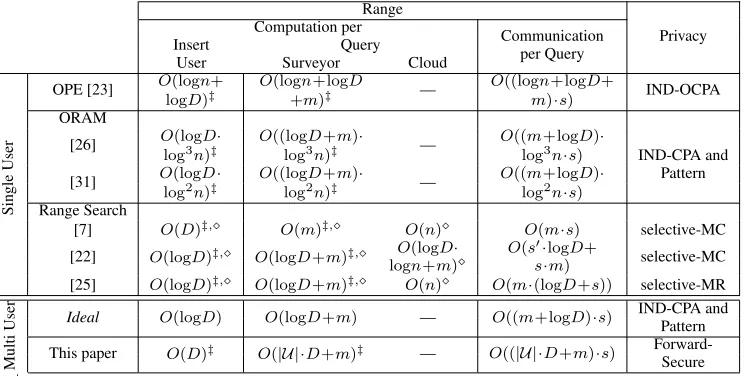
As RASP offers not only range search, but also sort capabilities together with stronger (forward-secure) privacy than related range search schemes or OPE, it is difficult to compare its performance. Still, to put things into perspective, we sum up RASP’s asymptotic performance and contrast it to related work in tables 1 and 2.
We stressthat related work has not been designed for use in multi-user scenarios. While related work could be extended to multiple users, e.g., using different keys for each user in OPE or separate ORAMs for each user, this increases complexities signif-icantly or would require a significant redesign. A straightforward extension adds a factor of|U |in tables 1 and 2, which renders such approaches overly costly.
Computation and Communication Tables 1 and 2 show the com-putational complexities to add a new record to the store for the user (for both range search and sort), for the surveyor to perform the query, and for the cloud during a query. The computational complexities comprise record encryption and decryption (form records) operations. The communication complexities denote the communication between surveyor and cloud during a range or sort query. Security factorsin the communication complexities indi-cates that symmetric key ciphertexts are exchanged, ands0 indi-cates asymmetric key ciphertexts. In each table, we compare to an idealsolution, representing a lower bound for each complexity.
ORAM provides a regular RAM interface, so any operation can be done by simply using the same “ideal” algorithm that would be used on unencrypted data. The overall cost of this operation will then be the same as the ideal, but with a poly-logarithmic overhead specific to the ORAM implementation. For example, In the case of an Insert, an ideal solution would be using an interval tree [12]. OPE and anIdealsolution all require (a factor of)logD communication complexity, because themrecords in theD
cate-gories/buckets need to be addressed.
Note: It is important to point out that, while related work on range search [7, 22, 25] or OPE [23] has better asymptotic com-plexities than RASP (logDvs. D), RASP is linear inDonly due to synchronization array∆. In practice, bit array∆is very small, especially compared to a single patient record. For example, with D= 8192categories,|∆|= 1KByte resulting in only 64 AES op-erations. In all practical scenarios as targeted in this paper (nD) the linear number of AES operations will outperformlogD expo-nentiations and pairing operations.
Refering to our evaluation in Section 5.3, we indicate that RASP’s constants are very low, using only symmetric cryptography, i.e., hash functions and block ciphers. Also, RASP does not require any expensiveO(n)computation on the cloud side that the surveyor would have to pay for [1], but only a cheap key-value based storage cloud such as Amazon Dynamo [2].
Form-sort, a scheme based on OPE [23] would just parse the OPE tree and send themrecords. Again, ORAM-based sorting mechanisms withO(m)accesses to the ORAM (assuming records are already sorted, e.g., in an interval tree) become quickly too ex-pensive. In contrast to related work, RASP is close to anIdeal solu-tion, besides the additional factor of|U |·Dwhich is small in prac-tice, cf. Section 5.3. Note that recent range search schemes [7, 22, 25, 33] do not supportm-sort queries in a straightforward way, so we cannot include them in Table 2. While extending range search schemes to support sorting in an efficient, yet secure (e.g., forward-secure) way might be possible, it is far from straightforward. Privacy RASP’s forward-secure privacy notion is stronger than re-lated work’s selective match concealing or selective match reveal-ing [25] or IND-OCPA as discussed in Section 3.3. Yet, RASP offers weaker privacy than ideal IND-CPA and indistinguishable query patterns.
Storage Finally, we briefly summarize storage requirements. Being tree based, OPE by Popa et al. [23] requires an additionalO(logn) storage overhead per ciphertext. Similarly, recent ORAMs are tree based and, withnnodes in the tree, require an overhead factor of eitherO(logn)[26] orO(s0)[31] per ciphertext. Here,s0is an ad-ditional security parameter. While the work by Stefanov et al. [31] has superior computational worst-case complexity than Shi et al. [26], O(log2n)
compared toO(log3n), a drawback is its large memory requirement ofO(s0·log2n·s). In contrast, RASP fea-tures onlyO(s)ciphertext overhead andO(D·logn+s)(forD counters and SK) memory requirements.
7.
CONCLUSION
RASP addresses privacy-preserving range search and sort on out-sourced, encrypted data. RASP offers stronger privacy than related work as well as support for multiple, non-trusted users. RASP builds on top ofLL, a new dynamic data structure (of independent interest) for privacy-preserving add/enumerate operations. Both, RASP andLLseamlessly integrate into cheap, real world storage-only cloud services such as S3 or DynamoDB. Abstaining from pairings and exponentiations, our protocols target practicality. Our performance evaluations show that, even without hardware accel-eration support, RASP offers substantially better performance than recentlogDrange search techniques for realistic settings, in addi-tion to requiring only storage capabilities and not cloud computa-tion (a significant cost savings).
References
Table 1: Worst-case complexities for range search and privacy comparison.n: total number of records, m: number of records queriedD: size of records’ domain,U: set of users,s,s0: security parameters. Typically,slogn,slogD,s0> s,nD,n≥m. Related work requires additional factor|U |for multi-user. Note: RASP is linear inDonly due to bit array∆which is very small in practice.
Range
Privacy Computation per
Communication Insert Query per Query
User Surveyor Cloud
Single
User
OPE [23] O(logn+ O(logn+logD — O((logn+logD+ IND-OCPA logD)‡ +m)‡ m)·s)
ORAM
[26] O(logD· O((logD+m)· — O((m+logD)·
log3n)‡ log3n)‡ log3n·s) IND-CPA and
[31] O(logD· O((logD+m)· — O((m+logD)· Pattern log2n)‡ log2n)‡ log2n·s)
Range Search
[7] O(D)‡, O(m)‡, O(n) O(m·s) selective-MC
[22] O(logD)‡, O(logD+m)‡, O(logD· O(s0·logD+ selective-MC
logn+m) s·m)
[25] O(logD)‡, O(logD+m)‡, O(n) O(m·(logD+s)) selective-MR
Multi
User Ideal O(logD) O(logD+m) — O((m+logD)·s)
IND-CPA and Pattern This paper O(D)‡ O(|U |·D+m)‡ — O((|U |·D+m)·s)
Forward-Secure
‡
Involves Symmetric Cryptography Involves Exponentiations/Pairings
Table 2: Worst-case complexity form-Sort.
m-Sort Computation per
Communication Query per Query Surveyor Cloud
Single User
OPE [23] O(m)‡ O(logn+m) O(m·s)
ORAM
[26] O(m·log3n)‡ — O(m·log3n·s)
[31] O(m·log2n)‡ — O(m·log2n·s)
Multi User
Ideal O(m) — O(m·s)
This paper O(|U |·D+m)‡ — O((|U |·D+m)·s)
‡
Involves Symmetric Cryptography
[2] Amazon. DynamoDB Pricing, 2013. http: //aws.amazon.com/dynamodb/pricing/.
[3] Anonymized for submission. RASP Source Code, 2015. https://www.dropbox.com/s/ 5am2r9g9u4coe2d/rasp.zip.
[4] M. Bellare. New Proofs for NMAC and HMAC: Se-curity without Collision-Resistance. In Proceedings of CRYPTO, pages 602–619, Santa Barbara, USA, 2006. ISBN 3-540-37432-9.
[5] M. Bellare and B. Yee. Forward-Security in Private-Key Cryptography. Cryptology ePrint Archive, Report 2001/035, 2001.http://eprint.iacr.org/.
[6] A. Boldyreva, N. Chenette, and A. O’Neill. Order-preserving encryption revisited: Improved security analysis and alterna-tive solutions. InProceedings of CRYPTO, pages 578–595, Santa Barbara, USA, 2011.
[7] D. Boneh and B. Waters. Conjunctive, subset, and range queries on encrypted data. InProceedings of TCC, pages 535–554, Amsterdam, Netherlands, 2007. ISBN 3-540-70935-5.
[8] D. Boneh, G. DiCrescenzo, R. Ostrovsky, and G. Persiano. Public key encryption with keyword search. InProceedings of Eurocrypt, pages 506–522, Barcelona, Spain, 2004.
[9] C. Bösch, P. Hartel, W. Jonker, and A. Peter. A Survey of Provably Secure Searchable Encryption. ACM Computing Surveys, 47(2), 2014. ISSN 0360-0300.
[10] A. De Caro and V. Iovino. jPBC: Java pairing based cryp-tography. InProceedings of Symposium on Computers and Communications, pages 850–855, Kerkyra, Greece, 2011.
[11] D. Cash, S. Jarecki, C. Jutla, H. Krawczyk, M. Rosu, and M. Steiner. Highly-Scalable Searchable Sym-metric Encryption with Support for Boolean Queries. Cryptology ePrint Archive, Report 2013/169, 2013. http://eprint.iacr.org/.
[12] T.H. Cormen, C.E. Leiserson, R.L. Rivest, and C. Stein. Introduction to Algorithms. MIT Press, 2009. ISBN 978-0262033848.
[13] R. Curtmola, J. Garay, S. Kamara, and R. Ostrovsky. Searchable Symmetric Encryption: Improved Definitions and Efficient Constructions. IACR ePrint Archive, 2006. http://eprint.iacr.org/2006/210.
[14] E.J. Goh. Secure Indexes. Cryptology ePrint Archive, Report 2003/216, 2003.http://eprint.iacr.org/.
[16] Google. A new approach to China, 2010. http: //googleblog.blogspot.com/.
[17] H. Hacigümüs, B.R. Iyer, C. Li, and S. Mehrotra. Executing SQL over encrypted data in the database-service-provider model. In Proceedings of SIGMOD Conference, pages 216–227, Madison, USA, 2002. ISBN 1-58113-497-5.
[18] B. Hore, S. Mehrotra, and G. Tsudik. A Privacy-Preserving Index for Range Queries. InProceedings of VLDB, pages 720–731, Toronto, Canada, 2004. ISBN 0-12-088469-0.
[19] M.S. Islam, M. Kuzu, and M. Kantarcioglu. Inference attack against encrypted range queries on outsourced databases. In Conference on Data and Application Security and Pri-vacy, pages 235–246, San Antonio, USA, 2014. ISBN 978-1-4503-2278-2.
[20] S. Kamara, C. Papamanthou, and T. Roeder. Dynamic Search-able Symmetric Encryption. Cryptology ePrint Archive, Report 2012/530, 2012.http://eprint.iacr.org/.
[21] J. Li, Maxwell N. Krohn, D. Mazières, and D. Shasha. Secure Untrusted Data Repository (SUNDR). InProceedings of Operating System Design and Implementation, pages 121–136, San Francisco, USA, 2004.
[22] Y. Lu. Privacy-preserving Logarithmic-time Search on En-crypted Data in Cloud. InProceedings of Network and Dis-tributed System Security Symposium, San Diego, USA, 2012.
[23] R.A. Popa, F.H. Li, and N. Zeldovich. An Ideal-Security Protocol for Order-Preserving Encoding, 2013. IACR ePrint Archive,http://eprint.iacr.org/2013/129.
[24] P. Rogaway. Nonce-Based Symmetric Encryption. In Proceedings of FSE, pages 348–359, Delhi, India, 2004. ISBN 3-540-22171-9.
[25] E. Shi, J. Bethencourt, H.T.-H. Chan, D.X. Song, and A. Perrig. Multi-Dimensional Range Query over Encrypted Data. InProceedings of Symposium on Security and Privacy, pages 350–364, Oakland, USA, 2007.
[26] E. Shi, T.-H.H. Hubert Chan, E. Stefanov, and M. Li. Oblivi-ous RAM withO(log3(N))Worst-Case Cost. InProceedings of ASIACRYPT, pages 197–214, Seoul, S. Korea, 2011.
[27] D.X. Song, D. Wagner, and A. Perrig. Practical techniques for searches on encrypted data. InProceedings of Symposium on Security and Privacy, pages 44–55, Berkeley, USA, 2000.
[28] E. Stefanov and E. Shi. ObliviStore: High Performance Oblivious Cloud Storage. InProceedings of Symposium on Security and Privacy, pages 253–267, Berkeley, USA, 2013.
[29] E. Stefanov, E. Shi, and D. Song. Towards practical oblivious RAM. In Proceedings of Network and Distributed System Security Symposium, San Diego, USA, 2012.
[30] E. Stefanov, C. Papamanthou, and E. Shi. Practical Dynamic Searchable Encryption with Small Leakage. Cryptology ePrint Archive, Report 2013/832, 2013. http://eprint.iacr.org/.
[31] E. Stefanov, M. van Dijk, E. Shi, C.W. Fletcher, L. Ren, X. Yu, and S. Devadas. Path-ORAM: An Extremely Simple Oblivious RAM Protocol, 2013. IACR ePrint Archive, http://eprint.iacr.org/2013/280.
[32] Techcrunch. Google Confirms That It Fired En-gineer For Breaking Internal Privacy Policies, 2010. http://techcrunch.com/.
[33] B. Wand, Y. Hou, M. Li, H. Wang, and H. Li. Maple: Scalable Multi-Dimensional Range Search over Encrypted Cloud Data with Tree-based Index, 2014. To appear in ASIACCS’14, preprint available at http://digital.cs.usu.edu/ ~mingli/papers/Wang_asiaccs14.pdf.