www.ijiset.com
112
The Effect of Transparency and
Replacing Gum by Dye Layer on Solar
Cell Efficiency When Doped By Cobalt
Oxide
1 Alobid Ali Khalid Awad Elkareem -2Mubarak Dirar Abd-alla - 3Mohammed Idriss Ahmed -4Abdalsakhi .S .M.H - 5 Rawia Abd Elgani4,
1-2 -5 Sudan University of Science and Technology - 3 Sudan Atomic Energy Commission (SAEC),
Khartoum –Sudan - 4Al Neenlen University – Faculty of Science and Technology Department of
Physics
– Faculty of Science and Technology Department of Physics
Abstract: Gum Arabic doped by CuO based Dye Sensitized Solar Cells (DSSC) with
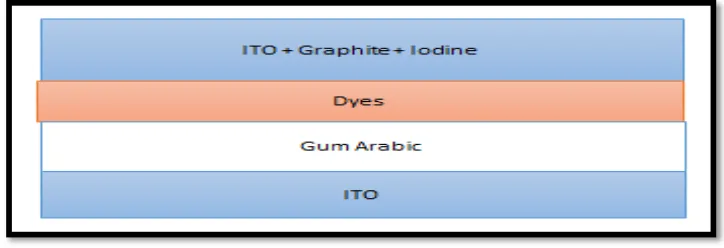
different type of dyes (Coumarin 500, Ecrchrom Black, Rhodamine B, DDTTc and Nile blue) were fabricated on ITO glass. Microstructure and cell performance of the solar cells with (ITO/ Gum Arabic / dye /ITO+ graphite and Iodine) structures were investigated. Photovoltaic devices based on the Gum Arabic +CuO/ (C Coumarin 500, Ecrchrom Black, Rhodamine B, DDTTc and Nile blue) dye hetrojunction structures provided photovoltaic properties under illumination. Absorption and energy gap measurement of the Coumarin 500, Ecrchrom Black, Rhodamin B, DDTTc and blue Nile were studied by using UV-VS mini 1240 spectrophotometer,The five (ITO/ dye / Gum Arabic /ITO+ graphite and Iodine) solar cells were produced and characterized, Another 5 samples were also prepared by replacing Gum Arabic layer by dye, such that the gum layer is above the dye one (ITO + graphite + Iodine) . The analysis shows that the efficiency of the solar cell increases when the upper layer is more transparent.
Keywords: Gum Arabic, Cobalt Oxide, solar cell, photovoltaic property, optical
property.
I. Introduction
www.ijiset.com
113
ultimately to elucidate the relationship between shapes, size these nanomaterial’s Shaw properties that are not present in their bulk counterparts., semiconductor quantum dots (QDs) have aroused paramount interest due to their novel technological applications that are realizable in the physics this needs characterization of these nanomaterial’s, the so-called semiconductor QDs [2–4]. These promising systems possess extraordinary electronic and optical characteristics that are tunable artificially. Gum Arabic is a complex polysaccharide, comprised mostly of glactose, arabinose, rhamnose and glucoronic acid, with ~2 % proteins as an integral part of its structure [1]. It is naturally obtained from Acacia (senegal and seyal) trees which are known to
grow in the sub- Sahara region of the Sudan the structure and chemical properties depend on the solid [2]. The material has many applications and uses, in confectionary, beverages, pharmaceuticals, backery, cosmetics,, etc. During growth, harvesting, or transport it could be environmentally contaminated by some micro-organisms which consequently affects its properties and functionality and hence its various uses. Properties of gum Arabic include emulsification, viscosity, colour, molecular weight, absorption, and chemical structure. For this paper one prepares Dye Sensitized Solar Cells (DSSC) with five different dyes (Coumarin 500, Ecrchrom Black, Rhodamine B , DDTTc and Nile blue)were fabricated on ITO glass this paper consists of section I for introduction , 2 for materials and methods , 3 for results , 4 for dis cuss ion and 5 for conclusion.
2. Materials and Methods
www.ijiset.com
114
glass. The ITO glasses were firstly cleaned by ethanol and distilled water. Gum Arabic was mixed in absolute methanol (99%) Then 0.01 M concentration of Cobalt acetate (274mg) was added in 125ml of methanol and stirred, heated to 60 °C under continuous stirring109 mg of potassium hydroxide (0.03M) concentration. the solution was then shaded until it become transparent then , added drop-wise from potassium hydroxide solution (to heated Cobalt acetate) under continuous stirred, then heated to 60°C for 2hours some drops of solution was taken on substrate leave to dry then the sample clean by Ethanol and add for Gum Arabic to mead Gum doping by CuO. Then 3mg of (Coumarin 500, Ecr-chrom Black, Rhodamin B and DDTTc) dye dissolved into 0.5 of high pure Ethanol, was deposited on Gum Arabic. Being inserted electrical circuit containing the (voltmeter and Ammeter and a light source Lamp with the intensity radiological” and a solar cell). Cell was offered to light and fulfilled taking the results of the current and voltages were recorded the UV spectrometer in as to display absorption spectrum. Five samples were prepared (ITO/ Gum Arabic + CuO / dyes /ITO+ graphite and Iodine).
Five additional samples were made by replacing dye by the gum layer to be above the dye layer
www.ijiset.com
115
3. Results and Discussion
Fig (2, a): the Eg curve and I-V graph of Coumarin 500sample F1 (Coumarin
500/gum)
Fig (2, b) theI-V graph of Coumarin 500 sample F2 (gum/ Coumarin 500)
Fig (3, a) the I-V graph of DDTTC sample F1 (DDTTC/Gum)
0.01326 0.01365 0.01404 0.01443 0.01482 0.01521 0.01560 27.152
27.168 27.184 27.200 27.216 27.232 27.248 27.264 27.280
C
ur
re
n
t (
m
A
)
Voltage ( V )
Gum+CuO2 +Cou500
Isc = 27.25 mA
Imax = 27.24 mA
Vmax = 0.0154 V Voc = 0.0157 V FF = 0.98
www.ijiset.com
116
Fig (3, b) the I-V graph of DDTTC sample F2 (Gum /DDTTC)
Fig (4, a) the I-V graph of Eri o-chrome sample F1 (Eri o-chrome /Gum)
Fig (4, b) the Eg carve I-V graph of Eri o-chrome sample F1 Gum (/Eri o-chrome)
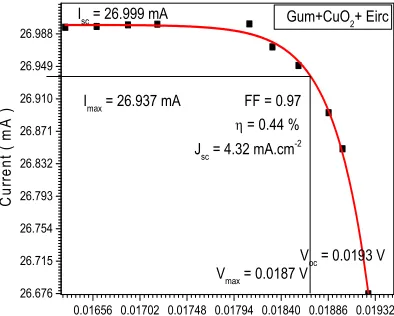
0.01656 0.01702 0.01748 0.01794 0.01840 0.01886 0.01932 26.676
26.715 26.754 26.793 26.832 26.871 26.910 26.949 26.988
C
u
rr
e
nt
(
m
A
)
Voltage ( V )
Gum+CuO2+ Eirc Isc = 26.999 mA
Imax = 26.937 mA
Vmax = 0.0187 VVoc = 0.0193 V FF = 0.97
www.ijiset.com
117
Fig (5, a) the I-V graph of Rhodamine B sample F1 (Rhodamine B /Gum)
Fig (5, b) the I-V graph of Rhodamine B sample F1 (Gum/Rhodamine B)
Fig (6, a) the I-V graph of Nile blue sample F1 (Nile blue /Gum)
0.000 0.013 0.026 0.039 0.052 0.065 0.07827.632 27.654 27.676 27.698 27.720 27.742 27.764 27.786
27.808 Roh-B+Gum with CuO2
C
ur
re
nt ( m
A
)
Voltage ( V ) Isc = 27.798 mA
Imax = 27.776 mA
Vmax = 0.0703 V
Voc = 0.0814 V FF = 0.86
= 1.7 % Jsc = 4.45 mA.cm-2
0.0553 0.0632 0.0711 0.0790 0.0869 0.0948 0.1027 27.7 27.8 27.9 28.0 28.1 28.2 28.3 28.4 28.5 28.6 C u rr e nt ( m A )
Voltage ( V )
Gum+CuO2 + Rho-B Isc = 28.48 mA
Imax = 28.37 mA
Vmax = 0.0899 V
Voc 0.0984 V FF = 0.91
= 1.9 % Jsc = 4.56 mA.cm-2
0.01292 0.01311 0.01330 0.01349 0.01368 0.01387 0.01406 27.300 27.328 27.356 27.384 27.412 27.440 27.468 27.496 27.524 C
urrent ( m
A
)
Voltage ( V )
Blue +Gum +CuO2
Isc = 27.50 mA
Imax = 27.45 mA
Vmax = 0.0138 V
Voc = 0.0141 V
FF = 0.98
www.ijiset.com
118
Fig (6, b) the I-V graph of Nile blue sample F1 (Gum/Nile blue)
Table (4.11)
iFactors for characterization of Arabic Gum solar cells
performance for samples
גm Eg 𝛈 % F.F Jsc MA.cm -2 Vmax (V) Voc (V) Imax mA Isc mA
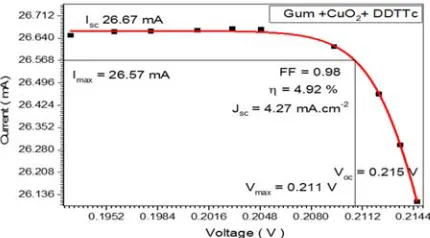
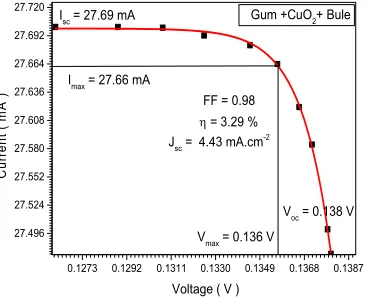
Sample 376 2.641 0.37 0.98 4.36 0.0154 0.0157 27.24 27.25 1C(F1) 376 2.614 0.38 0.99 4.37 0.0158 0.0159 27.26 27.29 2C(F2) 792 1.436 4.92 0.98 4.27 0.211 0.215 26.57 26.67 3D(F1) 792 1.436 5.15 0.99 4.27 0.221 0.223 26.67 26.70 4D(F2) 252 4.197 0.48 0.89 4.31 0.205 0.229 26.79 26.92 5E(F1) 252 4.197 0.44 0.97 4.32 0.0187 0.0193 26.937 26.999 6E(F2) 550 2.01 1.7 0.96 4.45 0.0703 0.0814 27.776 27.798 7R(F1) 550 2.01 1.9 0.91 4.56 0.0899 0.0984 28.37 28.48 8R(F2) 630 1.778 3.3 0.98 4.23 0.0138 0.0141 27.45 27.50 9N(F1) 630 1.778 3.29 0.98 4.43 0.136 0.138 27.66 27.69 10N(F2)
4. Discussion:
In view of table (1) it is clear that replacing gum layer by dye layer affect
the efficiency clearly. It is very interesting to note that for all 5 dyes the
efficiency increases when the gum layer becames above the dye layer
(F1) . When the dye is above gum the efficiencies of (Coumarin 500,
0.1273 0.1292 0.1311 0.1330 0.1349 0.1368 0.1387 27.496 27.524 27.552 27.580 27.608 27.636 27.664 27.692 27.720 C ur re nt ( m A )
Voltage ( V )
Gum +CuO2+ Bule Isc = 27.69 mA
Imax = 27.66 mA
Vmax = 0.136 V
Voc = 0.138 V FF = 0.98
www.ijiset.com
119
Ecrchrom Black, Rhodamine B, DDTTc and Nile blue) are (0.37, 4.92,
0.48, 0.17, 3.3). However when the gum layer is above (f2) the
corresponding efficiencies are (0.38, 5.15, 0.44, 1.9, 3.29), which are in
most cases less than that when the dye is above gum layer. This may be
related to the fact that gum is more transparent than Coumarin 500,
Ecrchrom Black, Rhodamine B, DDTTc and Nile blue. For Ecrchrom
Black, where the result is different, where the sample in which Ecrchrom
Black is above gum layer has more efficiency than that in which gum
layer is above the dye. This is since Ecrchrom Black is more transparent
than gum.This is confirmed by the fact that the efficiency of Ecrchrom
Black is (0.44) more than that of Coumarin 500 (0.37), despite the fact
that the
Ecrchrom Black energy gap (4.19 eV) is more than that of
Coumarin 500 (2.641 eV). This is since Ecrchrom Black is more
transparent than Coumarin 500 dye. For Nile blue the efficiency are
almost the same which may show that its transparency is similar to that of
the
Gum Arabic.
Conclusion
The transparency affect the efficiency of solar cell of gum Arabic doped
with cupper oxide and dyes. When the gum Arabic layer is replaced by
the dye layer, such that the gum layer is above the dye layer, the
efficiency increases when the gum is more transparent than the dye.
References
[1] Hino, Y., Kajii, H. & Ohmori, Y. 2006. Transient characteristics of polyfluorene-based polymer light-emitting diodes and their application for color tunable devices. Thin Solid Films, 499, pp.359-363.
[2] Spanggaard , H. & Krebs, F. C.( 2004). A Brief history of the development of organic and polymeric photo-voltaic .Solar Energy Materials & Solar Cells.
[3] Hoke, E. T. Vandewal, K., Bartelt, J. A., Mateker, W. R., Douglas, J. D., Noriega, R., Graham, K. R., Fréchet, J. M., Salleo, A. & McGehee, M. D. Recombination in Polymer:Fullerene Solar Cells with Open-Circuit Voltages Approaching and Exceeding 1.0 V. Adv. Energy Mater. 3,220–230 (2013).
www.ijiset.com
120
[6] Hermann, W. & Simon, A. J. 2007. Global Climate and Energy Project. [Online].
[Accessed9th of June 2009]. Available form World Wide Web:
http://gcep.stanford.edu/pdfs/GCEP_Exergy_Poster_web.pdf.
[7] Sakina Ibrahim Ali , Mubarak Dirar Abdallah, Sawsan Ahmed Elhouri Ahmed, Rawia Abdalgani, Amel Abdalla A, Abdalsakhi. S. M. H. INTERNATIONAL JOURNAL OF ENGINEERING SCIENCES & RESEARCH TECHNOLOGY. International Journal of Engineering Sciences & Research Technology. 5(8): ( 2016) [8] L. A. Dobrzanski, L. Wosinka, B. Bolzanka, and A. Drygala, “Comparison of Electrical Characteristics of Silicon Solar Cells,” Journal of Achievements in Material and Manufacturing Engineering, vol. 18, pp. 215-218, 2006.
[9] M. Chegaar, Z. Ouennoughi, F. Guevhi, and H. Langueur, “Determination of Solar Cells Parameters under Illuminated Conditions,” The Journal of Electron Device, vol. 2, pp. 17-22, 2003.
[10] J. D. Servaites, M. A. Ratner, and T. J. Marks, “Practical Efficiency Limits in Organic Photovoltaic Cells: Functional Dependence of Fill Factor and External Quantum Efficiency” Applied Physics Letters, vol. 95, no. 16, Article ID 163302, 3 pages, 2009.
[11] A. Subrahmanyan and N. Balasubramanian, “Studies of The Photovoltaic Behavior of Indium Tin Oxide (ITO)/Silicon Junctions Prepared by the Reactive Thermal Evaporation Technique,” Semiconductor Science and Technology, vol. 7, no. 3, Article 07, pp. 324-327, 1992.
[12] Kinoshita, T. et al. (2015) Spectral splitting photovoltaics using perovskite and wideband dye-sensitized solar cells. Nat. Commun. 6, 8834.
[13] NimaParsiBenehkohal (2013) Innovations in Electrophoretic Deposition of Nanotitania-Based Photoanodes for Use in Dyesensitized Solar Cells, Ph. D Thesis McGill University Montreal, QC, Canada.