Implementation of Full Adder using 120 nm Technology
Veena Tiwari.#1
, Mohd. Abuzer Khan*2
#Electronics & Communication, R.G.P.V Bhopal L.K.C.T. Indore M.P. India
Abstract: The efficiency of a system mainly depends on the performance of internal components present in the system. The internal components should be designed in such a way that they consume low power with high speed. Lot of components is in circuits including full-adder. This is mainly used in processors. A new Pass transistor full adder circuit is implemented in this paper. The main idea is to introduce the design of high performance and based pass transistor full adders which acquires less area and transistor count. The high performance of pass transistor low power full adder circuit is designed and the simulation has been carried out on Tanner EDA Tool. The result shows that the proposed full adder is an efficient full adder cell with least MOS transistor count that reduces the high power consumption and increases the speed. In this paper CMOS full adder circuits are designed to reduce the power and area and to increase the speed of operation in arithmetic application. To operate at ultra-low supply voltage, the pass logic circuit that co-generates the intermediate XOR and XNOR outputs has been improved to overcome the switching delay problem
Keywords: Arithmetic, Full-adder, Power consumption, High-speed.
Introduction
Addition, subtraction are basic arithmetic operations. It is mainly used in lot of VLSI systems such as microprocessors and application specific DSP architecture. In addition its main task is adding two numbers, it is used in many other useful operations such as, subtraction, multiplication, address calculation, etc. Building low power VLSI system has emerged as significant performance goal because of the fast technology in mobile communication and computation. The developments in battery technology have not taken place as fast as the advances in electronic devices. So the developers are attained with more; high speed, high throughput and at the same time, low power consumption as possible. Energy-efficiency is the one which required most features in modern electronic systems designed for high-performance and/or portable applications. In this, the ever increasing market segment of portable
Several CMOS logic styles have been evolved for the developing the of cell libraries. They are willing to immortalize the ability to further reduce the cost-per function and improve the performance of integrated circuits. By lowering the threshold voltage in ultra deep submicron technology, low supply voltage appears to be the most eminent means to reduce power consumption. The resultant full-adders show more efficiency in power consumption and delay when compared with other ones reported previously as good candidates to build low-power arithmetic modules.
II. Logic Styles
Many papers have been published for the optimization of low-power full-adders, Different logic styles can be used to reduce the full-adder such as (regular CMOS [2], differential cascade voltage switch (DCVS) [3], complementary transistor logic (CPL) [4], double pass-transistor logic (DPL) [5], swing restored CPL (SR-CPL) [6].
2.1 Existing Logic
2.1.1 Double-Pass Transistor Logic
Double-pass transistor logic eliminates some of the inverter stages required for complementary pass transistor logic by using both N and P channel transistors, with dual logical paths for each function. Though it has high speed due to low input capacitance, it has limited capacity to drive a load. The switching tree of a DPL gate consist of both NMOS and PMOS pass transistors, in contrast to the switching tree of a CPL gate, using only NMOS transistors there. Full swing operation is attained by simply adding PMOS transistors in parallel with the NMOS transistors. However, this addition will result in increasing input capacitance. The switching tree of a CPL gate consists of only NMOS transistors, which results in a lower input capacitance. The full-swing output-voltage restoration of a DPL-gate is done by the combination of an NMOS and a
PMOS transistor, instead of the PMOS-latches and inverters which are used by means of Complementary Pass Transistor logic. Double pass-transistor logic (DPL) uses both PMOS and NMOS devices in the pass-transistor network to avoid non full swing problems, but it has high-area and high-power drawbacks [5].
2.1.2 Swing Restored Pass Transistor Logic
SRPL is very similar to CPL, because it uses the same NMOS pass-transistor network. The two cross-coupled inverters are used for recovering the output signal. An advantage of pass-transistor logic is its simplicity, but a disadvantage of SRPL is similar to a disadvantage of standard CMOS, namely the spikes on the power-supply that occur during switching. A SRPL-CEU has the same disadvantages as a CPL-cell [6]. 2.1.3 Complementary Pass - Transistor Logic
occur on the power supply during switching. The input voltage-levels are equivalent to those of standard CMOS, and this has the disadvantage that the voltage-swing is equal to Vdd. Complementary pass-transistor logic (CPL) uses a complementary output pass-transistor logic network to perform logic evaluation and CMOS inverters for driving of the outputs. This arrangement, however, can have leakage current through the inverter if the soft pull-up latch is not used [4]
2.2 Proposed Logic
2.2.1 Pass Transistor Logic In electronics, pass
transistor logic (PTL) describes several logic families used in the design of integrated circuits. It reduces the count of transistors used to make different logic gates, by eliminating redundant transistors. Transistors are used as switches to pass logic levels between nodes of a circuit, instead of as switches connected directly to supply voltages. This reduces the number of active devices, but has the disadvantage that the difference of the voltage between high and low logic levels decreases at each stage. Each transistor in series is less saturated at its output than at its input[5].By contrast, conventional CMOS logic switches transistors so the output connects to one of the power supply rails, so logic voltage levels in a sequential chain do not decrease. Since there is less isolation between input signals and outputs, designers must take care to assess the effects of unintentional paths within the circuit. For proper operation, design
rules restrict the arrangement of circuits, so that sneak paths, charge sharing, and slow switching can be avoided. Simulation of circuits may be required to ensure adequate performance.
III. Alternative Logic Structure For A Full Adder
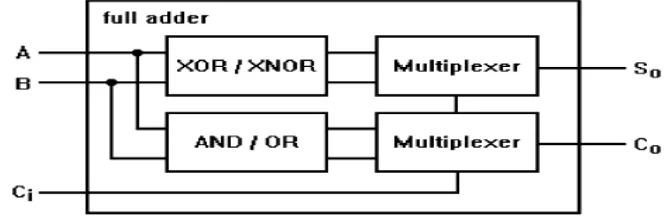
The full-adder true-table is shown in Table 1, it can be seen that the output Sum is equal to the AB value when Ci=0, and it is equal to AB when Ci=1. Here a 2*1 multiplexer can be used to obtain the respective value taking the Ci input as the selection signal. Following the same criteria, the output Co is equal to the A.B value when Ci=0, and it is equal to A+B value when Ci=1. Again, Ci can be used to select the respective value for the necessary condition, driving a multiplexer. Hence, an alternative logic scheme to design a full-adder cell can be formed by a logic block to obtain the AB and AB signals, another block to obtain the A.B and A+B signals, and two multiplexers being driven by the C input to generate the Sum and Co outputs, as shown in Figure 1 [13]. The characteristics and benefits of this logic structure are as follows.
There signals are not generated internally to control the selection of output multiplexers. The input signal, Ci exhibiting a full voltage swing and no extra delay, is used to drive the multiplexers, reducing so the overall propagation delays.
The capacitive load for the Ci input is reduced, as it is connected to some transistor gates and no longer to some drain or source terminals, as the diffusion capacitance is becoming a very large for sub-micrometer technology. Hence, the overall delay for larger modules where the Ci signal falls on the critical path can be reduced.
The propagation delays for the Sum and Co outputs can be tuned up individually by adjusting the XOR/XNOR and the AND/OR gates; the feature advantageous for applications where the skew between arriving signals is critical for a proper operation (e.g., wave pipelining), and for having well balanced propagation delays at the outputs Sum and Co to reduce the chance of glitches in cascaded applications.
Including buffers at the output of the full-adders can be implemented by interchanging the XOR/XNOR signals, and the AND/OR gates to NAND/NOR gates at the input of the multiplexers, improving in this way the performance for load-sensitive applications.
Figure 2: Full-adder designed with the Proposed Logic structure and a Pass Transistor Logic Style
IV. Conclusion
The main idea is to introduce the design of high performance and power efficient full adder designusing multiplexer based pass transistor logic. In the present work, the full adder design is realized by differentlogics like DPL, SR-CPL. Further the design is implemented by using pass transistor logic combine with otherlogic. The number of transistors required for realizing mixed CMOS design of full adder is less than the numberof transistors required in realizing the design of full adder using CMOS transistors independently. So, therequired logic can be realized within an optimized area which performs faster when compared to theconventional static CMOS full adder design.
V. Reference
[1]. A. M. Shams and M. Bayoumi, “Performance evaluation of 1-bit CMOS adder cells,” in Proc. IEEE ISCAS, Orlando, FL, May
1999,vol. 1, pp. 27–30.
[2]. N. Weste and K. Eshraghian, Principles of CMOS VLSI Design, ASystem Perspective. Reading, MA: Addison-Wesley, 1988, ch. 5.
[3]. K. M. Chu and D. Pulfrey, “A comparison of CMOScircuittechniques:Differentialcascode voltage switch logic versus conventional
logic,”IEEE J. Solid-State Circuits, vol. SC-22, no. 4, pp. 528–532, Aug.1987.
[4]. K. Yano, K. Yano, T. Yamanaka, T. Nishida, M. Saito, K. Shimohigashi,and A. Shimizu, “A 3.8 ns CMOS 16*16 -b multiplier
using complementary pass-transistor logic,” IEEE J. Solid-State Circuits, vol.25, no. 2, pp. 388–395, Apr. 1990. [5]. M. Suzuki, M. Suzuki, N. Ohkubo, T. Shinbo, T. Yamanaka, A.Shimizu, K. Sasaki, and Y. Nakagome, “A 1.5 ns 32 -b CMOS ALU
in double pass-transistor logic,” IEEE J. Solid-State Circuits, vol. 28,no. 11, pp. 1145–1150, Nov. 1993. [6]. R. Zimmerman and W. Fichtner, “Low-power logic styles: CMOS versus pass-transistor logic,” IEEE J. Solid-State Circuits, vol.
32, no.7, pp. 1079–1090, Jul. 1997.
[7]. M. Zhang, J. Gu, and C. H. Chang, “A novel hybrid pass logic with static CMOS output drive full-adder cell,” in Proc. IEEE Int.
Symp.Circuits Syst., May 2003, pp. 317–320.
[8]. C. Chang, J. Gu, and M. Zhang, “A reviewof 0.18-μm full adder performances for tree structured arithmetic circuits,” IEEE Trans.
Very Large Scale Integr. (VLSI) Syst., vol. 13, no. 6, pp. 686–695, Jun. 2005.
[9]. S. Goel, A. Kumar, and M. Bayoumi, “Design of robust, energy-efficient full adders for deep-sub micrometer design using hybrid-
CMOS logic style,” IEEE Trans. Very Large Scale Integr. (VLSI) Syst., vol. 14,no. 12, pp. 1309–1320, Dec. 2006. [10]. S. Agarwal, V. K. Pavankumar, and R. Yokesh, “Energy-efficient high performance circuits for arithmetic units,” in Proc. 2nd Int.
Conf. VLSI Des., Jan. 2008, pp. 371–376.
[11]. D. Patel, P. G. Parate, P. S. Patil, and S. Subbaraman, “ASIC implementation of 1-bit full adder,” in Proc. 1st Int. Conf. Emerging
Trends Eng. Technol., Jul. 2008, pp. 463–467.
[12]. N. Zhuang and H. Wu, “A new design of the CMOS full adder,” IEEE J. Solid-State Circuits, vol. 27, no. 5, pp. 840–844, May
1992.
[13]. M. Aguirre and M. Linares, “An alternative logic approach to implement high-speed low-power full adder cells,” in Proc. SBCCI,
Florianopolis,Brazil, Sep. 2005, pp. 166–171.
[14]. A. M. Shams, T. K. Darwish, and M. Bayoumi, “Performance analysis of low-power1-bit CMOS full adder cells,” IEEE Trans.