Privacy-Preserving Auditing for
Attribute-Based Credentials
Jan Camenisch, Anja Lehmann, Gregory Neven, and Alfredo Rial IBM Research – Zurich, Switzerland
{jca,anj,nev,lia}@zurich.ibm.com
Abstract. Privacy-enhancing attribute-based credentials (PABCs) al-low users to authenticate to verifiers in a data-minimizing way, in the sense that users are unlinkable between authentications and only disclose those attributes from their credentials that are relevant to the verifier. We propose a practical scheme to apply the same data minimization principle when the verifiers’ authentication logs are subjected to external audits. Namely, we propose an extended PABC scheme where the verifier can further remove attributes from presentation tokens before handing them to an auditor, while preserving the verifiability of the audited tokens. We present a generic construction based on a signature, a signature of knowl-edge and a trapdoor commitment scheme, prove it secure in the universal composability framework, and give efficient instantiations based on the strong RSA and Decision Composite Residuosity (DCR) assumptions in the random-oracle model.
1
Introduction
Privacy-enhancing attribute-based credentials (PABC) [1], also known as anony-mous credentials [2, 3] or minimal-disclosure tokens [4], are cryptographic mech-anisms to perform data-minimizing authentication. They allow users to obtain credentials from an issuer, by which the issuer assigns a list of certified at-tribute values to the user. Users can then use these credentials to authenticate to verifiers, but have the option to disclose only a subset of the attributes; all non-disclosed attributes remain hidden from the verifier. Moreover, different au-thentications are unlinkable, in the sense that a verifier can’t tell whether they were performed by the same or by different users. PABCs offer important privacy advantages over other attribute certification schemes, that usually either employ a central authority that is involved in every authentication and therefore forms a privacy bottleneck (e.g., SAML, OpenID, or Facebook Connect), or force users to disclose all of their attributes (e.g., X.509 certificates [5]).
the audit? Can one design a scheme where verifiers can further “maul” authen-tication tokens so that some of the disclosed attributes are blinded, yet keeping the audited token verifiable under the issuer’s public key?
Trivial constructions. Current PABC schemes don’t allow for such functional-ity, or at least not efficiently. Presentation tokens usually consist of non-malleable non-interactive zero-knowledge proofs. In theory, one can always rely on generic zero-knowledge techniques [6] to prove knowledge of a valid presentation token for a subset of the disclosed attributes, but such proofs will be prohibitively expensive in practice. If the number of disclosed attributes is small, or the com-bination of attributes required by the auditor is known upfront, the user can generate multiple separate presentation tokens, one for the verifier and one for each of the auditors. This solution doesn’t scale, however: if there aremdisclosed attributes and the audited combination is not known upfront, the user would have to prepare 2m presentation tokens.
Our contributions. We present an efficiently auditable PABC scheme, mean-ing the size of authentication as well as audited tokens stays linear in the num-ber of attributes. Just like many PABC schemes, credentials in our construction are signatures on blocks of messages, where each message block encodes an at-tribute value. A presentation token is computed with an efficient signature of knowledge [7] of a valid credential signature that reveals only part of the message blocks. The basic idea of our construction is that, rather than simply revealing the disclosed attribute values, the user commits to them and creates a signature of knowledge of a valid credential signature for the same values as those that he committed to. The opening information of all commitments is handed to the verifier, who can check that they contain the claimed attribute values, but in the auditing phase, the verifier only forwards the opening information of the transferred attributes to the auditor, together with the user’s original signature of knowledge.
We prove our construction secure in the universal composability (UC) frame-work [8], which guarantees that our protocol can be securely composed with it-self as well as with other protocols in arbitrary environments. Given the several iterations that it took to define the security of basic signatures in this frame-work [9–11], defining security for a complicated primitive like ours is a delicate balancing act. We elaborately motivate our design choices for our ideal function-ality in Section 3, in the hope that it can be of independent interest as a source of inspiration for future signature variants with privacy features.
Those mechanisms do not yield straightforward constructions of our primitive as they only consider modifications of signedmessages, whereas our scheme has to work with presentation tokens which itself are already derived from signed credentials. The crucial difference between signed messages and presentation tokens is that the latter should not be usable by a cheating verifier to impersonate the user at other verifiers. Therefore, the simple scheme where the credential and presentation token are redactable signatures on the list of attributes and where the presentation token can be further redacted by the verifier, doesn’t work.
Another related line of work is that on delegatable anonymous credentials [20], structure-preserving signatures [21], and commuting signatures [22]. The former allow credentials to be repetitively delegated while hiding the identity of the delegators. The latter two are more general signature schemes where the pub-lic key, the signed message, and the signature are all in the same mathematical group, and that among other things can be used to build delegatable credentials. Even though verifiable auditing is a sort of delegation, none of these primitives achieves the goals that we set out, as they cannot bind attributes to a delegatable credential.
2
System Overview
A privacy-preserving audit protocol consists of four parties: an auditor R, an issuerI, verifiersV1, . . . ,VJ, and usersU1, . . . ,UN. The interaction between the parties is as follows. First, in the issuing phase, a userUn gets credentials that certify her attributes from the issuer I. A credential consists of L attributes (a1, . . . ,aL). In thepresentation phase,Unsends a presentation token to a verifier
Vj. In each presentation token, U chooses which attributes are revealed to Vj and, moreover, which of those attributes can further be revealed to the auditor
R. The indexes of the attributes that are only revealed to Vj are included in a set F, and the indexes of the attributes that are revealed to Vj and that can also be revealed to Rare included in a setD. We call the attributes given byD transferable, while the ones given by F are non-transferable. In the audit phase, Vj reveals toR (a subset of) the transferable attributes, whose indexes are included in a subset T such thatT ⊆D.
3
Security Definition of Privacy-Preserving Audits
3.1 Universally Composable Security
The universal composability framework [23] is a general framework for analyz-ing the security of cryptographic protocols in arbitrary composition with other protocols. The security of a protocolϕis analyzed by comparing the view of an environmentZ in a real execution ofϕagainst that ofZ when interacting with an ideal functionality F that carries out the desired task. The environment Z
In the real world,Z can communicate freely with an adversaryAwho con-trols the network as well as any corrupt parties. We assume static corruptions, meaning that the adversary chooses which parties to corrupt at the beginning of the game. In the ideal world,Zinteracts with dummy parties, who simply relay inputs and outputs betweenZ andF, and a simulatorS. We say that protocol
ϕsecurely realizesFifZcannot distinguish the real world from the ideal world, i.e., Z cannot distinguish whether it is interacting withA and parties running protocolϕor with S and dummy parties relaying toFϕ.
More formally, letk∈Ndenote the security parameter anda∈ {0,1}∗denote an input. Two binary distribution ensembles X = {X(k, a)}k∈N,a∈{0,1}∗ and
Y ={Y(k, a)}k∈N,a∈{0,1}∗are indistinguishable (X ≈Y) if for anyc, d∈Nthere
exists k0∈Nsuch that for allk > k0 and alla∈ ∪κ≤kd{0,1}κ, |Pr [X(k, a) =
1]−Pr [Y(k, a) = 1]|< k−c. Let REALϕ,A,Z(k, a) denote the random variable given by the output ofZ when executed on inputawithAand parties running
ϕ, and let IDEALF,S,Z(k, a) denote the output distribution ofZ when executed onawithS and dummy parties relaying toF. We say that protocolϕsecurely realizes F if, for all polynomial-time A, there exists a polynomial-timeS such that, for all polynomial-time Z, REALϕ,A,Z≈IDEALF,S,Z.
When describing ideal functionalities, we use the following conventions:
Network vs. local communication. The identity of an ITM instance (ITI) consists of a party identifierpid and a session identifiersid. A set of parties in an execution of a system of ITMs are a protocol instance if they have the same session identifiersid. ITIs can pass direct inputs to and outputs from “local” ITIs that have the samepid. An ideal functionalityF haspid =⊥
and is considered local to all parties. An instance ofF with session identi-fiersid only accepts inputs from and passes outputs to machines with the same session identifiersid. When describing functionalities, the expressions “output toP” and “on input fromP”, whereP is a party identitypid, mean that the output is passed to and the input received from partyP only. Communication between ITIs with different party identifiers must take place over the network. The network is controlled by the adversary, meaning that he can arbitrarily delay, modify, drop, or insert messages.
Waiting for the simulator. When we say thatF sendsmtoS and waits for m0 from S, we mean thatF chooses a unique execution identifier, saves its current state, and sendsmtogether with the identifier toS. WhenSinvokes a dedicated resume interface with a messagem0 and an execution identifier,
F looks up the execution state associated to the identifier and continues running its program where it left off usingm0.
A protocolϕG securely realizesF in theG-hybrid model whenϕis allowed to invoke the ideal functionality G. Therefore, for any protocol ψ that securely realizes functionalityG, the composed protocolϕψ, which is obtained by replac-ing each invocation of an instance of G with an invocation of an instance ofψ, securely realizes F.
Our protocol makes use of the standard functionalities FREG [23] for key
reference strings with distribution D. Descriptions and realizations of all these functionalities can be found in the literature.
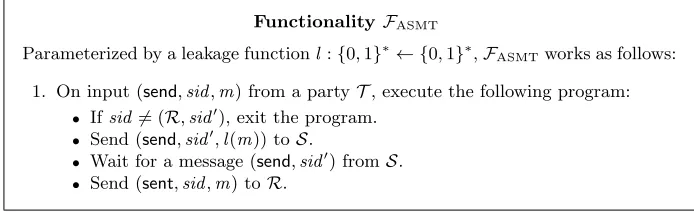
We also use the non-standard anonymous secure message transmission func-tionalityFASMTgiven in Figure 1. The literature provides a fair number of
pro-tocols that provide some form of anonymous communication. These include some onion routing protocols for which ideal functionalities have been defined [24, 25]. These functionalities are quite complex, as they model the various imperfection of the protocols, in particular, what routing information an adversary learns. These information depend heavily on how messages are routed, how many other users currently use the chanel, how many nodes are controlled by the adver-sary, etc. Indeed, the modelling and realizations of anonymous communcation is an active field of research. Now, if we used one of these functionalities for our protocols, we would have had to model all these imperfactions in our ideal func-tionality FAUD as well. We consider such modeling orthogonal to our protocol
and our goals and therefore choose to assume ideal anonymous communication where the adversary only learns that some message is sent (and is allowed to deny its delivery) but not not learn the identities of the sender and the receiver.
FunctionalityFASMT
Parameterized by a leakage functionl:{0,1}∗← {0
,1}∗
,FASMTworks as follows: 1. On input (send,sid,m) from a partyT, execute the following program:
• Ifsid6= (R,sid0), exit the program. • Send (send,sid0,l(m)) toS.
• Wait for a message (send,sid0) fromS. • Send (sent,sid,m) toR.
Fig. 1.The ideal functionality of anonymous secure message transmission.
3.2 Ideal Functionality of Privacy-Preserving Audits
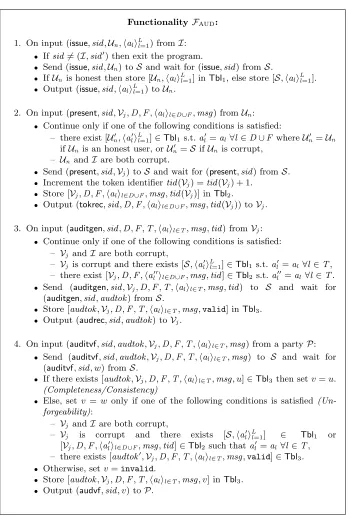
We describe an ideal functionalityFAUDof privacy-preserving audits in Figure 2.
We assume static corruptions, meaning that the adversary decides which parties to corrupt at the beginning of the game but cannot corrupt additional parties once the protocol is running.FAUD employs the following tables:
Table 1. Table 1 stores entries of the form [Un,haliLl=1] associating a userUn to her attributeshaliLl=1, or of the form [S,haliLl=1] if the credential was issued
to a corrupt user.
Table 2. Table 2 stores entries of the form [Vj,D,F,halil∈D∪F,msg,tid] asso-ciating verifiersVj to the information of previous presentation phases.
FunctionalityFAUD:
1. On input (issue,sid,Un,haliLl=1) fromI: • Ifsid6= (I,sid0) then exit the program.
• Send (issue,sid,Un) toS and wait for (issue,sid) fromS.
• IfUn is honest then store [Un,haliLl=1] inTbl1, else store [S,haliLl=1]. • Output (issue,sid,haliLl=1) toUn.
2. On input (present,sid,Vj,D,F,halil∈D∪F,msg) fromUn:
• Continue only if one of the following conditions is satisfied: – there exist [Un0,ha
0
liLl=1]∈Tbl1 s.t.al0=al ∀l∈D∪F whereUn0 =Un
ifUn is an honest user, orUn0 =S ifUn is corrupt,
– Un andIare both corrupt.
• Send (present,sid,Vj) toS and wait for (present,sid) fromS.
• Increment the token identifiertid(Vj) =tid(Vj) + 1.
• Store [Vj,D,F,halil∈D∪F,msg,tid(Vj)] inTbl2.
• Output (tokrec,sid,D,F,halil∈D∪F,msg,tid(Vj)) toVj.
3. On input (auditgen,sid,D,F,T,halil∈T,msg,tid) fromVj:
• Continue only if one of the following conditions is satisfied: – Vj andIare both corrupt,
– Vj is corrupt and there exists [S,hal0iLl=1]∈Tbl1 s.t.al0=al ∀l∈T,
– there exist [Vj,D,F,hal00il∈D∪F,msg,tid]∈Tbl2 s.t.al00=al ∀l∈T.
• Send (auditgen,sid,Vj,D,F,T,halil∈T,msg,tid) to S and wait for
(auditgen,sid,audtok) fromS.
• Store [audtok,Vj,D,F,T,halil∈T,msg,valid] inTbl3. • Output (audrec,sid,audtok) toVj.
4. On input (auditvf,sid,audtok,Vj,D,F,T,halil∈T,msg) from a partyP:
• Send (auditvf,sid,audtok,Vj,D,F,T,halil∈T,msg) to S and wait for
(auditvf,sid, w) fromS.
• If there exists [audtok,Vj,D,F,T,halil∈T,msg, u]∈Tbl3then setv=u.
(Completeness/Consistency)
• Else, set v =w only if one of the following conditions is satisfied (Un-forgeability):
– Vj andIare both corrupt,
– Vj is corrupt and there exists [S,hal0i L
l=1] ∈ Tbl1 or [Vj,D,F,hal0il∈D∪F,msg,tid]∈Tbl2such thatal0=al ∀l∈T,
– there exists [audtok0,Vj,D,F,T,halil∈T,msg,valid]∈Tbl3. • Otherwise, setv=invalid.
• Store [audtok,Vj,D,F,T,halil∈T,msg, v] inTbl3. • Output (audvf,sid, v) toP.
To save on notation we further introduce the following conventions, which basically enforce that the functionality only proceeds if the incoming messages are well-formed. That is, for the presentation, audit and verify messages,FAUD
only continues if D∩F =∅, D ⊆[1,L], F ⊆[1,L] andsid = (I,sid0). For the audit and verify messages,FAUD further checks thatT ⊆D.
The functionality assumes certified identities of the users, verifiers, and the signer. See the discussion on public keys below.
The issue interface is called by the issuer with the user identity and the
attributes in the issued credential, meaning that the issuer is aware of which attributes he issues to which user. The simulator indicates when the issuance is to be finalized by sending a (issue,sid) message. At this point, the issuance is recorded in Table 1. If the user is honest, then the issuance is recorded under the correct user’s identity; any instantiating protocol will have to set up an authenticated channel to the user to ensure this in the real world. If the user is corrupt, the credential is recorded as belonging to the simulator, modeling that corrupt users may pool their credentials. Note that the simulator is not given the issued attribute values, so the real-world protocol must hide these from the adversary.
Any party can verify an audited token through the auditvf interface. The functionality enforces consistency through Table 3, guaranteeing that verifica-tion of the same audited token for the same parameters always returns the same result. Note that this also enforces completeness, i.e., that honestly generated to-kens verify correctly, because honestly generated toto-kens are recorded in Table 3 as valid. When the issuer is honest, the functionality enforces unforgeability by rejecting all audited tokens that the adversary should not be able to create. If in the real world the adversary manages to come up with a valid forgery, then the environment will be able to notice a difference between the real and the ideal world by verifying the token. Tokens are considered forgeries when they could not have been derived from any credentials issued to corrupt users in Table 1, from any presentation to a corrupt verifierVj in Table 2, or from any honestly generated audited tokens in Table 3. Note that in the latter condition, the hon-estly generated token audtok0 may be different from the verified token audtok. This models conventional (i.e., non-strong) unforgeability: if the environment previously obtained any token that is valid for the same parameters, then the current token is no longer considered a forgery.
Public keys. We define our functionalityFAUDso that, rather than providing a
binding to the public key of the issuer, audited tokens provide a direct binding to the issuer’s identity, much like Canetti’s certified signature functionalityFCERT
provides a direct binding to the signer’s identity [11]. Similarly, presentation protocols are bound directly to verifiers’ identities rather than their public keys. This greatly simplifies the description of our functionality because we do not have to model public keys of issuers and verifiers, and we do not have to specify how the various interfaces behave when called with incorrect public keys. In-deed, when tokens are bound directly to party identities, public keys become an implementation detail of the protocol. This of course comes at a price: in order to satisfy the functionality, our protocol must rely on an underlying public-key infrastructure to bind public keys to party identities.
Session identifiers. The restriction that the issuer’s identity I must be in-cluded in the session identifier sid = (I,sid0) guarantees that each issuer can initialize its own instance of the functionality. In applications where the issuer is to remain anonymous, the issuer identity could be replaced with a unique pseudonym.
users’ credentials. However, if the functionality were to output actual credentials to honest users, the environment could itself derive valid audited tokens from these credentials, which the functionality would have to accept. Similarly, the presentation phase in Figure 2 merely records which combinations of attributes were shown to which verifier, without exposing a cryptographic token of that presentation to the environment.
Linkability of audit tokens. An audit token can be linked to the presenta-tion token from which it was computed. For each verifierVj, each presentation phase is given a unique identifier tid(Vj), and this identifier is passed to the functionality when creating an audit token through theauditgen interface. The functionality also passestid(Vj) to the simulator when it is asked to create the actual token, so that the simulator can create an audit token that respects the linkability to the corresponding presentation token. The simulator still does not get any information about the non-transferred attributes, however.
4
Technical Preliminaries
4.1 Trapdoor Commitment Schemes
A non-interactive commitment scheme consists of algorithmsComSetup,Commit
andVfCom.ComSetup(1k) generates the parameters of the commitment scheme
parc. Commit(parc,x) outputs a commitment com to x and auxiliary
informa-tionopen. A commitment is opened by revealing (x,open) and checking whether
VfCom(parc,com,x,open) outputs 1 or 0. A commitment scheme has a hiding
property and a binding property. Informally speaking, the hiding property en-sures that a commitment com to x does not reveal any information about x, whereas the binding property ensures that com cannot be opened to another valuex0.
A trapdoor commitment scheme [26, 27] is a commitment scheme where there exists trapdoor information that allows to open commitments to any value. More formally, there exist polynomial-time algorithms ComSimSetup and ComOpen, where ComSimSetup on input 1k outputs parameters par
c with trapdoor tdc such that parc are indistinguishable from those produced by ComSetup. Given a commitment com for message x1 and opening information open1, a second messagex2and trapdoortdc,ComOpenproduces the opening informationopen2
such thatVfCom(parc,com,x2,open2) = 1.
4.2 Signature Schemes
A signature scheme consists of the algorithmsKeyGen,Sign, andVfSig. Algorithm
KeyGen(1k) outputs a secret key sk and a public key pk, which include a
de-scription of the message spaceM.Sign(sk,m) outputs a signatures on message
m ∈ M. VfSig(pk,s,m) outputs 1 if s is a valid signature on m and 0
4.3 Signatures of Knowledge
LetL be an NP language defined by a polynomial-time computable relationR
as L={x|∃w : (x,w)∈R}. We callx a statement inLandw with (x,w)∈R
a witness forx. A signature of knowledge (SK) [29, 7] for L consists of the fol-lowing algorithms:
SKSetup(1k). Output parameterspar
s, which include a description of the mes-sage spaceM.
SKSign(pars,R,x,w,m). If (x,w)∈ R, output a signature of knowledgeσ on
the messagem with respect to statementx, else output⊥.
SKVerify(pars,R,x,m, σ). Ifσis a valid signature of knowledge on the message
m with respect to statementx, output 1, else output 0.
A signature of knowledge scheme needs to fulfil the following three properties.
Definition 1 (Correctness).Correctness ensures that the algorithm SKVerify
accepts the signatures of knowledge that are output by the algorithm SKSign. More formally, for any(x,w)∈R and any m∈ M, we require
Pr
pars←SKSetup(1k); σ←SKSign(pars,R,x,w,m) :
1←SKVerify(pars,R,x,m, σ)
= 1 . Definition 2 (Simulatability). Simulatability requires the existence of a sim-ulator defined by algorithms (SKSimSetup,SKSimSign) that can compute signa-tures without having a witness for the statement. Let SKSim be an algorithm that, on input(pars,R,x,w,m), if (x,w)∈R, outputsSKSimSign(pars,tds,R,
x,m), else outputs⊥. More formally, simulatability is defined as follows.
Pr
pars←SKSetup(1k); b← A(pars)↔SKSign(pars,·,·,·,·): b= 1−
Pr
(pars,tds)←SKSimSetup(1k);
b← A(pars)↔SKSim(pars,tds,·,·,·,·): b= 1
≤(k)
Definition 3 (Extraction). Extraction requires the existence of an algorithm
SKExtthat, given(R,x, σ,m)such thatSKVerify(pars,R,x,m, σ)outputs 1,
ex-tracts a witness w such that(x,w)∈R. Let Ssk contain the tuples(R,x,w,m)
submitted to SKSim. More formally, extraction is defined as follows.
Pr
(pars,tds)←SKSimSetup(1k); (R,x,m, σ)← A(par
s)↔SKSim(pars,·,·,·,·);
w ←SKExt(pars,tds,x,m, σ) :
1←SKVerify(pars,R,x,m, σ) ∧ (R,x,·,m)∈/Ssk ∧ (x,w)∈/ R
≤(k)
5
Construction of Privacy-Preserving Audits
The high-level idea of our protocol is as follows: a userUn can obtain credentials from an issuerI, where credentials are signed sets of attributes. From a credential the user can subsequently derive a presentation token which discloses attributes
in a non-transferable way. To this end, the user first creates a commitment and opening (coml,openl) for each disclosed attribute al with l ∈D ∪F. He then generates a signature of knowledge σ, proving that he has a valid credential for all the committed values. To further ensure that the signature can not be used in a different context, e.g., by a malicious party trying to impersonate an honest user, the proof signs a message which contains the public key of the verifier and a fresh nonce chosen by the user. The entire presentation token then consists of the signature of knowledge σ, the commitments hcomlil∈D∪F and openings
hopenlil∈D∪F for all disclosed attributes, and the randomnonce.
The verifier Vj can check the correctness of such a token by verifying the signature of knowledge and verifying whether the commitments coml open to the correct valuesal for alll ∈D∪F . If that is the case, the verifier stores the token and thenonce contained in those proofs and will not accept any further token that signs the samenonce.
When the verifier wants to derive an audit token from the presentation token where he wishes to disclose attributes T ⊆D to the auditor, he simply reuses the presentation token with the modification that he only includes the openings for the subset of transferred attributes into the audit token. The verifier further adds a signatures, where he signs the redacted presentation token with his own signing key. This ensures that a malicious user can not bypass an honest verifier and directly create an audit token by himself.
An auditor can verify an audit token by verifying the correctness of the forwarded signature of knowledgeσ, the correct opening of all commitments for the disclosed attributes and the verifiers signatures.
5.1 Our protocol
Our protocol uses a trapdoor commitment scheme (ComSetup,Commit,VfCom), and two signature schemes (KeyGenI,SignI,VfSigI) (for the issuer) and (KeyGenV,
SignV,VfSigV) (for the verifier). Both signature schemes follow the standard
sig-nature definition given in Section 4.2 and can be instantiated with the same construction. However, as the issuer’s signature also serves as witness in a signa-ture of knowledge scheme (SKSetup,SKSign,SKVerify) it might be beneficial to choose a signature scheme for (KeyGenI,SignI,VfSigI) that already comes with efficient protocols for such proofs. Furthermore, the issuers signature scheme must allow signing blocks of messages, whereas for the verifiers scheme only a single message needs to be signed.
For simplicity, it is assumed that all issuers and verifiers in the scheme have registered public keys. That is, the issuer generates its key as (ipk,isk) ←
KeyGenI(1k), stores (ipk,isk) and sends (register,I,ipk) to F
REG. Similarly,
each verifier Vj runs (vpkj,vskj)← KeyGenV(1k), stores (vpkj,vskj) and sends (register,Vj,vpkj) toFREG.
We further assume that all parties fetch the necessary parameters and public keys by invoking the corresponding functionalities. That is, the system parame-ters (pars,parc) withpars←SKSetup(1k) andpar
c ←ComSetup(1k) are obtain
via FD
the FREG functionality. Note that the issuer identity I is part of the session
identifier sid = (I,sid0) that is contained in every message. The verifier also maintains a list of of noncesLnonce which is initially set toLnonce :=∅ and will be filled with nonces of verified presentation tokens, which is used to guarantee a one-time showing for each token. The communication between the different parties is done over ideal functionalitiesFSMT andFASMTrespectively.
As in the ideal functionalityFAUD, the parties in our protocol only proceed
if the incoming messages are well-formed, i.e., for the presentation, audit and verify messages the respective party only continues if D ∩F = ∅, D ⊆ [1,L],
F ⊆[1,L] andsid = (I,sid0). For the audit and verify messages, the verifier and auditor further check thatT ⊆D.
Issuance Protocol. On input (issue,sid,Un,haliLl=1) wheresid = (I,sid
0), the issuerI and userUn execute the following program:
Step I1. IssuerI generates and sends credential:
a) Generate credential ascred←SignI(isk,haliLl=1).
b) Set sidSMT := (Un,sid,sid00) for a randomly chosen sid00 and send (send,
sidSMT,(sid,haliLl=1,cred)) toFSMT.
Step I2. UserUn verifies and stores credential:
a) Upon receiving (sent,sidSMT,(sid,haliLl=1,cred)) fromFSMT, verify that 1←
VfSigI(ipk,cred,haliLl=1) and abort if the verification fails.
b) Store (haliLl=1,cred) and output (issue,sid,haliLl=1).
Presentation Protocol. On input (present,sid,Vj,D,F,halil∈D∪F,msg), the userUn executes the following program with verifierVj.
Step S1. UserUn creates a presentation token:
a) Retrieve the credential (hal0iL
l=1,cred) whereal0 =al for alll ∈D∪F. Abort if no such credential exist.
b) Create a signature of knowledge of a valid credential w.r.t. committed at-tributes and bound to a nonce:
• Compute (coml,openl)←Commit(parc,al)∀l∈D∪F.
• Choose a random noncenonce∈ {0,1}k and set m:= (msg,Vj,nonce). • Prepare a signature of knowledge for the statement that a valid credential is known which contains the same attribute values as the commitments. That is, set the relation toR:=
(1←VfSigI(ipk,cred,haliLl=1) ∧ 1←VfCom(parc,al,coml,openl)∀l ∈D∪F), and set the statement and witness to x := (ipk,hcomlil∈D∪F,parc,D,
F),w:= (cred,haliLl=1,hopenli∈D∪F).
• Generate the signature asσ←SKSign(pars,R,x,w,m). c) Compose and send the presentation token:
• Send (send,sidASMT,(halil∈D∪F,D,F,msg,nonce,hcomlil∈D∪F,hopenlil∈D∪F,
σ)) toFASMT.
Step S2. VerifierVj verifies the presentation token:
a) Upon receiving a message (sent,sidASMT,(halil∈D∪F,D,F,msg,nonce,
hcomlil∈D∪F,hopenlil∈D∪F, σ)) fromFASMTcheck thatnonce ∈/ Lnonce and abort otherwise.
b) Verify signature of knowledge and commitments:
• Set (R,x,m) similarly as in Step S1(b) and verify that 1←SKVerify(pars,
R,x,m, σ).
• Verify that 1←VfCom(parc,al,coml,openl) for alll ∈D ∪F. Abort if a verification fails.
c) Store token & nonce and end:
• Set the token-identifier totid :=tid+ 1 andLnonce:=Lnonce∪nonce. • Store (halil∈D∪F,D,F,msg,nonce,hcomil∈D∪F,hopenlil∈D∪F, σ,tid). • Output (tokrec,sid,D,F,halil∈D∪F,msg,tid).
Audit Token Generation. On input (auditgen,sid,D,F,T,halil∈T,msg,tid), the verifierVj executes the following program.
a) Retrieve the tuple (hal0il∈D∪F,D,F,msg,nonce,hcomil∈D∪F,hopenlil∈D∪F,
σ,tid), such thatal0=al for alll ∈T, abort if no such tuple exist. b) Sign the redacted token information as
s←SignV(vskj,(hcomlil∈D∪F,hopenlil∈T, σ,T)).
c) Set the audit token toaudtok := (hcomlil∈D∪F,hopenlil∈T, σ,nonce,s) and end with output (audrec,sid,audtok).
Audit Token Verification. On input (auditvf,sid,audtok,Vj,D,F,T,halil∈T,
msg), the auditorRexecutes the following program. Whenever a verification step fails, the auditor ends with output (audvf,sid,invalid).
a) Parse token asaudtok = (hcomlil∈D∪F,hopenlil∈T, σ,nonce,s). b) Verify that 1←VfSigV(vpkj,s,(hcomlil∈D∪F,hopenlil∈T, σ,T)).
c) Set (R,x,m) as in Step S1(b) and verify that 1←SKVerify(pars,R,x,m, σ). d) Verify that 1←VfCom(parc,al,coml,openl) for all l∈T.
e) If all checks succeeded, output (audvf,sid,valid) and end.
5.2 Security
We prove our protocol secure in the UC model based on the security properties of the underlying building blocks. A sketch of the simulator is given in Appendix A.
Theorem 1. The above construction securely implements FAUD in the FREG,
6
Instantiation of Privacy-Preserving Audits
We recall the Damg˚ard-Fujisaki commitment scheme, which under the strong RSA assumption securely instantiates algorithms (ComSetup,Commit,VfCom,
ComSimSetup,ComOpen) described in Section 4.1. Let ln be the bit-length of
the RSA modulus n and lr be the bit-length of a further security parameter, both are functions ofk. Typical values areln = 2048 andlr= 80.
ComSetup(1k). Compute a safe RSA modulus ˜n of length ln, i.e., such that
˜
n = pq, p = 2p0 + 1, q = 2q0 + 1, where p, q, p0, and q0 are primes. Pick a random generator h ∈ QRn˜ and random α ← {0,1}ln+lr and compute g←hα. Output the commitment parameterspar
c= (g, h,n˜).
Commit(parc,x). Pick random open ← {0,1}ln+lr, compute com ← gxhopen
(mod ˜n), and output the commitment com and the auxiliary information
open.
VfCom(parc,com,x,w). On inputsxandw, computecom0←gxhw mod ˜nand
output 1 ifcom=com0 and 0 otherwise.
ComSimSetup(1k). Same as ComSetup, but outputting αas trapdoor.
ComOpen(com,x1,open1,x2,tdc). Computeopen2=open1+α(x1−x2).
We employ the Camenisch-Lysyanskaya signature scheme [30] to implement the issuer signature scheme (KeyGenI,SignI,VfSigI). This signature scheme is existentially unforgeable against adaptive chosen message attacks [28] under the strong RSA assumption.
Let`m, `e, `n, and `r be system parameters determined by a function ofk, where`ris a security parameter and the meaning of the others will become clear soon. We denote the set of integers {−(2`m−1), ....,(2`m−1)} by ±{0,1}`m.
Elements of this set can thus be encoded as binary strings of length`mplus an additional bit carrying the sign, i.e.,`m+ 1 bits in total.
KeyGen(1k). On input 1k, choose an`
n-bit safe RSA modulus n. Choose, uni-formly at random,R1, . . . , Rn, S, Z∈QRn. Output the public key (n, R1, . . . , Rn, S, Z) and the secret keysk ←p.
Sign(sk,hm1, . . . ,mLi). The message space is the set {(m1, . . . ,mL) : mi ∈
±{0,1}`m}.On inputm0, . . . ,mL, choose a random prime numbereof length
`e> `m+ 2, and a random numbervof length`v=`n+`m+`r. Compute
A←(Z/(Rm1
1 . . . R
mL
L S v))1/e
modn.Output the signature (e, A, v).
VfSig(pk,s,hm1, . . . ,mLi). To verify that the tuple (e, A, v) is a signature on
message hm1, . . . ,mLi, check that the statements Z ≡ AeRm11. . . R
mL
L S v
(modn),mi∈ ±{0,1}`m, and 2`e > e >2`e−1 hold.
For the realization of signatures of knowledge we use the CPA secure version of Camenisch-Shoup encryption scheme [31] as well as generalized Schnorr proof protocols [32, 29, 33]. We describe how to instantiate the signature of knowledge scheme for the relation we require in our protocol, i.e., for R := {(x := (ipk,
hcomlil∈D∪F,parc,D,F),w := (cred,haliLl=1,hopenli∈D∪F): s.t. 1←VfSigI(ipk,
signature of knowledge in the random oracle model under the strong RSA as-sumption and the DCR asas-sumption (the proof is straightforward and is given in the full version of this paper).
SKSetup(1k). On input 1k, choose an`
n =k-bit safe RSA modulus n. Choose randomx(1,1), . . . ,x(1,2L),∈R [n2/4], choose a randomg0 ∈R Z∗n2, and com-puteg←(g0)2n, andy
(1,i)←gx(1,i)fori= 1, . . . ,2L+2. Output (n,g,{y(1,i)}).
SKSign(pars,R,x,w,m). Let h = (1 +n). Compute a randomized credential:
choose randomv0 ∈
R {0,1}`v and computeA0 ← ASv 0
and v∗ ← v−v0e. Choose random r ∈R [n/4] and compute u ← gr, ei ← yr(1,i)h
ai for i =
1, . . . ,L, eL+l ← yr(1,L+l)h
openl for all l ∈ D ∪F, e
2L+1 ← yr(1,i)h
e, and
e2L+1←yr(1,i)hv
∗
. Compute
π←SPK{(r, A0, v∗,haliLl=1,{ol}l∈D∪F) :u=gr∧
^
∀l∈D∪F
coml =galhol (mod ˜n)∧eL+l =yr(1,L+l)h
ol∧
e1=yr(1,1)h
a1∧. . .∧e
1=yr(1,L)h
aL∧Z=AeRa1
1 . . . R
aL
L S
v (modn)
∧
e2L+1=y(1r,i)h
e∧e
2L+1=yr(1,i)h
v∗∧a
i∈ ±{0,1}`m∧2`e > e >2`e−1}(m) and output (u,{ei}, A0, π). For the realization of the non-interactive proof of knowledgeπwe refer Camenisch et al. [29, 33].
SKVerify(pars,R,x,m,(u,{ei}, A0, π)). This algorithm will verify whether π is
correct.
The signature of knowledge simulator SKSimSign will make use of the random oracle and the honest-verifier zero-knowledge property of the generalized Schnorr proofs. One can get rid of the random oracle with alternative techniques [34].
The SKExt works by decryption of (u,{ei}), providing all attributes, opening
information of the commitments, and the credential (CL-signature).
7
Conclusion
Data minimization is a basic privacy principle in authentication mechanisms. In this paper, we show that data minimization doesn’t need to stop at the verifier: using our auditable PABC scheme, the information revealed in a presentation to-ken can be further reduced when forwarding it to an auditor, all while preserving the verifiability of the audited token.
References
1. Camenisch, J., Krontiris, I., Lehmann, A., Neven, G., Paquin, C., Rannenberg, K., Zwingelberg, H.: H2.1 – abc4trust architecture for developers. ABC4Trust Heartbeat H2.1 (2011) Available fromhttps://abc4trust.eu.
2. Chaum, D.: Security without identification: Transaction systems to make big brother obsolete. Communications of the ACM28(10) (1985) 1030–1044
3. Camenisch, J., Lysyanskaya, A.: A signature scheme with efficient protocols. In SCN 02. Volume 2576 of LNCS., Springer (September 2002) 268–289
4. Brands, S.A.: Rethinking Public Key Infrastructures and Digital Certificates: Building in Privacy. MIT Press, Cambridge, MA, USA (2000)
5. Adams, C., Farrell, S.: Rfc 2510, x. 509 internet public key infrastructure certificate management protocols. Internet Engineering Task Force (1999)
6. Goldreich, O., Micali, S., Wigderson, A.: Proofs that yield nothing but their validity or all languages in NP have zero-knowledge proof systems. Journal of the ACM 38(3) (1991) 691–729
7. Chase, M., Lysyanskaya, A.: On signatures of knowledge. In Dwork, C., ed.: CRYPTO 2006. Volume 4117 of LNCS., Springer (August 2006) 78–96
8. Canetti, R.: Universally composable security: A new paradigm for cryptographic protocols. In: 42nd FOCS, IEEE Computer Society Press (October 2001) 136–145 9. Canetti, R.: Universally composable signature, certification, and authentication.
In: IEEE CSFW-17, IEEE Computer Society (2004).
10. Backes, M., Hofheinz, D.: How to break and repair a universally composable signature functionality. In ISC 2004. Volume 3225 of LNCS, Springer, pp. 61–72. 11. Canetti, R.: Universally composable signatures, certification and authentication.
Cryptology ePrint Archive, Report 2003/239 (2003)
12. Johnson, R., Molnar, D., Song, D.X., Wagner, D.: Homomorphic signature schemes. In CT-RSA 2002. Volume 2271 of LNCS, Springer, pp. 244–262. 13. Ateniese, G., Chou, D.H., de Medeiros, B., Tsudik, G.: Sanitizable signatures. In
ESORICS 2005. Volume 3679 of LNCS., Springer , pp.159–177.
14. Brzuska, C., Fischlin, M., Lehmann, A., Schr¨oder, D.: Unlinkability of sanitizable signatures. In PKC 2010. Volume 6056 of LNCS, Springer, pp., 444–461.
15. Brzuska, C., Fischlin, M., Freudenreich, T., Lehmann, A., Page, M., Schelbert, J., Schr¨oder, D., Volk, F.: Security of sanitizable signatures revisited. In PKC 2009. Volume 5443 of LNCS, Springer, pp. 317–336.
16. Brzuska, C., Busch, H., Dagdelen, ¨O., Fischlin, M., Franz, M., Katzenbeisser, S., Manulis, M., Onete, C., Peter, A., Poettering, B., Schr¨oder, D.: Redactable signa-tures for tree-structured data: Definitions and constructions. In ACNS 10. 17. Steinfeld, R., Bull, L., Zheng, Y.: Content extraction signatures. In Kim, K., ed.:
ICISC 01. Volume 2288 of LNCS., Springer (December 2001) 285–304
18. Ahn, J.H., Boneh, D., Camenisch, J., Hohenberger, S., Shelat, A., Waters, B.: Computing on authenticated data. In TCC 2012. Vol. 7194 of LNCS.
19. Bellare, M., Neven, G.: Transitive signatures based on factoring and RSA. In ASIACRYPT 2002. Volume 2501 of LNCS, Springer pp. 397–414.
20. Belenkiy, M., Camenisch, J., Chase, M., Kohlweiss, M., Lysyanskaya, A., Shacham, H.: Randomizable proofs and delegatable anonymous credentials. In CRYPTO 2009. Volume 5677 of LNCS. Springer, pp. 108–125.
22. Fuchsbauer, G.: Commuting signatures and verifiable encryption. In EURO-CRYPT 2011. Volume 6632 of LNCS, Springer, pp. 224–245.
23. Canetti, R.: Universally composable security: A new paradigm for cryptographic protocols. In: FOCS, IEEE Computer Society (2001) 136–145
24. Backes, M., Goldberg, I., Kate, A., Mohammadi, E.: Provably secure and practical onion routing. In IEEE CSF-25, IEEE press, pp. 369–385.
25. Camenisch, J., Lysyanskaya, A.: A formal treatment of onion routing. In: CRYPTO 2005, Springer, pp. 169–187.
26. Brassard, G., Chaum, D., Cr´epeau, C.: Minimum disclosure proofs of knowledge. J. Comput. Syst. Sci.37(2) (1988), pp. 156–189.
27. Fischlin, M.: Trapdoor Commitment Schemes and Their Applications. PhD thesis, Goethe Universit¨at Frankfurt (2001).
28. Goldwasser, S., Micali, S., Rivest, R.: A digital signature scheme secure against adaptive chosen-message attacks. SIAM J. Comput.17(2) (1988) 281–308 29. Camenisch, J., Stadler, M.: Efficient group signature schemes for large groups
(extended abstract). In CRYPTO 97. Vol. 1294 of LNCS, Springer, pp. 410–424. 30. Camenisch, J., Lysyanskaya, A.: A signature scheme with efficient protocols. In
SCN 02, Volume 2576 of LNCS, Springer, pp. 268–289.
31. Camenisch, J., Shoup, V.: Practical verifiable encryption and decryption of discrete logarithms. In CRYPTO 2003. Volume 2729 of LNCS, Springer, pp. 126–144. 32. Schnorr, C.P.: Efficient identification and signatures for smart cards (abstract)
(rump session). In EUROCRYPT ’89. Vol. 434 of LNCS, Springer, pp. 688–689. 33. Camenisch, J., Kiayias, A., Yung, M.: On the portability of generalized schnorr
proofs. In EUROCRYPT 2009. Volume 5479 of LNCS, Springer, pp. 425–442. 34. Damg˚ard, I.: Efficient concurrent zero-knowledge in the auxiliary string model. In
EUROCRYPT 2000, Volume 1807 of LNCS, Springer, pp. 418–430.
A
Security
To prove that our protocol securely realizes the ideal functionality FAUD, we
have to show that for any environment Z and any adversary A there exist a simulator S, such that Z can not distinguish whether it’s interacting with A
and the protocol in the real world or withS andFAUD.
The simulator thereby plays the role of all honest parties in the real world and interacts withFAUD for all corrupt parties in the ideal world. We denote by
00P00 that the simulator plays the role of the honest partyP in the real world. The simulation is described along two different main cases, depending on whether the issuer is honest or corrupt. Regarding the other parties, the adver-sary can corrupt an arbitrary subset of verifiers, users, and auditors. Depending on the different combinations of honest and corrupt parties, the simulation then branches further in the different subprotocols for issuance, presentation, audit token generation and verification. We now provide a sketch of our simulator, the full description and the games appear in the full version of the paper.
A.1 Sketch of Simulator
the trapdoors are known to the simulator. That is, the CRS is now replaced by (pars,parc) where (pars,tds)←SKSimSetup(1k) and (parc,tdc)←ComSimSetup(1k), and tds andtdc are known to the simulator. This has no noticeable impact on the view of the environment, due to the simulatability property of the signature of knowledge scheme and the trapdoor commitments.
Case 1 – Honest Issuer
When the issuer is honest, the simulated issuer “I” creates his signing key
(ipk,isk) ← KeyGenI(1k) as in the real protocol. Thus, we can create valid
credentials in the simulation.
Issuance: The simulation is triggered whenSreceives (issue,sid,Un) fromFAUD,
and then branches depending on whetherUn is corrupt or honest as follows.
honest user. If Un is honest, S starts the simulation of “Un” and “I” in the real world, merely simulating the traffic between both parties. When “Un” receives the dummy message that “I” had sent,Ssends (issue,sid) toFAUD,
ensuring that a credential entry in the ideal functionality will be created.
corrupt user. IfUnis corrupt,Ssends (issue,sid) toFAUD, receiving (issue,sid,
haliLl=1) fromFAUD. With the knowledge of all attributes, “I” then runs the
normal issuance protocol withUn in the real world and stores [S,haliLl=1] in
a locally maintained tableTbl1.
Presentation: The simulation for the presentation protocol again depends on the different combinations of user and verifier. Note that the case of a corrupt user and corrupt verifier requires no simulation, as all communication is internal to the adversary.
honest user & honest verifier. The simulation is triggered whenS receives
(present,sid,Vj) fromFAUD. Let “Un” send a dummy message of the correct
length to “Vj”. When “Vj” receives the message, S sends (present,sid) to
FAUD, increases the token identifiertid for “Vj” and stores an empty token presentation token ⊥ and dummy attributes haliLl=1 together with tid in
Tbl2.
honest user & corrupt verifier. Again, the simulation starts whenSreceives
(present,sid,Vj) fromFAUD. The simulator then sends (present,sid) toFAUD
and receives (tokrec,sid,D,F,halil∈D∪F,msg,tid(Vj)) in return. Knowing all attributes that will be shown to the verifier,S now creates real commit-ments and openings for all attributes inD∪F and produces a simulated σ
usingSKSimSignand the trapdoortds. The honest user “Un” then sends the composed presentation token toVj.
corrupt user & honest verifier Here the simulation starts when an honest verifier “Vj” in the real world receives a presentation token (sent,sidASMT,
(halil∈D∪F,D,F,msg,nonce,hcomlil∈D∪F,hopenlil∈D∪F, σ)) from a dishon-est user. If the token is valid, but there isno matching credential entry in
to obtain the underlying credential (and all attributes) fromσand derive a forgery against the issuers signature scheme.
If the token is valid and there is a matching entry inTbl1,Ssends (present,sid,
Vj,D,F,halil∈D∪F,msg) toFAUDand subsequently triggers with (present,sid)
the delivery to the honest verifier in the ideal world. The simulator increases
tid for Vj and stores the received presentation token (nonce,hcomlil∈D∪F,
hopenlil∈D∪F, σ) together with all disclosed attributes halil∈D∪Fandtid in
Tbl2.
Audit Token Generation: Here we only have to consider the case where the veri-fier is honest. The simulation is triggered whenSreceives (auditgen,sid,halil∈T,
D,F,T,tid) from FAUD. S then retrieves the presentation token stored with tid in Tbl2, which can come in three different flavours to which we have adapt
our simulation accordingly. Those are: the simulator retrieves (i) an empty pre-sentation token for tid, (ii) an incomplete (simulated) presentation token with dummy openings for attributes he has to reveal now, or (iii) a full presentation token.
honest verifier & case (i). In this case the retrieved token equals ⊥, which occurs when the presentation happened between an honest user and hon-est verifier.S then computes a (simulated) audit token from scratch. That is, the simulator first computes real commitments and openings for all at-tributes inT, whereas for all attributes in D\T andF he commits to ze-roes obtaining a “dummy” commitment and opening. He then chooses a fresh nonce and simulates σ using SKSimSign and the trapdoor tds. The signatures is computed normally and the audit token is set to audtok := (hcomlil∈D∪F,hopenlil∈T, σ,nonce,s) which is input toFAUDas (auditgen,sid, audtok).
Internally, S now stores the simulated presentation token, together with
hal0iL
l=1 and tid inTbl2, whereal0 :=al for alll ∈T and al0 :=⊥otherwise. Note that the audit token already reveals commitments for all attributes in
D\T and F, for which the simulator does not know the attribute value or real opening yet. However, we can open them in a correct way wheneverS
learns the real attributes in a subsequent audit token request. This is handled in the next case.
honest verifier & case (ii). Here, a simulated and incomplete presentation token retrieved fromTbl2andS received an audit request that should reveal
attributes al ∈ T where the stored presentation token contains (for some of them) a0
l := ⊥. That is, the simulator has to open some of the dummy commitments in the new audit token. However, asS now learned the corre-sponding attributes fromFAUD, he usesComOpenon input the trapdoortdc, the dummy commitment and the dummy opening (stored in the presenta-tion token) to produces openings that will open the dummy commitment to the correct attribute. The presentation token inTbl2is then updated
and S finally sends the produced audit token as (auditgen,sid,audtok) to
FAUD.
honest verifier & case (iii). In this case a full fledged presentation token is stored (received from a corrupt user, or generated by the simulator), and thus “Vj” simply derives an audit tokenaudtokaccording to the real protocol and sends it toFAUD.
Audit Token Verification: WheneverSreceives (auditvf,sid,audtok,Vj,D,F,T,
halil∈T,msg) fromFAUD, he verifiesaudtokaccording to our protocol and sends
the result toFAUD.
When an auditor receives a valid audit token in thereal world which would not be valid according to the functionality, we can either break the unforgeability of the signature scheme of the verifier or of the issuer. The information for the latter case will be extracted from the received audit token using SKExt. The reduction is given in the full version of the proof.
Case 2 – Corrupt Issuer
When the issuer is corrupt, the simulator no longer controls the set of “valid” credentials, which is reflected in the proof. The main changes occur in the sim-ulation of the issuance with an honest user and the presentation between an honest user and corrupt verifier. Thus, we omit the other cases here.
Issuance: Here we only have to consider issuance with an honest user, as with a corrupt user the communication is internal to the adversary.
with honest user. If an honest user “Un” receives a message (sent,sidSMT,
(sid,haliLl=1,cred)) wherecred is a valid credential from a dishonest issuer
I (specified in sid), the simulatorS sends (issue,sid,Un,haliLl=1) toFAUD,
and triggers the output to the honest user by sending (issue,sid) to FAUD.
Thus, a credential entry will be registered for the same attributes in the ideal functionality as well. The simulator also stores the credential and attributes inTbl1.
Presentation: The simulation of the presentation protocol between an honest user & honest verifier is exactly the same as in Case 1. For the setting of corrupt user & honest verifier, the only difference to Case 1 is that we no longer control the issued credentials and thus do not reduce a forged presentation token to a forged signature.
honest user & corrupt verifier. The simulation starts whenSreceives (present, sid,Vj) fromFAUD. The simulator then sends (present,sid) toFAUDand
re-ceives (tokrec,sid,D,F,halil∈D∪F,msg,tid(Vj)) in return. Having learned the verified attributes halil∈D∪F, S then retrieves a matching credential (and additional unrevealed attributes) fromTbl1 and derives the
presenta-tion token according to the protocol. The simulator stores the derived token together with the attributes andtid(Vj) in Tbl2 and sends the presentation