Raphael de Oliveira Santos
A Comprehensive Environment for
Collaborative Web Browsing – Pragmatic
Specification and Development Approach
Vitória - ES, Brasil 22 de Maio 2009
Raphael de Oliveira Santos
A Comprehensive Environment for
Collaborative Web Browsing – Pragmatic
Specification and Development Approach
Dissertação apresentada ao Programa
de Pós-Graduação em Informática da
Universidade Federal do Espírito Santo para obtenção do título de Mestre em Informática.
Orientador:
Prof. Dr. Magnos Martinello
Orientadora:Prof
a. Dr
a. Roberta Lima Gomes
PROGRAMA DEPÓS-GRADUAÇÃO EM INFORMÁTICA
DEPARTAMENTO DE INFORMÁTICA
CENTROTECNOLÓGICO
UNIVERSIDADEFEDERAL DOESPÍRITOSANTO
Vitória - ES, Brasil 22 de Maio 2009
Dados Internacionais de Catalogação-na-publicação (CIP)
(Biblioteca Central da Universidade Federal do Espírito Santo, ES, Brasil)
Santos, Raphael de Oliveira,
1984-S237c A comprehensive environment for collaborative web browsing: pragmatic specification and development approach / Raphael de Oliveira Santos. – 2009.
127 f. : il.
Orientador: Magnos Martinello.
Co-Orientadora: Roberta Lima Gomes.
Dissertação (mestrado) – Universidade Federal do Espírito Santo, Centro Tecnológico.
1. Grupos de trabalho. 2. Browsers (Programa de
computador). 3. Redes e Sistemas Distribuídos. 4. Modelagem de dados. I. Martinello, Magnos. II. Gomes, Roberta Lima. III. Universidade Federal do Espírito Santo. Centro Tecnológico. IV. Título.
Dissertação de Mestrado sob o título “A Comprehensive Environment for Collaborative Web Browsing – Pragmatic Specification and Development Approach”, defendida por Raphael de Oliveira Santos e aprovada em 22 de Maio 2009, em Vitória, Estado do Espírito Santo, pela banca examinadora constituída pelos doutores:
Prof. Dr. Magnos Martinello Orientador
Profa. Dra. Roberta Lima Gomes Orientadora
Profa. Dra. Patrícia Dockhorn Costa Examinador Interno
Prof. Dr. Daniel Ratton Figueiredo Examinador Externo
Abstract
The variety of ways by which people interact have dramatically changed in the recent years. The conception of new teamwork paradigms has encouraged the creation of innovative collaboration technologies. This fact has led to the dynamic collaboration scenarios faced nowadays. Amongst these recent paradigms, there is one calledcollaborative web browsing(co-browsing) paradigm. Collaborative systems that implement such paradigm provide a useful way for virtual groups to share information through the web.
However, the common set of features in these tools is not enough to offer a more face-to-face-like browsing experience. To fill this gap, this work presents a novel collaborative web browsing proposal, which aims at integrating notably three important characteristics. Firstly a flexible management of sessions, which allows the involved participants (i) to contribute freely or hierarchically to the teamwork, but also (ii) to prevent confusion or waste of work effort. The second characteristic refers to the maintenance of a shared production spaces for co-browsing sessions. At last, providing efficient communication facilities. In this case, such efficient communication are accomplished by annotations (i.e.: draw and text note elements over co-browsed contents) and privileges negotiation facilities.
Additionally, the proposed environment analysis relies on a collaboration ontology as a reference model, which provides a well defined conceptualization and a common vocabulary about the collaboration domain. Another characteristic explored in this work involves an architectural solution for supporting suitable performance, regarding the system response time perceived by participants and how effective is the maintenance of awareness in the co-browsing sessions. Such challenges are met by the design of a lightweight distributed architecture and communication protocol. In order to demonstrate the feasibility of our approach, a prototype is developed and its performance issues evaluated.
Dedicatory
To Rosangela I.O. Santos and Olair J. Santos, for being the best parents, ever.
Acknowledgements
During all this work long I have received such a valuable support from many partners, that I am absolutely certain that it would be impossible to obtain all these results without their help. Therefore this is a way the way I can say: "thank you so much, this work is also yours".
First of all, my advisors Magnos Martinello and Roberta Gomes. You have so much credit on all this, for guiding my steps and more important facing the problems that have appeared to me, without imposing any hierarchical condition or politics. This way, more than just coordinating this work and all the others we have conducted during my Master, we have became friends.
Great contributions have been provided by Felipe Oliveira and Julio Antunes to this work. These great friends have worked hard on LiCoB (the first version of OCEAN), since its conception. In this matter, Stanley Sperandio have helped a lot on producing the interface design for LiCoB and earlier for OCEAN too. In addition to that, special thanks to Felipe Oliveira and Bernardo Gonçalves, who also supported this work with several discussions and reviews about the collaboration ontology usage.
I’d like to thank professors Cesar Marcondes, Renata Guizzardi and Guillermo Hoyos-Rivera for the great help on discussing research questions and producing papers. In the same way, special thanks to Ramon Schwartz, who not only "pushed me"to the academic area but also worked a lot as a partner during the beginning of my Master, contributing a lot for my formation. Another partners have contributed in punctual aspects of this work, in particular, Frederico Franzozi on managing reports, Aline Martins on providing references and Gondiberto Carvalho for English tips. Also, I would like to thank all volunteers that have participated on our experiments.
Last but not least, I have personal thanks to my family, my girlfriend Bruna Bertoldi, and my friends. These people have not participated actively in this work, however contributed a lot for my formation.
It’s worth to mention that this work has been partially funded by FAPES/MCT/CNPq/CT-INFRA #36316008/2007, and Raphael O. Santos was supported by a master scholarship from CAPES/Brazil.
Contents
List of Figures
List of Tables
1 Introduction p. 14
1.1 Motivation . . . p. 14 1.2 Goals and Scope . . . p. 16 1.2.1 Specific Objectives . . . p. 16 1.2.2 Non-Objectives . . . p. 16 1.3 Approach . . . p. 17 1.4 Thesis Outline . . . p. 18
2 Background and Related Work p. 19
2.1 Computer-Supported Cooperative Work . . . p. 19 2.1.1 Common Groupware Classification Models . . . p. 20 2.1.2 The 3C-model . . . p. 23 2.2 The Co-Browsing Paradigm . . . p. 25 2.2.1 Recommendation Method . . . p. 26 2.2.2 Interaction Synchronism . . . p. 26 2.2.3 Users’ Location Requirements . . . p. 27 2.2.4 Co-browsing Purpose . . . p. 27 2.2.5 Coupling Level . . . p. 27 2.3 Related Work . . . p. 28
2.3.1 Synchronous Guided Co-browsing . . . p. 28 2.3.2 Domain Embedded Co-browsing . . . p. 30 2.3.3 Co-located Environments . . . p. 31 2.3.4 Loosely-coupled Browsing Recommendations . . . p. 32 2.4 Positioning our Proposal . . . p. 33
3 The Proposal: characterizing main features p. 35
3.1 Proposal General Description . . . p. 35 3.1.1 Coordination Aspect . . . p. 35 3.1.2 Cooperation Aspect . . . p. 41 3.1.3 Communication Aspect . . . p. 43 3.2 Conceptual Formalization . . . p. 47 3.2.1 The Collaboration Ontology . . . p. 48 3.2.2 OCEAN Conceptual Models . . . p. 50 3.3 Conclusions . . . p. 55
4 Design Issues p. 57
4.1 Distributed Architectures . . . p. 58 4.1.1 Commonly Adopted Approaches . . . p. 58 4.1.2 Our Approach . . . p. 62 4.2 Notification Protocol . . . p. 65 4.2.1 Definition . . . p. 66 4.2.2 Privileges Management Policy . . . p. 69 4.2.3 The Notification Process . . . p. 71 4.2.4 Acknowledgement Messages . . . p. 74 4.3 Conclusions . . . p. 77
5.1 Interaction Mechanisms . . . p. 82 5.1.1 Session Scope Toolbar . . . p. 82 5.1.2 Thread Scope Toolbar . . . p. 84 5.2 Browser Extension . . . p. 88 5.3 Conclusions . . . p. 89
6 Performance Evaluation p. 91
6.1 Notification Protocol Delay . . . p. 92 6.1.1 Number of Users Effect . . . p. 94 6.1.2 Web Pages Effect . . . p. 97 6.2 Application Server Scalability . . . p. 100 6.2.1 Knowing the Environment . . . p. 100 6.2.2 Workload Model . . . p. 101 6.2.3 Performance Model . . . p. 103 6.2.4 Analytical Model Results . . . p. 105 6.3 Conclusions . . . p. 108
7 General Conclusions and Outlooks p. 110
7.1 Revisiting our Goals . . . p. 110 7.2 Contributions . . . p. 112 7.3 Open Questions and Future Work . . . p. 114 7.4 Final Considerations . . . p. 115
Appendix A -- Experimentation Practices p. 116
A.1 Client Instrumentation . . . p. 116 A.2 Server Instrumentation . . . p. 117 A.3 Remote Test Agents . . . p. 119
List of Figures
2.1 3C-model Usages . . . p. 24 3.1 Coordination Levels . . . p. 38 3.2 Comparison of OCEAN and CoLab coordination mechanisms . . . p. 40 3.3 Co-Browsing History Example . . . p. 42 3.4 Annotations Example . . . p. 46 3.5 3C aspects inter-relations inside OCEAN . . . p. 47 3.6 Collaboration Ontology Fragments . . . p. 50 3.7 OCEAN Ontology-based Coordination Model . . . p. 52 3.8 OCEAN Ontology-based Cooperation Model . . . p. 53 3.9 OCEAN Ontology-based Communication Model . . . p. 54 4.1 Distributed Architecture Components . . . p. 64 4.2 Notification Protocol Design Concepts . . . p. 67 4.3 URL Broadcasting Scenario . . . p. 76 4.4 Design Introduced Concepts . . . p. 78 5.1 Login Screen . . . p. 80 5.2 User Interface Overview . . . p. 81 5.3 Session Scope Toolbar . . . p. 82 5.4 Co-browsing Session History . . . p. 83 5.5 Thread Scope Toolbar . . . p. 84 5.6 Address Bar . . . p. 84 5.7 Thread Awareness Panel . . . p. 85 5.8 Annotations Tools . . . p. 86
5.9 Some Annotated Objects . . . p. 86 5.10 Interaction Mode Switcher . . . p. 87 6.1 Notification Protocol Delay . . . p. 93 6.2 Proportional Delay - Number of Users Parameter . . . p. 95 6.3 Proportional Delay - Web Pages Parameter . . . p. 97 6.4 Delay Comparison - Web Pages Parameter . . . p. 99 6.5 Performance Model . . . p. 104 6.6 MVA Equations . . . p. 106 6.7 Analytical Model Results - Throughput . . . p. 107 6.8 Analytical Model Results - Response Time . . . p. 107 6.9 Validating the Performance Model . . . p. 108 A.1 Server Measurements Structure . . . p. 118
List of Tables
2.1 Time/Space Taxonomy . . . p. 20 3.1 Part of Terms Dictionary of Collaboration Ontology . . . p. 51 4.1 Session Scope Privileges . . . p. 70 4.2 Thread Scope Privileges . . . p. 70 4.3 Comparative of Download Ack Distribution Approaches . . . p. 76 6.1 Experiments Data - Number of User Parameter . . . p. 96 6.2 Experiments Data - Web Pages Parameter . . . p. 98 6.3 Service Demands Matrix . . . p. 103 6.4 Dependency Between Numbers of Requests and Participants . . . p. 105
14
1
Introduction
The term "collaboration", according to Merriam-Webster1 online dictionary is defined as the act of working jointly with others or together especially in an intellectual endeavor. This term has increasingly gained attention in computer systems, especially due to the growth of the Internet over the past years. In this scenario, new services denominated collaborative have been developed, becoming important tools for supporting groups and organizations to work together, in particular intermediated by the huge Internet infrastructure.
Considering this context, the focus of this work is oriented to collaborative web browsing paradigm, a subset of those collaborative services. Amongst the most relevant contributions of this work, we highlight a well-founded conceptualization of this collaboration paradigm, and a lightweight and flexible distributed system architecture. Moreover such proposed environment is implemented and evaluated by means of a proof-of-concept prototype.
This chapter introduces the motivation for the research in Section 1.1. Section 1.2 defines our specific objectives, situating the scope of this work. The proposed approach for dealing with collaborative web browsing is described in 1.3. Finally, the thesis structure is described in Section 1.4.
1.1
Motivation
A research field denominated Computer-Supported Cooperative Work (CSCW), has been recently created with the objective of gathering scientific and technological knowledge about computational solutions dedicated to foster collaboration among people. The evolution of web technologies and Internet infrastructure has been considered an important enabler for CSCW, favoring the emergence of new collaborative services. Such services have introduced innovative interaction ways among users, providing better results in team work, either for personal or professional purposes (1).
1.1 Motivation 15
Human beings have always worked and socialized in face-to-face groups. However, people no longer need to be in the same place to work together, especially in organizational context. Virtual groups can transcend distances, time zones, and organizational boundaries. As a result, the face-to-face nature of working relationships is changing dramatically, and a new business model gives rise to a novel organizational configuration, challenging the classical competitive market (2). Such emerging ubiquitous nature of business, organizations and even personal relations have attracted millions of users, demanding computational support for their newborn pervasive activities (3). In this matter, many applications aim to support such online collaborative work, for instance, email, conferencing (chat, audio or video), virtual workspaces and collaborative document writing. Among these collaborative solutions, we have the collaborative web browsing paradigm.
The collaborative web browsing paradigm consists of enabling web users to collaborate along their most common use of the web, that is, browsing web pages. The web (or www, from world wide web), is a publishing medium used to quickly disseminate information through the Internet (4), which basically represents a huge set of linked hypertext documents. In the traditional use of the web, users make solo tours through these documents, following the hyperlinks between them. The collaborative web browsing paradigm is, therefore, a proposal for embedding collaboration on this web tours, allowing users to jointly browse2through web documents.
Several application areas can take advantage of the collaborative web browsing paradigm. For example, web search, which is one of the most common online activities, is often undertaken in shared-computer context (5). Educators have also verified the added benefit of co-browsing for teaching as it fits nicely into the theory of constructivism, allowing students to learn by exploring and sharing their own ideas and knowledge (6). In fact, in different domains co-browsing systems have been commonly used as: (i) e-learning systems, to handle online lectures and presentations (1)(7)(8); (ii) helpdesk applications, to support users in guiding others through desired tasks (9); (iii) e-commerce environments, enabling users to recommend products or to negotiate purchases (10)(8); (iv) lightweight alternative for desktop sharing tools, to enable sharing of web-based content (11)(12); and recently (v) feeding social networks with browsing recommendations (13)(14).
2According to the Merriam-Webster online dictionary (www.merriam-webster.com/dictionary) the term
"browse"refers to access a network by means of a browser. Considering the web context, "web browsing"is related to the act of accessing web published documents, and moreover, the terms "web surfing"and "web navigating"are commonly used synonyms for that.
1.2 Goals and Scope 16
1.2
Goals and Scope
Our main objective in this work can be summarized as follows: "Propose an environment that fits users needs for collaboratively browsing the web with arbitrary purposes".
This main goal led us to develop OCEAN, a co-browsing environment that was the result of our investigation in order to understand (i) the intrinsic characteristics of the collaborative web browsing paradigm, and (ii) how the current Internet infrastructure can support such pervasive collaborative activities.
1.2.1
Specific Objectives
This work addresses more than one research issue and in each phase of OCEAN development, leads to concentrate on specific problems. Therefore, our main goal can be refined into some specific goals, described as follows.
1. Provide flexibility, a property that we pursuit during all this work. It refers to design the collaboration environment adaptable to users’ needs, as well as to the environment conditions.
2. Keep our work in accordance with well-founded collaboration theories, in an effort to produce broader and consistent results while avoiding mistakes during the whole development process.
3. Design an architecture capable of maintaining a high synchronization perception for users, while they collaboratively browse the web.
4. Adapt common features of traditional web browsing to this collaborative context. This way, users would feel more comfortable when using such environment.
1.2.2
Non-Objectives
Through these general objectives, we expect to contribute to the CSCW field. Even so, it is worth to clarify some issues that do not compose the objectives of this work. Suchnon-goals
are described in the following:
• We do not intent to propose a general web collaboration environment, that would be used for any collaboration scenario. Environments like that usually integrate a broad number
1.3 Approach 17
of collaborative functionalities. For instance, solutions like web-conference systems are in this category, providing instant messaging, audio/video calls, document editing, shared agenda,etc. Our scope in this work is strictly focused on the collaborative web browsing paradigm, since we have identified relevant issues that still need to be investigated in this field. Even though, our decision does not exclude the possibility of further integrating OCEAN in a broader collaboration environment.
• It is not our intention to develop a product or to offer a commercial solution. Our focus lies on performing a study identifying the major problems during OCEAN’s development process, thus proposing and developing feasible solutions to overcome those problems.
• A common practice in CSCW is to evaluate developed solutions regarding some complex variables such as usability issues for individuals and groups (ease of use, effectiveness, efficiency, satisfaction) and the social and organizational impact of using OCEAN (15). Such qualitative evaluations could be obtained by formative studies(16), similar to the adopted on (5)(15)(11) and (6). However, at this stage we are just interested on more basic questions about our proposal, for instance, we worried like to evaluating OCEAN’s specification and architectural design. Other evaluation aspects are also relevant and will be considered in the perspectives of future work.
• This work is not intended to be just an implementation guide of OCEAN, for instance, presenting a system development process in all terms of software engineering practices and models. Conversely, we intend to discuss relevant issues concerning the collaborative web browsing and the challenges faced by their developers, presenting justifications about our choices.
1.3
Approach
Along this work, we have adopted a pragmatic approach, organizing the most relevant issues through each phase of OCEAN’s development process, in an effort to facilitate understanding. This approach basically consists of standing a set of characteristics in the collaborative web browsing perspective. More specifically, our approach starts at a higher level of abstraction on the development process concerning the specification or conceptualization phase. The specification phase deals withwhatis the proposed environment. Thus we proceed to thedesign
phase in which the focus is devoted tohowa distributed architecture is able to support a set of required features. Following, in the implementation phase, we concentrate our attention on demonstrating the feasibility of the proposed collaborative web browsing system, developing a
1.4 Thesis Outline 18
prototype used as a proof-of-concept. At last, a performance evaluation is executed taking the implemented prototype as a testbed for experiments. The aim ofevaluationphase is to quantify some measures of interest. Usually the response time is a key metric, given that a collaborative web browsing is essentially an interactive system.
1.4
Thesis Outline
The core of this work deals with specification, design, implementation and performance evaluation issues as the development process of OCEAN advances. This thesis is structured in five chapters.
In Chapter 2, we present background to the collaborative browsing paradigm, discussing some definitions and classifications. We also compare different collaboration approaches and show related work.
Chapter 3 presents OCEAN, focusing on the general features covered by our specification proposal. Such specification is built upon a well-known collaboration theory, the 3C model (17)(18). Once informally specified, OCEAN is formally conceptualized using a more expressive collaboration theory, the Collaboration Ontology(2)(19).
Having formalized all the proposed features, Chapter 4 presents the OCEAN main design issues, regarding how its features could be implemented. The first aspect in this chapter is to define the distributed architecture of our environment, discussing commonly adopted approaches and presenting the components of OCEAN’s architecture. Subsequently, this chapter details the protocol proposed for communication among the distributed entities of the architecture.
Finally in Chapter 5, a proof-of-concept prototype is depicted, gathering the most relevant contributions of the previous chapters. This implemented prototype is also used as a testbed for a performance evaluation study, presented in Chapter 6. Such study evaluated the proposal regarding its design with respect to different evaluation perspectives, including experimentations and analytical models.
19
2
Background and Related Work
The main point on collaborative browsing paradigm is allowing people to collaborate in a traditionally solo browsing activity. This chapter is focused on summarizing the basic concepts behind collaboration, in an effort to reach a better understanding of proper collaborative browsing paradigm. Thus, Section 2.1 briefly describes the research area concerning collaboration from a computational perspective. After that, Section 2.2 explores the collaborative browsing, detailing intrinsic properties of this collaboration paradigm. Section 2.3 presents some related work. Finally, we conclude this chapter in Section 2.4, positioning our proposal in accordance with collaborative browsing specified classifications and some related work.
2.1
Computer-Supported Cooperative Work
The constant growth and evolution of the Internet favors the emergence of new services and interaction paradigms. Amongst them, there are the collaborative one, that have introduced innovative interaction ways among users, providing better results of the collaborative work, either for personal or professional purposes. Such services, also called groupwares, are the focus of a great research area, denominated CSCW (Computer-Supported Cooperative Work) (1). In other words, while CSCW includes the universal scientific research field, groupware deals with the respective practical system solutions of collaborative work (20). A classical and well-accepted definition of groupwares was proposed by Ellis, Gibbs & Rein(17):
Groupwares are computer-based systems that support groups of people en-gaged in a common task (or goal) and that provide an interface to a shared environment.
Someone could misinterpret groupware definitions, saying that "groupware" would be just a fancy name for multiuser systems. However, as opposed to common multiuser systems, such as distributed database systems or time-sharing operating systems, groupware systems send a notification whenever something is altered (20). This facilitates users’ awareness of each other’s existence and concurrent actions. The notification informs all users involved in a
2.1 Computer-Supported Cooperative Work 20
group session of modifications in their shared environment. If we take a look at conventional multiuser systems with respect to these notifications, the difference becomes obvious. If a user executes a certain task, such as inserting a new record into a distributed database system or generating a new process in a time-sharing operating system, then other users will not be informed. Instead they must initiate an explicit system query (database query or process listing) in order to be informed of the aforementioned activities (20). Therefore, groupwares are multiuser systems too, but more than that are designed for supporting teamwork, which mainly includes maintaining team’s members aware of the supported activities.
2.1.1
Common Groupware Classification Models
We know that groupwares are multiuser system (software or hardware) that support collaboration. However, there are many different ways to collaborate. People usually collaborate exchanging information, dividing work effort or even sharing tools and experiences. So, in order to classify these groupwares concerning collaboration perspective, some works have proposed classification models. The most commonly used aretaxonomies, which are ways of dividing groupwares into sets (or classes), based on some properties of these systems. These taxonomies are useful, for instance, on discerning the variety of existent groupwares and on identifying similarities among some of them. Two wide referred taxonomies are theTime/Space(17) and theApplication Level(17). Another groupwares’ taxonomies can be found in (20)(21).
The time/space taxonomy classifies groupwares into four basic categories, considering the interaction mechanisms provided by the system. These categories are defined by combining two dimensions,timeandspace, depicted in Table 2.1.
Table 2.1: Time/Space Taxonomy: the four basic groupware classes originated on combining thetimeandspaceclassification dimensions (17) (21)
.
TIME
Same Moment Different Moments
SPACE
Same synchronous local asynchronous local
Place interactions (face-to-face) interactions Different synchronous asynchronous
Places distributed interactions distributed interactions
The time dimension regards the synchronization of users’ interactions. When users are interacting at the "same" time, such as in a meeting or a phone call, these interactions are denominatedsynchronous. When these interactions happen over different periods of time, they are denominatedasynchronous. Groupwares are thus classified by means of their interactions
2.1 Computer-Supported Cooperative Work 21
types. Therefore an e-mail system is usually classified as an asynchronousgroupware, while a chat tool as synchronous. The space dimension reflects users closeness requirements for collaborating through the groupware. For example, a collaborative presentation room (22) demands users to be in the same place, whereas an audio conference tool usually does not.
Over the years, a number of different groupware systems were developed to support a specific work situation or a specific range of situations. The range of groupware systems available nowadays reflects the diversity of cooperative work tasks, duration, group size, group location and organizational context (21). Such diversity of groupware characteristics is the basis of theapplication level taxonomy. This taxonomy classifies groupware according to their most relevant characteristics. Due to that, it does not provide a fixed number of categories. Even so, in spite of being less accurate, this taxonomy is quite useful for grouping similar collaboration systems, for instance, in accordance to their goals and what team work support they offer.
Some application level classes frequently found in the literature are described in the sequel. Similar to Farias(21), we do not intent to be complete neither in terms of the classes of systems covered nor in terms of the representativeness of each class of applications. Rather, we aim at giving the reader a rough idea of the diversity of the existing groupware applications and the functionality provided by them for its users. For a more comprehensive description of groupware systems and their application classes, we refer to (21)(17) and (20).
Message Systems: Textual messages can be exchanged asynchronously between team members. Modern systems can handle graphics, images, and even sound and video. The message management is facilitated by additional structural information, such as field for "topic" or "group" (20). Some examples of these message systems are: e-mail, instant messaging
andaudio/video calls.
Group Editors: also called co-authoring systems or multi-user editors, are used to improve the efficiency and quality of group writing as well as to support the cooperation between authors collaborating during the development of a document. Most of the features frequently found in group editors are related to concurrency control and data sharing, multi-user interfaces, auxiliary communication channels, information storage and retrieval, and the provision of awareness and notification services (21).
Group Decision Support Systems (GDSS): provide computer-based facilities for exploring unstructured problems in a group setting. The goal is to improve the productivity of decision-making meetings, either by speeding up decision-making process or by improving the quality of resulting decisions (17).
2.1 Computer-Supported Cooperative Work 22
Coordination/Workflow Systems: coordination problems mainly arise with asynchronous activities (20), and can be seen as the integration and harmonious adjustment of individual work effort towards the accomplishment of a larger goal (17). To coordinate the activities of team members necessary to archive the common goal, there are four types of coordination systems, depending on the information to be modeled: (i) form-oriented systems, models the data flow within an organization; (ii) procedure-oriented systems, models functions and procedures within an organization, like the phases of a formal development process; (iii)conversation-oriented systems, models the interactions between team members and the resulting actions; and finally (iv) communication structure-oriented systems, that models complex communication structures within an organization (20). More details about coordination systems, and these four types can be found in (20) and (17).
Conference Systems: are among the most popular groupware systems in use nowadays. Conferencing systems can be roughly split into two categories, computer conferencing and multimedia conferencing. Computer conferencing systems are a variant of electronic mail systems, which allows one to send messages to a uniquely identified place dedicated to the discussion of a particular subject. Messages posted there can be then retrieved and responded asynchronously, by any participant. Whereas multimedia conferencing systems provide at least real-time (synchronous) audio and video conferencing support for remotely distributed participants (21).
Web Conferencing: some multimedia conferencing systems have also integrated support for the exchange of other types of media, such as messages and still images, and also provide a shared workspace (21). Recently proposals in this field have been built using Web technologies, gathering many common web tools into one unique collaboration environment. Such environments have integrated a lot of other minor groupware aiming to provide a complete solution for collaboration through the web, for instance, (i) co-authoring of documents, schedules and workflows; (ii) presentation and discussion of contents using web meetings, web seminars and audio/video conferences; and also (iii) manageable and flexible shared spaces for storing and controlling the collaborative production of this group. Examples of such environments are Cisco WebEx (23) and Adobe Acrobat Connect Pro (24).
2.1 Computer-Supported Cooperative Work 23
2.1.2
The 3C-model
Instead of simply organizing groupwares into sets, the 3C-model(17) appears as a complementary approach for classifying these systems according to the intensity of supported collaboration within a team (20). Despite presented taxonomies, which classifies systems considering their properties, the 3C-model is based on intrinsic characteristics of the proper collaboration concept, being somehow independent of implementation issues.
Generally, groupwares are considered "C-oriented" applications (20). This is due to even varying their goals, interaction mechanisms, potential users and collaboration intensity, it is usually possible to distinguish betweencoordination,cooperationandcommunication, the three "C’s". Indeed, these three concepts are the collaboration intrinsic characteristics that compose the 3C-model.
It is difficult to imagine a collaboration scenario without any communication. This way we can see the communication aspect as the basis to any collaborative system. Communication is related to the exchange of information among people (18) focusing on their mutual understanding (20). This can be seen, for example, in conversations between friends, negotiating decisions during meetings or publishing some news to a group. To transmit content, the sender expresses his intentions or goals, defined by symbols in a language that must be understood by all receivers. Moreover, information transmission needs to be accomplished by a communication media (2).
Coordination is related to the management of people, their activities and resources (18). In other words, it aims at finding the best way in which to arrange task-oriented activities and the allocation of resources in the best possible order (20). According to Farias(21), typical examples of coordination problems are the identification of goals, the mapping of goals to activities, the ordering of activities, the selection of actors to perform an activity, the management of interdependencies between activities and the allocation of resources for an activity.
Finally, cooperation is a joint effort in a shared space to achieve some goal (2), being represented by the production taking place in such space (18). In other words, the cooperation aspect is related to the resources dealt with the collaborative work, demanding communication for handling through different people and coordination for organizing how such resources should or could be handled.
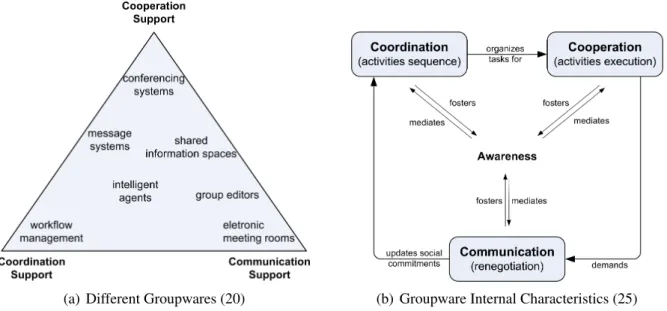
Figure 2.1 shows common usages of the 3C-model on classifying groupwares in accordance the three collaboration aspects. One first approach (Figure 2.1(a)) is focused on classifying different groupwares, in the same way that the presented taxonomies do. This type of
2.1 Computer-Supported Cooperative Work 24
(a) Different Groupwares (20) (b) Groupware Internal Characteristics (25)
Figure 2.1: 3C-model Usages: common usages of the 3C-model on classifying groupwares. classification does not organize groupware into specific well-defined classes, however distinguish them by an intuitive measurement about the intensity with which these systems support each one in terms of the collaboration aspects. Thus, they are classified through a similarity on how they support collaborative work.
The second common usage of the 3C-model is on classifying the internal characteristics of a groupware. In this matter, Figure 2.1(b) presents the internal aspects presented in a arbitrary adaptive workflow management system. Especially, this figure also introduces theawareness
concept as a relevant concept in the model. In short, the concept awareness concerns to groupware users being aware of other users intentions, actions and resources. More important, awareness in collaboration sessions is important for providing coordination and promoting usability (26). Much of the effort faced by groupware developers, especially in synchronous groupware, is related to the provision of awareness. Group collaboration relies not only on explicit communication among the members of the group, but also on implicit availability of information of each other’s presence and actions. In this way, awareness can be defined as the ability of the application to expose the activities of the people engaged in a common task (21).
As a remark, the 3C-model was originally proposed by Ellis, Gibbs & Rein(17), however in the same way that Fuks et al.(25)(18) and (2), we have adopted some terminology differences in this work. We consider the term "cooperation" representing what Ellis, Gibbs & Rein(17) denominate "collaboration".
2.2 The Co-Browsing Paradigm 25
2.2
The Co-Browsing Paradigm
Web browsing is traditionally an individual activity, where a person uses a web browser (e.g. Mozilla Firefox, Microsoft Internet Explorer) for accessing published hypertext documents. However, this browsing can actually be seen as a social event (8), where users share their browsing activity (11).
In this scenario raises the collaborative web browsing paradigm, also known as collaborative browsing (co-browsing) or collaborative navigation (co-navigation). In this browsing paradigm, besides retrieving web documents, a person is able to recommend browsed contents to other people, sharing their preferences or intentions, so making web browsing a collaborative activity. In fact, considering co-browsing a sort of recommendation paradigm figures out a great advantage of this paradigm, that is its applicability on many collaboration scenarios through the web. Illustrating such scenarios, we can see co-browsing on promoting products or contents by their popularity (13), or even in guided content visiting (1) like web seminars activities (24). These examples are basically composed by web pages recommendations, in other words, collaborative browsing. However these examples also indicate that the co-browsing paradigm is itself a broader concept, that could not be precisely classified by presented models.
Indeed, the way of performing recommendations is the most relevant decision on defining a co-browsing groupware. The chosen recommendation method may define the main goal of this groupware, imposing the most basic constraints or features available to its users. In other words, this recommendation method refines the co-browsing paradigm into an specific scope, thus enabling a more precise classification.
There are distinct ways of performing co-browsing recommendations. The simplest is through a standard communication action, where for instance, a person recommends a URL (Uniform Resource Locator) to a friend or a co-worker in order to ask an opinion. However such approach may impose a great overhead to the team work, especially on recommending many web documents for many people. Avoiding suchad-hoc approach, an specialized groupware can support the co-browsing paradigm, regarding some general characteristics described in the following subsections. Moreover, these characteristics are independent of design or implementation issues, being intrinsically related to the co-browsing paradigm itself. Design and implementation issues are discusses on next chapters.
2.2 The Co-Browsing Paradigm 26
2.2.1
Recommendation Method
We consider two basic modes for transmitting a web browsing recommendation, namelyactive
andpassive. In theactivemode, a person intentionally sends the recommendation to a known destination, that could be another person or a group. Conversely, in the passive, more the recommender is observed while browsing, and afterwards the observer entity automatically generates recommendations for other users.
For example, Amazon.com uses thispassiverecommendation concept for suggesting books to buy according to the behavior of other users having similar interests (8). Another example is the GoogleAds, which dynamically inserts advertisement links in web pages related to the web page matter and also the reader’s profile.
2.2.2
Interaction Synchronism
This characteristic regards how synchronous users’ interactions are. In other words, if they establish a synchronous collaboration session, in terms of the time/space taxonomy.
Usually, co-browsing systems that are based on synchronous session offer a common method for handling recommendations, where they get synchronized throughbrowsing follo-wing relations. In this method, when one user browses some web page, whereas all other users that are synchronized with him automatically follow such browsing action, thus moving to the same web page. This following mechanism is commonly implemented by the propagation the URLs (1)(11) or propagating the browsed web page content itself (12).
In particular, browsing following relations are commonly called asmaster/slaves(12)(11)(8), being the user who navigates denominated master, while the followers are the slaves. However, such terminology has been overused in the literature with so many different meanings. Especially, inside the proper co-browsing domain some works have proposed different meanings for master/slaves. For instance, Gerosa et al.(8) has defined "master" as a role with exclusive privileges, whereas Esenther(12) has defined "master" just as a momentary position of a user, without any coordination behind. In face of that and in an effort to not confuse the reader, we have decided to not use master/slaves terminology.
Therefore we have set three gradual definitions concerning the synchronous co-browsing recommendation methods: (i) browsing following relations, the aforementioned automatic browsing propagation method; and two specializations: (ii) rigid presenter-attendees, the specification of roles on following relations, defining one and only one user with rights
2.2 The Co-Browsing Paradigm 27
to browse by their own, while the others synchronized with him or her are meant to be followers; and (iii) flexible presenter-attendees1 , which enables users synchronized in a presenter-attendees method to exchange their roles, so giving chances to all users to contribute to the co-browsing session.
2.2.3
Users’ Location Requirements
Co-browsing systems can be designed for supporting specific users proximity (time/space taxonomy) requirements during co-browsing activities. This way, there are the ubiquitous co-browsing systems, which allow distant users to co-browse. In particular, this ubiquitous paradigm is the most easily encountered, for instance, on (11)(6)(27)(28) and (14).
On the opposite, there are the co-located co-browsing systems, which are based on supporting near users, for instance in the same room. Such co-browsing approach is very useful on improving lectures and meetings, providing more ways for participants contribute in the event. In particular, ubiquitous systems can be naturally used in co-located mode, the point is that generally, co-located systems provide specialized features, usually regarding hardware integration. For instance, Amershi & Morris(5) have integrated cellphones as telepointers, while Malcher & Endler(22) have integrated projectors and handhelds.
2.2.4
Co-browsing Purpose
Users can use the co-browsing paradigm for supporting different tasks. Even though, co-browsing tools can be specialized or not. Some of these tools are general enough, allowing users to co-browse through arbitrary domains, not mattering their goal, for instance (1)(29)(6) and (30). Despite that, some system are dedicated on performing specific co-browsing tasks, for instance, collaboratively presenting slides (22) or searching content on the web (5). Additionally, another sort of specific purpose is about embedding co-browsing features in specific web applications, which is the approach adopted by (12)(10) and (31).
2.2.5
Coupling Level
Despite the aforementioned interaction synchronism concept which is based on time relations, this concept regards how tight users collaborate. In other words, the coupling level refers
1The flexible presenter-attendees method has been proposed by Gerosa et al.(8) with the name ofsymmetric
2.3 Related Work 28
how much awareness and collaboration facilities are available in the co-browsing session, so indicating the closeness experienced by users, even in a distributed (ubiquitous) scenario.
At the lowest (or loosest) levels of co-browsing coupling, there are systems which only provide, for instance, URL sharing, without any kind of users tight relations (e.g. (6)). At higher levels, systems which provide browsing synchronization methods of shared web pages ( relaxed-WYSIWIS). Examples of these systems are (1)(11). On even higher coupling levels, specialized features permit users to get even more close (strict-WYSIWIS). On such environments users could, for instance, focus on the same content parts (co-scrolling,highlighting), fill forms ( co-filling) and update shared content (co-editing,annotations). More details on coupling levels can be found on (21).
In particular, WYSIWIS is an acronym for "What You See Is What I See", that aims at a consistent presentation of shared information to all participants. In its most strict form, WYSIWIS means that all participants have exactly the same context. Thus the screens of all session participants display the identical information (20). Whereas on relaxed forms, session participants could be, in a given moment, browsed to the same web page, but each of them could be reading some totally different piece of this same content.
2.3
Related Work
Many works have proposed solutions in the collaborative browsing area, and some of them are quite relevant to this work. These solutions are grouped through an application level classification are listed below. We do not intend to cover all possible (or existent) co-browsing applications with these classes, they are just an effort for reinforcing relevant systems similarities.
2.3.1
Synchronous Guided Co-browsing
This class consists of groups of users synchronously and actively co-browsing arbitrary web contents using browsing following relations. Amongst the advantages of such applications, the most relevant is allowing distributed users to collaborate through the web, being organized in virtual presentations, also known as web seminars. Especially, this application class definition is usually referred as the proper definition of the co-browsing paradigm, as in (8).
• LiCoB (1) – This is the precursor of OCEAN, and most of facilities proposed by LiCoB persist in this work. LiCoB aims at integrating important features of a lightweight
2.3 Related Work 29
distributed architecture, awareness, session state sharing and annotations (e.g. draw and comment elements over the shared web content). Also, the approach relies on a collaboration ontology that provides a well defined conceptualization and a common vocabulary. Regarding co-browsing characteristics, LiCoB supports ubiquitous and synchronous co-browsing paradigm with active recommendation method, getting synchronized in a flexible presenter-attendees way.
• CoLab (11)(30) – This work proposes CoLab, a new paradigm and tool for collaboratively browsing the web, and it is the most similar to our work. CoLab also supports the synchronous co-browsing paradigm with active recommendation method. Also, it is prepared for allowing its users to co-browse arbitrary web contents being wherever they want.
This work mainly proposes a new browsing paradigm, which provides coordination flexibility to the collaboration session. In other words, CoLab’s users are not necessarily forced to co-browse in a presenter-attendees method. Actually it proposes a workgroup based coordination mechanism for turning co-browsing synchronization even more flexible. Such mechanism allows the configuration of different collaboration scenarios, from rigid presenter-attendees browsing to completely free individual browsing. Another important contribution is that it supports the synchronization of continuous media embedded into co-browsed web pages (e.g., when a user pauses a video, the other users who are following him will also have their video paused).
CoLab’s major shortcomings are the great overhead it imposes on renegotiating workgroups coordination state, and missing of collaboration artifacts when using flexible co-browsing sessions. Exchanging the privilege on conducting the browsing of a workgroup illustrates the coordination problem, whereas revisiting previously co-browsed web pages and collaborate through different workgroups are examples of the artifacts problem.
• IMMEX Collaborative (8) – The IMMEX is a collaboration environment that also has co-browsing capabilities. Such co-browsing module provides synchronous sessions with a common presenter-attendees organization. In this case, this system imposes coordination rules where only one user has browsing rights (the presenter), while the others are only allowed to observe (or to "follow") his/her actions.
In addition to that, IMMEX has improved its coordination mechanism using a flexible presenter-attendees based on a token-passing-based mechanism, thus enabling users to change their roles. The authors denominate this mechanism as symmetricco-browsing, since all users have chances to be masters, presenting whatever they want. However, any
2.3 Related Work 30
user can decide to take the token, no token retention mechanism is provided (11).
• PageShare (31) – A commercial tool for providing co-browsing capabilities. Basically provides basic communication tools, such as simple annotations and collaborative objects manipulation, as filling forms.
• Browzmi (14) – Social network browsing recommendations is the focus of Browzmi. The major advantage of this system is that it allows users to co-browse though different paradigms. It could be active or passive, and synchronous or asynchronous. In other words, the users can join the same session at the same time, following a presenter-attendees approach, or not.
During a Browzmi session, being alone or not, users are able to browse and recommend favorite content, by using Browzmi collaboration tools. For instance, this system offers (i)clipping, for recommending specific pictures or other embedded medias; (ii)rating, for classifying the recommendation; and (iii)personal comments, for publishing a statement.
Such recommendations feed participant’s profile on Browzmi social network. In doing so, even that a person uses this system alone in a session, he or she can still co-browse with other people, based on the recommendations made all over the session.
2.3.2
Domain Embedded Co-browsing
Co-browsing is a widely applicable collaboration paradigm. However some multi-user systems may offer co-browsing features for supporting some specific activities. For instance, helpdesk portals allowing their users co-browsing an enterprise web application, in a tutoring session. The most important is that systems like this helpdesk portal, may need a co-browsing feature specialized to their needs. So, general purpose co-browsing tools usually not achieve all these applications’ requirements.
In this matter, domain embedded co-browsing gathers systems developed with the intention to offer co-browsing capabilities to specific domains. It means that they usually need to be somehow integrated to the target systems, for example, in a source code level integration or through application programming interfaces (API).
• CWB - Collaborative Web Browsing (12) – This proposal is focused on the basic features for providing synchronous and active co-browsing. The great advantage of this proposal is that it replicates whatever one user does for the others. These interactions can be,
2.3 Related Work 31
selecting a piece of text, filling HTML forms and even where the mouse pointer is in the web page.
However, CWB has many disadvantages. For instance, it is restricted to an specific domain (e.g.: *.ufes.com/), and has to be installed in the same domain that a web service which is desired to co-browse. Besides, it does not provide any coordination mechanism for organizing the browsing following relation. In other words, CWB does not prevent two different users browsing different web pages, at the same time. In this case, users cannot forecast what could happen, since CWB will accept the browsing action which firstly arrives in the server. Thus, the slowest browsing action will be just dropped, and how more users make simultaneous actions more confusing the session would become. Another restriction concerns its user interface, which is quite confusing, not making users aware of what is happening in the session, and moreover, who is doing what in the session.
• Clavardon (10) – This is a commercial tool specialized on embedding co-browsing synchronous sessions into web services, in particular, e-commerce applications. Besides, Clavardon also provides an online co-browsing service for browsing through arbitrary domains, using a rigid presenter-attendees approach.
In addition, the most relevant features on Clavardon is the ability of highlighting content parts, synchronizing participants scrolls, and also, allowing users to jointly filling forms. This way, Clavardon provides a higher coupling level towards a strict-WYSIWIS collaboration session.
2.3.3
Co-located Environments
As aforementioned, co-located co-browsing systems are designed for supporting participants in a closeness scenario, for instance inside the same classroom. Systems like these are usually augmented with integration to this shared physical environment, in order to take advantage of this participants proximity, and thus fostering a richer collaboration experience.
• CoSearch (5) – This work proposes a system for collaboratively search content on the Internet. However, its particularity is that it was designed to support users gathered around a single computer to work together in collaborative searching tasks. Such collaboration is supported by offering multiple inputs to the same environment. In this case, users that are not controlling the computer, can also contribute to the group task using his/her cellphone as an additional input mechanism (telepointing).
2.3 Related Work 32
• iPH (22) – The Interactive Presenter for Handhelds (iPH) is a groupware for supporting presentation of slides in a classroom. Besides having integration with a projector, attendees in this environment can use personal handhelds for contributing to the ongoing presentation, for instance making annotations over presented slides. However, all users in the same session still follows a rigid presenter-attendees synchronization method, where the presenter has the browsing rights, in this case, the privileges for choosing slides. Especially, a disadvantage of iPH is its too restrictive system requirements. For instance, it is completely designed for working on Microsoft Windows platform, even in mobile devices.
2.3.4
Loosely-coupled Browsing Recommendations
As defined, people can collaboratively browse independent of browsing following relations, just sharing their browsing recommendations, despite synchronous or asynchronous interactions. Groupwares that support these interactions, usually provide a collaborative production shared space where users can feed with browsing recommendations, and thus sharing with other participants. It characterizes a great cooperation degree, regarding the 3C-model.
In particular, such loosely-coupled browsing recommendation approach is often not considered co-browsing, however its similarities with all mentioned co-browsing characteristics made us to consider these applications as a co-browsing class too.
• GUH - Group Unified Histories(6) – This work also presents a system which allows users to get together in a session and synchronously co-browse the web. Especially, such sessions are augmented with different collaboration tools, allowing users to express their opinions through many different ways, for instance, through a chat room, or rating browsed contents.
Contrary to common co-browsing approaches, in GUH there is no predefined browsing synchronization relation, like the presenter-attendees synchronization method or at least browsing following relation. Instead, every user is free to browse the web on their own. Even though, this system presents an important cooperation advantage, as users’ browsing activities feed GUH’s session shared history. From this shared history, every participant can check out all browsing activities of all session members.
Thus, even not offering any browsing following mechanisms, this system allows users to make browsing recommendations, and moreover, to discuss such recommendations. However, such unconstrained co-browsing approach can damage the quality of collaboration
2.4 Positioning our Proposal 33
when the session grows up. Coordination mechanisms could prevent lost of information in such scenarios.
• Kiobo (28) – social navigation is based on a totally passive recommendation paradigm (9). This system observes users individual browsing activity, composing a unique repository. All these information combined, can provide social browsing recommendations. For instance, a user can see what subject have been more browsed recently, without necessarily knowing who has browsed each content.
• Blocool (13) – such system passively observes which blogs2, in particular blog posts, have been read by users. Such observations feed a reading history in the user’s profile. These histories are commonly useful for bloggers (blog owners), who wish to publish an automatically generatedblogroll3, containing his/her recent readings. In other words, Blocool tries to answer a simple question: "What blogs am I reading?".
In a blog maintained by a Blocool user, readers can see which material this blogger
is using as reference for his posts. In addition, Blocool also offers an asynchronous loosely-coupled following mechanism, where users pre-define other users to be followed, after that he/she can automatically receive blog recommendations of his friends (followed users’ readings) that are more related to his profile.
Due to its characteristics, Blocool approach can also be classified as collaborative browsing, as blog owners can use Blocool for recommending other blogs to their readers. Moreover, the co-browsing mechanism applied here has characteristics of passivity, asynchrony, ubiquity and presents the specific purpose of recommending blog readings. Another similar but less expressive applications are proposed in (32) and (33)
2.4
Positioning our Proposal
In this work, we focus on a subset of collaborative browsing, where distributed users get together in a synchronous session for actively browsing through shared web content. This subset is also referred as the proper definition of co-browsing (8), thus, in this work, we refer to this subset asco-browsing. Considering specific characteristics, OCEAN relies on some related work solutions structured in accordance with the 3C-model (Section 2.1.2):
2A blog (a contraction of the term weblog) is a type of web site, usually maintained by an individual with
regular entries of commentary, descriptions of events, or other material such as graphics or videos. Entries are commonly displayed in reverse-chronological order. <en.wikipedia.org/wiki/Blog>
3A blogroll is a list of links to other blogs or web sites that the author of the blog regularly likes to
read. The blogroll generally resides in one of the side columns of the blog. <The Blogosphere’s Dictionary: www.blogossary.com/define/blogroll>
2.4 Positioning our Proposal 34
• Regarding coordination, OCEAN’s approach is based on flexible presenter-attendees. Such coordination approach is designed by means of users’ roles and privileges which provides simple session management, regarding both system’s designer and final users points of view. Similarly to CoLab (11), OCEAN presents even more flexibility with the addendum of independent and synchronized groups, where a large variety of coordination scenarios can be performed, as opposed to over-constrained approaches like in (1) and (8).
• Considering cooperation aspects, OCEAN inherits collaborative production shared space concepts defined by GUH’s shared histories (6), Kiobo’s repository (28) and Blocool’s blogrolls (13). In other words, our proposal takes in consideration a shared space for aggregating the many productions of a co-browsing session, in an effort to maintain the participants tight related even when working independently.
• Finally on communication, OCEAN allows users to make annotations (draws and text notes) over shared web pages. For example, such annotations are useful for expressing thoughts and, getting the focus of attendees on what the presenter wants to highlight. Similar annotations concepts can be found in Clavardon(10), PageShare(31) and CWB(12), however, the way it is implemented in such tools is not expressive enough since users are just allowed to highlight parts of texts.
Recall that the main objective of this work is to propose a general co-browsing system that supports properly the three collaboration aspects. However, we are not interested on attending every distributed workgroups’ needs, proposing a general collaboration solution like web conferencing systems.
In the sequence, next chapter specifies and formally conceptualizes OCEAN, describing all features that compose this proposal through the prism of the 3C-model aspects.
35
3
The Proposal: characterizing
main features
The objective of this chapter is twofold: (i) presenting the characteristics and features of OCEAN, (ii) formalizing conceptual models. In an effort to keep our work in accordance with what has been produced in the CSCW field, we follow the widely adopted 3C Model (17)(20), trying to divide our discussion, specifications and models into three main aspects: cooperation, coordination and communication. This approach allows us to deeply discuss each collaboration aspect, favoring the understanding and validation of the identified concepts (25). Moreover, this distinguished view can support parallel comparisons with other groupwares, in particular another co-browsing systems.
3.1
Proposal General Description
This section presents an informal specification of OCEAN. This specification considerswhich
features our co-browsing service offers without showing how such features internally work. Detailed design and implementation concerns are discussed on further chapters. In the following, the specification is presented in terms of three distinguished points of view. Each perspective is guided by one of the 3C-aspects, and contains a discussion of the collaborative browsing paradigm intrinsic characteristics, and the OCEAN proposal.
3.1.1
Coordination Aspect
In the context of collaboration sessions, coordination appears to be a major aspect for keeping controlling or management. Commonly, this management is made by imposing constraints in order to control participants’ activity. This way, we could suppose that, the more restrictions our groupware impose, the more coordinated it might be, and, accordingly, more collaborative. The answer for this question can be visualized making a comparison with an example out
3.1 Proposal General Description 36
of the computational context: an arbitrary Brazilian public service. In this case, the service’s workers, the client and also the government are the participants of a collaboration session, which has the objective to solve the client’s problem (or should have). But this session is coordinated by various rules. For instance, the client should deliver several documents, each of them must be reviewed by a different worker from different sectors on different days. This massive set of coordination rules turns the service bureaucratic, making the collaboration a daunting task. Based on such example, the answer might be "No", because an excess of coordination could "over constrain" users’ contributions, turning the collaboration almost impossible. Conversely, not imposing any coordination could also be harmful for the quality of the session. Therefore, the point is to find an equilibrium, allowing users to collaborate in a certain manageable freedom state (34)(35).
Focusing on collaborative web browsing, the coordination aspect is commonly implemented based on offering (or not) browsing synchronization facilities. In other words, such coordination usually has one of two opposite approaches: unmanaged, found in (12)(6)(28) and (36); and
presenter-attendees, adopted in (11)(5)(8)(27) and (22).
In theunmanagedapproach, users can do whatever they want during the session long. So, co-browsing session participants rely on informal coordination, in which there is no predefined flow of work or privileges hierarchy, and coordination is handled by actions initiated by people themselves on an ad-hoc basis. Such informal coordination is supported mainly by computer-mediated communication systems (34), like conferencing systems. However, this lack of a formal control can generate a participation chaos in the session.
Such chaos problem becomes evident considering synchronization methods (browsing following relations) adopted by many approaches (11)(14)(22), including our proposal. In these cases, when one user browses to a different web page, this browsing action is propagated to all synchronized users, and after that these participants automatically browse to the same web page. Note that, if every participant were allowed to browse, then concurrent browsing actions may occur, generating confusion and damaging the quality of the session.
Proposed by Esenther(12), CWB1 is an example of a co-browsing system that is based on theunmanagedcoordination approach and also offers browsing following relations. Due to that, its users can experience confusion on executing concurrent browsing actions. In a contingency effort, when a concurrent browsing action occurs, CWB is designed to propagate just only the action which first reaches its central server, dropping out other concurrent actions. Such solution maintains the co-browsing session in a consistent state, however may generate confusion. For
3.1 Proposal General Description 37
instance, when two users are synchronized in CWB, and both concurrently browse to different web pages, the user who had unsuccessfully browsed (last reaches the central server) is moved to a web page different that the one he had chosen.
The second commonly adopted coordination model ispresenter-attendees. At any moment, only one user performs the presenter role, while all the others perform the attendee role (rigid presenter-attendees). A presenter is responsible for guiding the session, being the only one allowed to choose the contents to visit, whereas the attendees are just allowed to see what the presenter has chosen. In other words, the presenter and attendee roles stands for interaction constraints, avoiding concurrent browsing confusion in the session, and thus managing the browsing following relations. Hence, imposing rigid rules to the session, this approach avoids concurrent browsing. Conversely, if such rules are too restrictive, blocking attendees to also contribute for the session may damage the collaboration.
Some works, as the one proposed by Gerosa et al.(8), have evolved the presenter-attendees approach, allowing users to dynamically exchange their roles (flexible presenter-attendees). In other words, the current presenter could assign his/her presentation rights to one of the attendees. This role exchange protocol increases the flexibility of a co-browsing session, giving to users equals opportunities to participate. Even so, such improvement still is too restrictive, since it keeps users locked into tight browsing following relations, restricting their contributions by only one user at a turn.
A co-browsing session should be even more flexible in order to allow its participants to independently contribute to the shared goal. It means that the users should be able to browse documents by their own, without stopping to contribute to the session. It could be useful for a divide-and-conquer strategy, where for instance, the participants want to collaboratively search for some information on the Internet. In such scenario, each participant search through distinct paths, collecting and sharing interesting data with the rest of session members. This strategy is commonly present in co-searching tools (5), but also appears in some co-browsing tools (6). However, the presenter-attendees model still is very useful, whenever a guiding behavior is necessary. For instance, during lectures, online tutoring or any other kind of presentation tasks (1). Hence, an hybrid coordination mechanism enabling these two distinct strategies, divide-and-conquer and presenter-attendees2becomes necessary. Such a mechanism should be flexible, in order to allow the participants to migrate between both co-browsing strategies at any time, without affecting the continuity of the collaboration session.
2From now on, when mentioning "presenter-attendees" we are referring to the "flexible presenter-attendees"
3.1 Proposal General Description 38
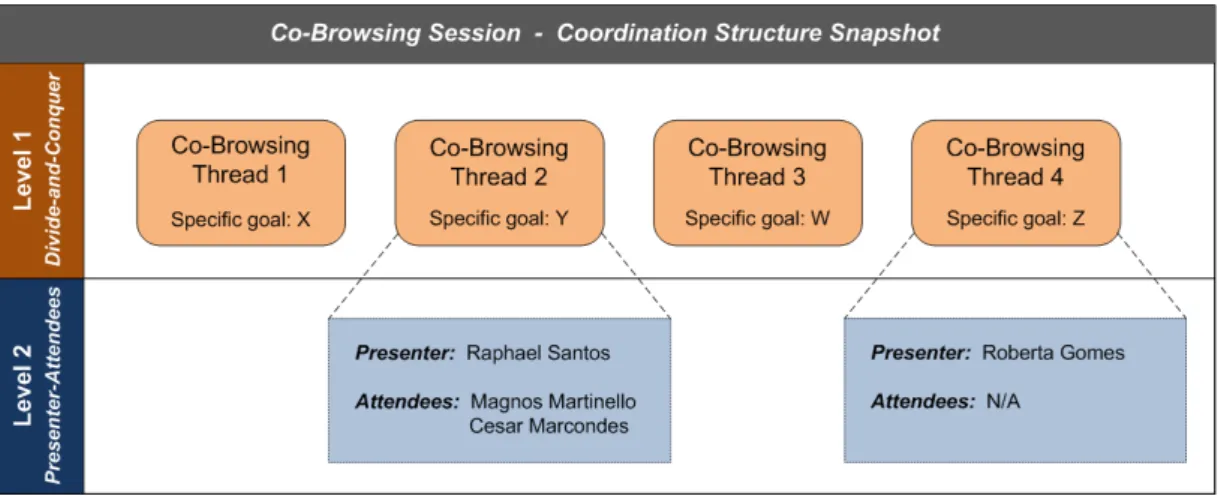
For this reason we propose a coordination mechanism designed to provide flexibility for dynamic co-browsing sessions. This mechanism is divided in two coordination levels. The first deals with subgroups of participants, supporting them to work following the divide-and-conquer strategy. In other words, session members could get organized into subgroups where each of these subgroups is independent to browse. Following, the second coordination level deals with subgroups’ internal coordination rules. Internally, each subgroup plays the role of presenter-attendees strategy. So, at any moment, there is only one participant with browsing privileges in the same subgroup, while all the others in the subgroup are attendees. In particular, the presenter role can be assigned to any other subgroup’s participant (flexible presenter-attendees), for instance through token passing mechanisms (20).
As a consequence, such division of users into subgroups leads to the formation of collaboration sub-sessions inside the co-browsing session. Note that, when co-browsing, the participants of a subgroup share information and characteristics that are specific of this subgroup, likewise a goal, a common production space, awareness information and etc. In fact, it characterizes that these people (subgroup members) are participating in a proper collaboration session. Therefore, OCEAN coordination mechanism enables the formation of specialized collaboration sub-session allowing groups of users to work on their specific goals, but still participating on a great co-browsing session, for a major shared goal. Additionally, in the scope of this work we have denominated such collaboration sub-sessions asco-browsing threads.
Figure 3.1: Coordination Levels
Figure 3.1 depicts an arbitrary scenario of a collaborative browsing session, focusing on the coordination levels. Regarding Level 1, this session presents four independent co-browsing threads. Regarding Level 2, the internal organization of threads two and four can be noted. Especially, thread four presents an special case, when there is only one participant. This particularity allows users to navigate alone, but still contributing for the co-browsing session