Symbolic computation in block cipher with application to
PRESENT
Changyong Penga Chuangying Zhub Yuefei Zhua Fei Kanga
aZhengzhou Information Science and Technology Institute,Zhengzhou, China, Email: [email protected],[email protected],[email protected],k [email protected]
bSchool of Computer and Control, Guillin University of Electronic Technology, Guilin, China
Abstract
In this paper,we give an example of how symbolic computation are used to analyze the block ci-pher PRESENT,an ultra-lightweight block cici-pher proposed by Bogdanov et al. at CHES’07.The block size is 64 bits and the key size can be 80 bit or 128 bit.Using Mathematica 7.0,this paper obtains the unexpanded polynomial expressions of the output of round 1-6 of PRESENT-80(80-bit key variant).The time complexity of getting these expressions is 4 minutes on a PC with a 2.6GHz CPU and 8G RAM.Then we expand the expressions of the output of round 1-2 and the LSB(least significant bit) of the output of round 3 and obtain the ANFs(Algebraic Normal Form) of these 129(=2*64+1) expressions. The time complexity of getting these ANFs is 22 minutes.It it known that the time complexity of the classical method of computing the ANF of ann-ary Boolean function from its truth table isO(n2n),with total time complexity of obtaining these 129 ANFsO(129∗144∗2144)=O(2158)(each of the 129 ANFs can be viewed as a 144-ary Boolean function,where 144=64+80,the sum of the block size and the key size).As an application,we give a side channel attack on PRESENT-80 under the single bit leakage model proposed by Dinur and Shamir.If the LSB bit of the output of the 3rd round can be obtained without error,then with 200 known plaintexts,we can set up an equation system in terms of the master key bits and can re-cover 43 bits key by the Gr¨obner Basis method.Compared with the previous side channel attack on PRESENT,such as Yang et al. in CANS 2009,Abdul-Latip et al. in ASIACCS 2011 and Zhao et al. in 2011,each of which needs at least 213chosen plaintexts,the data complexity of our attack is the best.
Keywords: PRESENT, symbolic computation, Gr¨obner Basis, side channel attack, block cipher
1. Introduction
As ubiquitous computing becomes a reality, sensitive information is increasingly processed and transmitted by smart cards, mobile devices and various types of embedded systems. This has led to the requirement of a new class of lightweight cryptographic algorithm to ensure security in these resource constrained environments.In January 2012,the International Organization for Standardization (ISO) has standardized two low-cost block ciphers [1] for this purpose,CLEFFIA and PRESENT.
al-gebraic expression of PRESENT.The standard alal-gebraic expression of a Boolean functions is called its algebraic normal form(ANF). Every Boolean function has a unique ANF.A block ci-pher can be viewed as a vector-valued Boolean function and each cici-phertext bit can be viewed as a Boolean function with the plaintext bits and key bits as variables. The ANF form of a block cipher is important in the cryptanalysis of the block cipher.For example, the idea of the method of formal coding [3] is to find the algebraic expression of each bit in the ciphertext as an XOR sum of products of the bits of the plaintext and the master key.The XOR-sum form of the ciphertext is just the algebraic normal form.The formal manipulations of these expressions may decrease the key search effort.The ANF form of a cipher is also useful in the realization of a cipher.For example,the author of [4],in order to obtain a minimal hardware realization of DES,optimized Boolean expressions that represents DES S-boxes.
The classical method for obtaining the ANF of ann-variable Boolean function is the algo-rithm [5] of computing the ANF from truth table,with time complexityO(n2n).For the PRESENT-80 block cipher,each bit of the middle state or the final ciphertext can be viewed as a 144-ary Boolean function.Here 144 is the sum of the block size(64) and the key size(80).So if we use the algorithm in [5] to find the ANF,the time complexity isO(144∗2144) = O(2151),which is computationally infeasible.
Using Mathematica 7.0,this paper obtains the unexpanded polynomial expressions of the output of round 1-6 of PRESENT-80(80-bit key variant).The time complexity of getting these expressions is 4 minutes on a PC with a 2.6GHz CPU and 8G RAM.Then we expand the expres-sions of the output of round 1-2 and the LSB(least significant bit) of the output of round 3 and obtain the ANFs(Algebraic Normal Form) of these 129(=2*64+1) expressions. The time com-plexity of getting these ANFs is 22 minutes.Note that the time comcom-plexity of computing these 129 ANFs by the classical method in [5] isO(129∗144∗2144)=O(2158)(each of the 129 ANFs can be viewed as a 144-ary Boolean function,where 144=64+80,the sum of the block size and the key size).As an application,we give a side channel attack on PRESENT-80 under the single bit leakage model proposed by Dinur and Shamir.If the LSB bit of the output of the 3rd round can be obtained without error,then with 200 known plaintexts,we can set up an equation system in terms of the master key bits and can recover 43 bits key by the Gr¨obner Basis method.Compared with the previous side channel attack on PRESENT,such as Yang et al. in CANS 2009,Abdul-Latip et al. in ASIACCS 2011 and Zhao et al. in 2011,each of which needs at least 213 chosen plaintexts,the data complexity of our attack is the best.
2. Description of PRESENT
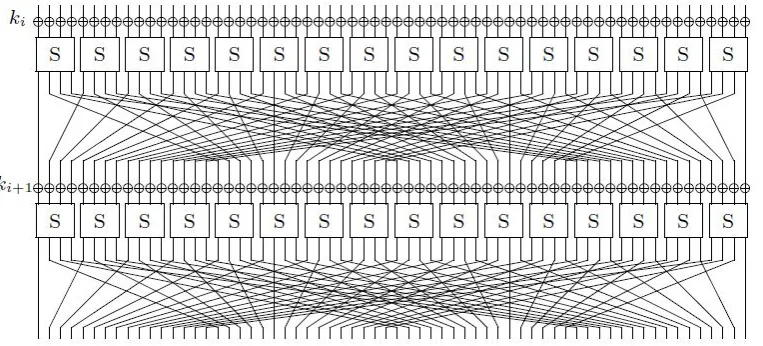
PRESENT is a 31-round SPN structure block cipher with block size of 64 bits, the cipher is described in Figure 1 and 2. It supports 80 and 128-bit secret key. Firstly, the plaintext Xored subkeyK1as the input of the 1st round, after 31 rounds iterations, the 31st round output Xored with the subkeyK32is the ciphertext.
Each round of PRESENT consists of the following 3 steps.
(1)addRoundKey. Given round key Ki=κi63...κ0i for 1 ≤ i ≤ 31 and current stateb63...b0, addRoundKey consists of the operation for 0≤i≤63,
bj→bj⊕κij.
Note:In this paper we number bits from zero with bit zero(the least significant bit) on the right of a block or word.
Figure 1: A top-level description of 31-round PRESENT encryption.
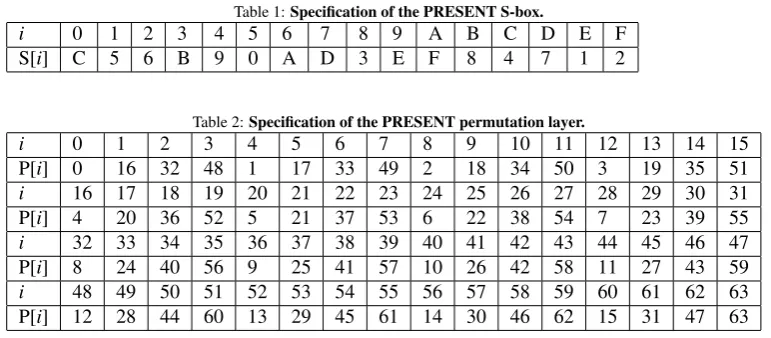
Table 1:Specification of the PRESENT S-box.
i 0 1 2 3 4 5 6 7 8 9 A B C D E F
S[i] C 5 6 B 9 0 A D 3 E F 8 4 7 1 2
Table 2:Specification of the PRESENT permutation layer.
i 0 1 2 3 4 5 6 7 8 9 10 11 12 13 14 15
P[i] 0 16 32 48 1 17 33 49 2 18 34 50 3 19 35 51
i 16 17 18 19 20 21 22 23 24 25 26 27 28 29 30 31
P[i] 4 20 36 52 5 21 37 53 6 22 38 54 7 23 39 55
i 32 33 34 35 36 37 38 39 40 41 42 43 44 45 46 47
P[i] 8 24 40 56 9 25 41 57 10 26 42 58 11 27 43 59
i 48 49 50 51 52 53 54 55 56 57 58 59 60 61 62 63
P[i] 12 28 44 60 13 29 45 61 14 30 46 62 15 31 47 63
(2)sBoxlayer. PRESENT uses a single 4-bit S-box S as shown in Table 1, which is applied 16 times in parallel in each round. The 4-bit nibbleiat the input of an S-box is substituted by the 4-bitS[i] in output, i.e.S :F42→F
4 2.
Letx=x3x2x1x0be the input of Sbox andy=y3y2y1y0be the output.Then we have
y3=x1x2x0+x1x3x0+x2x3x0+x0+x1+x1x2+x3+1,
y2=x0x1+x0x3x1+x3x1+x2+x0x3+x0x2x3+x3+1,
y1=x0x2x1+x0x3x1+x3x1+x1+x0x2x3+x2x3+x3,
y0=x0+x1x2+x2+x3.
(3)pLayer.The pLayer which provide linear bitwise permutation is shown in Table 2.Bitiof state is moved to bit positionP(i).
The key schedule. The difference between the 80-bit key and the 128-bit key variants of PRESENT is on the key schedule. For the 80-bit key variant, the user-supplied key that is stored in key registerK is represented ask79k78...k0. The 64-bit round keyKi=κ63...κ0 consists of the leftmost bits of the current contents (i.e. at roundi) of registerK. Thus the round key at roundi
can be depicted as:
Ki=κ63...κ0=k79k78...k16.
After extracting the round keyKi, the key registerK=k79k78...k0is updated as follows. 1. [k79k78...k1k0]=[k18k17...k20k19]
2. [k79k78k77k76]=S[k79k78k77k76]
3. [k19k18k17k16k15]=[k19k18k17k16k15]⊕round counter
Thus, the key register is rotated by 61 bit positions to the left, the left-most four bits are passed through the present S-box, and theround counter value i is exclusive-ored with bits
k19k18k17k16k15ofKwith the least significant bit ofround counteron the right.For more infor-mation of the key-schedule of PRESENT-128,see [2].
3. Obtaining the algebraic expression of the middle state of PRESENT
In this section,we give the polynomial expressions of the output of round 1-6 of PRESENT-80(It’s similar for PRESENT-128,we omit the details here).Of these 64*6=384 expressions,we
expand 129 expressions and obtain the standard algebraic expression i.e. the algebraic normal form(ANF).These 129 expressions are the output of the 1st two rounds and the least significant bit of the output of the 3rd round,with the plaintext bits and master key bits as variables.
Notation:
K=k79k78...k0: master key of PRESENT,
P=p63p62...p0: plaintext of PRESENT,
Bi=bi 63b
i 62...b
i
0: output of theith(i=1, ...,6)round of PRESENT.
We use the powerful symbolic computation software Mathematica [6] to obtain the result.Let
F2=GF(2) and f :Fn2−→F2be a mapping fromnbinary input bits into one output bit,then f is called a Boolean function. The ANF of the Boolean function f is the polynomial
f(x1,x2, ...,xn)=a0⊕a1x1⊕...⊕anxn⊕an+1x1x2⊕...⊕a2n−1x1x2...xn
with uniqueai’s inF2. The number of nonzeroai’s is called the number of terms in the ANF of
f.
First we give the ANF of the Sbox of PRESENT.Letx=x3x2x1x0be the input of Sbox and
y=y3y2y1y0be the output.Then we have
y3=x1x2x0+x1x3x0+x2x3x0+x0+x1+x1x2+x3+1,
y2=x0x1+x0x3x1+x3x1+x2+x0x3+x0x2x3+x3+1,
y1=x0x2x1+x0x3x1+x3x1+x1+x0x2x3+x2x3+x3,
y0=x0+x1x2+x2+x3.
With the above algebraic expressions of the Sbox of PRESENT,we can give the Mathematica code of the key schedule generation and the pure symbolic encryption procedure of PRESENT-80.The source code was given in appendix A.We have tested the correctness of our symbolic encryption code by using the 4 test vectors given in [2].The symbolic encryption code gets the correct answer each time.Then we set the plaintext and master key as pure symbols,i.e. let
K = k79k78...k0 be the master key,P = p63p62...p0 be the plaintext and Bi =bi63bi62...bi0 be the output of theith round of PRESENT-80.Then we run the symbolic encryption code and obtain the ANF of each bit ofBi=bi63bi62...bi0fori=1,2 and the ANF ofb30.
3.1. Algebraic normal form of the output of the 1st round
Let B1 = b163b162...b10 be the output of the 1st round of PRESENT-80.Then the number of terms ofB1 =b163b162...b10are as follows:35, 35, 35, 35, 35, 35, 35, 35, 35, 35, 35, 35, 35, 35, 35, 35, 33, 33, 33, 33, 33, 33, 33, 33, 33, 33, 33, 33, 33, 33, 33, 33, 36, 36, 36, 36, 36, 36, 36, 36, 36, 36, 36, 36, 36, 36, 36, 36, 10, 10, 10, 10, 10, 10, 10, 10, 10, 10, 10, 10, 10, 10, 10, 10.
We list only the most significant bitb163and the 4 least significant bitsb13,b12,b11,b10here.
b163=k78k76p61 +k79k76p61 +k77k76p62 +k79k76p62 +k76p61p62 +k77k76p63 +k78k76p63 +
k76p61p63+k76p62p63 +k77k78p60+k77k79p60 +k78k79p60+k78p61 +k78p60p61+k79p60p61 +
k77p62+k77p60p62+k79p60p62+k77p60p63+k78p60p63+k77k78k76+k77k79k76+k78k79k76+k76+
k77+k77k78+k79+p60+p61+p60p61p62+p61p62+p60p61p63+p60p62p63+p63+1
=(k76+p60) (k77+p61) (k78+p62)+(k77+p61) (k78+p62)+(k76+p60) (k77+p61) (k79+p63)+ (k76+p60) (k78+p62) (k79+p63)+k76+k77+k79+p60+p61+p63+1,
b1
0=k18p1+k17p2+k16+k17k18+k18+k19+p0+p1p2+p2+p3
=(k17+p1) (k18+p2)+k16+k18+k19+p0+p2+p3.
=k22p5+k21p6+k20+k21k22+k22+k23+p4+p5p6+p6+p7.
b1
2=(k25+p9) (k26+p10)+k24+k26+k27+p8+p10+p11
=k26p9+k25p10+k24+k25k26+k26+k27+p8+p9p10+p10+p11.
b1
3=(k29+p13) (k30+p14)+k28+k30+k31+p12+p14+p15
=k30p13+k29p14+k28+k29k30+k30+k31+p12+p13p14+p14+p15.
The correctness of these expressions can easily be checked manually from the description of PRESENT.
3.2. Algebraic normal form of the output of the 2nd round
LetB2 = b2 63b
2 62...b
2
0 be the output of the 2nd round of PRESENT-80.Then the number of terms ofB2 = b2
63b 2 62...b
2
0 are as follows:158482, 131145, 131145, 131145, 108339, 110055, 110055, 110055, 150702, 148686, 153440, 153440, 4148, 4148, 3638, 4148, 114455, 89495, 89495, 89495, 74059, 75207, 75207, 75207, 103030, 103704, 105488, 105488, 3048, 3048, 2738, 3048, 157359, 129956, 129956, 129956, 108470, 109000, 109000, 109000, 152045, 149993, 154771, 154771, 4257, 4257, 3721, 4257, 1711, 1330, 1330, 1330, 1186, 1188, 1188, 1188, 1478, 1476, 1480, 1480, 154, 154, 150, 154.
First,we give the algebraic expression of the least significant bitb20here. Sinceb20=b11+κ1 b12+κ2
+b10 +b12 +b13+κ0+κ2+κ3, whereκ3κ2κ1κ0 are the 4 least significant bits of the second round subkey.From the key schedule algorithm,we have
κ3 =k38, κ2=k37, κ1=k36, κ0 =k35.
Replaceb13,b12,b11,b10with their expressions in section 3.1 and expand it we have
b20=b20(k16,k17, ...,k30,k31,k35,k36,k37,k38,p0,p1, ...,p14,p15)=k16+k17k18+k18+k19+k20k24+
k21k22k24+k22k24+k23k24+k24+k20k26+k21k22k26+k22k26+k23k26+k20k25k26+k21k22k25k26+
k22k25k26+k23k25k26+k25k26+k26+k20k27+k21k22k27+k22k27+k23k27+k27+k28+k29k30+
k30 +k31+k35 +k24k36 +k25k26k36 +k26k36 +k27k36+k20k37+k21k22k37+k22k37 +k23k37 +
k36k37+k37+k38+p0+k18p1+k17p2+p1p2+p2+p3+k24p4+k25k26p4+k26p4+k27p4+
k37p4+k22k24p5+k22k26p5+k22k25k26p5+k22k27p5+k22k37p5+k21k24p6+k24p6+k21k26p6+
k21k25k26p6+k25k26p6+k26p6+k21k27p6+k27p6+k21k37p6+k37p6+k24p5p6+k25k26p5p6+
k26p5p6+k27p5p6+k37p5p6+k24p7+k25k26p7+k26p7+k27p7+k37p7+k20p8+k21k22p8+k22p8+
k23p8+k36p8+p4p8+k22p5p8+k21p6p8+p5p6p8+p6p8+p7p8+p8+k20k26p9+k21k22k26p9+
k22k26p9+k23k26p9+k26p9+k26k36p9+k26p4p9+k22k26p5p9+k21k26p6p9+k26p6p9+k26p5p6p9+
k26p7p9+k20p10+k21k22p10+k22p10+k23p10+k20k25p10+k21k22k25p10+k22k25p10+k23k25p10+
k25p10+k25k36p10+k36p10+k25p4p10+p4p10+k22p5p10+k22k25p5p10+k21p6p10+k21k25p6p10+
k25p6p10+k25p5p6p10+p5p6p10+p6p10+k25p7p10+p7p10+k20p9p10+k21k22p9p10+k22p9p10+
k23p9p10+k36p9p10+p4p9p10+k22p5p9p10+k21p6p9p10+p5p6p9p10+p6p9p10+p7p9p10+
p9p10+p10 +k20p11+k21k22p11 +k22p11+k23p11 +k36p11+p4p11 +k22p5p11 +k21p6p11 +
p5p6p11+p6p11+p7p11+p11+p12+k30p13+k29p14+p13p14+p14+p15.
Similarly,we have
b21=b21(k32,k33, ...,k46,k47,p16,p17, ...,p30,p31)=k33+p17 k34+p18+ k41+p25 k42+p26+
k37+p21k38+p22+k36+k38+k39+k40+p20+p22+p23 k41+p25k42+p26+k40+k41+
k42+k43+p24+p26+p27+ k45+p29k46+p30+k32+k34+k35+k39+k40+k41+k43+k44+
k46+k47+p16+p18+p19+p24+p26+p27+p28+p30+p31.
b2 2=b
2
2(k43,k44,k45,k46,k48,k49, ...,k62,k63,p32,p33, ...,p45,p46,p47)=k49+p33 k50+p34+
k57+p41k58+p42+ k53+p37k54+p38+k44+k52+k54+k55+p36+p38+p39 k57+
p41 k58+p42+k45+k56+k58+k59+p40+p42+p43+ k61+p45k62+p46+k43+k45+
k46+k48+k50+k51+k56+k58+k59+k60+k62+k63+p32+p34+p35+p40+p42+p43+p44+p46+p47.
b2 3=b
2
3(k47,k48,k49,k50,k64,k65, ...,k78,k79,p48,p49, ...,p62,p63)=k65+p49 k
66+p50+ k73+
p57 k74+p58+ k69+p53 k70+p54+k48+k68+k70+k71+p52+p54+p55 k73+p57k74+
p58+k49+k72+k74+k75+p56+p58+p59+ k77+p61k78+p62+k47+k49+k50+k64+
k66+k67+k72+k74+k75+k76+k78+k79+p48+p50+p51+p56+p58+p59+p60+p62+p63. The correctness of these expressions can also be easily checked manually from the descrip-tion of PRESENT.
3.3. Algebraic expressions of the output of round 3-6
The algebraic expressions after round 3 are quite quite complicated.We give only the simplest one,i.e.b30,the least significant bit of the output of the 3rd round of PRESENT-80. First we give the unexpanded form ofb30.
Sinceb3 0=
b2 1+κ1 b
2 2+κ2
+b2 0 +b
2 2 +b
2
3+κ0+κ2+κ3, whereκ3κ2κ1κ0 are the 4 least significant bits of the third round subkey.From the key schedule algorithm,we have
κ3 =k57, κ2=k56, κ1=k55, κ0 =k54+1. Replaceb2
3,b 2 2,b
2 1,b
2
0with their expressions in section 3.2 and we can obtain the unexpanded form ofb3
0,which is
b30=b30(k16,k17, ...,k78,k79,p0,p1, ...,p62,p63)
=k16+k18+k19+k24+k26+k27+k28+k30+k31+k35+k37+k38+k43+k45+k46+k47+k48+k49+
k51+k54+k57+k58+k59+k60+k62+k63+k64+k66+k67+k72+k74+k75+k76+k78+k79+p0+p2+k17+
p1k18+p2+p3+p8+p10+k25+p9k26+p10+p11+ k20+k22+k23+k36+p4+p6+k21+p5k22+
p6+p7 !
k24+k26+k27+k37+p8+p10+ k25+p9k26+p10+p11 !
+p12+p14+ k29+p13k30+
p14+p15+p32+p34+ k49+p33 k50+p34+p35+p40+p42+ k57+p41 k58+p42+p43+ k44+k52+
k54+k55+p36+p38+ k53+p37 k54+p38+p39 !
k45+k56+k58+k59+p40+p42+ k57+p41k58+
p42+p43 !
+p44+p46+k61+p45k62+p46+p47+ k32+k34+k35+k39+k40+k41+k43+k44+k46+
k47+k55+p16+p18+ k33+p17 k34+p18+p19+p24+p26+ k41+p25k42+p26+p27+
k36+k38+
k39+k40+p20+p22+ k37+p21k38+p22+p23
k40+k41+k42+k43+p24+p26+ k41+p25k42+
p26+p27
+p28+p30+ k45+p29k46+p30+p31 !
k43+k45+k46+k48+k50+k51+k58+k59+k60+
k62+k63+p32+p34+ k49+p33 k50+p34+p35+p40+p42+ k57+p41k58+p42+p43+
k44+k52+
k54+k55+p36+p38+ k53+p37k54+p38+p39
k45+k56+k58+k59+p40+p42+ k57+p41k58+
p42+p43
+p44+p46+ k61+p45k62+p46+p47 !
p58+k73+p57k74+p58+p59+ k48+k68+k70+k71+p52+p54+k69+p53k70+p54+p55 !
k49+
k72+k74+k75+p56+p58+ k73+p57k74+p58+p59
+p60+p62+ k77+p61k78+p62+p63+1. Then we use the Mathematica command
b30=(Expand[b30]/.Power[a ,b ]−>a)/.a Integer−>Mod[a,2]
to expand the above expression.The expanded expression contains terms like x2yz3,which is replaced with xyz after the command/.Power[a ,b ]− > a.This is a rule-based command in Mathematica,which replaces each term of the form ab witha. The Mathematica command
f/.a Integer−>Mod[a,2] replace each integer in the expression off with the integer mod2.With these computation,we can obtain the algebraic normal form ofb30.The number of terms ofb30is 23443.So we can not list its ANF here. The degree ofb30is 8.Of the 23443 terms ofb30,there are 256 terms of degree of 8, 1792 terms of degree 7, 5072 terms of degree 6, 7392 terms of degree 5, 5850 terms of degree 4, 2470 terms of degree 3, 550 terms of degree 2, 60 terms of degree 1 and the constant term 1.
For the other bits of the output of round 3,we list only the number of key bits and plaintext bits here.Each bit contains 64 plaintext bits.The number of key bits contained in the expressions from the most significant bit to the least significant bit are as follows:77, 67, 64, 64, 77, 69, 68, 68, 78, 67, 64, 64, 77, 67, 64, 64, 77, 67, 64, 64, 77, 69, 68, 68, 78, 67, 64, 64, 77, 67, 64, 64, 77, 67, 64, 64, 77, 69, 68, 68, 78, 67, 64, 64, 77, 67, 64, 64, 77, 67, 64, 64, 77, 69, 68, 68, 78, 67, 64, 64, 77, 67, 64, 64.
This shows that PRESENT-80 is not complete after 3 rounds.
Each algebraic expression of the bits of the output of round 4-6 contains all the 64 plaintext bits and 80 key bits.It’s too complicated to be listed here.
3.4. The correctness test of the algebraic expressions of PRESENT-80
The correctness of the algebraic expressions of the output of the first two rounds in sec-tion 3.1 and 3.2 can be checked manually.For the expressions of the output after round 3,it’s almost impossible to check it manually. The correctness of these expressions are guaranteed by the correctness of the symbolic encryption code on which we have made a correctness test using the test vector in [2] .Moreover,we have also made the following correctness test.
Let’s takeb30(see section 3.3) as an example.Do the following test 100 times:
(1)Random choose plaintext and key,encrypt the plaintext with the key,and output the value ofb30,denoted byA.
(2)Substitute the above chosen plaintext and key for the corresponding plaintext variables and key variables in the algebraic expression ofb3
0in section 3.3.Denote the value we obtain now byB.IfA=B,outputYes,otherwise outputNo.
We have obtained 100Yes.This shows the correctness of the algebraic expression ofb3 0(If the algebraic expression is not correct,then the probability we obtainYesin step (2) is 1/2 and the probability of obtaining 100Yes is 1/2100). The correctness of the other algebraic expressions can also be verified in just the same way.
4. Application of the algebraic expression ofb3
0– A side channel attack on PRESENT-80
In this section,we give a side channel attack on PRESENT-80 based on the algebraic expres-sions ofb3
model proposed by Dinur and Shamir in [7].In this paper we do not consider how information leakage can be measured. Rather, we assume the single-bit-leakage side channel model as an ab-stract attack model, and concentrate on investigating the security of the PRESENT block cipher against this attack model. So we suppose that the least significant bit of the output of the 3rd round of PRESENT can be obtained without error.
From the algebraic expression ofb3
0in section 3.3,if the value ofb 3
0is leaked and the plaintext is known,then an equation with the 64 master key bitsk16,k17, ...,k78,k79 as variables can be set up.Suppose we have obtainednleaked bitsv1, ...,vn.The correspondingnknown plaintexts are
Pi=pi63pi62...pi0,i=1, ...,n. Then we havenequations
vi=b30(k16,k17, ...,k78,k79,pi0,p i 1, ...,p
i 62,p
i
63),i=1, ...,n. (1)
With enough leaked bits and known plaintexts,the equation system can be solved via SAT solver [12] or Gr¨obner Basis method [13].Magma [11] is one of the best software of comput-ing Gr¨obner Basis.In this paper we choose the Magma online caculator v2.18-8 to solve the equation.Our experiment shows that with 200 known plaintexts,we can recover 43 bits key in an average time 70 seconds.The key bits which can not be determined in the experiments are
k19,k23,k27,k28,k31,k35,k39,k47,k51,k52,k55,k59,k60,k63,k64,k67,k68,k71,k75,k76,k79. We do our experiment in Mathematica 7.0.The experiment proceeds as follows.
(1)Use the Mathematica command Table[RandomInteger[],{80}] to generate a random key. (2)Use the Mathematica command Table[Table[RandomInteger[],{64}],{200}] to generate 200 known plaintexts.
(3)Encrypt each plaintext in (2) with the key in (1),denote the value of the least significant bit of round 2 byA.Substitute the plaintext for the corresponding plaintext variables in the algebraic expression ofb30 in section 3.3.Denote the algebraic expression we obtain now byB.Then we obtain an equationA=B.With 200 known plaintexts,we can obtain 200 equations.
(4)Output the equation system obtained in (3) as a text file,which is suitable for Magma to solve.
(5)Copy the content of the text file to Magma online calculator [11] and find the solution. We have made the above test 100 times.Each time Magma can only recover 43 bits key in less than 120 seconds and the average time is 70 seconds.Compared with the previous side channel attack on PRESENT,such as Yang et al. [8] in CANS 2009,Abdul-Latip et al. [9] in ASIACCS 2011 and Zhao et al. [10] in 2011,each of which needs at least 213 chosen plaintexts,the data complexity of our attack is the best.Moreover,ours is a known plaintexts model,which is better than the chosen plaintexts model.
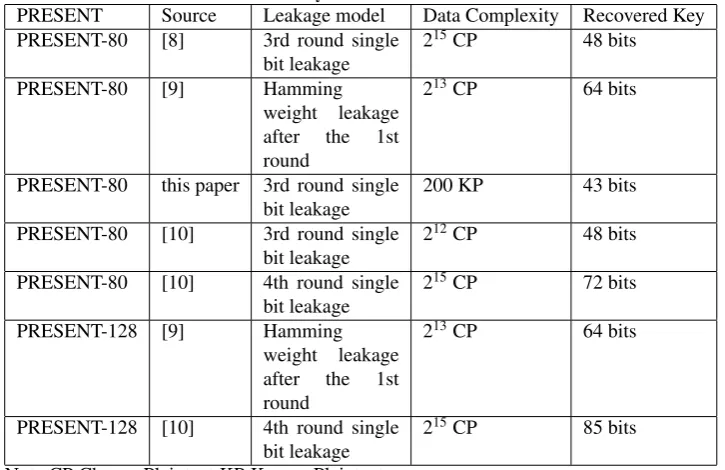
We summarize our work and the known side channel attack on PRESENT in Table 3.
5. Conclusion
sbox@8x3_, x2_, x1_, x0_<D:=81+x0+x1+x1 x2+x0 x1 x2+x3+x0 x1 x3+x0 x2 x3,
1+x0 x1+x2+x3+x0 x3+x1 x3+x0 x1 x3+x0 x2 x3, x1+x0 x1 x2+x3+x1 x3+x0 x1 x3+
x2 x3+x0 x2 x3, x0+x2+x1 x2+x3<;
sBoxLayer@state_D:=Table@sbox@Partition@state, 4D@@iDDD,8i, 1, 16<D Flatten;
keySchedule@masterKey_ , round_ , symbolFlag_D:=Module@8r, roundKey, keyRegister<,
keyRegister =masterKey;
roundKey =Table@0,8round+1<D; roundKey@@1DD=masterKey@@1 ;; 64DD;
For@r=1, r£round, r++, keyRegister =RotateLeft@keyRegister , 61D;
keyRegister@@1 ;; 4DD=sbox@keyRegister@@1 ;; 4DDD;
keyRegister@@61 ;; 65DD=keyRegister@@61 ;; 65DD+IntegerDigits@r, 2, 5D;
If@symbolFlag 0, keyRegister=Mod@keyRegister , 2DD;
roundKey@@r+1DD=keyRegister@@1 ;; 64DDD;
Return@roundKeyDD;
encryption@masterKey_ , plainText_ , round_ , outputMiddleFlag_ , symbolFlag_D:=
Module@8roundKey, state, i<, state=plainText;
If@symbolFlag==1, roundKey =keySchedule@masterKey, round, 1D,
roundKey=keySchedule@masterKey, round, 0DD;
For@i=1, i£round, i++, state =state+roundKey@@iDD;
state=sBoxLayer@stateD; If@symbolFlag0, state=Mod@state, 2DD;
state=state@@81, 5, 9, 13, 17, 21, 25, 29, 33, 37, 41, 45, 49, 53, 57, 61, 2, 6, 10, 14,
18, 22, 26, 30, 34, 38, 42, 46, 50, 54, 58, 62, 3, 7, 11, 15, 19, 23, 27, 31, 35, 39, 43,
47, 51, 55, 59, 63, 4, 8, 12, 16, 20, 24, 28, 32, 36, 40, 44, 48, 52, 56, 60, 64<DDD;
If@outputMiddleFlag 1, Return@stateDD;
state =state+roundKey@@round+1DD; If@symbolFlag 0, state=Mod@state, 2DD;
Return@stateDD;
key=Table@ToExpression@"k"<>ToString@iDD,8i, 79, 0,-1<D;
pText=Table@ToExpression@"p"<>ToString@iDD,8i, 63, 0,-1<D;
outPutOfRound1 =encryption@key, pText, 1, 1, 1D . a_Integer ®Mod@a, 2D;
outPutOfRound2 =encryption@key, pText, 2, 1, 1D . a_Integer ®Mod@a, 2D;
outPutOfRound3 =encryption@key, pText, 3, 1, 1D . a_Integer ®Mod@a, 2D;
outPutOfRound4 =encryption@key, pText, 4, 1, 1D . a_Integer ®Mod@a, 2D;
outPutOfRound5 =encryption@key, pText, 5, 1, 1D . a_Integer ®Mod@a, 2D;
outPutOfRound6 =encryption@key, pText, 6, 1, 1D . a_Integer ®Mod@a, 2D;
Figure A.3: Mathematica Symbolic encryption code of PRESENT-80.By running the above code in Mathematica we can obtain the algebraic expressions of the output of round 1-6 of PRESENT-80. Note:The outputMiddleFlag in the encryption function is used to test whether to output the middle state. The symbolFlag is used to test whether we do a symbol encryption or a numerical encryption.
Table 3:Summary of side channel attack on PRESENT
PRESENT Source Leakage model Data Complexity Recovered Key
PRESENT-80 [8] 3rd round single
bit leakage
215CP 48 bits
PRESENT-80 [9] Hamming
weight leakage after the 1st round
213CP 64 bits
PRESENT-80 this paper 3rd round single bit leakage
200 KP 43 bits
PRESENT-80 [10] 3rd round single
bit leakage
212CP 48 bits
PRESENT-80 [10] 4th round single
bit leakage
215CP 72 bits
PRESENT-128 [9] Hamming
weight leakage after the 1st round
213CP 64 bits
PRESENT-128 [10] 4th round single
bit leakage
215CP 85 bits
Note:CP:Chosen Plaintext;KP:Known Plaintext;
Appendix A. Symbolic encryption code of PRESENT-80 in Mathematica 7.0
[1] ISO/IEC 29192-2, Information technology-Security techniques-Lightweight cryptography-Part 2: Block ciphers, January 2012.
[2] Andrey Bogdanov, Lars R. Knudsen, Gregor Leander, Christof Paar, Axel Poschmann, Matthew J. B. Robshaw, Yannick Seurin, and C. Vikkelsoe. PRESENT: An Ultra-Lightweight Block Cipher. In Pascal Paillier and Ingrid Verbauwhede, editors, CHES, volume 4727 of Lecture Notes in Computer Science, pages 450-466. Springer, 2007. [3] Ingrid Schaumuller-Bichl, Cryptanalysis of the Data Encryption Standard by the Method of Formal Coding, Lec-ture Notes in Computer Science, Cryptography, proceedings of the Workshop on Cryptography, Burg Feuerstein, Germany, March 29,April 2, pp. 235-255, 1982.
[4] M.Kwan,Reducing the Gate Count of Bitslice DES,http://eprint.iacr.org/2000/051
[5] Hakan Englund,Thomas Johansson,Meltem Sonmez Turan,A Framework for Chosen IV Statistical Analysis of Stream Ciphers,INDOCRYPT 2007,pp.268-281.See also Tools for Cryptoanalysis 2007.
[6] http://www.wolfram.com/mathematica/
[7] Dinur, I., Shamir, A.: Side Channel Cube Attacks on Block Ciphers. Cryptology ePrint Archive, Report 2009/127 (2009), http://eprint.iacr.org/2009/127
[8] Yang, L., Wang, M., Qiao, S.: Side Channel Cube Attack on PRESENT. In: Garay, J.A., Miyaji, A., Otsuka, A. (Eds.) CANS 2009. LNCS, vol. 5888, pp. 379-391. Springer, Heidelberg (2009)
[9] Shekh Faisal Abdul-Latip, Mohammad Reza Reyhanitabar, Willy Susilo and Jennifer Seberry.Extended Cubes: Enhancing the cube attack by Extracting Low-Degree Non-linear Equations. In Bruce Cheung, Lucas Chi Kwong Hui, Ravi Sandhu, Duncan S.Wong (Eds.): ASIACCS 2011, pp.296-305,2011.
[10] XinJie Zhao, Tao Wang and ShiZe Guo: Improved Side Channel Cube Attacks on PRESENT. Cryptology ePrint Archive, Report 2011/165 (2011), http://eprint.iacr.org/2011/165
[11] http://magma.maths.usyd.edu.au/calc/
[12] G. Bard, N. Courtois, C. Jefferson, Efficient Methods for Conversion and Solution of Sparse Systems of Low-Degree Multivariate Polynomials over GF(2) via SAT-Solvers, Cryptology ePrint Archive, Report 2007/024. [13] G. Ars, J.-C. Faugre, H. Imai, M. Kawazoe, M. Sugita, Comparison Between XL and Gr¨obner Basis Algorithms,