Standoff Coordination for Multi-Tool Annotation in a Dialogue Corpus
Kepa Joseba Rodr´ıguez♣, Stefanie Dipper♠, Michael G¨otze♠, Massimo Poesio△, Giuseppe Riccardi♦, Christian Raymond♦, Joanna Wisniewska‡
♣
Piedmont Consortium for Information Systems (CSI-Piemonte) [email protected]
♠
Department of Linguistics. University of Potsdam.
{dipper|goetze}@ling.uni-potsdam.de
△
Center for Mind/Brain Sciences. University of Trento. [email protected]
♦
Department of Information and Communication Technology. University of Trento.
{christian.raymond|riccardi}@dit.unitn.it
‡
Institute of Computer Science. Polish Academy of Science. [email protected]
Abstract
The LUNA corpus is a lingual, multi-domain spoken dialogue corpus currently under development that will be used to de-velop a robust natural spoken language un-derstanding toolkit for multilingual dialogue services. The LUNA corpus will be notated at multiple levels to include an-notations of syntactic, semantic, and dis-course information; specialized annotation tools will be used for the annotation at each of these levels. In order to synchronize these multiple layers of annotation, the PAULA
standoff exchange format will be used. In this paper, we present the corpus and its
PAULA-based architecture.1
1 Introduction
XML standoff markup (Thompson and McKelvie,
1997; Dybkjær et al., 1998) is emerging as the clean-est way to organize multi-level annotations of cor-pora. In many of the current annotation efforts based on standoff a single multi-purpose tool such as the NITE XML Toolkit (Carletta et al., 2003) or Word-Freak (Morton and LaCivita, 2003) is used to
anno-1The members of the
LUNAproject consortium are: Pied-mont Consortium for Information Systems (IT), University of Trento (IT), Loquendo SpA (IT), RWTH-Aachen (DE), Uni-versity of Avignon (FR), France Telecom R&D Division S.A. (FR), Polish-Japanese Institute of Information Technology (PL) and the Institute for Computer Science of the Polish Academy of Sciences (PL),http://www.ist-luna.eu.
This research was performed in the LUNA project funded by the EC, DG Infso, Unit E1 and in the Collaborative Research Cen-ter 632 “Information Structure”, funded by the German Science Foundation,http://www.sfb632.uni-potsdam.de.
tate as well as maintain all annotation levels (cf. the
SAMMIEannotation effort (Kruijff-Korbayov´a et al., 2006b)).
However, it is often the case that specialized tools are developed to facilitate the annotation of particu-lar levels: examples include tools for segmentation and transcription of the speech signal like PRAAT
(Boersma and Weenink, 2005) and TRANSCRIBER
(Barras et al., 1998), theSALSAtools for FrameNet-style annotation (Burchardt et al., 2006), andMMAX
(M¨uller and Strube, 2003) for coreference annota-tion. Even in these cases, however, it may still be useful, or even necessary, to be able to visualize more than one level at once, or to ‘knit’ together2 multiple levels to create a file that can be used to train a model for a particular type of annotation. The Linguistic Annotation Framework by (Ide et al., 2003) was proposed as a unifying markup format to be used to synchronize heterogeneous markup for-mats for such purposes.
In this paper, we discuss how thePAULA represen-tation format, a standoff format inspired by the Lin-guistic Annotation Framework, is being used to syn-chronize multiple levels of annotation in theLUNA
corpus, a corpus of spoken dialogues in multiple lan-guages and multiple domains that is being created to support the development of robust spoken language understanding models for multilingual dialogue ser-vices. The corpus is richly annotated with linguistic information that is considered relevant for research on dialogue, including chunks, named entities, argu-ment structure, coreference, and dialogue acts. We chose to adopt specialized tools for each level: e.g.,
2
In the sense of theknittool of theLT-XMLsuite.
transcription using TRANSCRIBER, coreference us-ing MMAX, attributes using SEMANTIZER, etc. To synchronize the annotation and allow cross-layer op-erations, the annotations are mapped to a common representation format,PAULA.
The structure of the paper is as follows. In Sec-tion 2, we present the LUNA project and theLUNA
corpus with its main annotation levels. In Section 3, we introduce thePAULAexchange format, focusing on the representation of time alignment and dialogue phenomena. Finally we show howPAULAis used in
theLUNAcorpus and discuss alternative formats.
2 The LUNA project
The aim of theLUNAproject is to advance the state of the art in understanding conversational speech in Spoken Dialogue Systems (Gupta et al., 2005), (Bimbot et al., 2006).
Three aspects of Spoken Language Understand-ing (SLU) are of particular concern inLUNA: gen-eration of semantic concept tags, semantic compo-sition into conceptual structures and context sensi-tive validation using information provided by the di-alogue manager. In order to train and evaluate SLU models, we will create an annotated corpus of spo-ken dialogues in multiple domains and multiple lan-guages: French, Italian, and Polish.
2.1 TheLUNAcorpus
The LUNAcorpus is currently being collected, with a target to collect 8100 human-machine dialogues and 1000 human-human dialogues in Polish, Italian and French. The dialogues are collected in the fol-lowing application domains: stock exchange, hotel reservation and tourism inquiries, customer support service/help-desk and public transportation.
2.2 Multilevel annotation
Semantic interpretation involves a number of sub-tasks, ranging from identifying the meaning of indi-vidual words to understanding which objects are be-ing referred to up to recoverbe-ing the relation between different semantic objects in the utterance and dis-course level to, finally, understanding the commu-nicative force of an utterance.
In some annotation efforts–e.g., in the annotation of the French MEDIA Corpus (Bonneau-Maynard
and Rosset, 2003)– information about the meaning
of semantic chunks, contextual information about coreference, and information about dialogue acts are all kept in a single file. This approach however suf-fers from a number of problems, including the fact that errors introduced during the annotation at one level may make other levels of annotation unusable as well, and that it is not possible for two anno-tators to work on different types of annotation for the same file at the same time. Most current an-notation efforts, therefore, tend to adopt the ’multi-level’ approach pioneered during the development of theMAPTASK corpus and then developed as part of work on the EU-fundedMATEproject (McKelvie et al., 2001), in which each aspect of interpreta-tion is annotated in a separate level, independently maintained. This approach is being followed, for instance, in the ONTONOTES project (Hovy et al.,
2006) and the SAMMIE project (Kruijff-Korbayova et al., 2006a).
For the annotation of the LUNA corpus, we de-cided to follow the multilevel approach as well. That allows us to achieve more granularity in the anno-tation of each of the levels and to investigate more easily dependencies between features that belong to different levels. Furthermore, we can use different specialized off-the-shelf annotation tools, splitting up the annotation task and thus facilitating consis-tent annotation.
2.3 Annotation levels
TheLUNAcorpus will contain different types of in-formation. The first levels are necessary to prepare the corpus for subsequent semantic annotation, and include segmentation of the corpus in dialogue turns, transcription of the speech signal, and syntactic pre-processing with POS-tagging and shallow parsing.
The next level consists of the annotation of do-main information using attribute-value pairs. This annotation will be performed on all dialogues in the corpus.
2.3.1 Segmentation and transcription of the speech signal
Before transcription and annotation can begin, it is necessary to segment the speech signal into dia-logue turns and annotate them with speaker identity and mark where speaker overlap occurs. The goal of this segmentation is to be able to perform a tran-scription and annotation of the dialogue turns with or without dialogue context. While dialogue context is preferable for semantic annotation, it slows down the annotation process.
The tool we will use for the segmentation and transcription of the speech signal is the open source tool TRANSCRIBER3(Barras et al., 1998).
The next step is the transcription of the speech signal, using conventions for the orthographic tran-scription and for the annotation of non-linguistic acoustic events.
2.3.2 Part Of Speech Tagging and Chunking
The transcribed material will be annotated with POS-tags, morphosyntactic information like agree-ment features, and segagree-mented based on syntactic constituency.
For the POS-tags and morphosyntactic features, we will follow the recommendations made in EA
-GLES (EAGLES, 1996), which allows us to have a unified representation format for the corpus, inde-pendently of the tools used for each language.
2.3.3 Domain Attribute Annotation
At this level, semantic segments will be anno-tated following an approach used for the annotation for the French MEDIA dialogue corpus (Bonneau-Maynard and Rosset, 2003).
We specify the domain knowledge in domain on-tologies. These are used to build domain-specific dictionaries. Each dictionary contains:
• Concepts corresponding to classes of the ontol-ogy and attributes of the annotation.
• Values corresponding to the individuals of the domain.
• Constraints on the admissible values for each concept.
3
http://trans.sourceforge.net
The concept dictionaries are used to annotate mantic segments with attribute-value pairs. The se-mantic segments are produced by concatenation of the chunks produced by the shallow parser. A se-mantic segment is a unit that corresponds unambigu-ously to a concept of the dictionary.
(1) buongiorno lei [pu`o iscriversi]concept1 [agli
esami]concept2 [oppure]concept3 [ottenere
delle informazioni]concept4 come la posso
aiutare4
<concept1 action:inscription> <concept2 objectDB:examen>
<concept3 conjunctor:alternative>
<concept4 action:obtain info>
2.3.4 Predicate structure
The annotation of predicate structure facilitates the interpretation of the relation between entities and events occurring in the dialogue.
There are different approaches to annotate predi-cate structure. Some of them are based upon syntac-tic structure, with PropBank (Kingsbury and Palmer, 2003) being one of the most relevant, building the annotation upon the syntactic representation of the TreeBank corpus (Marcus et al., 1993). An alter-native to syntax-driven approaches is the annotation using semantic roles as in FrameNet (Baker et al., 1998).
For the annotation of predicate structure in the
LUNA corpus, we decided to use a FrameNet-like approach, rather than a syntax-based approach:
1. Annotation of dialogue interaction has to deal with disfluencies, non-complete sentences, un-grammaticality, etc., which complicates the use of deep syntactic representations.
2. If we start from a syntactic representation, we have to follow a long way to achieve the seman-tic interpretation. Syntacseman-tic constituents must be mapped to θ-roles, and then to semantic
roles. FrameNet offers the possibility of anno-tating using directly semantic criteria.
4
For each domain, we define a set of frames. These frames are defined based on the domain ontology, with the named entities providing the frame ele-ments. For all the frames we introduce the negation as a default frame element.
For the annotation, first of all we annotate the en-tities with a frame and a frame element.
Then if the target is overtly realized we make a pointer from the frame elements to the target. The next step is putting the frame elements and the target (if overtly realized) in a set.
(2) buongiorno [lei]f e1 [pu`o iscriversi]f e2
[agli esami]f e3 oppure [ottenere delle
informazioni]f e4 come la posso aiutare
set1 ={id1, id2, id3}
frame: inscription
frame-elements:{student, examen, date}
set2 ={id4}
frame = info-request
frame-elements:{student, addressee, topic}
<fe1 frame="inscription" FE="student" member="set1" pointer="fe2">
<fe2 frame="inscription" FE="target" member="set1">
<fe3 frame="inscription" FE="examen" member="set1" pointer="fe2">
<fe4 frame="information" FE="target" member="set2">
2.3.5 Coreference / Anaphoric relations
To annotate anaphoric relations we will use an an-notation scheme close to the one used in theARRAU
project (Artstein and Poesio, 2006). This scheme has been extensively tested with dialogue corpora and includes instructions for annotating a variety of anaphoric relations, including bridging relations. A further reason is the robustness of the scheme that doesn’t require one single interpretation in the an-notation.
The first step is the annotation of the information status of the markables with the tags given and
new. If the markables are annotated withgiven, the annotator will select the most recent occurrence
of the object and add a pointer to it. If the mark-able is annotated withnew, we distinguish between markables that are related to a previously mentioned object (associative reference) or don’t have such a relation.
If there are alternative interpretations, which of a list of candidates can be the antecedent, the annota-tor can annotate the markable asambiguousand add a pointer to each of the possible antecedents.
(3) Wizard: buongiorno [lei]cr1 [pu`o
iscriversi]cr2 [agli esami]cr3 oppure
ot-tenere [delle informazioni]cr4 come la posso
aiutare
<cr1 inf status="new" related="no"> <cr2 inf status="new" related="no">
<cr3 inf status="new" related="no"> <cr4 inf status="new" related="no">
Caller: [iscrizione]cr5 [esami]cr65
<cr5 inf status="given" single phrase antecedent="cr2"
ambiguity="unambiguous">
<cr6 inf status="given" single phrase antecedent="cr3"
ambiguity="unambiguous">
2.3.6 Dialogue acts
In order to associate the intentions of the speaker with the propositional content of the utterances, the segmentation of the dialogue turns in utterances is based on the annotation of predicate structure. Each set of frame elements will correspond to an utter-ance.
Each utterance will be annotated using a multi-dimensional annotation scheme partially based on theDAMSL scheme (Allen and Core, 1997) and on the proposals ofICSI-MRDA (Dhillon et al., 2004).
We have selected nine dialogue acts from the
DAMSLscheme as initial tagset, that can be extended for the different application domains. Each utter-ance will be annotated with as many tags as applica-ble.
(4) Wizard: [buongiorno]utt1 [lei pu`o iscriversi
agli esami]utt2 oppure [ottenere delle
5
informzaioni]utt3 [come la posso aiutare]utt4
<utt1 d-act="opening/closing"> <utt2 d-act="statement"
link-frame="set1">
<utt3 d-act="statement" link-frame="set2">
<utt4 d-act="info-request">
Caller: [iscrizione esami]utt5
<utt5 d-act="answer;statement" link-frame="set3">
3 PAULA - a Linguistic Standoff Exchange Format
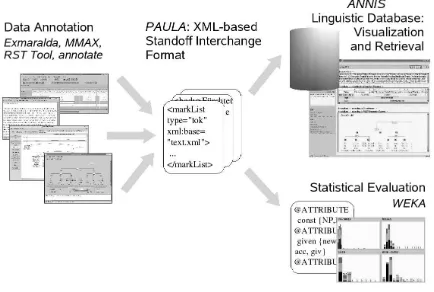
PAULA stands for Potsdamer Austauschformat f¨ur linguistische Annotation (“Potsdam Interchange Format for Linguistic Annotation”) and has been de-veloped for the representation of data annotated at multiple layers. The application scenario is sketched in Fig 1: researchers use multiple, specialized off-the-shelf annotation tools, such as EXMARALDAor MMAX, to enrich data with linguistic information. The tools store the data in tool-specific formats and, hence, it is not straightforward to combine informa-tion from different sources and, e.g., to search for correlations across multiple annotation layers.
This is where PAULA comes in: PAULA maps the tool-specific formats to a common format and serves as an interchange format between these tools.6 Moreover, the annotations from the different sources are merged into one single representation.
PAULA makes this data available for further appli-cations, such as searching the data by means of the tool ANNIS7, or to feed statistical applications like WEKA8.
PAULAis an XML-based standoff format for
lin-guistic annotations, inspired by the “dump format”
6
Currently, we providePAULAimport filters for the follow-ing tools and formats: Exmaralda, MMAX, RST Tool/URML, annotate/TIGER XML. Export fromPAULAto the tool formats is at present supported for the original source format only. We plan to support the export of selected annotations to other tools. This is, however, not a trivial task since it may involve loss of information.
7
ANNIS:http://www.sfb632.uni-potsdam.de/ annis
8
WEKA: http://www.cs.waikato.ac.nz/ml/ weka
Figure 1: PAULAannotation scenario
of the Linguistic Annotation Framework (Ide et al., 2003).9 With PAULA, not only is the primary data separated from its annotations, but individual anno-tation layers (such as parts of speech and dialogue acts) are separated from each other as well. The standoff approach allows us to mark overlapping segments in a straightforward way: by distributing annotations over different files (XML as such does not easily account for overlapping segments, since its object model is a hierarchical, tree-like structure). Moreover, new annotation layers can be added eas-ily.
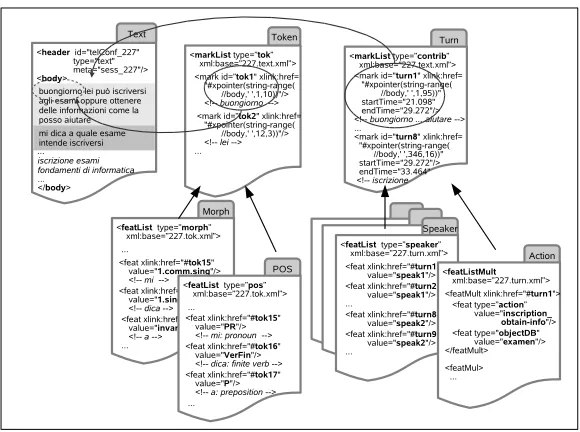
PAULA assumes that a representation of the pri-mary data is stored in a file that optionally spec-ifies a header with meta information, followed by a tag <body>, which contains a representation of the primary data. In Fig. 2, the first box displays the transcription, with all contributions from the first speaker coming first, and the contributions from the other speaker(s) following (put in italics in the Fig-ure).
The basic type of “annotation” are markables, en-coded by the XML element <mark>. Markables specify “anchors”, i.e., locations or ranges that can be annotated by linguistic information. The loca-tions and ranges are posiloca-tions or spans in the source text or timeline, which are referenced by means of XLinks and XPointer expressions. For instance, the “Token” markables in Fig. 2 define spans that
cor-9
Figure 2: PAULAsample annotation
respond to words. The first markable, with the ID
tok1, specifies the span that starts at character po-sition 1 and is of length 10: buongiorno. Simi-larly, the speakers’ individual turns are specified by the “Turn” markables. Here, the first markable (ID
turn1) specifies the entire dialogue turn of the first speaker (which corresponds to the part marked in light grey within the text file). Additionally, the markable encodes the time range that is occupied by that turn: it starts at time point 21.098, and ends at time point 29.272.
Markables represent a special kind of annotation: they mark linguistic units. The actual annotation, though, specifies properties of these units, such as part of speech or dialogue acts. For the encoding of these properties, PAULA provides <feat>
elements, which point to<mark>elements by ref-erencing their IDs. Token markables are annotated by “Morph” and “POS” features. The name of the annotated feature is specified by the attributetype
of the<featList>element; the value of the fea-ture is given by the attributevalueof the<feat>
elements. For instance, the token with ID tok15
is annotated with morph="1.comm.sing"
and pos="PR". Similarly, the Turn markables are specified for the speakers uttering the turns (“Speaker” features), and details of the dialogue acts (“Action”) are given. The file with the dialogue
act annotations specify multiple features within one tag <feat>, rather than distributing the features over several files, as we do in the case of morphol-ogy and POS annotations. This way, we explicitely encode the fact that the individual annotations
(action="inscription obtain-info"
and objectDB="examen") jointly form one
complex annotation.
PAULA markables can also refer to points or ar-eas within pictures or videos (by referring to co-ordinates) or point to other markables (Fig. 2 does not illustrate these options). Moreover, for the en-coding of hierarchical structures like graphs,PAULA
provides<struct>(structure) elements (see Fig. 3 below for an example).
The PAULA standoff format is a generic format
that does not necessarily prescribe in detail how to represent annotations. Often there is more than one way to represent the data inPAULAstandoff format.
In the next section, we present the way we intend to represent dialogue data, which involve possibly overlapping contributions by several speakers, and often include time-alignment information.
4 RepresentingLUNADialogue Annotations inPAULA
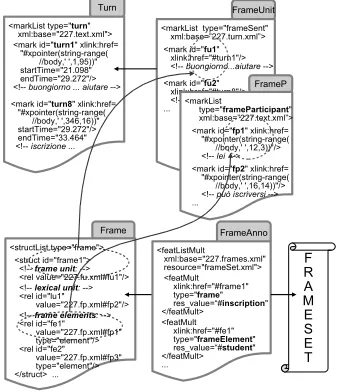
fo-cusing on the representation of frame annotation. In Fig. 3, the top elements represent the dialogue turns and the semantic units underlying the frame annota-tions, which are defined on the base of the dialogue turns. “FrameUnit” markables define the scope or extension of the frames, and roughly correspond to a sentence or turn. “FrameP” markables specify the frame participants, i.e., all elements that receive a semantic role within some frame.
The annotations at the bottom contain information about individual frames. The frames are encoded as
<struct>elements, constituting complex objects that group semantic units to form frames instances. In Fig. 3, the frame with ID frame 1 consists of the frame unit, the lexical unit and the frame partic-ipants. The “FrameAnno” box encodes the name of the frame: “inscription”. The frames can be defined by external “Framesets”, such as FrameNet (Baker et al., 1998), which in our example is stored in an external XML-resource calledframeSet.xml.
Figure 3: Frame annotation inPAULA
5 Alternative Formats
For richly annotated dialogue corpora, alternative representation formats have been proposed. Two of the most prominent ones are the NITE-XML10
10
NITE: http://http://www.ltg.ed.ac.uk/ NITE
and the ELAN11 format. Similar to PAULA, NITE
-XML focuses on richly annotated corpus data. It comes with a rich data model and employs a rich meta specification, which determines—based upon the individual corpus characteristics— the concrete linearization of the respective XML representation. Furthermore, it is accompanied by a JAVA API and a query tool, forming a valuable toolkit for corpus engineers who can adapt available resources to their specific needs. TheELANformat is used by a family of tools developed primarily for language documen-tation, of which the most advanced one isELAN, a robust, ready-to-use tool for multi-level annotation of video. Its underlying data model is the Abstract Corpus Model (ACM) (Brugman and Russel, 2004).
PAULA aims at an application scenario different from both of these formats. First, it builds upon the usage of specialized off-the-shelf annotation tools for the variety of annotation tasks. Both the NITE -XMLandELANapproaches require additional effort and skills from the user, to add the required function-ality, which PAULA aims to avoid. Second, PAULA
takes care of merging the annotations from different sources, which is not in focus ofELANorNITE.
6 Discussion and Future Directions
We presented theLUNAdialogue corpus and its rep-resentation format, the standoff exchange format
PAULA.
In contrast to other formats, PAULA focuses on
an application scenario in which different annota-tions come in their own specific format and are to be merged into one corpus representation. This in-cludes, for instance, the use of specialized off-the-shelf annotation tools for specific annotation tasks, as well as distributed and incremental annotation. The creation of theLUNA dialogue corpus is a pro-totypical example for this scenario.
However, the usefulness of a format also depends on its interoperability and the available tools. With its import filters,PAULAalready serves the needs of linguists of different linguistic communities, while more export functionality is still to be integrated. With the export to WEKA, a first step in this direc-tion is done. Furthermore,ANNIS–a web-based tool for visualizing and searching complex multi-level
11
annotations– is available and will be developed fur-ther.
In our next steps, we will focus on a deliberate extension of thePAULAformat for further and more
complex dialogue annotations, which will enable the use ofPAULAas an exchange format also in this do-main.
References
J. Allen and M. Core. 1997. Draft of DAMSL: Dialog Act Markup in Several Layers.
R. Artstein and M. Poesio, 2006. ARRAU Annotation
Manual (TRAINS dialogues). Univerity of Essex, U.K.
C. F. Baker, C. J. Fillmore, and J. B. Lowe. 1998. The Berkeley FrameNet project. In Proceedings of
COLING-ACL. Association for Computational
Lin-guistics.
C. Barras, W. Geoffrois, Z. Wu, and M. Libermann. 1998. Transcriber: a free tool for segmenting, labeling and transcribing speech. In Proceedings of the First
International Conference on Language Ressources and Evaluation (LREC).
F. Bimbot, M. Faundez-Zanuy, and R. deMori, editors. 2006. Special Issue on Spoken Language
Understand-ing, volume 48 of Speech Communication. Elsevier.
P. Boersma and D. Weenink. 2005. Praat: doing phonetics by computer (Version 4.3.14).
http://www.praat.org.
H. Bonneau-Maynard and S. Rosset. 2003. A semantic representation for spoken dialogues. In Proceedings
of Eurospeech, Geneva.
H. Brugman and A. Russel. 2004. Annotating multi-media/multi-modal resources with ELAN. In
Pro-ceedings of the Fourth International Conference on Language Resources and Evaluation, pages 2065–
2068, Paris: ELRA.
A. Burchardt, K. Erk, A. Frank, A. Kowalski, and S. Pado. 2006. SALTO – A Versatile Multi-Level An-notation Tool. In Proceedings of LREC 2006.
J. Carletta, S. Evert, U. Heid, J. Kilgour, J. Robertson, and H. Voormann. 2003. The NITE XML Toolkit: flexible annotation for multi-modal language data.
Be-havior Research Methods, Instruments, and Comput-ers – special issue on Measuring Behavior,, 35(3).
R. Dhillon, S. Bhagat, H. Carvez, and E. Shriberg. 2004. Meeting Recorder Project: Dialog Act Label-ing Guide. Technical report, TR-04-002 ICSI.
L. Dybkjær, N.O. Bernsen, H. Dybkjær, D. McKelvie, and A. Mengel. 1998. The MATE markup framework. MATE Deliverable D1.2.
EAGLES. 1996. Recommendations for the Morphosyn-tactic Annotation of Corpora. EAGLES Document EAG-TCWG-MAC/R.
N. Gupta, G. Tur adn D. Hakkani-Tur, S. Bangalore, G. Riccardi, and M. Rahim. 2005. The AT&T Spoken Language Understanding System. IEEE Transactions
on Speech and Audio, PP(99).
E. Hovy, M. Marcus, M. Palmer, L. Ramshaw, and R. Weischedel. 2006. Ontonotes: the 90% solution. In Proc. HLT-NAACL.
N. Ide, L. Romary, and E. de la Clergerie. 2003. Interna-tional standard for a linguistic annotation framework. In Proceedings of HLT-NAACL’03 Workshop on The
Software Engineeri ng and Architecture of Language Technology.
P. Kingsbury and M. Palmer. 2003. PropBank: the Next Level of TreeBank. In Proceedings of the
Sec-ond Workshop on Treebanks and Linguistic Theories (TLT).
I. Kruijff-Korbayova, C. Gerstenberger, V. Rieser, and J. Schehl. 2006a. The SAMMIE multimodal dialogue corpus meets the NITE XML toolkit. In Proc. LREC, Genoa.
I. Kruijff-Korbayov´a, V. Rieser, J. Schehl, and T. Becker. 2006b. The Sammie Multimodal Dialogue Corpus Meets the Nite XML Toolkit. In Proceedings of the
Fifth Workshop on multi-dimensional Markup in Nat-ural Language Processing, EACL2006. EACL.
M. Marcus, B. Santorini, and M.A. Marcinkiewicz. 1993. Building a large annotated corpus of English.
Coputational Linguistics, (19).
D. McKelvie, A. Isard, A. Mengel, M. B. Moeller, M. Grosse, and M. Klein. 2001. The MATE work-bench - an annotation tool for XML corpora. Speech
Communication, 33(1-2):97–112.
T. Morton and J. LaCivita. 2003. WordFreak: an open tool for linguistic annotation. In Proceedings of the
2003 Conference of the North American Chapter of the Association for Computational Linguistics on Human Language Technology: Demonstrations.
Ch. M¨uller and M. Strube. 2003. Multi-Level Anno-tation in MMAX. In Proceedings of the 4th SIGdial
Workshop on Discourse and Dialogue.
H. Thompson and D. McKelvie. 1997. Hyperlink se-mantics for standoff markup of read-only documents. In Proceedings of SGML Europe’97.http://www.