Volume 8, No. 5, May – June 2017
International Journal of Advanced Research in Computer Science
RESEARCH PAPER
Available Online at www.ijarcs.info
ANN Based Framework for Energy Efficient Routing In Multi-Hop WSNs
Rajan Sharma
Department of Electronics and Communication Engineering I.K. Gujral Punjab Technical University, Jalandhar
Punjab, India
Amar Singh
Department of Computer Science and Engineering Baddi University of Emerging Sciences & Technology
Baddi (HP) India
Balwinder Singh Sohi
Department of Electronics and Communication Engineering CGC Group of Colleges, Mohali
Punjab, India
Shakti Kumar
Computational Intelligence Laboratory Baddi University of Emerging Sciences & Technology
Baddi (HP) India
Abstract – This paper proposes a soft computing based framework for optimal cost path routing in the large scale WSNs. The proposed approach works in two phases; initialization phase and the operational phase. In order to evaluate route costs, the paper first proposes an ANN based integrated link cost (ILC) measure. ILC is a function of residual sensor node energy, average end to end delay (EED) and network throughput. In the initialization phase the framework sets up and self-organizes the WSN and creates routing tables and initial set of s-t paths through cluster heads. In the operational phase optimal routes under given timing constraints are evolved using BB-BC optimization approach. Timing constraints are imposed due to dynamic conditions arising because of energy expenditure of the nodes. Once the near shortest path/optimal routes are available, data transmission for a predefined interval takes place in the WSN. The ILC based dynamic shortest path routing approach improves throughput, reduces average end to end delay and improves the life time of the WSN. We implemented the proposed framework in MATLAB and its performance on optimal path enumeration was simulated. The framework was observed to be working extremely efficiently by evaluating near least cost path, thus keeping track on throughput, end to end delay and energy efficiency of the given WSN.
Keywords - Wireless Sensor Networks, Integrated Link Cost, Artificial Neural Network (ANN), Big Bang- Big Crunch (BB- BC).
I. INTRODUCTION
Wireless Sensor Networks (WSNs) is an emerging field that has been target of recent research due to its ever growing popularity attributed to its wide range of applications. A WSN is the network of distributed and connected tiny wireless sensors nodes that have the ability to sense a variable of interest [1]. The sensor networks are different from other networks as these do not focus on human interaction but instead focus on interaction with the environment. A sensor node integrates sensing, computing, and Communication into a single unit. These sensor nodes have limited battery based capacity; are deployed in untethered and unattended environment and hence, it is not possible to improve battery life by replacing or recharging the battery [2][3][4]. Routing is a very challenging task in this unpredictable environment. Energy is a factor of utmost importance in wireless sensor networks and energy efficient operation is the fundamental need for WSNs. In WSNs, the network life time is considered to be equally important to their performance. The most challenging concern in WSNs is to reduce energy consumption and to increase the lifetime of the network to reasonable times without compromising
with their performance. The most of the energy consumption take place in the transmission/ reception process which is dependent upon amount of communication and the distance of communication. The multi-hop communication reduces the burden of energy consumption on individual node by dividing this consumption into number of intermediate nodes but it also increases delay to reach the data from source to destination. So there has to be a trade-off between delay and distance while keeping power optimization as main criteria before selecting multi-hop or single hop in the wireless sensor networks [5]. Thus, choosing the least cost route in terms of energy usage has great impact on the life time of WSNs.
simulation and discussion on the results. Finally section V concludes the paper.
II. RELATED WORK
Power consumption in WSNs has been critical concern as it determines the lifetime and performance of networks. Reduction in power consumption has been an area of research for long.
Shakti Kumar et al. [8] proposed an energy efficient communication approach for WMNs which could also be adapted for WSNs. The proposed frame work for optimal routing based on integrated link cost measure named ILC; which is a function of three network parameters i.e., throughput, jitter, delay and residual energy of the node. Authors used a fuzzy logic based approach to evaluate ILC. They also proposed that Big Bag- Big Crunch (BB-BC) optimization algorithm [6][7] is the potential candidate to evaluate the shortest path or near shortest path in wireless mobile networks (WMN) applications.
Heinzelman et al. [9] proposed a low energy efficient adaptive clustering hierarchy (LEACH) algorithm in which wireless sensor nodes are deployed in the form of clusters for data aggregation. In LEACH, cluster heads (CHs) perform the aggregation of data in periodic manner to reduce the redundancy in data to be communicated to Base Station. In setup phase, the rotation/selection of CHs is the function of two parameters: Percentage of CH selection and how many times a specific node has been elected as CH. To make a decision for election, a random number between 0 and 1 is chosen by the wireless sensor node. To become a winner as CH for a particular round, the random number picked by sensor node should be less than threshold value. In the steady state phase, transmission of data takes place between the cluster members to CH, and then finally data is transmitted to the Base Station.
Di Tang et al. [10]focused on lifetime optimization, Packet Delivery Ratio (PDR) and security concerns. They investigated that non uniform deployment strategy in terms of energy is more efficient, optimize lifetime and increases Packet delivery ratio (PDR) under the same requirements like energy resources and security as compared to uniform energy deployment strategy.
Jalal Habibi et al. [11] presented the framework in which they emphasize on optimal link cost assignment, extending network lifetime and provides optimal route strategy by implementing heuristic algorithm. In this work, the cost assigned are changing dynamically and re-computing the routes which are more energy efficient.
From the above discussion, we can summarize that optimal and energy efficient routes provided by different clustering techniques on the basis of earlier proposed integrated link cost measure still have several shortcomings that need to be addressed, for power optimization and to increase the life time of network. The approaches based on clustering increases robustness, scalability and provide data aggregation and load balancing [3, 4, 12-19]. The above discussion also shows that reducing the distance of communication strategically is a better option but energy efficiency and lifetime depends upon the cluster head selection method, number of hops and optimal route evaluation for data transfer between sources to destination or Base Station. Furthermore, the proposed technique not
only is energy efficient but also performs better on load balancing, decreases delay, increases throughput and thus extends the lifetime of network when compared with state-of-the-art techniques.
III. THE WSN FRAMEWORK
In this section we propose an ANN based WSN routing framework and its constituent modules. The framework can be divided into cost evaluation module called ANN based ILC evaluation module, the node architecture and the BB-BC algorithm based optimal cost route evaluation module.
a) The ANN Based ILC Evaluation:
In order to find out the shortest route from amongst a number of alternatives available we need to find cost of the route. The cost of the route is the sum total of the costs of the links which form the route between source to destination node. There are a large number of cost measures available in the literatures which a designer could use [20]. In order to have an energy efficient routing protocol we use an integrated link cost (ILC) measure similar to the one defined in [8]:
Integrated Link Cost (ILC) = ƒ(Residual Energy, Throughput, End to End Delay)
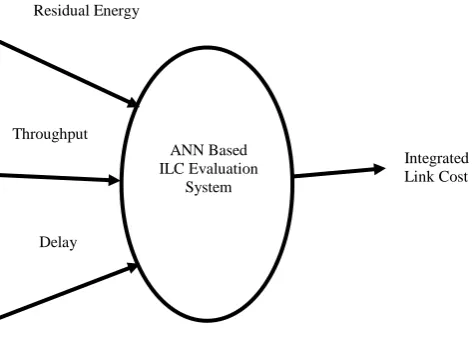
[image:2.595.319.556.460.629.2]We propose the ANN based cost computing approach as shown in Fig. 1 to compute the link cost between two adjacent nodes. This cost computing system is part of the each WSN sensor node. The ANN is trained on the training data available for the ILC.
Fig. 1 ANN based Integrated Link cost computing system
The residual energy is the energy left in the sensor node after sensing, computation and communication. Most of the node energy is spent in communication for transmission and reception.
The energy consumption for transmission of data is expressed as [21]:
(1) ANN Based
ILC Evaluation System Throughput
Residual Energy
Delay
Integrated Link Cost
1 , 2 * * *
) ,
( = k+Camp k d d >
The energy consumption for reception of data is expressed as [21]:
(2)
Where K is expressed as data to be transmitted and “d” is the distance between the two intermediate nodes or from node to cluster head or base station. Represents the energy consumed for transmitting per bit.
Throughput is the rate of successful data delivery in a given time period from source to destination in the wireless sensor networks [22]. The end to end delay (EED) is the time taken by data packet to reach the destination point BS from source in WSN [23] and it also comprises all types of delays which are generally caused because of transmission, processing, buffering etc., at the time of route discovery and queuing at the specific interface. Mathematically, it is expressed as [24]:
EED = Tp + Tq + TT
Whereas Tp = Processing Time
Tq = Queuing Delay
TT
b) The Node Architecture:
=Transmission Time
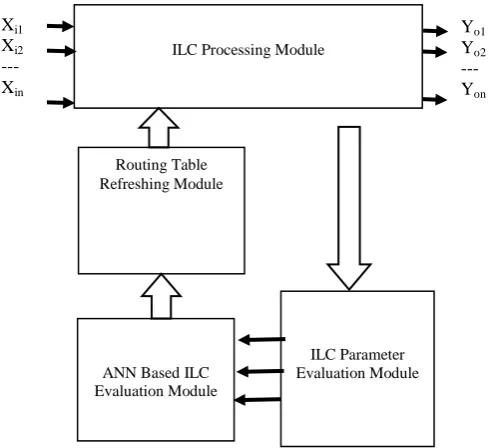
[image:3.595.35.280.458.682.2]The architecture of a proposed WSN node is as given in figure 2. Each node contains an ANN based ILC evaluation module that computes the ILC between all adjacent node pairs of the WSN and conveys this information to every node of the network. Each node maintains a link cost table which helps in evaluating the route costs.
Fig. 2 Architecture of a Proposed WSN Node
c) Dynamic shortest path routing Algorithm for WSNs
The proposed algorithm for the framework for routing in WSNs consists of two phases. In the initialization phase it creates the adjacency matrix and routing tables whereas in operational phase it maintains the data routing between
source-terminal node pair and updates the routing information periodically.
Assumptions:
1. All network nodes are similar in their radio characteristics.
2. Initially any of the WSN nodes can be assigned as cluster head (CH). Thereafter for next round, the sensor node with highest energy in a cluster shall act as CH.
3. Each node has a range to communicate to any other node of the adjacent cluster with additional power consumed. Nodes working as CH are allowed to consume energy twice of the energy when these are working as ordinary sensor nodes.
4. A given WSN is set up into a given number of clusters. 5. Nodes within a cluster communicate to CH directly.
Initialization Phase:
1. Organize entire WSN into clusters and assign a CH for every cluster.
2. For all Clusters, each CH senses neighborhood CH within its operating radio range in the WSN. Through control messages this information is conveyed to all the CHs to constitute a WSN wide adjacency matrix for each of the CH node. A sensor node whose energy level drops down to a minimum energy threshold required for it to be treated as CH can’t act as CH. This CH is allowed to exit network. In its place a new node with highest energy is allowed to join the network as CH. If more than one nodes have highest energy one of them is assigned randomly as the CH by the cluster. This sets up WSN wide communication network; it also allows the entry and exit of any CH in the communication network with most recent information.
3. From all source nodes of the cluster generate a very small percentage of rated traffic towards CHs. Assuming equal throughputs, permitted network delays, and full residual energy for every source-destination node pair.
4. For each cluster Compute ILCs based distance for each adjacent node pair.
5. For each cluster build cost matrix for each adjacent node pair.
6. For each source-BS pair, create the routing tables and allow the traffic to flow in the network.
7. For each of the source nodes of a cluster compute set of paths between source node-BS pair.
Operational Phase:
1. WSN wide, for each cluster:
a) A cluster is maintained by allowing entry/exit of incoming/outgoing nodes.
b) Allows the entry/exit of new CH/Old CH. c) ILC based distance/cost is computed between the
sources sensor node-BS pair through a communication network formed by adjacent CHs for the current traffic. Update cost matrix at each node [25].
ILC Processing Module
ILC Parameter Evaluation Module ANN Based ILC
Evaluation Module Routing Table Refreshing Module Xi1
Xi2 --- Xin
Yo1 Yo2 --- Yon k
elec E k Rx
2. The shortest path/ near shortest path is evaluated for given source node–BS (terminal) pair, using a suitable soft computing approach [25]. To enumerate ILC based near shortest path, we adapted for WSNs, the BB-BC optimization algorithm based approach as given in [6].
3. Update the routing tables (for each source node-BS (terminal) node pair).
4. Continue with the data routing process for a pre-specified time/ as required by the network dynamics.
5. Go to step 1.
As stated in step 2 above we use the BB-BC approach to evaluate ILC based near shortest path. The path evaluated is not the shortest path but we term it as the “near shortest path” as this BB-BC based approach generates a good enough path that can be evaluated within a given time constraint. Hence, we have no option but to use this good enough/near shortest path in place of shortest path.
IV. SIMULATION, RESULTS AND DISCUSSION
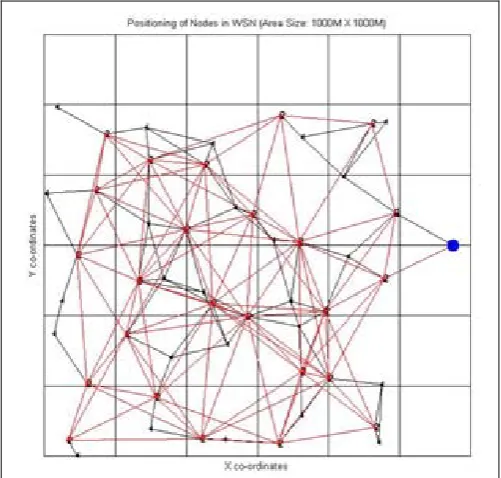
In order to validate our framework we implemented the proposed framework in MATLAB and simulated the approach for various WSN scenarios as given in Table 1. The ILC was evaluated using the proposed ANN model. The optimized ANN model was identified using proprietary model identification software available with Computational Intelligence Laboratory (CI-Lab) at Baddi University of Emerging Sciences and Technology. We conducted 25 simulation trials for each scenario of the implemented framework. In all of the trials the software was able to generate the WSN successfully. Fig. 3 presents a WSN formed by one of the trials.
[image:4.595.318.572.239.467.2]
Fig. 3 Positioning of Nodes in WSN
Once the WSN was constituted, the framework then enumerated a set of initial routes between a given source node of a given cluster and the destination node which is the
base station (BS) node. The frame work then applied a Big Bang- Big Crunch (BB-BC) optimization based approach to evolve optimal paths/near shortest path routes within the stipulated timing constraint. We have used a proactive routing approach in which an initial population of four routes between the source sensor node and the destination node (BS) was created.
[image:4.595.30.281.476.715.2]The framework evolves a new population of routes from the given population. The BB-BC approach used to evolve new generations of routes from the current generation of routes has been adapted from [8]. The Figure 4 depicts the progress of near shortest path enumeration with the increasing iterations. We observed that in all the 25 trials which were conducted the frame work was able to establish a near shortest path within the specified time constraint.
Fig. 4 Progress ofshortest path evaluation process using BB-BC Approach
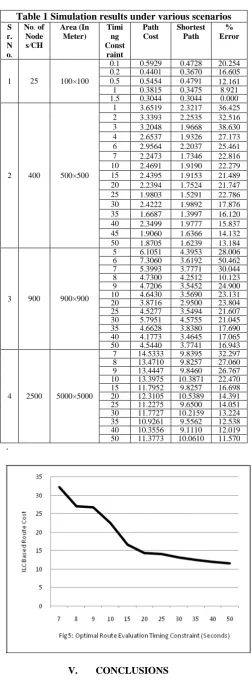
The simulation results under various network scenarios are presented in Table 1. A look at the percent error indicates that as the processing time constraint is relaxed with increased processing time constrain, the percentage error comes down. This reduction in route cost is not linear this is due to the fact that we used BB-BC algorithm based optimization approach. It is an approximate reasoning based approach which is a randomized guided process. Most often but not always higher processing times result into lesser cost routes. Figure 5 presents the ILC based route cost with increasing time constraint for a 2500 cluster WSN spread over an area of 5000× 5000 m2.
.
V. CONCLUSIONS
Routing and life time improvement are two challenging issues faced by WSN designers. In this paper we presented a new soft computing based framework for optimal path routing in the large scale WSNs. The first module of the
proposed framework is an ANN based integrated link cost (ILC) measure evaluation module. The ILC is a function of residual sensor node energy, average end to end delay (EED) and network throughput/packets sent. The framework uses a near shortest path routing evaluation approach based upon BB-BC optimization based approach to improve the throughput, reduces the average delay and attempts to improve the average life time of the WSN. The framework first self-organizes itself to a WSN by using the radio ranges of its nodes. It is able to adjust to the new incoming and exiting nodes. Once the network is constituted it evaluates initial population of paths between a source sensor node and the destination node (base station) through a set of cluster heads by taking a proactive routing approach. Once the initial set of routes is established the framework evolves optimal routes using the big bang big crunch optimization approach through a series of big bang and big crunch operations. In order to keep an effective control over the node energies, the optimal cost paths are enumerated under given timing constraints. Once the optimal route evaluation phase is over, the data transfer takes place for a given interval of time called WSN operational phase. We implemented the proposed framework in MATLAB and its performance was simulated for various WSN scenarios. The framework was observed to be working extremely efficiently by evaluating near minimal cost paths, thus keeping track on throughput, end to end delay (EED) and energy efficiency of a given WSN. We conducted 25 trials for each of the WSN scenarios and observed that the framework was able to enumerate near minimum cost route under given timing constraints.
VI. REFERENCES
[image:5.595.30.283.45.727.2][1] N. S. Kulkarni, R. Rakesh, S. Bhargava, S. S. Bundela, and R. Hegde, “Zigbee based low power Wireless Sensor Network motes,” in Proceedings of the International Conference on Next Generation Networks, Mumbai, India, 24-25 September, 2010,
Table 1Simulation results under various scenarios
IET Digital Library, DOI:10.1049/ic.2010.0210, pp. 1–6,
[2] Quanhong Wangand and Hossam Hassanein, A Comparative Study of Energy-Efficient (E2) Protocols for Wireless Sensor Networks, Handbook of Sensor Networks Compact Wireless and Wired Sensing Systems, CRC Press 2004, Chapter 18, Print ISBN: 978-0-8493-1968-6, eBook ISBN:978-0-203-48963-5, DOI:10.1201/9780203489635.
[3] H. Y. Kim, “An energy-efficient load balancing scheme to extend lifetime in wireless sensor networks,” Cluster Computing, Springer, vol. 19, Issue 1, March 2016, doi: 10.1007/s10586-015-0526-9, pp. 279–283.
[4] F. Chiti, R. Fantacci, R.Mastandrea, G. Rigazzi, ´ A. S. Sarmiento, and E. M. M. L´opez, “A distributed clustering scheme with self-nomination: proposal and application to critical monitoring”, Wireless Networks, vol. 21, issue 1, January 2015. DOI: 10.1007/s11276-014-0785-z, pp. 329–345.
[5] M. Younis, I. F. Senturk, K. Akkaya, S. Lee, and F. Senel, “Topology management techniques for tolerating node failures in wireless sensor networks: a survey”, Computer Networks: The International Journal of Computer and Telecommunications Networking,
Volume 58, January, 2014,
doi:10.1016/j.comnet.2013.08.021, pp. 254-283. S
r. N o.
No. of Node s/CH
Area (In Meter)
Timi ng Const
raint
Path Cost
Shortest Path
% Error
1 25 100×100
0.1 0.5929 0.4728 20.254 0.2 0.4401 0.3670 16.605 0.5 0.5454 0.4791 12.161
1 0.3815 0.3475 8.921
1.5 0.3044 0.3044 0.000
2 400 500×500
1 3.6519 2.3217 36.425
2 3.3393 2.2535 32.516
3 3.2048 1.9668 38.630
4 2.6537 1.9326 27.173
6 2.9564 2.2037 25.461
7 2.2473 1.7346 22.816
10 2.4691 1.9190 22.279
15 2.4395 1.9153 21.489
20 2.2394 1.7524 21.747
25 1.9803 1.5291 22.786
30 2.4222 1.9892 17.876
35 1.6687 1.3997 16.120
40 2.3499 1.9777 15.837
45 1.9060 1.6366 14.132
50 1.8705 1.6239 13.184
3 900 900×900
5 6.1051 4.3953 28.006
6 7.3060 3.6192 50.462
7 5.3993 3.7771 30.044
8 4.7300 4.2512 10.123
9 4.7206 3.5452 24.900
10 4.6430 3.5690 23.131
20 3.8716 2.9500 23.804
25 4.5277 3.5494 21.607
30 5.7951 4.5755 21.045
35 4.6628 3.8380 17.690
40 4.1773 3.4645 17.065
50 4.5440 3.7741 16.943
4 2500 5000×5000
7 14.5333 9.8395 32.297
8 13.4710 9.8257 27.060
9 13.4447 9.8460 26.767
[6] O.K.Erol and I.Eksin, “A new optimization method: Big Bang-Big Crunch”, Advances in Engineering Software, Elsevier, vol. 37, no. 2, Feb. 2006, pp. 106–111. [7] Kumbasar T, "Adaptive fuzzy model based inverse
controller design using BB-BC optimization algorithm", Expert Systems with Applications: An International Journal, Volume 38, Issue 10, September 2011, doi:10.1016/j.eswa.2011.04.015, pp. 12356-12364 [8] S. Kumar, B. Singh, S. Sharma. “Soft Computing
Framework for Routing in Wireless Mesh Networks: An Integrated Cost Function Approach, IJECCT 2013, Vol. 3 (3). 2013, pp. 25-32.
[9] W. R. Heinzelman, A. Chandrakasan, and H. Balakrish-Nan, “Energy-efficient communication protocol for wireless microsensor networks,” in Proceedings of the IEEE 33rd Annual Hawaii International Conference on System Sciences (HICSS ’00), Maui, HI, USA, vol. 2, January 2000, ISBN:0-7695-0493-0, pp. 1-10,
[10] Di Tang, Tongtong Li, Jian Ren and Jie Wu, “Cost- Aware Secure Routing (CASER) Protocol Design for Wireless Sensor Networks”, IEEE Transactions on Parallel and Distributed Systems, Vol, 26, no. 4, April 2015, pp. 960 - 973
[11] Jalal Habibi, Amar G. Aghdam and Ali Ghrayeb, “A framework for evaluating the best achievable performance by distributed lifetime- efficient routing schemes in Wireless Sensor Networks”, IEEE transactions on Wireless communications Vol. 14, issue 6, Feb. 2015, pp. 3231-3246
[12] M. Pant, B. Dey, and S. Nandi, “A multihop routing protocol for wireless sensor network based on grid clustering,” in Proceedings of the 2nd International Conference on Applications and Innovations in Mobile Computing (AIMoC ’15), Kolkata, India, February
2015, pp. 137–140, DOI:
[16] E. A. Khalil, B. A. Attea, “Energy-aware evolutionary routing protocol for dynamic clustering of wireless
sensor networks”, Swarm and Evolutionary Computation, vol. 1, no.4, 2011, pp. 195-203, https://doi.org/10.1016/j.swevo.2011.06.004
[17] A. Thakkar and K. Kotecha, “A new Bollinger Band based energy efficient routing for clustered wireless sensor network,” Applied Soft Computing, vol. 32, July 2015, pp. 144–153, https://doi.org/10.1016/j.asoc.2015.03.018
10.1109/AIMOC.2015.7083842
[13] J. Y. Chang and P. H. Ju, “An energy-saving routing architecture with a uniform clustering algorithm for wireless body sensor networks”, Future Generation Computer Systems, vol. 35, 2014, pp.128–140, https://doi.org/10.1016/j.future.2013.09.012
[14] G. Smaragdakis, I. Matta, A. Bestavros, “SEP: A stable election protocol for clustered heterogeneous wireless sensor networks”, in International Workshop on SANPA, 2004.
[15] D. Kumar, T. C. Aseri, R. B. Patel, “EEHC: Energy efficient heterogeneous clustered scheme for wireless sensor networks”, Computer Communications, vol. 32,
issue 4, March 2009, pp. 662–667,
https://doi.org/10.1016/j.comcom.2008.11.025.
[18] SS J. Chang-Jiang, S. Wei-Ren, T. Xian-Lun, W. Ping, and X. Min, “Energy-balanced unequal clustering routing protocol for wireless sensor networks,” The Journal of China Universities of Posts and Telecommunications, vol. 17, no. 4, 2010, pp. 94–99. [19] X. Liu, “A survey on clustering routing protocols in
wireless sensor networks” Sensors, vol. 12, no. 8, pp. 11113–11153, 2012.
[20] Amar Singh, Sukhbir S. Walia and Shakti Kumar, “FW-AODV : An Optimized AODV Routing Protocol for Wireless Mesh Networks”, International Journal of Advanced Research in Computer Science, Vol. 8, No.3, March-April 2017, pp 1131-1135.
[21] Haouari Benlabbes, Benahmed Khelifa, and Beladgham Mohammed. "Image Transmission Model with Quality of Service and Energy Economy in Wireless Multimedia Sensor Network", International Journal of Advanced Computer Science and Applications, Volume 7, Issue 2, 2016,
[24] V. Rajendran, K. Obraczka and J. J. Garcia-Luna-Aceves: Energy efficient collision-free medium access control for wireless sensor networks: Proceedings of the 1st International Conference on Embedded Networked Sensor Systems, SenSys ’03, Nov. 5–7, 2003, Los Angeles, California, USA, pp. 181-192, DOI:
pp. 180 – 184. DOI 10.14569/IJACSA.2016.070224
[22] W. Ye, J. Heidemann and D. Estrin, “Medium access control with coordinated adaptive sleeping for wireless sensor networks, In IEEE/ACM transactions on networking, vol. 12, no. 3, 2004, pp. 493-506
[23] Wahid, Abdul, Sungwon Lee, and Dongkyun Kim. "A reliable and energy-efficient routing protocol for underwater wireless sensor networks”, International Journal of Communication Systems, Wiley, Volume 27, Issue 10, Oct 2014, pp. 2048 – 2062, DOI: 10.1002/dac.2455.