Url: http://usnsj.com/index.php/JEE Email: [email protected]
Integrating Edmodo-based Digital Portfolio with EFL Writing
Instruction: Exploring the Students’ Perceptions
Suggestion for the Citation and Bibliography
Citation in text:
Sumarno & Tatik (2018) or (Sumarno & Tatik, 2018) Bibliography:
Sumarno, W. K. & Tatik. (2018). Integrating Edmodo-based Digital Portfolio with EFL Writing Instruction: Exploring the Students’ Perceptions. Journal of English Education, 3(2), 100-106. doi: http://dx.doi.org/10.31327/jee.v3i2.864
A. Introduction
The conventional way of assessment was largely criticized for it focuses only on the students' ability to recall what has been learned, or memorization (Singh, Samad, Hussin, & Sulaiman, 2015) rather than the students’ actual competence to contextually use what has been learned. In Wahyu Kyestiati Sumarno
Universitas Islam Darul Ulum [email protected] +6285640777045
Tatik
Universitas Islam Darul Ulum [email protected] +6285743072382
o-ISSN:2502-6909 p-ISSN: 2502-9207
Vol. 3, No. 2, December 2018
URL: http://dx.doi.org/10.31327/jee.v3i2.864
Received : 7 November 2018 Reviewed : 8 November 2018 Accepted : 20 November 2018
© 2018 JEE All rights reserved
Abstract
T
he increasing number of ICT integration into language classrooms has made many teachers conducted research to examine its effectiveness. Studies have shown that Edmodo is an effective tool for students to improve their writing skills. However, very few studies investigate the use of Edmodo as a media for digital portfolio and explore its impact in EFL writing classes. This research was done primarily aimed to describe EFL learners’ perceptions of the implementation of Edmodo-based digital portfolio in a Paragraph-based Writing course. Fifteen students participated in the study that lasted for seven meetings. Data were analyzed qualitatively and collected by using questionnaire and a semi-structured interview. Findings revealed that the students responded positively to the use of Edmodo-based digital portfolio in the writing course. Furthermore, they also reported that digital portfolio helps them improving their writing fluency and increasing self-reflection. This study recommends the use of Edmodo as a platform for an online portfolio in the writing class.Keywords: Edmodo, digital portfolio, writing course, students’ perceptions
AUTHORS INFO ARTICLE INFO
to an alternative assessment which is process-oriented and asks the students to perform real-world tasks is highly suggested. Meanwhile, since assessment and instructions are inseparable, a process-oriented assessment will automatically require a process-oriented teaching approach. A process-oriented approach deals with the way through which a person achieves the final product (Sun & Feng, 2009). It gives more attention to how to get there and skill development along the way. A process-oriented writing class will facilitate the students to practice writing step by step, just like a professional author. Remembering that it is impossible to produce a well-written text without any revisions, students need to be taught the same way. They must go through a sequence of process writing to finalize their works, which generally includes pre-writing, outlining, writing and revising, and writing the final draft. Some studies have shown that process-oriented writing is highly influential in improving the students’ writing skills (Kaya & Ateş, 2016).
Then, to assess these writing processes, a portfolio is one kind of authentic assessments that is suitable for process-oriented writing class. It includes a purposeful collection of students’ works showing their potential progress and achievements (Weigle, 2007). By using portfolios, students' writing that commonly product-based assessed, will alter into process-oriented. In other words, students are given the opportunity to revise their writings and improve the quality based on peer and teacher’s feedback and guidance. A study by Tabatabaei & Assefi (2012) has revealed that portfolio assessment technique improves writing ability of the students.
Meanwhile, the limitation of time allotment given to English class, including writing, makes it difficult to give intensive portfolio assignment. A media is required to be the bridge for students’ controlled-learning outside of the class. Online application, named Edmodo, is proposed in this study. Edmodo is a social-network-based learning platform intended for educational practitioners, such as teachers, students, and parents. Edmodo was first developed at the end of 2008 by Nic Borg and Jeff O'Hara. This media was initially made as an e-learning program which tries to apply an easy, efficient and more enjoyable learning system (Yagci, 2015). The display design of Edmodo is almost the same as Facebook. With Edmodo, teachers can create out of class activities and post comments or grades directly and easily. Portfolio then can be done digitally and can be accessed anywhere with the teacher’s control.
Many studies have shown the positive role of portfolios for writing learners, but very few studies examine the use of Edmodo-based digital portfolio in a process-oriented EFL writing course. Barrot (2016) noted that e-portfolio improves students’ writing performance, aligns teaching and assessment, strengthens students’ learning, enhances teachers’ roles, improves testing process, and increases students’ involvement. While Singh et al. (2015) found that portfolio assessment has provided ESL teachers with the opportunity to document individual student’s growth. Regarding the Edmodo usage into classrooms, Durak, Cankaya, Yunkul, & Ozturk (2017) noted that students who were taught by using Edmodo achieved higher academic performance than those who did not. Al-Kathiri (2015) also concluded that the high positive response to Edmodo made students' attitudes towards learning improved positively. Al-Said (2015) also found that students showed high positive perceptions toward Edmodo. In further, Sumarno & Shodikin (2018) demonstrated that Edmodo facilitated students’ improvement in writing quality and engagement. Considering the potentials of joining together process-oriented approach, portfolio assessment, and Edmodo which still get few attention, this study aims to explore the students’ responses toward the integration of Edmodo-based digital portfolio in a paragraph-based writing class.
B. Methodology 1. Research Design
included activities of choosing and narrowing the topic, and brainstorming. While in the planning stage, the students made sub lists with the words they had listed in the previous stage, created some topic sentences, and designed an outline for their paragraph writing. The students began to write in the third stage, which was writing and revising drafts. As named, this stage required students to start writing their paragraph based on their outlines. Revisions were done in response to the teacher’s and friend’s feedbacks. After being revised, a final copy of the paragraph then was written and turned in. Each of the students' writing in every stage was evaluated for its development of idea, structure, grammar use, vocabulary use, and punctuation.
2. Participants
The subjects of this research were the students of Paragraph-based Writing course at English Department, Darul Ulum Islamic University, Lamongan. Fifteen students took part in this study which was held in seven meetings. They were asked to post each stage of the writing process on a platform made by the teacher at Edmodo.
3. Technique of Data Collection
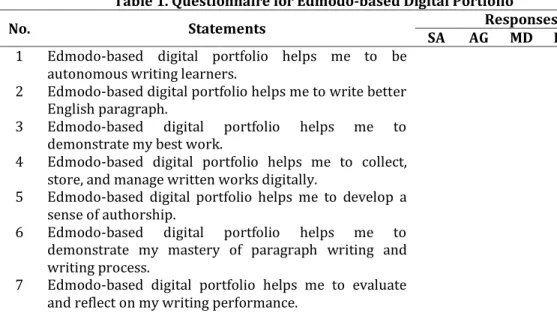
To explore the students’ perceptions toward the usage of Edmodo in their writing class, a questionnaire, and a semi-structured interview were given at the end of the meeting. The questionnaire contained 15 ended statements and 1 open-ended question. The close-ended questions utilized Likert-scale that expected students to choose a response ranged from 1-5, namely strongly agree, agree, moderate, disagree, and strongly disagree. The open-ended question asked them if there was any problem that they faced while using the Edmodo. The interview session was given to each participant. They were asked in English but they could answer either in Indonesian or English. Yet, most of the students answered it in Indonesian. In this case, they were asked about their opinion after being taught by using Edmodo-based digital portfolios with process-oriented approach, their perception about the feedbacks and suggestions for future practices.
4. Technique of Data Analysis
Data from questionnaires and interview were analyzed descriptively to answer the research questions. Standard deviation was firstly calculated to the data gotten in the close-ended questionnaire to see the students’ answers distribution. Then, the open-ended questionnaire and the interview data were discussed one by one according to the grouping developed based on the students’ answers.
5. Instruments
The questions in the questionnaire which was used in this study were adapted and modified from a questionnaire developed by Barrot (2016).
Table 1. Questionnaire for Edmodo-based Digital Portfolio
No. Statements SA AG Responses MD DA SD
1 Edmodo-based digital portfolio helps me to be autonomous writing learners.
2 Edmodo-based digital portfolio helps me to write better English paragraph.
3 Edmodo-based digital portfolio helps me to demonstrate my best work.
4 Edmodo-based digital portfolio helps me to collect, store, and manage written works digitally.
5 Edmodo-based digital portfolio helps me to develop a sense of authorship.
6 Edmodo-based digital portfolio helps me to demonstrate my mastery of paragraph writing and writing process.
No. Statements SA AG Responses MD DA SD
8 Edmodo-based digital portfolio helps me to monitor my progress.
9 Edmodo-based digital portfolio helps me to improve my self-understanding
10 Edmodo-based digital portfolio helps me to recognize the gaps in my current knowledge and skills.
11 Edmodo-based digital portfolio motivates me to write better.
12 Edmodo-based digital portfolio reduces my stress and anxiety in writing.
13 Edmodo-based digital portfolio helps me to practice critical thinking and deep learning.
14 Edmodo-based digital portfolio is easy to manage. 15 Edmodo-based digital portfolio facilitates constructive
feedback from peers and teachers.
Note: SA = Strongly Agree, AG = Agree, MD = Moderate, DA = Disagree, SD = Strongly Disagree
The open question: “What are the problems you encountered during the implementation of the Edmodo-based digital portfolio?”
C. Findings and Discussion 1. Findings
This study focused on exploring students’ perceptions on the integration of Edmodo-based digital portfolio in a writing course. Questionnaire and interview analysis demonstrated that the students perceived both advantages and problems when using Edmodo.
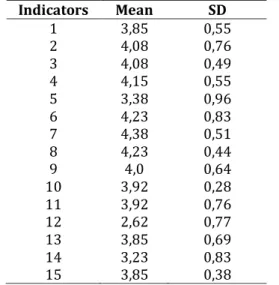
Table 2. Scores and Standard Deviations of the Questionnaire
Indicators Mean SD
1 3,85 0,55
2 4,08 0,76
3 4,08 0,49
4 4,15 0,55
5 3,38 0,96
6 4,23 0,83
7 4,38 0,51
8 4,23 0,44
9 4,0 0,64
10 3,92 0,28
11 3,92 0,76
12 2,62 0,77
13 3,85 0,69
14 3,23 0,83
15 3,85 0,38
Table 2 shows that the standard deviations for all indicators are below 1. It means that the distribution of the students’ answers are good. The mean scores ranged from 2,63 (moderate) to 4,38 (great). It means that generally, Edmodo-based digital portfolio gave positive effects to the students’ learning. More specifically, it appeared to give the greatest positive effect on helping the students evaluate and reflect on their writing. Yet, it also has the least effect on reducing the students’ stress and anxiety in writing. Nevertheless, the majority of the indicators (12 of 15) were positively responded.
trouble when sending the assignment. This may be the reasons why Edmodo did not reduce their stress and anxiety in writing. Many of them (22%) also said that they did not get a notification for accepted assignment thus they sometimes noted as did not submit the assignment even though they did. These problems indicated that future integration of internet-based instruction asks for serious readiness regarding the internet stuff.
Even though students faced a relatively great problem in dealing with the internet, interview session has shown that they benefited a lot on the use of Edmodo as a media for an online portfolio. As one of the students pointed out:
Lebih ngerti, Miss, kalau nulis itu langkah-langkahnya seperti apa, komponen-komponennya apa aja, terutama controlling idea. Awalnya saya nulis tanpa controlling idea, topic sentence dan concluding sentence juga masih salah.
[It enabled me to train my writing skills step by step. I do not know before about the components of a paragraph and how to write each of them correctly. Now I know that there is a controlling idea for each paragraph.]
Another student also said:
Proses revisi membuat saya belajar bagaimana mengembangkan tiap poin, Miss. Jadi merasa lebih dalam belajar nulisnya.
[Through a sequence of revisions, now I can reflect on my writing and know how to develop an idea or supporting sentences. I think my quality of writing is getting better.]
Regarding the feedbacks, which were given online by the teacher and the other students by peer editing, most of them argued that they appreciate comments from their peer but prefer to the teacher’s suggestions. One of them said:
“Biasanya pada nggak serius, Miss. Mungkin karena dia sendiri masih belum paham. [Sometimes, my peer is not so serious giving me comments. Maybe she doesn’t fully understand yet.]
When the students were asked about the weaknesses of this learning strategy, almost all of them said that the internet is not cooperative.
Edmodo is not easy to manage. When I send my assignment, sometimes it is error. It is quite frustrating. Moreover, if I have sent the file, but do not get any notification, then the teachers said in the class that she does not receive yet. It's very disappointing.
However, some students just kept silent for this question. The other thing they learn through this media was punctuation rules. One of them declared:
Sebelumnya, kalau nulis, saya tidak memperhatikan aturan penulisan, Miss. Sekarang saya lebih berhati-hati.
[I never pay attention to my punctuation before like the capitalization. By this process, I feel become more careful in writing.]
As the closing, the students were asked about suggestions for future implementation. One student pointed out:
Setuju, Miss. Tapi, berharap masalah akses internet bisa teratasi terlebih dulu. [I agree, Miss, but please think about the internet problem solution.]
Another student also commented:
[This strategy is actually very helpful. If only we have a good campus Wi-Fi.]
Based on the interview session, it can be concluded that the students took advantage of Edmodo-based digital portfolios implementation, but it was not without problems. Many students got troubles regarding the internet connection. Thus, future integration must look for the solution for the problems.
2. Discussion
This study's objective was to explore the students' responses toward the implementation of Edmodo-based digital portfolio in their paragraph-based writing class. In 7 meetings, the students were asked to post each of their works in the Edmodo. The method used in the class was process-oriented writing, thus the digital portfolio contained the record of students' compositions in each stage of the writing process. The students got feedback from their teacher online as well for every submission so that they can revise. Peer editing was also given once in the middle of the learning process.
Results showed that the students gave positive perceptions to the integration of Edmodo-based digital portfolio in their writing class. Most of them agreed that Edmodo helped them evaluate and reflect on their writing performance, monitor their progress, and collect, store and manage their works digitally. Through the interview, most students' also told that digital portfolio enables them to revise their works thus they were trained to write step by step and are assessed by process. They also told that their quality of writing is getting better. This finding is in line with what had been noted by Alshahrani & Windeatt (2012). Through their study, they concluded that the students benefited from the use of E-portfolios for it provides a means for students to control their learning and record their academic development and their strengths and weaknesses. Barrot (2016) on E-portfolio also demonstrated that E-portfolio gives the students opportunities to reflect on their works and present their best works.
During the implementation of the Edmodo-based digital portfolio, the students were also asked to do peer-editing, in addition to teacher’s feedback. This activity was given to make student-student interaction so that they can learn from each other. In this case, the teacher created a rubric to be filled by every student with comments to their friend's writing. Interview results showed that only a few students got the advantage of this activity. Most of them told that not every student is serious in giving comments thus their suggestions were not quite helping. The reason for this is perhaps the students are not ready yet to give comments since they do not fully understand yet, hence they still need the teacher's company. This results actually in contrast to some studies, such as Jeong (2016) who found that students have affirmative perceptions about the use of the cloud-based online writing tool and having collaborative peer-editing experience. Therefore, evaluation is required for future practices.
Furthermore, the students’ positive perception towards Edmodo utilization is not without problem. From the questionnaire and interview, plenty of them criticized that Edmodo application requires many spaces in internal memory and a good internet connection. Hence, they told that Edmodo does not reduce their stress and anxiety in writing and that Edmodo is not easy to manage. They even expected consideration for better internet connection before a teacher implements internet-based instruction. For this matter, the teacher has to reflect and make sure providing stable internet connection if he intends to utilize internet tools again in the future.
D.Conclusion
Acknowledgement
We would like to say thank you to the Directorate of Research and Community Service, Ministry of Research, Technology, and Higher Education for funding this study with contract number 038/U/BU.2/A.4/IV/2018.
E. References
Al-Kathiri, F. (2015). Beyond the Classroom Walls: Edmodo in Saudi Secondary School EFL Instruction, Attitudes and Challenges. English Language Teaching, 8(1), 189–204. doi: https://doi.org/10.5539/elt.v8n1p189.
Al-Said, K. M. (2015). Students’ Perceptions of Edmodo and Mobile Learning and Their Real Barriers towards Them. Turkish Online Journal of Educational Technology - TOJET, 14(2), 167–180. url: http://www.tojet.net/articles/v14i2/14220.pdf.
Alshahrani, A. & Windeatt, S. (2012). Using an e-Portfolio System to Improve the Academic Writing Performance of ESL Students. In CALL: Using, Learning, Knowing, EUROCALL Conference, Gothenburg, Sweden, 22-25 August 2012, Proceedings (pp. 10–14). Research-publishing.net. doi: https://doi.org/10.14705/rpnet.2012.000018.
Barrot, J. S. (2016). Using Facebook-Based e-Portfolio in ESL Writing Classrooms: Impact and Challenges. Language, Culture and Curriculum, 29(3), 286–301. doi: https://doi.org/10.1080/07908318.2016.1143481.
Durak, G., Cankaya, S., Yunkul, E., & Ozturk, G. (2017). The Effect of a Social Learning Network on Student’ Performances and Attitudes. European Journal of Education Studies, 3(3), 312– 333. doi: https://doi.org/10.5281/zenodo.29295.
Jeong, K. O. (2016). A Study on the Integration of Google Docs as a Web-based Collaborative Learning Platform in EFL Writing Instruction. Indian Journal of Science and Technology, 9(39). doi: https://doi.org/10.17485/ijst/2016/v9i39/103239.
Kaya, B. & Ateş, S. (2016). The Effect of Process-Based Writing Focused on Metacognitive Skills-Oriented to Fourth Grade Students’ Narrative Writing Skill. TED EĞİTİM VE BİLİM, 41(187). doi: https://doi.org/10.15390/EB.2016.6752.
Oshima, A. & Hogue, A. (1994). Writing Academic English (4th ed., Vol. 37). New York: Longman. Singh, C. K. S., Samad, A. A., Hussin, H., & Sulaiman, T. (2015). Developing a Portfolio Assessment
Model for the Teaching and Learning of English in Malaysian L2 Classroom. English Language Teaching, 8(7), 164–173. doi: https://doi.org/10.5539/elt.v8n7p164.
Sumarno, W. K. & Shodikin, A. (2018). Students’ Engagement, Writing Performance and Perception towards the Utilization of Edmodo in a Writing Course (pp. 381–386). Presented at the Tenth International Conference on Applied Linguistics and First International Conference on Language, Literature and Culture. Retrieved from http://www.scitepress.org/DigitalLibrary/Link.aspx?doi=10.5220/0007167703810386. Sun, C. & Feng, G. (2009). Process Approach to Teaching Writing Applied in Different Teaching
Models. English Language Teaching, 2(1). doi: https://doi.org/10.5539/elt.v2n1p150. Tabatabaei, O. & Assefi, F. (2012). The Effect of Portfolio Assessment Technique on Writing
Performance of EFL Learners. English Language Teaching, 5(5). doi: https://doi.org/10.5539/elt.v5n5p138.
Weigle, S. C. (2007). Teaching writing teachers about assessment. Journal of Second Language Writing, 16(3), 194–209. doi: https://doi.org/10.1016/j.jslw.2007.07.004