Using Web Selectors for the Disambiguation of All Words
Hansen A. Schwartz and Fernando Gomez School of Electrical Engineering and Computer Science
University of Central Florida Orlando, FL 32816, USA
{hschwartz, gomez}@cs.ucf.edu
Abstract
This research examines a word sense dis-ambiguation method using selectors acquired from the Web. Selectors describe words which may take the place of another given word within its local context. Work in using Web se-lectors for noun sense disambiguation is gen-eralized into the disambiguation of verbs, ad-verbs, and adjectives as well. Additionally, this work incorporates previously ignored ad-verb context selectors and explores the effec-tiveness of each type of context selector ac-cording to its part of speech. Overall results for verb, adjective, and adverb disambigua-tion are well above a random baseline and slightly below the most frequent sense base-line, a point which noun sense disambigua-tion overcomes. Our experiments find that, for noun and verb sense disambiguation tasks, each type of context selector may assist target selectors in disambiguation. Finally, these ex-periments also help to draw insights about the future direction of similar research.
1 Introduction
The great amount of text on the Web has emerged as an unprecedented electronic source of natural language. Recently, word sense disambiguation systems have fostered the size of the Web in or-der to supplant the issue of limited annotated data availability for supervised systems (Mihalcea, 2002; Agirre and Martinez, 2004). Some unsupervised or minimally supervised methods use the Web more di-rectly in disambiguation algorithms that do not use a training set for the specific target words.
One such minimally supervised method uses se-lectors acquired from the Web for noun sense disam-biguation by comparing the selectors of a given
sen-tence to a target noun within the sensen-tence (Schwartz and Gomez, 2008). Although this work found strong results, many aspects of the use of selectors was left unexplored. For one, the method was only applied to noun sense disambiguation, focusing on the well-developed noun hypernym hierarchy within Word-Net (Miller et al., 1993). Additionally, the role of different types of selectors was not extensively ex-plored, and adverb selectors were not used at all. We seek to address those issues.
In this paper, we extend our method of using se-lectors from the Web for noun sense disambigua-tion into a more robust method of disambiguating words of all parts of speech. After a brief back-ground on selectors and related work, we explain the acquisition and empirical application of selec-tors from nouns, verbs, adjectives, pronouns/proper nouns, and adverbs. Finally, results are presented from the SemEval-2007 coarse grained all-words task (Navigli et al., 2007), and we explore the influ-ence of various types of selectors on the algorithm in order to draw insight for future improvement of Web-based methods.
2 Background
In this section we describe related research in selec-tors and solving the problem of word sense disam-biguation (WSD). Specifically, two types of WSD research are examined: works that used the Web in direct manner, and works which applied a similarity or relatedness measure.
2.1 Selectors
The term selector comes from (Lin, 1997), and refers to a word which can take the place of another given word within the same local context. Although
Lin searched a dependency relationship database in order to match local context, it is not yet possible to parse dependency relationships of the entire Web. In turn, one must search for text as local context. For example, in the sentence below, the local context for ‘strikers’ would be composed of “he addressed the” and “at the rally.”.
He addressed the strikers at the rally.
Previously, we introduced the idea of using selec-tors of other words in a sentence in addition to se-lectors of the target, the word being disambiguated (Schwartz and Gomez, 2008). Words taking the place of a target word are referred to astarget selec-torsand words which take the place of other words in a sentence are referred to as context selectors.
Context selectorscan be classified further based on their part of speech. In our example, if ‘striker’ was the target word, theverb context selectorswould be verbs replacing ‘addressed’ and thenoun context se-lectorswould be nouns replacing ‘rally’.
Similarityis used to measure the relationship be-tween a target word and its target selectors, while
relatednessmeasures the relationship between a tar-get word and context selectors from other parts of the sentence. Thus, the use of selectors in disam-biguating words relies on a couple assumptions:
1. Concepts which appear in matching syntactic constructions aresimilar.
2. Concepts which appear in the context of a given target word are relatedto the correct sense of the target word.
Note that ‘concept’ and ‘word sense’ are used in-terchangeably throughout this paper. This idea of distinguishing similarity and relatedness has an ex-tensive history (Rada et al., 1989; Resnik, 1999; Pat-wardhan et al., 2003; Budanitsky and Hirst, 2006), but most algorithms only find a use for one or the other.
2.2 Related Word Sense Disambiguation
A key aspect of using selectors for disambiguation is the inclusion of context in the Web search queries. This was done in works by (Martinez et al., 2006) and (Yuret, 2007), which substituted relatives or similar words in place of the target word within a
given context. The context, restricted with a win-dow size, helped to limit the results from the Web. These works followed (Mihalcea and Moldovan, 1999; Agirre et al., 2001) in that queries were con-structed through the use of a knowledge-base, fill-ing the queries with pre-chosen words. We also use context in the web search, but we acquire words matching a wildcard in the search rather than incor-porate a knowledge-base to construct queries with pre-chosen relatives. Consequently, the later half of our algorithm uses a knowledge-base through simi-larity and relatedness measures.
Some recent works have used similarity or relat-edness measures to assist with WSD. Particuarly, (Patwardhan et al., 2003) provide evaluations of var-ious relatedness measures for word sense disam-biguation based on words in context. These evalu-ations helped us choose the similarity and related-ness measures to use in this work. Other works, such as (Sinha and Mihalcea, 2007), use similar-ity or relatedness measures over graphs connecting words within a sentence. Likewise, (Navigli and Ve-lardi, 2005) analyze the connectivity of concepts in a sentence among Structured Semantic Interconnec-tions (SSI), graphs of relaInterconnec-tionships based on many knowledge sources. These works do not use selec-tors or the Web. Additionally, target selectorsand
context selectorsprovide an application for the dis-tinction betweensimilarityandrelatednessnot used in these other methods.
Several ideas distinguish this current work from our research described in (Schwartz and Gomez, 2008). The most notable aspect is that we have gen-eralized the overall method of using Web selectors into disambiguating verbs, adverbs, and adjectives in addition to nouns. Another difference is the in-clusion of selectors for adverbs. Finally, we also ex-plore the actual impact that each type of selector has on the performance of the disambiguation algorithm.
3 Approach
In this section we describe the Web Selector algo-rithm such that verbs, adjectives, and adverbs are disambiguated in addition to nouns. The algorithm essentially runs in two steps:acquisition of selectors
3.1 Acquisition of Selectors
Selectors are acquired for all appropriate parts of speech. Whether the selectors are used as target selectorsorcontext selectors depends on the target word with which they are being applied. Thus, one process can be used to acquire allnoun,verb, adjec-tive, andadverb selectors. Additionally, noun selec-tors can be acquired for pronouns and proper nouns (referred to as “pro” selectors). These are regular nouns found to replace a pronoun or proper noun within their local context.
The first step in acquisition is to construct a query with a wildcard in place of the target. In our ex-ample, with ‘address’ as the target, the query is “he * the strikers at the rally.” Yahoo! Web Services1
provides the functionality for searching the web for phrases with wildcards. Selectors are extracted from the samples returned from the web search by match-ing the words which take the place of the wildcard. All words not found in WordNet under the same part of speech as the target are thrown out as well as phrases longer than 4 words or those containing punctuation.
The system enters a loop where it:
• searches the web with a given query, and
• extracts selectors from the web samples.
The query is truncated and the search is repeated un-til a goal for the number of selectors was reached or the query becomes too short. This approach, de-tailed in (Schwartz and Gomez, 2008), removes se-lect punctuation, determiners, and gradually short-ens the query one word at a time. Selectors retrieved from a larger query are removed from the results of smaller queries as the smaller queries should sub-sume the larger query results. Some selectors re-trieved for the example, with their corresponding web query are listed in Table 1.
3.2 Similarity and Relatedness
To apply selectors in disambiguation,similarityand
relatednessmeasures are used to compare the selec-tors with the target word. We incorporate the use of a few previously defined measures over WordNet (Miller et al., 1993). The WordNet::Similarity pack-age provides a flexible implementation of many of these measures (Pedersen et al., 2004). We config-ured WordNet::Similarity for WordNet version 2.1,
1http://developer.yahoo.com/search/
He addressed the * at the rally
crowd:1
He addressed * at the rally
student:1, supporter:2
He addressed * at the
Council:1, Muslim:1, Saturday:1, Ugandan:1, analyst:2, attendee:20, audience:3, class:2, consumer:1, council:1, delegate:64, diplomat:2, employee:2, engineer:1, fan:1, farmer:1, globalization:1, graduate:5, guest:2, hundred:3, investor:1, issue:1, journalist:9, lawmaker:11, legislator:1, member:6, midshipman:1, mourner:1, official:2, parliamentarian:1, participant:17, patient:1, physician:18, reporter:8, sailor:1, secretary:1, soldier:3, staff:3, student:20, supporter:8, thousand:3, today:2, trader:1, troops:2, visitor:1, worker:1
He * the strikers at the
treat:2
He * the strikers at
get:1, keep:1, price:1, treat:1
Table 1: Lists of selectors for the target words ‘striker’ and ‘address’ returned by corresponding web queries.
the same version used to annotate our chosen exper-imental corpus.
Arelatednessmeasure was used withcontext se-lectors, and we chose the adapted Lesk algorithm (Banerjee and Pedersen, 2002). An important char-acteristic of this measure is that it can handle multi-ple parts of speech. Fortarget selectorswe sought to use measures over the WordNet ontology in order to most closely measuresimilarity. An information-content (IC) measure (Resnik, 1999) was used for target selectors of nouns and verbs. However, be-cause IC measures do not work with all parts of speech, we used the adapted Lesk algorithm as an approximation of similarity for adjectives and ad-verbs. Note that finding the best relatedness or sim-ilarity measure was outside the scope of this paper.
The following function, based on Resnik’s word similarity (Resnik, 1999), is used to find the max similarity or relatedness between a concept and a word (specifically between a sense of the target word,ctand a selector,ws).
maxsr(ct, ws) = max cs∈ws[
meas(ct, cs)]
where cs is a sense of the selector and meas is a
Figure 1: General flow in applying selectors to word sense disambiguation. Note that the target selectors may be any part of speech.
3.3 Application of Selectors
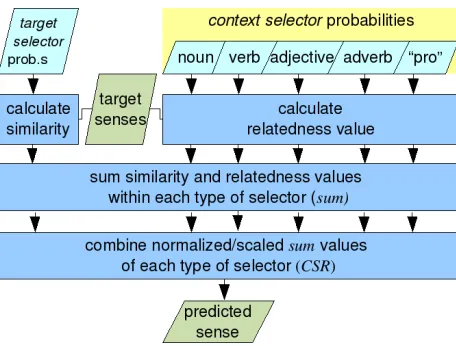
Next, we briefly describe the empirical basis for scoring senses of the target word. This step is out-lined in Figure 1. The occurrences of selectors can be converted to a probability of a selector, ws
ap-pearing in a web query,q:
p(ws, q)
The senses of the target word are compared with each selector. For a given sense of the target word, ct, the similarity or relatedness from a selector and
query is computed as:
SR(ct, ws, q) =
p(ws, q)∗maxsr(ct, ws)
senses(ws)
where senses(ws) is the number of senses of the
selector.
As the queries get shorter, the accuracy of the se-lectors becomes weaker. In turn, theSRvalue from selectors is scaled by a ratio of the web query length, wql, to the original sentence length,sl. This scaling is applied when the SR values for one target word sense are summed:
sum(ct, T) = X
q∈qs(T) X
ws∈sels(q)
SR(ct, ws, q)∗
wql sl
whereqs(T)represents the set of queries for a selec-tor type,T, and ws ranges over all selectors found
withq, denotedsels(q).
The general approach of disambiguation is to find the sense of a target word which is most similar to all target selectors and most related to all context selec-tors. This follows our assumptions about selectors given in the background section. Thus, similarity and relatedness values from different selector types (represented asT ypes) must be combined. By ag-gregating the normalizedsumsfrom all types of se-lectors, we get a combined similarity/relatedness for a given target word sense:
CSR(ct) = X
T∈T ypes
scale(T)∗ maxsum(ct, T)
ci∈wt
[sum(ci, T)]
wherewtrepresents the set of all senses belonging to
the target word, andscale(T)is a coefficient used to weight each type of selector. This term is important in this work, because our experiments explore the impact of various selector types.
The top sense is then chosen by looking at the CSRof all senses. For some situations, specifically when other senses have a score within 5% of the top CSR, the difference between concepts is very small. In these cases, the concept with the lowest sense number in WordNet is chosen from among the top scoring senses.
4 Experiments
Our experiments are run over the SemEval2007 Task 7: coarse-grained English all-words. The sense in-ventory was created by mapping senses in WordNet 2.1 to the Oxford Dictionary of English (Navigli et al., 2007). The corpus was composed of five docu-ments with differing domains resulting in 2269 an-notated word instances. Our system runs on fine-grained WordNet senses, but evaluation is done by checking if the predicted fine-grained sense maps to the correct coarse-grained sense. Many issues as-sociated with fine-grained annotation, such as those brought up in (Ide and Wilks, 2006) are avoided through the use of this corpus.
BLRand MED WS BLM F S
53.43 70.21 76.02 78.89
Table 2: Results as F1 Values of our system, WS, compared with baselines: random, BLRand; most
fre-quent sense,BLM F S; median system performance at
Se-mEval07,MED.
UPV-WSD NUS-PT SSI
78.63 82.50 83.21
Table 3: Results as F1 Values of top performing systems for the SemEval07 Task07 (UPV = (Buscaldi and Rosso, 2007), NUS-PT = (Chan et al., 2007), and SSI = a task organizer’s system (Navigli and Velardi, 2005)).
4.1 Evaluating All Words
In this section, we seek to apply the algorithm to all instances of the testing corpus in order to compare with baselines and other disambiguation algorithms. Unless stated otherwise, all results are presented as F1 values, whereF1 = 2∗PP+∗RR. For SemEval2007, all systems performed better than the random base-line of 53.43%, but only 4 of 13 systems achieved an F1 score higher than the MFS baseline of 78.89% (Navigli et al., 2007).
Table 2 lists the results of applying the general-ized Web selector algorithm described in this paper in a straight-forward manner, such that allscale(T) are set to 1. We see that this version of the system performs better than the median system in the Se-mEval07 task, but it is a little below the MFS base-line. A comparison with top systems is seen in Table 3. Our overall results were just below that of the top system not utilizing training data, (UPV-WSD (Bus-caldi and Rosso, 2007)), and a little over 6 percent-age points below the top supervised system (NUS-PT (Chan et al., 2007)).
The results are broken down by part of speech in Table 4. We see that adjective disambiguation was the furthest above our median point of refer-ence, and noun disambiguation results were above the MFS baseline. On the other hand, our adverb disambiguation results appear weakest compared to the baselines. Note that we previously reported a noun sense disambiguation F1 value of 80.20% on the same corpus (Schwartz and Gomez, 2008). Cur-rent results differ because the previous work used
N V A R
MED 70.76 62.10 71.55 74.04
WS 78.52 68.36 81.21 75.48
BLM F S 77.44 75.30 84.25 87.50
insts 1108 591 362 208
Table 4: Results as F1 values (precision = recall) of our system by parts of speech (N = noun, V = verb, A = ad-jective, R = adverb).insts= disambiguation instances of each part of speech. For other keys see Table 2.
differentscale(T)values as well as a custom noun similarity measure.
4.2 Selector Acquisition Analysis
We examine the occurrences of acquired selectors. Listed as the column headings of Table 5, selectors are acquired for five parts of speech (prois actually a combination of two parts of speech: pronoun and proper noun). The data in Table 5 is based on re-sults from acquiring selectors for our experimental corpus. The information presented includes:
insts instances which the algorithm attempts to acquire selectors
% w/ sels percentage of instances for which selectors were acquired
sels/inst average number of selectors for an instance (over allinsts)
unique/inst average number of unique selectors for an instance (over allinsts)
insts/sent average instances in a sentence
noun verb adj. adverb pro
insts 1108 591 362 208 370
% w/ sels 54.5 65.8 61.0 57.2 27.0
sels/inst 36.5 51.2 29.5 17.7 15.9
unique/inst 11.6 13.1 8.4 4.1 5.6
insts/sent 4.5 2.4 1.5 0.8 1.5
Table 5: Various statistics on the acquired selectors for the SemEval07 Task 7 broken down by part of speech. Row descriptions are in the text.
The selector acquisition data provides useful in-formation. In general,% w/ selswas low from be-ing unable to find text on the Web matchbe-ing local context (even with truncated queries). The lowest
[image:5.612.328.526.52.126.2]used (pronouns acquired were thrown out since they are not compatible with the relatedness measures). There was quite a variation in thesels/instdepending on the type, and all of these numbers are well below the upper-bound of 200 selectors acquired before the algorithm stops searching. It turned out that only 15.9% of the instances hit this mark. This means that most instances stopped acquiring selectors be-cause they hit the minimum query length (5 words). In fact, the average web query to acquire at least one selector had a length of 6.7 words, and the bulk of selectors came from shorter queries (with less con-text from shorter queries, the selectors returned are not as strong). We refer to the combination of quan-tity and quality issues presented above, in general, as thequality selector sparsityproblem.
Although quality and quantity were not ideal, when one considers data from the sentence level, things are more optimistic. The average sentence had 10.7 instances (of any part of speech listed), so when certain selector types were missing, oth-ers were present. As explained previously, the tar-get selectorandcontext selectordistinction is made after the acquisition of selectors. Thus, each in-stance is used as both (exception:proinstances were never used as target selectors since they were not disambiguated) . Employing this fact, more infor-mation can be discovered. For example, the aver-age noun was disambiguated with 36.5target selec-tors, 122.9 verb context selectors (51.2 sels/inst * 2.4insts/sent), 44.3adjective context selectors, 14.2
adverb context selectors, and 23.9 pro context se-lectors. Still, with the bulk of those selectors com-ing from short queries, the reliability of the selectors was not strong.
4.3 Exploring the Influence of Selector Types
This section explores the influence of each context selector on the disambiguation algorithm, by chang-ing the value of scale(T) in the previously listed CSRfunction.
Examining Table 6 reveals precision results when disambiguating instances with target selec-tors, based only on the target word’s similarity with target selectors. This serves as a bearing for inter-preting results of context selector variation.
We tested how well each type of context selec-tor complements thetarget selectors. Accordingly,
wsd prec.% insts.
N 64.08 348
V 52.86 227
A 77.36 106
[image:6.612.370.485.53.127.2]R 58.39 56
Table 6: Precision when disambiguating withtarget se-lectorsonly. All instances contain target selectors and multiple senses in WordNet. (insts. = number of in-stances disambiguated.)
wsd noun verb adj. adverb pro
N 272 186 120 84 108 V 211 167 110 80 103
A 97 78 50 40 34
[image:6.612.331.520.198.262.2]R 47 44 30 17 26
Table 7: Instance occurrences used for disambiguation when experimenting with all types of context selectors (listed as columns). The rows represent the four parts of speech disambiguated.
scale(target) was set to 1, and scale(T) for all other context types were set to 0. In order to limit ex-ternal influences, we did not predict words with only one sense in WordNet or instances where theCSR was zero (indicating no selectors). Additionally, we only tested on examples which had at least one tar-get selector and at least one selector of the specific type being examined. This restriction ensures we are avoiding some of thequality selector sparsity prob-lem described in the analysis. Nevertheless, results are expected to be a little lower than our initial tests as we are ignoring other types of selectors and not including monosemous words according to Word-Net. Table 7 lists the instance occurrences for each of the four parts of speech that were disambiguated, based on these restrictions.
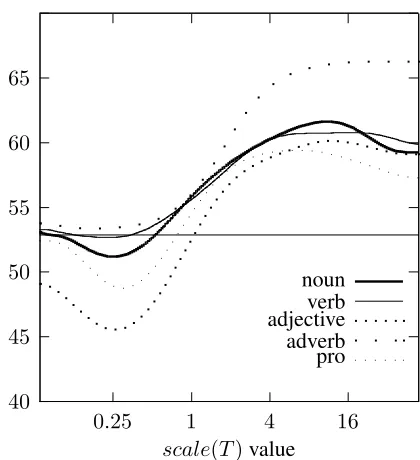
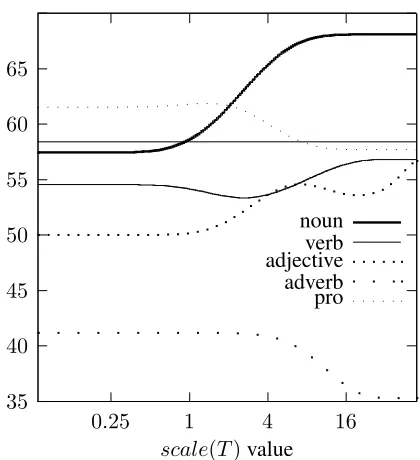
Figures 2 through 5 show graphs of the precision score while increasing the influence of each context selector type. Each graph corresponds to the disam-biguation of a different part of speech, and each line in a graph represents one of the five types of context selectors:
1. noun context
2. verb context
3. adjective context
4. adverb context
62 64 66 68 70 72 74 76 78
0.25 1 4 16
scale(T)value noun
[image:7.612.327.537.58.288.2]verb adjective adverb pro
Figure 2: Thenounsense disambiguation precision when varying thescale(T)value for each type of context selec-tor.scale(target)is always 1.
The lines are formed with a Bezier curve algorithm2
on the precision data. The horizontal line represents the precision of only using the target selectors to dis-ambiguate instances with target selectors. Precision either decreases or remains the same if any graph line was extended past the right-most boundary.
When examining the figures, one should note when the precision increases as thescale value in-creases. This indicates that increases in influence of the particular type of context selector improved the results. The x-axis increases exponentially, since we would like a ratio ofscale(T)toscale(target), and atx= 1thecontext selectorhas the same influence as thetarget selector.
We see that all types ofcontext selectorsimprove the results for noun and verb sense disambiguation. Thus, our inclusion of adverb context selectors was worthwhile. It is difficult to draw a similar conclu-sion from the adverb and adjective disambiguation graphs (Figures 4 and 5), although it still appears that thenoun context selectorsare helpful for both and thepro context selectorsare helpful for the ad-jective task. We also note that most selector types
2http://www.gnuplot.info/docs/node124.html
40 45 50 55 60 65
0.25 1 4 16
scale(T)value noun
verb adjective adverb pro
Figure 3: Theverbsense disambiguation precision when varying thescale(T)value for each type of context se-lector.scale(target)is 1.
achieve highest precision above ascalevalue of 1, indicating that thecontext selectorshould have more influence than the target selectors. This is proba-bly due to the existence of more selectors from con-text than those from the target word. The results of adverb disambiguation should be taken lightly, be-cause there were not many disambiguation instances that fit the restrictions (see Table 7).
4.4 Discussion of Future Work
Based on the results of our analysis and experiments, we list two avenues of future improvement:
[image:7.612.89.298.58.287.2]60 62 64 66 68 70 72 74 76 78 80
0.25 1 4 16
scale(T)value noun
[image:8.612.328.538.58.288.2]verb adjective adverb pro
Figure 4: Theadjectivesense disambiguation precision when varying thescale(T)value for each type of context selector.scale(target)is 1.
reconstruction can be accomplished by using a constituent-based parser, which will help to produce syntactic alternations and other trans-formations such as the dative.
2. Improving Similarity and Relatedness: Noun sense disambiguation was the only subtask to pass the MFS baseline. One reason we suspect for this is that work in similarity and related-ness has a longer history over nouns than over other parts of speech (Budanitsky and Hirst, 2006). Additionally, the hypernym (is-a) re-lationship of the noun ontology of WordNet captures the notion of similarity more clearly than the primary relationships of other parts of speech in WordNet. Accordingly, future work should look into specific measures ofsimilarity
for each part of speech, and further improve-ment to relatedness measures which function accross different parts of speech. A subtle piece of this type of work may find a way to effec-tively incorporate pronouns in the measures, al-lowing less selectors to be thrown out.
35 40 45 50 55 60 65
0.25 1 4 16
scale(T)value noun
verb adjective adverb pro
Figure 5: The adverb sense disambiguation precision when varying thescale(T)value for each type of con-text selector.scale(target)is 1.
5 Conclusion
We found the use of Web selectors to be a worth-while approach to the disambiguation of other parts of speech in addition to nouns. However, results for verb, adjective, and adverb disambiguation were slightly below the most frequent sense baseline, a point which noun sense disambiguation overcomes. The use of this type of algorithm is still rich with avenues yet to be taken for improvement.
Future work may address aspects at all levels of the algorithm. To deal with aquality selector spar-sity problem, a system might automatically form alternative web queries utilizing a syntactic parser. Research may also look into definingsimilarity mea-sures for adjectives and adverbs, and refining the similarity measures for nouns and verbs. Neverthe-less, without these promising future extensions the system still performs well, only topped by one other minimally supervised system.
6 Acknowledgement
[image:8.612.90.298.60.288.2]References
Eneko Agirre and David Martinez. 2004. Unsupervised WSD based on automatically retrieved examples: The importance of bias. InProceedings of EMNLP 2004, pages 25–32, Barcelona, Spain, July.
Eneko Agirre, Olatz Ansa, and David Martinez. 2001. Enriching wordnet concepts with topic signatures. In
In Proceedings of the NAACL workshop on WordNet and Other Lexical Resources: Applications, Exten-sions and Customizations, Pittsburg, USA.
Satanjeev Banerjee and Ted Pedersen. 2002. An adapted lesk algorithm for word sense disambiguation using wordnet. In Proceedings of the Third International Conference on Intelligent Text Processing and Com-putational Linguistics. Mexico City, Mexico.
Alexander Budanitsky and Graeme Hirst. 2006. Evalu-ating wordnet-based measures of lexical semantic re-latedness.Computational Linguistics, 32(1):13–47. Davide Buscaldi and Paolo Rosso. 2007. UPV-WSD :
Combining different WSD methods by means of fuzzy borda voting. InProceedings of SemEval-2007, pages 434–437, Prague, Czech Republic, June.
Yee Seng Chan, Hwee Tou Ng, and Zhi Zhong. 2007. NUS-PT: Exploiting parallel texts for word sense dis-ambiguation in the english all-words tasks. In Pro-ceedings of ProPro-ceedings of SemEval-2007, pages 253– 256, Prague, Czech Republic, June.
Nancy Ide and Yorick Wilks, 2006. Word Sense Dis-ambiguation: Algorithms And Applications, chapter 3: Making Sense About Sense. Springer.
Dekang Lin. 1997. Using syntactic dependency as lo-cal context to resolve word sense ambiguity. In Pro-ceedings of the 35th annual meeting on Association for Computational Linguistics, pages 64–71.
David Martinez, Eneko Agirre, and Xinglong Wang. 2006. Word relatives in context for word sense dis-ambiguation. InProceedings of the 2006 Australasian Language Technology Workshop, pages 42–50. Rada Mihalcea and Dan I. Moldovan. 1999. An
auto-matic method for generating sense tagged corpora. In
Proceedings of AAAI-99, pages 461–466.
Rada Mihalcea. 2002. Bootstrapping large sense tagged corpora. In Proceedings of the 3rd International Conference on Languages Resources and Evaluations LREC 2002, Las Palmas, Spain, May.
George Miller, R. Beckwith, Christiane Fellbaum, D. Gross, and K. Miller. 1993. Five papers on word-net. Technical report, Princeton University.
Roberto Navigli and Paola Velardi. 2005. Structural semantic interconnections: A knowledge-based ap-proach to word sense disambiguation. IEEE Trans. Pattern Anal. Mach. Intell., 27(7):1075–1086.
Roberto Navigli, Kenneth C. Litkowski, and Orin Har-graves. 2007. Semeval-2007 task 07: Coarse-grained english all-words task. In Proceedings of SemEval-2007, pages 30–35, Prague, Czech Republic. Associa-tion for ComputaAssocia-tional Linguistics.
Siddharth Patwardhan, S. Banerjee, and T. Pedersen. 2003. Using Measures of Semantic Relatedness for Word Sense Disambiguation. In Proceedings of the Fourth International Conference on Intelligent Text Processing and Computational Linguistics, pages 241–257, Mexico City, Mexico, February.
Ted Pedersen, S. Patwardhan, and J. Michelizzi. 2004. WordNet::Similarity - Measuring the Relatedness of Concepts. In Human Language Technology Confer-ence of the NAACL Demonstrations, pages 38–41, Boston, MA, May.
R. Rada, H. Mili, E. Bicknell, and M. Blettner. 1989. Development and application of a metric on semantic nets. InIEEE Transactions on Systems, Man and Cy-bernetics, volume 19, pages 17–30.
Philip Resnik. 1999. Semantic similarity in a taxonomy: An information-based measure and its application to problems of ambiguity in natural language. Journal of Artificial Intelligence Research, 11:95–130.
Hansen A. Schwartz and Fernando Gomez. 2008. Ac-quiring knowledge from the web to be used as selec-tors for noun sense disambiguation. InCoNLL 2008: Proceedings of the Twelfth Conference on Computa-tional Natural Language Learning, pages 105–112, Manchester, England, August.
Ravi Sinha and Rada Mihalcea. 2007. Unsupervised graph-based word sense disambiguation using mea-sures of word semantic similarity. Irvine, CA, Septem-ber.