Generalizing local translation models
Michael Subotin
Laboratory for Computational Linguistics and Information Processing Department of Linguistics
University of Maryland College Park, MD 20742 [email protected]
Abstract
We investigate translation modeling based on exponential estimates which generalize essen-tial components of standard translation mod-els. In application to a hierarchical phrase-based system the simplest generalization al-lows its models of lexical selection and re-ordering to be conditioned on arbitrary at-tributes of the source sentence and its anno-tation. Viewing these estimates as approxi-mations of sentence-level probabilities moti-vates further elaborations that seek to exploit general syntactic and morphological patterns. Dimensionality control with `1 regularizers
makes it possible to negotiate the tradeoff be-tween translation quality and decoding speed. Putting together and extending several recent advances in phrase-based translation we ar-rive at a flexible modeling framework that al-lows efficient leveraging of monolingual re-sources and tools. Experiments with features derived from the output of Chinese and Arabic parsers and an Arabic lemmatizer show signif-icant improvements over a strong baseline.
1 Introduction
Effective handling of large and diverse inventories of feature functions is one of the most pressing open problems in machine translation. While min-imum error training (Och, 2003) has by now be-come a standard tool for interpolating a small num-ber of aggregate scores, it is not well suited for learning in high-dimensional feature spaces. At the same time, although recent years have seen consid-erable progress in development of general methods
for large-scale prediction of complex outputs (Bakır et al., 2007), their application to language transla-tion has presented considerable challenges. Sev-eral studies have shown that large-margin methods can be adapted to the special complexities of the task (Liang et al., 2006; Tillmann and Zhang, 2006; Cowan et al., 2006) . However, the capacity of these algorithms to improve over state-of-the-art baselines is currently limited by their lack of robust dimen-sionality reduction. Performance gains are closely tied to the number and variety of candidate features that enter into the model, and increasing the size of the feature space not only slows down training in terms of the number of iterations required for con-vergence, but can also considerably reduce decod-ing speed, leaddecod-ing to rtime costs that may be un-acceptable in industrial settings. Vector space re-gression has shown impressive performance in other tasks involving string-to-string mappings (Cortes et al., 2007), but its application to language transla-tion presents a different set of open problems (Wang et al., 2007). Other promising formalisms, which have not yet produced end-to-end systems compet-itive with standard baselines, include the approach due to Turian et al (2006), the hidden-state syn-chronous grammar-based exponential model studied by Blunsom et al (2008), and a similar model in-corporating target-side n-gram features proposed in Subotin (2008).
Taken together the results of these studies point to a striking overarching conclusion: the humble relative frequency estimate of phrase-based mod-els makes for a surprisingly strong baseline. The present paper investigates a family of models that
capitalize on this practical insight to allow efficient optimization of weights for a virtually unlimited number of features. We take as a point of depar-ture the observation that the essential translation model scores comprising standard decoding deci-sion rules can be recovered as special cases of a more general family of models. As we discuss be-low, they are equal to maximum likelihood solu-tions for locally normalized ”piecewise” approxi-mations to sentence-level probabilities, where word alignment is used to determine the subset of fea-tures observed in each training example. The cases for which such solutions have a closed form corre-spond to particular restrictions placed on the feature space. Thus, relative frequency phrase models can be obtained by limiting the feature space to indica-tor functions for the phrase pairs consistent with an alignment. By removing unnecessary restrictions we restore the full flexibility of local exponential mod-els, including their ability to use features depending on arbitrary aspects of the source sentence and its annotation. The availability of robust algorithms for dimensionality reduction with `1 regularizers (Ng, 2004) means that we can start with a virtually un-limited number of candidate features and negotiate the tradeoff between translation quality and decod-ing speed in a way appropriate for a given settdecod-ing. A further attractive property of locally normalized models is the modest computational cost of their training and ease of its parallelization. This is par-ticularly so for the models we concentrate on in this paper, defined so that parameter estimation decom-poses into a large number of small optimization sub-problems which can be solved independently.
Several variants of these models beyond rela-tive frequencies have appeared in the literature be-fore. Maximum entropy estimation for transla-tion of individual words dates back to Berger et al (1996), and the idea of using multi-class classi-fiers to sharpen predictions normally made through relative frequency estimates has been recently rein-troduced under the rubric of word sense disambigua-tion and generalized to substrings (Chan et al 2007; Carpuat and Wu 2007a; Carpuat and Wu 2007b). Maximum entropy models for non-lexicalized re-ordering rules for a phrase-based system with CKY decoding has been described by Xiong et al (2006). Some of our experiments, where exponential models
conditioned on the source sentence and its parse an-notation are associated with all rewrite rules in a hi-erarchical phrase-based system (Chiang, 2007) and all word-level probabilities in standard lexical mod-els, may be seen as a synthesis of these ideas.
The broader perspective of viewing the product of such local probabilities as a particular approxima-tion of sentence-level likelihood points the way be-yond multi-class classification, and this type of gen-eralization is the main original contribution of the present work. Training a classifier to predict the tar-get phrase for every source phrase is equivalent to conjoining all contextual features of the model with an indicator function for the surface form of some rule in the grammar. We can also use features based on less specific representation of a rule. Of par-ticular importance for machine translations are rep-resentations which generalize reordering informa-tion beyond identity of individual words – a type of generalization that presents a challenge in hierarchi-cal phrase-based translation. With generalized lohierarchi-cal models this can be accomplished by adding features tracking only ordering patterns of rules. We exper-iment with a case of such models which allows us to preserve decomposition of parameter estimation into independent subproblems.
Besides varying the structure of the feature space, we can also extend the range of normalization for the exponential models beyond target phrases co-occurring with a given source phrase in the phrase table. This choice is especially natural for richly in-flected languages, since it enables us to model mul-tiple levels of morphological representation at once and estimate probabilities for rules whose surface forms have not been observed in training. We apply a simple variant of this approach to Arabic-English lexical models.
Experimental results across eight test sets in two language pairs support the intuition that features conjoined with indicator functions for surface forms of rules yield higher gains for test sets with better coverage in training data, while features based on less specific representations become more useful for test sets with lower baselines.
ex-tensions of the feature space beyond multiclass clas-sification. However, the results reported here show considerable promise and we believe that the flexi-bility of these models combined with their computa-tional efficiency makes them potentially valuable as an extension for a variety of systems using transla-tion models with local conditransla-tional probabilities and as a feature selection method for globally trained models.
2 Hierarchical phrase-based translation We take as our starting point David Chiang’s Hiero system, which generalizes phrase-based translation to substrings with gaps (Chiang, 2007). Consider for instance the following set of context-free rules with a single non-terminal symbol:
hA , Ai → hA1A2, A1A2i
hA , Ai → hd0A1idees A´ 2, A1A2ideasi
hA , Ai → hincolores , colorlessi hA , Ai → hvertes , greeni hA , Ai → hdorment A , sleep Ai hA , Ai → hf urieusement , f uriouslyi
It is one of many rule sets that would suffice to generate the English translation 1b for the French sentence 1a.
1a.d’ incolores id´ees vertes dorment furieusement 1b.colorless green ideas sleep furiously
As shown by Chiang (2007), a weighted gram-mar of this form can be collected and scored by simple extensions of standard methods for phrase-based translation and efficiently combined with a language model in a CKY decoder to achieve large improvements over a state-of-the-art phrase-based system. The translation is chosen to be the target-side yield of the highest-scoring synchronous parse consistent with the source sentence. Although a va-riety of scores interpolated into the decision rule for phrase-based systems have been investigated over the years, only a handful have been discovered to be consistently useful, as is in our experience also the case for the hierarchical variant. Setting aside spe-cialized components such as number translators, we concentrate on the essential sub-models1comprising
1
To avoid confusion with features of the exponential models described below we shall use the term ”model” for the terms
the translation model: the phrase models and lexical models.
3 Local exponential translation models 3.1 Relative frequency solutions
Standard phrase models associate conditional proba-bilities with subparts of translation hypotheses, usu-ally computed as relative frequencies of counts of extracted phrases.2 Letrybe the target side of a rule andrx its source side. The weight of the rule in the
”reverse” phrase model would then be computed as
p(ry|rx) = count(hr
x, ryi)
P
ry0count(hrx, ry 0
i) (1)
When used to score a translation hypothesis cor-responding to some synchronous parse treeT, the phrase model may be conceived as an approxima-tion of the probability of a target sentenceY given a source sentenceX
p(Y|X)≈ Y
r∈T
p(ry|rx) (2)
Although there is nothing in current learning the-ory that would prompt one to expect that expressions of this form should be effective, their surprisingly strong performance in machine translation in an em-pirical observation borne out by many studies. In order to build on this practical insight it is useful to gain a clearer understanding of their formal proper-ties.
We start by writing out an expression for the like-lihood of training data which would give rise to max-imum likelihood solutions like those in eq. 1. Con-sider a feature vector whose components are indi-cator functions for rules in the grammar, and let us define an exponential model for a sentence pair
(Xm, Ym)of the form
p (Ym|Xm)≈
Y
r∈(Xm,Ym)
p(ry|rx) (3)
= Y
r∈(Xm,Ym)
exp{w·fr(Xm, Ym)}
P
˜
r:rx=˜rxexp{w·f˜r(Xm, Ym)}
(4)
interpolated using MERT. 2
where fr(Xm, Ym) is a restriction of the feature
vector such that all of its entries except for the one corresponding to the rulerare zero and the summa-tion is over all rules in the grammar with the same source side. As can be verified by writing out the likelihood for the training set and setting its gradi-ent to zero, maximum likelihood estimation based on eq. 4 yields estimates equal to relative frequency solutions. In fact, because its normalization fac-tors have non-zero parameters in common only for rules which share the same source phrase, param-eter estimation decomposes into independent opti-mization subproblems, one for each source phrase in the grammar. However, recovering relative fre-quencies of the needed form requires further atten-tion to the relaatten-tionship between the definiatten-tion of fea-ture functions and phrase extraction. Computation of phrase models in machine translation crucially re-lies on a form of feature selection not widely known in other contexts. A rule is considered to be ob-served in a sentence pair only if it is consistent with predictions of a word alignment model according to heuristics for alignment combination and phrase ex-traction. The standard recipes in translation model-ing can thus be seen to include a feature selection procedure that appliesindividually to each training example.
3.2 Classifier solutions
We can now generalize these relative frequency estimates by relaxing the restrictions they implic-itly place on the form of permissible feature func-tions. The simplest elaboration involves allow-ing indicator functions for rules to be conjoined with indicator functions for arbitrary attributes of the source sentence or its annotation. This pre-serves a decomposition of parameter estimation of optimization subproblems associated with individ-ual source phrase, but effectively replaces proba-bilities p(ry|rx) in eqs. 2 and 3 with probabili-ties conditioned on the source phrase together with some of its source-side context. We may, for ex-ample, conjoin an indicator function for the rule
hA , Ai → hd0A1idees A´ 2, A1A2ideasiwith a function telling us whether a part-of-speech tagger has identified the word at the left edge of the source-side gap A2 as an adjective, which would provide additional evidence for the target side of this rule.
Combining a grammar-based formalism with con-textual features raises a subtle question of whether rules which have gaps at the edges and can match at multiple positions of a training example should be counted as having occurred together with their re-spective contextual features once for each possible match. To avoid favoring monotone rules, which tend to match at many positions, over reordering rules, which tend to match at a single span, we ran-domly sample only one of such multiple matches for training.
Unlike conventional phrase models, contextually-conditioned probabilities cannot be stored in a pre-computed phrase table. Instead, we store informa-tion about features and their weights and compute the normalization factors at run-time at the point when they are first needed by the decoder.
At the expense of more complicated decoding procedures we could also apply the same line of reasoning to generalize the ”noisy channel” phrase model p(rx|ry) to be conditioned on local target-side context in a translation hypothesis, possibly combining target-side annotation of the training set with surface form of rules. We do not pursue this elaboration in part because we are skeptical about its potential for success. The current state of machine translation rarely permits constructing well-formed translations, so that most of the contextual features on the target side would be rarely if at all observed in the training data, resulting in sparse and noisy es-timates. Furthermore, we have yet to find a case where relative frequency estimatesp(rx|ry)make a useful contribution to the system when contextually-conditioned ”reverse” probabilities are used, sug-gesting that viewing translation modeling as approx-imating sentence-level probabilitiesp(Y|X)may be a more fruitful avenue in the long term.
which are beyond the scope of our discussion, there are several further contrasts between these studies and standard practice in machine translation in how the learned parameters are used to make predic-tions. Unlike inference in piecewise-trained graphi-cal models, where all parameters for a given output are added together without normalization, features that enter into the score for a translation hypothe-sis are restricted to be conhypothe-sistent with a single syn-chronous parse and the local probabilities are nor-malized in decoding as in training.
3.3 Lexical models
The use of conditional probabilities in standard lex-ical models also gives us a straightforward way to generalize them in the same way as phrase models. Consider the lexical model pw(ry|rx), defined
fol-lowing Koehn et al (2003), withadenoting the most frequent word alignment observed for the rule in the training set.
pw(ry|rx) = n
Y
i=1
1
|j|(i, j)∈a| X
(i,j)∈a
p(wiy|wjx)
(5) We replace p(wiy|wjx) with context-conditioned probabilities, computed similarly to eq. 4, but at the level of individual words. Our experience suggests that, unlike the analogous phrase model, the stan-dard lexical modelpw(rx|ry)is not made redundant
by this elaboration, and we use its baseline variant in all our experiments. While this approach seeks to make the most of practical insights underlying state-of-the-art baselines, it is of course not the only way to combine rule-based and word-based features. See for example Sutton & Minka (2006) for a discussion of alternatives that are closer in spirit to the idea of approximating global probabilities.
3.4 Further generalizations
An immediate practical benefit of interpreting rela-tive frequency and classifier estimates of translation models as special cases is the possibility of gener-alizing them further by introducing additional fea-tures based on less specific representations of rules and words.
Among the least specific and most potentially use-ful representations of hierarchical phrases are those
limited to the patterns formed by gaps and words, allowing the model to generalize reordering infor-mation beyond individual tokens. We study two types of ordering patterns. For rules with two gaps we form features by conjoining contextual indicator functions with functions indicating whether the gap pattern is monotone or inverting. We also use an-other type of ordering features, representing the pat-tern formed by gaps and contiguous subsequences of words. For example, the rule with the right-hand sideh d0A1idees A´ 2, A1A2ideasimight be asso-ciated with the patternh a A1a A2, A1A2ai. Be-cause some source-side patterns of this type apply to many different rules it is no longer possible to de-compose parameter estimation into small indepen-dent optimization subproblems. For practical conve-nience we enforce decomposition in the experiments reported below in the following way. We define indi-cator functions for sequences of closed-class words and the most frequent part-of-speech tag for open-class words on the source side. For the rule above and a simple tag-set the pattern tracked by such an indicator function would bed0A1N A2. We require all reordering features to be conjoined with an indi-cator function of this type, ensuring that each cor-responds to a separate optimization subproblem. We further split larger optimization subproblems, so that parameters for identical reordering features are in some cases estimated separately for different subsets of rules.
in the experiments below.
3.5 Regularization
We apply `1 regularization (Ng, 2004; Gao et al., 2007) to make learning more robust to noise and control the effective dimensionality of the feature space by subtracting a weighted sum of absolute val-ues of parameter weights from the log-likelihood of the training data
w∗= arg max
w LL(w)− X
i
Ci|wi| (6)
We optimize the objective using a variant of the orthant-wise limited-memory quasi-Newton algo-rithm proposed by Andrew & Gao (2007).3 All val-uesCiare set to 1 in most of the experiments below,
although we apply stronger regularization (Ci = 3)
to reordering features. Tuning regularization trade-offs individually for different feature types is an at-tractive option, but our experiments suggest that us-ing cross-entropy on a held-out portion of trainus-ing data for that purpose does not help performance. We leave investigation of the alternatives for future work.
4 Experiments 4.1 Data and methods
We apply the models to Arabic-English and Chinese-English translation, with training sets con-sisting of 108,268 and 1,017,930 sentence pairs, re-spectively.4 All conditions use word alignments produced by sequential iterations of IBM model 1, HMM, and IBM model 4 in GIZA++ , followed
3
Our implementation of the
algo-rithm as a SciPy routine is available at http://www.umiacs.umd.edu/∼msubotin/owlqn.py
4
The Arabic-English data came from Arabic News Transla-tion Text Part 1 (LDC2004T17), Arabic English Parallel News Text (LDC2004T18), and Arabic Treebank English Translation (LDC2005E46). Chinese-English data came from Xinhua Chi-nese English Parallel News Text Version 1 beta (LDC2002E18), Chinese Treebank English Parallel Corpus (LDC2003E07), Chinese English News Magazine Parallel Text (LDC2005T10), FBIS Multilanguage Texts (LDC2003E14), Chinese News Translation Text Part 1 (LDC2005T06), and the HKNews por-tion of Hong Kong Parallel Text (LDC2004T08). Some sen-tence pairs were not included in the training sets due to large length discrepancies.
by ”diag-and” symmetrization (Koehn et al., 2003). Thresholds for phrase extraction and decoder prun-ing were set to values typical for the baseline sys-tem (Chiang, 2007). Unaligned words at the outer edges of rules or gaps were disallowed. A trigram language model with modified interpolated Kneser-Ney smoothing (Chen and Goodman, 1998) was trained by the SRILM toolkit on the Xinhua por-tion of the Gigaword corpus and the English side of the parallel training set. Evaluation was based on the BLEU score with 95% bootstrap confidence in-tervals for the score and difference between scores, calculated by scripts in version 11a of the NIST dis-tribution. The 2002 NIST MT evaluation sets was used for development. The 2003, 2004, 2005, and 2006 sets were used for testing.
perform lemmatization.
The total number of candidate features thus de-fined is very large, and we use a number of sim-ple heuristics to reduce it prior to training. They are not essential to the estimates and were chosen so that the models could be trained in a few hours on a small cluster. With the exception of discarding all except the 10 most frequent target phrases ob-served with each source phrase,5which benefits per-formance, we expect that relaxing these restrictions would improve the score. These limitations included count-based thresholds on the frequency of contex-tual features included into the model, the frequency of rules and reordering patterns conjoined with other features, and the size of optimization subproblems to which contextual features are added. We don’t con-join contextual features to rules whose source phrase terminals are all punctuation symbols. For subprob-lems of size exceeding a certain threshold, we train on a subsample of available training instances. For the Chinese-English task we do not add reorder-ing features to problems with low-entropy distribu-tions of inversion and reordering patterns and dis-card rules with two non-terminals altogether if the entropy of their reordering patterns falls under a threshold. None of these restrictions were applied to the baselines. Finally, we solve only those optimiza-tion subproblems which include parameters needed in the development and training sets. This leads to a reduction of costs that is similar to phrase table fil-tering and likewise does not affect the solution. At decoding time all features for the translation models and their weights are accessed from a disk-mapped trie.
4.2 Results and discussion
The results are shown in tables 1 and 2. For both lan-guage pairs we had a choice between using a base-line that is computed in the same way as the other ex-ponential models, with the exception of its use of rel-ative frequency estimates and a baseline that incor-porates averaged fractional counts for phrase mod-els and lexical modmod-els, as used by Chiang (2007). For the sake of completeness we report both (though without performing statistical comparisons between
5
This has prompted us to add an additional target-side token to lexical models, which subsumes the discarded items under a single category.
Condition MT03 MT04 MT05 MT06
[image:7.612.312.556.110.194.2]Rel. freq. 48.24 43.92 47.53 37.94 Frac. 48.34 45.68 47.95 39.41 Context 49.47* 45.65 48.76 39.49 +lex 50.42* 46.07* 49.66* 39.32 +lex+lemma 49.86* 47.02* 49.29* 40.81*
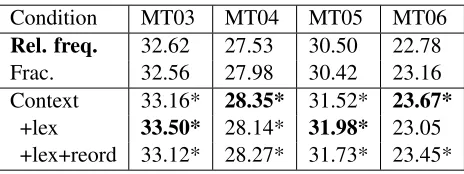
Table 1: Arabic-English translation, BLEU scores on testing. Conditions include two baselines: simple rela-tive frequency (rel. freq.) and fractional estimates (frac.). Experimental conditions: contextual features in phrase models (context); same and contextual features in lexi-cal models (+lex); same and lemma based features in lex-ical models (+lex+lemma). Stars mark statistlex-ically sig-nificant improvements over the fractional baseline which produced a higher score on the dev-test MT02 set than the other baseline (59.75 vs. 59.66).
Condition MT03 MT04 MT05 MT06
Rel. freq. 32.62 27.53 30.50 22.78
Frac. 32.56 27.98 30.42 23.16
Context 33.16* 28.35* 31.52* 23.67* +lex 33.50* 28.14* 31.98* 23.05 +lex+reord 33.12* 28.27* 31.73* 23.45*
[image:7.612.314.546.437.524.2]them). Statistical tests for experimental conditions were performed in comparison to the baseline which achieved higher score on the test-dev MT02 set: the fractional count baseline for Arabic-English and the simple relative count baseline for Chinese-English.
We test models with classifier solutions for phrase models alone and for phrase models together with lexical models in both language pairs. For Arabic-English translation we also experiment with adding features based on lemmas to lexical models, while for Chinese-English we add ”reordering” features – features based on the ordering pattern of gaps for rules with two gaps and features based on ordering of gaps and words for rules with a single gap.
For both language pairs the results show con-sistent distinctions in behavior of different mod-els between the test sets giving rise to generally higher scores (MT03 and MT05) and generally lower scores (MT04 and MT06). The fractional counts seem to be consistently more helpful for test sets with poorer coverage, although the rea-son for this is not immediately clear. For exponen-tial models the two type of sets present two pos-sible sources of difference. The lower-performing sets have poorer coverage in the training data, and they also may suffer from lower-quality annotation, since the training sets for both the translation mod-els and the annotation tools are dominated by text in the same, newswire domain. Overall, the use of features based on surface forms is more beneficial for MT03 and MT05. Indeed, using lexical models with contextual features in addition to phrase models hurts performance on MT06 for Arabic-English and on both MT04 and MT06 for Chinese-English. In contrast, using features based on less specific repre-sentations is more beneficial on test sets with poorer coverage, while hurting performance on MT03 and MT05. This agrees with our intuitions and also sug-gests that the differences in coverage of training data for the translation models may be playing a more important role in these trends than coverage for an-notation tools.
5 Conclusion
We have outlined a framework for translation modeling that synthesizes several recent advances in phrase-based machine translation and suggests
many other ways to leverage sub-token representa-tions of words as well as syntactic and morpholog-ical annotation tools, of which the experiments re-ported here explore only a small fraction. Indeed, the range and practicality of the available options is perhaps its most attractive feature. The inital results are promising and we are optimistic that continued exploration of this class of models will uncover even more effective uses.
Acknowledgments
I would like to thank David Chiang, Chris Dyer, Lise Getoor, Kevin Gimpel, Adam Lopez, Nitin Mad-nani, Smaranda Muresan, Noah Smith, Amy Wein-berg and especially Philip Resnik for discussions re-lating to this work. I am also grateful to David Chi-ang for sharing source code of the Hiero translation system and to the two anonymous reviewers for their constructive comments.
References
Galen Andrew and Jianfeng Gao. 2007. Scalable train-ing of L1-regularized log-linear models. In Proc. ICML 2007
G¨okhan H. Bakır, Thomas Hofmann, Bernhard Sch¨olkopf, Alexander J. Smola, Ben Taskar and S. V. N. Vishwanathan, eds. 2007. Predicting Structured Data. MIT Press.
Adam Berger, Stephen Della Pietra, and Vincent Della Pietra. 1996. A maximum entropy approach to nat-ural language processing Computational Linguistics, 22(1).
Phil Blunsom, Trevor Cohn and Miles Osborne. 2008. Discriminative Synchronous Transduction for Statisti-cal Machine Translation Inproc. ACL 2008.
Marine Carpuat and Dekai Wu. 2007a. Improving Sta-tistical Machine Translation using Word Sense Disam-biguation InJoint Conference on Empirical Methods in Natural Language Processing and Computational Natural Language Learning (EMNLP-CoNLL 2007).. Marine Carpuat and Dekai Wu. 2007b. How Phrase
Sense Disambiguation outperforms Word Sense Dis-ambiguation for Statistical Machine Translation. In
11th Conference on Theoretical and Methodological Issues in Machine Translation (TMI 2007).
Yee Seng Chan, Hwee Tou Ng, and David Chiang. 2007. Word sense disambiguation improves statistical ma-chine translation. InProc. ACL.
Modeling.Technical Report TR-10-98, Computer Sci-ence Group, Harvard University.
David Chiang. 2007. Hierarchical phrase-based transla-tion. Computational Linguistics, 33(2):201-228. Corinna Cortes, Mehryar Mohri, and Jason Weston.
2007. A General Regression Framework for Learning String-to-String Mappings. InPredicting Structured Data. MIT Press.
Brooke Cowan, Ivona Kucerova, and Michael Collins. 2006. A Discriminative Model for Tree-to-Tree Trans-lation. Inproceedings of EMNLP 2006.
J. Gao, G. Andrew, M. Johnson and K. Toutanova 2007. A Comparative Study of Parameter Estimation Meth-ods for Statistical Natural Language Processing. In
Proc. ACL 2007.
Philipp Koehn, Franz Josef Och, and Daniel Marcu. 2003. Statistical Phrase-Based Translation. Proceed-ings of the Human Language Technology Conference (HLT-NAACL 2003).
P. Liang, Alexandre Bouchard-Cote, D. Klein and B. Taskar. 2006. An End-to-End Discriminative Ap-proach to Machine Translation. In Association for Computational Linguistics (ACL06).
A. Y. Ng. 2004. Feature selection, L1 vs. L2 regular-ization, and rotational invariance In Proceedings of the Twenty-first International Conference on Machine Learning
Franz Josef Och. 2003. Minimum Error Rate Train-ing for Statistical Machine Translation. InACL 2003: Proc. of the 41st Annual Meeting of the Association for Computational Linguistics.
F. P´erez-Cruz, Z. Ghahramani and M. Pontil. 2007. Ker-nel Conditional Graphical Models InPredicting Struc-tured Data. MIT Press.
Michael Subotin. 2008. Exponential models for machine translation. Generals paper, Department of Linguis-tics, University of Maryland.
Charles Sutton and Andrew McCallum. 2005. Piecewise training for undirected models. InConference on Un-certainty in Artificial Intelligence (UAI).
Charles Sutton and Tom Minka. 2006. Local Training and Belief Propagation. Microsoft Research Technical Report TR-2006-121..
Christoph Tillmann and Tong Zhang 2006. A Dis-criminative Global Training Algorithm for Statistical MT. In Association for Computational Linguistics (ACL06).
Joseph Turian, Benjamin Wellington, and I. Dan Melamed 2006. Scalable Discriminative Learning for Natural Language Parsing and Translation In Proceed-ings of the 20th Annual Conference on Neural Infor-mation Processing Systems (NIPS).
Zhuoran Wang, John Shawe-Taylor, and Sandor Szedmak 2007. Kernel Regression Based Machine Translation. InProceedings of NAACL HLT.