Generalizing Local and Non-Local Word-Reordering Patterns for
Syntax-Based Machine Translation
Bing Zhao
IBM T.J. Watson Research Yorktown Heights, NY-10598
Yaser Al-onaizan
IBM T.J. Watson Research Yorktown Heights, NY-10598
Abstract
Syntactic word reordering is essential for translations across different grammar struc-tures between syntactically distant language-pairs. In this paper, we propose to em-bed local and non-local word reordering de-cisions in a synchronous context free gram-mar, and leverages the grammar in a chart-based decoder. Local word-reordering is ef-fectively encoded in Hiero-like rules; whereas non-local word-reordering, which allows for long-range movements of syntactic chunks, is represented in tree-based reordering rules, which contain variables correspond to source-side syntactic constituents. We demonstrate how these rules are learned from parallel cor-pora. Our proposed shallow Tree-to-String rules show significant improvements in trans-lation quality across different test sets.
1 Introduction
One of the main issues that a translator (human or machine) must address during the translation pro-cess is how to match the different word orders be-tween the source language and the target language. Different language-pairs require different levels of word reordering. For example, when we translate between English and Spanish (or other Romance languages), most of the word reordering needed is local because of the shared syntactical features (e.g., Spanish noun modifier constructs are written in English as modifier noun). However, for syn-tactically distant language-pairs such as Chinese-English, long-range reordering is required where whole phrases are moved across the sentence.
The idea of “syntactic cohesion” (Fox, 2002) is characterized by its simplicity, which has attracted researchers for years. Previous works include sev-eral approaches of incorporating syntactic informa-tion topreprocessthe source sentences to make them more like the target language in structure. Xia and McCord (2004) (Niessen and Ney, 2004; Collins et al., 2005) described approaches applied to language-pairs such as French-English and German-English. Later, Wang et al. (2007) presented specific rules to pre-order long-range movements of words, and improved the translations for Chinese-to-English. Overall, these works are similar, in that they design a few language-specific and linguistically motivated reordering rules, which are generally simple. The elevenrules described in Wang et al. (2007) are ap-pealing, as they have rather simple structure, mod-eling only NP, VP and LCP via one-level sub-tree structure with two children, in the source parse-tree (a special case of ITG (Wu, 1997)). It effectively en-hances the quality of the phrase-based translation of Chinese-to-English. One major weakness is that the reordering decisions were done in the preprocessing step, therefore rendering the decoding process un-able to recover the reordering errors from the rules if incorrectly applied to. Also the reordering decisions are made without the benefits of additional models (e.g., the language models) that are typically used during decoding.
Another method to address the re-ordering prob-lem in translation is the Hiero model proposed by Chiang (2005), in which a probabilistic synchronous context free grammar (PSCFG) was applied to guide the decoding. Hiero rules generalize phrase-pairs
by introducing a single generic nonterminal (i.e., a variable) [X]. The combination of variables and lex-icalized words in a Hiero rule nicely captures local word and phrase reordering (modeling an implicit reordering window of max-phrase length). These rules are then applied in a CYK-style decoder. In Hiero rules, any nested phrase-pair can be general-ized as variables [X]. This usually leads to too many redundant translations, which worsens thespurious ambiguities (Chiang, 2005) problems for both de-coding and optimization (i.e., parameter tuning). We found thatvariables(nonterminal[X]) in Hiero rules offer a generalization too coarse to improve the ef-fectiveness of hierarchical models’ performance.
We propose to enrich the variables in Hiero rules with additional source syntactic reordering informa-tion, in the form of shallow Tree-to-String syntactic structures. The syntactic information is represented by flat one-level sub-tree structures, with Hiero-like nonterminal variables at the leaf nodes. The syntac-tic rules, proposed in this paper, are composed of (possibly lexicalized) source treelets and target sur-face strings, with one or more variables that help capture local-reordering similar to the Hiero rules. Variables in a given rule are derived not only from the embedded aligned blocks (phrase-pairs), but also from the aligned source syntactic constituents. The aligned constituents, as in our empirical observa-tions for Chinese-English, tend to move together in translations. The decoder is guided by these rules to reduce spurious derivations; the rules also constrain the exploration of the search space toward better translation quality and sometime improved speed by breaking long sentences into pieces. Overall, what we want is to enable the long-range reordering deci-sions to be local in a chart-based decoder.
To be more specific, we think the simple shal-low syntactic structure is powerful enough for cap-turing the major structure-reordering patterns, such as NP, VP and LCP structures. We also use sim-ple frequency-based feature functions, similar to the blocks used in phrase-based decoder, to further im-prove the rules’ representation power. Overall, this enables us to avoid either a complex decoding pro-cess to generate the source parse tree, or difficult combinatorial optimizations for the feature func-tions associated with rules.
In Marton and Resnik (2008), hiero variables
were disambiguated with additional binary feature functions, with their weights optimized in standard MER training. The combinatorial effects of the added feature functions can make the feature se-lection and optimization of the weights rather dif-ficult. Since the grammar is essentially the same as the Hiero ones, a standard CYK decoder can be simply applied in their work. Word reordering can also be addressed via distortion models. Work in (Al-Onaizan and Kishore, 2006; Xiong et al., 2006; Zens et al., 2004; Kumar and Byrne, 2005; Tillmann and Zhang, 2005) modeled the limited information available at phrase-boundaries. Syntax-based ap-proaches such as (Yamada and Knight, 2001; Graehl and Knight, 2004; Liu et al., 2006) heavily rely on the parse-tree to constrain the search space by as-suming a strong mapping of structures across distant language-pairs. Their algorithms are also subject to parsers’ performances to a larger extent, and have high complexity and less scalability in reality. In Liu et al. (2007), multi-level tree-structured rules were designed, which made the decoding process very complex, and auxiliary rules have to be designed and incorporated to shrink multiple source nonter-minals into one target nonterminal. From our em-pirical observations, most of the time, however, the multi-level tree-structure is broken in the translation process, and POS tags are frequently distorted. In-deed, strictly following the source parse tree is usu-ally not necessary, and maybe too expensive for the translation process.
The remainder of this paper is structured as fol-lows: in section§2, we define the notations in our synchronous context free grammar, in section§ 3, the rule extractions are illustrated in details, in sec-tion§4, the decoding process of applying these rules is described. Experiments in § 5 were carried out using GALE Dev07 datasets. Improved translation qualities were obtained by applying the proposed Tree-to-String rules. Conclusions and discussions are given in§6.
2 Shallow Tree-to-String Rules
form:
X →< `;γ;α;∼; ¯w >, (1)
whereX abstracts nonterminal symbols inN;γ ∈
[N, VS]+ is a sequence of one or more source 1 words (as in the vocabulary ofVS) and nonterminal symbols inN;α ∈ [N, VT]+ is a sequence of one or more target words (inVT) and nonterminals inN . ∼is the one-to-one alignment of the nonterminals betweenγ andα;w¯ contains non-negative weights associated with each rule;`is a label-symbol speci-fying the root node of the source span coveringγ. In our grammar,`is one of the labels (e.g., NP) defined in the source treebank tagset (in our case UPenn Chinese tagset) indicating that the source spanγ is rooted at`. Additionally, a NULL tagØin`denotes a flat structure ofγ, in which no constituent structure was found to cover the span, and we need to back off to the normal Hiero-style rules. Our nonterminal symbols include the labels and the POS tags in the source parse trees.
In the following, we will illustrate the Tree-to-String rules we are proposing. At the same time, we will describe the extraction algorithm, with which we derive our rules from the word-aligned source-parsed parallel text. Our nonterminal setN is a re-duced set of the treebank tagset (Xue et al., 2005). It consists of17unique labels.
The rules we extract belong to one of the follow-ing categories:
• γcontains only words, and`is NULL; this cor-responds to the general blocks used in phrase-based decoder (Och and Ney, 2004);
• γ contains words and variables of [X,0] and [X,1], and `is NULL; this corresponds to the Hiero rules as in Chiang (2005);
• γ contains words and variables in the form of [X,TAG2], in which TAG is from the LDC tagset; this defines a well formed subtree, in which at least one child (constituent) is aligned to continuous target ngrams. Ifγcontains only variables from LDC tag set, this indicates all the constituents (children) in the subtree are aligned. This is a superset of rules generalizing
1we use end-user terminologies forsourceandtarget. 2we index the tags for multiple occurrences in one rule
those in Wang et al. (2007). Ifγ contains vari-ables from POS tags, this essentially produces a superset of the monolingual side POS-based reordering rules explored in Tillmann (2008).
We focus on the third category — a syntactic label `over the span ofγ, indicating the covered source words consist of a linguistically well-defined phrase. `together withγdefine a tree-like structure: the root node is`, and the aligned children are nonterminals in γ. The structure information is encoded in (`, γ) pair-wise connections, and the variables keep the generalizations over atomic translation-pairs similar to Hiero models. When the rule is applied during decoding time, the labels, the tree-structure and the lexical items need to be all matched.
3 Learning and Applying Rules
A parser is assumed for the source language in the parallel data. In our case, a Chinese parser is applied for training and test data. A word alignment model is used to align the source words with the target words.
3.1 Extractions
Our rule extraction is a three-step process. First, tra-ditional blocks (phrase-pairs) extraction is carried out. Secondly, Tree-to-String rules, are then ex-tracted from the aligned blocks, of which the source side is covered by a complete subtree, with different permutations of the embedded aligned constituents, or partially lexicalized constituents. Otherwise, the Hiero-like rules will be extracted when there is no sub-tree structure identified, in our final step. Fre-quencies of extracted rules were counted to compute feature functions.
March before the sunrise
咢ᯢ ࠡ
ߎথ
VP
PP VP
咢ᯢ ࠡ before the sunrise
ߎথ March
咢ᯢ sunrise
[X,PP] [X,VP] [X,VP] [X,PP]
[X,PP]ߎথ March [X,PP]
咢ᯢ ࠡ [X,VP] [X,VP] before the sunrise
咢ᯢ ࠡ ߎথ March before the sunrise [X,0] ࠡ[X,VP] [X,VP ] before the [X,0]
[image:4.612.88.531.59.184.2](a) Parse-Tree Alignment (b) Blocks Alignment (c) Tree-to-String rules with root of VP
Figure 1: Example rules extracted. (a) the aligned source parse tree with target string; (b) general blocks alignment; (c) Tree-to-String rules, with root of VP. The tree structure is aligned with target strings
This The
case cases
triggered trigger
an enormous tremendous a huge
shock shocked shocks in
In the local locally In the local
This case The case This case was
a great shock great shocks a huge shock locally
in the local local
ℸ Ḝ ᔧഄ ᓩথ Ꮌ 䳛ࡼ
in
this case the locals triggered enormous shock
triggered a huge
ℸ Ḝ ᔧഄ ᓩথ Ꮌ
䳛ࡼ
IP
NP VP
DP NP
DT NN
PP
P
VP
NP
NN
VV NP
ADJP
JJ NP
NN
Translations of “ ᔧഄᓩথ Ꮌ 䳛ࡼ”:
triggered a huge shockin the local locallytriggered an enormous shock
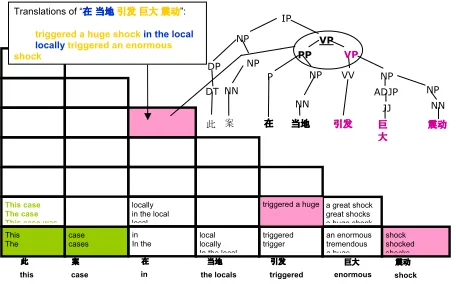
Figure 2: Subtree of “VP(PP,VP)” triggered a reordering pattern of swapping the order of the two children PP and VP in the source parse tree. This will move the translation “in the local” after the translation of “triggered a huge shock”, to form the preferred translation in the highlighted cell: “triggered a huge shock in the local”.
variable [X,0] and the label-based variable [X,VP] co-exist in our proposed rule.
We illustrate several special cases of our extracted Tree-to-String rules in the following. We index the variables with their positions to indicate the align-ment∼, and skip the feature functionw¯to simplify the notations.
X →< [X, IP]; [X, N P0] [X, V P0]; (2)
[X, N P0]is[X, V P0]> .
The rule in Eqn. 2 shows that a source tree rooted at IP, with two children of NP and VP generalized into variables [X,NP] and [X,VP]; they are rewritten into “[X,NP] is [X,VP]”, with the spontaneous word isinserted. Such rules are not allowed in Hiero-style models, as there is no lexical item between the two variables (Chiang, 2005) in the source side. This
rule will generate a spontaneous word “is” from the given subtree structure. Usually, it is very hard to align the spontaneous word correctly, and the rules we proposed indicate that spontaneous words are generated directly from the source sub-tree struc-ture, and they might not necessarily get aligned to some particular source words.
A second example is shown in Eqn. 3, which is similar to the Hiero rules:
X →< Ø; [X,0]zhiyi; (3)
one of the[X,0]> .
[image:4.612.193.421.239.381.2]map-ping of the root of the span. In this way, the repre-sentation power is kept in the variables in our rules, even if the source subtree is aligned to a discontin-uous sequence on the target side. This is important for Chinese-to-English, because the grammar struc-ture is so different that more than 40% of the subtree structures were not kept during the translation in our study on hand-aligned data. Following strictly the source side syntax will derail from these informative translation patterns.
X →< [X, N P]; [X, N N1][X, N N2][X, N N3]; [X, N N3][X, N N1][X, N N2]> . (4)
Eqn. 4. is a POS-based rule — a special case in our proposed rules. This rule shows the reorder-ing patterns for three adjacent NN’s. POS based rules can be very informative for some language-pairs such as Arabic-to-English, where the ADJ is usually moved before NN during the translations.
As also shown in Eqn. 4 for POS sequences, in the UPenn treebank-style parse trees, a root usually have more than two variables. Our rule set for subtree, therefore, contain more than two variables: “X→<
[X, IP]; [X, ADV P0][X, N P0][X, V P0]; [X, N P0] [X, ADV P0][X, V P0] >”. A CYK-style decoder has to rely on binarization to preprocess the grammar as did in (Zhang et al., 2006) to handle multi-nonterminal rules. We adopt the so-called dotted-rule or dotted-production, similar to the Early-style algorithm (Earley, 1970), to handle the multi-nonterminal rules in our chart-based decoder.
3.2 Feature Functions
As used in most of the SMT decoders for a phrase-pair, a set of standard feature functions are applied in our decoder, including IBM Model-1 like scores in both directions, relative frequencies in both direc-tions. In addition to these features, a counter is as-sociated to each rule to collect how many rules were applied so far to generate a hypothesis. The stan-dard Minimum Error Rate training (Och, 2003) was applied to tune the weights for all feature types.
The number of extracted rules from the GALE data is generally large. We pruned the rules accord-ing to their frequencies, and only keep at most the top-50 frequent candidates for each source side.
4 Chart-based Decoder
Given the source sentence, with constituent parse-trees, the decoder is to find the best derivation D∗ which yield the English stringe∗:
e∗= arg max
D∗ {φ(D)φ(e)φ(f|e)}, (5)
where φ(D) is the cost for each of the derivations that lead to e from a given source-parsed f; φ(e)
is for cost functions from the standard n-gram lan-guage models; φ(f|e) is the cost for the standard translation models, including general blocks. We separate the costs for normal blocks and the general-ized rules explicitly here, because the blocks contain stronger lexical evidences observed directly from data, and we assign them with less cost penalties via a different weight factor visible for optimization, and prefer the lexical match over the derived paths during the decoding.
Our decoder is a chart-based parser with beam-search for each cell in a chart. Because the tree-structure can have more than two children, there-fore, the Tree-to-String rules extracted usually con-tain more than two variables. Slightly different from the decoder in (Chiang, 2005), we implemented thedotted-rulein Early-style parser to handle rules containing more than two variables. Our cube-expansion, implemented the cube-pruning in Chiang (2007), and integratedpiece-wisecost computations for language models via LM states. The intermedi-ate hypotheses were merged (recombined) accord-ing to their LM states and other cost model states. We use MER (Och, 2003) to tune the decoder’s pa-rameters using a development data set.
Figure 2 shows an example of a tree-based rule fired at the subtree of VP covering the highlighted cell. When a rule is applied at a certain cell in the chart, the covered source ngram should match not only the lexical items in the rules, but also the tree-structures as well. The two children under the sub-tree root VP are PP (“在当地”: in the local) and VP
(“引发巨大震动”: triggered a huge shock ). This
5 Experiments
Our training data consists of two corpora: the GALE Chinese-English parallel corpus and the LDC hand-aligned corpus1. The Chinese side of these two
cor-pora were parsed using a constituency parser (Luo, 2003). The average labeled F-measure of the parser is 81.4%.
Parallel sentences were first word-aligned using a MaxEnt aligner (Ittycheriah and Roukos, 2005). Then, phrase-pairs that overlap with our develop-ment and test set were extracted from the word alignments (from both hand alignments and auto-matically aligned GALE corpora) based on the pro-jection principle (Tillmann, 2003). Besides the regu-lar phrase-pairs, we also extracted the Tree-to-String rules from the two corpora. The detailed statistics are shown in Table 1. Our re-implementation of Hi-ero system is the baseline. We integrated the eleven reordering rules described in (Wang et al., 2007), in our chart-based decoder. In addition, we report the results of using the Tree-to-String rules extracted from the hand-aligned training data and the automat-ically aligned training data. We also report the result of our translation quality in terms of both BLEU (Pa-pineni et al., 2002) and TER (Snover et al., 2006) against four human reference translations.
5.1 The Data
Table 1 shows the statistics of our training, develop-ment and test data. As our word aligner (Ittycheriah and Roukos, 2005) can introduce errors in extracting Tree-to-String rules, we use a small hand-aligned data set “CE16K”, which consists of 16K sentence-pairs, to get relatively clean rules, free from align-ment errors. A much larger GALE data set, which consists of10million sentence-pairs, is used to in-vestigate the scalability of our proposed approach.
Table 1: Training and Test Data
Train/test sentences src words tgt words CE16K 16379 380103 477801
GALE 10.5M 274M 310M
MT03 919 24099
-Dev07 2303 61881
-1LDC2006E93
The NIST 2003 MT Evaluation (MT03) is used as our development data set to tune the decoder’s parameters toward better BLEU score. The text part of GALE 2007 Chinese-to-English Development set (GALE DEV07) is used as our test set. MT03 sists of 919 sentences, whereas GALE DEV07 con-sists of 2303 sentences under two genres: NewsWire and WebLog. Both have four human reference trans-lations.
5.2 Details of Extracted Rules
From the hand-aligned data, the rules we extracted fall into three categories: regular blocks (phrase-pairs), Hiero-like rules, and Tree-to-String rules. The statistics of the extracted rules are shown in Ta-ble 2
Table 2: Rules extracted from hand-aligned data Types Frequency
Block 846965
Hiero 508999
Tree-to-String 409767
Total 1765731
We focus on Tree-to-String rules. Table 3 shows the detailed statistics of the Tree-to-String rules ex-tracted from the Chinese-to-English hand-aligned training data. The following section provides a de-tailed analysis of the most frequent subtrees ob-served in our training data.
5.2.1 Frequent Subtrees: NP, VP, and DNP The majority of Tree-to-String rules we extracted are rooted at the following labels: NP (46%), VP(22.8%), DNP (2.23%), and QP(2.94%).
Wang et al. (2007) covers only subtrees of NP, VP, and LCP, which are a subset of our proposed Tree-to-String rules here. They apply these rules as a pre-processing step to reorder the input sentences with hard decisions. Our proposed Tree-to-String rules, on the contrary, are applied during the de-coding process which allows for considering many possible competing reordering options for the given sentences, and the decoder will choose the best one according to the cost functions.
Table 5: Hiero, Tree-Based (eleven rules in Wang et al. (2007)), and Tree-to-String Rules with “DE”
Ruleset Root Src Tgt Frequency
Hiero
NULL [X,0] 的[X,1] [X,0] ’s [X,1] 347 NULL [X,0] 的[X,1] [X,1] of [X,0] 306 NULL [X,0] 的[X,1] [X,0] of [X,1] 174
Tree-Based
NP DNP(NP) NP NP DNP(NP)
-NP DNP(PP) NP NP DNP(PP)
-NP DNP(LCP) NP NP DNP(LCP)
[image:7.612.92.281.267.458.2] [image:7.612.87.283.516.603.2]-Tree-to-String
[X,DNP] [X,NP] [X,DEG] [X,NP] [X,DEG] 580 [X,DNP] [X,NP] [X,DEG] [X,DEG] [X,NP] 2163 [X,DNP] [X,NP] [X,DEG] [X,NP] , [X,DEG] 4
Table 3: Distributions of the NP, VP, QP, LCP rules Root Frequency Percentage (%)
NP 189616 46.2
VP 93535 22.8
IP 68341 16.6
PP 18519 4.51
DNP 9141 2.23
QP 12064 2.94
LCP 4127 1.00
CP 2994 0.73
PRN 2810 0.68
DP 1415 0.34
Others 6879 1.67
Total 409767
-Table 4: Distribution of the reordering rules for subtrees rooted at VP: [X,VP]; [X,PP] [X,VP]; statistics are col-lected from GALE training data
Root Target Frequency
VP
[X,PP] [X,VP] 126310 [X,VP] [X,PP] 22144 [X,PP] , [X,VP] 1524 [X,PP] that [X,VP] 1098 [X,PP] and [X,VP] 831
it is impossible to come up with a reordering rule that is always applicable. For instance, (Wang et al., 2007) will always swap the children of the sub-tree VP(PP,VP). However, the statistics shown in Ta-ble 4 suggest that might not be best way. In fact, due to parser’s performance and word alignment
ac-curacies, the statistics we collected from the GALE dataset, containing 10 million sentence-pairs, show that the children in the subtree VP(PP,VP) is trans-lated monotonically 126310 times, while reordered of only 22144 times. However, the hand-aligned data support the swap for 1245 times, and monotoni-cally for only 168 times. Part of this disagreement is due to the word segmentation errors, incorrect word alignments and unreliable parsing results.
Another observations through our extracted Tree-to-String rules is on the controlled insertion of the target spontaneous2(function) words. Instead of hy-pothesizing spontaneous words based only on the language model or only on observing in phrase-pairs, we make use of the Tree-to-String rules to get suggestion on the insertion of spontaneous words. In this way, we can make sure that the spontaneous words are generated from the structure information, as opposed to those from a pure hypothesis. The ad-vantage of this method is shown in Table 4. For in-stance, the word “that” and the punctuation “,” were generated in the target side of the rule. This proves that our model can provide a more principled way to generate spontaneous words needed for fluent trans-lations.
5.2.2 DEG and DEC
An interesting linguistic phenomenon that we in-vestigated is the Chinese word DE “的”. “的” is an informative lexical clue that indicates the need for long range phrasal movements. Table 5 shows a few
2Target spontaneous words are function words that do not
high-frequent reordering rules that contain the Chi-nese word “DE”.
The three type of rules handle “DE” differently. A major difference is the structure in the source side. Hiero rules do not consider any structure, and ap-ply the rule of “[X,0] 的[X,1]”. Tree-based rules, as described in Wang et al. (2007) do not handle
的 directly; they are often implicitly taken care of when reordering DNPs instead. Our proposed Tree-to-String rules model 的directly in a subtree con-taining DEG/DEC, which triggers word reordering within the structure. Our rule set includes all the above three rule-types with the associated frequen-cies, this enriched the reordering choices to be cho-sen by the chart-based decoder, guided by the statis-tics collected from the data and the language model costs.
5.3 Evaluation
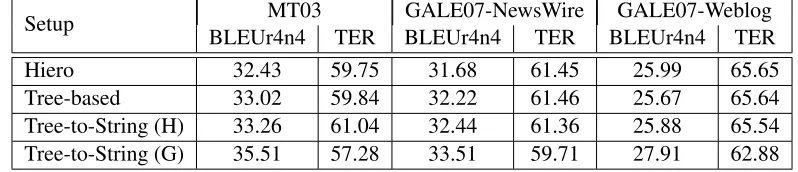
We tuned the decoding parameters using the MT03 data set, and applied the updated parameters to the GALE evaluation set. The elevenrules of VP, NP, and LCP (tree-based) improved the Hiero baseline3
from 32.43 to 33.02 on BLEU. The reason, the tree-reordering does not gain much over Hiero baseline, is probably that the reordering patterns covered by tree-reordering rules, are potentially handled in the standard Hiero grammar.
A small but noticeable further improvement over tree-based rules, from 33.02 to 33.26, was ob-tained on applying Tree-to-String rules extracted from hand-aligned dataset. We think that the Tree-based rules covers major reordering patterns for Chinese-English, and our hand-aligned dataset is also too small to capture representative statistics and more reordering patterns. A close check at the rules we learned from the hand-aligned data shows that the tree-based rules are simply the subset of the rules extracted. The Tree-to-String grammar im-proved the Hiero baseline from 32.43 to 33.26 on BLEU; considering the effects from the tree-based rules only, the additional information improved the BLEU scores from 33.02 to 33.26. Similar pictures of improvements were observed for the two unseen tests of newswire and weblog in GALE data.
When applying the rules extracted from the much
3Hiero results are from our own re-implementation.
larger GALE training set with about ten million sentence-pairs, we achieved significant improve-ments from both genres (newswire and web data). The improvements are significant in both BLEU and TER. BLEU improved from 32.44 to 33.51 on newswire, and from 25.88 to 27.91 on web data. Similar improvements were found in TER as shown in the table. The gain came mostly from the richer extracted rule set, which not only presents robust statistics for reordering patterns, but also offers more target spontaneous words generated from the syntac-tic structures. Since the top-frequent rules extracted are NP, VP, and IP as shown in Table 3, our proposed rules will be able to win the correct word order with reliable statistics, as long as the parser shows accept-able performances on these structures. This is espe-cially important for weblog data, where the parser’s overall accuracy potentially might not be very good. Table 7 shows the translations from different grammars for the same source sentence. Both Tree-based and Tree-to-String methods get the correct re-ordering, while the latter can suggest insertions of target spontaneous words like “a” to allow the trans-lation to run more fluently.
6 Conclusion and Discussions
In this paper, we proposed our approach to model both local and non-local word-reordering in one probabilistic synchronous CFG. Our current model incorporates source-side syntactic information, to model the observations that the source syntactic con-stituent tends to move together during translations. The proposed rule set generalizes over the variables in Hiero-rules, and we also showed the special cases of the Tree-based rules and the POS-based rules. Since the proposed rules has at most one-level tree structure, they can be easily applied in a chart-based decoder. We analyzed the statistics of our rules, qualitatively and quantitatively. Next, we compared our work with other research, especially with the work in Wang et al. (2007). Finally, we reported our empirical results on Chinese-English transla-tions. Our Tree-to-String rules showed significant improvements over the Hiero baseline on the GALE DEV07 test set.
Table 6: Hiero, Tree-Based (NP, VP, LCP), and Tree-to-String rules extracted from hand-aligned data (H) or from GALE training data (G)
Setup MT03 GALE07-NewsWire GALE07-Weblog
BLEUr4n4 TER BLEUr4n4 TER BLEUr4n4 TER
Hiero 32.43 59.75 31.68 61.45 25.99 65.65
Tree-based 33.02 59.84 32.22 61.46 25.67 65.64 Tree-to-String (H) 33.26 61.04 32.44 61.36 25.88 65.54 Tree-to-String (G) 35.51 57.28 33.51 59.71 27.91 62.88
Table 7: Hiero, Tree-Based (NP, VP, LCP), Tree-to-String Translations
Src-Sent 此案在当地引发巨大震动。
Hiero in this case local triggered shock . Tree-Based the case triggered uproar in the local. Tree-to-String the case triggered a huge uproar in the local .
word-alignments, our rules learned are still noisy. Exploring better cost functions associate each rule might lead to further improvement. Because of the relative high accuracy of English parsers, many works such as Zollmann and Venugopal (2006) and Shen et al. (2008) emphasize on using syntax in tar-get languages, to directly influence the fluency as-pect of the translation output. In future, we plan to incorporate features from target-side syntactic infor-mation, and connect them with the source informa-tion explored in this paper, to model long-distance reordering for better translation quality.
Acknowledgments
The authors would like to thank the anonymous reviewers for their comments to improve this pa-per. This work was supported by DARPA GALE program under the contract number HR0011-06-2-0001.
References
Yaser Al-Onaizan and Papineni. Kishore. 2006. Distor-tion models for statistical machine translaDistor-tion. In Pro-ceedings of ACL-COLING, pages 529–536.
David Chiang. 2005. A hierarchical phrase-based model for statistical machine translation. In Proceedings of the 43rd Annual Meeting of the Association for Com-putational Linguistics (ACL’05), pages 263–270, Ann Arbor, Michigan, June. Association for Computational Linguistics.
David Chiang. 2007. Hierarchical phrase-based transla-tion. InComputational Linguistics.
Michael Collins, Philipp Koehn, and Ivona Kucerova. 2005. Clause restructuring for statistical machine translation. InProceedings of ACL.
Jay Earley. 1970. An efficient context-free parsing al-gorithm. InCommunications of the ACM., volume 13, pages 94–102.
Heidi J. Fox. 2002. Phrasal cohesion and statistical machine translation. In Proc. of the Conference on Empirical Methods in Natural Language Processing, pages 304–311, Philadelphia, PA, July 6-7.
Jonathan Graehl and Kevin Knight. 2004. Training tree transducers. InProc. NAACL-HLT.
Abraham Ittycheriah and Salim Roukos. 2005. A maxi-mum entropy word aligner for arabic-english machine translation. InHLT/EMNLP.
Shankar Kumar and William Byrne. 2005. Local phrase reordering models for statistical machine translation. InHLT/EMNLP 2005, Vancouver, B.C., Canada. Yang Liu, Qun Liu, and Shouxun Lin. 2006.
Tree-to-string alignment template for statistical machine trans-lation. InACL-Coling.
Yang Liu, Yun Huang, Qun Liu, and Shouxun Lin. 2007. Forest-to-string statistical translation rules. In 45th Annual Meeting of the Association for Computational Linguistics.
Xiaoqiang Luo. 2003. A maximum entropy chinese character-based parser. InProc. of ACL.
Sonja Niessen and Hermann Ney. 2004. Statistical machine translation with scarce resources using mor-phosyntactic information. InComputational Linguis-tics.
Franz J. Och and Hermann Ney. 2004. The alignment template approach to statistical machine translation. InComputational Linguistics, volume 30, pages 417– 449.
Franz J. Och. 2003. Minimum error rate training for statistical machine translation. In Proc. of the 41st Annual Meeting of the Association for Computational Linguistics, Japan, Sapporo, July.
Kishore Papineni, Salim Roukos, Todd Ward, and Wei-Jing Zhu. 2002. Bleu: a method for automatic evalu-ation of machine translevalu-ation. InProc. of the 40th An-nual Conf. of the Association for Computational Lin-guistics (ACL 02), pages 311–318, Philadelphia, PA, July.
Libin Shen, Jinxi Xu, and Ralph Weischedel. 2008. A new string-to-dependency machine translation algo-rithm with a target dependency language model. In
Proceedings of ACL.
Matthew Snover, Bonnie Dorr, Richard Schwartz, Lin-nea Micciulla, and John Makhoul. 2006. A study of translation edit rate with targeted human annotation. InAMTA.
Christoph Tillmann and Tong Zhang. 2005. A localized prediction model for statistical machine translation. In
Proceedings of the 43rd Annual Meeting of the Asso-ciation for Computational Linguistics (ACL’05), pages 557–564, Ann Arbor, Michigan, June. Association for Computational Linguistics.
Christoph Tillmann. 2003. A projection extension algo-rithm for statistical machine translation. In Proc. of the Conference on Empirical Methods in Natural Lan-guage Processing.
Christoph Tillmann. 2008. A rule-driven dynamic pro-gramming decoder for statistical mt. InHLT Second Workshop on Syntax and Structure in Statistical Trans-lation.
Chao Wang, Michael Collins, and Phillip Koehn. 2007. Chinese syntactic reordering for statistical machine translation. Inproceedings of EMNLP.
Dekai Wu. 1997. Stochastic inversion transduction grammars and bilingual parsing of parallel corpora. In
Computational Linguistics, volume 23(3), pages 377– 403.
Fei Xia and Michael McCord. 2004. Improving a sta-tistical mt system with automatically learned rewrite patterns. In the 20th International Conference on Computational Linguistics (COLING 2004), Geneva, Switzerland, Aug 22-29.
Deyi Xiong, Qun Liu, and Shouxun Lin. 2006. Maxi-mum entropy based phrase reordering model for sta-tistical machine translation. InACL-Coling.
Nianwen Xue, Fei Xia, Fu-Dong Chiou, and Martha Palmer. 2005. The penn chinese treebank: Phrase structure annotation of a large corpus. InNatural Lan-guage Engineering, volume 11, pages 207–238. K. Yamada and Kevin. Knight. 2001. Syntax-based
Sta-tistical Translation Model. InProceedings of the Con-ference of the Association for Computational Linguis-tics (ACL-2001).
Richard Zens, E. Matusov, and Hermmann Ney. 2004. Improved word alignment using a symmetric lexicon model. InProceedings of the 20th International Con-ference on Computational Linguistics (CoLing 2004), pages 36–42, Geneva, Switzerland, Auguest.
Hao Zhang, Liang Huang, Daniel Gildea, and Kevin Knight. 2006. Synchronous binarization for machine translation. InProceedings of the HLT-NAACL. Andreas Zollmann and Ashish Venugopal. 2006.
![Table 4: Distribution of the reordering rules for subtreesrooted at VP: [X,VP]; [X,PP] [X,VP]; statistics are col-lected from GALE training data](https://thumb-us.123doks.com/thumbv2/123dok_us/1376168.671299/7.612.87.283.516.603/table-distribution-reordering-rules-subtreesrooted-statistics-lected-training.webp)