Machine Translation as Tree Labeling
Mark Hopkins Department of Linguistics University of Potsdam, Germany
Jonas Kuhn Department of Linguistics University of Potsdam, Germany
Abstract
We present the main ideas behind a new syntax-based machine translation system, based on reducing the machine translation task to a tree-labeling task. This tree la-beling is further reduced to a sequence of decisions (of four varieties), which can be discriminatively trained. The optimal tree labeling (i.e. translation) is then found through a simple depth-first branch-and-bound search. An early system founded on these ideas has been shown to be competitive with Pharaoh when both are trained on a small subsection of the Eu-roparl corpus.
1 Motivation
Statistical machine translation has, for a while now, been dominated by the phrase-based translation par-adigm (Och and Ney, 2003). In this paradigm, sentences are translated from a source language to a target language through the repeated substitution of contiguous word sequences (“phrases”) from the source language for word sequences in the target language. Training of the phrase translation model builds on top of a standard statistical word align-ment over the training corpus for identifying corre-sponding word blocks, assuming no further linguis-tic analysis of the source or target language. In de-coding, these systems then typically rely on n-gram language models and simple statistical reordering models to shuffle the phrases into an order that is coherent in the target language.
There are limits to what such an approach can ul-timately achieve. Machine translation based on a
deeper analysis of the syntactic structure of a sen-tence has long been identified as a desirable objec-tive in principle (consider (Wu, 1997; Yamada and Knight, 2001)). However, attempts to retrofit syn-tactic information into the phrase-based paradigm have not met with enormous success (Koehn et al., 2003; Och et al., 2003)1, and purely phrase-based machine translation systems continue to outperform these syntax/phrase-based hybrids.
In this work, we try to make a fresh start with syntax-based machine translation, discarding the phrase-based paradigm and designing a machine translation system from the ground up, using syntax as our central guiding star. Evaluation with BLEU and a detailed manual error analysis of our nascent system show that this new approach might well have the potential to finally realize some of the promises of syntax.
2 Problem Formulation
We want to build a system that can learn to translate sentences from a source language to a destination language. As our first step, we will assume that the system will be learning from a corpus consisting of tripleshf, e, ai, where: (i)f is a sentence from our source language, which is parsed (the words of the sentence and the nodes of the parse tree may or may not be annotated with auxiliary information), (ii)eis a gold-standard translation of sentencef (the words of sentenceemay or may not be annotated with aux-iliary information), and (iii) ais an automatically-generated word alignment (e.g. via GIZA++) be-tween source sentencef and destination sentencee.
1(Chiang, 2005) also reports that with his hierarchical
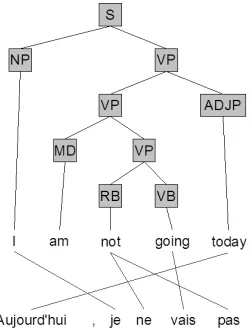
Figure 1: Example translation object.
Let us refer to these triples as translation objects. The learning task is: using the training data, pro-duce a scoring function P that assigns a score to every translation objecthf, e, ai, such that this scor-ing function assigns a high score to good transla-tions, and a low score to poor ones. The decoding task is: given scoring function P and an arbitrary sentence f from the source language, find transla-tion objecthf, e, aithat maximizesP(hf, e, ai).
To facilitate matters, we will map translation ob-jects to an alternate representation. In (Galley et al., 2003), the authors give a semantics to every trans-lation object by associating each with an annotated parse tree (hereafter called a GHKM tree) represent-ing a specific theory about how the source sentence was translated into the destination sentence.
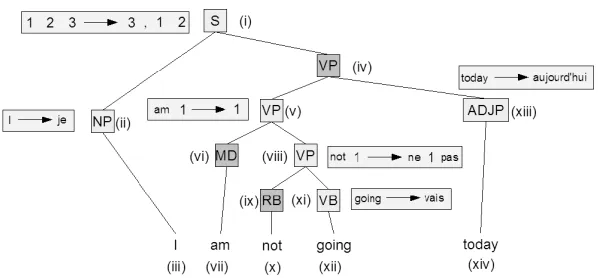
In Figure 1, we show an example translation ob-ject and in Figure 2, we show its associated GHKM tree. The GHKM tree is simply the parse treef of the translation object, annotated with rules (hereafter referred to as GHKM rules). We will not describe in depth the mapping process from translation object to GHKM tree. Suffice it to say that the alignment in-duces a set of intuitive translation rules. Essentially, a rule like: “not 1→ne 1 pas” (see Figure 2) means: if we see the word “not” in English, followed by a phrase already translated into French, then translate the entire thing as the word “ne” + the translated phrase + the word “pas.” A parse tree node gets la-beled with one of these rules if, roughly speaking, its span is still contiguous when projected (via the alignment) into the target language.
Formally, what is a GHKM tree? Define a rule
el-ement as a string or an indexed variable (e.g. x1, x4, x32). A GHKM rule of rank k (where k is a non-negative integer) is a pair hRs, Rdi, where source listRsand destination list Rdare both lists
of rule elements, such that each variable ofXk ,
{x1, x2, ..., xk}appears exactly once in Rs and
ex-actly once inRd. Moreover, inRs, the variables
ap-pear in ascending order. In Figure 2, some of the tree nodes are annotated with GHKM rules. For clarity, we use a simplified notation. For instance, rulehhx1, x2, x3i,hx3,“,”, x1, x2iiis represented as “1 2 3→3 , 1 2”. We have also labeled the nodes with roman numerals. When we want to refer to a particular node in later examples, we will refer to it, e.g., ast(i)ort(vii).
A rule node is a tree node annotated with a GHKM rule (for instance, nodest(i) ort(v) of Fig-ure 2, but not nodet(iv)). A tree nodet2is reachable from tree nodet1iff nodet2 is a proper descendant of nodet1 and there is no rule node (not including nodest1,t2) on the path from nodet1 to nodet2.
Define the successor list of a tree nodetas the list of rule nodes and leaves reachable fromt(ordered in left-to-right depth-first search order). For Figure 2, the successor list of node t(i) is ht(ii), t(v), t(xiii)i, and the successor list of nodet(v) isht(vii), t(viii)i. The rule node successor list of a tree node is its suc-cessor list, with all non-rule nodes removed.
Define the signature of a parse tree nodetas the result of taking its successor list, replacing the jth rule node with variablexj, and replacing every
rule node with its word label (observe that all non-rule nodes in the successor list are parse tree leaves, and therefore they have word labels). For Figure 2, the signature of nodet(i)ishx1, x2, x3i, and the sig-nature of nodet(v)ish“am”, x1i.
Notice that the signature of every rule node in Fig-ure 2 coincides with the source list of its GHKM rule. This is no accident, but rather a requirement. Define a GHKM tree node as a parse tree node whose children are all GHKM tree nodes, and whose GHKM rule’s source list is equivalent to its signa-ture (if the node is a rule node).
Given these definitions, we can proceed to define how a GHKM tree expresses a translation theory. Suppose we have a listS = hs1, ..., ski of strings.
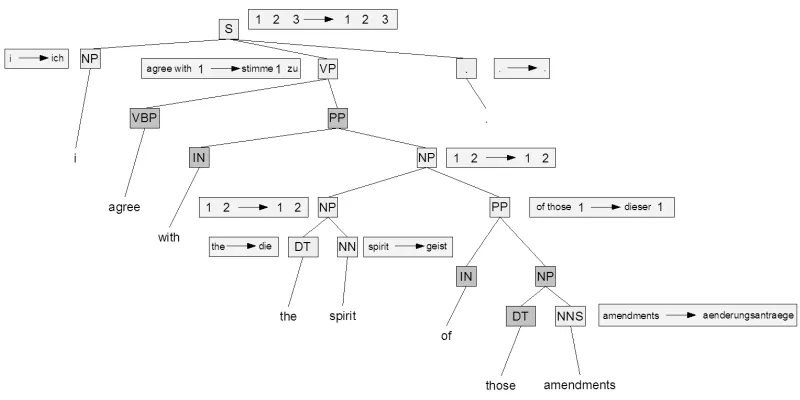
ele-Figure 2: GHKM tree equivalent of example translation object. The light gray nodes are rule nodes of the GHKM tree.
mentras:
r[S] =
s
i ifris indexed varxi
r otherwise
Notice that this operation always produces a string. Define the substitution of string list S into rule element listR=hr1, ..., rjias:
R[S] =concat(r1[S], r2[S], ..., rj[S])
where concat(s1, ..., sk)is the spaced concatenation
of strings s1, ..., sk (e.g., concat( “hi”, “there” ) =
“hi there”). This operation also produces a string. Finally, define the translation of GHKM tree node
tas:
τ(t),Rd[hτ(t1), ..., τ(tk)i]
where ht1, ..., tki is the rule node successor list of
GHKM tree nodet.
For Figure 2, the rule node successor list of node
t(viii)isht(xi)i. So:
τ(t(viii)) =h“ne”, x1,“pas”i[hτ(t(xi))i]
=h“ne”, x1,“pas”i[h“vais”i]
=“ne vais pas”
A similar derivation gives us:
τ(t(i)) =“aujourd’hui , je ne vais pas”
In this way, every GHKM tree encodes a transla-tion. Given this interpretation of a translation object, the task of machine translation becomes something concrete: label the nodes of a parsed source sentence with a good set of GHKM rules.
3 Probabilistic Approach
To achieve this “good” labeling of GHKM rules, we will define a probabilistic generative model P
of GHKM trees, which will serve as our scoring function. We would like to depart from the stan-dard probabilistic approach of most phrase-based translators, which employ very simple probability models to enable polynomial-time decoding. In-stead, we will use an alternative probabilistic ap-proach (an assignment process), which sacrifices polynomial-time guarantees in favor of a more flexi-ble and powerful model. This sacrifice of guaranteed polynomial-time decoding does not entail the sacri-fice of good running time in practice.
3.1 Assignment Processes
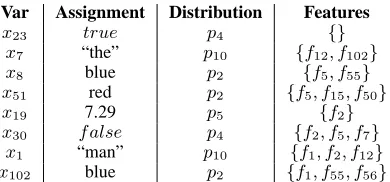
An assignment process builds a sequence of vari-able assignments (called an assignment history) by repeatedly iterating the following steps. First, it re-quests a variable name (say x22) from a so-named
variable generator. It takes this variable name and the assignment history built so far and com-presses this information into a set of features (say
{f2, f6, f80}) using a feature function. These fea-tures are then mapped to a probability distribution by a function (sayp7) requested from a so-named
distri-bution generator. The iteration ends by assigning to
[image:3.612.186.485.51.190.2]Var Assignment Distribution Features
x23 true p4 {}
x7 “the” p10 {f12, f102}
x8 blue p2 {f5, f55}
x51 red p2 {f5, f15, f50}
x19 7.29 p5 {f2}
x30 f alse p4 {f2, f5, f7}
x1 “man” p10 {f1, f2, f12}
[image:4.612.89.284.53.144.2]x102 blue p2 {f1, f55, f56}
Figure 3: A example assignment history generated by an assignment process.
point, the assignment history built so far (like the example in Figure 3) is returned.
Formally, define a variable signature as a pair Σ = hX, Vi, where X is a set of variable names andV is a set of values. Define a variable
assign-ment of signaturehX, Vi as a pairhx, vi, for vari-ablex ∈Xand valuev ∈V. Define an assignment
history of signatureΣas an ordered list of variable assignments ofΣ. The notationH(Σ)represents the set of all assignment histories of signatureΣ.
We define a feature function of signature Σ =
hX, Vi as a functionf that maps every pair of set
X×H(Σ)to a set of assignments (called features) of an auxiliary variable signatureΣf.
We define an assignment process of signature Σ =hX, Vias a tuplehf, P, gx, gpi, where: (i)f is
a feature function ofΣ, (ii)P ={p1, ..., pk}is a
fi-nite set ofkfunctions (called the feature-conditional
distributions) that map each feature set inrange(f) to a probability distribution overV, (iii)gxis a
func-tion (called the variable generator) mapping each assignment history in the setH(Σ)to either a vari-able name in X or the reserved tokenST OP, and (iv) gp is a function (called the distribution gener-ator) mapping each assignment history in the set
H(Σ)to a positive integer between1andk.
An assignment process probabilistically generates an assignment history of signatureΣin the follow-ing way:
1. h←empty list
2. Do untilgx(h) =ST OP:
(a) Letx=gx(h)and letj=gp(h).
(b) Draw valuevprobabilistically from distri-butionpj(f(x, h)).
(c) Append assignmenthx, vito historyh.
3. Return historyh.
3.2 Training
Given all components of an assignment process of signature Σ except for the set P of feature-conditional distributions, the training task is to learn
P from a training corpus of assignment histories of signatureΣ. This can be achieved straightforwardly by taking the feature vectors generated by a partic-ular distribution and using them to discriminatively learn the distribution. For instance, say that our cor-pus consists of the single history given in Figure ??. To learn distribution p2, we simply take the three variable assignments produced byp2and feed these feature vectors to a generic discriminative learner. We prefer learners that produce distributions (rather than hard classifiers) as output, but this is not re-quired.
3.3 Decoding
Notice that an assignment process of signatureΣ in-duces a probability distribution over the setH(Σ)of all assignment histories of Σ. The decoding ques-tion is: given a partial assignment historyh, what is the most probable completion of the history, ac-cording to this induced distribution? We will use the natural naive search space for this question. The nodes of this search space are the assignment his-tories of H(Σ). The children of the search node representing historyhare those histories that can be generated fromhin one iteration of the assignment process. The value of a search node is the proba-bility of its assignment history (according to the as-signment process). To decode, we begin at the node representing history h, and search for the highest-value descendant that represents a complete assign-ment history (i.e. an assignassign-ment history terminated by theST OP token).
This is, potentially, a very large and intractible search space. However, if most assignment deci-sions can be made with relative confidence, then the great majority of search nodes have values which are inferior to those of the best solutions. The standard search technique of depth-first
branch-and-bound search takes advantage of search spaces with
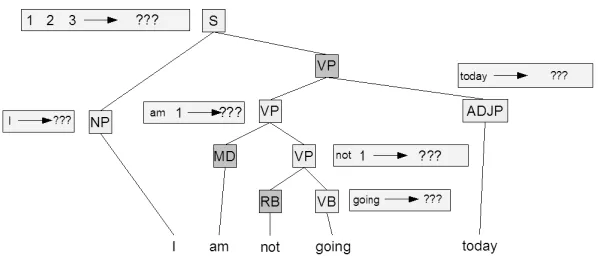
Figure 4: Partial GHKM tree, after rule nodes have been identified (light gray). Notice that once we identify the rule node, the rule left-hand sides are already determined.
Depth-first branch-and-bound search has the follow-ing advantage: it finds a good (suboptimal) solution in linear time and continually improves on this solu-tion until it finds the optimal. Thus it can be run ei-ther as an optimal decoder or as a heuristic decoder, since we can interrupt its execution at any time to get the best solution found so far. Additionally, it takes only linear space to run.
4 Generative Model
We now return to where we left off at the end of Sec-tion 2, and devise an assignment process that pro-duces a GHKM tree from an unlabeled parse tree. This will give us a quality measure that we can use to produce a “good” labeling of a given parse tree with GHKM rules (i.e., the probability of such a la-beling according to the assignment process).
The simplest assignment process would have a variable for each node of the parse tree, and these variables would all be assigned by the same feature-conditional distribution over the space of all possible GHKM rules. The problem with such a formulation is that such a distribution would be inachievably dif-ficult to learn. We want an assignment process in which all variables can take only a very small num-ber of possible values, because it will be much eas-ier to learn distributions over such variables. This means we need to break down the process of con-structing a GHKM rule into simpler steps.
Our assignment process will begin by sequen-tially assigning a set of boolean variables (which we will call rule node indicator variables), one for each node in the parse tree. For parse tree nodet, we de-note its corresponding rule node indicator variable
xrt. Variable xrt is assigned trueiff the parse tree nodetwill be a rule node in the GHKM tree.
In Figure 3.3, we show a partial GHKM tree af-ter these assignments are made. The key thing to observe is that, after this sequence of boolean deci-sions, the LHS of every rule in the tree is already determined! To complete the tree, all we need to do is to fill in their right-hand sides.
Again, we could create variables to do this di-rectly, i.e. have a variable for each rule whose do-main is the space of possible right-hand sides for its established left-hand sides. But this is still a wide-open decision, so we will break it down further.
For each rule, we will begin by choosing the
template of its RHS, which is a RHS in which
all sequences of variables are replaced with an empty slot into which variables can later be placed. For instance, the template of h“ne”, x1,“pas”i is h“ne”, X,“pas”iand the template ofhx3,“,”, x1, x2i ishX,“,”, Xi, where X represents the empty slots.
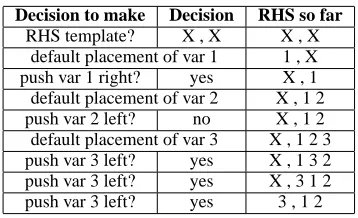
Once the template is chosen, it simply needs to be filled with the variables from the LHS. To do so, we process the LHS variables, one by one. By default, they are placed to the right of the previously placed variable (the first variable is placed in the first slot). We repeatedly offer the option to push the variable to the right until the option is declined or it is no longer possible to push it further right. If the vari-able was not pushed right at all, we repeatedly offer the option to push the variable to the left until the option is declined or it is no longer possible to push it further left. Figure 4 shows this generative story in action for the rule RHShx3,“,”, x1, x2i.
Decision to make Decision RHS so far
[image:6.612.96.275.52.161.2]RHS template? X , X X , X default placement of var 1 1 , X push var 1 right? yes X , 1 default placement of var 2 X , 1 2 push var 2 left? no X , 1 2 default placement of var 3 X , 1 2 3 push var 3 left? yes X , 1 3 2 push var 3 left? yes X , 3 1 2 push var 3 left? yes 3 , 1 2
Figure 5: Trace of the generative story for the right-hand side of a GHKM rule.
in order to label a parse tree with GHKM rules. No-tice that, aside from the template decisions, all of the decisions are binary (i.e. feasible to learn discrimi-natively). Even the template decisions are not terri-bly large-domain, if we maintain a separate feature-conditional distribution for each LHS template. For instance, if the LHS template is h“not”, Xi, then RHS template h“ne”, X,“pas”iand a few other se-lect candidates should bear most of the probability mass.
5 Evaluation
In this section, we evaluate a preliminary English-to-German translation system based on the ideas outlined in this paper. We first present a quantia-tive comparison with the phrase-based approach, us-ing the BLEU metric; then we discuss two con-crete translation examples as a preliminary qualita-tive evaluation. Finally, we present a detailed man-ual error analysis.
Our data was a subset of the Europarl corpus con-sisting of sentences of lengths ranging from 8 to 17 words. Our training corpus contained 50000 sen-tences and our test corpus contained 300 sensen-tences. We also had a small number of reserved sentences for development. The English sentences were parsed using the Bikel parser (Bikel, 2004), and the sen-tences were aligned with GIZA++ (Och and Ney, 2000). We used the WEKA machine learning pack-age (Witten and Frank, 2005) to train the distribu-tions (specifically, we used model trees).
For comparison, we also trained and evaluated Pharaoh (Koehn, 2005) on this limited corpus, us-ing Pharaoh’s default parameters. Pharaoh achieved a BLEU score of 11.17 on the test set, whereas our
system achieved a BLEU score of 11.52. What is notable here is not the scores themselves (low due to the size of the training corpus). However our system managed to perform comparably with Pharaoh in a very early stage of its development, with rudimen-tary features and without the benefit of an n-gram language model.
Let’s take a closer look at the sentences produced by our system, to gain some insight as to its current strengths and weaknesses.
Starting with the English sentence (note that all data is lowercase):
i agree with the spirit of those amendments .
Our system produces:
ich I
stimme vote
die the.FEM
geist spirit.MASC
dieser these ¨anderungsantr¨age
change-proposals zu to
. .
The GHKM tree is depicted in Figure 5. The key feature of this translation is how the English phrase “agree with” is translated as the German “stimme ... zu” construction. Such a feat is difficult to pro-duce consistently with a purely phrase-based sys-tem, as phrases of arbitrary length can be placed be-tween the words “stimme” and “zu”, as we can see happening in this particular example. By contrast, Pharaoh opts for the following (somewhat less de-sirable) translation:
ich I
stimme vote
mit with
dem the.MASC
geist spirit.MASC
dieser these ¨anderungsantr¨age
change-proposals . .
A weakness in our system is also evident here. The German noun “Geist” is masculine, thus our system uses the wrong article (a problem that Pharaoh, with its embedded n-gram language model, does not encounter).
In general, it seems that our system is superior to Pharaoh at figuring out the proper way to arrange the words of the output sentence, and inferior to Pharaoh at finding what the actual translation of those words should be.
Consider the English sentence:
Figure 6: GHKM tree output for the first test sentence.
Here we have an example of a double verb: “shall submit.” In German, the second verb should go at the end of the sentence, and this is achieved by our system (translating “shall” as “werden”, and “sub-mit” as “vorlegen”).
wir we
werden will
eine a.FEM
vorschlag proposal.MASC
in in
dieser these haushaltslinien
budget-lines vor before
die the.FEM
ende end.NEUT dieser
this.FEM jahres year.NEUT
vorlegen submit
. .
Pharaoh does not manage this (translating “sub-mit” as “unterbreiten” and placing it mid-sentence).
werden will
wir we
unterbreiten submit
eine a
vorschlag proposal
in in
dieser these haushaltslinien
budget-lines vor before
ende end
dieser this.FEM
jahr year.NEUT
. .
It is worth noting that while our system gets the word order of the output system right, it makes sev-eral agreement mistakes and (like Pharaoh) doesn’t get the translation of “along these lines” right.
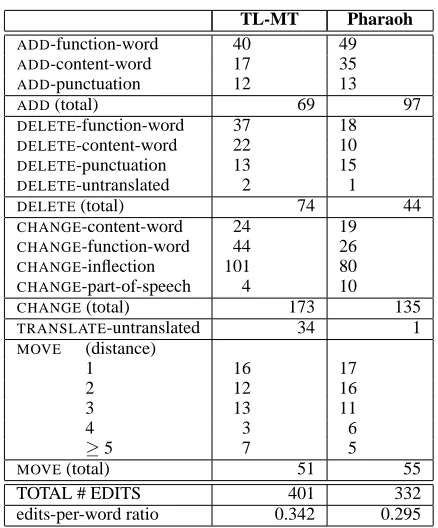
To have a more systematic basis for comparison, we did a manual error analysis for 100 sentences from the test set. A native speaker of German (in the present pilot study one of the authors) determined the editing steps required to transform the system output into an acceptable translation – both in terms of fluency and adequacy of translation. In order to avoid a bias for our system, we randomized the pre-sentation of output from one of the two systems.
We defined the following basic types of edits, with further subdistinctions depending on the word type:
ADD,DELETE,CHANGEandMOVE. A special type
TRANSLATE-untranslated was assumed for
untrans-lated source words in the output. For theCHANGE, more fine-grained distinctions were made.2 A sin-gleMOVEoperation was assumed to displace an
en-tire phrase; the distance of the movement in terms of the number of words was calculated. The table in Figure 7 shows the edits required for correcting the output of the two systems on 100 sentences.
We again observe that our system, which is at an early stage of development and contrary to the Pharaoh system does not include an n-gram lan-guage model trained on a large corpus, already yields promising results. The higher proportion of CHANGE operations, in particular CHANGE -inflection and CHANGE-function-word edits is pre-sumably a direct consequence of providing a lan-guage model or not. An interesting observation is that our system currently tends to overtranslate, i.e., redundantly produce several translations for a word, which leads to the need ofDELETEoperations. The Pharaoh system had a tendency to undertranslate, of-ten with crucial words missing.
2
CHANGE-inflection: keeping the lemma and category the same, e.g. taken →takes; CHANGE-part-of-speech: choos-ing a different derivational form, e.g., judged →judgement;
TL-MT Pharaoh
ADD-function-word 40 49 ADD-content-word 17 35 ADD-punctuation 12 13
ADD(total) 69 97
DELETE-function-word 37 18 DELETE-content-word 22 10 DELETE-punctuation 13 15 DELETE-untranslated 2 1 DELETE(total) 74 44 CHANGE-content-word 24 19 CHANGE-function-word 44 26 CHANGE-inflection 101 80 CHANGE-part-of-speech 4 10 CHANGE(total) 173 135 TRANSLATE-untranslated 34 1 MOVE (distance)
1 16 17
2 12 16
3 13 11
4 3 6
≥5 7 5
MOVE(total) 51 55
TOTAL # EDITS 401 332
[image:8.612.76.295.50.314.2]edits-per-word ratio 0.342 0.295
Figure 7: Edits required for an acceptable system output, based on 100 test sentences.
6 Discussion
In describing this pilot project, we have attempted to give a “big picture” view of the essential ideas behind our system. To avoid obscuring the presen-tation, we have avoided many of the implementation details, in particular our choice of features. There are exactly four types of decisions that we need to train: (1) whether a parse tree node should be a rule node, (2) the RHS template of a rule, (3) whether a rule variable should be pushed left, and (4) whether a rule variable should be pushed right. For each of these decisions, there are a number of possible fea-tures that suggest themselves. For instance, recall that in German, typically the second verb of a double verb (such as “shall submit” or “can do”) gets placed at the end of the sentence or clause. So when the system is considering whether to push a rule’s noun phrase to the left, past an existing verb, it would be useful for it to consider (as a feature) whether that verb is the first or second verb of its clause.
This system was designed to be very flexible with the kind of information that it can exploit as fea-tures. Essentially any aspect of the parse tree, or of previous decisions that have been taken by the
assignment process, can be used. Furthermore, we can mark-up the parse tree with any auxiliary infor-mation that might be beneficial, like noun gender or verb cases. The current implementation has hardly begun to explore these possibilities, containing only features pertaining to aspects of the parse tree.
Even in these early stages of development, the system shows promise in using syntactic informa-tion flexibly and effectively for machine translainforma-tion. We hope to develop the system into a competitive alternative to phrase-based approaches.
References
Daniel M. Bikel. 2004. Intricacies of Collins’ parsing model.
Computational Linguistics, 30(4):479–511.
David Chiang. 2005. A hierarchical phrase-based model for statistical machine translation. In Proceedings of ACL, pages 263–270.
Michel Galley, Mark Hopkins, Kevin Knight, and Daniel Marcu. 2003. What’s in a translation rule? In Proc. NAACL.
Philipp Koehn, Franz Josef Och, and Daniel Marcu. 2003. Sta-tistical phrase-based translation. In Proceedings of the
Hu-man Language Technology Conference 2003 (HLT-NAACL 2003), Edmonton, Canada.
Philipp Koehn. 2005. Pharaoh: a beam search decoder for phrase-based statistical machine translation models. In
Pro-ceedings of the Sixth Conference of the Association for Ma-chine Translation in the Americas, pages 115–124.
F. J. Och and H. Ney. 2000. Improved statistical alignment models. In Proc. ACL, pages 440–447, Hongkong, China, October.
Franz Josef Och and Hermann Ney. 2003. A systematic com-parison of various statistical alignment models.
Computa-tional Linguistics, 29(1):19–51.
F. J. Och, D. Gildea, S. Khudanpur, A. Sarkar, K. Yamada, A. Fraser, S. Kumar, L. Shen, D. Smith, K. Eng, Viren Jain, Z.Jin, and D. Radev. 2003. Syntax for statistical ma-chine translation. Technical report, Center for Language and Speech Processing, Johns Hopkins University, Baltimore. Summer Workshop Final Report.
Ian H. Witten and Eibe Frank. 2005. Data Mining: Practical
machine learning tools and techniques. Morgan Kaufmann.
Dekai Wu. 1997. Stochastic inversion transduction grammars and bilingual parsing of parallel corpora. Computational Linguistics, 23(3):377–403.
Kenji Yamada and Kevin Knight. 2001. A syntax-based statis-tical translation model. In Proceedings of the 39th Annual
Meeting of the Association for Computational Linguistics,