1
ON TRACK WITH
THRACE: EXPLORING
CROSS-BORDER
COOPERATION IN THE
EU'S SOUTH-EASTERN
EXTERNAL BORDERS
MASTER THESIS DUBBEL-DIPLOMA EUROPEAN STUDIES
Universiteit Twente and Westfälische Wilhelms-Universität Münster
Thesis Supervisors: Prof. Dr. Gert-Jan Hospers and Prof. Dr. Norbert Konegen
External Supervisor: Martin Guillermo-Ramírez
December 2009
Shira Godfried
2
ABSTRACT
This study has been written in the light of my Masters Degree European Studies at the University of Twente and the Westfälische Wilhelms-Universität Münster, under the authority of the Association of European Border Regions. This thesis was aimed at finding the current missing links in cross-border cooperation in South-East Europe on the basis of theory and best-practices. These missing links were based on three models: the theory of Paasi regarding the institutionalization of a region; the theory of Perkmann in relation to determinants of successful cross-border cooperation within the scope of policy entrepreneurship; and best-practices with regards to elements of successful cross-border cooperation provided by the Association of European Border Regions. These three models are elaborately described in the theoretical framework in this thesis.
The field research included looking at to what extent these models could be found in the practice of cross-border cooperation in South-East Europe, more specifically Thrace. Thrace served as a case study as the region is representative for the past and contemporary problems in the entire area. The results were obtained by means of conducting a series of in-depth interviews of a qualitative nature (N=10).
As for my conclusions, the results indicated that cross-border cooperation is still at in a developing phase. At the moment, cross-border cooperation mainly revolves around ad-hoc, project oriented relations between municipal and regional authorities from across the borders. This can be
3
CONTENT
Chapter 1: Introduction ... 7
1.1 Introduction to the study ... 7
1.2 History of the region ... 11
1.2.1 Ancient times ... 12
1.2.2 the middle ages (330-1453) ... 13
1.2.3 Ottoman rule (1354-1922) ... 13
1.2.4 the turbulent 20th century ... 15
1.2.5 Concluding ... 16
1.3 Methodology ... 17
1.4 Structure of the study ... 19
Chapter II: Theory ... 21
A History and Geography on the basis of Paasi (2009): ... 21
2.1.1 Introduction ... 21
2.1.2 Theories on a “Region” ... 21
2.1.3 Definition of a Region ... 22
2.1.4 Defining criteria of a Region ... 24
2.1.5 Conclusion ... 26
B Practice and Politics on the basis of Perkmann ... 27
2.2.2 Cross-Border Regions and Cross-Border Cooperations in Europe ... 27
2.2.3 Euroregions ... 29
2.2.4 Cross-border regions in the external borders ... 30
2.2.5 Determinants of successful cross-border cooperation in Euroregions ... 32
2.2.6 Conclusion ... 37
C Practice and Politics on the basis of key elements in successful cross-border cooperation (AEBR 2008) ... 39
2.3.1 AEBR ... 39
2.3.2 Cross-border cooperation in Euroregions ... 40
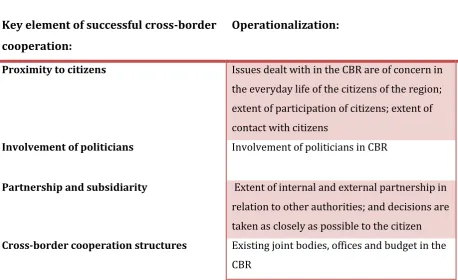
2.3.3 Key elements of successful cross-border cooperation ... 43
2.3.4 Conclusion ... 46
D Conclusion ... 47
Chapter III: History and Geography of the Region ... 49
3.1: Introduction ... 49
3.2: Territorial shape ... 50
3.3: Symbolic shaping ... 51
3.4: Institutional shaping ... 52
4
3.6: Conclusions ... 57
Chapter IV: Practice and Politics of the CBR’s in South-East Europe ... 59
4.1: Introduction ... 59
4.2: Dimensions of a Cross-Border Region ... 60
4.3: Organizational Development ... 62
4.4:Diversification of resource base ... 63
4.5: Appropriation of cross-border activities ... 64
4.6: Cross-Border cooperation fields on the basis of Best-practices ... 66
4.7: Proximity to the citizens ... 69
4.8: Involvement of politicians ... 71
4.9: Partnership and subsidiarity ... 73
4.9.1 External Partnerships ... 74
4.9.2 Internal Partnerships... 76
4.9.3 Subsidiarity ... 77
4.10: Cross-border cooperation structures ... 78
4.11: Conclusion ... 81
4.11.1 Practice and politics on the basis of theory ... 81
4.11.3 Practice and Politics on the basis of Best-Practices ... 83
Chapter v: Conclusions and recommendations ... 88
5.1 reflections ... 88
5.2 The future of Cross-Border Cooperation in Thrace ... 89
5.3 general conclusions and answers to central research question ... 91
5.4 Recommendations in relation to missing links ... 95
5
LIST OF TABLE’S
Table 1: Stages of Institutionalization of a Region and operationalization ... 27
Table 2: Typology of CBR's ... 29
Table 3: Operationalization of criteria of policy entrepreneurship ... 38
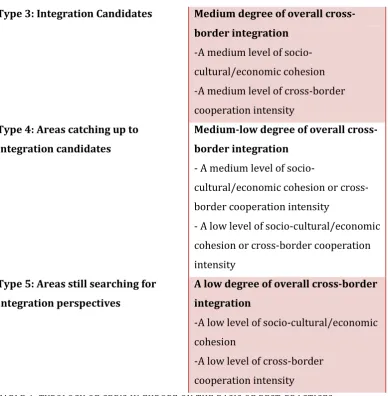
Table 4: Typology of CBR’s in Europe on the basis of best-practices ... 43
Table 5: Operationalization key elements of successful cross-border cooperation ... 46
Table 6: Formal social and Cultural Institutions ... 52
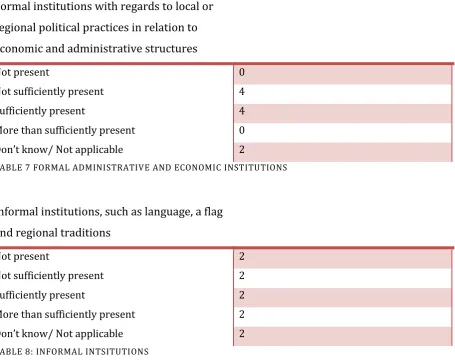
Table 7 Formal Administrative and Economic Institutions ... 53
Table 8: Informal Intsitutions ... 53
Table 9: Interpretation of Marks ... 60
Table 10: Organizational Development of CBR's ... 61
Table 11: Typology of CBR's ... 61
Table 12: Strategic and Operational Independence CBR's ... 62
Table 13: Joint Office... 79
Table 14: Joint Bodies ... 79
Table 15: Joint Budget ... 79
LIST OF FIGURE’S
Figure 1 Cross-border Structures South-East Europe ... 9Figure 2 Map of regions in ancient times ... 11
Figure 3 Cross-border cooperation in external borders ... 32
Figure 4 Operationalization of "Policy entrepreneurship" ... 37
Figure 5 Overview of cross-border cooperation based on best-practices ... 41
Figure 6 Region of Thrace... 50
Figure 7 Traditional Thracian Clothing ... 54
Figure 8: Promotion of Thrace’s rich Culture (Thracian tomb of Kazanlak) ... 70
6
ACKNOWLEDGEMENTS
This thesis has been written as a conclusion of my Master European Studies under the authority of the Association of European Border Regions. In a previous project involving cross-border cooperation I have discovered my interest in the topic. Cross-border cooperation has a direct impact on regional development of often peripheral areas and therefore improves the lives of citizens in multiple ways. Because of this, I have decided to dedicate my Master Thesis to the topic as well, hoping to provide a contribution to the development of cross-border cooperation in South-East Europe.
With this thesis, I hope to receive my Dubbel-Diploma from the University of Twente and the Westfälische Wilhelms-Universität Münster. Of course, I could not have been able to accomplish this thesis without some help and therefore, I wish to thank a number of people. First of all, I would like to thank Bart van Winsen for introducing me to the AEBR and helping me obtaining the assignment for my thesis. Secondly, I would like to thank Martin Guillermo-Ramírez for his confidence in me and giving me a chance to work at the AEBR, it has been a great work
experience. Thirdly, I would very much like to thank prof. Gert-Jan Hospers for his excellent substantive guidance, support and help with this thesis. Fourthly, I would like to thank all my respondents – specifically Menelaos Hatziapostolidis for providing me with the contacts and arranging an accommodation for me – for their cooperation and contribution, but also for their hospitality and all the wonderful diners they took me to. Because of you, my stay in Greece has not only been proven useful for my study, but has been a fantastic time all in all.
Finally, I wish to thank the obvious people for their confidence in me during all my trials and tribulations – not only when I was working on my thesis, but also during my entire studies: my family, Femme Fatale and my roommates at AC Noorderhagen.
7
CHAPTER 1: INTRODUCTION
1.1 INTRODUCTION TO THE STUDY
“Regional co-operation amongst the countries of South-East Europe (SEE) is a condition for closer integration with the European Union. It is also at the heart of economic development and
stabilization in SEE. Cross-Border Cooperation between local actors (governmental, civic, and business) across national borders provides the practical underpinning to regional cooperation while catering to the particular needs and interests of local communities in border regions: it serves as an important tool for reinforcing institutions at local level, regional economic
development as well as security and the peaceful coexistence of neighbouring peoples and states Cross-border co-operation as a means for reconciliation and regional development, going back to the 50s of the last century, proved to be an important tool for the integration process in Europe after the 2nd world war. Following this experience, but also the experience and positive results achieved through cross-border co-operation and Euroregions on the external borders of the EU, especially towards the Central and East European countries after 1989 and the fall of the iron curtain, one can recognize the importance of supporting such local initiatives of cross-border co-operation” (Cross-border cooperation in South-East Europe, 2002:1).
This statement was made at the International Conference on Cross-border cooperation in South-East Europe in 2002. Therefore, it can be established that 7 years ago the importance and added value of cross-border cooperation in South Eastern Europe was already recognized. It is clear that cross-border cooperation is considered an important factor in the light of European integration, regional development and the overall rebuilding of relations and trust across Europe after the Second World War and more recently the Cold War. It is therefore not surprising that many scholars, researchers and policy makers have already committed themselves to the study of cross-border cooperation. From a theoretical and practice
8
politicians participating in cross-border cooperation, it can be defined what makes cross-border cooperation successful.
In this study these three models – institutionalization of a (cross-border) region, theory and best-practices of border cooperation – are used to look into the development of cross-border cooperation in South-East Europe. Question remained to what extent these three models of successful cross-border cooperation can be found in this region. Therefore, within the
framework of cross-border cooperation in South-East Europe, Cross-Border Regions in the area of Greece, Bulgaria and Turkey have been studied by applying the following question:
“To what extent can cross border cooperation in the regions in the South-East European external borders be improved?”
This question can be considered as the central research question in this study aimed at making recommendations for enhanced or better cross border cooperation in South Eastern Europe‘s external borders on the basis of theory, best practices and empirical research. An important part of this study is in the form of field research. The field research was aimed at discovering the missing links in cross-border cooperation in South-East Europe and on the basis of these missing links tailor-made recommendations can be proposed.
In order to answer this central research question a specific set of sub-questions have been drafted:
1. “To what extent is the region of Thrace institutionalized as a cross-border region?”
2. “What are determinants of successful cross-border cooperation on the basis of theory and to what extent are these determinants present in the Cross-Border Regions in question?”
3. “What are determinants of successful cross-border cooperation on the basis of best practices and to what extent are these determinants present in the Cross-Border Regions in question?”
These sub questions will be more elaborately addressed in paragraph 1.4 regarding the structure of this thesis.
9
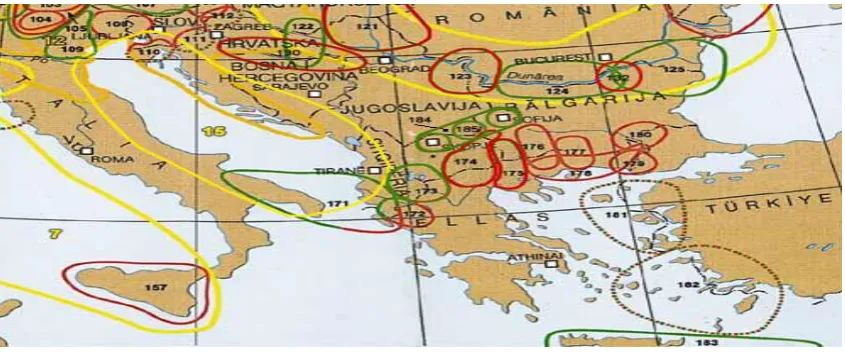
FIGURE 1 CROSS-BORDER STRUCTURES SOUTH-EAST EUROPE, SOURCE: WWW.AEBR.NET, 2009
The specific area that has been approached is known as “Thrace”, and has existed since ancient times across the borders of Greece, Bulgaria and Turkey. The cross-border cooperation
structures that that are subject of this study include numbers 175 to 180 (AEBR Website, 16 November 2009):
175: Euroregion Strymon-Strouma (BG/GR) 176: Euroregion Nestos-Mesta (BG/GR) 177: Euroregion Delta-Rhodopi (BG/GR) 178: Region East-Macedonia Thrace (GR) 179: Euroregion Network Polis-Kent (GR/TR)
180: Euroregion Evros – Meric – Maritsa (GR/BG/TR)
10
11
1.2 HISTORY OF THE REGION
From literature, Thrace is considered to be a geographical and historical region in South-East Europe, spreading over Bulgaria (Northern Thrace), North-East Greece (Western Thrace) and European Turkey (Eastern Thrace). Furthermore, three seas shape the coastline of Thrace: the Black Sea, the Aegean Sea and the Sea of Marmara. The region is shaped by leafy mountains in the North and the long Aegean coastline in the South. Thrace is unique for its minorities: in Greek Thrace, a strong Turkish minority with its own language and culture is still very strong. Unfortunately, the Greek minority in Turkey has dwindled (Encyclopaedia State University, 2009; Armstrong et all. 2008:310:312). In this paragraph a short overview of the history of Thrace is provided including Ancient Times, the Middle Ages, the Ottoman Rule and the 20th Century turbulence in this beautiful region.
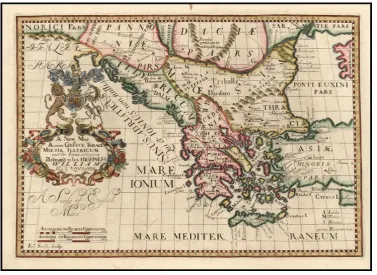
[image:11.595.72.450.450.725.2]Today Thrace still has a principally agricultural economy. In Eastern Thrace, high-quality Turkish tobacco is the chief crop of the region. In Western Thrace corn and rice are grown in the lowlands of the Evros River and the lower planes. Furthermore, near Alexandroupoli, vineyards can be found where wine is produced. Oyster farming and eel fishing in Keramoti and Komotini are the primary form production and are exported to Central Europe. The manufacturing industries of Thrace are mainly driven by the processing of agricultural crops, tobacco curing, and wine production (Encyclopaedia Britannica, 2009).
12
1.2.1 ANCIENT TIMES
Until the 4th Century BC, Thrace, as depicted in Fig. 2 in yellow, was home to a number of warring tribes. Their religion was also known as the cult of the Great Gods. It was a pagan religion which influenced the whole of Greece and started already in 1000 BC. In the 4th Century BC the Odrysian State was formed, which contained some form of political organization, since the Thracians organized themselves in petty kingdoms and tribes. These small units never achieved any form of national unity beyond short, dynastic rules at the height of the Greek classical period. The inhabitants were of Indo-European decent and had developed advanced forms of music, poetry and artistic crafts. The father of Thracian culture is considered to be Orpheus, who in modern times is still captivated in society. Furthermore, Thracian mercenaries were always in demand, as they were fierce fighters, although a bit expensive at times, and liable to switch sides (Armstrong et all. 2008:310; Encyclopaedia State University, 2009).
Early on Thracians came under the cultural influence of the ancient Greeks, preserving until a much later time, however, their language and culture. The first Greek colonies in Thrace were founded in the 6th century BC. Furthermore, Thracian infantry was heavily recruited by Greek states and large deposits of gold and silver were mined.The region was conquered by Philip II of Macedon in the 4th century BC and was ruled by the kingdom of Macedon for a century and a half. The destruction of the ruling parties in Macedonia destabilized their authority over Thrace, and its tribal authorities began to act once more on their own accord. However, when the Romans annexed the Macedonian Kingdom in 146 BC, they faced neighbouring Thrace and created conditions for their involvement in their affairs. After the Macedonian Wars (215 BC -148 BC), Thrace came to acknowledge Roman rule. Thracia was established in AD 46, when the former Roman client state of Thrace was annexed by order of Emperor Claudius. (Encyclopaedia State University, 2009; Avramea 2003:135).
13
therefore maintain its political institutions during the period of Roman rule (Avramea 2003:147).
1.2.2 THE MIDDLE AGES (330-1453)
After the 4th Century AD division of the Roman Empire in East and West, Thrace became strategically significant, since it was part of the Via Egnatia trade route1. From 330-1453 AD Thrace fell under the rule of the Eastern Roman Empire: the Byzantine Empire. Under this rule, Eastern Thrace was considered to be the ‘the breadbasket of Constantinople’, which was an allusion to its wheat production, but also a reference to the fact that Thrace was of vital importance for the defence of the Byzantine capital. Thrace, surrounding and defending the heart of the Byzantine Empire, Constantinople, therefore became the victim of pillage and destruction. Thrace was “easy pickings” for marauding Goths, Huns, Vandals, Bulgars, and crusaders. Therefore, characteristic of the archaeology of Thrace is the small number of surviving monuments and the large numbers of ruins (Armstrong et all. 2008:312; Bakirtzis 2003:151).
The Byzantine Empire retained control over the region until the beginning of the 9th century when the larger part of Thrace was annexed by the Bulgarians. Constantinople regained Thrace in 972, only to lose it again to the Bulgarians at the end of the 12th century. Throughout the 13th century and the first half of the 14th century, the region oscillated between Bulgaria and the Byzantine Empire. A sudden destruction of the region came in 1265, when Thrace suffered a Mongol raid. Only in 1352, the Ottomans conducted their first incursion into the region subduing it completely within a matter of two decades and occupying it for five centuries. For Thrace – even though the citizens suffered from the occupation – it meant that for the first time since the division of the Roman Empire, it could enjoy some extended periods of peace and quiet
(Armstrong et all 2008; Encyclopaedia State University, 2009).
1.2.3 OTTOMAN RULE (1354-1922)
When Gallipoli was captured by the Ottoman Turks in 1354, the Ottomans had in fact conquered Thrace as well, since they now controlled the sea traffic between Europe and Asia trough the Dardanelles. The invasion of the Turks into the heartland of Thrace forced the Greek population to seek refuge in the upland regions which were difficult to access. Mass settling of Muslims in modern Eastern Thrace took place as well. The Ottomans attempted to alter the ethnological
1 The Via Egnatia was a Roman trade route built in the 3rd Century BC connecting the Roman colonies on
14
structure of the territory, by organizing this migration, while at the same time sending wealthy and powerful Thracian families to Karesi, located in Asia Minor. This resulted in a large scale Muslimization of Thrace, at the cost of the Christian population. The phenomenon of
Muslimization in Thrace was accompanied by the violent displacement of the Christian element: a significant part of the population was obliged to convert to Islam, because otherwise it would be impossible to survive (Vakalopoulos 2003:211).
In the Struggle for Independence of 1821, the Thracians played a vital role. Thracian
revolutionaries were active in villages surrounding the Saros Gulf and the mountains were ideal hiding places for Thracian rebels. However, the revolutionaries were not trained well enough and proved to be inexperienced in the art of war during the battle in Samothrace (1821). In the end, the Ottomans plundered and destructed villages in the whole of Thrace, massacring 700 men and enslaving many women and children. However, the Thracians continued their struggle for liberty and independence (Vakalopoulos 2003:220-221).
In the nineteenth century further disruptions in the area stemmed from an ecclesiastical issue in both the countryside as well as in the urban centres of Northern Thrace. The antagonism
between Christian national groups was further exacerbated by Muslim fanaticism. The goals of the Bulgarian nationalist movement entailed the separation of the ecclesial jurisdiction of the Patriarchate2 and thereby the founding of the independent Bulgarian Church and the promotion of Bulgarian language at schools. This crisis came to a climax in 1857 when a proposal
concerning the foundation of new community regulations was rejected during the general assembly of the Christian community of Philippopolis. In 1861 the final separation of the two communities (Bulgarian and Greek) took place when the Bulgarians de facto occupied some churches and a school. Bulgarian education gradually got the upper hand in the province of Philippopolis. The Bulgarian nationalist movement was supported by Russia as well (Vakalopoulos 2003: 225-226).
The Eastern Crisis, which broke out in the Balkans (1875-1878), meant some substantial developments for the future status of Thrace as well. These developments became even clearer after the Bulgarian Revolt of 1876, including atrocities and massacres among citizens and the vehemence of Muslim fanaticism. In 1876 the Conference of Constantinople took place, which resulted in the provisions for the formation of a Bulgarian state, redrawing the borders of Thrace (and Macedonia as well) and including a large part of the Balkan mountain range. This measure mobilized Thracian Hellenism in all directions: it became clear for the Patriarchate and for official Greek policy, that the removal of the Greek provinces of Thrace to the future Slav
15
provinces was not an option. Only with the ending of the Russian-Turkish war, with the signing of the Treaty of San Stefano (1878) an autonomous Bulgarian state was founded, including extensive regions of Thrace, in practice starting the current division within the region. Finally, during the Congress of Berlin (1878), it was decided that Northern Thrace would be
incorporated into the semi-autonomous Ottoman province of Eastern Rumelia, which finally united with Bulgaria in 1885 (Vakalopoulos 2003:227).
1.2.4 THE TURBULENT 20
THCENTURY
The first disruption in the 20th Century in the Thrace was caused by the Balkan Wars (1912-1918). The Balkan League fought against the Ottoman Empire and annexed most of its Western territory, among it Thrace. The Balkan Wars led to the destruction of cities and towns in Eastern Thrace, the extermination of Greeks in Adrianople and several other cities. While suffering from the occupation of the region by the Bulgarian army, the population also underwent reprisals from the Turkish army. In Greek Thrace, Bulgarian atrocities were unprecedented. During the second Balkan War, the Greek army liberated Western Thrace and Eastern Thrace was recaptured by the Ottomans. The Treaty of Bucharest (1913) reversed these territorial gains, assigning Western Thrace to Bulgaria again, subsequently leading to the mass departure of Greeks and Muslims to respectively Macedonia and Constantinople. The new Bulgarian occupation in Thrace led to a repetition of the events in the first Balkan War: violence against the population (Vakalopoulos 2003:238).
During the First World War, Bulgaria, Greece and Turkey each forced respective minority populations out of the Thrace region they controlled. Whole communities of Greeks in Eastern Thrace, the Black Sea coasts and southern Bulgaria, were expelled to Greek-controlled Thrace. At the same time, a large number of Bulgarians was forced from the region into Bulgaria by the Greeks and Turks. Turkish populations in the area were also targeted by the Bulgarians and Greeks and forced to relocate in Eastern Thrace. By means of the Treaty of Neuilly (1919), and subsequent agreements, the status of the expelled populations was legitimized. The Treaty of Neuilly and the Treaty of Sevres defined the definitive borders of Thrace between Greece and Turkey. This was followed by a further population exchange which radically changed the demographics of the region: the ethnic character of Thrace had become more homogeneous during the 20th century (Encyclopaedia Britannica, 2009; Svolopoulos 2003:267).
16
many emigrated after the appropriation of their land in 1924 and subsequently continued to emigrate because of deteriorating relations between Greece and Turkey. During the second World War, Greek Thrace has been occupied by Bulgaria (1941-1944), since Bulgaria was part of the Axis powers, further changing the demographics of the region by arresting and deporting the Jews of the region to Germany and death camps (Encyclopaedia Britannica, 2009; Asia Minor, 2009).
1.2.5 CONCLUDING
17
1.3 METHODOLOGY
The methodology used in this study consists of a literature study and qualitative research. The literature study is intended to provide the groundwork for my research and to sketch a
theoretical framework with which can be worked. The theoretical framework provides the basis for the empirical part of the study, providing assumptions on the basis of theory by scholars and best-practices. The most important theories include those on the institutionalization of a region provided by Paasi (2009) and on the basis of the practice and politics of Euroregions provided by Perkmann (2007). The best-practices are provided by the Association of European Border Regions, developed on the basis of their long experience regarding cross-border cooperation. On the basis of this theoretical framework, the questionnaire has been drafted, by means of
operationalization of the most important concepts and assumptions derived from theory and best-practices. These concepts included stages of institutionalization of a region, determinants for success and key elements of cross-border cooperation. The objective has been to explore to what extent these concepts are present in Cross-Border Regions in the EU’s South-East external borders.
The most appropriate method to come to these recommendations would encompass qualitative field research. Qualitative research entails the “non-numerical examination and interpretation of observations, for the purpose of discovering underlying meanings and patterns of relationships” (Babbie 2003:370). This type of field research can provide researchers a comprehensive perspective, which is necessary to meet the objective of this research: make recommendations for enhanced/better cross border cooperation in South Eastern Europe external borders on the basis of theory, best practices and empirical research. Therefore, I left for North East Greece for Thrace in order to find my answers for my research questions. The object of research included formal organizations: Cross-Border Regions in South-East Europe. By means of field research answers in relation to my research question have been revealed that otherwise would not be apparent. The method that has been applied within the range of qualitative field research has been that of a qualitative interview. Qualitative interviews are based on a set of topics to be discussed based on a general plan. In essence it is a conversation. (Babbie 2003:300). In this case, these topics were based on the theoretical framework based on Paasi, Perkmann and best-practices provided by the AEBR.
Qualitative interviews seemed to be the most appropriate instrument to study the phenomenon of cross-border cooperation structures in South Eastern Europe since:
18
clear and convincing model of the phenomenon you are studying” (Rubin 1995: 46-47). The intentions of this study are to form a basic idea or model concerning the state of cross-border cooperation in South-East Europe.
While qualitative research formally is shaped within the conversation itself and the interviewer does not provide a specific set of questions that must be answered with particular words or in a particular order, this actually has been done in this study (Babbie 2003:300). Since this study provides a clear framework regarding the success of cross-border cooperation in South-East Europe, it would almost be a pity not to try to generate the appropriate answers. Therefore, by means of a questionnaire mostly including open questions – open for redirection – and some closed questions, an attempt has been made to answer the central question “to what extent can cross border cooperation in the regions in the South Eastern European external borders
be improved”.
The respondents of the qualitative interviews included stakeholders and participants in cross-border cooperation. These respondents are involved in cross-cross-border cooperation through their own organisations, including municipal and regional authorities, chambers of commerce, organisations promoting employment, development agencies and universities. Therefore, they can be considered as experts regarding cross-border cooperation in South-East Europe. In total, 10 people have been interviewed, from which 9 from Greece and 1 from Turkey3. Unfortunately, no respondents are included from Bulgaria due to physical accessibility problems – big
mountains hindering the infrastructure between Greece and Bulgaria – and language problems – English is not commonly spoken in Bulgaria. However, even though unfortunately no Bulgarian respondents were available, the current results sketch a realistic vision on cross-border
cooperation in Thrace. The results of the interviews have subsequently been analyzed and are presented as well in this study by means of quotes in the text, by means of graphs and tables. Finally, on the basis of the information gathered from the interviews plausible and realistic conclusions and recommendations are presented.
3 For this study I have interviewed 9 men and 1 woman. This can be explained by the predominantly male
19
1.4 STRUCTURE OF THE STUDY
Following the central research question, “to what extent can cross border cooperation in the regions in the South Eastern European external borders be improved”, a set of three sub-questions have been drafted that are directly linked to the chapters in this thesis. The three sub-questions include:
4. “To what extent is the region of Thrace institutionalized as a cross-border region?”
5. “What are determinants of successful cross-border cooperation on the basis of theory and to what extent are these determinants present in the Cross-Border Regions in question?”
6. “What are determinants of successful cross-border cooperation on the basis of best practices and to what extent are these determinants present in the Cross-Border Regions in question?”
These sub-questions are dealt with in Chapters 2, 3 and 4. In Chapter 2, the theory regarding the institutionalization process of a region on the basis of Paasi is introduced. Furthermore, in Chapter 2 the determinants of successful cross-border cooperation on the basis of theory (Perkmann) and on the basis of best-practices (AEBR) are presented, thereby elaborating on the theory used in all three sub-questions. Chapter 2 is therefore divided into three main parts, wherein all three models defining successful cross-border cooperation are presented:
A. History and Geography on the basis of Paasi (2009); B. Practice and Politics on the basis of Perkmann (2007);
C. Practice and Politics on the basis of key elements in successful cross-border cooperation (AEBR 2008).
In Chapter 3 the findings from the field research regarding the history and geography relating to the institutionalization process of a region are analyzed. In the conclusion of this chapter the first sub-question is answered and some recommendations for future cooperation will be presented. These recommendations are presented in the text in bold.
20
recommendations will be made in relation to the current missing links that have been found on the basis of the field research – they are printed in bold as well.
In the fifth and final Chapter of this thesis I will first of all reflect on some aspects of this study. Secondly, the respondents were asked in the last question of the questionnaire to provide the researcher with a final statement with regards to cross-border cooperation in general and in relation to their CBR in the future in particular. These statements will be presented in the
21
CHAPTER II: THEORY
A
HISTORY AND GEOGRAPHY ON THE BASIS OF PAASI (2009):
TO W HA T EXTEN T IS TH E REGIO N O F THRA CE I NSTITU TIONA LIZED AS A CROSS -BORDER REGION
2.1.1 INTRODUCTION
In this part of the theoretical framework I will discuss several facets of a region. Looking into these facets of a region is of importance for further research. Finally the focus will be on Thrace as a cross-border region. Since a cross-border region is a specific type of region, we will look into the concept of a region as well. In this section of the study some of the theoretical considerations of what constitutes a region will be explained. I will attempt to define the concept of a region, as well as four specific criteria that define the institutionalization process of region in general. Finally I will provide a short conclusion before looking into the practice and politics of Cross-Border Regions in South-East Europe.
2.1.2 THEORIES ON A “REGION”
Theoretical perspectives on what we will try to define a “region” can be described as
regionalism. Broadly defined, regionalism can be seen as preferential trade agreements among a sub-set of nations (Bhagwati et. al. 1999:3). Within the theory of regionalism, multiple
perspectives are possible, providing different definitions regarding a region and angles towards the drivers of regional trade agreements. Furthermore, the development of two trends in regionalism has been visible in the last and current century, these aspects and perspectives will be discussed in the next section.
After the Cold War, the balance of power shifted from a bipolar, to a multipolar world. By means of this shift, the number of regional organisations strongly increased; more and more regionalist projects were initiated, which were increasingly shaped “from below” by the interests of actors, such as domestic civil society, in addition to states themselves. On the basis of this movement, a distinction could be made between “old” and “new” regionalism: “the old form of regionalism tended toward protectionist economic blocs, where trade between member countries was
encouraged but trade with countries outside the bloc was discouraged by external trade barriers. In contrast, the new regionalism was of a more open form, where the preferential treatment
22
Additionally, old or “traditional regionalism” is based on popular identification with a well established region, while new regionalism is closely linked to nation-state policies (Terlouw 2008:105). Furthermore, new regionalism seeks to explain this process of regionalism, which exhibits qualitative differences from the processes of regionalism that took place soon after World War II. This theory of regionalism envisages the region as a complex construct, including attributes such as geography, politics, economics, and culture that are consistently created or reshaped by human activity. Contextually, regionalism represents a multi-faceted process that interacts with processes of global transformations in the world order.
In relation to old and new regionalism, we shall discuss several perspectives on regionalism (Budzugan 2006b) Firstly, the neo-functionalist perspective deals with the question as to why sovereign nation-states choose to integrate in such a manner resulting in a transfer of some extent of their sovereignty for the authority of regional institutions. Key concepts herein are spill-over effects and the interests of national and supranational political actors; eventually this will lead to sectoral integration between regions.
Similarly, neoliberal institutionalists emphasize the role of institutions in the formation of regional organizations. Rationale behind this includes the idea that transaction costs are lowered by means of increased cooperation. Regional institutions, it is argued, may provide the transparency, unified expectations and the mechanisms to avert cheating because they play a coordinating role at the supranational level, such as in the case of the EU (Budzugan 2006b). Neorealist accounts of regionalism, however, argue that integration is dependent on the (sub-) nations and is concerned with their own security from external threats. The underlying
constraint to integration is related to the relative gains and losses of the involved states. As states are concerned with the relative gains from cooperation, an uneven distribution of gains, where some states experience losses relative to others, will affect their security and hinder efforts to form and maintain regional arrangements. In addition, the role of a hegemonic power (a state with the military and economic resources, as well as the impetus to impose order— both at the global and regional level) may affect the creation and dynamics of regional institutions (Budzugan 2006b).
23
An important step in this respect is answering the question to what extent from a theoretical perspective Thrace can be defined as a region. In the previous paragraph we have seen the theoretical approaches towards a region. In this section, we will discuss the theoretical aspects of what “makes” a region. The assumption herein is that Thrace – comprising of both north-east Greece and south-east Bulgaria – indeed can be defined as a region. If this assumption is true we can approach Thrace as a (cross-border) region, as opposed to merely cooperation between two separate regional entities.
However, several difficulties arise when trying to come up with a suitable definition of “a region”. A clear universal definition of a region is difficult to find: usually definitions are contextual (Paasi 2009:126). The traditional concept of a region is related to a “bounded space” at a sub-state level, but has meanwhile been challenged (Paasi 2002:807; Paasi 2009:122). So, what defines a region? According to Encyclopaedia Britannica a region “in social science [is], a cohesive area that is homogeneous in selected defining criteria and is distinguished from
neighbouring areas or regions by those criteria. It is an intellectual construct created by the selection of features relevant to a particular problem and the disregard of other features considered to be irrelevant. A region is distinguished from an area, which is usually a broader concept designating a portion of the surface of the Earth. Area boundaries are arbitrary, established for convenience. Regional boundaries are determined by the homogeneity and cohesiveness of the section” (Encyclopaedia Britannica, 21 Apr. 09). This seems to be a comprehensive idea of what defines a region.
When it comes specifically to a cross-border region, it appears that the “regionness” of a cross-border region cannot be taken for granted but has to be understood as the outcome of a process of social construction. Perkmann (2003) therefore defines a cross-border region (CBR) as a “bounded territorial unit composed of the territories of authorities participating in cross-border cooperation”. This implies that a CBRis not just understood as a functional space, but also as a socio-territorial unit equipped with a certain degreeof strategic capacity on the basis of certain organizational arrangements (Perkmann 2003: 157). Further aspects of a cross-border region and these organizational arrangements will be dealt with more extensively in section B of the Chapter on Theory. Furthermore, regions can be understood as institutional structures – “institutional facts” for that matter – because they are dependent on human agreement and institutions, such as the media, the education system, political organization, governance and economics (Paasi 2002:805).
24
practices - and through these practices - by individuals as well as institutions (MacLeod 1998: 834-835). Furthermore, a region may not have spatially defined borders: it can refer to a single neighbourhood, a city or municipality, an entire country or even a nation state. A region is an abstract that cannot be reduced to a) a given administrative unit; b) a given scale, without considerations with regards to socio-spatial connections; or c) a concrete or practical area. Instead, a region should be perceived as the result of a “complex history of economic, political, and social processes into a specific cultural image”. Therefore, a region is an institutional construction reflecting the collective history of an area, influencing the everyday lives of its citizens (Paasi 1991:243; Macleod 1998:836)
2.1.4 DEFINING CRITERIA OF A REGION
In the previous chapter we have seen that whether or not a bounded space can be defined as a region is dependent upon the corresponding criteria. In this section, we will discuss the defining criteria that determine whether or not Thrace can be seen as a region, and, more specifically, as a cross-border region. According to the Council of Europe (1995) a cross-border region “is a potential region, inherent in geography, history, ecology, ethnic groups, and economic possibilities and so on, but disrupted by the sovereignty of the governments ruling on each side of the frontier”. So, in effect a cross-border region could become a region as a whole. Therefore, it is important to look into the extent to which Thrace can be seen as a region. However, in order to make a clear distinction on this point, clearer and more unambiguous criteria are necessary.
Paasi (2009) provides a solution for this problem. He presents a theory with regards to the institutionalization of regions, which sheds a light on the process of region-building. Regions are herein conceptualized as the results of historically contingent processes. If one wishes to study the process of the institutionalization of a region, four stages can be distinguished for analytical purposes. However, these stages may not occur consecutively in a fixed order: their order can vary and some stages can even occur simultaneously (Paasi 2009:134).
25
cohesion includes a well developed labour market, commuting over the border as well, and contacts among individuals that contribute to inter-cultural learning and understanding. In regions with a low extent of economic cohesion, these aspects are not or only partially
developed. These aspects are of importance, since they define the extent of (future) cross-border integration (AEBR 2008:87-88).
2.1.4.1TERRITORIAL SHAPING
The first stage that can be distinguished is territorial shape. This territorial shaping can have a historical basis, or can be decided ad hoc. Furthermore, this shape is often used to distinguish the region from others in social classification and is normally based on a combination of functional, political, economic, cultural and administrative practices. Effectively, territorial shaping refers to the emergence of boundaries of a regional entity: the geography of a region. To analyse this stage, one has to localize social practices – such as economy, politics and
administration – and the “reach of power relations”, by which regional transformation takes place, before one can identify the region as a bounded space in the larger spatial structure. (Paasi 2009:134; Macleod 1998:837; Reynolds 1994).
2.1.4.2 SYMBOLIC SHAPING
The second stage comprises a symbolic shaping of the region. In this stage of the process of the institutionalization of a region, a creation of additional symbols takes place. In most cases, these symbols express and strengthen the idea of the specific region and more importantly, regional identity. One of the most important aspects of symbolic shaping of a region includes “naming”. This aspect brings cultural, historical and political interests together and furthermore, is an expression of the regions mentioned power relations we discussed earlier. By means of symbolic shaping, a collective identity among the citizens of a region can be created, whether or not divided by a border (Paasi 2009:135).
More specifically:
“Territorial symbols are often abstract expressions of supposed group solidarity, embodying the actions of political, economic, administrative and cultural institutions in the continual reproduction and legitimization of the system of practices that constitute and demarcate the territorial unit concerned. Thus symbols are instrumental in the sense that they serve to evoke powerful emotions of identification with territorial groupings and can generate action. Symbols are ‘keywords’ in the dominating story of a territorially based community” (Paasi 1996:34).
26
Institutional shaping is the third stage of the institutionalization process of a region. This stage includes the development of informal and formal institutions that are needed to produce and reproduce other shapes. Informal institutions include a common dialect, or common regional traditions. Formal institutions on the other hand include social and political organizations that dedicate themselves to the advancement of the region. More specifically, these formal
institutions include educational and legal institutions, the media as well as local or regional political practices, economics, administrative structures and culture. Institutional shaping supports the stage of symbolic shaping, by providing additional symbolism by means of establishing more institutions. Such processes provide “effective means of reproducing the material and [a] mental existence of the territories” (Paasi 1991:246; Paasi 2009:135; Macleod 1998:837).
2.4.1.4 ESTABLISHMENT OF A REGION
Finally, the establishment of a region refers to the acceptation of the regional system and broader social consciousness. At different levels this stage has a different meaning: at the supra-state level it is the institutional functioning of the unit that provides legitimacy; at state level the establishment of a region requires that the sovereignty of the regional entity is recognized; and on sub-national level the establishment of a region is based on the administrative status within the broader system of the regional system. This administrative status provides the opportunity for the region to act rationally with these others administrative levels. When a region has literally “established” itself, it becomes a “localized social structure”. (Paasi 2009:136; Macleod 1998:838; Cox and Mair 1991). Therefore it follows that the establishment of a region is
dependent upon the regional (self-) proclamation of the region itself. By means of for instance a regional administrative body or government, the legitimacy, sovereignty and administrative status of the region is provided for.
2.1.5 CONCLUSION
27
analysis of the region Thrace in Chapter 3. In that Chapter we will look into the history of the region and determine to what extent the process of institutionalization of a region has taken place in Thrace, i.e. to what extent the processes of territorial, symbolic and institutional shaping, and the establishment of a region have occurred.
Stage of Institutionalization of Region
Operationalization
Territorial shaping Geography and existence of boundaries of a regional entity
Symbolic shaping Abstract expressions of supposed group
solidarity, that constitute a collective identity Institutional shaping Development of informal and formal
institutions
Establishment of a region Acceptation of regional systems and broader social consciousness
Table 1: Stages of Institutionalization of a Region and operationalization
B
PRACTICE AND POLITICS ON THE BASIS OF PERKMANN
WHA T ARE D ETERMIN AN T S OF SUCCESSFUL CROS S-BORD ER CO OPERA TION O N THE BASIS OF THEORY A ND TO W HA T E XTEN T ARE THESE DETE RMIN AN TS PRESEN T IN THE CROSS-B ORDER
REGIONS IN QUESTIO N?
2.2.2 CROSS-BORDER REGIONS AND CROSS-BORDER COOPERATIONS IN EUROPE
In the previous section we have explained theoretical perspectives on what comprises a region. In this part and in the rest of the study, the focus will primarily be directed to one specific kind of region, the so-called Cross-Border Region (CBR). As earlier defined, a Cross-Border Region is “bounded territorial unit composed of the territories of authorities participating in a cross-border cooperation”. Therefore a CBR should be interpreted as socio-territorial unit equipped with a certain extent of strategic capacity and organizational arrangements (Perkmann 2003:157). However, for the sake of clarity and understanding, it will be useful to further demarcate the concept of a Cross-Border Region. Originally, Cross-Border Regions in Europe, or “Euroregions”,4 were denoted as formal collaborations between municipalities; involving a council, a president, a
28
secretariat and subject-oriented working groups. These cooperation forms have emerged from a need to better manage cross-border interests, by meeting the interests of local residents
directly. Meanwhile, apart from local authorities, the actors involved in a Cross-Border Region are comprised of other public authorities and agencies, such as chambers of commerce,
educational institutions and health care organizations. Taking this into account, a Cross-Border Region can be distinguished as “ a territorial unit that has historical, socio-economic and cultural commonalities, as well as, at least tentatively, its own regional identity and autonomous
institutions and therefore claims its needs and interests which it is capable to articulate and defend” (Perkmann 1999:658; Raich 1995:25; Säre 200x).
In relation to section A, cross-border regions are part of the “new regionalism” perspective on regions. They are considered a reaction on the competitive pressures of globalization and the related rescaling of the nation-state. In the case of CBR’s, new regionalism is part of the process of decentralization of the nation state, overall European integration; and the growing
importance of policy networks, location policies, inter-municipal cooperation and urban alliances (Terlouw 2008:105).
However, the term Cross-Border Region (CBR), is often used in a similar way as Cross-Border Cooperation (CBC). However, cross-border cooperation is a broader term than “cross-border region”: cross-border cooperation can be defined as “a more or lessinstitutionalized
collaboration between contiguoussub-national authorities across national borders”. In practice, a Cross-Border Cooperation has four basic characteristics (Perkmann 2003:157):
1. It’s main protagonists are always public authorities, since CBC’s must be located in the public realm;
2. The collaboration within the CBC consists of regional or local authorities in different countries, providing that these actors in normal circumstances are not subject to international law;
3. The CBC is mostly concerned with practical problem-solving with regards to a broad range of issues concerning administrative life;
29
are in fact always present in Euroregions. Therefore, when discussing the Euroregions we will be referring to them as Cross-Border Regions.
When analyzing CBR’s three dimensions are of importance (Perkmann 2003:159):
1. Geographical scope: small CBC initiatives vs. working communities including five or more regions;
2. Intensity of the cooperation: strategic capacity and an autonomous CBR, with common permanent secretariat, developed documented strategy and a broad scope of
cooperation vs. a dependent and non-autonomous vis-à-vis central state and other authorities, with loose cooperation, arrangements without a permanent secretariat and development plans for comprehensive cooperation;
3. Type of actors: driven by local municipal authorities vs. driven by regional (meso-level) authorities.
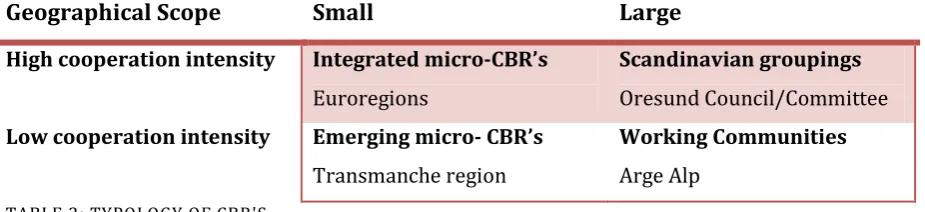
On the basis of these three dimensions, Perkmann (2003) is able to construct a typology of CBR’s (p.160):
Geographical Scope
Small
Large
High cooperation intensity Integrated micro-CBR’s Euroregions
Scandinavian groupings Oresund Council/Committee Low cooperation intensity Emerging micro- CBR’s
Transmanche region
[image:29.595.68.531.383.489.2]Working Communities Arge Alp
TABLE 2: TYPOLOGY OF CBR'S
Even though three dimensions are mentioned, the typology is equipped with only two
dimensions. In my opinion, this can be attributed to the fact that the third dimension is implicitly related to the geographical scale: assumption herein is that a CBR driven by local municipal authorities is automatically considered “small”, as opposed to a CBR that is supported by meso-level authorities which would be considered “large”.
2.2.3 EUROREGIONS
30
Turnock 2002:29-31; Yoder 2003:91). Furthermore, Euroregions usually do not correspond to any existing legislative or governmental institution, they do not possess political power and their activities are limited to the competences of the local and regional authorities which constitute them. The organizational structure is aimed at promoting common interests across the border and cooperation for the common good of the border populations
(http://knowledgerush.com/kr/encyclopedia/Euroregion/, May 18 2009).
The characteristics of a possible Euroregion have been defined by the Association of European Border Regions (AEBR)
(http://www.coe.int/T/E/Legal_Affairs/Local_and_regional_Democracy/Transfrontier_co-operation/Euroregions/2Definition.asp, May 18, 2009):
An association of local and regional authorities on either side of the national border, sometimes with a parliamentary assembly;
A cross-border association with a permanent secretariat and a technical and administrative team with own resources;
Of private law nature, based on non-profit-making associations or foundations on either side of the border in accordance with the respective national law in force;
Of public law nature, based on inter-state agreements dealing, among other things, with the participation of territorial authorities.
On the one hand taking European integration into account , and on the other the increasing trend towards regionalization, Euroregions have the potential to make a big and unique
contribution in integrating “old” and “new” Member States, as well as providing a further extent of integration between the EU and sub-national levels of politics and society. The most
important goal of a Euroregion is to “promote cooperation, trust and [cross-]border development in a number of spheres, namely economic, social, cultural, spatial planning, the environment and transportation and communication infrastructures” (Yoder 2003:91).
2.2.4 CROSS-BORDER REGIONS IN THE EXTERNAL BORDERS
31
relations – among inhabitants of both sides of the border within a specific region could be
overcome. Thirdly, by the establishment of a cross-border region democracy is strengthened and development of operational public administration structures is stimulated. Fourthly, economic growth is promoted and living standards should be improved. Fifthly, CBR’s have significantly contributed to the development of regional policies and spatial planning perspectives in these countries. Finally, establishing CBR’s has boosted economic development in border areas, which includes overcoming the problems caused by economic imbalances (Säre 200x; Turnock
2002:34; Euro East, 21 January 1997).
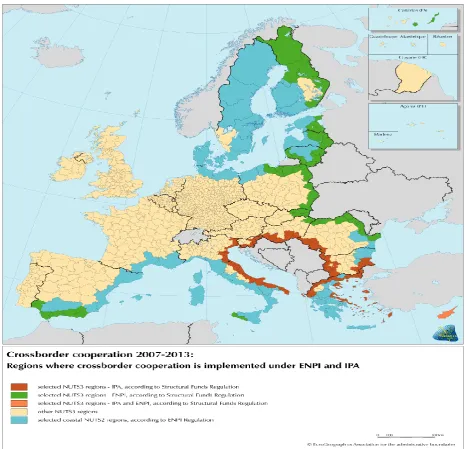
Cross-border cooperation on the external borders of the EU is funded by means of two
instruments: countries that are part of the European Neighbourhood Policy,5 are funded by the European Neighbourhood Policy Instrument, while for countries that are either candidate or pre-candidate members ,the Instrument for Pre-Accession is utilized to establish cross-border cooperation contacts (Cross-Border Cooperation within IPA 2007-13 INTERACT Conference 2006:1; Seminar on European Territorial Cooperation 2005).
5 European Neighbourhood Policy is a policy developed in 2004, aiming at avoiding the emergence of new
dividing lines between the enlarged EU and its neighbours and instead strengthening the prosperity,
32
FIGURE 3 CROSS-BORDER COOPERATION IN EXTERNAL BORDERS
2.2.5 DETERMINANTS OF SUCCESSFUL CROSS-BORDER COOPERATION IN
EUROREGIONS
2.2.5.1 FRAMEWORK
33
extent of autonomy in relation to its participating member local and regional authorities (Perkmann 2007:3, 7-8).
The development of Euroregions can therefore in this perspective be seen as an organization-building process. In the process of organization-building, the concept of policy entrepreneurship is an important element for analysis of one or multiple CBR’s. Policy entrepreneurs are political actors who “seek to initiate dynamic policy change” by winning support for their ideas for policy innovation. They can play a key role in identifying policy problems, by attracting the attention of decision-makers, and at the same time indicating appropriate policy responses (Mintrom
1997:739; Perkmann 2007:10). So in effect, policy entrepreneurship entails a group of political actors who take the initiative to promote and eventually induce new policy ideas and changes. Policy entrepreneurship is an important element of the Stream model of Kingdon (1984). Kingdon’s model, which mainly focuses on the flow and timing of policy action, is useful in analyzing complexities and realities of policy-making. The model tries to explain why some issues and problems become prominent on the policy agenda and in time are translated into concrete policies, while others do not. In his model, Kingdon distinguishes three streams, which are separate and independent (Kingdon 1984;
http://www.metagora.org/training/encyclopedia/streams.html, 26 May 2009):
a) the stream of problems, which represent the specific problems in a given situation on which people concentrate on - if these problems are not envisaged, the problems/issues will of course never be converted into a policy;
b) the stream of policies, explains how an issue rises or falls on an agenda and it includes the formulation of policy alternatives and proposals;
c) the stream of politics, political events, can lead to a given topic or policy to be included in, to be excluded from or to change the political agenda – furthermore, consensus is
usually obtained as a result of bargaining rather than persuasion.
Furthermore, the stream of problem recognition, the formulation of policy proposals, and political events each has its own dynamic and pace. However, policy change cannot take place if beforehand the Window of Opportunity has not opened. When it comes to connecting the streams, policy entrepreneurs play a key role in generating policy changes. A policy
34
Returning to Cross-Border Regions and determinants of successful cross-border cooperation, the framework of policy entrepreneurship can be used in the sense that Euroregions can indeed be considered as policy entrepreneurs. However, two amendments have to be made with respect to applying policy entrepreneurship in Euroregions (Perkmann 2007:866-867; Kingdon 1984):
1. While policy entrepreneurs are mainly seen as individual agents, in the case of Euroregions policy entrepreneurship is viewed in the context of organisations;
2. Next to creating windows of opportunity, Euroregions will simultaneously be engaged in the process of organization building.
In addition to the considerations above, Euroregions have to engage in policy entrepreneurship – we have considered the properties of these types of agents in the section above – for the following reasons. First of all, Euroregions are not public sector organisations: they consist of informal or private-law arrangements. The organizational arrangements of Euroregions are policy innovations an sich. Furthermore, these organizational arrangements were developed over time and within the context of legal uncertainty and novelty. Secondly, the resource bases of most Euroregions are not guaranteed by statutory income flows, are mostly secured only on the short term and are derived from multiple sources.
Therefore, for a CBR to survive good strategic alternatives are necessary. Thirdly, the
responsibilities of Euroregions were not defined a priori, but are the result of a complex search-process within the overall theme and goals of cross-border cooperation. Therefore, Euroregions should behave in an entrepreneurial fashion, because they have a large extent of policy
discretion in their decisions. In corollary, the Euroregion can be considered successfulif they engage actively in policy entrepreneurship within the field of cross-border cooperation, thereby fully exploiting windows of opportunity and simultaneously expanding their organizational base (Boekema 2000:8; Perkmann 2007:867, 871). Perkmann (2007) operationalized the concept of policy entrepreneurship in three criteria: organizational development, diversification of
resource base and appropriation of cross-border cooperation (CBC) activities. These criteria will be further elaborated on in the following three sub-paragraphs.
2.2.5.2 ORGANIZATIONAL DEVELOPMENT
35
and operational autonomy vis-à-vis ‘ordinary’ border authorities”, since successful Euroregions need to develop as independent organisations with a clear specialization in cross-border
cooperation relation issues (Perkmann 2007:867). Therefore, the organizational development of Euroregions, in this thesis refers to the extent the development of the organizational basis. More specifically, we will look into the organizational size, and “on the one hand the relative autonomy they [Euroregions] have achieved within local and vertical networks of public authorities
concerned with cross-border policies, and on the other whether or not they have widened their range of activities by taking on related tasks and competences within their context” (Perkmann 2007:871).
2.2.5.3 DIVERSIFICATION OF RESOURCE BASE
Looking at the resource base of a Euroregion one may determine the strategic resources available to the specific CBR. This method of analysis is based on the resource based view of an organization. In this context a resource based view is concerned with the success of an
organization, which can be attributed to the application of the full range of valuable resources at the organizations disposal (Wernerfelt 1984:172; Rumelt 1984:557-558). In general, resources refer to “all assets, capabilities, organizational processes, [organizational] attributes, information, knowledge, etc; controlled by a[n][organization] that enable the [organization] to conceive of and implement strategies that improve its efficiency and effectiveness” (Barney 1991:101). However, in this study we will limit the definition of “resource” merely to funding (Perkmann 2007:867). On the one hand, Euroregions can be distinguished that solely rely on INTERREG6 funding for their resources and their activities are therefore reduced to merely implementing a specific type of EU regional policy; as such they become an instrument for implementing EU regional policy . On the other hand, successful Euroregions are expected to have a more diversified resource base; by for instance, asking or demanding a membership fee from its’ participating authorities and thereby they are able to engage in other policy activities related to cross-border cooperation (Perkmann 2007:867)7. By realizing their own alternative resources, the organizations’ survival is better secured and their range of activities and involvement in cross-border issues can be
6 INTERREG is a European subsidy program intended to promote cross-border cooperation and European
integration within Euroregions on a project-basis, in the field of sustainable regional development. It is designed to lessen development differences between the European regions and to strengthen economic
solidarity. For more information I refer to the following link:
http://www.deutschland-nederland.eu/seiten/interreg/was_ist_interreg.cfm
7 Of course INTERREG remains a very important source of income for cross-border projects, without this
36
broadened as well. A diverse resource base is therefore considered very important. So when looking at the aspect of policy entrepreneurship regarding “diversification of resource base”, in practice in this study we will look at “the extent to which Euroregional organisations have
diversified their resource base away from the INTERREG subsidy program” (Perkmann 2007:872).
2.2.5.4 APPROPRIATION OF CROSS-BORDER ACTIVITIES
According to Perkmann (2007), successful Euroregions establish themselves as important players within the overall context of border strategies in a given border area. These cross-border strategies can be pursued by other public or semi-public authorities, commercial
organisations, or civil society organisations as well. The Euroregions can play a role in this process by appropriating or influencing the cross-border strategies of the other players in the cross-border arena and by being recognized as the legitimate and competent authority in this field by the other players (Perkmann 2007:867).
In practice, the final aspect of policy entrepreneurship – and therefore successful development of a CBR - refers to the extent to which Euroregions succeed to appropriate other cross-border policy activities in the field of cross-border cooperation in general. More specifically, this aspect relates to the extent to which a Euroregions are“involved as protagonists, or….participants, in other policy activities aimed at promoting cross-border integration” (Perkmann 2007:873). More specifically, these policy activities consist of: cross-border economic and regional policy; encouraging cooperation between enterprises; fostering technologies of the future;
37
2.2.6 CONCLUSION
In this part of the theoretical chapter, we have looked into the many facets of cross-border cooperation. We have discussed the difference between a Border Region and a Cross-Border Cooperation; we have looked into the different types of CBR’s; and defined what type of CBR we were discussing: the Euroregion. We looked into what a Euroregion entails, what its goals and characteristics are, and what place it has in the grand picture of cross-border
cooperation. In the continuation of Euroregions in general, we have looked into the function and development of Euroregions in the external borders, since the focus of this study lies in South-East Europe. Finally, we have explained how the (potential) success of CBR’s can be determined by means of the concept of “policy entrepreneurship”. The concept has been operationalized into three aspects: organizational development, diversification of the resource base and the
[image:37.595.109.445.385.506.2]appropriation of cross-border activities. In effect, these three aspects determine the (potential) success of a CBR. In the empirical part we shall look into the second part of the sub-question proposed in the beginning of this part of the theoretical chapter, and establish to what extent these aspects are present in the Euroregion we will analyze.
FIGURE 4 OPERATIONALIZATION OF "POLICY ENTREPRENEURSHIP"
Criteria of policy entrepreneurship
Operationalization
Organizational development Degree of strategic and operational autonomy vis-à-vis ‘ordinary’ border authorities,
organizational size and range of activities by taking on related tasks and competences within their context
Diversification of resource base The extent to which Euroregional
organisations have diversified their resource base away from the INTERREG subsidy
Policy
Entrepreneurship
organizational
development
diversification of
the resource base
appropriation of
cross-border
38
program Appropriation of cross-border cooperation
activities
The extent to which Euroregions are involved as protagonists, or participants, in other policy activities aimed at promoting cross-border integration
39
C
PRACTICE AND POLITICS ON THE BASIS OF KEY ELEMENTS IN
SUCCESSFUL CROSS-BORDER COOPERATION (AEBR 2008)
WHA T ARE D ETERMIN AN T S OF SUCCESSFUL CROS S-BORD ER CO OPERA TION O N THE BASIS OF BEST PRACTICES A ND T O WHA T EX TEN T ARE TH ESE DETERMINAN TS PRESEN T IN THE CRO SS
-BORDER REG IO NS IN QU ESTIO N?
2.3.1 AEBR
In the previous part we have looked into determinants of successful cross-border cooperation in CBR’s on the basis of theory. In this part of the thesis, we will do practically the same, with the only difference being that these determinants will be based on best practices. Best practices are those “processes, practices, and systems identified in public and private organizations that [perform] exceptionally well and are widely recognized as improving an organization's
performance and efficiency in specific areas” (BPR Glossary, 27 May 2009). In this case, the best practices with regards to determinants of successful cross-border cooperation are based on the experiences of the Association of European Border Regions (AEBR).
In 1965 – when cross-border cooperation was already present in Western-Europe for almost 10 years – the idea of establishing a “union for border regions” was put forward at the International Regional Planning Conference. Finally, in 1971 the “Association of European Border Regions” was established by 10 border regions at the Standing Conference of European Border Regions; the AEBR consists of a General Assembly, an Executive Committee and a Secretary General. 10 Years later, in 1981 the AEBR adopted the European Charter for Border and Cross-Border Regions, by which the writers hoped to “establish the goals of CBR’s and cross-border cooperation, to establish the political background, provide some historical perspectives on the subject, as well as future challenges and perspectives” 8. The AEBR is located in Gronau, at the joint secretariat of the EUREGIO9 and its objectives are set out in its Statutes (AEBR 2008:16, 23-24; European Charter for Border and Cross-Border R