Differential Cross Sections and the Impact of Model Defects in
Nuclear Data Evaluation
Georg Schnabel1,2,aand Helmut Leeb1,b
1Atominstitut, TU Wien, Wiedner Hauptstrasse 8-10, 1040 Vienna, Austria 2CEA, Saclay, Irfu/SPhN, Gif-sur-Yvette, France
Abstract. A statistically consistent method for the inclusion of the so-called model de-fects into Bayesian evaluation methods based on extensive modeling is presented. The method uses Gaussian processes to define a-priori probability distributions for possible model defects. The inclusion is of particular importance for the proper evaluation of dif-ferential data, i.e. angle-differential cross sections and spectra of ejectiles. The method is successfully applied to a simple realistic example which clearly shows the impact of model defects in a simultaneous evaluation of angle-differential and angle-integrated cross sections.
1 Introduction
Nuclear data evaluation yields consistent sets of reaction data, comprising cross sections, spectra and production cross sections for a given group of isotopes. Recent demands triggered by the develop-ment of novel nuclear technologies and applications include the extension of the energy range as well as the inclusion of uncertainty information. Because of the scarcity of neutron-induced reaction data beyond 20 MeV, corresponding evaluations depend strongly on nuclear models. Nowadays it is well established that Bayesian statistics [1] is the proper mean for a consistent combination of experimen-tal data with values obtained from nuclear model calculations. Corresponding evaluation procedures yield mean values of the observables and associated covariance matrices containing uncertainty in-formation. However, the unreflected inclusion of results from model calculations into a Bayesian evaluation may lead to unrealistically small uncertainties. This effect is particularly striking in angle-differential cross sections, which are strongly correlated and additionally include phase information not available in angle-integrated data.
In this contribution we consider this problem in more detail. Especially, we show at a schematic example in section 2 that this finding may be the consequence of the assumption of perfect models, frequently used in nuclear data evaluation. In section 3 we present a novel evaluation concept which provides within Bayesian statistics a consistent treatment of model defects on the basis of Gaussian processes. The advantages of this extended procedure are demonstrated at an example simultaneously evaluating simple, but realistic sets of angle-differential and angle-integrated cross section data. The results of this first application are very promising and therefore concluding remarks and an outlook on the potential of the method are given in the final section 4.
ae-mail: [email protected]
πp|σexp
=
ddpσexp|p
π(p)
−1
σexp|p
π(p). (1)
Here,π(p|σexp) is the a-posteriori distribution of the model parameterspconditioned on the
mea-sured valuesσexpof the observables,(σexp|p) is the likelihood andπ(p) is the a-priori distribution
which reflects the availablea-prioriknowledge. The integral in Eq. (1) acts as a normalization and is usually denoted asevidence. In the following discussion we substitute the parameter distributions
π(p),π(p|σexp) by cross section distributionsπ(σ),π(σ|σexp). For details on this approach see e.g.
[2, p. 37]. Bayes theorem is applicable for arbitrary probability distributions, but for the sake of simplicity we restrict the present discussion to multivariate normal distributions,
ρ(t)= 1
(2π)d|V|exp
−1
2(t− t)
TV−1(t− t) , (2)
where the mean valuetand the covariance matrix V characterize the multivariate normal distri-bution denoted byN(t,V). Assuming a multivariate normal distribution for the experimental un-certainties with covariance matrixBgives rise to the likelihood(σexp|σ) ∼ N(σ,B). Using the
further assumption of a multivariate normal a-priori distributionN(σ0,A0), Eq. (1) leads to a
multi-variate normal a-posteriori distributionπ(σ|σexp)∼ N(σ1,A1). The evaluated mean values and the
covariance matrix are available in closed-form,
σ1 = σ0+A0ST
SA0ST+B
−1
σexp− Sσ0
, (3)
A1 = A0− A0ST
SA0ST +B
−1
SA0, (4)
whereSis the so-called sensitivity matrix providing the mapping from the angle/energy grid of the model vectorσto the grid of the experiment vectorσexp. Especially, we set upSin a way to
im-plement bilinear interpolation for angle-differential and linear interpolation for angle-integrated cross sections.
In general, applications of the standard Bayesian evaluation procedures lead to reasonable mean values of the observables, while the uncertainties are frequently underestimated. In order to reveal the origin of this finding, we consider a schematic example of generated experimental data (Fig. 1a) and a linear model (Fig. 1b) asa-prioriinformation. The result of the evaluation is displayed in Fig. 1c. The unrealistically small uncertainties associated with the evaluated observables are a direct consequence of the rigidity of the model. Moreover, in standard Bayesian evaluations the predictive power of the model has no influence on evaluated uncertainties – a questionable feature. The increase of the prior uncertainties, as frequently suggested, cannot cure the problem. The outcome of this schematic example indicates that one has to find either theperfect modelor a proper method to account for model defects in the evaluation process.
3 Novel Evaluation Concept including Model Defects
Figure 1. Evaluation based on schematic experimental data (red) and a model (blue), linear in the energyE. (a) generated experimental data set; (b) prior based on a linear model with given uncertainty; (c) Result of the standard Bayesian evaluation.
Bayesian evaluation procedure [2] assumingσexp =σmod+mod+exp. The inclusion of the model
defectsmodrequires an extension of Eq. (1),
π(p,comb|σexp)=Cˆ(σexp|p,mod)π(p)π(comb) (5)
with the extended evidence ˆC,
T comb=
T
pred,modT
and π(comb)∝exp
−1 2
T
combK0−1comb . (6)
The factorized form of the prior in Eq. (5) is due to the assumption of vanishing a-priori correlation between the model parameterspand the model defectsmod. The covariance matrixK0reflects the
a-priori assumptions about possible model defects.
The determination of the model defectmodis the key issue of the procedure because it is beyond
the theory underlying the model. Usually, there is no knowledge about the specific functional form of mod, but frequently we have an idea about the smoothness of the cross section curve and the
overall quality of the model. Therefore, we adopted the concept of Gaussian processes [7, 8], which allows us to specify a probability distribution for the shape of an unknown function using the expected smoothness of the function and the expected magnitude of the function values. More specifically, a probability distributionρ(.) on a function spaceF corresponds to a Gaussian process if for any finite set of{xi}i=1,...,N,∀xi ∈ Rd the associated function values {f(xi)}i=1,...,N follow a multivariate
normal distribution. A Gaussian process is completely characterized by a mean functionm(x) and a covariance functionk(x,x). The covariance function is used to construct the covariance matrixK0
introduced in Eq. (6).
We adopt the assumptionm(x) ≡ 0 meaning that the model prediction is a-priori regarded as the most likely guess to represent the true cross section. Further, we use for the evaluation of the angle-differential cross sections the covariance function
˜
k(E, θ;E, θ)= dσ dΩ(E, θ)
dσ dΩ(E
, θ)
i=1,2
αi(θ)αi(θ)g(E−E, θ−θ;δi, λi, ηi) (7)
withα2(θ)=1−α1(θ),
g(E, θ;δ, λ, η)=δ2exp
−E2 2λ2 exp
−θ2
2η2 and α1(θ)=
1+exp
a−θ
b
−1
. (8)
This covariance function contains two components: one component for small angles and another one for big angles. Each componentiis characterized by the magnitude of the model defectδi and the
smoothness hyperparametersλi andηi. The transition between the two angle domains is achieved
If there is no idea about the values of the hyperparameters of the Gaussian process, one may determine these by maximizing the evidence ˆC. In general, this procedure leads to reasonable values for the hyperparameters (δ, λ,· · ·), but one must be aware that this method involves experimental values and is therefore not a completely independenta-prioriinformation.
In principle, the extended Bayesian evaluation proceeds analogously to the standard procedure. Especially, one may use the linearized version for the Bayesian update (4). In addition to standard Bayesian evaluations, one also obtains mean values and covariance matrices for the model defects as well as cross correlations between observables and model defects.
The procedure outlined above can be applied simultaneously for angle-integrated and differential data. Especially for the evaluation of angle-differential cross sections, the inclusion of model defects is of great importance. Therefore, we present a test example of a simultaneous evaluation of a set of angle-differential cross sections atE = 8.03 MeV together with corresponding angle-integrated cross sections in the energy regime between 2 and 9 MeV. For the inclusion of model defects, we use the covariance functions (9) for angle-integrated cross sections and (7) for angle-differential cross sections. Assuming a model defect ofδ1 =5% in forward direction, we obtain the following values
for the other hyperparameters by maximizing the evidence: a = 23.014◦,b = 4.127◦,λ1 = 1.121
MeV,η1=60◦,δ2=0.69,λ2=0.523 MeV,η2 =2.944◦.
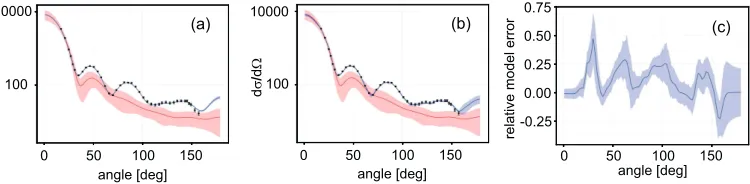
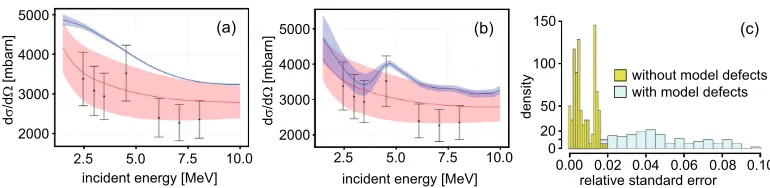
In Fig. 2 the evaluated differential cross sections atE=8.03 MeV without and with model defects are shown. In both evaluations the experimental values of the differential cross sections are well reproduced. However, ignoring the model defects leads to an unrealistically small error band, while accounting for model defects leads to larger and more realistic uncertainties in the order of the exper-imental errors (see Fig. 3c). The method also yields the mean value of the model defect and its error band (Fig. 2c). Due to the conservation of sums, the inclusion of model deficiencies has also a direct impact on the evaluation of angle-integrated cross sections (Fig. 3). If model defects are ignored, the evaluated angle-integrated cross section deviates completely from the experimental value. Including model defects leads to a significantly better overlap between experimental and evaluated cross section. The remaining deviations reflect the fact that the values of the angle-integrated cross section are not compatible with available angle-differential data. Apart from mean values and associated uncertainties, the extended evaluation procedure yields also the complete set of covariance matrices.
Figure 3.Evaluated (blue) and a-priori (red) angle-integrated cross section data with the associated uncertainty band. (a) Evaluation without model defects; (b) Evaluation accounting for model defects; (c) Histogram compar-ing the uncertainties without (yellow) and with (blue) model defects.
4 Conclusions and Outlook
We developed a statistically consistent procedure for the inclusion of model defects into nuclear data evaluations. The method is based on Gaussian processes, which allows to formulate the expected deviations from the nuclear model calculations in terms of reasonable assumptions for the covariance matrices. The method provides not only values for the evaluated observables and uncertainties, but also provides mean values and uncertainties of the model defects, which is an important information, especially for differential data. Applications of the method to evaluations of neutron-induced reaction data are currently in progress.
The presented method adresses the general problem of the assessement of the quality of models and is therefore not only of interest for nuclear data evaluation. Hence it has a high potential for applications in different fields of physics which strongly rely on modelling.
Acknowledgements
Work partly supported by the F4E Partnership Agreement grant F4E-FPA-168.02 and the associated KKKÖ project G. Schnabel of the Austrian Academy of Sciences as well as via the EURATOM project CHANDA. The views and opinions expressed herein do not reflect necessarily those of the European Commission.
References
[1] T. Bayes,An Essay towards Solving a Problem in the Doctrine of Chances, Philosophical Trans-actions53, 370 (1763)
[2] G. Schnabel,Large Scale Bayesian Nuclear Data Evaluation with Consistent Model Defects, PhD thesis, TU Wien (2015)
[3] M.T. Pigni, H. Leeb,Uncertainty estimates of evaluated56Fe cross sections based on extensive modelling at energies beyond 20 MeVin: Proc. Int. Workshop on Nuclear Data for the Transmuta-tion of Nuclear Waste (GSI Darmstadt, Darmstadt, 2003) PO21
[4] H. Leeb, D. Neudecker, Th. Srdinko, Nucl. Data Sheets109, 2762 (2009) [5] A. Trkovet al., Nucl. Instr. Meth. A212, 3098 (2011)
[6] D. Neudecker, R. Capote, H. Leeb, Nucl. Instr. Meth. A723, 163 (2013) [7] D.G. Krige, J. Chemical, Metallurgical and Mining Society52, 119 (1951)