517
THE EFFECT OF EXCHANGE RATE FLUCTUATIONS ON ECONOMIC
GROWTH CONSIDERING THE LEVEL OF DEVELOPMENT OF FINANCIAL
MARKETS IN SELECTED DEVELOPING COUNTRIES
Mehdi Basirat
Assistant Professor and Head of Economics Department, Science and Research Branch, Islamic Azad University, Khuzestan, Iran
Arezoo Nasirpour
MA student, Department of Economics, Science and Research Branch, Islamic Azad University, Khuzestan, Iran
Alireza Jorjorzadeh
Assistant Professor Department of Economics, Science and Research Branch, Islamic Azad University, Khuzestan, Iran
ABSTRACT
This study aimed to investigate the effect of exchange rate fluctuations on economic growth considering the rate of development of financial markets in developing countries over the period 1986-2010. The effects of variables such as trading volume, inflation, and production of the previous period on economic growth have been studied as well. The results obtained by analyzing panel data of 18 countries show that the effect of financial development on economic growth as well as the effect of exchange rate fluctuation on economic growth are negative and significant. On the other hand, the mutual effect of exchange rate fluctuations and financial development on economic growth is positive, but the effect in the studied countries is so small that is not statistically significant.
Keywords:
The currency fluctuation, Economic growth, Financial development, Panel data.Classification:
016, C23, 004, F31.1. INTRODUCTION
The exchange systems over the last few years have experienced many ups and downs at the
international level and have affected the economic structures of some countries. Different exchange systems show how exchange rate is determined in an economy. Exchange rate over the years, especially after the collapse of the fixed exchange rate system (the Bretton Woods system) has had
many fluctuations (Ehsani et al., 2009). Furthermore, one of the most important issues in
Asian Economic and Financial Review
518 developing countries after World War II has been the economic growth. Among the important
factors that affect economic growth, has been exchange rate fluctuation.
The effect of exchange rate fluctuations on economic growth varies in different countries. It
can be said that one of the factors determining the way exchange rate fluctuations affect economic growth is the development level of each country's financial markets. New theories emphasize the
high correlation between economic growth and innovation. This innovation in financial markets occurs by introducing new tools of financial development and in the real sectors of the economy
with the introduction of new products. In fact, with the arrival of the financial intermediaries to growth models, by introducing new tools of finance and financial development, goals such as
reducing risk, increasing capital efficiency through optimal resource allocation and mobility of savings are taken into consideration that eventually follow the objective of achieving long-term
growth of the economy (Hosseini et al., 2011).
Studies suggest that when financial markets are developed enough, the exchange rate fluctuations will not have a negative effect on economic growth, while when financial markets are
undeveloped, exchange rate fluctuations will hinder economic growth. This study examines the effect of exchange rate fluctuations on economic growth considering the level of development of
financial markets in developing countries and in this respect the following questions are raised: 1 - Does the development of financial markets have a positive effect on economic growth?
2 - Do the exchange rate fluctuations have a negative effect on economic growth? 3 - Does development of financial markets neutralize the negative effect of exchange rate
fluctuations on economic growth?
2 .THEORETICAL FOUNDATIONS
2.1. Real Exchange Rate and Economic Growth
Economic Growth is one of the main objectives of economic policy and economic
decision-making. Among economic variables, the variable which is most closely and directly related to the external sector of the economy and more than any other variable can provide economic growth is
the macroeconomic variable of real exchange rate because fluctuation of real exchange rate can cause high fluctuation in foreign trade and balance of payments. Today, due to deep changes in
exchange systems, the exchange rate shows off as a key factor in economic policy making more than ever (Jafari, 1999). On the other hand, one of the effective factors in choosing the appropriate
exchange system in developing countries is the relationship between real exchange rate and economic growth. Choosing ineffective exchange system and inappropriate exchange policies in many countries has had negative effects on their economic growth. Fluctuations of real exchange
rate in a flexible exchange system make ample changes in investment and international trade, thereby on economic growth.
Many countries, to avoid exchange rate fluctuations, fix the value of their currency against the most important currencies. However, it is observed that some other countries refuse to fix the
519 The point worthy of attention is that the observations show some difficulties such as negative effects on economic growth are raised as the result of applying floating exchange rate systems and the resulted exchange rate fluctuations in some countries, while in many other countries most of
which are developed countries such negative effects are not observed . This dichotomy suggests that the effect of exchange rate fluctuations on important variables such as economic growth
depends on a third factor named the level of financial development.
2.2. Development of Financial Markets and Economic Growth
Since capital accumulation is one of the major sources of every economy, capital formation
process can be accelerated through financial markets (Khataee and Khavari, 1999). In the Keynesian models of growth, since Keynes introduces function of investment as inverse function of
interest rates and savings function as direct function of income, lower interest rates is proposed. McKinnon and Shaw rejected Keynes' monetary models, Keynesians and structuralists theories and believed that the main assumptions of these approaches did not suit the conditions in developing
countries of that time. They emphasized the key role of liberalization and financial development on economic growth and showed that the financial repression, that is, stabilizing the nominal interest
rate below the equilibrium level of real interest rates, by limiting real investment and the amount of savings would lead to the slowdown of economic growth. Neostructuralists, represented by Edward Buffie (1984), Akira Kohsaka (1984), Lance Taylor (1983), and Sweder Van Wijnbergen (1983a and 1983b), challenged McKinnon - Shaw School in the early 1980s. According to these neostructuralists, in practice, financial liberalization, most likely is due to reduced real granting of credits available to businesses, reduces economic growth. Neostructuralists assume that financial resources are freely flowing between banking system and the unorganized markets, and any
increase in unorganized market interest rates, increases the prices level. In their analysis, eliminating interest rate ceilings will increase deposits interest rate and through increasing
unorganized market interest rates may reduce total supply of circulating capital, thereby decrease economic growth (Komeyjani and Pourrostami, 2008). Patrick (1966) argues that in the early stages of economic development, the financial sector causes economic growth by expanding and providing capital and in the next stages when economy is growing, the demand for financial
services is enhanced and leads to financial development.
3. LITERATURE REVIEW
Rioja and Valev (2002) showed that the relationship between financial development and growth is not a one-to-one monotonic relation and depends on their level of financial development.
Their study shows that in countries with low levels of financial development, some indices of financial development have negative effects on growth, while some others have positive but very
low and negligible effects. In countries with intermediate levels of financial development, financial development indices have a positive effect greater than that of countries with advanced financial
520 markets and economic growth and investigated the effects of four fundamental, structural and efficiency indices of financial development as well as the ratio of time or savings deposits to GDP and three economic performance indices, including economic growth, per capita capital
accumulation growth and capital productivity. Based on their findings, due to the dominant effect of government presence in Iran economy, the financial development effects on the real sector are
weaker than those in other countries. Moreover, the effects have been negative in some cases. Aghion et al. (2006) examined the changes in exchange rates and productivity growth with respect
to the role of financial development, based on the data of 83 countries over the years 2000-1960. They showed that changes in exchange rates can have a significant effect on productivity growth in
the long-term. However, this effect strongly depends on the country's level of financial development. For countries with relatively low financial development, exchange rate change
generally reduces growth, while for countries with advanced financial development exchange rate change has no significant effect. Suleiman and Aamer (2007), in their study titled "Financial Development and Economic Growth: the Egyptian experience" examined the relationship between
financial development and economic growth in Egypt, using VAR model, in the period 1960-2001. The results of their study suggest that there is a mutual relationship between financial development
and economic growth in Egypt. They also proved that financial development, through increasing investment resources and enhancing investment efficiency, leads to economic growth in this
country. They suggested accelerating the financial reform that began in Egypt in 1991 in order to stimulate investment and savings and consequently, long-term economic growth. Schnabel (2008)
examined the effect of stabilization of the exchange rate on economic growth in 41 economies of the Europe Union. The findings of this study, introduces international trade, international capital flows and stabilizing the macroeconomic as major channels for transmission of exchange rate
stability to economic growth. The study uses panel data approach to measure the negative effect of exchange rate fluctuations on economic growth. Khataee and Mousavi (2008), using the five-year
means of data from a sample of 69 countries and employing a panel data model, examined the effect of exchange rate fluctuations on the level of economic growth considering the level of
financial markets development. The results of their study show that in lower level development of financial markets, the effect of exchange rate fluctuations on economic growth is negative and in
upper levels this effect can be positive. Seifipour (2010) examined the effect of financial development on economic growth using panel data for 85 countries. The results show that in
countries with high-income which are financially more developed in money and investment market improving financial development leads to economic growth. In countries with low and intermediate income and low level of financial development in money and investment market improving
financial development in money market has negative effect but improving financial development in investment market has positive effect on economic growth. Toulaboe (2011) investigate the
relationship between the mean growth rate of per capita (GDP) and real exchange rate misalignment, using data from 33 developing countries. He concludes that average real exchange
521 exchange rate policies result in poor economic performance that many developing countries have
experienced.
4. INTRODUCING THE MODEL
Based on the findings in theoretical study of Aghion et al. (2006) the relation of economic
growth with financial development and exchange rate fluctuations can be as follows:
t t
t t
t
ER
ER
FD
FD
GY
1
2
(1)Where
GY
tshows the economic growth,ER
tis real exchange rate fluctuations variable andFD
tis financial development index. Furthermore,
ER
t
FD
trepresents the mutual effects of exchangerate fluctuations and financial development on economic growth and shows the role of financial development whilst exchange rate fluctuation effects on economic growth. In a number of applied
studies such as Levin et al. (2000) in the relation of economic growth variables such as trading volume, inflation and previous period of production as factors affecting economic growth have
entered. Therefore:
t t
t t t
t
lagy
ER
ER
FD
FD
z
GY
1
2
(2)Where lagy is the logarithm of previous period of production (y represents the logarithm of
production) and
Z
tis the vector of control variables, including variables such as trading volumeand inflation. Considering these points the estimated model, would be as follows:
t t t t
t t
t
lagy
ER
ER
FD
FD
z
U
GY
1
2
(3)This model is a time series model, but in order to consider the role of intersections, that is the different countries, a dynamic model with panel data is used. Thus, the final model which will be
estimated is as follows:
t i i t t t
t t t
t
lagy
ER
ER
FD
FD
z
GY
1
2
, (4)Where i and t represent country and time respectively,
tis time specific effect and
icountryspecific effect. In this study, the growth of per capita GDP is used as a measure of economic growth. There are different indices of financial development, but because the theoretical foundation
for selection of this model is the businesses' borrowing and getting credit from banking system and financial institutions, the ratio of total credit granted to the private sector to GDP (multiplied by
522 fluctuations and for the real exchange rate fluctuations, the five -year standard deviation of the effective real exchange rate is considered, that is:
ln(
,)
ln(
, 1)
5 , , , cpi t i cpi t i t t i t
i
stdev
RER
RER
ER
t
z
, the vector of control variables includes the variableTo
i,tthe ratio of total exports and importsof country i to GDP at time t as an index of economic openness and the variable
p
i,t, inflation asan index of the economy instability.
The model was estimated over the period 1986-2010. To eliminate the effects of short-term cycles and to avoid fluctuating annual data make a dent in the resulting, the annual data are not
used, and for each of the variables, the 5-year mean is used. According to Aghion et al. (2006) definition, the countries with total credit granted to the private sector to GDP ratio of less than 0.7 are considered to be financially less developed countries. In this study, 18 selected developing
countries which have this common feature are examined. The statistics for all variables are extracted from World Development Indicators (WDI) in the World Bank website. Considering data types and statistical analysis method available, to estimate model parameters and examine hypothesis testing, econometric model of panel data is used because on the one hand the
quantitative values of independent and dependent parameters are related to different subgroups of developing countries, and on the other hand the estimation covers the period 1986-2010. In such
cases, to obtain reasonable results, panel data method is used.
5. MODEL ESTIMATION
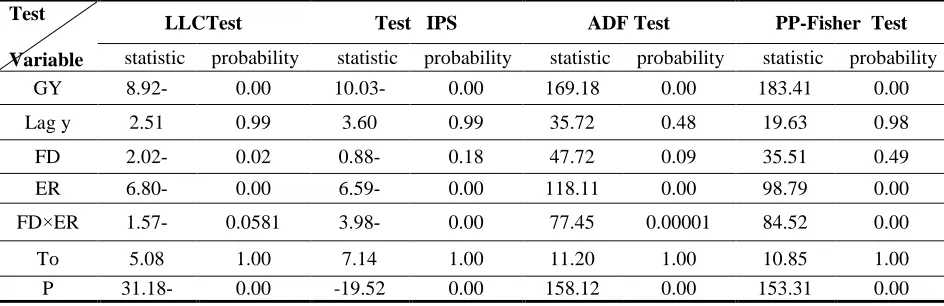
Prerequisite for accurate estimation is stationary of variables. To evaluate stationarity or nonstationarity of variables Lin, Levin, and Chu (LLC), Im, Pesaran, and Shin (IPS), Fisher (ADF),
and PP-Fisher tests are used. The results of the tests for all the variables in the model are shown in Table 1.
Table- 1.Investigate stationary on the level Variables
Datum: Computing Research
PP-Fisher Test ADF Test
Test IPS LLCTest
Test
523 Variables GY, ER, P, are based on LLC, IPS, ADF and PP-Fisher Tests and at the stationary level ((I (0). Variable FD × ER is based on IPS, ADF and PP-Fisher tests and at the stationary level; but variables lagy, FD, and To are not at the stationary level.
Table-2. Investigate stationary on the 1 st difference
PP-Fisher Test ADF Test
Test IPS LLCTest
Test
Variable statistic probability statistic probability statistic probability statistic probability 0.00 197.65 0.00 216.59 0.00 12.90- 0.00 13.36- Lag y 0.00 140.88 0.00 124.43 0.00 7.13- 0.00 5.93- FD 0.00 309.51 0.00 296.55 0.00 17.69- 0.00 19.52- TO
Datum: Computing Research
As shown in Table 2, variables FD, lagy, and To are based on LLC, IPS, ADF, PP-Fisher tests and after one time differentiation become stationary (I (1)). Given that the variables lagy, FD and To, are I (1) and other variables are I (0), panel cointegration test should be examined.
Cointegration test results are shown in Table 3:
Table-3.cointegration test
probability statistic Test 0.00 8.97- Panel PP–Statistic 0.03 1.85-
Panel ADF– Statistic
0.00 10.01-
Group PP–Statistic
Datum: Computing Research
As can be seen, according to Panel Statistic PP- and Panel ADF-Statistic (within-dimension Statistic) and Group PP - Statistic (between-dimension Statistic) tests H0 hypothesis suggesting
lack of cointegration is rejected and cointegration or the existence of long-term equilibrium relation between the variables of the model is accepted. Now to use panel data model against fixed effects model, Chow test is examined results of which are shown in Table 4.
Table-4. Chow test
probability
Degree of
freedom statistic Chow test 0.00 ),5921( 4.128021 F
Datum: Computing Research
Given that the probability level of F-statistic is less than 0.05, the H0 hypothesis is rejected and fixed effects are accepted and different y-intercepts should be considered in assessing. To choose
524 Table-5. Hausman test
probability Degrees of
freedom Chi-sq. statistic
Hausman test
0.0019 6
20.901027 Datum: Computing Research
The results show that the H0 hypothesis suggesting that the random model can be used instead of a fixed model is rejected at 95% degree of certainty. So, the best estimation method is fixed effects method. According to the Hausman test results and by choosing fixed effects method, model coefficients are estimated using generalized least squares (EGLS). The results of the model estimation assuming fixed effects are shown in Table 6.
Table- 6.Results of the model estimation
Economic growth (GY): Dependent variable
probability t- statistic
Std.Error Coefficient Variable 0.5089 0.665608 0.044569 0.029666 Constant 0.6673 0.432587- 0.006837 0.002958- Lagy 0.0250 2.315123- 0.000126 0.000292- FD 0.0198 2.411532- 0.016459 0.039691- ER 0.7947 0.261699 0.001189 0.000311 FD×ER 0.0001 4.267395 0.001076 0.004591 TO 0.0000 4.735084- E-061.33 E-066.28- P 0.89 0.84 Adjusted- 2.5 Statistic D-W 17.72 F-statistic
0.0000 Prob(F)
Datum: Computing Research
As the results show in Table 6, the coefficient of financial development is negative and statistically
significant at 95% degree of certainty. In other words, financial development in selected countries has a negative effect on economic growth which is consistent with experimental findings in Latin American countries (Nazifi, 2004). Also, the results indicate that the direct effect of exchange rate
fluctuations, irrespective of the mutual effects of financial development and exchange rate fluctuations on economic growth is negative and significant. Furthermore, the mutual effects of real
exchange rate fluctuations and financial development on economic growth is positive but not statistically significant. Trading volume variable has a significant positive relation to economic
525 significant at 99% degree of certainty. In other words, with rising inflation, economic growth decreases. Logarithm coefficient of the previous period of production is negative and statistically not significant.
6. CONCLUSIONS AND SUGGESTIONS
This paper examined the effect of exchange rate fluctuations on economic growth considering the level of development of financial markets in selected developing countries over the period 1986
-2010. Our results suggest that financial development coefficient is negative and statistically significant at 95% level. This means that the effect of development of financial markets during the
period 2010-1986 in selected developing countries on economic growth has been negative. Effectiveness of financial development on economic growth is not uniform across countries and
across time. Levin et al. (2000) and De Gregorio and Guidotti (1995) have shown that effectiveness of financial development on economic growth depends on the level of financial development. That is, in developing countries, this effect may be negligible or statistically meaningless. The reason of
the negative relationship between financial markets development and economic growth in developing countries is that the credits granted to the private sector include both the credits granted
by private financial institutions, and the credits allocated by the central bank as well as state-owned banks. In developing countries, the share of public monetary institutions active in the money
market is higher than that of private institutions. In these public financial institutions, credits are not granted based on the profitability of the project but as an imposition. Also, due to the existence
of financial repression in these countries, the rates of facilities granted are much lower than the market rate. Therefore projects with lower profitability rates are also accepted despite the fact that they are not economical. Thus, in developing countries to pay these facilities will not necessarily
increase the level of investment and economic growth. The direct effect of real exchange rate fluctuations on economic growth is at 95% degree of certainty negative and statistically significant.
The coefficient of the mutual effects of exchange rate fluctuations and financial development on economic growth is positive but not statistically significant. In other words, if exchange rate
fluctuations exist and we consider financial development, financial development to some extent has a positive effect, but not enough to be significant. The reason for the non-significance of coefficient
of the mutual effects of exchange rate fluctuations and financial development on economic growth in selected developing countries can be explained as follows: exchange rate fluctuations can cause
changes in effective real rates in developing countries and obscurity in profitability of investment in export goods, public finance management, their foreign debts and foreign reserves. The reason of the growing trend towards more flexible exchange systems in which exchange rates are adjusted
continuously and officially are called guided float or float independently, is that many developing countries which are faced with high internal inflation rates, are forced to weaken their currencies
severely to maintain international competitiveness of their goods.
In this study, the total export and import statistics for the selected sample of studied countries
526 Gambia in Africa) were collected. The results indicate that in these countries, total imports during the period studied is higher than total exports. For Iran, considering that the majority of its exports are oil exports, total import was compared to non-oil exports, and the findings show that total
imports are higher than non-oil exports. Therefore, the selected countries in the sample are more Importer rather than Exporter. Now, if we divide import goods into three categories of
intermediate, capital and consumer goods, we observe that the share of imports of capital goods and intermediate goods is higher than share of consumer goods.
Furthermore, as the statistics of the real exchange rate in selected countries show for the six countries until 2001 (16 years of the study period), 2 countries until 2002 (17 years of the study
period), 5 countries until 2003 (18 years of the period under review), two countries until 2004 (19 years of the study period) and also Malawi and Congo respectively 21 and 20 years of the period
studied and Colombia 12 years of the study period , have had rising real exchange rate, meaning that these countries in the majority of years of the study have faced devaluation of the national currency. Devaluation of the national currency increases the price of imported goods including
intermediate and capital goods, which in turn increases production costs. Therefore, if the exchange rate fluctuations in a period inflict losses on firms, the firms receive loans from financial market
and expect that in the next period the conditions improve. However in such economies during the abovementioned years, the firms, which sustained losses because of exchange rate fluctuations, did
not experience a subsequent period in which exchange rate fluctuations would benefit them so that neutralize the negative effect of exchange rate fluctuations in previous period and compensate for
their losses. As a result, development of financial markets and receiving the varieties of loans do not benefit them, but increases their debts. Furthermore, the numbers of years in which the real exchange rate increases, is so high that financial markets cannot reduce the negative effects of it. In
other words, the studied countries, financial markets are not able to reduce the negative impact of exchange rate fluctuations effectively.
According to findings of this study, and considering the significant negative effect of financial development on economic growth in the studied countries, the following suggestions are offered:
1 – Since the effect of the openness of the economy (trade volume) is positive, decreasing barriers to trades (exports and imports) in order to increase trades with the foreign countries will have a
positive effect on economic growth.
2 – In Iran granting of banking credits is usually imposed to the banking system by the government,
therefore the government's domination on granting of banking facilities should be reduced. The credit transfer to inefficient enterprises and economic activities should be prevented and directed toward generating activities by creating and promoting a competitive environment in the banking
system.
3- Providing necessary facilities to further activate private banks can promote competition in
527 returns. So as the result of higher efficiency and expected profitability in the private sector, this
sector could have a bigger share of the budget allocated to the banking system.
REFERENCES
Aghion, P., P. Bacchetta, R. Ranciere and K. Rogoff, 2006. Exchange rate volatility and productivity growth: The role of financial development, NBER Working Paper.
Buffie Edward, E., 1984. Repression, the new structuralists, and stabilization policy in semi-industrialized economies. Journal of Development Economics, 14(3): 305 322.
De Gregorio, J. and P.E. Guidotti, 1995. Financial development and economic growth. July. Washington D.C:
International Monetary Fund.
Ehsani, M., A. Khanalipour and J. Abbasi, 2009. Effect of exchange rate volatility on exports to Iran. Journal
of Economic Sciences, 9(1): 13-34.
Hosseini, S., Y. Ashrafi and A.E. Ciyami, 2011. Investigation of the relationship between financial
development and economic growth in iran by introducing new variables. Journal of Economic Policy, 19(60): 19-34.
Jafari, M., 1999. The effect of real exchange rate on the economic growth; case study of the economy of Iran during the period 1959-1996. Master Thesis, Faculty of Humanities and Social Sciences
Mazandaran University.
Khataee, M. and n.A. Khavari, 1999. Development of financial markets and economic growth, the central
bank of Iran. Tehran: Institute for Monetary and Banking Researches.
Khataee, M. and N.S. Mousavi, 2008. Effect of exchange rate fluctuations on the economic growth given the level of financial market development. Journal of Economic Researches Iran, 10(37): 1-19.
Kohsaka, A., 1984. The high interest rate policy under financial repression. Journal of the Institute of Developing Economies, 22(4): 419-452.
Komeyjani, A. and N. Pourrostami, 2008. The effect of financial suppressed on economic growth (compared to less developed economies and emerging markets). Journal of Economic Studies, 12(37): 31-51.
Levin, R., N. Loayza and T. Beck, 2000. Financial intermediation and growth;causality and causes. Journal of Monetary Economics, 46(1): 31-77.
Nazifi, F., 2004. Financial development and economic growth in Iran. Journal of Economic, 4(14): 97-130. Nili, M. and M. Rastad, 2003. Financial development and economic growth, Proceedings of the Thirteenth
Conference on Monetary and Exchange Rate Policies, The Role of Financial Institutions in Economic Development: Performance and Prospects - Iranian Experience, Institute for Monetary and Banking. pp: 96-71.
Patrick, H.T., 1966. Financial development and economic growth in underdeveloped countries. Economic Development and Cultural Change, 14(2): 89-174.
Schnabel, G., 2008. Exchang rate volatility and growth in small open economy at the EMU periphery. Leipzing University.
528
Suleiman, A.B. and S. Aamer, 2007. Financial development and economic growth: The egyption experience. Journal of Policy Modeling, Article in Press.
Toulaboe, D., 2011. Real exchange rate misalignment and economic growth in developing countries, Hays State University. pp: 57-72.
Van Wignbergen, S., 1983 a. Credit policy, inflation and growth in a financially repressed economy. Journal of development economics, 13(1-2): 45-65.
Van Wignbergen, S., 1983 b. Interest rate management in LDCʼs. Journal of Monetary Economics,
12(3):433-452.
BIBLIOGRAPHY
Rioja, F. and N. Valev, 2002. Financial and sources of growth of various stages of economic development.
Economic Inquiry. 42(1):127-140.
Taylor, L., 1983. Structuralist macroeconomics: applicable models for the third world. Basic Books, the