Available online: https://edupediapublications.org/journals/index.php/IJR/ P a g e | 1422
Efficacy of Centering Techniques for Creating
Interaction Terms in Multiple Regression for
Modeling Brand Extension Evaluation
Harleen Kaur
Author Profile:
Dr. Harleen Kaur is Assistant Professor in the Department of Commerce and Business, Mata Sundri College for Women, University of Delhi, Delhi, India. She did her M.Com from Delhi School of Economics and Ph.D. from the Faculty of Management Studies, University of Delhi, Delhi, India. Her research interests include brand extensions, brand equity and advertising. Her research is published in Journals of International repute like Vision: The Journal of Business Perspectives and Journal of Empirical Generalizations in Marketing Science. She has been teaching undergraduate commerce and business students of University of Delhi for more tan ten years.
Contact details of the author are-
Assistant Professor Department of Commerce Mata Sundri College for Women University of Delhi, Delhi, India Email: [email protected] M: 7838381755
ABSTRACT
Interaction terms (representing interaction of the model variables) are commonplace when it comes to multiple regression. Our primary contribution is to verify the benefit of applying different statistical techniques for creating interaction effects in multiple regression models, specifically for the case of brand extension model. Cross product interaction term is considered as a traditional technique for creating interaction effects as compared to mean centered
Available online: https://edupediapublications.org/journals/index.php/IJR/ P a g e | 1423
Keywords: Consumer Behavior, Brand Extension, Residual Centering, Mean Centering
INTRODUCTION
The current study presents a comparison of three statistical approaches of creating interaction terms in the regression model discussed in the formative research of Aaker and Keller (1990) (henceforth A&K) in the domain of brand extension. A&K’s regression model included cross product interaction terms. While their study worked as founding pillars for the budding researchers in the brand extension domain, it had its fair share of criticism for the
multicollinearity present in their model. Researchers later suggested using centering techniques to alleviate multicollinearity. The utility of such techniques still has to be tested with regards to improvement in the overall model. The present study aims to address the above issue of studying the impact of centering techniques in improving the regression models.
Available online: https://edupediapublications.org/journals/index.php/IJR/ P a g e | 1424 extension categories. Majority of their variables were found to be affecting extension evaluation except for Quality of the parent brand. However, multiple replication studies performed later on proved that quality impacts the brand extension evaluation strongly whereas difficulty in
manufacturing the extension product had mixed results from the researchers (e.g., Sunde and Brodie, 1993; Patro and Jaiswal, 2003; Kaur and Pandit, 2014; Holden and Barwise, 1996).
Replication and meta-analysis studies also found that the primary reason for inconsistency in earlier research could primarily be linked with the presence of multicollinearity which was established to be corrected using residual centering (Barrett, Lye and P. Venkateswarlu, 1999; Bottomley and Holden (2001); Kaur and Pandit, 2014). These replication studies articulate the need for further empirical generalizability and for deeper understanding of utility of centering techniques, which were established as the major reason for differences in results among others such as different methodology or stimuli.
As an illustration of how a cross product term may cause the problem of multicollineairtity, the Equation 1 given below has p1 and p2 independent variables along with p1p2 as cross product interaction term.
Y= α1p1 + α2p2 + α3p1p2 + ε ………. (1)
Multicollinearity involves the situation when the cross product term p1p2, representing
Available online: https://edupediapublications.org/journals/index.php/IJR/ P a g e | 1425 Empirical results demonstrate that mean centering results in reduced covariance and correlation between the independent variables (p1 and p2 in Equation 1) and their interaction term (p1p2 in Equation 1). As a result, the problem of multicollinearity gets alleviated and the precision of estimates increases. The procedure of centering is commonly endorsed to moderate the possible impact of multicollinearity between independent variables and their cross-product terms. While centering has proven to improve interpretation of the predictor variables (Gwowen Shieh 2011), if the regression model includes interaction terms, the statistical interpretations of several
coefficients in the linear model will not remain the same as in the model where interaction terms are excluded. Echambadi, Arroniz, Reinartz, and Lee (2006) and Kaur and Pandit (2014) very strongly endorsed a full effects model that includes interaction effects between the independent variables if the coefficient of the interaction term is non zero.
LITERATURE REVIEW
A survey through the accomplished literature clearly demonstrates that the problem of
multicollinearity has been of concern in several linear regression models (Belsley 1991, Belsley, Kuh, and Welsch 1980, and Fox and Monette 1992). Researchers have differed in their ways of reducing the multicollinearity by using residual centered interaction terms (Bottomley and Holden 2001) and mean centering for creating interaction terms (Aiken and West 1991). Another plausible solution for lightening multicollinearity could be to obtain larger amount and better quality data (Judge et al., 1988, p. 874). A few other researchers suggest that the effects of multicollineairity could be offset by enough power in the model (Mason and Perreault, 1991).
Available online: https://edupediapublications.org/journals/index.php/IJR/ P a g e | 1426 multicollinearity. Residual centering primarily involves a two-stage ordinary least squares (OLS) procedure wherein the product or the powered term is regressed onto their corresponding first-order effect(s) (Little, Bovaird and Widaman, 2006). Bottomley and Holden (2001) and Kaur and Pandit (2014) used the data set of A&K for further analyses of their brand extension model. Both of them, after accounting for correction of multicollinearity, concluded that the
residual-centering method indeed resulted in substantial reduction of collinearity between the moderating variables. According to another research (Echambadi and et al., 2006) residual-centering
approach used by Bottomley and Holden (2001) to alleviate collinearity problems is
inappropriate. (Little et al., 2006) highlighted that the advantage of residual centering is its ease of implementation. McClelland et. al. (2016) in their critical research verified the irrelevance of multicollinearity in the model with moderator variables.
As discussed above, a lot of contrary opinions and outcomes of the research in the literature exists which forms the basis for the current study to investigate the utility of centering techniques in improving the model and alleviating the multicollinearity.
In the next section, the methodology adopted for the current study is explained along with the research hypotheses and the data analysis. Results are discussed in detail thereafter. Finally, conclusions include the limitations as well as proposed suggestions for future extensions.
METHOD
Stimuli
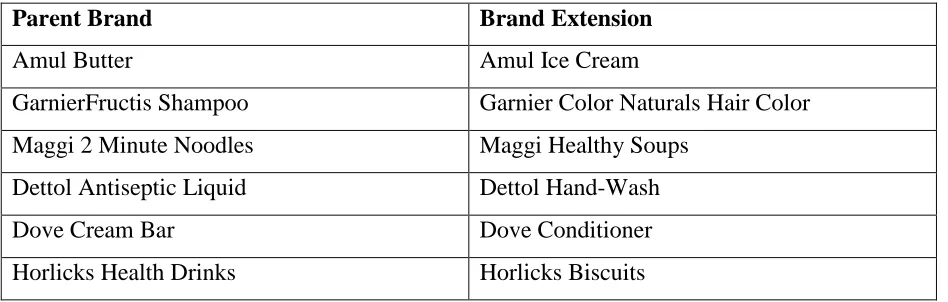
A set of six well known CPG brands and their widely advertised extensions were used as stimuli in this study. Brands meeting the criteria of Aaker & Keller (1990) - generally perceived as high quality, being relevant to subjects, not extended previously and eliciting specific associations, were shortlisted for the study. Preliminary tests were conducted before shortlisting the final set of brands and their corresponding extensions. All the measures selected in this study, for
Available online: https://edupediapublications.org/journals/index.php/IJR/ P a g e | 1427 analysis for uni-dimensionality of the construct) were run before the main study was conducted. Parent brands and their extensions finally selected for this study are illustrated in Table 1. Primary data, together with secondary data from prior literature, is then used to perform statistical and comparative analysis.
Parent Brand Brand Extension
Amul Butter Amul Ice Cream
GarnierFructis Shampoo Garnier Color Naturals Hair Color
Maggi 2 Minute Noodles Maggi Healthy Soups
Dettol Antiseptic Liquid Dettol Hand-Wash
Dove Cream Bar Dove Conditioner
Horlicks Health Drinks Horlicks Biscuits
Table 1: Brands and their extensions used in this study
Sample
Sample set for the study included Management students of a renowned National University of India. Both full-time and part-time students were included to ensure diversity. The respondents were contacted during classes (while taking prior permission from the concerned faculty). All the students present on the day, survey was conducted, were distributed first round of questionnaire in which their demographic profile and their familiarity with the brands selected in the study were sought. Care was taken to ensure that only the respondents that were familiar with a specific brand provide information on that brand.
Available online: https://edupediapublications.org/journals/index.php/IJR/ P a g e | 1428 Research Objectives and Hypotheses Formulation
Formative work of Aaker and Keller (1990) motivated several brand extension research studies in various countries. This exploratory study gave pivotal knowledge about the factors influencing the consumers’ attitude towards the brand extension. Replication studies that followed showed varying results. Such variations were primarily attributed to interaction effects between the independent variables leading to multicollinearity. Such lack of generalization served as basis for the further analysis undertaken in the current study.
Objective: To test the utility of creating and using centered interaction terms instead of cross
product interaction terms for brand extension evaluation model, as proposed by Aaker and
Keller (1990)
DATA ANALYSIS AND RESULTS
The regression model used for this study (as also hypothesized by Aaker and Keller) is mentioned below:
Attext = α + β1 * Quality + β2 * Complement + β3 * Substitute + β4 * Difficulty + β5 *Transfer + β6 Quality*Complement + β7 Quality*Substitute + β8 Quality*Transfer + ε" …(2)
Regression results using three different techniques for creating interaction terms, using data collected from responses from the survey of management students (mentioned in detail in the previous section), are reported in Table 2, 3 and 4. Table 2 reports regression results of brand extension model of Aaker and Keller (1990) with cross product interaction terms, residual centered and mean centered interaction terms. Table 3 reports these results in a more
Available online: https://edupediapublications.org/journals/index.php/IJR/ P a g e | 1429 Next, each of the four hypotheses as first observed in Aaker and Keller (1990) are taken for
comparison (βrc, βmc, βcp respectively denote beta coefficients for the three regression models – the first one using the residual centered terms, the second one using the mean centered terms and the third one using the cross product interaction terms).
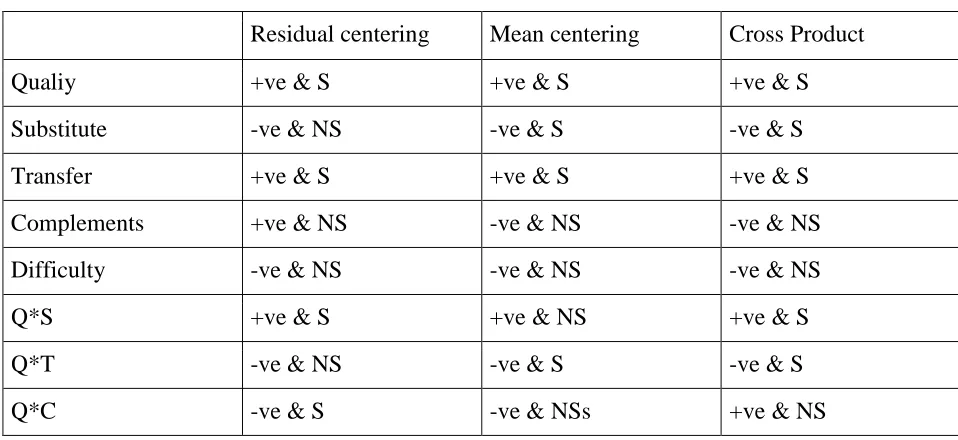
The first hypothesis (H1), from A&K, postulates that parent brand with higher quality perception will result in more favorable evaluation of the extension. Regression results of all the three techniques support H1. However, the initial study from A&K failed to support it. In the current work, the coefficient for Quality term (β1) is both positive and statistically significant (βrc = 0.606, p < .05; βmc= .640, p< .05 and βcp= .688, p< .05). These results indicate direct link between consumers’ attitude towards brand extension and their perceived Quality of the brand. The magnitude of beta coefficient involving no centering comes out to be highest for H1. These results, supporting H1, are in line with a few other replication studies of A&K model
(Olavarrieta et al. 2009; Patro and Jaiswal 2003; Bottomley and Holden 2001; Sunde and Brodie 1993; Kaur and Pandit 2015).
The second hypothesis (H2), from the original A&K study, postulates that the brand’s perceived Quality is better transferred to the extension when both of them fit well together. Regression results from the interaction between Quality and the three variables representing perceived fit vis-a-vis Transfer, Substitute and Complement, can help test this hypothesis. Mixed results were found for the two interaction terms i.e. quality & complement (βrc = 0.060, p< .05; βmc= -.0001, p> .05 and βcp= .006, p> .05) and quality & substitute (βrc = 0.081, p< .05; βmc= -.0190, p> .05 and βcp= .076, p< .05) though the results for the interaction term, quality and transfer were found to be more consistent, beta coefficient being negative in all three techniques (βrc = -0.021, p> .05; βmc= -.083, p> .05 and βcp= -.069, p< .05) though it was not significant
statistically.
In the third hypothesis (H3), A&K postulated that the Perceived Fit between the parent brand and its extension has a direct positive association with the attitude of customers towards brand
Available online: https://edupediapublications.org/journals/index.php/IJR/ P a g e | 1430 towards brand extension. Following A&K model, we also examined the relationship of customer attitude with all the three components of fit individually using different statistical techniques. The results for substitute (βrc = -0.020, p> .05; βmc = -.031, p< .05 and βcp = -.333, p< .05) and transfer(βrc = 0.075, p< .05; βmc = .068, p< .05 and βcp = .354, p< .05) are consistent in full effects model using different statistical techniques though for complement, the direction of the beta coefficients differ in case of the residual centered interaction term vis a vis others (βrc = 0.000, p> .05; βmc = -.005, p > .05 and βcp = .032, p > .05). Results demonstrate that Transfer is a relatively important predictor of customer attitude towards brand extension, as compared to complementarity or substitutability. This result also likely reflect relatively fewer brand
extensions that represent actual substitutes or complements of the parent brand in the consumer goods segment or else it may lead to cannibalization for the manufacturers.
Final hypothesis (H4) from A&K proposes positive relationship between the difficulty of manufacturing the product extension and customer attitude. Regression results in negative beta coefficient for the “Difficult” variable, which is not statistically significant in all three statistical techniques. Correspondingly, results on our data and model do not support H4.
Similarities in the regression results for all the three statistical techniques can be observed suggesting low utility of using interaction terms in multiple regression.
Collinearity control
Available online: https://edupediapublications.org/journals/index.php/IJR/ P a g e | 1431
CONCLUSION
The results show almost similar explanatory power of the model in all three cases (Adjusted R2 between 37- 40%). Also, majorly the results are similar using different approaches to interaction effects. The magnitude and direction of the beta coefficients are majorly similar, except for a few cases where direction of the beta coefficient is opposite or not significant. Results from the current study show no remarkable improvement in either the beta coefficients or the power of the model while using any of the much hyped centering techniques vis a vis cross product interaction terms. This study concludes that centering techniques apparently remove collinearity but do not miraculously improve their computational or statistical conclusions or model per se. These findings will help future researchers understand the over hyped benefits of centering and hence avoid it while creating interaction terms in multiple regression, unless the inclusion of interaction terms is critical to the model (Echambadi and Hess 2007, Shieh 2011).
Available online: https://edupediapublications.org/journals/index.php/IJR/ P a g e | 1432
Table 2: Regression results
Residual centering Mean centering Cross Product
Quality .606 .640 .688
Substitutes .020 -.031 -.333
Transfer .075 .068 .354
Complements .000 -.005 -.032
Difficulty -.007 -.005 -.006
Q*S .081 -.019 .076
Q*T -.021 -.083 -.069
Q*C -.060 -.001 .006
Adjusted r2 .374 .400 .403
Table 3: Summary of results showing direction and statistical significance (S – Significant, NS – Non Significant)
Residual centering Mean centering Cross Product
Qualiy +ve & S +ve & S +ve & S
Substitute -ve & NS -ve & S -ve & S
Transfer +ve & S +ve & S +ve & S
Complements +ve & NS -ve & NS -ve & NS
Difficulty -ve & NS -ve & NS -ve & NS
Q*S +ve & S +ve & NS +ve & S
Q*T -ve & NS -ve & S -ve & S
Available online: https://edupediapublications.org/journals/index.php/IJR/ P a g e | 1433
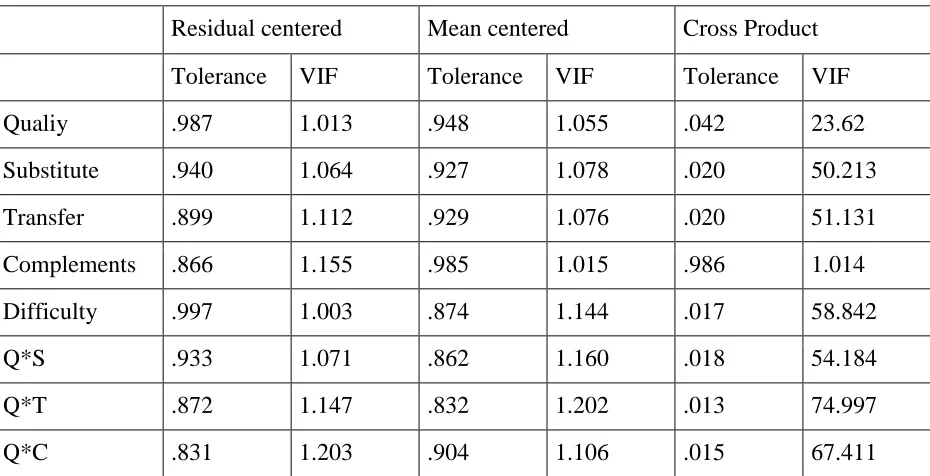
Table 4: Collinearity statistics
Residual centered Mean centered Cross Product
Tolerance VIF Tolerance VIF Tolerance VIF
Qualiy .987 1.013 .948 1.055 .042 23.62
Substitute .940 1.064 .927 1.078 .020 50.213
Transfer .899 1.112 .929 1.076 .020 51.131
Complements .866 1.155 .985 1.015 .986 1.014
Difficulty .997 1.003 .874 1.144 .017 58.842
Q*S .933 1.071 .862 1.160 .018 54.184
Q*T .872 1.147 .832 1.202 .013 74.997
Available online: https://edupediapublications.org/journals/index.php/IJR/ P a g e | 1434
Bibliography
Aaker, D.A., Keller, K.L. (1990). Consumer Evaluations of Brand Extensions. Journal of Marketing, 54(1), 27-41.
Aaker, D.A, Keller, K.L. (1993). Interpreting Cross-Cultural Replications of Brand Extension Research. International Journal of Research in Marketing, 10(1), 55-59.
Aiken, L. S., West, S.G. (1991). Multiple Regression: Testing and Interpreting Interactions. US:Sage publication
Arslan, F.M., Altuna, O.K. (2010). The Effect of Brand Extensions on Product Brand Image. Journal of Product and Brand Management, 19(3), 170–180.
Belsley, D. A.(1991). A Guide to using the Collinearity Diagnostics. Computer Science in Economics and Management, 4(1), 33-50.
Belsley, D. A., Kuh, E., Roy, E. Welsch, (1980). Regression Diagnostics: Identifying Influential Data and Sources of Collinearity. J. Wiley.
Bottomley, P. A., Doyle, J. R. (1996). The Formation of Attitudes towards Brand Extensions: Testing and Generalizing Aaker and Keller's model. International Journal of Research in Marketing, 13(4), 365-377.
Bottomley, P.A., Holden, S.J. (2001). Do we really know how Consumers Evaluate Brand Extensions? Empirical Generalizations based on Secondary Analysis of Eight studies. Journal of Marketing Research, 38(4), 494-500.
Echambadi, R., Arroniz, I., Reinartz, W., Lee, J. (2006). Empirical Generalizations from Brand Extension Research: How sure are we?. International Journal of Research in Marketing, 23(3), 253-261.
Echambadi, R., Hess, J. D. (2007). Mean-centering does not Alleviate Collinearity Problems in Moderated Multiple Regression Models. Marketing Science, 26(3), 438-445.
Available online: https://edupediapublications.org/journals/index.php/IJR/ P a g e | 1435 Guoqun, F., Saunders, J. (2002). Consumer Evaluations of Brand Extensions: Empirical
Evidence from China. Asia Pacific Advances in Consumer Research,5, 395-399.
Hayes, A. F. (2013). Introduction to mediation, moderation, and conditional process analysis: A regression-based approach. New York: The Guildford Press.
Hayes, A. F., Glynn, C. J., & Huge, M. E. (2012). Cautions regarding the Interpretation of Regression Coefficients and Hypothesis Tests in Linear Models with Interactions.
Communication Methods and Measures, 6, 1-11.
Hubbard, R., Armstrong, J. S. (1994). Replications and Extensions in Marketing: Rarely Published but quite Contrary. International Journal of Research in Marketing, 11 (3), 233-248.
Irwin, J. R.,McClelland, G.H. (2001). Misleading Heuristics and Moderated Multiple Regression Models. Journal of Marketing Research, 38(1),100-09.
Janssens, W., Wijnen, K., De Pelsmacker, P., Kenhove, V. (2008). Marketing Research with SPSS. Hanlow, UK: Prentice Hall.
Judge, G. G., Hill, R. C., Griffiths, W., Lutkepohl, H., Lee, T. C. (1988). Introduction to the Theory and Practice of Econometrics.New York: John Wiley & Sons.
Kaur, H., Pandit, A. (2014). Consumer Evaluation of Brand Extension: Empirical Generalization and Comparative Analysis. Journal of Empirical Generalisations in Marketing Science, 15(1), 1-23.
Lance, C. (1988). Residual Centering, Exploratory and Confirmatory Moderator Analysis, and Decomposition of Effects in Path Models containing Interactions. Applied Psychology
Measurement, 12 (2), 163-175.
Leone, R. P., Schultz, R. L. (1980). A Study of Marketing Generalizations. The Journal of Marketing, 44 (Winter),10-18.
Little, T. D., Bovaird, J. A., Widaman, K. F. (2006). On the Merits of Orthogonalizing powered and Product terms: Implications for Modeling Interactions among Latent Variables. Structural Equation Modeling, 13(4), 497-519.
Available online: https://edupediapublications.org/journals/index.php/IJR/ P a g e | 1436 and a critique of Iacobucci, Schneider, Popovich, and Bakamitsos. Behav Res Methods. Aug 16. [Epub ahead of print] PubMed PMID: 27531361.
Maslow, A. H. (1946). Problem-centering vs. Means-centering in Science. Philosophy of Science,13(4), 326-331.
Mather, D. W. (2011). Empirical Generalisations of Brand Extension Theory and the Role of General Linear Mixed Models (Thesis, Doctor of Philosophy). Publisher: University of Otago
Myers, R.H. (1986). Classical and Modern Regression with Applications. MA: Duxbury Press, Boston edition.
Patro, S. K., Jaiswal, A. K. (2003). Consumer Evaluations of Brand Extensions: Evidence from India. Journal of Academy of Business and Economics, 1 (February),170-178.
Sharma, S., Durand, R.M., Gur-Arie,O. (1981). Identification and Analysis of Moderator Variables. Journal of Marketing Research, 18 (3), 291-300.
Shieh, G. (2011). Clarifying the Role of Mean Centering in Multicollinearity of Interaction Effects. British Journal of Mathematical and Statistical Psychology, 64(3),462-477.
Steinmetz, H., Davidov, E., Schmidt, P. (2011). Three Approaches to Estimate Latent Interaction Effects: Intention and Perceived Behavioral Control in the Theory of Planned Behavior.
Methodological Innovations Online, 6(1), 95-110.