ISSN (Print) : 2320 – 3765
ISSN (Online): 2278 – 8875
I
nternational
J
ournal of
A
dvanced
R
esearch in
E
lectrical,
E
lectronics and
I
nstrumentation
E
ngineering
(A High Impact Factor, Monthly, Peer Reviewed Journal)
Website: www.ijareeie.com
Vol. 8, Issue 4, April 2019
A Review on Video Stabilization Using Block
Matching Algorithm and Motion Estimation
Vidya Patanwar1, Sachin Meshram2
M.Tech Scholar, Dept. of Electronics & Telecommunication Engg, Chhattisgarh Swami Vivekanand Technical
University Bhilai, Chhattisgarh, India1
Asst. Professor, Dept. of Electronics & Telecommunication Engg, Chhattisgarh Swami Vivekanand Technical
University Bhilai, Chhattisgarh, India 2
ABSTRACT: As the telecommunication technology grows in the modern era from internet to video conferencing, Video stabilization has become an avoidable feature in information broadcast and also in the entertainment media. In this thesis we compared a different block matching motion estimation algorithms to find the motion estimation with a rapid growth of multimedia information; when transmitting a large amount of data video coding standards have become crucial. Motion estimation ascertain to be the key to splendid performance in video coding by recover the temporal redundancy effectively between adjacent frames.So Based on the study of motion vector distribution from several commonly used test image sequences algorithm for EBMA block matching motion estimation is proposed. The performance of this algorithm is compared with other existing algorithms of basic full search [FS] by means of error metrics and no of search points in this the simulation results shows that the proposed search algorithm achieves close performance uses less no of search points When compared with previous work, this algorithm requires less computation time and gives an improved performance.
KEYWORDS: Block matching algorithm ,Motion estimation, Motion vector Search pattern
I. INTRODUCTION
Video stabilization is a key problem in producing high quality video sequence, especially when we are in self-media age and much more videos are shot with smart phones, which meansvideo stabilization is in great demand.
Typically, there are three steps in video stabilization workflow: i. motion estimation shaking recognition
ii. motion compensation
Among all three steps, the most computationally expensive and resource consumed one is motion estimation. Some mature models are discussed in [1]: based on optical flow, based on pixel, based on block, based on mesh, etc.
BLOCK MATCHING
ISSN (Print) : 2320 – 3765
ISSN (Online): 2278 – 8875
I
nternational
J
ournal of
A
dvanced
R
esearch in
E
lectrical,
E
lectronics and
I
nstrumentation
E
ngineering
(A High Impact Factor, Monthly, Peer Reviewed Journal)
Website: www.ijareeie.com
Vol. 8, Issue 4, April 2019
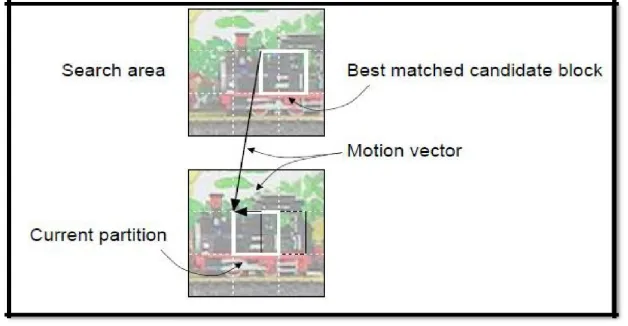
Figure 1.1 The current Frame and reference frame
MOTION ESTIMATION
A video sequence can be considered to be a discredited three dimensional projection of the real four-dimensional continuous space time. The objects in the real world may move, rotate, or deform. The movements cannot be observed directly, but instead the light reflected from the object surfaces and projected onto an image.. The current frame and reference frame difference can observe in the figure 1.2 diagram.
Figure 1.2 motion estimation detector
ISSN (Print) : 2320 – 3765
ISSN (Online): 2278 – 8875
I
nternational
J
ournal of
A
dvanced
R
esearch in
E
lectrical,
E
lectronics and
I
nstrumentation
E
ngineering
(A High Impact Factor, Monthly, Peer Reviewed Journal)
Website: www.ijareeie.com
Vol. 8, Issue 4, April 2019
Figure 1.3 Motion compensated video coding
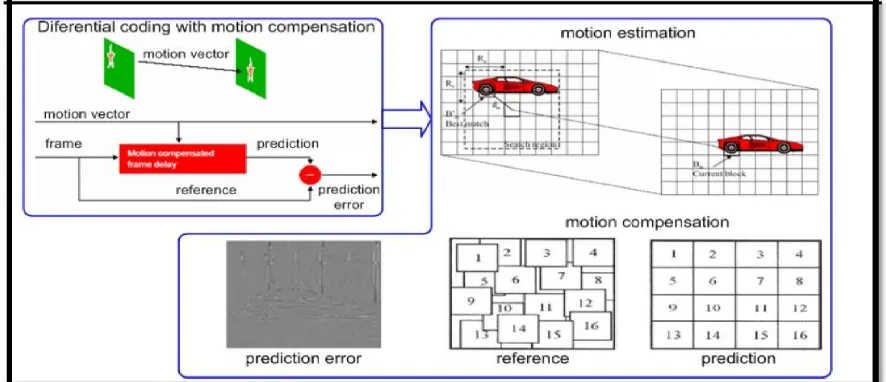
This process is known as motion compensation (MC), and the prediction so produced is called the motion-compensated prediction (MCP) or the displaced-frame (DF) [13]. In this case, the coded prediction error signal is called the displaced-frame difference (DFD).A block diagram of a motion compensated coding system is illustrated in Figure 1.3 This is the most commonly used inter frame coding method. The reference frame employed for ME can occur temporally before or after the current frame. The two cases are known as forward prediction and backward prediction, respectively. The prediction can be observed in figure 1.
Figure 1.4 Predictive sources coding with motion compensation
ISSN (Print) : 2320 – 3765
ISSN (Online): 2278 – 8875
I
nternational
J
ournal of
A
dvanced
R
esearch in
E
lectrical,
E
lectronics and
I
nstrumentation
E
ngineering
(A High Impact Factor, Monthly, Peer Reviewed Journal)
Website: www.ijareeie.com
Vol. 8, Issue 4, April 2019
RazaliYaakob et.al(2) In this paper, four different block matching algorithms using motion estimation are evaluated where the effects of the macro block size used will be reviewed to find the best algorithm among them is scrutinized to determine the most optimal algorithm.
Sonam T. Khawase1 (3)In video compression technique, motion estimation is one of the key components because of its high computation complexity involves in finding the motion vectors (MV) between the frames
WissalHassen et.al (4)he Block Matching is a temporal compression technique used in the video encoding. The main purpose of this method is to determine the displacements of each block of pixels between two successive frames
Maria Santamaria et.al (5) Block-matching motion estimation is an efficient algorithm for reducing the temporal redundancy in video coding and is adopted by video coding standards. Many fast blockmatching algorithms have been devised to reduce the computational complexity without degrading the estimation quality.
K. W. Cheng et.al (6) Motion compensation is an effective method for reducing temporal redundancy found in video sequence compression. However, the complexity of the full-search block matching algorithm (BMA) is extremely high and a number of fast algorithms have been proposed to reduce the computational complexity of the BMA
Hussain Ahmed Choudhury et.al (7) in video both temporal redundancies as well as spatial redundancy occurs. So to remove the both type of redundancies we need combination of systems that can remove both type of redundancies and hence we use Hybrid Video Codec for video compression.
Manisha Pal et.al (8) the fundamental of motion estimation is that the objects in a frame of video sequence should only move within the original frame to form corresponding objects on the next frame.
III PROBLEM STATEMENT
ISSN (Print) : 2320 – 3765
ISSN (Online): 2278 – 8875
I
nternational
J
ournal of
A
dvanced
R
esearch in
E
lectrical,
E
lectronics and
I
nstrumentation
E
ngineering
(A High Impact Factor, Monthly, Peer Reviewed Journal)
Website: www.ijareeie.com
Vol. 8, Issue 4, April 2019
IV. BLOCK MATCHING ALGORITHMS FOR MOTION ESTIMATION
ISSN (Print) : 2320 – 3765
ISSN (Online): 2278 – 8875
I
nternational
J
ournal of
A
dvanced
R
esearch in
E
lectrical,
E
lectronics and
I
nstrumentation
E
ngineering
(A High Impact Factor, Monthly, Peer Reviewed Journal)
Website: www.ijareeie.com
ISSN (Print) : 2320 – 3765
ISSN (Online): 2278 – 8875
I
nternational
J
ournal of
A
dvanced
R
esearch in
E
lectrical,
E
lectronics and
I
nstrumentation
E
ngineering
(A High Impact Factor, Monthly, Peer Reviewed Journal)
Website: www.ijareeie.com
ISSN (Print) : 2320 – 3765
ISSN (Online): 2278 – 8875
I
nternational
J
ournal of
A
dvanced
R
esearch in
E
lectrical,
E
lectronics and
I
nstrumentation
E
ngineering
(A High Impact Factor, Monthly, Peer Reviewed Journal)
Website: www.ijareeie.com
Vol. 8, Issue 4, April 2019
V. EXPECTED OUTCOME
Predict a new frame from a previous frame and only code the prediction error .Prediction error will be coded using an image coding method. Prediction errors have smaller energy than the original pixel values and can be coded with fewer bits .Those regions that cannot be predicted well will be coded directly.
Use motion-compensated prediction to account for object motion .Work on each macroblock (MB) (16x16 pixels) independently for reduced complexity .Motion compensation done at the MB level.
Blocking effect (discontinuity across block boundary) in the predicted image .Because the block-wise translation model is not accurate – Fix: Deformable BMA (next lecture).
Motion field somewhat chaotic, because MVs are estimated independently from block to block Fix 1: Mesh-based motion estimation.
Fix 2: Imposing smoothness constraint explicitly.
The video is stabilizes using EBMA algorithm. We calculate motion vector,compute motion vector entropy,calaculate mean square error, compute frame difference entropy
REFERENCES
[1]. Y.Wang, J.Ostermann and Y.Q.Zhang. Video Processing and Communications. Tsinghua University Press and Prentice Hall, Beijing, China,
2002.
[2]. ISO/IEC 11 172-2, ‘Information technology-coding of moving pictures and associated audio
for digital storage media at up to about 1.5 Mbit/s-part 2: Video’, 1993 *MPEGl Video+.
[3].GorpuniPawankumarandGanapatiPanda‘development of motion estimation and compensation algorithms for video compression’ in digital storage media, India 2009.
[4].B.Liu and A.Zaccarin, New fast algorithms for the estimation of block motion vectors, IEEE Trans. Circuits Syst. Video technology, Vol.3, pp.440–445,Dec 1995.
[5].Tekalp Murat A. Digital video processing, Prentice Hall, PTR, 1995.
[6].I. E. G. Richardson. H.264 and MPEG-4 video compression. Wiley, Chichester, England, 2003. [7].I. E. G. Richardson. H.264 and MPEG-4 Video Compression. John Wiley Publisher,2003.
[8].B. Parhami. Computer Arithmetic: Algorithms and Hardware Designs. Oxford University Press, 2000. [9].ISO/IEC15444. Information technology - JPEG2000 imagecoding system. 2000.
[10].W.Hsuand H. Derin. Three-dimensional subbandcodingofvideo.Proc. Int. Conf. Acoustics, Speech, and Signal Processing (ICASSP), pages 1100–1103, Apr. 1988.
[11].ISO/IEC14496-2. Amendment 1, Information technology coding of audio-visual objects Part2: Visual. 2001.
[12].J.R.Jain and A.K.Jain, “Displacement measurement and its application in inter frame image coding,” IEEE Trans. Commun., vol.COM-29,PP. 1799–1808, Dec.1981.
[13].S.kappagantula and K.R.Rao, “Motion compensated interframe image Prediction”,IEEE Trans. Commun.vol,COM 33,PP, 1011–l015,Sept, 1985.