Original Article
Using the strengths and difficulties questionnaire to
screen for child mental health in the
twins and the only-child
Qing Qin1, Yi-Xiao Fu2, Hua-Qing Meng1, Hui Xiang1, Ji-Ze Jiang3, Ying Huang1, Yu Zhou1, Mao-Lan Zhang1
1Department of Psychiatry, The People’s Hospital of Gui Zhou Province, China; 2Department of Psychiatry, The
First Affiliated Hospital, Chongqing Medical University, Chongqing, China; 3Department of Cardiovascular
Medi-cine, The Specialist Hospital for Respiratory Diseases, China
Received July 30, 2015; Accepted March 9, 2016; Epub May 15, 2016; Published May 30, 2016
Abstract: Background: The psychiatric disorders of children are common, but the sensitivity of screening measures to detect children with mental health problems is different in China. Meanwhile, the evaluation measure that could not screening impairment in social functioning and dimensions caused by the psychiatric disorder was lack of sys-temic assessments. In 1979, China began to carry out the family planning policy to effectively control the popula-tion. In 2008, there are more than 100 million families with only-child. We found that the present researches on the mental health were compared in a community sample of family with the only-child and with two or more children in China, but less research focused on the difference of the mental health between the twins and the only-child group. This study is to assess the difference of mental health between the twins group and the only-child group. Method: The mental health problems were compared in the four scales of SDQ in the sample of 6 to 16 years olds from the twins group and the only-child group. A sample of 443 children was evaluated using parents as informants. And 268 more than 11 years old children were evaluated using parents and themselves as informants. Results: In the parents report, the distribution of peer problems was significantly different between the two groups. In the self report, the distribution of all scales was no significantly different between the two groups. The difference of SDQ prediction between the two groups, in the twins group, the proportion of “probable” was 0.9% for anxiety-depressive disorder, the proportion of “probable” was 3.1% for conduct disorder and 1.3% for Hyperactivity disorder. At last, the proportion of probable was 5.3% for any disorder. In the only-child group, the proportion of “probable” was 1.9% for anxiety-depressive disorder. The proportion of “probable” was 3.4% for conduct disorder and “possible” was 13.5% for Hyperactivity disorder. At last, the proportion of probable was 5.3% for any disorder. There was no significant dif-ference for the proportion of “probable” by the SDQ algorithm between the two groups. Conclusions: The distribution of individuals with the peer problems in the sample of the only-child group was more than that of the twins group, and there were significantly different between the two groups. We presume that the children and adolescents in the only-child group were easy to encounter with the peer relationship problems. The influence of children number to mental health of children and adolescents is a superficial factor, the most important factor is the parenting style and the quality of the home environment.
Keywords: Mental health, the only-child, the twins, strengths and difficulties questionnaire
Introduction
The 6-16 years is the important stage of devel-oping the ability and consciousness of the indi-vidual. Thus, the prevalence rates of the emo-tional and behavioral problems are high in this stage. There is 3.4%-11.5% of children with depressive disorder [1]. Emotional and behav-ioral disorder is a common problem in children and adolescents. It is necessary to pay
mental health problems is different in different areas. Meanwhile, the evaluation measure that could not screening impairment in social func-tioning and dimensions caused by the psychiat-ric disorder was lack of systemic assessments; therefore the detection rate of most of the development of mental health problems was low. The diagnosis prediction for clinical sam-ples based on the Strengths and Difficulties Questionnaire (SDQ) and Development and Well-Being Assessment (DAWBA) agree well with clinical diagnoses [2]. There is a special group in our country namely the only-child. In 1979, our country began to carry out the family planning policy to effectively control the popu-lation. In 2008, there are more than 100 mil-lion families with the only-child. A growing num-ber of publications have raised awareness of the high prevalence of emotional and behav-ioral disorder in the only-child. We can conclude through the study about the only-child that, in the past 30 years, the difference of personality characteristics between the only-child and the children with the multiple brother or sister will gradually disappear [3]. However, other re- searches show that the rates of impulse-con-trol disorder and hyper-activity disorder in the children with multiple brother or sister than the only-child group [4]. The psychological health development is influenced by the number of child, which has been a controversial problem. We found that the present research on the mental health was about the family with the only-child or two or more children in China. The twins is a special category of population. And there were less research about mental health development for them in our country. And their characteristics of the psychological health are different from those of the only-child and the general children with two or more brothers or sisters. Thus, this study adopts SDQ preliminar-ily to screen what the difference of mental health between the only-child and the twins is.
brought up by the same family and study in the same school and without the colorblindness, mental illness and the physical disability. Secondly, we made a randomized selection of only-child group who was in the same school with the twins, but the classes were random-ized. Because the establishment of the resource library for twins is in the first stage, we have collected the sample of twin was 116 pairs. Finally, the sample of the only-child group required was 211.
Measures
The SDQ was created by Robert Goodman at the Institute of Psychiatry in London. The SDQ in its different language version has been wide-ly used in accessing children at potential risk in many countries, such as the United States, the Netherlands, Germany and Britain [5]. The Chinese version of SDQ proved to have good reliability and validity [6]. There are three ver-sions of the Questionnaire, parent, teacher and self-report version. It consists of 25 core items, including emotional symptoms, behavioral problems, hyperactivity problems, peer rela-tionship problems and pro-social behaviors and so on. The total difficulty score is generated by adding the scores from all the scales except the prosocial one. Computerized algorithms exist for predicting psychiatric disorder by bringing together information on symptoms and impact from SDQs completed by multiple informants [2]. The algorithm makes separate predictions for four groups of disorder, namely conduct dis-orders, hyperactivity-inattention disorder, emo-tional disorders and any psychiatric disorder. Each is predicted to be “unlikely”, “possible” or “probable”.
Assessment method
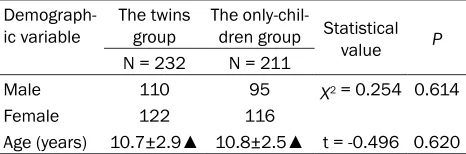
For the only-child group, the teachers were responsible for providing the parents with tionnaires and collecting the completed ques-Table 1. General demographic data
Demograph-ic variable The twins group The only-chil-dren group Statistical value P
N = 232 N = 211
Male 110 95 X2 = 0.254 0.614
Female 122 116
Age (years) 10.7±2.9▲ 10.8±2.5▲ t = -0.496 0.620 Note: ▲: M ± SD, M: Mean, SD: Standard Deviation.
Method Sample
[image:2.612.91.324.85.162.2]tionnaires. At the same time, for the twin group, we collected the twin from the same school or the same living department with the only child. Our colleagues are responsible for providing the questionnaires and collecting the complet-ed questionnaires. The parent’s questionnaire was filled in by both parents together, In cases where parents were separated, the parent who spent most time with the child was responsible for filling in the questionnaires.
Statistical method
All the data entry ACCESS database with the SDQ, data managing and analyses were carried out using SPSS16.0., the statistical descrip-tion, and Mann-Whitney Rank Sum test. Result
The age and gender for two groups
As shown in Table 1, there was no significant difference of age and gender between the two groups.
The descriptive statistics and Mann-Whitney rank sum test of all the scale for parents The SDQ is divided into 5 scales. The total dif-ficulty score is generated by adding the scores
[image:3.612.91.527.84.191.2]The hyperactivity problem is rated as being nor-mal or close to average (0-5), borderline or slightly raised (6), and abnormal or very high (7-10). The peer problem is rated as being nor-mal or close to average (0-2), borderline or slightly raised (3), and abnormal or very high (4-10). The prosocial behavior is rated as being normal or close to average (6-10), borderline or slightly low (5), and abnormal or very low (0-4). Table 2 presents data on the two groups. The proportion of “abnormal” was 11.2% for emo-tional symptoms of the twins group. The propor-tion of “abnormal” was 13.1% for conduct prob-lems, 22.4% for Hyperactivity problems and 19.2% for peer problems. The prosocial prob-lem was “borderline” in 21.5% of the twins group. And in the only-child group, the propor-tion of “abnormal” was 17.6% for emopropor-tional symptoms of the twins group. The proportion of “abnormal” was 14.2% for conduct problems, 18.1% for Hyperactivity problems and 35.3% for peer problems. The prosocial problem was “borderline” in 24.5% of the twins group. And there is 20.6% of individuals with the total dif-ficulty problems in the sample.
As shown in Table 3, the distribution of peer problems was significantly different between Table 2. The SDQ for all the scale for parents
The twins group The only-child group
1 2 3 1 2 3
Total difficulties 149 (69.6) 36 (16.8) 29 (13.6) 127 (62.3) 35 (17.2) 42 (20.6)
Emotional symptoms 167 (78) 21 (9.1) 26 (11.2) 148 (72.5) 20 (9.8) 36 (17.6)
Conduct problems 150 (70.1) 36 (16.8) 28 (13.1) 143 (70.1) 32 (15.7) 29 (14.2)
Hyperactivity problems 140 (65.4) 26 (12.1) 48 (22.4) 146 (71.6) 21 (10.3) 37 (18.1)
Peer problems 142 (66.4) 31 (14.5) 41 (19.2) 91 (44.6) 41 (20.1) 72 (35.3)
Prosocial behaviors 168 (78.5) 46 (21.5) - 154 (75.5) 50 (24.5)
[image:3.612.91.352.253.372.2]-1 = Close to average, 2 = Slightly raised or low, 3 = Very high or low.
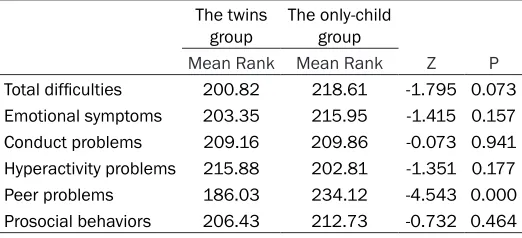
Table 3. The Mann-Whitney Rank Sum Test for two groups of all the scale of SDQ for parents
The twins
group The only-child group
Mean Rank Mean Rank Z P
Total difficulties 200.82 218.61 -1.795 0.073
Emotional symptoms 203.35 215.95 -1.415 0.157
Conduct problems 209.16 209.86 -0.073 0.941
Hyperactivity problems 215.88 202.81 -1.351 0.177
Peer problems 186.03 234.12 -4.543 0.000
Prosocial behaviors 206.43 212.73 -0.732 0.464
the two groups, but the distribution of other scales was no significantly different between the two groups.
The descriptive statistics of all the scale for self for self report
The symptoms scores in the self report are ferent from those of the parent’s. The total dif-ficulties scale is rated as being normal or close to average (0-15), borderline or slightly raised (16-19), and abnormal or very high (20-40). The Emotional symptoms scale is rated as being normal or close to average (0-5), borderline or slightly raised (6), and abnormal or very high (7-10). The conduct problems scale is rated as being normal or close to average (0-3), border-line or slightly raised (4) and abnormal or very high (5-10). The hyperactivity problem is rated as being normal or close to average (0-5), bor-derline or slightly raised (6), and abnormal or very high (7-10). The peer problems are rated as being normal or close to average (0-3), bor-derline or slightly raised (4-5), and abnormal or very high (6-10). The prosocial behavior is rated as being normal or close to average (6-10), bor-derline or slightly low (5), and abnormal or very low (0-4).
In the only-child group, the proportion of “abnor-mal” was 6.7% for emotional symptoms of the twins group. The proportion of “abnormal” was 8.5% for conduct problems, 8.5% for Hyper- activity problems and 9.1% for peer problems. The prosocial problem was “borderline” in 15.2% of the twins group. And there are 6.7% of individuals with the total difficulty problems in the sample.
As shown in Table 5, the distribution of all scales was no significantly different between the two groups.
The difference of SDQ prediction between the two groups
[image:4.612.90.527.84.191.2]As shown in Table 6, in the twins group, the pro-portion of “probable” was 0.9% for anxiety-depressive disorder, the proportion of “proba-ble” was 3.1% for conduct disorder and 1.3% for Hyperactivity disorder. At last, the propor-tion of probable was 5.3% for any disorder. In the only-child group, the proportion of “proba-ble” was 1.9% for anxiety-depressive disorder. The proportion of “probable” was 3.4% for con-duct disorder and “possible” was 13.5% for Hyperactivity disorder. At last, the proportion of Table 4. The SDQ for all the scale for Self report
The twins group The only-child group
1 2 3 1 2 3
Total difficulties 75 (76.5) 18 (18.4) 5 (5.1) 118 (72) 35 (21.3) 11 (6.7)
Emotional symptoms 89 (90.8) 3 (3.1) 6 (6.1) 145 (88.4) 8( 4.9) 11 (6.7)
Conduct problems 75 (76.5) 15 (15.3) 8 (8.2) 129 (78.7) 21 (12.8) 14 (8.5)
Hyperactivity problems 80 (81.6) 10 (10.2) 8 (8.2) 139 (84.8) 11 (6.7) 14 (8.5)
Peer problems 61 (62.2) 31 (31.6) 6 (6.1) 95 (57.9) 54 (32.9) 15 (9.1)
Prosocial behaviors 76 (77.6) 22 (22.4) - 139 (84.8) 25 (15.2)
[image:4.612.92.353.251.367.2]-1 = Close to average, 2 = Slightly raised or low, 3 = Very high or low.
Table 5. The Mann-Whitney Rank sum test for two groups of all the scale of SDQ for self-report
The twins
group The only-child group
Mean Rank Mean Rank Z P
Total difficulties 127.63 133.81 -0.831 0.406
Emotional symptoms 129.61 132.63 -0.583 0.560
Conduct problems 133.03 130.59 -0.349 0.727
Hyperactivity problems 133.80 130.13 -0.589 0.556
Peer problems 127.24 134.05 -0.810 0.418
Prosocial behaviors 137.41 127.97 -1.468 0.142
probable was 5.3% for any disorder. There was no significant difference for the proportion of “probable” by the SDQ algorithm between the two groups.
Discussion
In 1979, China began to carry out the family planning policy. Thus, one-child family ture has become one of the major family struc-ture in most of the cities in China. The particu-larity of one-child triggered research related to mental health development of the one-child. The one-child policy is not conducive to the development of mental health for child and adolescent in most study conclusion. American psychologist G. Stanley Hall was presented the point of view that “singletons was the sick” in 1907. The relevant research shows that the only-child was headstrong, self-centered. And they are unsuitable to the environment. Chinese researchers began to carry out a lot of research work on the only-child in 1980s. Most of the researches show that there was no sig-nificant difference between the only-child and the children with the multiple children in per-sonality, behavior and emotional problems [7-10]. However, one study about the related factors of the incidence of Multiple Tic disease showed that the bad influence of the family education and personality in the only-child fam-ily were more than the famfam-ily with the multiple children [11]. That whether the number of chil-dren was the factor that affects chilchil-dren’s men-tal health development was a controversial topic, so most studies are concerned with the only-child and the families with multiple chil-dren. The mental health for twin is less con-cerned. Since the family with twin as another special family structure, there are different in the characteristics of psychological develop-ment process from the general children. Studies have shown that incidence of
[image:5.612.90.523.99.182.2]behav-ioral problems of twin is lower than the only-child and the only-children with two more brother or sister [12]. This research shows that distribu-tion of individuals with the peer problems in the sample of the only-children group was more than that of the twins group, and there were sig-nificantly different between the two groups. The parents devoted much attention to the child in the only-child family, and due to the child grow in the specific environment where there were no brothers and sisters, there were no chance to establish a suitable environment for the development of social ability, we pre-sume that the children and adolescents in the only-child group were easy to encounter with the peer relationship problems. The incidence rate for the children and adolescents of emo-tional and hyperactivity behavior in twins group is lower than that in the only child group. We think it may have the following reasons, firstly, the influence of birth order and attachment relationship. The child born with the other child who had the same age and similar appearance with him or her, so there almost never produce confrontation competition and even hate that caused by birth order is different between brothers and sisters. In addition, the parents of twins are easier to make the same reaction to all the children than that parents who have the two or more children, and the twins learned to share earlier, there will not be produce the con-flicts caused by “unfair” feeling between the twins. Thus the aggressive behavior and anti social behavior that because of the fight between brother or sister get inappropriate intervention will be reduced [13]. Secondly, emotional support among the twins was better than the general siblings. Unlike the general family with multiple children, there was less competition between the twins, they are more likely to develop confidence in the safety of sib-ling, and it is good for forming the sub system in the family that can provide support within the Table 6. The detecting diagnostic groupings through the parents and self reports SDQ predictions for the two groups
The twins group (N = 228) The only-child group (N = 207) Z P
1 2 3 1 2 3
Anxiety-depressive disorders 210 (92.1) 13 (5.7) 2 (0.9) 184 (88.9) 19 (9.2) 4 (1.9) -1.452 0.146 Conduct-oppositional disorders 170 (74.6) 48 (21.1) 7 (3.1) 169 (81.6) 31 (15.0) 7 (3.4) -1.272 0.203 Hyperactivity-inattention disorders 190 (83.3) 32 (14.0) 3 (1.3) 179 (86.5) 28 (13.5) 0 (0.0) -0.781 0.435 Any psychiatric disorders 145 (63.6) 68 (29.8) 12 (5.3) 143 (69.1) 53 (25.6) 11 (5.3) -0.854 0.393
system for the twins. At the same time, there was no significant difference in the detection rate of the children with DSM-IV psychiatric dis-orders between the two groups. In conclusion, the influence of child number to mental health of children and adolescents is a superficial fac-tor; the most important factor is the parenting style and the quality of the home environment. In order to ensure the growth of child mental health, we should pay more attention to the problem for socialization of the only-child. Thus, we think that the parents should develop the peer relationship with another child and to cul-tivate independence of child in the family edu-cation for the only-child.
Acknowledgements
We would like to thank Professor Li Tao and her team, for her support and assistance during the study.
Disclosure of conflict of interest
None.
Address correspondence to: Hua-Qing Meng, De- partment of Psychiatry, The First Affiliated Hospital, Chongqing Medical University, Chongqing 400016, China. Tel: 89012865; Fax: +86-023-89012865; E-mail: [email protected]
References
[1] Guo LT, Shan YH, Zhou ZD, et al. AD Institute of Mental health. Chinese Mental Health Journal 1998; 12: 151-154.
[2] Goodman R, Ford T, Simmons H, Gatward R, Meltzer H. Using the Strengths and Difficulties Questionnaire to screen for child psychiatric disorders in a community sample. Br J Psychia-try 2000; 177: 534-539.
[3] Xiao FQ, Feng XT. The study for only-child in 30years of China: the two perspectives and the limitations of them. Academic Journal of Zhongzhou 2010; 44-52.
[4] Yang HY, Wang CJ. Application of Conners par-ent symptom questionnaire in children and adolescents. Journal of Clinical Psychiatry 2007; 17: 51-52.
[5] Goodman R. Psychometric properties of the strength and difficulties questionnaire. J Am Acad Child Adolesc Psychiatry 2001; 40: 1337-1345.
[6] Liu SJ. Reliability and validity of the Chinese version of the SDQ. The collection of theses for master of Sichuan University 2006: 6-7. [7] Ye GJ, Guo M. Is the only-child must be have
the personality or conduct disorder? Chinese Mental Health Journal 1987; 1: 35-37. [8] Wang YF, Sheng YC. The study of behavior
problems in school-age children-Epidemiologi-cal investigation report. Chinese Mental Health Journal 1989; 104-110.
[9] Su LY, Li XR, Tang XL. The study of behavior and emotional features in only-children. Chinese Mental Health Journal 1993; 7: 18-19. [10] Fallo T. Only children: a review the
stringle-child family. New York: The Guilford Press; 1984. pp. 1-20.
[11] Chen XM, Guo ML. Investigation of the correla-tion factor on the Tic. Chinese pediatrics of In-tegrated Traditional and western Medicine 2011; 10: 385-387.
[12] Jin M, Zhang L, Yang YC, et al. A survey on Be-havior Problems in Twins Aged 10-16 in Cheng-du. Chinese Journal of Evidence-Based Medi-cine 2007; 7: 561-565.