International Journal of Research (IJR)
e-ISSN: 2348-6848, p- ISSN: 2348-795X Volume 3, Issue 05, March 2016Available at http://internationaljournalofresearch.org
A Study of Effect of Accelerators on Compressive and Flexural
Strength of High Strength Concrete
Malhar Jog1; Dr. U.B. Choubey2
1
M.E. Scholar Department of Civil Engineering & Applied Mechanics, SGSITS Indore (M.P.) India,
2
Professor Department of Civil Engineering & Applied Mechanics, SGSITS Indore (M.P.) India
Email: 1 [email protected]
ABSTRACT
This paper presents an experimental study of effect of accelerators on compressive and flexural strength of high concrete. Ordinary Portland Cement (OPC) 43 grade was used to produce concrete mixtures M40 and M60. Concrete mixtures were designed as per the new guidelines of IS 10262:4009.Toal 240 specimen were made (120 cubes and 120 beams). Three accelerators Potassium Carbonate, Sodium Thiosulfate and Triethanolamine were used. Both compressive strength and flexural strength of standard specimens with accelerators have been recorded at one, three, seven, fourteen and twenty-eight days of curing with water and compared with strengths of controlled specimens at their corresponding ages. The test results revealed that the maximum percentage gain was observed for Triethanolamine accelerator out of three accelerators at 1, 3, 7, 14 and 28 days compressive and flexural strength for both M40 and M60 grade of concrete. Also there is a very little change in 28 days compressive strength with all accelerators for both M40 and M60 grade of concrete.
Keywords: Accelerator; Compressive Strength;
Flexural Strength; OPC
1. INTRODUCTION
In recent years, government and industry have been placing strong emphasis on high early-strength and high-performance concrete and on shorter construction times. In response to this
challenge, research has been focused on producing changes in the properties of the basic ingredients of concrete, such as cement, and on developing new ingredients to achieve better-quality, high early strength concrete. The rates of chemical reactions between clinker materials in cements and water, often referred to as cement hydration reactions, may be altered by adding small amounts of chemical substances to the cement-water mix. Substances affecting these rates to give an overall increase in the hydration rate, i.e. an accelerating effect, are termed accelerating admixtures or simply accelerators. Hence, an accelerator is added to concrete for the purpose of shortening setting time and/or increasing early strength development. The most commonly used accelerator is calcium chloride but when it reacts with water forms
hydrochloric acid which corrodes the
reinforcement, due to this reason non chloride accelerators were chosen and used in the present study.
Objective:
c e-ISSN: 2348-6848, p- ISSN: 2348-795X Volume 3, Issue 05, March 2016
International Journal of Research (IJR)
Available at http://internationaljournalofresearch.org
strength of concrete mixtures M40 and M60 at standard ages (1, 3,7,14 and 28 days).
Scope of the work:
An experimental comparative study on the influence of various type of accelerator on the compressive strength and flexural strengths of concrete at early and later ages, assumes greater importance to learn usefulness of non-chloride hardening accelerator in the early and later strength-gain of concrete mixtures typically for fast-track construction.
2. EXPERIMENTAL PROGRAMME
The properties of materials used in preparation of concrete is determined as per the codal provisions and described as follows:Materials
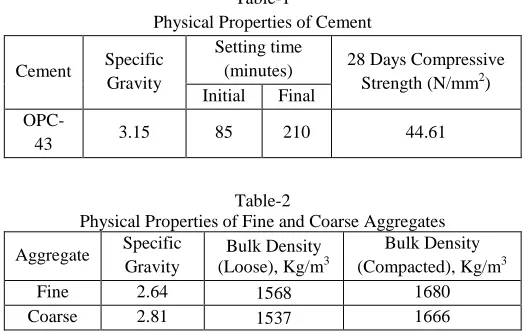
Ordinary Portland Cement Grade-43 conforming to IS 8112was used. It was tested as per Indian standard specification, whose physical properties are given in Table 1. Locally available natural sand conforms to grading zone III as per IS: 383-1970 was used as fine aggregate. Its physical properties are given in Table 2. Crushed stone with maximum 40 mm graded aggregates (nominal size) conforming to Table 2 of IS: 383- 1970 was used. Physical properties are given in Tables 2.Three accelerators Potassium Carbonate, Sodium Thiosulfate and Triethanolamine were used.
Table-1
Physical Properties of Cement
Cement Specific Gravity
Setting time
(minutes) 28 Days Compressive Strength (N/mm2) Initial Final
OPC-43 3.15 85 210 44.61
Table-2
Physical Properties of Fine and Coarse Aggregates
Aggregate Specific Gravity
Bulk Density (Loose), Kg/m3
Bulk Density (Compacted), Kg/m3 Fine 2.64 1568 1680 Coarse 2.81 1537 1666
Concrete Mix Proportioning
Concrete mixtures of grade M 40 and M 60 are designed as per new guidelines of IS 10262:4009. Table 3 shows the ingredient per cubic meter of concrete.
Table-3
Concrete Mix Proportioning
Grade Water (Liters)
Cement (Kg)
Fine Aggregate
(Kg)
Coarse Aggregate
(Kg)
M 40 140 400 726 1158
M 60 140 500 716 1191
Details of Test Specimens
Control Specimens: Total Sixty (60) specimens, Thirty (30) cubes and Thirty (30) beams have been prepared for M40 and M60 grade of concrete. Out of sixty specimens, Thirty (30) cubes specimens have been tested for compressive strength and Thirty (30) beams specimens for flexural strength without accelerators.
Specimens with Accelerators: A total of One Eighty (180) specimens, Ninety (90) cubes and Ninety (90) beams have been prepared for M40 and M60 grade of concrete using three type of accelerators. Out of One Eighty (180) specimens, Ninety (90) cubes specimens have been tested for compressive strength and Ninety (90) beams specimens for flexural strength.
Test Procedure
c e-ISSN: 2348-6848, p- ISSN: 2348-795X Volume 3, Issue 05, March 2016
International Journal of Research (IJR)
Available at http://internationaljournalofresearch.org
strength is expressed as Modulus of Rupture (MPa) and is determined by third-point loading test.
3. TEST RESULTS
Fig. 1.Percentage of Compressive Strength achieved for Mix M40 with Accelerator I, II, III
Fig. 2.Percentage of Compressive Strength achieved for Mix M60 with Accelerator I, II, III
Fig. 3.Percentage of Flexural Strength achieved for Mix M40 with Accelerator I, II, III
Fig. 4.Percentage of Flexural Strength achieved for Mix M60 with Accelerator I, II, III
Fig5. Percentage Increase in Compressive Strength of Mix M40 with Accelerator I, II, III
0 20 40 60 80 100 120
1 3 7 14 28
P
er
ce
n
tage
s
tr
en
gt
h
ac
h
ieve
d
Number of Days
Accelerator I Potassium Carbonate Accelerator II Sodium Thiosulfate
0 20 40 60 80 100 120
1 3 7 14 28
P
er
ce
n
tage
s
tr
en
gt
h
ac
h
ieve
d
Number of Days
Accelerator I Potassium Carbonate
Accelerator II Sodium Thiosulfate
0 20 40 60 80 100 120
1 3 7 14 28
P
er
ce
n
tage
s
tr
en
gt
h
ac
h
ieve
d
Number of Days
Accelerator I Potassium Carbonate Accelerator II Sodium Thiosulfate
0 20 40 60 80 100 120
1 3 7 14 28
P
er
ce
n
tage
s
tr
en
gt
h
ac
h
ieve
d
Number of Days
Accelerator I Potassium Carbonate Accelerator II Sodium Thiosulfate
0 5 10 15 20 25
1 3 7 14 28
Per
ce
n
ta
g
e
in
cr
ea
se
Number of Days
c e-ISSN: 2348-6848, p- ISSN: 2348-795X Volume 3, Issue 05, March 2016
International Journal of Research (IJR)
Available at http://internationaljournalofresearch.org
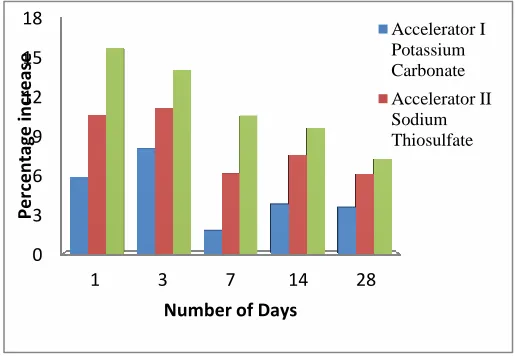
Fig 6. Percentage Increase in Compressive Strength of Mix M60 with Accelerator I, II, III
Fig 7. Percentage Increase in Flexural Strength of Mix M40 with Accelerator I, II, III
Fig 8. Percentage Increase in Flexural Strength of Mix M60 with Accelerator I, II, III
4. CONCLUSIONS
The present work investigated the effect of accelerators on compressive and flexural strength of two grades (M40 & M60) of concrete. On the basis of the results from the present study, following conclusions are drawn:
Maximum percentage gain was observed for triethanolamine accelerator out of all three accelerators at 1, 3, 7, 14 and 28 days compressive strength for both M40 and M60 grade of concrete.
There is a very little change in 28 day
compressive strength with three
accelerators for both M40 and M60 grade of concrete.
More than eighty percent of the target compressive strength was achieved at seven day of curing for M40 grade of concrete with accelerators sodium thiosulfate and triethanolamine.
More than seventy eight percent of the target compressive strength was achieved at seven day of curing for M60 grade of concrete with accelerators sodium thiosulfate and triethanolamine.
For three accelerators, percentage increase in 1 and 3 days compressive strength is more for M40 grade as compared to M60 grade of concrete.
Maximum percentage gain in compressive strength was more than twenty four percent, recorded at three days of curing with accelerator triethanolamine in M40grade of concrete.
Maximum percentage gain in compressive strength was more than seventeen percent, recorded at seven days of curing with 0
5 10 15 20
1 3 7 14 28
Per
ce
n
tage
in
cr
e
ase
Number of Days
Accelerator I Potassium Carbonate
Accelerator II Sodium Thiosulfate
0 3 6 9 12 15 18
1 3 7 14 28
Per
ce
n
tage
in
cr
e
ase
Number of Days
Accelerator I Potassium Carbonate
Accelerator II Sodium Thiosulfate
0 3 6 9 12 15 18 21 24
1 3 7 14 28
Pe
rc
en
ta
g
e
in
cr
ea
se
Number of Days
c e-ISSN: 2348-6848, p- ISSN: 2348-795X Volume 3, Issue 05, March 2016
International Journal of Research (IJR)
Available at http://internationaljournalofresearch.org
accelerator triethanolamine in M60grade of concrete.
Maximum percentage gain was observed for triethanolamine accelerator out of all accelerators at 1, 3, 7, 14 and 28 days flexural strength for both M40 and M60 grade of concrete.
There is a very little change in 1, 3, 7, 14 and 28 days flexural strength with accelerator potassium carbonate for both M40 and M60 grade of concrete.
For accelerators, sodium thiosulfate and triethanolamine percentage increase in 1, 3 and 7 days was more for M40 grade as well as M60 grade of concrete.
Maximum percentage gain in flexural strength was more than fifteen percent, recorded at one day of curing with accelerator triethanolamine in M40 grade of concrete.
Maximum percentage gain in flexural strength was more than twenty three percent, recorded at seven days of curing with accelerator triethanolaminein M60 grade of concrete.
REFERENCES
[1] Marc Jolin, Denis Beaupre, Michel Pigeon and
Ann Lamontagne “Use of Set Accelerating Admixtures in Dry-Mix Shotcrete” Journal of Materials in Civil Engineering.Vol. 9. No.4. ASCE. ISSN 0899-1561/97/0004-0180-0184.
[2] J.J. Brooks, M.A. MegatJohari, M. Mazloom
“Effect of Admixtures on the Setting Times of High-Strength Concrete” Cement & Concrete Composites 22 (4000) 293-601.
[3] Vilas V. Karjinni and Mushtaq Ahmed
Bhavikatti “Effect of Non-Chloride Hardening
Accelerator on the Compressive and Flexural Strengths at Early and Later Age of Pavement Concrete Produced with Pozzolana Cement” Internatıonal Journal of Natural and Engineering Sciences 6 (2) : 59-63 (4012), ISSN: 1607-1149, E-ISSN: 2146-0086.
[4] A. Sivakumar and V. M. Sounthararajan “The
Effect of Accelerators and Mix Constituents on the High Early Strength Concrete Properties” International Scholarly Research Network ISRN Civil Engineering
Volume 4012, Article ID 103534, 7 pages
doi:10.5402/4012/103534.
[5] A. Abdullah, M. S Jaafar, Y. H Taufiq-Yap, A.
Alhozaimy, A Al-Negheimish and J. Noorzaei “The Effect of Various Chemical Activators on Pozzolanic Reactivity: A review” Scientific Research and Essays Vol. 7(7), pp. 719-729, 23 February, 4012 Academic Journals.
[6] D. P. Bentz “Lithium, Potassium, and Sodium
Additions to Cement Pastes” Advances in Cement Research, 4006, 18, No. 1-6.
[7] V.M. Sounthararajan and A. Sivakumar “Effect
of Calcium Nitrate on the Pozzolanic Properties of High Early Strength Concrete” Research Journal of Applied Sciences, Engineering and Technology 6(13): 2502-2508 (4013), ISSN: 4040-7459; e-ISSN: 4040-7467.
[8] Mushtaq Ahmed Bhavikatti and Vilas V.
Karjinni “Combined Effect of Hardening Accelerator and Method of Curing in the Strength Development of Pavement Concrete” International Journal of Civil and Structural Engineering Volume 2, No 4, 4012.
[9] S. Aggoun, M. Cheikh-Zouaoui, N. Chikh and