High Error Tolerant Resource Allocation with High Cost
Reduction in Cloud
1
AllareddyAmulya M.Tech, 2Dorababu Sudarsa M.Tech.,Ph.D,MISTE
2
Associate Professor
1,2
Audisankara college of engineering and technology
ABSTRACT
In Cloud systems Virtual Machine technology being
increasingly grown-up, compute resources which can be
partitioned in fine granularity and allocated them on
demand. In this paper we formulate a deadline-driven
resource allocation problem based on the Cloud
environment that provides VM resource isolation
technology, and also propose an optimal solution with
polynomial time, which minimizes users payment in terms
of their expected deadlines. We auxiliary propose an
error-tolerant method to guarantee task’s completion within its
deadline. And then we validate its effectiveness over a real
VM-facilitated cluster environment under different levels
of competition. To maximize utilization and minimize total
cost of the cloud computing infrastructure and running
applications, efficient resources need to be managed
properly and virtual machines shall allocate proper host
nodes . In this work, we propose performance analysis
based resource allocation scheme for the efficient
allocation of virtual machines on the cloud infrastructure.
Our experimental results shows that our work more
efficient for scheduling and resource allocation and
improving the resource utilization.
Key words: fault torenant, resource allocation, cloud
computing, payment minimization, hashing
1. INTRODUCTION:
Cloud Computing[1] is a model for enabling convenient,
on-demand network access to a shared group of
configurable and consistent computing resources (e.g.,
networks, servers, storage, applications, services) that can
be rapidly provisioned and released with minimal consumer
management effort or service provider interaction. Cloud
computing is the delivery of computing as a service rather
than a product, whereby shared resources, software, and
information are provided to computers and other devices as
a metered service over a network (typically the Internet).
Cloud computing provides computation, software, data
access, and storage resources without requiring Cloud users
to know the location and other details of the computing
infrastructure. Cloud computing is transforming business
by offering new options for businesses to enlarge efficiency
while reducing costs. These problems include:
a. High operational costs: typically associated with
implementing and managing desktop and server
infrastructures
b. Low system utilization: often associated with
non-virtualized server workloads in enterprise environments
c. Inconsistent availability: due to the high cost of
providing hardware redundancy.
d. Poor agility: This makes it difficult for businesses to
meet evolving market demands.
The resource allocation in cloud computing is more
complex than in other distributed systems like Grid
computing platform. In a Grid system [2], it is
inappropriate to share the compute resources among the
multiple applications at the same time running atop it due
them. Whereas, cloud systems usually do not providing
physical hosts directly to users, but influence virtual
resources isolated by VM technology [3], [4], [5]. Not only
can such an elastic resource usage way adapt to user’s
specific demand, but it can also maximize resource
utilization in fine granularity and isolate the atypical
environments for safety purpose. Some successful
platforms or cloud management tools leveraging VM
resource isolation technology include Amazon EC2 [6] and
Open Nebula [7]. On the other hand, with fast development
of scientific research, users may propose to some extent
complicated demands. For example, users may want to
minimize their payments when verify their service level
such that their tasks can be finished before deadlines. Such
a deadline ensures the resource allocation with minimized
payment is rarely studied in literatures. Moreover,
unavoidable errors with an anticipate the task workloads
will definitely make the problem harder. Based on the
elastic resource usage model, we aim to design a
reallocation algorithm with high anticipate error tolerance
ability, also minimizing users’ payments subject to their
expected deadlines. Since the idle physical resources can be
arbitrarily divide and allocated to new tasks, the VM-based
divisible resource allocation could be very flexible. This
implies the feasibility of finding the optimal solution
through convex optimization strategies [8], unlike the
traditional Grid model that relies on the indivisible
resources like the number of physical cores. However, we
found that it is in avoidable to directly solve the necessary
and sufficient condition to find the optimal solution, a.k.a.,
Karush-Kuhn-Tucker (KKT) conditions [9]. Our first
contribution is devising a new approach to solve the
problem.
2. RELATED WORK:
A Static resource allocation based on peak demand is not
cost-effective because of poor resource utilization during
off-peak periods.. Resource provisioning for cloud
computing, an important issue is how resources may be
allocated to an application mix such that the service level
agreements (SLAs) of all applications are met Heuristic
algorithm that determines a resource allocation strategy
(SA or DA) that results in the smallest number of servers
required to meet the SLA of both classes; Comparative
evaluation of FCFS, head-of-the-line priority (HOL) and a
new scheduling discipline called probability dependent
priority (PDP). Scott et al[10] proposed a finding the
failure rate of a system is a crucial step in high performance
computing systems analysis. Fault tolerant mechanism,
called checkpoint restart technique, was introduced.
Incremental checkpoint model can reduce the waste time
more than it is reduced by the full checkpoint model. Singh
et al. presented a slot-based provisioning model on grids to
provide scheduling according to the availability and cost of
resources.
2.1 Cloud Environment Infrastructure Architecture:
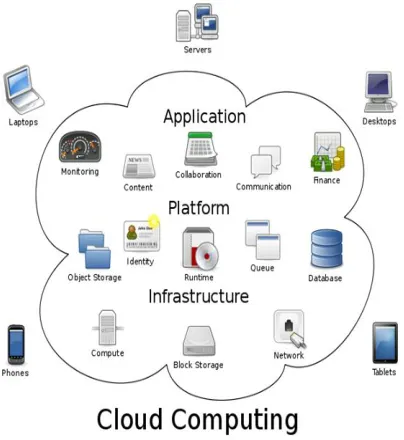
Cloud users combine virtualization, automated software,
and internet connectivity [11] to provide their services. A
basic element of the cloud environment is client, server,
and network connectivity [13]. A hybrid computing model
allows customer to leverage both public and private
computing service to create a more flexible and
cost-effective computing utility. The public cloud environment
involves Web based application, Data as a service (DaaS),
Infrastructure as a Service (IaaS), Software as a service
(SaaS), and Email as a service (EaaS). A private cloud
accesses the resources from the public cloud organization
to provide services to its customers. In a hybrid cloud
environment, an organization combines various services
and data model from various cloud environments to create
Fig 2.1: Cloud Environment Infrastructure Architecture
2.2. Infrastructure as a service (IaaS) :
Infrastructure as a service (IaaS) controls user and manage
the systems, it provides the cloud infrastructure that is the
resources available in the cloud to complete the user tasks.
However, for business IaaS takes an advantage in its
capacity. IT companies able to develop its own software
and implements, that can able to handles the ability to
re-schedule resources in an IaaS cloud. IaaS consists of a
combination of internal and external resources. IaaS is
low-level resource that runs independent of an operating system
called a hypervisor and is responsible for taking rent of
hardware resources based on pay as you go basics. This
process is known as resource gathering. Resource
gathering by the hypervisor makes virtualization possible,
and virtualization makes multiprocessing computing that
leads to an infrastructure shared by several users with
similar resources in regard to their requirements.
2.3. Task Scheduling and Resource Allocation:
To increase the flexibility, cloud allocates the resources
according to their demands. Major problems in task
scheduling environment are load balancing, scalability,
reliability, performance, and re-allocation of resources to
the computing nodes dynamically. In past days, there are
various methods and algorithms to solve the problem of
scheduling a resource in Preempt able Job in cloud
environment. In cloud environment, resources are allocated
to the customers under the basics of pay per use on
demand. Algorithms used in the allocation of the resources
in cloud computing environment differ according to
schedule of task in different environment under different
circumstances. Dynamic load balancing in cloud allocates
resource to computational node dynamically. Task
Scheduling algorithms aim at minimizing the execution of
tasks with maximizing resource usage efficiently.
Rescheduling is need only when the customer’s request the
same type of resources. Each and every task is different and
autonomous their requirement of more bandwidth, response
time, resource expenses, and memory storage also differs.
Efficient scheduling algorithms maintain load balancing of
task in efficient manner. Efficiency of cloud environment
only depends on the type of scheduling algorithm used for
task scheduling.
3. IMPLEMENTATION
In this paper we proposing Hash-based Multi-set algorithm
to maximize the utilization of the resources with minimum
cost. The Hash-based Multi-set algorithm used to
scheduling the set of tasks for the allocation of cloud
resources without error occurrence. We can obtain the high
task completion with this scheduling. Whenever a task to
be complete and that needs the cloud resources,
immediately that will store into the one of the set. The
hash-based multi-set scheduling event occurs the task set is
searched for the process closest to its deadline and is
scheduled for its execution.
In hash-based multi-set scheduling, at every scheduling
point the task having the shortest deadline is taken up for
scheduling. The basic principle of this algorithm is very
with CPU burst time less than remaining time of current
executing process. Hash-based multi-set satisfies the
condition that total processor utilization (Ui) due to the task
set is less than 1. With scheduling periodic processes that
have deadlines equal to their periods, queue set has a
utilization bound of 100%.
For example let us Consider periodic Tasks scheduled
using hash-based multi-set algorithm, the following
acceptance test shows that all deadlines will be met.
Process Execution Time=C Period=T
P1 3 8
P2 2 5
P3 1 7
Table1: Task Parameter
The utilization will be:
T=3/8+2/5+1/7=55.5%
The theoretical limit for any number of processes is 100%
and so the system is schedulable. The hash-based multi-set
algorithm chooses for execution at each instant in the time
currently active task that has the nearest deadlines. The
hash-based multi-set implementation upon uniform parallel
machines is according to the following rules [2], No
Processor is idle while there are active task waiting for
execution, when fewer then m tasks are active, they are
required to execute on the fastest processor while the
slowest are idled, and higher priority tasks are executed on
faster processors. A formal verification which guarantees
all deadlines in a real-time system would be the best. Then
this verification is called feasibility test.
Three different kinds of tests are available:- 1.Exact tests
with long execution times or simple models.
2. Fast sufficient tests which fail to accept feasible task
sets, especially those with high utilizations.
3. Approximations, which are allowing an adjustment of
performance and acceptance rate.
Task migration cost might be very high. For example, in
loosely coupled system such as cluster of workstation a
migration is performed so slowly that the overload
resulting from excessive migration may prove unacceptable
[3]. In this paper we are presenting the new approach call
the hash-based multi-set algorithm is used to reduce the
efficient time complexity.
4. Hash-based multi-set algorithm:
Let m denote the number of processing nodes(resources)
and n,(n≥m) denote the number of available tasks in a Real-Time System. Let S0,S1,S2,… Si denote the set of sets,
each set can store set of tasks which are waiting for a
specific resource type(node). In this section we are
presenting five steps of hash-based multi-set algorithm.
Here each resource maintains multiple sets, each stores
multiple tasks and its dead line and execution time values.
1. Perform a feasibility check to specify the task which
has a chance to meet their deadlines and put them into
a set and , Put the remaining tasks into next sets up to
n number of sets.
2. A set Si can store the multiple tasks with their dead
line and execution time values, which are having the
hash results is equal to i. That is a task will enter into
a particular set based on hash function results.
The hash function is: h(d)=d/10;
Where d is deadline value. Here the task which has
lower deadline is assigning to the first set, higher
deadline is assigning to the last set.
3. Sort all the tasks in the set according to their deadline
value in a non-descending order by using any sorting
algorithm.
4. Now process the task with the resource which is
meeting its deadline in their order after sorting. While
one task is running, other tasks deadline values will
5. Like wise continue the processing all the tasks which
are ready to process in all the sets from S1 , S2, …. up
to Si.
Since in this algorithm all the tasks are maintain
in a particular set, to assign to the corresponding resource
no need to search and no need to verify their deadline
every time. The tasks are ready to assign to the resource
according to their deadlines.
For example let us Consider periodic Tasks scheduled
using hash-based multi-set algorithm, the following
acceptance test shows that all deadlines will be met.
Tasks Deadline Execution Time(hours)
Resource requested
T1 5 3
Disk
T2 22 2
T3 10 5
T4 7 24
T5 2 2
CPU
T6 9 4
T7 20 7
T8 3 1
T9 7 2 Printer
T10 9 5
T11 5 4
File1
T12 14 2
T13 30 7
Table1: Tasks are waiting for resources with their deadline and execution times Parameter
Tasks Hash results Assigned set
T1 5/10=0 S0
T2 22/10=2 S2
T3 10/10=1 S1
T4 7/10=0 S0
Table1: Tasks are assigning to a specific set using Hash-based Multi Set Algorithm
Here for the resource Disk, the sets are:
S0 = {T1, T4}; S1 = {T3}; S2 = {T2};
Since deadline(T1) < deadline(T4) , these two tasks will be
in the given order only even they are sorted according to
their deadline. Now processing can be performed in the
order of T1 T4 T3 , T2 and so on. When time is reaching to
deadline during the execution of a task remaining tasks
may move from one set to another set.
Error Tolerant Method
Because the proposed Hash-based Multi-Set
algorithm providing the multi-sets to maintain the set of
tasks, it is not possible to occur the errors because of
clashes between the tasks for resource allocation. Hence the
given algorithm guarantees that no error will occur.
5. CONCLUSION:
Cloud Computing is a promising technology to support IT
organizations in developing cost, time and resource
effective products. Since, Cloud computing is a
pay-go-model, it is necessary to reduce cost at the peak hours
ignored to improve the business performance of the cloud
system. By using the Hash-based Multi-Set algorithm, the
cost will be reduced and efficient resource utilization also
possible. To have an maximized error tolerant approach
that can efficiently allocate the resources to reach the
deadline.
6. REFERENCES:
[1] Above the clouds: a Berkeley view of cloud computing
by M. Armbrust, et al
[2] Cloud computing and emerging IT platforms: vision,
hype, and reality for delivering computing as the 5th utility
by R. Buyya, C. Shin Yeo, S. Venugopal, J. Broberg, I.
[3] Amazon Elastic Compute Cloud,
http://aws.amazon.com/ec2/, 2012. D. Milojicic, I.M.
Llorente, and R.S. DB.add(Ni );
[4] Montero, “Opennebula: A Cloud Management Tool,”
IEEE Internet Computing, vol. 15, no. 2, pp. 11-14,
Mar./Apr. 2011.
[5] S. Boyd and L. Vandenberghe, Convex Optimization.
Cambridge Univ. Press, 2009.
[6] E. Imamagic, B. Radic, and D. Dobrenic, “An
Approach to Grid Scheduling by Using Condor-G
Matchmaking Mechanism,” Proc. 28th Int’l Conf.
Information Technology Interfaces, pp. 625-632, 2006.
[7] Naksinehaboon N, Paun M, Nassar R, Leangsuksun B,
Scott S (2009) High performance computing systems
with various checkpointing schemes.
[8] Ratan Mishra and Anant Jaiswal, “Ant colony
Optimization: A Solution of Load balancing in Cloud”, in:
International Journal of Web & Semantic Technology
(IJWesT-2012) Vol 3, PP 33-50 (2012). DOI:
15121/ijwest.2012.32
[9] Chandrashekhar S. Pawar and R.B.Wagh, “A review of
resource allocation policies in cloud computing”, IN:
World Journal of Science and Technology (WJST) Vol 3,
PP 165-167 (2012).
[10] K C Gouda, Radhika T V, Akshatha M, "Prio+-rity
based resource allocation model for cloud computing",
Volume 2, Issue 1, January 2013, International Journal of
Science, Engineering and Technology Research (IJSETR).
[11] W. Zhao, K.Ramamritham, and J.A.Stankovic,
“Preemptive scheduling under time and resource
constraints”, In: IEEE Transactions on Computers C-36 (8)
(1987)949–960.
[12] Alex King Yeung Cheung and Hans-Arno Jacobsen,
“Green Resource Allocation Algorithms for
Publish/Subscribe Systems”, In: the 31th IEEE
International Conference on Distributed Computing
Systems (ICDCS), 2011.
[13] Mrs.S.Selvarani1; Dr.G.Sudha Sadhasivam,
“Improved Cost - Based Algorithm For Task Scheduling In