Performance Analysis of Different Diversity
Combining Techniques with MIMO Systems
Mitesh Patel
1, Prof. Nirav Patel
2, Prof. Anurag Paliwal
3PG Student (DC), Dept. of ECE, Geetanjali Institute of Technical Studies, Udaipur, Rajasthan, India1 Assistant Professor, Dept. of EEE, Grow More Faculty of Engineering, Himatnagar, Gujarat, India2 Associate Professor, Dept. of ECE, Geetanjali Institute of Technical Studies, Udaipur, Rajasthan, India3
ABSTRACT: In wireless mobile communications, diversity techniques are widely used to reduce the effect of
multipath fading and improve the reliability of transmission without increasing the transmitted power or sacrificing the bandwidth. The diversity technique requires multiple replicas of transmitted signals at the receiver, all carrying the same information but with small correlation in fading statistics. Proper combination of various samples results in greatly reduced severity of fading, and correspondingly, improved reliability of transmission. In most wireless communication systems a number of diversity methods are used in order to get better performance.
KEYWORDS: Multiple Input Multiple Outputs, EGC, Wireless Communication, MRC, SNR.
I. INTRODUCTION
In radio, multiple-input and multiple-output, or MIMO (commonly pronounced my-moh or me-moh), is the use of multiple antennas at both the transmitter and receiver to improve communication performance. It is one of several forms of smart antenna technology. Note that the terms input and output refer to the radio channel carrying the signal, not to the devices having antennas. Pre coding is multi-stream beam forming, in the narrowest definition. In more general terms, it is considered to be all spatial processing that occurs at the transmitter. In (single-layer) beam forming, the same signal is emitted from each of the transmit antennas with appropriate phase (and sometimes gain) weighting such that the signal power is maximized at the receiver input. The benefits of beam forming are to increase the received signal gain, by making signals emitted from different antennas add up constructively, and to reduce the multipath fading effect. In the absence of scattering, beam forming results in a well defined directional pattern, but in typical cellular conventional beams are not a good analogy. When the receiver has multiple antennas, the transmit beam
forming cannot simultaneously maximize the signal level at all of the receive antennas, and pre coding with multiple streams is used. Note that pre coding requires knowledge of channel
state information (CSI) at the transmitter. Spatial multiplexing requires MIMO antenna configuration. In spatial multiplexing, a high rate signal is split into multiple lower rate streams and each stream is transmitted from a different transmit antenna in the same frequency channel.[3] If these signals arrive at the receiver antenna array with sufficiently different spatial signatures, the receiver can separate these streams into (almost) parallel channels. Spatial multiplexing is a very powerful technique for increasing channel capacity at higher signal-to-noise ratios (SNR). The maximum number of spatial streams is limited by the lesser in the number of antennas at the transmitter or receiver. Spatial multiplexing can be used with or without transmit channel knowledge. Spatial multiplexing can also be used for simultaneous transmission to multiple receivers, known as space-division multiple accesses. By scheduling receivers with different spatial signatures, good separability can be assured
II. LITERATURE SURVEY
performance of Alamouti scheme and Maximum ratio combining technique are evaluated under the assumption of BPSK signals affected by reflection, diffraction and scattering environment. It is shown that in wireless MIMO system based on Alamouti diversity technique and Maximum ratio combining technique can help to combat and mitigate against Rayleigh fading channel and approach AWGN channel performance with constant transmit power. For this reason, multi-antenna MIMO channels have recently become an attractive scheme means to increase quality of wireless communications by the use of spatial diversity at both sides of the link and occupies a considerable part. [3] In this paper, the performance investigation of EGC diversity technique is presented by comparing between co-phased and non co-phased signals in fading channels. The numerical and simulation results reveal the significant differences of performance only if the fading is not AWGN channel. Moreover, this paper presents both simulation and measurement results of using non co-phase EGC diversity technique with increased antennas on limited dimension of WLAN terminal like notebook. [10] In this paper, the diversity is used to provide the receiver with several replicas of the same signal. Diversity techniques are used to improve the performance of the radio channel without any increase in the transmitted power. As higher as the received signal replicas are de-correlated, as much as the diversity gains can be achieved. Different types of Diversity schemes have their own merits and demerits so in different environment different diversity schemes are selected. [11]
III. DIVERSITY
relationships, the symbol duration is small compared with (∆t)c. Delays between different paths can be relatively large with respect to the symbol duration. We then assume that we would receive multiple copies of the signal. [8]
IV. MODULATION TECHNIQUES
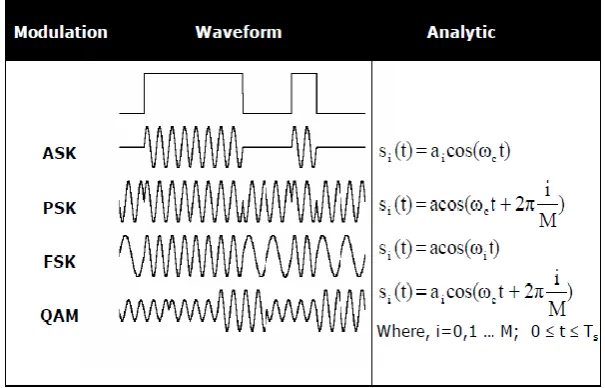
Examples of digital modulation formats: Amplitude shift keying (ASK), Phase shift keying (PSK), Frequency shift keying (FSK), and a hybrid combination of ASK and PSK sometimes called Quadrature amplitude modulation (QAM). When the receiver exploits knowledge of the carrier wave’s phase reference to detect the signals, the process is called
coherent detection; when it does not have phase reference information, the process is called no coherent. In ideal coherent detection, prototypes of the possible arriving signals are available at receiver.[6] These prototype waveforms exactly replicate the signal set in every respect, even RF phase. During detection, the receiver multiplies and integrates (correlates) the incoming signal with each of its prototype replicas. No coherent modulation refers to systems designed to operate with no knowledge of phase. As phase estimation processing is not required, system complexity is reduced. FSK modulated waves can be demodulated both coherently and non-coherently. But there cannot be no coherent PSK
because no coherent means without using phase information. However, there is a pseudo no coherent PSK technique termed differential PSK (DPSK) that utilizes RF phase information of the prior symbol as a phase reference for detecting the current symbol. Since signal propagation takes place in the atmosphere and near the ground, apart from the can be defined as propagation.
Fig 1. Different Modulation Techniques.
The effect can cause fluctuations in the received signal's amplitude, phase and angle of arrival, giving rise to terminology multipath fading. Generally, there are two fading effects in mobile communications: large-scale and small-scale fading. Large-small-scale fading represents the average signal power attenuation or path loss due to shadowing effects when moving over large areas. On the other hand, small-scale fading refers to the dramatic changes in signal amplitude and phase that can be experienced as a result of small changes (as small as a half-wavelength) in the spatial separation between a receiver and transmitter. Small-scale fading is also called Rice fading because the envelope of received signal can be represented by a Rice pdf. To understand and compare different modulation format efficiencies, it is important to understand the difference between bit rate and symbol rate. The signal bandwidth for the communications channel depends on the symbol rate or also known as band rate.
Symbol rate=Bit rate/ Number of bits transmitted per symbol
are ignored for simplicity. In GMSK, only one bit can be transmitted for each symbol. Thus, the symbol rate for this modulation technique is 80 kbps. However, high data rate like 8-PSK, as it will be reviewed in the next section, can transmit 3 bits per symbol. Thus, the symbol rate, if this modulation scheme is employed, is 26.7 kbps. The symbol rate for 8-PSK is three times smaller than that of GMSK. In other words, 8-PSK or any high order (M) modulation scheme can transmit same information over a narrower piece of RF spectrum. BER is a performance measurement that specifies the number of bit corrupted or destroyed as they are transmitted from its source to its destination. Several factors that affect BER include bandwidth, SNR, transmission speed and transmission medium. SNR is defined as the ratio of a signal power to noise power and it is normally expressed in decibel (dB). The mathematical expression of SNR is
SNR= 10log10 (SignalPower)/ Noise Power Db
V. SIMULATION RESULTS
1) Channel Capacity of MIMO:
Fig 2. Channel Capacity of MIMO
From the above graph, we can say that, as the SNR increasing the Speed of the data transmission is increase as compare to SISO. The physical antenna spacing are selected to be large; multiple wavelengths at the base station. The antenna separation at the receiver is heavily space constrained in hand sets, though advanced antenna design and algorithm techniques are under discussion. Recently, the research on multi-user MIMO technology has been emerging.
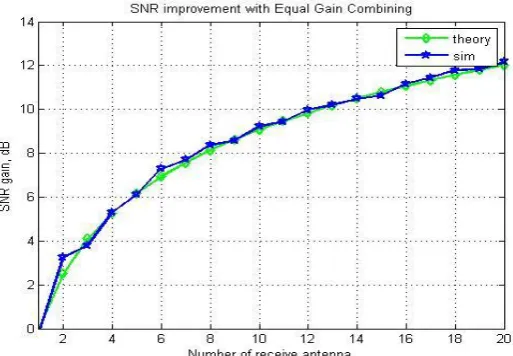
2) No. of Antenna Vs SNR for EGC:
From the above graph, we can say that, as the No of Antenna increase then the SNR is increase with Equal gain combining Technique.
3) No. of Antenna Vs SNR for MRC:
Fig 4. No. of Antenna vs. SNR for MRC.
From the above graph, we can say that, as the No of Antenna increase then the SNR is increase with Maximum ratio combining Technique as compare to Equal Gain combining.
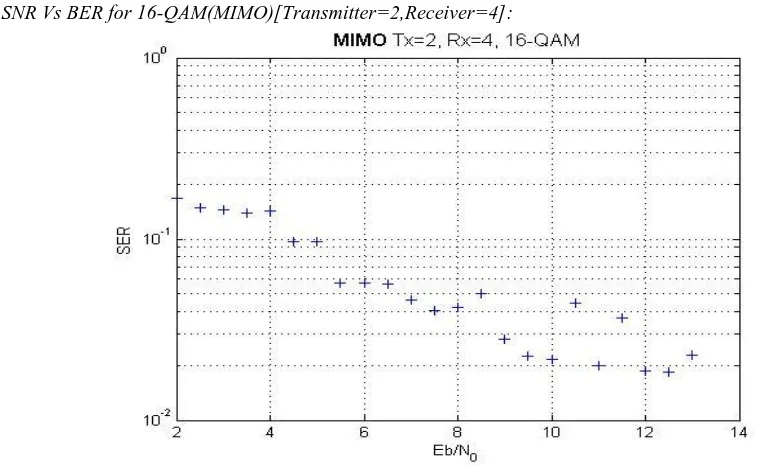
4) SNR Vs BER for 16-QAM(MIMO)[Transmitter=2,Receiver=4]:
Fig 5. SNR Vs BER for 16-QAM (MIMO)[Transmitter=2,Receiver=4]
5) SNR Vs BER for 16-QAM (MIMO) [Transmitter=8,Receiver=12]:
Fig 6. SNR Vs BER for 16-QAM (MIMO) [Transmitter=8, Receiver=12]
Here the Receiver Antenna is increase. With 16-QAM Modulation technique, SNR is increase then SER is Decrease in the case when Tx=8 & Rx=12. (MIMO).
6) SNR Vs BER for 16-QAM with Selection Combining Technique No of Antenna:
Fig 7. SNR Vs BER for 16-QAM with Selection Combining Technique No of Antenna
7) SNR Vs BER for 16-QAM with Equal Combining Technique No of Antenna:
Fig 8. SNR Vs BER for 16-QAM with Equal Combining Technique No of Antenna
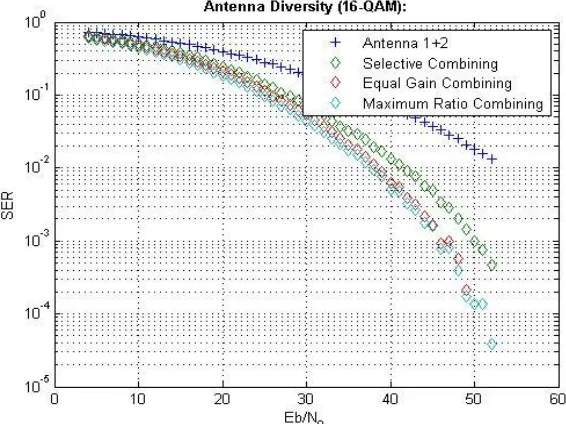
SNR Vs BER for 16-QAM with Selection Combining Technique & Equal Gain Combining with increasing No of Antenna. The SER is more decrease in the case of EGC as compare to Selection combining Technique. This makes EGC more efficient over selection combining techniques.
8) Comparison SNR Vs BER for 16-QAM with Selection Combining Technique, Equal Gain Combining & Maximum Ratio Combining:
This Graph shows the SNR Vs BER for 16-QAM with Selection Combining Technique, Equal Gain combining & Maximum Ratio Combining. Here the SER is much decrease with MRC as compare to other three techniques. There is highest SER in selective combining and if there is less number of antennas to be used.
VI. CONCLUSION
The focus was comparing the performance of the three techniques in terms of the complexity and improvement in SNR. Figure 9 plots the improvement in SNR as a function of the number of elements. As expected the best improvement is for the maximal ratio combiner, while the worst is for the selection diversity technique. Note that the improvement in the case of equal gain combining is comparable to that of maximal ratio combining. In terms of the required processing, the selection combiner is the easiest - it requires only a measurement of SNR at each element, not the phase or the amplitude, i.e., this combiner need not be coherent. Note, however, that the results presented use a coherent receiver (the phase of channel is removed after the fact). Both the maximal ratio and equal gain combiners, on the other hand, require phase information. The maximal ratio combiner requires accurate measurement of the gain too. This is clearly difficult to implement, as the dynamic range of a Rayleigh fading signal may be quite large. For this additional cost, for two elements, the MRC improves performance by about 0.6dB over the equal gain combiner at a BER of 1%. This section suggests that receiver diversity combining technique using the modulation techniques are MSK & GMSK.
REFERENCES
1. Robert W. Heath, Jr. and Arogyaswami J. Paulraj, “Switching Between Diversity and Multiplexing in MIMO Systems”, JUNE 2005.
2. Fading, Masuda Hossain, Md. Rubaiyat Hossain Mondal, “Effectiveness of Selection and Maximal Ratio Combining Diversity Techniques on
an OS-COMA Wireless Communication System”, December, 2009.
3. Muhammad Sana Ullah, Mohammed Jashim Uddin, “Performance Analysis of Wireless MIMO System by Using Alamouti’s Scheme and
Maximum Ratio Combining Technique”.
4. Matthew R. McKay, Alex J. Grant, and Iain B. Collings, “Performance Analysis of MIMO-MRC in Double-Correlated Rayleigh
Environments”, November 2005.
5. Juan M. Romero-Jerez, Juan P. Peña-Martín, Gabriel Aguilera and Andrea J. Goldsmith, “Performance of MIMO MRC Systems with
Co-Channel Interference”.
6. Severine Catreux, Member, IEEE, Larry J. Greenstein, Life Fellow, IEEE, and Vinko Erceg, Senior Member, IEEE, “Some results and insights
on the performance gains of MIMO System”, 2003.
7. Sang Wu Kim and Zhengdao Wang, “Maximum Ratio Diversity Combining Receiver Using Single Radio Frequency Chain and Single
Matched Filter”, 2007.
8. Nakagami-Fading Chan, Department of Electrical Engineering from Indian Institute of Technology, “Performance evaluation of SC-MRC and
SC-EGC driver combines system”, [1999].
9. Abhishek Sharma, Anil Garg, “BER Analysis based on Transmit & Receive Diversity Techniques in MIMO-OFDM System ”, Volume 3, Issue
1, January – March 2012.
10. Tanongsak Ngamjaroen, Peerapong Uthansakul, Monthippa Uthansakul, “Performance of Non Co-phase EGC Diversity Technique with
Multiple Antennas on Limited Space”, ECTI TRANSACTIONS ON ELECTRICAL ENG., ELECTRONICS, AND COMMUNICATIONS VOL.9, NO.1 February 2011.
11. Neelam Shrivastava, “Diversity Schemes for Wireless Communication – A Short Review”, Journal of Theoritical and Applied Information
![Fig 6. SNR Vs BER for 16-QAM (MIMO) [Transmitter=8, Receiver=12]](https://thumb-us.123doks.com/thumbv2/123dok_us/7781852.1285722/6.595.151.432.479.709/fig-snr-vs-ber-qam-mimo-transmitter-receiver.webp)