Impacts of agricultural trade and market liberalization of food security in
developing countries: comparative study of Kenya and Zambia
By
Nyairo, Newton Morara; Kola, Jukka; and Sumelius, John
Contributed Paper presented at the Joint 3
rdAfrican Association of Agricultural
Economists (AAAE) and 48
thAgricultural Economists Association of South Africa
Impacts of agricultural trade and market liberalization of food security in developing countries: comparative study of Kenya and Zambia
Newton Morara Nyairo1, Jukka Kola2 and John Sumelius3 Abstract
The introduction of agricultural reforms has debatable effects on food security in developing countries. This research investigates how such effects influenced maize supply in two developing countries which were among the first to introduce agricultural reforms. Conclusions from the research suggest that agricultural reforms led to mixed results. This may be attributed to the sometimes stop-go nature of reform implementation. The mixed results are reflected in the weak maize output response to price changes. Overall country economic conditions, state of agricultural development can be attributed to the pace of response, hence effect on agricultural supply. Elasticity of maize output to changes in price and acreage are strongly significant in maize output for the case of Kenya. Both restricted models of maize production suggest that prior to the introduction of reforms acreage, prices and alternative crops were more elastic when simulated with Zambian data than with Kenyan data.
Keywords: food security, agricultural reforms, elasticity of supply 1 Introduction
The threat of food insecurity in developing countries is a daunting policy challenge several decades after the introduction of agricultural market and economic liberalization. For Kenya and Zambia, this challenge is further compounded by diminishing agricultural productivity, unprofitable prices (poor price and cost incentives), and incoherent policies in the agricultural sector. Ironically, the agricultural sector continues to fulfil two central roles in the overall economy. First, agricultural exports constitute an essential source of foreign exchange earnings, a basis for government revenue. Second, a sizable portion of staple agricultural output is consumed domestically while the surplus exported. The critical role faced by the government in shoring the agricultural sector echoes Theodore Schultz's Nobel acceptance speech in 1979 in which he underlined the potential of agriculture, in low-income countries, to produce enough food for the then growing population and to improving the incomes and welfare of the people (Schultz, 1999).
1
Doctoral candidate Department of Economics & Management, University of Helsinki,
2
Professor of Agricultural Policy, University of Helsinki
3
The pre-reform period in Kenya and Zambia, as in many other developing countries, was rife with government intervention in the economy, and strict controls over the pricing and marketing of agricultural commodities. In the face of the control of domestic and external economic activities, serious economic imbalances began to pile up in developing country economies (Thomas, 2006). Economic growth rates were stagnating or mostly in the negative (Mohan et. al., 2000). Reforming the structural economic and political policies was deemed a recipe for correcting the economic bottlenecks and for reversing the rapid decline and economic instability characterized by weakening macroeconomic indicators (Mohan et al., 2000). The slow economic growth evident in the 1980s and the 1990s, which marked a stark contrast to the moderate rates of growth experienced in the 1960s and 1970s, was perceived to have resulted from imprudent economic management. In part, weak national economic policies and structural weaknesses also contributed to rapidly collapsing economies (Mohan et al. 2000).It is against this economic backdrop that the World Bank (WB) and the International Monetary Fund (IMF) initiated structural adjustment programs4 (SAP). The core of these policies favoured functional liberal markets and institutional reforms to strengthen them. The unfolding market era was preceded by institutional barriers to the exchange rate system, domestic interest rates and an economic system mostly relying on the state. The wide-ranging reform policy proposals were of immense interest to the agricultural sector and the economy at large. Reforming the agricultural sector was critical in the economy given the sector's contribution to gross national product (GDP). For instance, import and export sectors of inputs and outputs were subject to greater reform. Previously, governments had an upper hand in external trade through the issuance of import and export licenses. Publicly financed marketing enterprises5 participated in the procurement of inputs and the purchasing of agricultural outputs. The procurement of agricultural inputs and the marketing of tradable agricultural output managed by these publicly financed enterprises impeded free market functioning. Financing these institutions was a liability to the national treasury (exchequer). Therefore the objectives of reforms were to remove policies that impeded markets and decelerated economic progress. The core of the structural reorientation was considered
4
Structural adjustment programs were the reforms proposed by the IMF and the World Bank and upon which lending to underdeveloped economies were based upon (Mohan et al., 2000).
5
essential in the improvement of domestic and cross border marketing (Edwards, 1993; Mohan et al, 2000).
1.1 Overview of agricultural sector reforms and maize supply
Maize is the main production cereal featured. Maize is a widely consumed staple food in many households and it is a source of income for producing households. The political economy of maize production is an important one for both Kenya and Zambia. By studying maize production and its response to agricultural reforms this research study provides an understanding on staple cereal response (particularly how they influenced the cereal supply sector) and trace those effects on the state of food security through maize production trends in Kenya and Zambia. Both countries are still faced with economic and other food security challenges. In analyzing agricultural sector growth dynamics, the issues of development economics within the African context, which will innately arise, represent an important segment of the overarching theme of this research. The implementation of WB policies in the foregoing countries has led to a chorus of questions regarding the role of such reforms on the agricultural sector and staple food supply. The effectiveness of stated policy intervention in the agricultural sector and support programs financed by the World Bank and the donor community has a mixed assessment of the outcome. This study analyses existing research and literature pertaining to maize supply responses to agricultural reform policies. Despite competing views over food security in the liberalization debate, literature affirms that food supply is highly dependent on the growth in agricultural supply of the main food crops. The supply of the main cash crops such as maize and wheat is a critical factor in enabling access to cereals by households for own consumption. This research's empirical analysis seeks to test the hypothesis that the introduction of reforms weakened Kenya and Zambia's food security by the introduction of agricultural reforms through domestic production. In the section that follows, I describe the general foundation of agricultural liberalization – including the various forms of structural adjustment programs supported by the World Bank in the 1980s.
independence; the country's balance of payments was in serious deficit (Mosley, 1986). The rise in oil prices and the decline in the value of most raw commodities, representing a large portion of developing country exports, exacerbated the already worsening domestic economic conditions. Many governments were consequently pushed to the arms of the IMF, and later the WB or to other bilateral donors for loans. Kenya and Zambia, in fulfilling conditions attached to granted credits, had to devalue their currencies against other currencies and the special drawing rights6 (SDR), as well as implementing other institutional reforms.
The government’s role in dispensing public goods and services and ensuring their equitable distribution cannot be underestimated. Government entrenchment in market regulation cannot entirely be removed, but can be improved to facilitate market functioning. Agricultural market restructuring is pivotal in facilitating growth within the sector and to enhance wider economic growth. The agricultural reforms introduced sought to reduce; not entirely remove government participation in the economy as stated in the Berg report7 or subsequent WB directives, regarding institutional reforms during the 1980s. The Berg report bestowed upon the government the mandate of implementing overall reform, but it was perceived as being against government participation in reform. The policies coming down from the World Bank emphasized increased inclusion and involvement of the private sector in input and output markets. The role of the private sector was deemed important in facilitating market functioning and as a recipe of leading to better economic outcomes.
Reforms were important policy instruments in streamlining price signal barriers between producers and product markets. Output response to price signals had the potential of reversing balance-of-payments imbalances on condition of increased exports. The economic instruments embodied in reforms were integral in the reversal of the downward economic spiral accompanying the underperformance of the economies of Kenya and Zambia. The deterioration of the main economic indicators in Zambia led to unprecedented economic decline in the period from the mid-1970s to mid-1987 (Young & Loxley, 1990). The ensuing economic collapse is associated with the sharp fall in the export price of copper, the country's main export commodity. Subsequent collapse in the country’s terms of trade evidenced the dependence of a single commodity, whose terms of trade fell by more than 77 percent
6
The SDR is an international reserve currency, created by the IMF in 1969 to supplement existing reserves of member countries. The SDR are allocated to member countries in proportion to their IMF quotas.
7
between 1973 and 1984 (Young & Loxley, 1990). This rapid decline precipitated the fall in the value of 'real imports' and an increase in external debt. Young & Loxley (1990) conclude that the overvalued exchange rate turned against agriculture and domestic food producers. For the case Zambia, the fall in its exports weakened the country’s food security pillars - the possibility to import or to sufficiently produce domestically- were directly subverted.
1.2 Objectives
The study investigates the influence of market reform on food security8 through the maize sub-sector in Kenya and Zambia. The study focuses on staple food supply and its role in ensuring national self-sufficiency by concentrating on maize, commonly produced and consumed in both Kenya and Zambia. Secondarily, the study seeks to ascertain the contribution of policy influence on supply-side food security and if those influences are similar or different across countries.
Justification for the study is based on the greater emphasis on agriculture as the main sector for drawing economic livelihood for a large portion of the population in Kenya and Zambia. The link between agricultural supply, marketing, distribution and food security remain relevant overall.
The main thrust of the research seeks to highlight the impact of reforms on the agricultural commodity supply and subsequently to food security which is fortified by domestic production. In investigating these questions the following sub-elements are discussed in depth:
1. Agricultural reform implementation and resulting response from cereal production and markets in Kenya and Zambia;
2. How policies can be formulated in order to facilitate the expansion of markets in a manner that benefits both producers and consumers (rural and urban households); 3. To draw applicable conclusions regarding cereal production in Kenya and Zambia in
an effort to address regional food security challenges.
8
The hypothesis in this study suggests that agricultural market reforms exerted a negative influence on the supply of the main cereals consumed and resulted in reduced access to staple food supply. The hypothesis further asserts that by reforming the agricultural sector, access to agricultural inputs (fertilizer and hybrid seeds), important factors of production, constrained agricultural productivity.
The investigation of the foregoing hypothesis is based on price theory, upon which classical agricultural production is presumed. Price policies are considered integral in: income distribution, agricultural investment and in the allocation of farm resources. The optimizing behaviour of producers in a market system is an underlying principle in neoclassical production economics. Besides the production for own-consumption, producers would stand to gain from output price increase which, ceteris paribus, raises production factor returns.
In investigating this hypothesis, a study of maize, the main cereal consumed in eastern and southern Africa, is considered and its relation to policy reforms. The closest maize substitutes are also included in the estimated equations as explanatory variables to maize supply. Policy interpretation of agricultural market reform can be inferred from the prices of maize and its substitutes as well as through input prices. The assumption of structural change in times series equations is important in drawing conclusions whether maize output, hence available food supply, was influenced by agricultural reforms introduced during the 1980s. Agricultural supply movements and fluctuations arguably dictate producer incomes and hence food security.
The hypothesis is investigated in the following steps:
1) A theoretical framework of supply equations that represent agricultural production in general is introduced. The framework mainly considers cereal production (mainly maize production) under a developing country setting;
2) The ensuing econometric model elaborates on a dynamic cereal crop supply analysis, which consists of supply equations with lags to account for a producer’s rational expectations;
and their subsequent roles in the production process will be provided as an aid in facilitating model interpretation;
4) An econometric model is introduced and then applied to data sets from Kenya and Zambia to evaluate how the effect of selected explanatory variables influence maize output. The interpretation of the parameter estimates is crucial in drawing policy inferences. The supply trends are analyzed in relation to output and input within the agricultural sector.
The stated methodological approach provides a logical investigation of the effects on food security of agricultural market liberalization. This approach validates an investigation of the introduction of agricultural reforms and their influence on the agricultural sector, and particularly in maize production. Agricultural production, marketing and distribution of major cereals were a target of institutional reforms.
2 Theoretical Model of Cereal Production
Previous literature has investigated the role of product prices on agricultural production and land allocation. Eckstein (1984) considers an empirical model of agricultural supply based on a dynamic and stochastic framework where farmers are presumed to maximize their present supply by choice of land allocation subject to dynamic and stochastic technology as well as uncertainties triggered by price movements.
The consequences of product price movements are important and significant for a farmer's production decisions. The prices of inputs and outputs are mediated by markets, which in turn determine producer margins. Acreage often responds to corresponding input and output price movements. Eckstein (1984) has analyzed a stochastic dynamic optimization problem of a farmer endowed with land allocated between two crops. Eckstein's analysis uses a dynamic linear rational expectations modelling approach using time-series observations.
The theoretical model analyzed below is adapted from Tegene et al. (1988) and it follows the adaptive expectations hypothesis9. Eckstein (1984) has used a similar model to estimate the impact of product prices and land allocation. However, Tegene et al. (1988) consider the production of two types of crops; maize and another cash crop. The model encapsulates the Leontief (fixed proportions) technology conceptual approach by taking into account the
9
combination of land and other non-land factor inputs. Both model features are typical of the agricultural sectors of developing countries. However, the model introduced below embodies the exogeneity effect of policies on agricultural output.
Maize production is made dynamic by allowing past land allocation to affect current levels of output. The price of maize during the preceding year is assumed to influence current year's acreage and output. Conversely, future production, driven by the adaptive expectations hypothesis, relies on current producer decisions and is supported by producer rational expectations of the production conditions in the future. Production decisions between the two crops are jointly made because of the capacity constraint - available land.
To develop a production model which captures maize supply (and alternative crops), we consider the following definitions:
is the production of crop at time ;
is the producer price of crop at time ;
is the land allocated at time for the production of crop at time ;
is the total available cultivated land at time ;
is the objective discount factor equivalent
is the expectations operator, where and is the information set available for farmers at time ; and
is the lag operator defined by the property
Crop 1 represents maize and Crop 2 is wheat, while Crop 3 is tea or some other cash crop competing for land and other resources at the farmer’s disposal.
Third, agricultural policies affect the supply of the stated commodities through inputs and output prices. Producer intervention in soil conservation is maintained by careful choice of applied fertilizer and other inputs less harmful to existing soil organic matter.
In extensive agricultural production, the area of arable land is the main supply shifter. However, this type of production is subject to physical and economic constraints, such as diminishing returns and the limit of the expansion of arable land. While agricultural productivity can be improved by the application of modern production techniques, the absence of these techniques restricts the level of productivity. Applying improved agricultural technology has been considered essential in raising output through the application of intensive production techniques. Besides, other choice variables combined with the area of productive farmland, contribute decisively to raising productivity. This concept is consistent with agricultural producer theory through the variables likely to be most important in leading to optimal returns (Tomek, 1985).
A two period production cycle is assumed for the production of a staple cereal (maize) crop and a competing cash crop such that output in period t1 is sold or consumed in periodt. As a result of the fixed proportions production technology between land and non-land factors, the output of each activity can be related to the size of land utilized for that activity. This property is expressed as:
(1)
The production functions are assumed to be quadratic for corn and linear for other crops in land use during time t and both are stochastic:
1 1 2
1 1 1 1 21 1 0 1
2
t t t t t
t A d A A e A
d d X
(2)
t
tt d e A
X21 3 2 2 (3)
t
X1= output of maize in periodt; t
X2 = out of alternative crop in periodt;
t
e1= zero mean random disturbance term for maize;
t
1 1
2 At At d= dynamic trend in land utilization
The average yields per unit of maize in period t increases (decreases) when less (more) of other crops are harvested from the land during periodt1. The production parameter d2 is positive if raising maize successively from the same land decreases its average yield per acre. All the production parameters are expected to have positive signs, reflecting effects of weather and crop diseases. The random component is assumed to be proportional to the acreage allocated to that activity.
The output from the production of the stated agricultural products is either consumed and the surplus marketed for producer monetary income. The producers are assumed to obtain receipts from maize and other crop sales upon the delivery of output and incur expenses for the non-land factor inputs used in the production. The producer/farmer incurs some costs for inputs and additional cost to market his output.
Following [1] through [3] and assuming the production of crop 1 is subject to dynamic production constraints, its production can be expressed as follows
(4)
where , is a vector of other inputs applied to the land. The production function for crop 2 (wheat) is given simply by
(5)
where , ,. The representative producer is expected to maximize his expected discounted profit in terms of the price of crop 1 (maize) by choosing a contingency plan at each period for allocating his given area for the time production of crops. Therefore the producer’s objective is to maximize
(6)
Agricultural policies enter equations (4) and (5) through the variables associated with vector (input prices; fertilizers, hybrid seeds, extension services, simple production tools). Maize production in Kenya and Zambia is small scale on pieces of land, 5 hectares on average. The preference for fertilizer over other inputs in maize production is prevalent among many farmers due to its effects on yield and it relative affordability. The use of a variety of seeds for planting is a common practice. The quality of the seeds used for planting is an important yield determinant. The use of fertilizers (particularly nitrogen ones) is widely common in maize production even if its environmental side effects have not been adequately studied. Nitrogen positively affects the soil carbon level. The perceived benefit of using fertilizer does not preclude possible negative environmental effects such as emissions from the soil.
Labour, the main input in agricultural production in developing agriculture, is cheaply available in large quantities. Cheap labour is particularly essential during planting and harvesting seasons. The cost of labour to producers is minimized by the abundance of family labour which reduces the direct cost to the producers. Small scale maize farming, which dominates agricultural production in Kenya and Zambia, is characterized by low productivity. For a variety of crops, small scale farming is integrated in a market-oriented production system. This semi-subsistence maize farming provides most of the food consumed, particularly in the rural regions of these countries, where purchasing power is limited by the levels of poverty. These producers often operate on low incomes and directly consume some of their production and surplus production to the market. This preference is common in small size farms which limit the use of advanced farm technology.
Is the one period discount factor
1
1r
it
PIs the nominal price received from outputXit,i1,2, and c1 and c2 are the non-land costs of producing crop maize and other crops. Given the stated constraints above, the farmer's objective is to choose the Aitjin order to maximize output for production; both for
consumption and for sale.
0 2 1 1 1 1 1 2 1 2 2 1 1 1 2 1 1 0 2 max 0 1 t t t t t t t t t t t t t t t t A A c A P A P A A d A A d A d A c c e d E J t t
(7)The values of the stated variables are not known to farmers, but expectations about them are formed when land allocation decisions are made10. Known variables take precedence over the unknown variables whose logical relevance to the outcomes of the farmers' output is immeasurable.
The information set available to producers is broadly defined to include the past history of prices and production trends. Current and past economic variables exogenous to the producer, are among the factors which enable producer decisions to choose any given production levels. Even the past policies affecting production, and which are likely to recur in the future become influential in the determination of the types of production that a producer engages in.
3 Econometric specification of supply equations
An econometric model of cereal supply requires sufficient analysis of the commodities that are being estimated. In any form of agricultural production, farmers are assumed to have rational expectations and to make some predictions on unknown variables based upon available information set at the time of production. These predictions are represented as mathematical expectations of the exogenous variables. Qualitatively, they are captured by the farmer's production level.
... (8)
In the econometric analysis, two types of cereals are analyzed: wheat and maize (also referred to corn, in most literature). Agricultural production in developing countries affects the market formation of various commodities and their marketing. Intensive production is presumed to lead to rapid vertical expansion (greater production per unit area) than the non-intensive production. This form of production also relies on more intensive research aimed at further improvement of cultivars for yield potential and the enhancement of cultural technology. Wheat production in Kenya has undergone such intensive research aiming at producing cultivars more tolerant to soil acidity and aphids.
The random disturbance term in average annual output of maize is represented by a first-order autoregressive process,
10
e t t
t e U
e1 11 ,
1
(9)The total acreage planted to all crops (maize and other crops) is represented by a second-order autoregressive process.
,
1
,
22 2 1
1
a
t t t
t
A
A
U
A
1
2 1,
2
1 1 (10)A suggested option is to treat the area of land as fixed for allt. Farmers are often confronted by low crop yields (low productivity) due to inefficient production techniques applied on the land. In addition to these productivity constraints, agricultural policies exogenously constrain the level of maize output.
The condensed variables in equation [8] are selected based on their presumed contribution to agricultural output, particularly cereal production. The estimation of a maize supply function will rely on the economic relationship of the prescribed variables with total maize output. In effect, the extent to which the explanatory variables influence the dependent variable will be interpreted on the basis of the sign and intensity of the individual variable parameters. However, it is commonly assumed that due to the limited use of dynamic production technology in developing country agriculture, the application of intensive agricultural production techniques is not considered to be a reliable maize supply shifter. Natural or biological factors, which in most cases remain unmeasured, are aggregated to form the era term. A common example is the irregularity of droughts or similar weather-related changes on which agricultural production depends.
(11)
Productive arable land is shared between a diverse set of commodities and producers continually change the type of commodity produced based upon its economic value, its productive capacity or, in some cases, its cultural value. In general, maize production competes for existing land against tea, coffee and other staple or unstable crops. Increasing food production can be achieved by both intensive and extensive means. The intensive growth entails increasing the yield of a crop from a given area of land. Extensive agricultural production entails increasing total output by expanding the area of land. It is a practice that is preferred by agricultural producers in Kenya and Zambia, where the return to labour applied is much higher than that applied for production using intensive techniques. Given that these countries are technology deficient and have abundant labour, it is economically practical to expend the labour.
(12)
Deletion of corn production costs and the other agricultural crop, the following equation represents a function of variables that farmers might be aware of at timet. It is non-stochastic because it contains only variables in the farmers' information set.
(13)
The s represents non-linear functions of the parameters and the stochastic processes for the exogenous variables and the discount factor.
, 1 4 1 3 3 2 2 1 1 2 1 2 1 1 1 1 1 1 e t t t t t t t t t U P P A A A A A A
(14) t t tt P P T e
A
0
1 1
2 2
3 (15)a t t t
t
A
A
U
A
1 1
2 2
(16)
change. The effect of policy changes are assumed to be passed through to the land allocated to agricultural production.
The econometric model consists of the following supply estimation:
(17)
4 Econometric Results (Kenya)
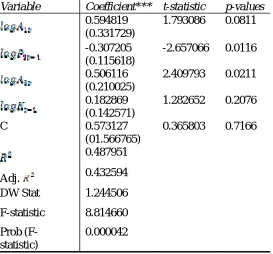
Table 1 (1963-2004)
, , ,
Variable Coefficient*** t-statistic p-values
0.594819 (0.331729)
1.793086 0.0811 -0.307205
(0.115618)
-2.657066 0.0116 0.506116
(0.210025)
2.409793 0.0211 0.182869
(0.142571)
1.282652 0.2076 C 0.573127
(01.566765)
0.365803 0.7166 0.487951
Adj. 0.432594 DW Stat 1.244506
F-statistic 8.814660 Prob
(F-statistic)
0.000042
*** Standard errors are in parenthesis
control over credit, input, marketing and price of agricultural commodities was rife during the first half of the period.
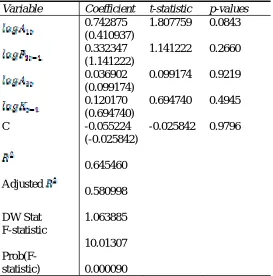
Table 2 (1963-1989)
Variable Coefficient t-statistic p-values
0.742875 (0.410937)
1.807759 0.0843 0.332347
(1.141222)
1.141222 0.2660 0.036902
(0.099174)
0.099174 0.9219 0.120170
(0.694740)
0.694740 0.4945 C -0.055224
(-0.025842)
-0.025842 0.9796
0.645460 Adjusted
0.580998 DW Stat 1.063885 F-statistic
10.01307
Prob(F-statistic) 0.000090
*** Standard errors are in parenthesis
In Table 2 as in the other tables, it is clear that acreage responds strongly to changes in maize acreage and reaffirms the pre-existing relationship between output and acreage. The acreage-output relationship is a common one in extensive agricultural production. Output elasticity with respect to tea acreage in the unrestricted model is higher than in the restricted model. This might suggested a weak link between tea acreage and maize output. The restricted model in Table 3 reflects changes in the coefficients of both the logged values of maize acreage, tea acreage and fertilizer. It is noted that price reforms affecting prices of inputs and outputs had an effect on the variables explaining maize output.
Table 3 (1990-2004)
Variable Coefficient t-statistic p-value
C -3.044101 (1.950221)
-0.486697 (0.107499)
-4.527460 0.0011 1.374406
(0.364740)
3.768180 0.0037 0.186473
(0.162949)
1.144367 0.2791 0.773469
(0.404801)
1.910740 0.0851 0.835812
Adj. 0.770137
DW Stat 2.925720
F-Stat 12.72645 Prob(F-Stat) 0.000618
The results from Table 3 capture the post liberalization period when most of the proposed reforms are assumed to have been implemented. During this period the maize sector, due to donor pressure, imports permits were discouraged and maize millers were allowed to take up to 30 percent of maize requirements from private traders (Hubbard, 2003). In the face of such liberalization developments, the elasticity of maize output relative to maize prices shows a negative sign, which might be indicative of the inconsistence of reform implementation. However, maize acreage is significantly elastic at 1.374. This might be capturing the removal of the permits that were erstwhile common for input procurement. The absence of a signal between maize output and producer prices is evident. These results are considered to be plausible statistical as observed by the which is 83.5 percent.
4.1 Test of Structural Break
It is herewith assumed that the adoption of agricultural reform policies at the beginning of the 1990s marks a structural shift in the operation of the agricultural sector and the economy. Institutional reforms that characterized the post-1990 period mark the departure from the preceding period when agriculture was marked with distortions. A relation between the two time periods; the pre- and post-reform period, is assumed. Such test is possible as long as the number of observations in each period is more than the parameters to be estimated.
some degrees of freedom. If variance estimates are close to each other their ratio will approach one. The greater the discrepancy between the variances the greater is the F-statistic/ratio. Higher values of the ratio suggest that the variance between the two variances is significant, or it implies a rejection of the null hypothesis that the difference is not significant between the variances.
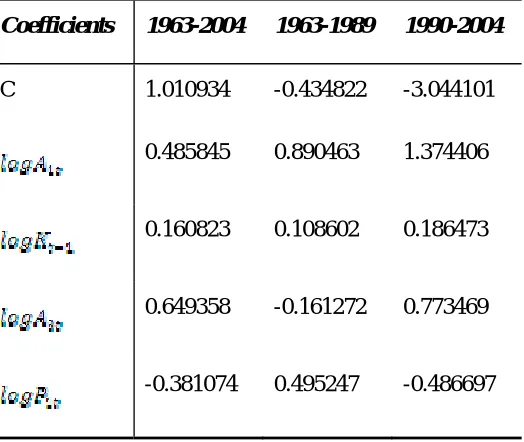
Table 4
Coefficients 1963-2004 1963-1989 1990-2004
C 1.010934 -0.434822 -3.044101
0.485845 0.890463 1.374406
0.160823 0.108602 0.186473
0.649358 -0.161272 0.773469
-0.381074 0.495247 -0.486697
From these sample results we reject the null hypothesis that the variances of the sub-samples are significantly different, or are closer to one. It is observed that the coefficients of the elasticity of supply in pre-breakpoint sample are different from those of the post-sample ones. This outcome presents a valid point of departure for drawing conclusions and making policy inferences.
Prices are important in signalling producers and they provide a benchmark for the valuation of commodities in markets. Price changes allow producers to increase or decrease their production based upon existing market conditions. Demand markets tend to behave inversely; consumers respond positively in the presence of low prices, for normal goods. In the first sub-sample, the price elasticity of maize supply may be presumed inelastic, .49. The relationship suggests a less than expected response from maize producers.
attributed to policy reforms impinging on the maize sub-sector. As discussed earlier, the effect in output of changes in acreage seems marginal in elasticity terms. However in real terms the resulting effect on the amount of maize output could be significant. What seems as marginal responsiveness can have a significant effect in available supply of maize. The production responses, even though marginal, can be a guide for policy making purposes.
In Kenya, the general prices have been below the inflation rate, but for maize price increases have often exceed the inflation rate in the 1975-1984 period (Hebinck, 1990). During the reference period, increases in producer prices have not been passed on to consumers to the full extent. Part of the shortfall was passed on to the marketing boards which in turn depended on the government support for the operational losses. In this case it is clear that the government implemented a precarious cheap food policy financed by the state budget.
5 Econometric Results (Zambia)
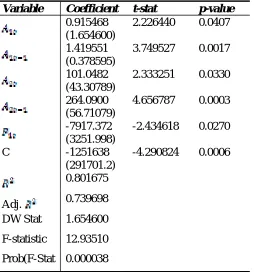
Table 5 (1966-1987)
Variable Coefficient t-stat p-value
0.915468 (1.654600)
2.226440 0.0407 1.419551
(0.378595)
3.749527 0.0017 101.0482
(43.30789)
2.333251 0.0330 264.0900
(56.71079)
4.656787 0.0003 -7917.372
(3251.998)
-2.434618 0.0270 C -1251638
(291701.2)
-4.290824 0.0006 0.801675
Adj. 0.739698
DW Stat 1.654600
F-statistic 12.93510 Prob(F-Stat 0.000038
given the inverse relationship between total output and area of productive land. Its parameter and sign in the equation remains consistent with economic theory in shifting the supply of maize output. The a priori expected signs of the parameters are meet agricultural production theory. The positive sign on acreage on the acreage parameter implied the inverse relationship between output and arable land.
As in the results from Tables 1 through Table 4 the acreage variable shows strong influence on changes in maize output. Due to lack of aggregated data on the fertilizer input, that variable is not included in the unrestricted model of maize supply in Zambia. However, the elasticity of maize output with regard to output is inelastic. For the case of Zambia, an underdeveloped agricultural sector and strong direct state control can be an explanation for this statistic.
The equation simulation indicates the importance of prices in agricultural production and points to the evidence of producer. Its interpretation suggests that prices in the preceding year serve as a guide to current year production, with profits as the main objective. A negative sign can be expected when previous prices were low and they discourage production in the next season. This does not preclude additional producer considerations within the producer’s purview.
Table 6 (1966-1987)
Variable Coefficient t-Stat p-value
0.944557 (0.150478)
6.277035 0.0000 -0.101781
(0.018704)
-5.44162 0.0000 0.150756
(0.045269)
3.330230 0.0037 C 0.556145
(1.062092)
0.523632 0.6069
F-Stat 22.73428 Pb(F-Stat) 0.000002
5.1 Measuring supply response
In Table 6 elasticity estimates are generally low, except for those of maize acreage; and appear insignificant. Acreage elasticity on maize output is significantly higher than other numerical results: , , . The effect of maize acreage on agricultural output once again underscores the sensitivity of output to the area of land. This approach is a simplification of the relationship between the explanatory variables expressed in linear form. The elasticities, which seem rather small, have the potential to have far-reaching implications in real terms. The unity cut-point for an elastic or inelastic response is crucial in revenue and demand analysis (Sobhan, 1977). Positive correlation is economically plausible in the maize supply equations; the response is at the threshold point. While the actual statistic is rather marginal in theory, the practical implications are often large. In Zambia where food security is a delicate issue, even low or threshold elasticity can be substantially significant for policy planning purposes. Even with a lower elasticity parameter, a slight change in acreage would have a significant effect on consumers of maize or its by-products for own-consumption or for markets market.
In the econometric supply specification, and according to economic theory, wheat is a competitive substitute. However, wheat production is significantly marginal when compared with the production and economic value of maize. A major portion of the wheat consumed in Zambia is not locally produced; it is imported. Previous studies suggest that this trend is similar generally in most of SSA. There exist huge differences in wheat production requirements that renders different from the other cereals produced in the region. Wheat production, which is largely a mechanized crop and whose farming needs, also requires further processing before it direct consumption takes place.
individual product in the economy and the extent of the availability of resources and alternatives, rather than the intrinsic inclinations of farmers to respond to price or market incentives.
6 Conclusions from the maize supply estimations
The maize output equation (17), which is the core estimated supply equation, has direct implications on food security due to domestic maize production’s presumed contribution to domestic consumption and incomes earned thereof. The predominance of the maize staple in rural and urban consumption is evident when compared to other cereals. Previous research on food security and agriculture has reiterated how agricultural productivity can enhance food security (Pletcher, 1986; Seshamani, 1998; Sitko, 2008; Muyatwa, 2001). These studies also imply that the proportion of aggregate population dependent directly on agriculture continues to increase. The rise in maize production, due to maize research and the commercialization of the maize variety technology, is also indicative of the importance of maize as a single staple and cash crop. Further, the decreasing or constant production value of traditional substitute cereals (millet and sorghum) suggests that the value of maize in consumer diets on average is higher and increasing. Access to production-based endowments also strengthens access to food and other livelihood available from markets for average households.
There was a strong link between tea acreage and the maize output. This is observed in the results obtained from Kenyan data. The positive correlation between the two commodities effectively tied through channelling tea production earnings. In practice, the two markets have few direct linkages. Rising cost in agricultural production, particularly in maize production, can mean that farmers with a tea plantation are well off than those who do not have. The tea market is more vertically integration and guarantees a constant source of earnings for farmers. Maize production inputs consist of: fertilizers, hybrid seeds and other tools. Income from tea acreage expansion indirectly facilitates maize productivity growth.
ensuring food self-sufficiency. The reflected long run elasticity trends for maize output are crucial in aiding policy makers to draw policy conclusions. The data sets used in the main econometric equation are all aggregated nationally, which makes any conclusions drawn to embody national food supply dynamics.
There was a strong but significant negative maize price response compared to other variables. Rather than the maize price variable coefficient being positive, it suggests a negative relationship with maize output measured in metric tons. The argument behind this relationship may be based on the end-of-season supply of output which drives down prices when demand and supply markets fail to clear. Domestic agricultural markets face institutional and infrastructural bottlenecks which undermine delivery of supply to food scarce regions in the country. In Kenya, maize production is concentrated in regions of the country with arable soils and favourable climatic conditions.
As reiterated earlier, the maize acreage variable, or the acreage variable in general, is a significantly important one in maize productivity. This is consistent with maize production which is mostly extensive crop and mostly common in many agricultural economies. Maize output elasticity with respect to acreage is positive for both Kenya and Zambia. The elasticity measure is an important indicator of the extensive nature of maize production. Even with the investment in maize research through agricultural research institutions, access to yield enhancing technology has yet to be widespread. The diversity of farming systems and the scale of production in the country cannot decisively be assumed to converge. Some generality is assumed on that regards. Derived elasticity may not be representative of each individual farmer, but only serves as a guideline for policy makers on the selection of efficient policies. The maize output response to changes in acreage suggests a strong positive correlation with maize output. On one hand, that confirms the extensive nature of maize production in Kenya. The acreage coefficient is positive in relation to maize output at an aggregate level, and in keeping with the general expectation on agricultural production in Kenya. However, this does not assume a similar trend when viewed domestically due to decreasing per capita land holdings and decreasing marginal output cased by abundant labour.
of agricultural markets by enabling producers to deliver desirable levels of output. Thin input markets can contribute to a contraction of agricultural output. Due to lack of reliable data from the reference countries, input price data is not comprehensively elaborated. The maize supply response in the foregoing equation can be interpreted both as a response of output to prices, but it can also be a response of output to the manipulation of inputs. Input access manipulation can have consequent effects on the quantities producers can apply in a given crop year. However, other important production inputs, such as technology, extension, marketing, are not well included in the study; their role is qualitatively discussed in the course of the study.
The results of the foregoing estimation suggest that wheat is a weak maize substitute for the case of Kenya. Wheat is a more intensive cereal and utilizes less labour and more machinery from planting to harvesting compared to maize, which is mostly labour intensive. Wheat productivity has not improved and its supply has remained weak in the face of a rising demand. In Sub-Saharan Africa, wheat demand has been overtaken by other coarse grains such as maize and rice, which can both be grown on much smaller scale. The production of cereals, particularly wheat is also constrained by ecological factors, so that its demand is met by other cereals. It is also noted in literature that on average the SSA region produces only about 18% of the wheat it consumes while the rest is imported (Morrison, 1984).
The coefficient signs on tea acreage suggest a complementally relationship with maize production, in the case of Kenya. As a perennial plant, the crop has a guaranteed market and income for producers. Vertical coordination in tea production, processing and marketing implies that producers would respond and adjust to market changes. Tea growing is important for small scale rural producers as well as large tea growing estates. The results suggest that farmers use income from tea and plough it to maize production. Variable costs and other overhead costs incurred in agricultural production tend to be lower due to cost sharing among the various farm activities.
7 Policy recommendations
production that at least meet their basic consumption needs. Maize is produced by rural farmers with limited incomes, or sometimes poor production techniques.
A general conclusion from this research would be that since prices are an important component both for producers and consumers, it would be imperative for policy makers to consider clearly defined price policies in consideration of the various producers. Elaborate input and output prices are necessary in order to ensure that consumers are not marginalized and producers forced out production. This applies for both input and output markets. Allowing markets to determine those prices across the board may not be socially sustainable for households. In both Kenya and Zambia, There is a need to develop a mechanism in when the ministries of agriculture prepare clear price guidelines for inputs and outputs. It is clear from the foregoing maize output estimates that output responds positively to fertilizer use. Given that consideration, it is in the best interest of agricultural sector policymakers to introduce programs that subsidize basic access to inputs.
The introduction of agricultural reforms can divert resources from food crop production to cash crop production for the case of Kenya and Zambia. Such a production shift can create dependence on food imports as the mainstay of food security and a reliance on foreign exchange as a source of financing. Global agricultural markets have shown a penchant for volatility, particularly sudden price hikes not uncommon. The recent global food price crisis is one such example of how externalities can ruin domestic markets. In response to those volatilities, creating a reliable food production base can avert externally generated production and price shocks. However, this can be further enhanced by streamlining domestic markets and ensuring that regulatory agencies are efficient. For the latter, a comprehensive overhaul of the institutional structure would engender institutions which thrive.
It may be concluded that supply response is synergistic and policy development must consider strengthening components of agricultural production and maintain a sustainable level of output. The degree of agricultural supply response in production depends on the level of agricultural development. Therefore, improvements in the infrastructural framework in both countries and the development of credit, research, education and the presence of insurance service for farmers are integral in harnessing market delivery of s would render benefits.
implementation of price reform policies without appraising underlying national food security strategies and implementation approaches is tantamount to underestimating the likely outcomes of reforms. Decision makers need to explore the implications of introducing reforms, particularly how prospective changes may affect the most food insecure.
References
Eckstein, Z. 1984, "A Rational Expectations Model of Agricultural Supply", the Journal of Political Economy, vol. 92, no. 1, pp. 1.
Edwards, S. 1993, "Openness, Trade Liberalization, and Growth in Developing Countries",
Koning, N. & Pinstrup-Andersen, P. (eds) 2007, Agricultural Trade Liberalization and the Least Developed Countries, Springer, cop, Dordrecht.
Koutsoyiannis, A. 1977, Theory of Econometrics: an Introductory Exposition of Econometric Methods, Second edition edn, The Macmillan Press, London
Mohan, G., Brown, E., Milward, B., & Zack-Williams, A. B. 2000, Structural Adjustment: Theory, Practice and Impacts, Routledge
Morisson, T. K. 1984, Cereal imports by developing countries: trends and determinants, Food Policy, vol. 9, no. 1, pp 13-26
Mosley, P. 338, "The Politics of Economic Liberalization: The USAID and the World Bank in Kenya, 1980-84", African Affairs, vol. 85, no. 338, pp. 107-119.
Muyatwa, V.P. 2001, The Liberalization and Integration of Regional Maize Markets in Zambia, National Library of Canada= Bibliothèque nationale du Canada.
Mwega, F. M., Nyangito, H. O. (ed) 2005, African imperatives in the new world trade order: Case studies on Kenya, African Economic Research Consortium (AERC) & Kenya Institute for Public Policy Research and Analysis (KIPPRA), Nairobi, Kenya.
Pletcher, J.R. 1986, "The Political Uses of Agricultural Markets in Zambia", the Journal of Modern African Studies, vol. 24, no. 4, pp. 603-617.
Schultz, T.W. 1999, "The Economics of being poor", Economic Sciences
Seshamani, V. 1998, "The impact of market liberalisation on food security in Zambia", Food Policy, vol. 23, no. 6, pp. 539-551
Sitko, N. 2008, "Maize, food insecurity, and the field of performance in southern Zambia",
Agriculture and Human Values, vol. 25, no. 1, pp. 3-11.
Tegene, A., Huffman, W.E. & Miranowski, J.A. 1988, "Dynamic Corn Supply Functions: A Model with Explicit Optimization", American Journal of Agricultural Economics, vol. 70, no. 1, pp. 103-111.
Thomas, H.C. 2006, "Trade reforms and food security: country case studies and synthesis",
Rome: Food and Agriculture Organization of the United Nations, 2006
Tomek, W.G. & Robinson, K.L. 1985, Agricultural product prices, Cornell University Press Ithaca, NY