Raspberry pi and Matlab based 3D Scanner
Sera Mathew1, Ahnas Muhammed 2, Allen Boby3, Sahid P4
Assistant Professor, Dept. of EEE, MA Engineering College, Kothamangalam, Kerala, India1
B. Tech Student, Dept. of EEE, MA Engineering College, Kothamangalam, Kerala, India2
B. Tech Student, Dept. of EEE, MA Engineering College, Kothamangalam, Kerala, India3
B. Tech Student, Dept. of EEE, MA Engineering College, Kothamangalam, Kerala, India4
ABSTRACT: A 3D scanner is a device which analyses a real world object to collect raw data on the shape and appearance of the object. Digital 3-dimensional model can be constructed by the data that has been collected.3D scanners are relatively new technologies that have many useful applications, but yet very few people own them, mostly due to the expense of the product. We will propose a way to create an economic standalone 3D scanning system, through which by the information taken by a camera and line lasers, digitized 3D models can be created. The proposed 3D scanner uses laser triangulation method for obtaining the 3D model. Raspberry pi is the main controller used. The 3D models created can be used in digital animation or printed with 3D printers for a wide variety of applications.
KEYWORDS: Laser triangulation, scanning, 3d model, Raspberry pi.
I.INTRODUCTION
used in micro technologies but are not found Secondly the other operating principle is known as laser triangulation, which mathematically relates between the directions the emitted laser beam and the direction of the detected refection which isallowed for gaining the information of the position of an object surface point. Thistechnique is applied toobjects with typical dimensions from 1 cm to 1 m and can achieve a few micrometers resolution. This technique is very well used for musiologicalartwork and to gain further details of the selected parts of the larger monuments. The overall scanning of laser beam over the complete surface of an object is obtained in different manners, associated to the dimensions of the imaged areas and the required resolutions.
II.DESIGN OF 3D SCANNER
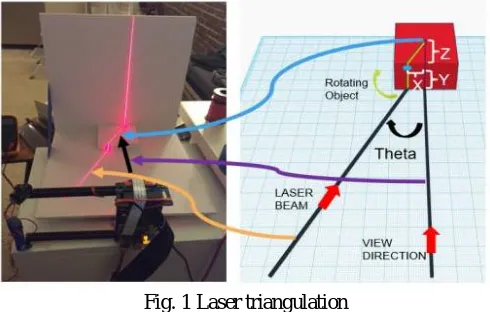
This 3D scanner uses a very simple triangulation setup using a camera and a line LASER. The LASER diode is positioned such that it creates a triangle with the view direction of the camera. As you can see from the image, the LASER line projects on the object and intersects the view direction of the camera exactly at the axis of rotation of the object.
Fig. 1 Laser triangulation
The angle at the intersection of the LASER line and the view direction(we will call it THETA) provides us with the first tool for extracting depth related information from the image captured by the camera.
III
.
PRINCIPLE OF WORKINGdepth of the surface point with respect to the axis of rotation, again with a scaling factor. As you can see, the calculations are basic trigonometrical operations. Now, let’s use this information to build our basic scanning algorithm. In order to extract 3D information of each point lying on the surface of the object, we need to first deter-mine the points at which we can extract this information. This can be achieved very easily by capturing two images once without the LASER on and once with the LASERon. Since everything else in the view of the camera remains the same, difference of the two images should give us all the points that lie on the LASER line projected on the object. By converting the difference image into a binary image, we can remove most of the extraneous information in the difference image and mark all points lying on the LASER line in white and the remaining pixels of the image as black. We can further narrow down our region of interest by making assumptions about the rectangular area that covers the entire object in the image. Now we have all the necessary components available for extracting the 3D coordinates of every point lying on the surface of the object. There is still one part that still needs to be taken care of. The points extracted from the images lie on the same image plane and are not oriented correctly in the 3D space. For this, we need to rotate each extracted 3D point by some amount about the axis of rotation. By carefully keeping track of the rotation of the object, we can easily determine the angle by which the points need to be rotated after each rotation step.
IV.EXPERIMENTAL SETUP
The figure given below shows the circuit diagram of a 3d scanner. Raspberry pi is the main controller used.
Fig. 2 Circuit diagram
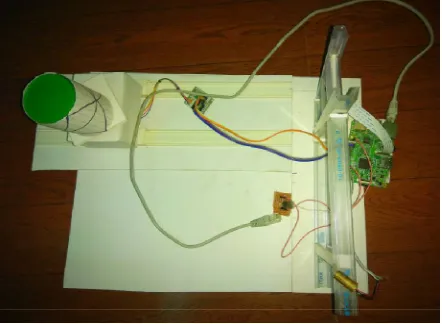
The above shown circuit diagram is implemented as shown below
As seen in the figure, the object to be scanned is kept on a turn table which is rotated by means of a stepper motor. The pi camera takes the images of the object.
The laser used is a line laser and will produce a line on the object as shown below
Fig. 4 working of 3D scanner
An image is taken with this line on the object. Then the laser is made off and another image is taken at the same position of object. Then the object is rotated and this process is repeated.
V. RESULT
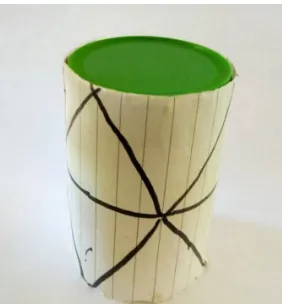
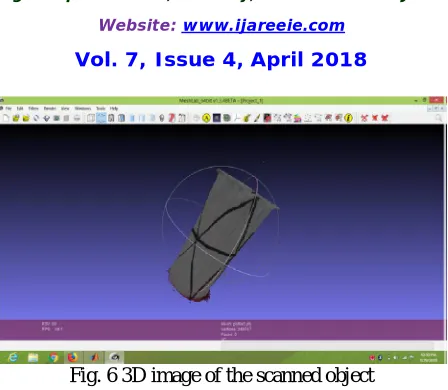
The object to be scanned is kept on the turn table. The turn table rotates and imagesof the object with laser and without laser are taken. While taking images, the points are generated by matlab and these points are added to the cloud. After rotation of 360degrees, all the pints are added to the cloud and a file is created in matlab containinginformation of the points. This file is then processed in a software named meshlab to get the 3D image of the object. In this project, a cylindrical shaped object as shown below was scanned.
Fig. 6 3D image of the scanned object
The above figure shows the 3D image of the scanned object. This figure can be rotated to see all the sides of the image.
VI.CONCLUSION
During the course of this project it was possible to develop a complete 3D scanner by pairing a camera with a laser line projected onto the object to be scanned. Afterstartup, the scan completes entirely autonomously, and after the scan has completed, the resulting file can be copied onto one or more machines to be opened in modelling software. The automatic scanning process first generates a point cloud calculated based on the laser line position in the image captured, then the point cloud is used to calculate faces and generate a solid 3D object. The scanning process takes about 45 minutes to obtain the 3D model of the object.3D scanning makes it possible to easily obtain a highly accurate 3D images of all of the existing components without having to draw them in 3D.
REFERENCES
[1] Cappelletto, E.; Zanuttigh, P.; Cortelazzo, G.M. Handheld Scanning with 3D Cameras. In Proceedings of the IEEE 15th International Workshop on Multimedia Signal Processing (MMSP), Pula, Croatia, 30 September–2 October 2013; pp. 367–372.
[2] L. Gilpin, '8 things you need to know about 3D scanners - TechRepublic', TechRepublic, 2015. [Online]. Available: http://www.techrepublic.com/article/8 -things -you -need -to - know -about -3d -scanners/. [Accessed: 08 - Dec - 2015].
[3] 3dscanco.com, 'Benefits of 3D Scanning, 3D Scanners and Reverse Engineering', 2015. [Online]. Available: http://www.3dscanco.com/about/3d -scanning/benefits.cfm . [Accessed: 08 - Dec - 2015].
[4] LIM Innovations, 'Photogrammetry: Turning photos into 3D scans - LIM Innovations', 2015. [Online]. Available: http://www.liminnovations.com/photogrammetry -photos - 3 d -scans/. [Accessed: 09 - Dec - 2015].
[5] D. Lanman and G. Taubin, "Build Your Own 3D Scanner: Optical Triangulation for Beginners", Mesh.brown.edu, 2016. [Online]. Available: http://mesh.brown.edu/byo3d/links.html. [Accessed: 20 - Nov - 2016].
[6] Pololu.com, "Pololu - A4988 Stepper Motor Driver Carrier", 2016. [Online]. Available: https://www.pololu.com/product/1182. [Accessed: 17 - Oct - 2016].
[7] Bogdanova, G.; Todorov, T.; Noev, N. Digitization and 3D scanning of historical artifacts. Digital Present. Preserv. Cultural Sci. Herit. 2013, 3, 133–138.
[8] Bindean, I.; Stoian, V. Determination of the Remaining Bearing Capacity of an Existing Slab Using 3D Scanning Technology. In Recent Advances in Civil and Mining Engineering; WSEAS Press: Athens, Greece, 2013; pp. 136–140.
[9] Ciobanu, O.; Ciobanu, G. The use of 3D scanning and rapid prototyping in medical engineering. Fiabil. Durab. 2013, 1, 241–247.
[10] Gu, F.; Xie, H. Status and development trend of 3D laser scanning technology in the mining field. Adv. Intell. Syst. Res. 2013, doi:10.2991/rsete.2013.99.
[11] Shih, J.; Lin, T. Fusion of image and laser-scanning data in a large-scale 3D virtual environment. Proc. SPIE 2013, 8881, doi:10.1117/12.2030996.
[12] Dawson, P.C.; Bertulli, M.M.; Levy, R.; Tucker, C.; Dick, L.; Cousins, P.L. Application of 3D laser scanning to the preservation of fort conger, a historic polar research base on Northern Ellesmere Island, Arctic Canada. Arctic 2013, 66, 147–158.