46 |
P a g e
An application of a voting method to the participative
management in a transboundary protected area
de Castro-Pardo Mónica
1, Pérez-Rodríguez Fernando
2, Martín Martín
José María
31
Departamento de Economía de la Empresa,Universidad Rey Juan Carlos 28032 Madrid, España
2
Fora Forest Technologies, 42004, Soria, España
3
Universidad Internacional de La Rioja, 26006, Madrid, España
ABSTRACT
This paper presents the application of a voting method based on the Bordacount to the participative management of a transboundary protected area. The method was carried out in a Spanish-Portuguese reserve in order to figure out the primary management goals while having into account the preferences of four groups of stakeholders: scientists, public authorities, farmers and local companies.The first results showthat the primary management goals in the reserve should be oriented towards the conservation (water and wildlife conservation) and towards local development (cattle raising and forestry). On the other hand, the goals related to theuse and governance should receive less attention in the management plan of the reserve.
Key words: protected areas; voting; management
I. INTRODUCTION
The land use policy in protected areas is complex due to the different excluding uses of the natural resources and
the involvement of a large number of stakeholders. Actually, in protected areas, there exist two constraints
related to the use of the resources and to the decision-making processes. The first constraint is found in the
Theory of the Tragedy of the Commons [1], that argues that humans cannot manage resources without market
valueefficentlyand thus, the total termination of the natural resources is inevitable. The second restriction is
associated with the tough regulation of the policy processes affecting protected territories. The existence of
these limits implies that, in many ocasions, the governance of protected spaces can be very complex.
In transboundary reserves, complexity increases given that there are different levels of governance and their
coordination is difficult. Conservation policies become harsher when there are administrative and political
borders in a territorry, since international political borders rarely coincide with the natural ecological boundaries
[2]. In recent times, to reduce these limitations, transboundary cooperation is being promoted as an efficient way
to preserve the natural environment of these areas[3]. Transboundary conservation has the potential to bring
about specific ecological benefit, such as ensuring the long-term persistence of viable populations of species,
securing the survival of migratory species, facilitating the reintroduction or natural recolonization of populations
of species that currently survive in isolated patches only, building greater ecological integrity and maintaining,
or strengthening ecosystem resilience with regards to climate change [4]. However, the management of this type
47 |
P a g e
diversity of stakeholders from different countries involved in the same area, each of them with interests that
conflict with one another. On the other hand, it is usual that there is, at least, onepolicy-maker for each
institution of each country with decision power in the governance in the same area.
Fortunately, by promoting the participation in the planning of protected areas,both problems might be
diminished: the aforementioned constraints and the lack of fredoom in decision-making processes. The
dimensions of good governance of protected areas are defined by seven principles: Legitimacy, Inclusiveness,
Accountability, Performance, Equity, Connectivity [5]. Lockwood (2010) noted the special relevance of two of
them: Inclusiveness and Connectivity. Inclusiveness is related to the participation of all the people with interest
in the territory, whereas Connectivity is associated with the efficient links among all management levels.
Furthermore, some studies have shown that in order to ensure the participation of every type of stakeholder
involved in a territory, it is essential to reduce conflicts and improve the management. In line with this, many
multi-criteria techniques oriented to ensure participation in the planning processes of protected areas have been
developed and applied [6].
The goal of this study is to offer the first results of the application of asimple multi-criteria analysis based on a
voting method that seeks toidentify the primary management goals considering the stakeholders’ preferences.
For this purpose, the method was carried out in a Spanish-Portuguese reserve named MesetaIbérica.
II. METHODS
Participationcan be integrated in the decision-making processes by using hard policies or soft policies. Hard
policiesgive rigour and a rigid structure to the decisional problems. Examples of these policies are the analytical
hierarchy process, linear programming or basedon-value techniques. Soft policies, which are simpler than hard
methods,allow us tosolve decisional problems that involve multiple participants [7]. The limitations of the
former are related to the inflexibility as well as to the difficulty to implement these methods with inexpert
participants, although it gives more rigour to the definition of the decisional problem [8]. On the contrary, soft
policies are not so rigorous, but their application is easier, which is why they fit well in contexts that
involvedecision makers without a deep knowledge of the problem. Moreover, the collection of data is usually
shorter and more understandable than when using hard methods.Some soft methods are frequently used in
decisional problems relative to the management of natural resources, such as workshops, popular juries or
voting methods [6].
In this study we used a voting method based on Bordacount, due to the fact thatit is a simple method difficult to
tamper with, which does not permit Condorcet losers, and verifies consistency, monotonicity as well asthe
properties of the Paretian optimum[9]. The method takes into account the voters' ranking of the candidates in
order of preference. In the case of n candidates, each voter casts n votes for their most preferred candidate, n−1
for the second preferred candidate, and finally one vote for the least preferred candidate. The candidate getting
the most votes is the winner. In the present project, the Borda method is used to elicit the participants'
preferences by ranking the criteria taken into account in descending importance order [10]. Voting methods
provide a simple tool to obtain individual preferences, however, they reveal limitations related to manipulation
and lack of rigour. The voting-Borda method is a simple technique, easy to understand by all the participants
48 |
P a g e
III. CASE STUDY
This method was carried out in a transboundary reserve named MesetaIbérica. MesetaIbéricais a protected
territory categorized as a Transboundary Biosphere Reserve that comprises two natural parks in Portugal
(Parque Natural do Montesinho and Parque Natural do Douro International), and two natural parks in Spain (Parque Natural de Lago de Sanabriay alrededores and Parque Natural de losArribes del Duero). Altogether, the territory involves 12 Portuguese municipalities and 59 Spanish municipalities. The total extension of the
Transboundary Biosphere Reserve MesetaIbérica is of 1,132,607 ha.,and a population density of 14 habitants
per km2. The region is located between the Mediterranean and Eurosiberian biogeographic regions with a
temperate oceanic sub-Mediterranean climate [11]. The landscape is representative of the northwestern Iberian
Peninsula.
In order to obtain the stakeholders’ preferences, the most representative stakeholder groups were asked for their
individual preferences (Farmers, Local companies, Public authorities and Scientists). Said preferences were
categorized into fourdifferent dimensions (Conservation, Use, Development, Governance) and 18 criteria. The
hierarchical structure is shown in figure 1. Dimensions and criteria include the most important issues to consider
in the management plan and are defined based on the management plans of the four national parks that comprise
this area.
Figure 1. Hierarchical structure of the management goals in theMesetaIbérica Reserve.
In order to find out the stakeholders’ preferences, we designed a surveybased on the issues identified, which by
means of the Borda count, allowed us to rank by order of priority the dimensionsand criteria defined in figure
1.This survey was conductedonline and through face-to-face enterviews.
IV. RESULTS AND DISCUSSION
Management Goals for Meseta Ibérica
CONSERVATION
Fauna
Flora
Atmosphere
Water
Geology
Lansdcape
Fire
USE
Education
Leisure
Tourism
Research
DEVELOPMENT
Agriculture
Cattle raising
Forestry
Hunt/Fishing
Local development
GOVERNANCE
Participation
Connectivity
Simplicity
49 |
P a g e
49 surveys were analysed using the voting method ofBordacount.As a result of this assessment, Conservation
was the most preferred dimension across the board, except for the businessmen, whoprioritise Development
before Conservation. Thus, the global rank pinpointed Conservation as the most preferred dimension, followed
by Development, Use and Governance, in this order (table 1). These results fall in line with the idea that local
communities are the most interested group in the conservation of the natural resources, given that they actually
inhabit the area. Ostrom et al. (1999) showed some cases of local communities that were capable of organizing
themselves efficiently in order to manage natural resources in a sustainable manner. Nevertheless, may only be
possible when some conditions of good governance are given.
Table 1. Weights assigned to the main goals of the planning process of the MesetaIberica and their ranking.
Weights Ranking Conservation 0.33 1
Use 0.21 3
Development 0.27 2
Governance 0.19 4
The results of the specific analysis of each of the management goals group are described in figures 2,3, 4 and 5.
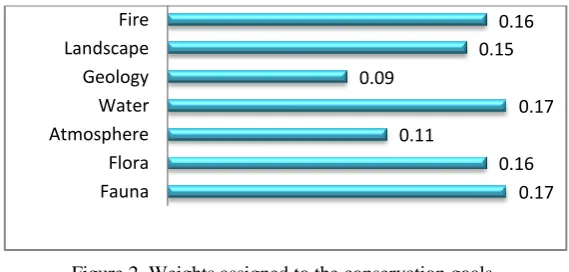
The best-assessed conservation goals were fauna and water, with a relative importance of 17% for both
objectives. Fire and flora were the second objective according to the stakeholders’ preferences. On the other
hand, geology and athmosphere were the worst assessed issues in this area (figure 2). These results show that
the wildlife conservation and the preservation of the water quality are issues of major relevance for the
stakeholders involved in the territory. Moreover, the fire (hazard?) is also a great concern. Obviously, despite
the fact that all the issues are intertwined, the planning of the reserve calls for a careful definition of the
priorities in order to guide the monetary and human resources in the right direction.
Figure 2. Weights assigned to the conservation goals.
The greatestweights within the development goals categorywere assigned to forestry and cattle raising (23%),
followed by agriculture (21%) (figure 3).
0.17 0.16 0.11
0.17 0.09
0.15 0.16
50 |
P a g e
Figure 3. Weights assigned to the development goals.
The priorities within the category of territorial use goals remarked education as the most relevant issue, with a
relative importance of 33% (figure 4). Education, tourism and research were the most valued issues. This might
be related to the local’s concern for the conservation of the landscape. Tourism turned out to be ofgreat
importance. Probably because this activity has a strong presence in the local economy.However, stakeholders
are aware of the need for the conservation of the landscape, something that is essential for the tourism
sustainability.
Figure 4. Weights assigned to the use goals.
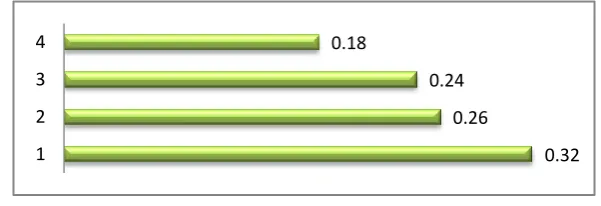
Finally, participation was the most important objective to achieve the governance goals (32%), a percentage that
shows relevant distance to the next most valued issues, i.e. connectivity (26%) (figure 5). Although the
governance issue was the worst assessed issue, stakeholders assign great importance to participation. In fact,
ensuring the complete, equitative and representative participation of all the stakeholders might be the best way
to improve the governance and lay the foundations for the efficient and sustainable management of the territory
by the locals.
Figure 5. Weights assigned to the governance goals.
V. CONCLUSION
Results showed that the most important goals for the stakeholders in theMesetaIbérica reserve were related to
the conservation and development, followed bythe conservation of fauna, water, cattle raising, forestry,
education and participation.
0.21 0.23 0.23 0.15
0.17
Agriculture Cattle Raising Forestry Hunt/Fishing Local Development
0.33 0.15
0.28 0.24
Education Leisure Tourism Research
0.32 0.26
0.24 0.18
51 |
P a g e
The case study allowed us to test the usefulness that this method haswhen identifying the priorities of the
planning process of a transboundary protected area. This analysis might improve the governance of this type of
protected areas, ensuring the efficientparticipation of all stakeholders involved with the territory. It could also
allow for the improvement of democracy in decision-making processes. The application and assessment of other
participative methods might be of interest in order to improve the planning of protected areas in specially
complex contexts.
REFERENCES
[1] Hardin, G. (1968). The tragedy of the commons. Science, 162, 1243-1248.
[2] Petursson, J. G., Vedeld, P., &Kaboggoza, J. (2011). Transboundary biodiversity management: institutions, local
stakeholders, and protected areas: a case study from Mt. Elgon, Uganda and Kenya. Society & Natural Resources,
24(12), 1304-1321.
[3] Schulte-Wülwer-Leidig, A., Gangi, L., Stötter, T., Braun, M., &Schmid-Breton, A. (2018). Transboundary
Cooperation and Sustainable Development in the Rhine Basin. In Achievements and Challenges of Integrated River
Basin Management. IntechOpen.
[4] Kutal, M., Váňa, M., Suchomel, J., Chapron, G. &López-Bao, J. V.(2016). Transboundary edge effects in the western
Carpathians: The influence of hunting on large carnivore occupancy. PloS one,11(12).
[5] Lockwood, M., (2010). Good governance for terrestrial protected areas: A framework, principles and performance
outcomes. Journal of Environmental Management, 91, 754-766.
[6] de Castro Pardo, M., &Urios, V. (2017). A critical review of multi-criteria decision making in protected areas. In
Economía Agraria y Recursos Naturales-Agricultural and ResourceEconomics, 16 (2), 89-109.
UniversitatPolitècnica de València.
[7] Feick, R., & Hall, B. (2004). A method for examining the spatial dimension of multi-criteria weight sensitivity.
International Journal of Geographical Information Science, 18(8), 815-840.
[8] Pérez-Rodríguez, F. &Rojo-Alboreca, A. (2017). The triangle assessment method: A new procedure for eliciting
expert judgement. Expert Systems with Applications, 72, 139-150.
[9] Menezes, M.B., da Silveira, G.J., Drezner, Z., (2016). Democratic elections and centralized decisions: Condorcet and
Approval Voting compared with Median and Coverage locations. European Journal of Operational Research 253(1),
195-203.
[10] Kangas, A., Kurttila, M., Hujala, T., Eyvindson, K., &Kangas, J. (2015). Voting Methods. In Decision Support for
Forest Management (pp. 233-251). Springer, Cham.
[11] Aguiar, C., & Vila-Viçosa, C. (2017). Trás-os-Montes and Beira Alta. In The Vegetation of the Iberian Peninsula
(pp. 367-394). Springer, Cham.
[12] Ostrom, E., Burguer, J., Field, C.B.,Norgaard, R.B. &Policansky, D. (1998). Revisiting the commons: Local Lessons,