ISSN(Online): 2320-9801
ISSN (Print) : 2320-9798
I
nternational
J
ournal of
I
nnovative
R
esearch in
C
omputer
and
C
ommunication
E
ngineering
(An ISO 3297: 2007 Certified Organization)
Vol. 4, Issue 3, March 2016
Effective e-governance through Cloud
Computing
Dr.Nidhi Srivastava
Assistant Professor, AIIT, Amity University, Lucknow, India
ABSTRACT: E-governance has changed the way the users interact with the government. ICT has been a key contributor in the growth and success of e-governance. But with the development of new technologies, cloud computing has come in front and is being used in e-governance. In fact, G-cloud (Governance on Cloud) is the new way of using Government services. This paper highlights the key features of the cloud computing and then gives a new architecture for e-governance based on clouds.
KEYWORDS: e-governance; cloud computing; G-Cloud; ICT;
I. INTRODUCTION
In today’s world e-governance and ICT have blended together so well that we cannot think of e-governance without ICT. ICT has revolutionized the way e-governance is being used now. Government is now delivering e-services which is proving a boon for the people. In fact we are moving towards digital India. With the usage of ICT, need for infrastructure and also storing of data of such a huge amount has become an area of concern. The data needs to be stored so that it is available to the users 24x7. Thus the latest technology of cloud computing has gained importance in e-governance. This paper has 7 sections. In this paper section II explains e-governance, Section III lists the different stakeholders of the e-governance. Section IV gives definition of cloud computing. Section V explains the three different cloud deployment models available. Section VI describes the traditional e-governance architecture used. Section VII highlights the new e-governance architecture over cloud and its benefits and lastly Section VIII gives the conclusion.
II. E-GOVERNANCE
The use of Information and Communication Technology in governance has led to the concept of e-governance.e-governance has facilitated in the fast delivery of government services to different stakeholders. In fact it has become the need of the hour. E-governance is a move towards the SMART government. A government that is simple, moral, accountable, responsive and transparent. [1]
According to the World Bank:
“E-Government refers to the use by government agencies of information technologies (such as Wide Area Networks, the Internet, and mobile computing) that have the ability to transform relations with citizens, businesses, and other arms of government. These technologies can serve a variety of different ends: better delivery of government services to citizens, improved interactions with business and industry, citizen empowerment through access to information, or more efficient government management. The resulting benefits can be less corruption, increased transparency, greater convenience, revenue growth, and/or cost reductions.”
United Nations (AOEMA Report)
ISSN(Online): 2320-9801
ISSN (Print) : 2320-9798
I
nternational
J
ournal of
I
nnovative
R
esearch in
C
omputer
and
C
ommunication
E
ngineering
(An ISO 3297: 2007 Certified Organization)
Vol. 4, Issue 3, March 2016
III.STAKEHOLDERS OF E-GOVERNANCE
E-governance is beneficial in that it makes the governance easy, convenient, efficient, transparent and accountable. E-governance eases the flow of information among different stakeholders as shown in Fig. 1. It includes following interaction:
A. Government to Citizen- Various services have been provided by the government for the citizens like online
payment of electricity bill, water tax, house tax, etc. Also, birth certificates or death certificates can be applied for online instead of queuing in the office. Also citizens can lodge complaint online. Thus at just a mouse click the work can be completed. In 1976, National Informatics Centre (NIC) was established. NICNET, is the ICT network of NIC which links all the ministries and departments of the Central Government, state government and union territories, districts and blocks. [2]
B. Government to Government- Government shares data amongst different departments. Intra departmental
information should be available online so that there is a prompt communication between the two departments. The information should easily flow horizontally among the departments and also vertically within the departments. This will help in reduction of paperwork and will also help in good and timely planning of new schemes or policies for the benefit of people. [3]
Fig1: Different stakeholders of e-governance
C. Government to Business –This deal with the services offered by the Government to encourage the business. This
includes in it the services given by the Government like e-procurement, e-payment of all bills, tax collection, information about tenders, auctions, patents etc. Also, rules and regulations are shared online for all which increases transparency and reduces corruption. [4]
D. Government to Employee –It is easy for the Government to keep a track of their employees through this online
system. Employee’s personal details, their leaves and their attendance can be electronically maintained. Further, e-learning programs and online training programs can be arranged for the benefit of the employees. [5]
IV.CLOUD COMPUTING
According to National Institute of Standards and Technology, USA (NIST):
“Cloud computing is a model for enabling ubiquitous, convenient, on demand network access to a shared pool of configurable computing resources (e.g., networks, servers, storage, applications, and services) that can be rapidly provisioned and released with minimal management effort or service provider interaction.”
With the huge amount of data to be maintained by the government, cloud computing seems to be a good and viable option. In fact cloud computing plays an important role in efficiently and effectively managing e-governance.
Before the advent of the cloud computing, the organization either owned the IT services or used an outsourced dedicated IT services. But now, by using cloud computing, on demand, scalable IT services can be availed. [6]
According to Vikram Kumar Mallavarapu, Vice President – Sales, Public Sector, Cisco India & SAARC:
“Cloud computing can contribute in a variety of ways to deliver citizen services efficiently and enable IT resources to be provided on demand, at scale in a multi-tenant, yet secured environment.” [6]
There are different types of clouds available for the government to choose from:
Government Government
Citizen Business
ISSN(Online): 2320-9801
ISSN (Print) : 2320-9798
I
nternational
J
ournal of
I
nnovative
R
esearch in
C
omputer
and
C
ommunication
E
ngineering
(An ISO 3297: 2007 Certified Organization)
Vol. 4, Issue 3, March 2016
A. Private Cloud: Also known as corporate / Internal cloud. It is exclusively used by any one organization with
many consumers. It can be maintained by the organization itself or by any external agency. [7]
B. Public Cloud: As the name suggests it is public to all. Any individual, organization or institution can use it.
Enough security is provided so that the data of each and every one is safeguarded from breach.[8,9]
C. Hybrid Cloud: It takes up the good features of both the public and the private cloud. Thus, it is a combination of
these clouds. Depending on the requirements of the organization the data and services are used of public cloud or private cloud.[7,8]
As far as e-governance is concerned the data with the government is highly confidential and valuable and so a private cloud dedicated solely for the use of government is a good idea.
V. CLOUD DELIVERY MODEL
A. IAAS – In Infrastructure as a service model the responsibility of the storage, network and server lies with the provider whereas the consumer can only control the database, application and operating system. Thus, the consumer does not have much control over the services given by the provider. [10]
B. PAAS – In Platform as a service model there are already deployed and configured IT resources which are available over Internet. The tools provided can be used by the developers to develop their own services and applications. The customers of the cloud can use the features available as per their need. That is only the services they require they can avail off and rest they can leave. Thus the user keeps the application with him and rest all the infrastructure like OS, server, database, network, storage etc. are on the cloud. [11]
C. SAAS – In this the provider manages all the resources and the consumer only uses it as per their need. It is very cost effective, especially as the licensed software are very expensive, the consumer can use the application provided on the cloud by the service provider. [9, 10, 11]
VI.TRADITIONAL E-GOVERNANCE ARCHITECTURE
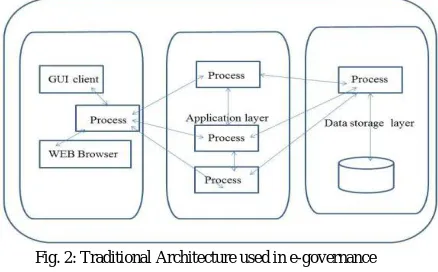
The traditional system of keeping and accessing the data in e-governance is three-tier architecture. In the traditional system we have three layers as shown in fig. 2-
A.Presentation Layer- It is the layer through which the different users of the e-governance interacts with the system.
The user is provided with a GUI interface, through which they interact and get the information they need.
B. Application Layer- It is the layer which facilitates the interaction between the presentation and the database layer.
C.Database Layer- This layer stores all the data. It is from here that the data is retrieved and passed over to the
presentation layer to display to the user.[12]
Fig. 2: Traditional Architecture used in e-governance
VII. PROPOSED ARCHITECTURE OF E-GOVERNANCE BASED ON CLOUD
ISSN(Online): 2320-9801
ISSN (Print) : 2320-9798
I
nternational
J
ournal of
I
nnovative
R
esearch in
C
omputer
and
C
ommunication
E
ngineering
(An ISO 3297: 2007 Certified Organization)
Vol. 4, Issue 3, March 2016
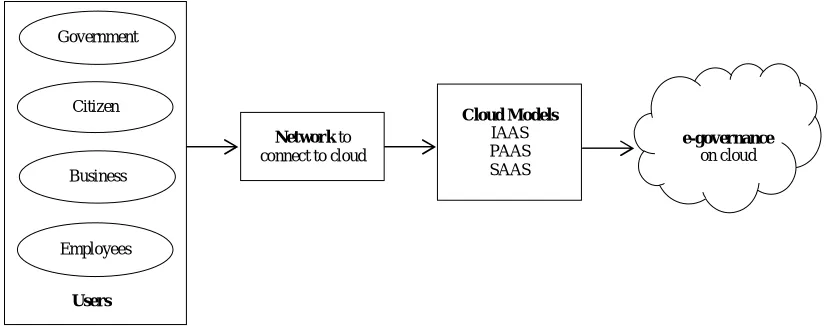
A. Users - In this the different users or the stakeholders like citizens, business, employees and other government
departments use the service for various purposes. Users can download the various documents and can fill online forms like passport, birth certificate etc. Also, they can make online payments for water tax, electricity, etc.
B. Network – Each of the user use their own network be it LAN or WAN to connect to the Internet so as to use the
e-governance applications available on the cloud.
Fig. 3: Proposed e-governance Architecture on cloud
C. Cloud Model – Here out of the three service models IAAS, PAAS and SAAS, the government can choose any
one. It is at the sole discretion of the Government to choose from any of these models. Mainly, if the Government does not want to invest into any infrastructure and application then SAAS is a good idea as the services can be started in a very short span of time. IAAS is a good choice where infrastructure is used as a service and so the Government uses the network, storage and server services available on the cloud. The advantage is that the services are available 24X7X365. In PAAS OS, virtualized servers and middleware are given by the provider. The Government need not worry about the underlying infrastructure services and they run the data and applications on it. [13,14]
D. E-governance on cloud – This is the place where all the dataset is stored and retrieved from. All the dataset
required by any of the user is stored here. Some of the datasets required by users are as follows. It contains all the details of list of voters for e-voting, all judicial cases which have been held or are to be held in the courts are available online for reference. Tax returns can be filed online. All the information for the benefit of the farmers is present. Also the user can fill all the forms online, etc.
The benefit of using cloud computing is scalability, elasticity, pay-as-you-go service, software standardization, etc.
VIII. CONCLUSION
E-governance has changed the way of interaction between the government and its users. In the earlier phase of implementing e-governance using the traditional model was a good idea. But now, with the change in the technology and with the advent of cloud computing and its advantage, it is definitely a better idea. Cloud computing for e-governance is more effective and efficient as compared to the traditional architecture. But there are certain challenges which the government has to deal with like the security of the data on the cloud
REFERENCES
1. CSR Prabhu, ‘E-Governance: Concepts and Case Studies’, New Delhi, PHI Learning Private Limited 2004. 2. http://www.nic.in/about-us.
3. IIIT Hyderabad, ‘Cloud Computing for E-Governance - A white paper’, January 2010.
4. Nikita Yadav, V. B. Singh , ‘E-Governance: Past, Present and Future in India’, IJCA, Volume 53, No.7, September 2012.
5. V.B.Ganapathy,Dr.V.Kiran Kumar,‘E-Government: Concepts and Applications’, IPASJ International Journal of Computer Science (IIJCS),Volume 2, Issue 8, August 2014.
Network to connect to cloud
Cloud Models IAAS PAAS SAAS
e-governance on cloud Government
Citizen
Business
Employees
ISSN(Online): 2320-9801
ISSN (Print) : 2320-9798
I
nternational
J
ournal of
I
nnovative
R
esearch in
C
omputer
and
C
ommunication
E
ngineering
(An ISO 3297: 2007 Certified Organization)
Vol. 4, Issue 3, March 2016
6. ‘Cisco Cloud Computing - Data Center Strategy, Architecture, and Solutions- A white paper’, 2008
http://www.cisco.com/web/IN/about/network/governance.html
7. Meher N. K., Lokhande S.P. , ‘Cloud Computing :An Architecture, its Security Issues & Attacks’ IJARCET , Vol. 2, No. 3, pp. 884-890, March 2013.
8. Olekar G., Sreekumar V., ‘Cloud Computing: Migration from Traditional Systems to the Cloud’, IJARCET, Vol. 2, No. 3, pp. 1128-1131, March 2013.
9. ‘Cloud: Powered by the Network, What a Business Leader Must Know’, CISCO, 2010www.cisco.com/web/strategy/docs/gov/cloud_wp_c11_609220.pdf
10. Mishra N., Khushwha K., Chasta R., Choudhary,‘Technologies of Cloud Computing - Architecture Concepts based on Security and its Challenges’, IJARCET, Vol. 2, No. 3, pp. 1143-1149,March 2013.
11. NidhiSrivastava, Rajiv Pandey, ‘Educational Institution Intranet Zone: Scalability to Cloud’, IJCA, Vol. 133, No. 5, January 2016. 12. Manoj Kumar, Manish Shukla, SonaliAgarwal, ‘An e-governance model using cloud computing technology for Developing Countries’,
January 2013 (https://www.researchgate.net/publication/262105425).
13. M.K.Sharma, M.P. Thapliyal,‘G-cloud (e-Governance in cloud)’Int J EnggTechsci, Vol 2, Issue , pp.134-137, 2011
14. VikramJeet Singh, AshwaniChandel, ‘Evolving E-Governance through Cloud- Computing based environment’, IJARCCE, Vol. 3, Issue 4, April 2014.
BIOGRAPHY