Designing and Implementation of a Highly
Efficient Object Tracking System Using
Modified Mean Shift Tracking
Vani Biradar G
M. Tech student, Dept of CSE, UBDT College of Engineering, Davanagere, Karnataka, India
ABSTRACT: By studying the moment characteristics of the weight image of the “Bhattacharyya” coefficients and target candidate area as well as we improved an orientation and scale adaptive mean shift tracking (MMST) algorithm. It is capable of resolve the difficulty of how to estimate vigorously the orientation and scale changes of the target under the mean shift tracking framework. Here a new strategy is proposed to improve the tracking ability of mean shift alogorithm, in which the contrast between object and background along with similarity evaluation are applied for generating and updating object model. To eliminate the interference of the most similar features between tracking object and background, the coefficient ratio of the object to surrounding environment is first imported to generate the object model.To make sure the accuracy of updating object model, the effective way that combines similarity evaluation and Kalman filtering prediction is then applied for judge whether the tracking object is sheltered by other objects or background. The experimental results have shown that the proposed method can track the moving object stably.
KEYWORDS: mean- shift, object tracking, Bhattacharyya-coefficient, kalman filtering, object model
I. INTRODUCTION
Video can be captured is becomingly easily. Machine is recognized the atomsphere which is exists already, In video testing algorithms the some improved testing algorithms can be accelerated and with microelectronics. At present, numerous chance to have opened for the improvement of more affluent uses in different fields such as personal communications, video surveillance, natural human–machine interface and robotics,content creation. Most essential characteristics of machines is to observe, recognize and respond to the environment is ability to check their and object can be track of interest. Object tracking is nothing but estimating the area of one or more objects can be tracked usinng a cameraa in time.
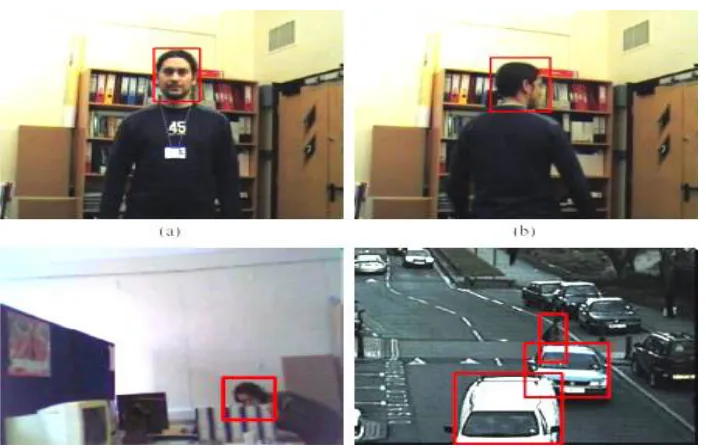
The rapid improvement both in quality, the dramatic increase in computational power with resolution of imaginng sensors initially have favoured applications and invention new algorithms using object tracking.here object of a particular part of a dependent on a the specified object in the video sequence. In above figure1 it can be observed that the interests sometimes contingent on to track persons or sometimes depends on the tracking of faces. The tracking of the object faith on the resolution of the camera which is it depends on the pixels. As amount of pixels gets high the more appropriate tracking can be done. The resolution of the video cameras is quiet important. Usually the illumination change affects the tracking of the object.
ISSN(Online): 2320-9801
ISSN (Print) : 2320-9798
I
nternational
J
ournal of
I
nnovative
R
esearch in
C
omputer
and
C
ommunication
E
ngineering
(An ISO 3297: 2007 Certified Organization)
Vol. 4, Issue 6, June 2016
Fig. 1: showes particular appearence that make object tracking difficult. (a)– (b) A reference point to shoot at head changes its pose then its appeared. next: 2 examples are target of occlusions. (c) refenced /refered is hide by still things in the scene. (d) The particular shoot the object is occludeed by another moving substances in picture.
II. RELATED WORK
Comaniciu et. al., was introduced Vision based tracking, it was a demanding engineering difficulty is emerging fields in machine vision. At that instance central core based tracking for non-rigid object tracking throughout the series of images by “Bhattacharya”. In Comaniciu they have offered a vigorous and proficient tracking method for targets have outsized motion as distinguished to their degree of sizes. Their tracking method was depends on calculate the Gaussian pyramids of the images and subsequently apply to it at every pyramid intensity for track the target. based of model tracking frequently suffer rapid change in reference model, which is rewarded by the model update of target. This lead to a extremely proficient arid vigorous nonparametric tracking algorithm the new method was simply capable to track the quick dynamic targets and is mostly robust and surroundings independent as comprised to unique central core based object tracking.
Quast K., Kaup a , they had established a method for object tracking having base on the mean shift technique. As an alternative having symmetry kernel similar in traditional mean shift tracking and also developed tracking algorithm uses an having differ kernel that is derived from an object cover. For the duration of the mean shift steps to solving not just the new object location was situated, however the kernel level is changed followed by object level, provides an primary adaptation of the object outline. The ultimate kernel shape was then getting through partitioning the region within and in the order of the modified kernel and distinctive the object segments from the non-object segments. Therefore, the object shape was tracked extremely well still if the object is doing exposed of uniform rotation
III. METHODOLOGY
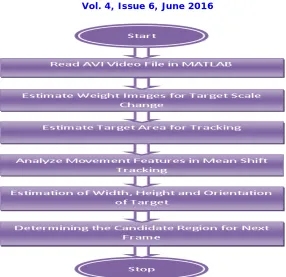
Figure 3.1: Project Methodology
3.1Implementation of the MSOMST Algorithm
The discussion above made regarding mean shift, the direction and scale of the target can be examines and then MSOMST algorithm, can be derived. The algorithm steps are given below.
1) Initially compute model of target ^ and determine location 0y0 in the previous frame from candidate model of target.
2) Let k ←0 is number of iteration.
3) In the present frame, compute candidate model of target ^( ). 4) compute { } ⋯ i.e, vector weight.
5) Using some equations, compute candidate model of target for location y1.
6) Allow d ← || y1-y0 ||, y0 ← y1.Setting maximum Iterations as N (default 15) and the error threshold ε (default 0.1).
( ∨ > , ∨ > ) move to step 07;
ℎ k+0101, and move step 3.
7) Estimating of the direction, altitude and width of the targeting applicant model using equation. 8) Estimation of the primary target/referenced candidate model for another next frame.
IV. EXPERIMENTAL RESULTS AND DISCUSSIONS
ISSN(Online): 2320-9801
ISSN (Print) : 2320-9798
I
nternational
J
ournal of
I
nnovative
R
esearch in
C
omputer
and
C
ommunication
E
ngineering
(An ISO 3297: 2007 Certified Organization)
Vol. 4, Issue 6, June 2016
A reference point to shoot at head changes its pose then its appeared. next: 2 examples are target of occlusions. (c) refenced /refered is hide by still things in the scene. (d) The particular shoot the object is occludeed by another moving substances in picture. And in Fig 3.1: mean shift, the direction and scale of the target can be examines and then MSOMST algorithm,in the above algorithm can be explained about the proposed algorithm first read the images from AVI video file from matlab, then estimate the weight images and target area for tracking and anlalyse movement features for mean shift and finaly determine the candidate region for the next frame.
4.1 Experiment on a Synthetic serials
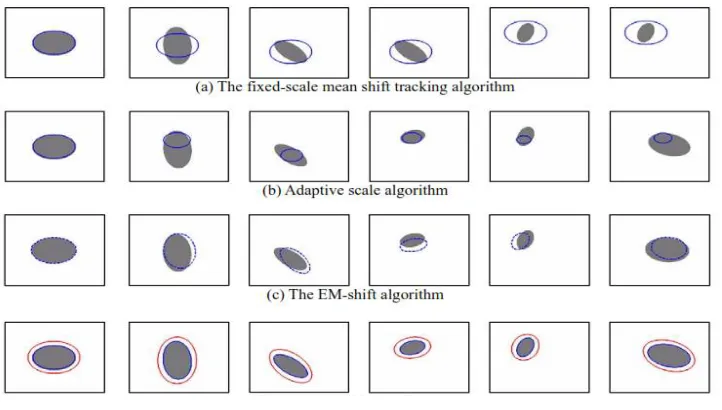
validate The efficiently predict of the MSOMST algorithm, we initially using a synthetic ellipse adjacent frames. The size window for primary target is 59×89 for ellipse in blue color as shown in fig 4.1(d). Δk =10 is selected for improved algorithm of MSOMST, thus size of window for candidate area of target in frame 1 is 79×109 for ellipse in red color is shown in fig 4.1(b). In the MSOMST outcomes for other frames, the outer ellipses correspond to the target point of candidate region. which can be used for estimation of the real targets point, i.e., . The experimental outcomes represents that the improved MSOMST statergy may possibly consistently track the ellipse along with direction and scale various. For the moment, the experimentally outcomes provide the static-scale mean shift is not superior for the reason that remarkable direction and levels adjust of the things. The adaption range algorithm will not evaluate the point of direction vary The algorithm of Em-shift fails for accurately approximates ellipse scale as well as direction, even though sequence of target is easy.
(d) The proposed algorithm for MSOMST
Fig. 4.1: Algorithm of tracking outcomes for sequence of synthetic ellipse.
List of direction, height and width for sequence of ellipse used during MSOMST method . Evaluation of direction is the angle between the x-axis and major lines. To describe the rest frames and target model were used for testing. the initial frame of the sequence was used. It can be proved that the improved MSOMST technique gains excellent estimation accurateness of the direction and scale of the target.
4.2 Experimental Analysis
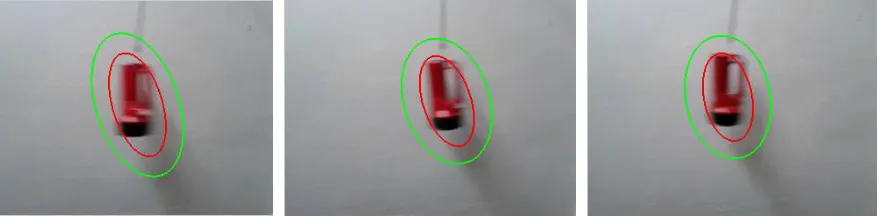
Fig 4.2. track domino effect of the torch series for MSOMST designing. enclose i.e., 20, 40 and 80 are displayed.
V . CONCLUSIONS AND FUTURE WORK
By studying the coefficient of Bhattacharyya for candidate region of target along with the proposed work shows the improvisation in the direction and modified scale and orientation based MSOMST of an object. It is capable of resolve the difficulty of how to identity very fastly orientation and scale modify of the target point underneath the mean of shift of tracking. probability can represent by the weight or coefficients of pixels in the candidate area of belong to the target, although the order of zeroth moment represents candidate area of weight image. The moment of zeroth order and coefficients of Bhattacharyya are used among the candidate and the reference model, a easy with efficience technique to estimation of the particular point of region was declared. Subsequently a discovred method, that is depend on the corrected second order and the center moments region of the target, it was projected to adaptively estimation of the height, width and direction changes of the reference point to be hit. here improved MSOMST technique inherits the advantages of mean shift of tracking robust, simplicity, efficiently. The consistency in the improvised algorithm can be observed and validated. In the coming up work will be going to on how to estimate and make work the accurate the shape of target, as another of a rectangle or an elliptic model used for a further robust tracking. And also research will focus on the object tracking under multi-camera video surveillance.
REFERENCES
1 Alper Yilmaz, Omar Javed, and Mubarak Shah, “Object tracking”, A survey Acm Computing Surveys (CSUR), 38(4):13, 2006. 2 Gary Bishop and Greg Welch, “An introduction to the kalman filter”, Proc of SIGGRAPH, Course, 8:27599–3175, 2001.
3 J Cezar Silveira , Jacques, Claudio Rosito Jung, and Soraia Raupp Musse, “Background subtraction and shadow detection in grayscale video sequences”, In Computer Graphics and Image Processing IEEE, 2005.
4 Budi Sugandi, Hyoungseop Kim, Joo Kooi Tan, and Seiji Ishikawa. “ A block matching technique for object tracking employing peripheral increment sign correlation image”, International Conference on IEEE, pages 113–117,, 2008.
5 Alan J Lipton, Hironobu Fujiyoshi, and Raju S Patil, “Moving target classification and tracking from real-time video”, Fourth IEEE Workshop on, pages 8–14 , 1998.
BIOGRAPHY