A sequential approach to the
characteristic function and the core in
games with externalities
Marini, Marco A. and Currarini, Sergio
Faculty of Economics, University of Urbino "Carlo Bo"
2003
Online at
https://mpra.ub.uni-muenchen.de/1689/
and the Core in Games with Externalities
⋆Sergio Currarini1⋆⋆and Marco Marini2
1
Department of Economics University of Venice S.Giobbe 873, 30121 Venezia
2
Department of Economics University of Urbino
Abstract. This paper proposes a formulation of coalitional payoff possibili-ties in games with externalipossibili-ties, based on the assumption that forming coali-tions can exploit a ”first mover advantage”. We derive a characteristic func-tion and show that when outside players play their best response noncooper-atively, the core is nonempty in games with strategic complements. We apply this result to Cournot and Bertrand games and to public goods economies.
Keywords.Core, cooperative games, externalities.
JEL Classification.C7
1
Introduction
This paper proposes a formulation of coalitional payoff possibilities in games with externalities, based on the assumption that forming coalitions can choose their strate-gies before the outside players. The idea that forming coalition can move first is motivated by the observation that in many economic environment, objections to cooperative agreements are carried out by directly choosing strategy in the ongoing strategic form game. Firms defecting from an industrial cartel can simply set a lower price; countries wishing not to comply with internationally agreed pollution abate-ments can simply set higher levels of production, and so on. In these cases, forming coalitions seem to exploit a positional advantage, very much as Stackelberg lead-ers, while outside players optimally react as followers. We accordingly construct a characteristic function assigning to each coalition its equilibrium payoff in an ap-propriately defined sequential game in which it moves as a Stackelberg leader. We
⋆
The authors wish to thank Francis Bloch, Carlo Carraro, Parkash Chander, Kevin Roberts, Sang-Seung Yi, Yair Taumann, Henry Tulkens and the seminar audience at the Rhodes 1999 Meeting of the Society for the Advancement of Economic Theory and the Bilbao Games 2000 Conference for their useful comments and suggestions. The usual disclaimer applies.
⋆⋆
study the core of the associated cooperative game and establish sufficient conditions
on the underlying strategic form gamefor the existence of core imputations. The problem of defining a characteristic function in games with externalities is a wellknown problem in cooperative game theory. Since the payoff of each player is affected by all the strategic choices made in the game, coalitional possibilities cannot be defined independently of the behaviour of external players. The relevance of these considerations becomes apparent once we observe that externalities are a common feature of most economic problems in which group formation is a relevant issue: cartel formation in oligopolies, international cooperation on trade, monetary and environmental issues, joint ventures, R&D associations and so on. This prob-lem was in fact already considered by Von Neumann and Morgenstern (1944), who conceived the characteristic function of a coalitional game as the maximal aggre-gate payoff that a coalition canguaranteeto its members (see also Aumann (1959)). Their formulation, in which players in the complementary coalition minimize the payoff of the forming coalition, does not address the problem of how coalitions make rational predictions about the reaction of excluded players. This is an open and highly debated issue in the theory of cooperation. Some important contribu-tions have attempted to develope a general analysis by imposing consistency re-quirements on the overall coalition structure induced by the formation of a coali-tion (see Ray and Vohra (1997), Ray and Vohra (1999)), or by studying games of coalition formation (Hart and Kurz (1983), Bloch (1996), Bloch (1997), Yi (1997)). Other contributions have addressed specific economic problems by directly intro-ducing assumptions on the predicted behaviour of outside players. In particular, Chander and Tulkens (1997) study the core of an economy with multilateral exter-nalities adopting the following logical construct. Acoalition formation rule, given
ex ante, specifies the predicted coalition structure induced by the formation of every coalition. In particular, they propose that all players excluded from a forming coali-tion simply organize themselves into singletons. This rule is strictly related to the gamma game of coalition formation studied by Hart and Kurtz (1983), in which the decision of a subcoalition of players to separate from an existing coalition induces the remaining players to split up into singletons.1 Given this coalition formation rule, the strategies induced in the underlying strategic form game by the formation of a coalitionSare then naturally determined by lettingSand each player outside S simultaneously maximize their own payoff. In this logic, Chander and Tulkens determine the valuev(S)as the Nash equilibrium payoff ofSin the strategic form game played by S, acting as a single player, and by excluded players, acting as singletons. Because of the simultaneity of strategic choices, we will refer to this approach assimultaneous conversion of a strategic form game. To give a simple
1
example, consider three firms with linear technology competing `a la Cournot in a linear demand market. Letaandbbe the demand parameters andcbe the marginal cost. If all firms merge together, they get the monopoly payoffv({1,2,3}) = A4, whereA= (a−c)2/b. If two firms, say firms 1 and 2, jointly leave the merger, a simultaneous duopoly game is played between the joint firm{1,2}and firm 3, with equilibrium payoffv({1,2}) = A
9. Similarly, if a single firmileaves the merger,
a triopoly game is played, with symmetric payoffs 16A =v({i})(these payoffs are obtained from the general expression (n−s+2)A 2 expressing firms’ profits in an n
firm oligopoly). It can easily be checked that the equal split imputation12A,A 12,12A
is in the core. However, other asymmetric imputations belong to the core, such as 3A
32. 3A
32,16A
, giving player 3 his reservation valuev({3})and equally splitting the rest between the other two players.
The simultaneous conversion implicitly assumes that coalitional payoffs orig-inate in two stages: a coalition formation stage, in which the coalition structure forms; a strategic form game, in which Nash strategies are played by each coalition. In fact, Nash strategies are a predictable outcome only if all elements of the game (the set of players,i.e., the elements of the newly formed coalition structure, their payoff functions and strategy sets) are commonly known. In other terms, deviations from a generally agreed joint strategy are carried out by first publicly abandoning the negotiation process (as, for instance, a group of countries leaving the international negotiation table) and then playing the Nash equilibrium strategies of the induced simultaneous game. Although appropriate in certain cooperative environments, the simultaneous conversion fails to capture the dynamic nature of coalition formation that we claimed is common to several economic problems. As we argued at the be-ginning, coalitions can often deviate by directly choosing an alternative strategy in the underlying game, as do firms defecting from an industrial cartel by directly and unexpectedly setting a lower price. In order to explore this idea, we construct a char-acteristic function formally expressing the assumption that forming coalitions can move first. We stress here that we do not attempt to endogenize the coalition struc-ture induced by a deviation, but we adopt the gamma assumption used in Chander and Tulkens (1997).2More precisely, we derive the coalitional valuevφ(S)as the
perfect equilibrium payoff ofSin the sequential game in whichSchooses a strategy as leader, and the players in the complementary coalitionN\Sreact simultaneously and noncooperatively. We refer to this operation assequential conversion of the gamma game, denoted by(N, vφ).
As an illustration of this approach, consider again the Cournot oligopoly ex-ample used above for the simultaneous conversion. As before, the grand coalition obtains the monopolistic profitv({1,2,3}) =A
4. Now, if firms 1 and 2 jointly leave
the merger, a Stackelberg quantity setting game with the joint firm{1,2}as leader
2
and firm3as follower originates. The leader’s payoffs is given byv({1,2}) = A 8.
If a single firm, say firm 1, deviates, it becomes the leader in the sequential game in which firms 2 and 3 simultaneously set their quantities at the second stage. Firm 1’s profit in equilibrium is given by 12A =v({1})(these numbers are obtained from the general expression4(n−As+1)expressing the payoff of a leader with(n−s)followers in a Stackelberg game). We use this example to discuss the main properties of the se-quential conversion, formally established in the paper. We first note that every proper subcoalition of players does strictly better under the sequential conversion than un-der the simultaneous conversion. This directly implies that the sequential core is strictly included in the simultaneous core. As will be shown in theorem 1, this is a generic property for smooth games. Secondly, in the above example the sequential core consists of a unique, symmetric, imputation. Under the assumed linear struc-ture, this remains true for any number of players. Unfortunately, the greater power of deviating coalitions under the sequential conversions yields an empty core as soon as the linear structure of the example is abandoned. In fact, since the above Cournot oligopoly exhibits strategic substitutes, forming coalitions (moving as Stackelberg leaders) enjoy a first mover advantage, and the profitability of deviations rule out the existence of stable imputations. Following the same intuition, stable coopera-tive outcomes could emerge when the power of deviating coalitions is less strong, that is, when the game has strategic complements. We show in proposition 1 that all smooth, symmetric games with strategic complements have a nonempty core. This nonemptiness result trivially extends to the simultaneous conversion.
The paper is organized as follows: the next section presents the general setup, introducing and comparing the simultaneous and the sequential conversions. Sec-tion 3 presents our existence result. SecSec-tion 4 illustrates, in the framework of some wellknown economic applications, the mechanics underlying the existence result: the core is nonempty when leaders cannot exploit their positional advantage too much. Finally, section 5 concludes the paper.
2
The Model
2.1 Setup
We consider a set of playersN ={1, .., i, .., n}, each endowed with a setXi ⊂R
of feasible actions and a payoff functionui : X → R, whereX ≡ i∈N
Xi. For
eachS ⊆ N we denote byuS : X → Rthe function defined for allx ∈ X by
uS(x)≡ i∈S
ui(x). We assume that utility is transferable, so thatuS(x)is a well
defined index of the aggregate utility ofS. We will only consider continuous pay-off functions. The strategic form gameΓ =
N,(Xi, ui)i∈N
is obtained from the above elements. A Nash equilibriumxof the gameΓ is defined in the usual way. We will be considering gamesΓ(S, xS)derived by Γ restricting the set of
the paper that the gameΓ andΓ(S, xS)admits a unique Nash Equilibrium for all
S ⊂N andxS ∈ XS. Although this may seem a strong restriction, we anticipate
here that for the class of games covered by theorem 1 (supermodular games) our as-sumption of symmetric externalities (asas-sumption 2) guarantees that Nash equilibria are Pareto rankable. We may therefore argue that, if multiple equilibria should exist, the optimal equilibrium would be chosen through some pre-play communication.
We will associate to the gameΓvarious cooperative games(N, v)by specifying characteristic functionsv: 2N →R
+, wherev(S)expresses the maximal aggregate
payoff attainable by coalitionSinΓ. An imputation for(N, v)is a vectorz∈Rn
+
such that
i∈N
zi≤v(N)andzi≥v(i)for alli∈N.
Definition 1. The core of the cooperative game(N, v), denotedC(N, v), is the set of imputationsz∈Rn
+such that
i∈S
zi≥v(S)for allS⊆N.
2.2 Simultaneous Conversion
As argued in the introductory section, the simultaneous approach to the derivation of a characteristic function for the gameΓ views the valuev(S)as resulting from an implicit two stage process. At the first stage players announce coalitions, and a coalition structure includingSforms according to some specific coalition formation rule. At the second stage, the formed coalitions play the Nash equilibrium strategy of the induced game. In this paper we will consider the gamma coalition formation rule, predicting that if a coalitionSforms and breaks the agreement within the grand coalition, no other coalition forms, and outside players split up into singletons. This rule seems appropriate in some specific institutional settings: in some instances of international environmental agreements, for instance, treaties require the formation of at most one coalition (see, for instance, Murdoch and Sandler (1997) on the reg-ulation of chlorofluorocarbon emissions). Similarly, the assumption of one coalition with fringe outside players is extensively used in the theory of industrial organiza-tion for the analysis of horizontal mergers (see Salant et al.(1983), Deneckere and Davidson (1985), Shaffer (1995)).
Formally, we associate with each coalitionSthe coalition structureπγ(S)whose
elements areS and all players outsideS as singletons. LettingΓ(πγ(S))denote
the strategic form game played by the elements ofπγ(S), the characteristic function
vγ(S)is thus defined as the aggregate payoff ofSin the (unique) Nash equilibrium
¯
xof the gameΓ(πγ(S)),i.e.,
vγ(S) =
i∈S
ui(¯x). (1)
2.3 Sequential Conversion
normal form game. Outside players, at least for some transitional period, have to react to coalitional deviations by choosing their strategies very much as followers in a Stackelberg game. Again, although the characteristic function can be defined under this approach for any arbitrary coalition formation rule, we will consider the specific case of the gamma rule. Let, as before, πγ(S) denote the coalition structure in
which onlyScontains more than one player. LetΨ(πγ(S))be the sequential game in whichSmoves first choosing an actionxS ∈XS and, at the second stage, the
other elements ofπγ(S)simultaneously choose an element out of their respective
strategy sets. Let the function fN\S : XS → XN\S map a joint strategy xS of
coalitionS into the Nash equilibrium of the gameΓ(S, xS), withfj denoting its
projection on thej-th element:
fj(xS)∈arg max xj∈Xj
uj(xS, xj, fk(xS)k∈N\S\j), ∀j∈N\S. (2)
A perfect equilibrium ofΨ(πγ(S))is a pair(x∗
S, fN\S)such that:
x∗S ∈arg max xS∈XS
i∈S
ui(xS, fN\S(xS)). (3)
We denote byx∗(S)the strategy profile(x∗
S, fN\S(x∗S)). The assumption of
con-tinuous payoffs and the closedness property of the Nash correspondence graph (see, for instance, Fudenberg and Tirole (1991)) imply thatS faces a continuous maxi-mization problem in (3) so that, by Weiestrass’ theorem, a perfect equilibrium of Ψ(πγ(S))always exists. The characteristic function is here defined by assigning to each coalitionSits aggregate payoff at the relevant perfect equilibrium:
vφ(S) =
i∈S
ui(x∗(S)). (4)
2.4 Sequential versus Simultaneous Conversion
In this section we examine the relation between the core of the cooperative games obtained under the simultaneous and sequential conversions of a given strategic form gameΓ (henceforth, simultaneous and sequential cores). We first note that since the joint strategyx¯S is a feasible choice forS in the maximization problem
(3), and sincex¯N\S =fN\S(¯xS), it follows thatvφ(S)≥vσ(S)for allS ⊂N.
In turns, this implies that the sequential core is weakly included in the simultaneous core. A more interesting question is whether this inclusion is strict under additional assumptions on the gameΓ.
Assumption 1. The functionuiis twice differentiable,i= 1,2, ..., n.
Given differentiability of payoffs, we can write the equilibrium change inS’s payoff induced by a change in the strategy of itsi-th member at a pointxin the interior of Xas follows:
duS(x)
dxi
=
j∈N\S
∂uS(x)
∂xi
+∂fj(xS)
∂xi
∂uS(x)
∂xj
Considering the Nash equilibriumx¯of the gameΓ(πγ(S))(provided this is
inte-rior), we can use an envelope argument to express the change inS’s payoff induced by an infinitesimal changedxS in its joint strategy:
duS(¯x) =
i∈S
j∈N\S
∂fj(¯xS)
∂xi
∂uS(¯x)
∂xj
dxi.
It follows that coalitionS can strictly increase its payoff with respect to the Nash payoff atx¯whenever the term∂fj(¯xS)
∂xi
∂uS(¯x)
∂xj is non-null for somei∈Sandj ∈
N\S. Under this condition,vφ(S)> vγ(S). The term ∂f∂xj(¯xiS) can be obtained by
implicit differentiation of the first order necessary conditions for a Nash equilibrium of the gameΓ(S,x¯S):
∂fj(¯xS)
∂xi
=−
∂2uj(¯x) ∂xi∂xj +
k=j k∈N\S
∂2uj(¯x) ∂xk∂xj
∂fk(¯xS)
∂xi
∂2uj(¯x) ∂x2
j
.
This leads to the following result:
Proposition 1. LetΓ be a strategic form gameΓ satisfying assumption 1 and such that, for all S ⊂ N, the Nash equilibrium of the gameΓ(S,x¯S) is unique and
interior. For allS ⊂ N, let ∂2uj(¯x)
∂xi∂xj = 0for at least one playeri ∈ S and one
player j for which ∂uS(¯x)
∂xj = 0. Then, either the cores of the associated games
(N, vφ)and(N, vγ)are both empty or the former is strictly included in the latter.
Proof. >From the above discussion, under the assumptions of this proposition, for allSwe havevφ(S)> vγ(S). We also already know thatC(N, vφ)⊆C(N, vσ).
Then we just need to show that C(N, vφ)\C(N, vγ) = ∅. Note first that being
defined by a series of linear weak inequalities, the set C(N, vγ) is closed and
convex. The boundary of C(N, vγ) contains all allocations z ∈ Rn such that
i∈S
zi=vγ(S)for someS⊂N. By closedness ofC(N, vγ), such boundary is
in-cluded inC(N, vγ). Sincevγ(S)< vφ(S), we can thus pick an arbitrary allocation
won the boundary relative toS, for which
i∈S
wi=vγ(S). Sincevγ(S)< vφ(S),
it follows thatSimproves uponwandw /∈C(N, vφ).
3
A Class of Games with a Nonempty Core
empty core. In particular, this can happen in games with strategic substitutes. We show in theorem 1 that all symmetric smooth games with strategic complements have a nonempty core. This existence result, when applied to the simultaneous con-version, can itself be regarded as a new contribution (we note here that the only ex-istence result for the core of(N, vγ)was obtained by construction by Chander and
Tulkens (1997) for a multilateral externalities game with quasilinear preferences). An intuitive exposition of the proof is as follows. Games with strategic comple-ments have the property that Stackelberg followers are better off than leaders. This is a wellknown result for symmetric duopolies (see, for instance, Gal-Or (1985)), and is extended to our setting ofnplayers in lemmas 1 and 2. Suppose that a coali-tion, acting as leader, could improve on the efficient equal split allocation. Since every follower is better off than every leader, the sum of payoffs after the deviation would exceed the sum of the equal split allocation, violating efficiency of the latter. Given differentiability of payoff functions, strategic complementarity is equiva-lent to the following condition:
∂2u i(x)
∂xi∂xj
≥0∀i, j∈N, i=j,∀x∈X. (5)
A wellknown theorem by Milgrom and Roberts (1990) directly implies that if pay-offs satisfy (5) then the functionfN\S is non decreasing inxS (see Theorem 4.2.2
in Topkis (1998)).3
For our main result, stated in theorem 1, we need some additional assumptions.
Assumption 2. (Symmetric players).Players have identical strategy sets and pay-off functions in the following sense: there exists X such that Xi = X for all
i∈Nand a functionu:X×Xn−1→Rsuch thatu(x, y) =u
i(xi, xN\i)for all
i∈Nand for all(x, y), xi, xN\i
∈Xn×Xnsuch that(x, y) = xi, xN\i
.
Assumption 3. (Symmetric externality).Either ∂ui(x)
∂xj
≥0for alli, j∈Nand
x∈Xor ∂uj(x)
∂xi
≤0for alli, j∈Nandx∈X.
Assumption 4. (Strict concavity).ui(x)strictly concave inxifor alli∈N.
Assumption 2 requires that all players are identical in the sense that they all have the same strategy set and identical preferences over their own strategies and their competitors’ strategies. The second assumption has been shown to play a crucial role in various cooperative game theory results (see, for instance, Milgrom and Roberts (1996), Yi (1999)), and requires that the sign of the effect of each player’s action on
3
In order to apply this result, we here exploit the fact thatRis a chain (which, together with condition (8), implies that the game is supermodular) and the assumption of a unique Nash equilibrium (that implies thatfN\Sis singlevalued, so that the greatest and least elements
the payoff of the rest of players is the same. We will denote the case of a positive sign as ”positive externality” and the case of a negative sign as ”negative externality”.
To simplify notation, for a given action profilexS we will denote by
xS\i, y
the vector(x1, ...xi−1, y, xi+1, .., xs).
Lemma 1. LetS ⊂N and considerx∗(S).
(a) If externalities are positive, theni∈Sandj∈N\Simplyx∗
i ≥x∗j;
(b) If externalities are negative, theni∈Sandj∈N\Simplyx∗
i ≤x∗j.
Proof. (a). We proceed by contradiction. Supposex∗
i < x∗j for somei ∈ S and
j∈N\S. The next series of inequalities follows:
∂ui
x∗
S, x∗N\S
∂xi
> ∂ui
x∗
S\i, x
∗
j, x∗N\S
∂xi
≥
∂ui
x∗
S\i, x
∗
j, x∗(N\S)\j, x
∗ i ∂xi = ∂uj x∗
S, x∗N\S
∂xj
= 0 (6)
The first inequality follows by the strict concavity (assumption 4); the second by condition (5); the third by assumption 2, and the fourth by the equilibrium conditions defining the equilibrium reaction functionfN\S. Note next that everyi ∈ S first
order condition of problem (3) can be rewritten as
h∈S
∂uh(x∗)
∂xi
+
j∈N\S
∂uh(x∗)
∂xj
∂fj(x∗S)
∂xi
≡0. (7)
Let us examine an arbitrary elementhof the summation overS in (7): by the as-sumption of case (a) of this lemma, the first term is non-negative ifh=i; moreover, by (6), this term is strictly positive forh=i. This facts, together with the fact that fN\S is increasing, imply that condition (7) can be satisfied only if∂uh(x
∗) ∂xj <0for
someh∈S, which contradicts the assumption of the lemma.
(b).The same contradiction argument used for case (a) can be proved by invert-ing the inequality signs in (6) in the appropriate manner.
Lemma 2. LetS⊂Nand considerx∗(S). Ifj ∈N\Sandi∈Sthenu
j(x∗)≥
ui(x∗).
Proof. The following inequalities hold for allj∈N\Sandi∈S:
uj
x∗
S, x∗N\S ≥uj
x∗
S, x∗(N\S)\j, x∗i ≥uj
x∗
S\i, x∗j, x∗(N\S)\j, x∗i . (8)
The first part is implied by condition (2), while the second follows from lemma 1 and assumption (3). By the assumption of symmetric players, we also have
uj
x∗S\i, x
∗
j, x∗(N\S)\j, x
∗
i =ui
Inequalities (8) and (9) imply
uj(x∗)≥ui(x∗),
which proves the result.
Theorem 1. Let the gameΓ satisfy assumptions 1-4 and exhibit strategic comple-mentarity. Then, the associate cooperative game(N, vφ)has a nonempty core.
Proof. We prove the theorem showing that the equal split allocation giving vφ(N) n to each player inNis in the core of the game(N, vφ). Suppose not, so thatvφ(S)>
vφ(N)for someS⊂N. By lemma 2, the maximal payoff of players inSis weakly
lower than the minimal payoff of players inN\S. This implies that
j∈N\Suj(x∗)
n−s ≥
i∈Sui(x∗)
s =
vφ(S)
s ,
so that
vφ(S)
s > vφ(N)
n ⇒
j∈N\Suj(x∗)
n−s > vφ(N)
n .
This in turns implies that
s
i∈Sui(x∗)
s + (n−s)
j∈N\Suj(x∗)
n−s > s vφ(N)
n + (n−s) vφ(N)
n
or
i∈N
ui(x∗)> vφ(N)
which contradicts efficiency ofvφ(N).
The following corollary directly follows from the fact thatvφ(S)≥vγ(S)for
allS.
Corollary 1. Let the gameΓ satisfy assumptions 1-4and exhibit strategic comple-mentarity. Then, the associate cooperative game(N, vγ)has a nonempty core..
4
Discussion and Applications
of coalitional members. In line with some well established results in the theory of industrial organization, this property ensures that excluded players, acting as fol-lowers, are better off than players in the leading coalition.4 Deviations by proper subcoalitions of players are therefore not very profitable, while the grand coalition, not affected by this ”deviator’s curse”, produces a sufficiently big aggregate payoff for stable cooperative outcomes to exist.
In this section we discuss our result and its main requirement in relation to some notable economic applications of game theory: Cournot oligopolies, Bertrand oligopolies and public goods economies. The analysis of Cournot games clearly il-lustrates the mechanics at work in theorem 1: as long as best replies are such that leading coalitions have not a ”too” big positional advantage, stable cooperative out-comes exist. Bertrand games are traditionally games with strategic complements. We discuss them here as an example of the property of the sequential core to act as a refinement of the simultaneous core (see proposition 1). Finally, we work out an example replicating the economy with multilateral externalities studied by Chander and Tulkens (1997). This case is interesting both because it first motivated the use of the gamma core solution concept (see the exhaustive discussion in their paper) and because it generates a game with strategic substitutes for which the sequential core is empty although the simultaneous core is always nonempty.
4.1 Cournot Games
Some recent contributions (Amir (1996), see also Vives (2000)) have shown that the sufficient condition for a Cournot game without costs to be log-supermodular (and so best replies to be increasing) is a log-convex inverse demand functionP(.). Fol-lowing Amir’s example, consider the symmetric Cournot oligopoly with inverse de-mand functionP(X) = (X+ 1)−α, whereX is aggregate production andα≥n, with zero production costs and no capacity limits. In this case the Cournot game is log-supermodular, best reply functions are increasing and have a unique sym-metric intersection. For this case, our theorem 1 implies that the sequential core is nonempty. This can be easily checked by assigning the numerical valuesn= 3and α= 3; in this case, the characteristic function under the sequential conversion is
v(S) = α −2α
α−1
α2−α+ (1−α) (n−s)α .
It can be shown that the term v(S)
s is monotonically increasing ins; the equal split allocation giving
v(N)
n =
(α−1)α−1α−α
3
to all players is therefore contained in the core. As shown by Amir (1996), intro-ducing linear costs can make the game non log-supermodular and best replies non
4
monotonic. As an example, let costs of each firm be defined by the term x
4. It is
immediately clear that, forn= 2andα= 1,
v({i}) =.104 > .0261 = v(N)
n
implying that the core is empty.
However, the (sufficient) condition used in theorem 1 is far from being minimal: it is easy to construct examples of games with strategic substitutes and for which core allocations exist. A simple Cournot example can be used to illustrate how the same mechanics underlying the result of theorem 1 determine the nonemptiness of the core when strategies are substitutes. In particular, the core is nonempty when best replies are nottoo decreasing or, in other terms, when strategies are not too substitute. This in turn requires that the profit function does not decreasetoo much
with other firms’ output, a property mainly depending on the level of log-concavity of the inverse demand functionP(.). To show this, letP(X) = (a−X)β, with a > X (forα = 1, this becomes the usual linear demand case). Note thatP(.)
is log-concave (and the game is not log-supermodular) forβ >0, and best replies are decreasing. When production costs are zero, the Cournot game admits a unique Nash equilibriumx¯ withxi = β+na for everyi ∈ N. Also, very simple algebra
yields the following characteristic function:
v(S) =aβ+1β2β(β+ 1)−β−1
(β+n−s)−β.
By computing the difference between the equal split allocation and what a single player obtains by deviating as leader, we get
vφ(N)
n −vφ({i}) =β
β(β+n−1)−βn−1<0⇔β <1.
It follows that when the demand is strictly concave (β <1) the core is empty. How-ever, whenβ = 1, the core is nonempty with the equal split allocation as a unique element. It is also easy to show that forβ > 1(convex inverse demand) the equal split allocation still belongs to the core. We conclude that in this case nonemptiness of the core only requires a not too strong log-concavity ofP(.). This ensures that the marginal revenue of each firm does not decrease too much with the rivals’ out-put and hence a deviating coalition, by expanding its outout-put as leader (see lemma 1) does not exploit too much its first mover advantage against complementary players. When this is the case, the sequential core of a Cournot game, which is a natural ”strategic substitute” game, turns out to be nonempty.
4.2 Bertrand Games
Consider first the traditional symmetric Bertrand game with a homogeneous good, with market demandD(p) =a−p,a > pand cost functionC(x) = x2
2. At the
core of the associated game(N, vγ)includes all Pareto efficient allocations,
corre-sponding to all possible distributions of the valuevγ(N) =12a2 n
2n+1. The
sequen-tial conversion yields the characteristic functionvφ(S) = 12s a 2
1+2n+n2−s2, directly
implying thatC(N, vφ) ⊂C(N, vγ)(to see this, note that all imputations giving
less than 12 a2
2n+n2 to at least one player are not in the core of the game(N, vφ)).
The more complex case of differentiated goods can be used to illustrate the effect of complementarity on the relation between the simultaneous and sequential core. Denecker and Davidson (1985) show that when cartels (or mergers) and the fringe of outside firms set their price `a laNash, cartels are increasingly profitable in the number of members. Moreover, they also show that merging is more convenient for low degrees of product differentiation. Using the present paper’s terminology, their
theorem 2 proves that the termvγ(S)
s for their game is monotonically increasing in s, implying that the core of the associated game(N, vγ)always contains at least the
equal split allocation.
Turning now to the sequential conversion, note first that all assumption in propo-sition 1 for strict inclusion of the sequential core are satisfied in the above example. To have a more precise idea of the effect of the degree of good differentiation on the relation between the core of the games(N, vφ)and(N, vγ), consider the following
example of a symmetrically differentiated triopoly with inverse demand function given by pi = a−xi −b
j=i
xj. Note that (see Bloch (1995) and Shubik and
Leviatan (1980) goods are complements for the range ofb∈[((n−1)/n),0]and substitutes forb∈[0,1]. Taking the direct demand functionxi=α−βpi+γ
j=i
pj,
withα= (n−1)b+1a ,β = (1−1b)((n−(n−−2)b1)b+1) andγ= (1−b)((nb−1)b+1), we obtain the following coalitional values:
vγ({i}) = 14
α2
β
(β−γ)2, vφ({i}) = 1 4
α2
(2β+γ)2
(2β−γ)
2β2
−βγ−2γ2, i= 1,2,3
vγ({i, j}) =
α2β2
−γβ−γ2
2β2
−2γβ−γ2,vφ({i, j}) = 1 2
α2
2β−βγ−γ2
(2β+γ)
2β2
−γ2−2βγ2
vγ({1,2,3}) = 34
α2
(β−2γ), vφ({1,2,3}) =
3 4
α2
(β−2γ).
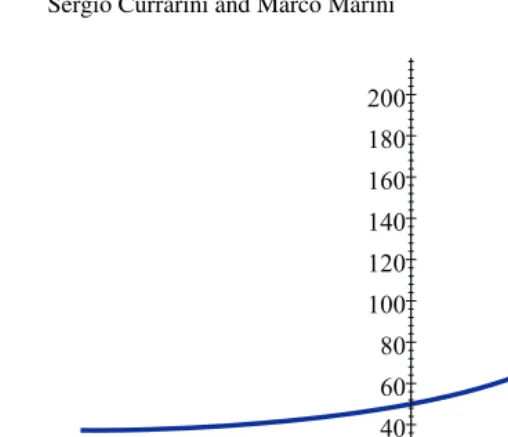
Numerical simulations show that when goods from complements (b ≤0) become substitutes (0 < b≤1), the worth of every single firm as leadervφ({i})increases
slightly more than its worth in the simultaneous casevγ({i}), while for every
inter-mediate coalition (see figure below),vφ({i, j})(thick line) increases substantially
more thanvγ({i, j})(thin line). As a consequence, for lower degrees of product
20 40 60 80 100 120 140 160 180 200
-0.3 -0.2 -0.1 0 0.1 0.2 0.3
[image:15.595.81.335.44.262.2]b
Fig. 1.
leave the grand coalition as Stackelberg leaders and, as a result, the sequential core shrinks.
4.3 Public Goods Economies
Consider an economy with two commodities, a public goodqand a private goody. The set of agents isN = {1,2, ., i, ., n}. Each agenti ∈ N is endowed with the amountwiof the private good. The public good is produced by each agentiout of
the private good, with convex cost function
C(q) = q
2
2 .
We letq = (qi)i∈N andQ =
Nqi. Quasilinear preferences are represented by
the utility function
ui(q, xi) = (Q−αQ2) +yi.
For this economy, the efficient production of public good implied by Samuelson’s conditions is
Q∗= n
2
1 + 2n2α.
This setup is formally equivalent to the one considered by Chander and Tulkens (1997), and satisfies their assumption 1” forα≥1
2. This implies, by their main
of the public good at the efficient production levels(q∗
1, ..., q∗n):
yi=wi−
v′
i(Q∗)
j∈Nv′j(Q∗)
j∈N
q∗
j
2 =wi− 1
n
Q∗
n 2
. (10)
We will show that for this economy the sequential core is empty. We proceed by showing that each player, by deviating alone as a Stackelberg leader, improves upon the allocation given by (10). We do not solve the whole maximization problem of a single leader. It is sufficient to show that there exists one strategy for playeriwhich gives him a higher payoff than the proposed allocation, given the equilibrium reac-tion funcreac-tions of the other(n−1)agents. Consider then the strategy of producing a zero amount of public good, i.e.,qi = 0. The reactionfN\i(qi = 0)is given by
the following first order conditions:
1−2αqj(n−1) =qj, ∀j=i,
yielding
qj=
1
1 + 2α(n−1), ∀j =i
and, aggregating, a total produced public good equal to
Q= n−1
1 + 2α(n−1).
We are now able to compare agenti’s payoff after his deviation, or, in other terms, the valuevφ({i}), with his payoff in the proposed allocation given in (10), that we
labelu∗
i:
u∗i =
n2
1 + 2n2α−α
n2
1 + 2n2α
2
+wi−
1 2n
n
1 + 2n2α
2
;
vφ({i}) =
n−1
1 + 2α(n−1)+wi−α
n−1 1 + 2α(n−1)
2 .
It can be checked thatvφ({i}) > u∗i forn ≥ 2 andα ≥ 0.5, implying that the
allocation given by (10) is not in the sequential core. The following table reports figures for some values ofnandα= 0.5:
n 2 10 50 100
vφ({i})−ui∗0.224 0.8 0.96 0.98
.
This result directly implies that for this economy the core of the game(N, vφ)is
empty. Since
i∈Nu∗i ≥
i∈Nui(q, yi)for all feasible vectors(q, y1, ..., yn), it
follows that every other feasible imputationzis suchzj < u∗j for somej(z)∈N.
Since we have shown thatvφ({i})−u∗i > 0for alli ∈ N, it follows that every
5
Concluding Remarks
In this paper we have proposed a sequential approach to the determination of the characteristic function in games with externalities. The appropriateness of this ap-proach depends on the strategic context in which players choose their actions. The sequential conversion seems appropriate in settings in which players’ actions are perfectly monitored and players can fully commit to their strategies. In these cases, the derived characteristic function simply formalizes the assumption that a forming coalition anticipates the (optimal) reaction of outside players who face its forma-tion as a fait accompli.On the other hand, a simultaneous conversion seems ap-propriate when the formation of a deviating coalition can be monitored before its strategy choice, and all strategies are chosen only once the new coalition structure has formed. The sequential structure of the game characterizing the payoff of form-ing coalitions has proved useful to establish sufficient conditions for the nonempti-ness of the core. The crucial property for nonemptinonempti-ness (strategic complementarity) is often encountered (and easily testable) in economic applications. Moreover, the property of the sequential core to act as arefinementof the simultaneous core yields interesting results in some economic examples.
References
[1.] Amir, R. (1996) Cournot Oligopoly and the Theory of Supermodular Games.Games and Economic Behaviour15: 132-148.
[2.] Aumann, R. (1959) Acceptable Points in General Cooperativen-person Games. An-nales of Mathematics Studies40: 287-324.
[3.] Bloch, F. (1995) Endogenous Structures of Associations in Oligopolies.Rand Journal of Economics26: 537-556.
[4.] Bloch, F. (1996) Sequential Formation of Coalitions with Fixed Payoff Division.
Games and Economic Behaviour14: 90-123.
[5.] Bloch, F. (1997) Non Cooperative Models of Coalition Formation in Games with Spillovers. In: Carraro C. Siniscalco D. (eds.)New Directions in the Economic The-ory of the Environment.Cambridge University Press, Cambridge.
[6.] Bulow, J., Geanokoplos, J., Klemperer, P. (1985) Multimarket Oligopoly: Strategic Substitutes and Complements.Journal of Political Economy93: 488-511.
[7.] Carraro, C., Siniscalco, D. (1993) Strategies for the International Protection of the En-vironment.Journal of Public Economics52: 309-328.
[8.] Chander, P., Tulkens, H.(1997) The Core of an Economy with Multilateral Externali-ties.International Journal of Game Theory26: 379-401.
[9.] Deneckere, R., Davidson, C., (1985) Incentives to Form Coalitions with Bertrand Com-petition.Rand Journal of Economics16: 473-86.
[10.] Fudenberg, D., Tirole, J. (1991)Game Theory. MIT Press, Cambridge, MA.
[11.] Gal-Or, E. (1985) First Mover and Second Mover Advantage.International Economic Review3: 649-653.
[12.] Hart, S., Kurz, M. (1983) Endogenous Formation of Coalitions. Econometrica 52: 1047-1064.
[14.] Milgrom, P., Roberts, J. (1996) Strongly Coalition-Proof Equilibria in Games with Strategic Complementarities. Unpublished manuscript, Stanford University.
[15.] Murdoch, J., Sandler, T. (1997) The Voluntary Provision of a Pure Public Good: the Case of Reduced CFC Emissions and the Montreal Protocol.Journal of Public Eco-nomics63: 331-349.
[16.] von Neumann, J., Morgenstern, O. (1944)Theory of Games and Economic Behaviour.
Princeton University Press Princeton.
[17.] Ray, D., Vohra, R. (1997) Equilibrium Binding Agreements.Journal of Economic The-ory 73: 30-78.
[18.] Ray, D., Vohra, R. (1999) A Theory of Endogenous Coalition Structures.Games and Economic Behaviour 26:286-336.
[19.] Salant, S.W., Switzer, S., Reynolds, R., J. (1983) Losses from Horizontal Merger: The Effects of an Exogenous Change in Industry Structure on Cournot-Nash Equilibrium.
Quarterly Journal of Economics98: 185-99.
[20.] Shaffer, S. (1995) Stable Cartels with a Cournot Fringe.Southern Journal of Economics
61: 744-754.
[21.] Shubik, M., Leviatan, R. (1980)Market Structure and Behaviour. Harvard University Press Cambridge MA.
[22.] Topkis, D. M. (1998)Supermodularity and Complementarities. Princeton University Press, Princeton.
[23.] Vives, X. (2000)Oligopoly Pricing. M.I.T. Press.
[24.] Yi, S.-S. (1997) Stable Coalition Structure with Externalities.Games and Economic Behaviour20: 201-237.