HOLT, DANIEL LESTER. The Effects of Bus Stops on the Saturation Flow Rate of Signalized Intersections. (Under the direction of Dr. Joseph E. Hummer)
The total number of vehicle-miles traveled on our roadways has rapidly increased resulting in an increase in traffic congestion and a decrease in the operational integrity of the transportation system. To reduce these numbers of vehicle-miles, agencies attempt to influence and educate users on choosing the alternative mode of travel known as transit. For the potential users to conveniently use transit, agencies must conveniently locate bus stops so as to provide a high level of service. Though transit use has increased to provide
approximately 8 billion passenger trips nationally, the number of vehicles and vehicle-miles traveled on our roadways has not decreased. With these bus stops usually located directly in the traffic stream, detrimental impacts to the traffic flow cannot be avoided as a bus stops and consequently blocks the traffic flow. Therefore, a realistic measure of the effect these transit vehicles have on the transportation system is needed. The 2000 Highway Capacity Manual’s (HCM) Fbb adjustment factor equation found in Chapter 16 uses an average bus blockage time of 14.4 seconds. However, according to Chapter 27 of the 2000 HCM, when an average deceleration and acceleration time of 10 seconds for a bus to enter and exit a bus stop is applied to this 14.4 value, a total bus dwell time of only 4.4 seconds remains to actually serve its passengers. An additional review of Chapter 27 revealed that 15 seconds is a
on the assumption that the maximum impact of a bus stop occurs during the effective green time period. The near-side bus stop was shown to prohibit the progression of vehicles through the intersection, but that the effective green time and the cycle length were established as non-factors in evaluating this effect. However, the far-side bus stop does allow vehicle progression, but this progression is limited by the available vehicle storage space between the bus and the stop bar and the point in the signal cycle when the stop is performed. These equations were validated using CORISM simulation runs of a simple, saturated roadway network with a single bus route and bus stop that resulted in a simulated and an ideal saturation flow rate. A predicted saturation flow rate was then calculated to compare against the simulated saturation flow rate. Statistical testing and a sensitivity
Author’s Biography
The author was born in Sanford, North Carolina, on October 24, 1973, to the parents
of James and Alice Holt. Growing up, the author participated in many social and recreational
activities including the Webelos and Boy Scouts of America, local youth and young adult
baseball, basketball, and soccer leagues and in activities associated with his church. Along
with his parents, the experience of participating in these programs taught the author to set and
achieve lofty goals and high achievements by committing 110% physical and mental effort
towards them and never giving up in pursuit of them.
After relocating to Erwin, North Carolina in the late 1980s, the author graduated from
Triton High School in 1992. Later that year, the author began the pursuit of his Bachelor’s of
Science degree in Civil Engineering at North Carolina State University. During the pursuit
of this degree, the author also spent many hard-earned, but fun-filled, memorable years with
the marching and pep band programs at NCSU as a playing member, as a Drum Major, and
as the graduate assistant. It is these programs that took him to many exciting places
throughout the United States while in support of the Wolfpack of N. C. State including
giving him his first airline trip at the young age of 23.
During the summers between semesters while working toward his bachelor’s degree,
the author gained valuable experience working as an engineering assistant and an engineering
technician with several construction and design units at the North Carolina Department of
Transportation (NCDOT). While working with the band programs at N. C. State and with
State University with his Bachelor’s of Science degree in Civil Engineering in 1997.
However, the author desired more knowledge to continue his career as a civil engineer.
Later in 1997, with the aide of a graduate assistant and athletic scholarship with the
N. C. State band program, the author began his pursuit of a Masters’ of Science degree in
Civil Engineering at N. C. State. While pursuing and completing his graduate degree, the
author has continued his full-time, professional career as a transportation engineer with the
Traffic Engineering Branch and now as a current member of the Chief Engineer’s Office of
the NCDOT. It was during this time that the author took and passed the Professionals’
Engineering (PE) exam and is now a licensed professional civil engineer with the State of
Acknowledgements
I wish to thank Dr. Joseph Hummer for his valuable guidance and persistence over the past six years that has helped make this possible. Through the pursuit of my academic and professional career as a transportation engineer, I cannot think of many advisors who have the persistence and belief in a topic to see a professional graduate student through to the end. Not only is this a testament to Dr. Hummer, but it is one to the staff and faculty of the Civil Engineering Department at N. C. State. To these individuals, Dr. John Stone, and Dr. Billy Williams, whose willingness and acceptance to come on at the end is truly appreciative and is something that I may not truly realize, I thank you.
I wish to thank my parents, James and Alice Holt, for their love, support,
encouragement, and, above all, their patience during the past six years. Between the good times and the bad times, your unconditional love, support, and desire for me to achieve a higher education is truly beyond what words could express. For you both I say, ‘I FINALLY did it.’
I would also like to thank some current and former North Carolina Department of Transportation employees including Jim Rand, Gary Faulkner, and James Dunlop. Your support, understanding, and flexibility during my graduate education and research were greatly appreciated and did not go unnoticed.
Lastly, I would like to express my sincere gratitude to Katherine English. A warm, thoughtless, and patient person who provided unconditional love, support, and
encouragement by giving up countless hours and days so I could finish. Though you only became a part of my life in the past two plus years, it was your inspiration that helped me complete my degree. In hindsight, I think you may have wanted me to have it more than I wanted me to have it. I only hope that life gives me the opportunity to show you my appreciation of your devotion.
Above all, I would be remiss if I did not think God. Things truly happen for a reason. Without him, none of this would be possible.
Table of Contents
Page
List of Tables ... viii
List of Figures ... x
Chapter 1: Introduction... 1
Purpose and Scope ... 2
Report Outline... 3
Chapter 2: Literature Review... 4
Highway Capacity Manual Treatment ... 4
Curbside Bus Stop ... 7
Reserved Bus Lanes/Bus Bays... 9
Queue Jumpers... 10
Traffic Signal Bus Preemption... 11
Transit Priority Traffic Signal Timing... 12
Contra-Flow Bus Lanes ... 14
Chapter 3: Alternative Selection... 17
Selection Summary ... 22
Chapter 4: Equation Formulation... 23
Near-Side Bus Stop... 23
Far-Side Bus Stop ... 25
Chapter 5: Simulation Approach and Results... 31
Method of Analysis... 31
Far-Side Bus Stop ... 34
Far-Side Simulation Results ... 37
Far-Side Statistical Testing ... 45
Comparison against the HCM Method for the Far-Side Bus Stop ... 53
Far-Side Equation: Sensitivity Analysis ... 54
Near-Side Bus Stop Experiment ... 58
Comparions against the HCM Method for the Near-Side Bus Stop... 64
Chapter 6: Conclusions and Recommendations ... 66
Future Work... 68
List of References ... 70
Appendix A... 71
List of Tables
Page
Table 1: Bus Blockage Adjustment Factor Values, 1994 HCM... 6
Table 2: Alternative Evaluatin Matrix ... 18
Table 3: CORSIM Case Inputs – Far-Side Bus Cases... 36
Table 4: Average Simulated and Predicted Flow Rates – Far-Side Bus Cases ... 39
Table 5: T-test Results of Dwell Time, 15 sec vs 30 sec... 45
Table 6: T-test Results of Effective Green Time, 40 sec vs 60 sec ... 45
Table 7: T-test Results of Effective Green Time, 40 sec vs 80 sec ... 46
Table 8: T-test Results of Effective Green Time, 40 sec vs 100 sec ... 46
Table 9: T-test Results of Effective Green Time, 60 sec vs 80 sec ... 47
Table 10: T-test Results of Effective Green Time, 60 sec vs 100 sec ... 47
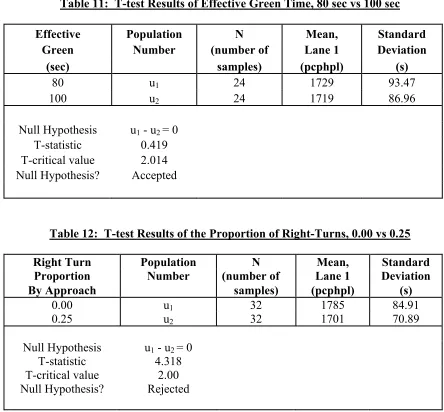
Table 11: T-test Results of Effective Green Time, 80 sec vs 100 sec ... 48
Table 12: T-test Results of the Proportion of Right-Turns, 0.00 vs 0.25 ... 48
Table 13: T-test Results of the Proportion of Right-Turns, 0.00 vs 0.50 ... 49
Table 14: T-test Results of the Proportion of Right-Turns, 0.25 vs 0.50 ... 49
Table 15: T-test Results of Bus Stop Location, 100 feet vs 250 feet... 50
Table 16: T-test Results of Predicted vs Simulated Flow Rates for Accepted Cases... 51
Table 17: T-test Results of Cases D, E, and F ... 52
Table 18: T-test Results of Cases G, H, I, and L ... 53
Table 19: T-test of Simulated Flow Rates vs HCM Flow Rates for Far-Side Stops ... 53
Table 20: T-test of Predicted Flow Rates vs HCM Flow Rates for Far-Side Stops ... 54
Table 21: Case Inputs for Sensitivity Analysis... 56
Table 22: Inputs for Near-Side Cases ... 59
Table 23: Average of Simulated and Predicted Saturation Flow Rate Values - Near-Side Cases ... 60
Table 24: T-test of Predicted Flow Rates vs Simulated Flow Rates for Near-Side Stops.... 62
Table 25: T-test Results of Dwell Time, 15 sec vs 30 sec... 62
Table 27: T-test Results of Dwell Time, 30 sec vs 45 sec... 63
Table 28: T-test of Simulated Flow Rates vs HCM Flow Rates for Near-Side Stops... 64
Table 29: T-test of Predicted Flow Rates vs HCM Flow Rates for Near-Side Stops... 64
Table A1: Far-Side CORSIM Results, Cases 1 - 12... 72
Table A2: CORSIM Results and Calculations, Case 14... 73
Table A3: CORSIM Results and Calculations, Case 15... 75
Table A4: CORSIM Results and Calculations, Case 16... 77
Table A5: CORSIM Results and Calculations, Case 17... 79
Table B1: Near-Side CORSIM Results, Repetitions 1 - 5... 82
List of Figures
Page
Figure 1: Diagram of Time Period One (P1)... 27
Figure 2: Diagram of Time Period Two (P2) ... 28
Figure 3: Diagram of All Three Time Periods... 29
Figure 4: Simulated CORSIM Network ... 32
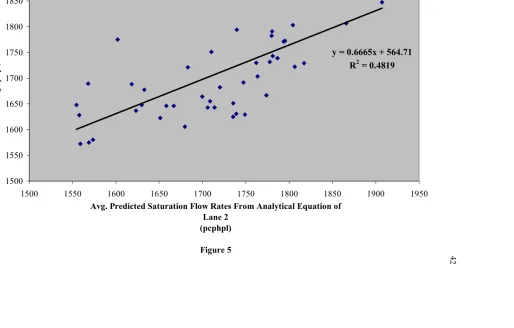
Figure 5: Avg. Predicted Saturation Flow Rates vs Avg. Simulated Saturation Flow Rates (Accepted Cases Only) ... 42
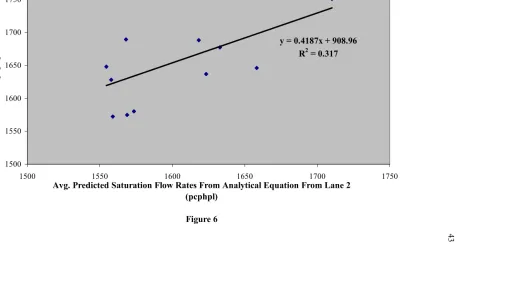
Figure 6: Avg. Predicted Saturation Flow Rates vs Avg. Simulated Saturation Flow Rates Only for Cases with Suffixes D, E, F... 43
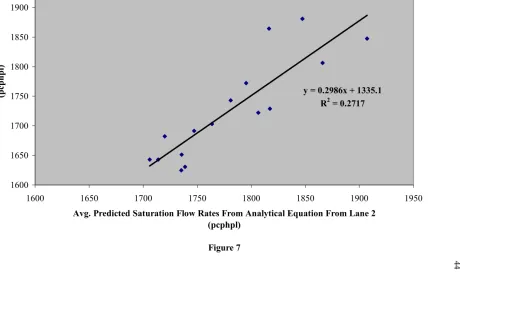
Figure 7: Avg. Predicted Saturation Flow Rates vs Avg. Simulated Saturation Flow Rates Only for Cases with Suffixes G, H, I, L... 44
Chapter 1: Introduction
In the past fifty years, the total number of vehicle-miles traveled on America’s
roadways has rapidly increased resulting in an increase in traffic congestion and a decrease in
the operational integrity of the transportation system. In an attempt to reduce the number of
vehicles and miles traveled, agencies attempt to influence and educate transportation users to
choose alternative modes of travel. Their goal is to advocate public transportation and
person-trips rather than vehicular trips to reduce the number of vehicle-miles, thereby
decreasing the amount of traffic congestion. (1)
On a typical weekday, the transportation system may experience more than seven
million workday commuters using public transportation with some additional thirty million
persons depending on it to reach other destinations. Transit stops may accommodate an
estimated eight billion passenger trips nationally. (2)
For these eight billion public transportation passengers, it is necessary for agencies to
locate and design bus stop locations that provide good service, while trying to minimize any
effects to traffic. Besides stopping traffic to serve passengers, transit vehicles are larger,
slower, and less maneuverable than average automobiles and cause detrimental impacts to
the traffic flow and the facility. The effects of these transit vehicles in the traffic flow can be
observed as a reduction in corridor speed or as an increase in vehicular queues and delay. (1)
Ultimately, better measures of the effects these transit vehicles and their stops have on the
Purpose and Scope
As it currently stands, the NCDOT does not have a formal policy concerning the
construction design or placement of bus stops with respect to its location from intersections
on state maintained roadways in the State of North Carolina. However, a joint effort between
the City of Charlotte and the North Carolina Department of Transportation is currently
underway to develop such a policy for state maintained roadways located within the authority
of the City of Charlotte. As this joint effort continues, it is an objective of this research to
provide recommendations for these agencies to consider in their development of a formal
policy by indicating the potential effects to the transportation system of locating a bus stop
near a signalized intersection.
As a result, the goal of the research is to analyze the effects of a bus stop on the
saturation flow rate of a signalized intersection through the development of analytical
equations with simple, available inputs that estimate those bus stop effects. The equations
will be validated using a simulation of a simple, saturated roadway network with a single bus
route and a single bus stop. As the literature review in Chapter 2 will show, previous
research that investigated the implementation of alternative bus stop designs and treatment
did not evaluate their effect to vehicular traffic during a saturated flow condition. In
addition, keeping the simulation experiment simple allows the researcher to reduce the
number and complexity of the simulation runs as well as minimize the number of factors in
the experiment thereby creating credible and usable results. The validated equations
saturation flow rate. This, in turn, will allow traffic engineers to quantify the effects of bus
stops on the highway system using standardized procedures.
Report Outline
The process of evaluating the effect bus stops have on the saturation flow rate began
with a literature review. This review involved the use of Internet databases, physical searches
of personal, academic, professional, and other resource libraries, and communication with
contacts in the transportation industry. After completion of this review, criteria were
compiled to evaluate the types of bus stops contained in the literature review for evaluation
in this research.
An evaluation matrix examined each alternative bus stop design based on the
availability of analysis tools to evaluate the design, their effects on traffic capacity, the safety
of the bus stop, and their use in North Carolina. After selecting the alternatives for analysis,
analytical equations were developed to predict the effect of these bus stop alternatives on
saturation flow at signalized intersections. A section of this document describes how the
equations were developed and how the assumptions were made. Next, experimental runs
were created using the CORSIM program to validate the performance of the equations. After
completion of the CORSIM runs and after performing the appropriate statistical tests to
assess the validity of the analytical equations, recommendations were made for a future
Chapter 2: Literature Review
The intent of the literature review was to identify any research that has been
performed regarding the effects of a bus stop as it relates to the operational performance of a
signalized intersection. Once this research was identified, questions surrounding the validity
of the results were compiled. These questions led to the creation of criteria used in
evaluating this past research to formulate the scope, design, and limitations of the research.
Highway Capacity Manual Treatment
Prior to the year 1965, approximately 1,600 intersection studies were completed for
the Highway Capacity Manual (HCM) for use in level of service and capacity evaluations in
the HCM. As a result of these studies, it was found that the proportion of heavy vehicles was
a factor that influences an intersection’s operational performance. It was concluded that the
degree of this impact was dependent on the type of vehicle, its weight-power ratio, and its
size and turning characteristics. It was also concluded that the effect of a bus and its stop on
an intersection depended on the area of the city in which it was located (central business
district, CBD, or suburban stop), the street geometrics and channelization, any on-street
parking conditions, and the number of buses. (3) Much of this analysis structure survives in
the current (2000) version of the HCM.
Under prevailing traffic conditions, the capacity of a signalized intersection is
calculated and measured in terms of a saturation flow rate – the equivalent hourly rate at
indication is available at all times and no lost times are experienced. This saturation flow is
measured in terms of passenger cars per hour per lane (pcphpl). (4)
The calculation begins with the selection of an ideal saturation flow rate, So, currently
estimated as 1,900 passenger cars per hour per lane (pcphpl). This ideal flow rate, So, is then
adjusted for field conditions through the utilization of adjustment factors, F, as shown in the
following equation: (4)
S=SoFwFhvFgFpFbbFaFluFltFrtFlpbFrpb , (Equation 16-4, 2000 HCM)
where,
S = saturation flow rate for subject lane group; Fw = adjustment factor for lane width;
Fhv = adjustment factor for heavy vehicles in traffic stream; Fg = adjustment factor for approach grade;
Fp = adjustment factor for existence of a parking lane or parking activity; Fbb = adjustment factor for blocking effect of local buses;
Fa = adjustment factor for area type; Flu = adjustment factor for lane utilization;
Flt = adjustment factor for left turns in lane group; Frt = adjustment factor for right turns in lane group; Flpb = pedestrian adjustment for left-turn movements; and Frpb = pedestrian-bicycle adjustment for right-turn movements.
Of these adjustment factors, Fbb, the bus blockage factor, accounts for the effect of a bus stop
that is located within 250 feet, either upstream or downstream, of the signalized intersection.
The adjustment value is based on the number of lanes in a lane group and the number of bus
the HCM with negligible numerical changes between the values that can be attributed to
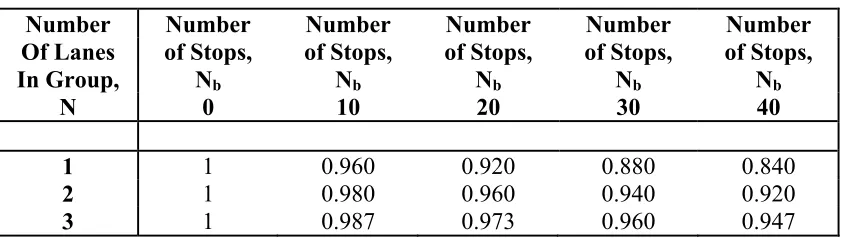
mathematical rounding. Table 1 shows the table for finding Fbb from the 1994 HCM.
Table 1: Bus Blockage Adjustment Factor Values, 1994 HCM
Number Number Number Number Number Number Of Lanes of Stops, of Stops, of Stops, of Stops, of Stops,
In Group, Nb Nb Nb Nb Nb
N 0 10 20 30 40
1 1 0.960 0.920 0.880 0.840
2 1 0.980 0.960 0.940 0.920
3 1 0.987 0.973 0.960 0.947
However, beginning with the 1994 HCM, an equation to directly calculate the value
of the bus blockage factor was introduced: (4)
Fbb = (N – ((14.4Nb)/3600)) / N (Exhibit 16-7, 2000 HCM)
In this equation, ‘N’ represents the number of lanes in the lane group and ‘Nb’ represents the
number of buses stopping per hour. This equation was also recommended for use when the
number of bus stops per hour exceeded 40 in an hour. The 2000 HCM omits the table of bus
blockage adjustment values and only a calculation utilizing the equation is now available.
In the 2000 HCM equation for bus blockage, the value of 14.4 (seconds) represents
the average bus blockage time per bus stop. Of the available bus characteristics that can
impact a facility’s traffic flow, the blockage time is perhaps the most critical. Simply
defined, the blockage time is the amount of time a bus blocks a travel lane. The capacity
reduction to the intersection is directly correlated to the amount of blockage time. A portion
time. Though a field calculation of dwell time is possible, in the absence of field data,
Chapter 27 of the 2000 HCM recommends commonly-accepted values of dwell times from
15 to 60 seconds. The remainder of the blockage time is what is necessary for the bus to
decelerate to a stop and to accelerate from a stop. Chapter 27 of the HCM recommends
typical values of five seconds for deceleration and five seconds for acceleration for a total of
ten additional seconds. (4) When this additional ten seconds is applied to the 14.4 value in
Chapter 16, it is unrealistic to assert that approximately 4.4 seconds is available to serve the
passengers at a bus stop.
A review of the differing bus blockage and dwell times from Chapters 16 and 27
reveal an additional discrepancy in the Fbb adjustment factors from Table 1. If an
HCM-recommended dwell time of fifteen seconds is coupled with the additional ten seconds from
the bus maneuvers to equate a total bus blockage time of twenty-five seconds and as the
number of bus stops (Nb) increase from zero to one per minute, with all other factors held
constant and ideal, the total Fbb adjustment factor increases from zero to forty-two percent.
However, using a bus blockage time of only 14.4 seconds per stop, the HCM adjustment
factor approaches, at most, a twenty-four percent adjustment as the value of Nb approaches
one per minute. Therefore, this research will question whether the value of 14.4 is
appropriate.
Curbside Bus Stop
A common design of most bus stops is the curbside bus stop. With these types of
stops, the bus performs its stop in the actual travel lane. Typically, this stop is either located
the stop bar (i.e., the far-side stop). Located either upstream or downstream, it is the
stopping of the bus in the travel lane that is the curbside’s bus stop greatest impact to the
traffic flow. To analyze the impact to traffic operations, a portion of Transit Cooperative
Research Program (TCRP) Project A-10 was set aside to study how bus stops influenced both
roadway and pedestrian traffic for both the curbside and bus bay types of bus stops on
suburban arterials. (5) The TCRP project visited and collected data at fourteen sites located
in Arizona, Michigan, and California. These field studies indicated that through vehicles
with the far-side bus stop encountered more delay than those with a near-side bus stop. The
project noted that buses stopping at near-side stops, particularly at signalized intersections,
overlapped with the red phases of the traffic signal which resulted in less delay.
During the computer simulation portion of the study, researchers concentrated their
investigations on using such factors as vehicle speeds and maximum queue lengths behind a
stopped bus. The researchers calibrated the models by comparing field studies for travel time
and queue lengths with the data generated by the computer model. In the outputs, a
relationship between vehicle speed differences and bus dwell times was discovered for dwell
times of twenty, forty, and sixty seconds. In its conclusions, the study reported that the bus
bay stop, where an exclusive lane or turnout is provided to remove a bus from the traffic
stream to perform its stop, showed advantages over curbside stops in increased average
vehicle speeds at simulated traffic volumes of 250 and 350 vehicles per hour (vph). (5)
The results of this research indicated, as expected, that when a bus stop is out of the main
travel lane the impact to traffic operations is minimized. However, factors related to such
roadway geometry were not identified as being significant in their field studies or in their
computer modeling. In addition, though a plot of the speed difference versus the total traffic
volume was presented, the impact to the saturation flow was unknown.
Reserved Bus Lanes/Bus Bays
A bus bay is a designated area adjacent to a roadway that allows for the loading and
unloading of passengers while removing the transit vehicle from the adjacent traffic flow.
The removal of buses from the traffic flow allows the facility to maintain a consistent traffic
flow without significant interruption (5). Transportation analysts with the IBI Group in
Toronto, Ontario, Canada, researched the impacts of bus bays on a surface street corridor in
Toronto. The research team wanted to conduct a corridor study to evaluate whether bus bays
are successful in improving bus and corridor performance. Rather than physically
implementing bus bays into an existing transportation system, they chose simulation with the
TRANSYT-7F program, a macroscopic simulation and signal-optimization program, to
model traffic conditions. The decision to use TRANSYT-7F resulted from its history of
analyzing transit priority measures and its estimates of delay based on the principles
associated with the theory of deterministic queuing.
The experiments employed basic study cases that evaluated the ‘before/after’
conditions of transit and traffic flow operations during AM and PM peak hour of traffic
volume. The ‘before’ case consisted of the shared-lane scenario (where a bus and
automobile utilize the same lane) with a curbside bus stop. The ‘after’ case simulated the
existence of a bus bay that separated the transit vehicle from the adjacent traffic flow. To
conducted to collect data on traffic signal delay, total vehicular travel time, and bus stop
dwell time. Using field validation, the local saturation flow rate was calculated.
The research results showed that the average delay and travel time for the adjacent
traffic increased by 28% and 15%, respectively, with a 15% decrease in average speed, as the
bus dwell time increased to serve the increased bus ridership. Likewise, buses experienced a
14% reduction in average delay and a 9% reduction in average travel time with an 11%
improvement in average speed. As can be seen by these results, the improvements in bus
operation were exceeded by the degradation impacts to the adjacent traffic stream. However,
it was unclear whether the increased bus ridership and dwell time was attributed to a possible
traffic shift to other surface street routes with the implementation of bus bays or whether
users actually switched to the transit mode. (6)
As the research noted, the use of the TRANSYT-7F program resulted in unreliable
capacity estimates as the degree of saturation approached 100%. However, it is at the
saturated condition where the greatest detrimental impact of a bus stop on an intersection’s
capacity should be measured. Therefore, for this research, a computer simulation program
will be selected that will allow saturated traffic conditions to be analyzed so that the
detrimental impact to an intersection’s capacity can be quantified.
Queue Jumpers
A portion of TCRP Project A-10 also studied the queue jumper, a unique type of bus
bay, in a transit-priority design that provides the bus the ability to bypass queued vehicles at
a signalized intersection to reach a far-side bus stop. This bypass maneuver is accomplished
intersection. This exclusive lane allows for a direct movement to a far-side bus stop. A
queue jumper removes a bus from the traffic flow and allows it to make its stop while being
removed from the traffic flow. A queue jumper study was performed to develop possible
recommendations for queue jumper designs at far-side bus stops. The potential benefits of a
queue jumper for buses are measured in terms of travel time savings and an increase in
speed. To estimate the advantages of a queue jumper, the travel time savings were converted
to speeds. The research indicated that the bus benefits of a queue jumper were noticed once
traffic volumes exceeded 250 vph. (5) A queue jumper is an example of a transit-priority
design that improves the efficiency and operation of the transit vehicle. By removing a
transit vehicle from the main traffic flow via an exclusive lane, its impact to saturation flow
rate has already been minimized. Therefore, this bus stop design would not be a good
treatment to analyze for its effect on the saturation flow rate.
Traffic Signal Bus Preemption
Khasnabis, Karnati, and Rudraraju discuss traffic signal preemption techniques that
provide preferential treatment for bus progression through signalized intersections. (7) This
priority is achieved via green extension, red truncation, or red interruption. Green extension
increases the green time by a specified amount. Red truncation terminates a red phase with
the injection of a short green phase that is not a part of the normally-programmed green
phase. The lack of contiguity with using a red truncation calls for additional time to be
incorporated into the clearance phase. With each technique, an increase in green time, a
reduction in delay, a reduction in queue lengths, and an increase in vehicle capacity are the
To analyze this signal preemption, the researchers chose the NETSIM software. The
primary objective of the research was to develop a procedure for assessing the operational
impacts of implementing the signal preemption. To perform the research, a series of
signalized intersections on a primary bus route in Ann Arbor, Michigan was selected for data
collection and validation. To minimize the complexity of the data collection, a number of
signalized intersections were excluded based on their complex phasing and actuated signal
operations.
At the outset, it was suggested that bus preemption may adversely impact side street
traffic operations as the preferential allocation of effective green time for the main street
increases vehicular delay and queue length on remaining approaches not given preferential
treatment. However, the paper indicated that no preemption technique was validated in its
entirety with this research nor should it be used to evaluate the results of bus preemption on
intersections, and that further research is necessary to estimate a net savings in vehicular
delay. (7)
Transit Priority Traffic Signal Timing
The Southwest Region University Transportation Center presented research into
modifying the existing transportation infrastructure in lieu of the higher cost of physically
reconstructing a transportation infrastructure. (8) To offset an increased traffic demand and
congestion, the encouragement of high occupancy vehicles (HOV) such as surface street
buses, as an alternative in meeting travel demand, was introduced. This research noted that
one method of promoting the use of mass transit by increasing its operational efficiency in
research team believed that the signal timing adjustments should be re-focused on the entire
transportation system and not just at a single point, i.e. the transit vehicle.
To model and simulate the impacts of implementing any signal timing priority
scheme, the TRAF-NETSIM software, a microscopic simulation program that analyzes
individual vehicles as they interact with other vehicles, was chosen. The simulation used
signal timing methods such as green extension or red truncation over a run time of sixty
minutes to evaluate any effect from a signal adjustment. The researchers simulated traffic
volumes that ranged, in increments of 10%, from 0% to 100% of saturated flow. In each
simulation run, a transit priority cycle was inserted in lieu of the normal signal timing plan
once every ten minutes to simulate a ten-minute bus headway. After completing these
NETSIM runs, an increase in travel delay was observed along with a degree of uncertainty as
to whether the bus benefits of the transit priority signal timing scheme outweighed the delay
increase incurred by the remaining vehicles.
The NETSIM outputs indicated that once the level of saturation reached 100%,
priority signal timing schemes yield no significant advantage. The results further noted
limited success utilizing the green extension treatment method with a near-side bus stop.
However, the research indicated that priority methods might have success with far-side bus
stops since the measure of effectiveness is no longer a direct function of the bus dwell time.
The researchers further noted that the use of the green extension method could allow traffic
to operate under its normal signal timing scheme. The results showed a positive effect in that
transit vehicles gain a significant share of trips through the use of a priority signal timing
cycle length, transit delay, and vehicular delay can in fact decrease. However, it should be
noted that the runs involved with this research concentrated on off-peak times of operation.
Therefore, the researchers indicated that an emphasis on peak hour operations when traffic
corridors are operating at their highest possible degree of saturation needs to be performed.
(8)
Contra-Flow Bus Lanes
In order to improve surface street traffic operations, Rouphail presented research
involving the use of contra-flow bus lanes and the programming of traffic signal settings to
minimize passenger delays rather than using the conventional signal timing method of
minimizing vehicular delays. (9) The research intent was to evaluate the relationship between
bus performance and signal priority techniques. A contra-flow bus lane provides a bus an
exclusive lane to travel and perform its operation in the opposite direction of the adjacent
traffic flow. The advantage of a contra-flow bus lane is that any bus blockage of traffic flow
is eliminated and the adjacent traffic flow is not impeded, although cars lose the use of one
lane.
The research reflected actual field observations on a typical Chicago, Illinois,
downtown street where a contra-flow bus lane was installed in 1980. The conclusions
indicated that bus operation dramatically improved with the dedication of an exclusive lane
to bus traffic. This improvement was observed by an increase in the overall bus speed on the
route. This separation of bus traffic from the normal traffic flow was viewed as a means of
To evaluate the effectiveness of the contra-flow bus lanes and a traffic signal timing
priority schemed designed to minimize passenger delays, the researchers chose the
TRANSYT-7F program. In using this program, six scenarios were developed for analysis.
However, with the density of the pedestrian traffic in the study area, the default saturation
flow rate in TRANSYT-7F was revised.
The TRANSYT-7F model results showed that the degree of operational improvement
was dependent on whether the buses operated in mixed traffic conditions or in exclusive
contra-flow lanes. In addition, the research noted that the total number of vehicle-miles for
the nonbus traffic did decrease after the implementation of the contra-flow bus lane. The
research noted that some of the improvements in nonbus traffic could be attributed to the
increased bus ridership. Though a ridership increase and a lower total of vehicle-miles
traveled with the implementation of the contra-flow bus lane has a positive impact on a
congested arterial, the impact of these bus treatment measures on the saturation flow rate was
still not known. (9)
The literature review uncovered several research projects that looked at different
strategies and bus stop treatments at intersections to improve bus performance while also
attempting to reduce the magnitude of traffic congestion on our nation’s roadways. The
analysis for each of these strategies typically resulted in an improvement and enhancement of
the bus ridership and operations. However, as buses and vehicles predominately share the
same travel lanes, the magnitude of the bus operation improvement was usually at a cost to
the vehicular portion of the traffic stream. Whether it was an increase in bus ridership that
signal network was optimized for bus vehicles to improve or maintain its service, it is the
vehicular traffic that is negatively impacted. This impact to vehicular operations was not
accurately estimated or, at times, even noted in the research analysis. Though certain
research reported the degradation to adjacent vehicles in terms of speed or delay, a more
basic measure of the impact a bus stop has on an intersection, its saturation flow rate was not
quantified. Though computer software such as TRANSYT-7F was used to evaluate traffic
operations, at the time the computer software included flaws in its modeling that can
inaccurately report the level of operations, especially at saturated conditions. In addition,
most of the research and computer software had its handling of bus operations and its effects
on the traffic stream rooted in the Highway Capacity Manual. In using the manual, it is
observed that the handling and characteristics of buses and bus stops from the average or
typical bus blockage time to the equations to use differ even between the chapters of the
same manual.
With the clear discrepancies in the average bus blockage times found in Chapters 16
and 27 of the Highway Capacity Manual, 14.4 and 25 seconds respectively, and the lack of
any conclusive analysis in the literature review of the impacts that an alternative bus stop
design and treatment have on an intersection’s saturation flow rate, this research will focus
its efforts on developing analytical equations that serve to more accurately estimate and
quantify the bus blockage adjustment factor for use in the calculation of an intersection’s
Chapter 3: Alternative Selection
Upon completion of the literature review, a list of bus treatments that have the
potential for further analysis was compiled. This list was narrowed in an evaluation matrix
that uses criteria that arose during the literature review that measure the scope of the impacts.
The first criterion measures the potential use and application of the bus stop on roadways in
the State of North Carolina. The second criterion measures the ability of computer software
such as CORSIM, TRANSYT, Synchro, and HCM to analyze an intersection containing a
bus stop. The next criterion measures the effects the bus stop treatment has on the vehicular
safety of the adjacent traffic volume. This criterion measures the expectation of a transit
vehicle performing a stop and how this expectation alters driver behavior. The remaining
criteria measure the use of a particular type of bus stop and its effect on the capacity of a
signalized intersection and the effect it can produce on transit operations in terms of whether
transit can deliver a high quality of service to its users. Each bus stop treatment was assigned
a categorical score - positive, negative, or neutral benefit – based on its comparison to a
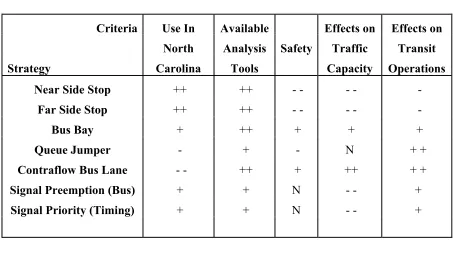
signalized intersection without a bus stop. Presented in Table 2 is an evaluation matrix that
shows the score for each bus stop treatment in each criteria category that was used in
Table 2: Alternative Evaluation Matrix
Criteria Use In Available Effects on Effects on
North Analysis Safety Traffic Transit
Strategy Carolina Tools Capacity Operations
Near Side Stop ++ ++ - - - - -
Far Side Stop ++ ++ - - - - -
Bus Bay + ++ + + +
Queue Jumper - + - N + +
Contraflow Bus Lane - - ++ + ++ + +
Signal Preemption (Bus) + + N - - +
Signal Priority (Timing) + + N - - +
Legend
+ + = very positive effect + = somewhat positive effect N = neutral effect
- = somewhat negative effect - - = very negative effect
Alternatives that create only marginal results as well as those that would create a
complex experimental design beyond the constraints of the research were not selected. After
considering the results of the literature review and the evaluation matrix, two alternatives
emerged as promising for further analysis. In the following sections, the two alternatives
selected for further analysis are discussed with the remaining sections examining those
alternatives that were not selected.
Curbside bus stops, both near-side and far-side, appropriately satisfied the
selected as the most promising alternatives for further analysis. These common types of bus
stops are perhaps the easiest and most convenient for passengers and transit vehicles to use.
However, these curbside stops are perhaps the most detrimental to the traffic flow.
As a curbside stop occurs in the traffic flow lane, they impede traffic progression and
reduce the number of vehicles that an intersection can process. With the relative ease and
ability to model these types of stops, obtaining credible results and conclusions can be
accomplished within the constraints of the research.
Though not a common bus design treatment on North Carolina’s roadways due to the
right-of-way necessary for it, a bus bay bus stop is a condition where a transit vehicle uses
an exclusive travel lane or turnout to perform its stop. A major advantage of the bus bay is
the opportunity it provides for a bus to perform a stop while removed from the traffic flow.
This opportunity assists in minimizing the impact the stop has on the adjacent traffic flow.
With the stop performed outside of the traffic flow, the surrounding vehicles can continue
their normal traffic progression.
Though the bus bay allows a stop to occur outside the traffic flow, a degree of
concern is introduced when the transit vehicle exits and re-enters the traffic stream. Due to
the nature of the transit vehicle, the amount of time and space necessary for it to decelerate
and accelerate before and after the stop may alter the behavior of the adjacent traffic flow.
However, with an overall positive benefit to the traffic flow of a bus bay, it was not selected
for further analysis.
An uncommon design in North Carolina, a queue jumper is a type of bus stop that is
turn lane, allows a bus to bypass a standing queue, if it exists, and to progress through the
intersection to perform a stop in an extension of this exclusive lane on the far-side of the
intersection. Though the frequency of implementing this type of stop is low, it does provide
benefits to transit similar to a bus bay. By utilizing an exclusive lane to bypass a vehicle
queue, a bus can avoid delay in performing its stop. In addition, the exclusive transit lane
allows the normal traffic progression to continue without impedance from a stopped bus. As
is the case with a bus bay stop, the deceleration and acceleration associated with the bus
exiting and re-entering the traffic stream can provide some impacts to traffic operations.
Though the initial exiting and re-entering of the bus into the traffic stream will degrade
traffic operations, the traffic progression is not forced to endure additional effects that result
from a stopped bus. With an overall positive impact to the adjacent traffic flow, a queue
jumper was not selected for further analysis.
Extremely uncommon in North Carolina, a contra-flow bus lane is an exclusive
transit lane that allows transit vehicles to perform their stops while traveling in the opposite
direction of the vehicular traffic flow on a one-way street. The potential for this design to
provide a positive benefit to transit operations and the surrounding traffic flow may be
substantial where it can be implemented. As a bus performs its functions outside of the
traffic flow, the acceleration and deceleration characteristics and the dwell time that
accompanies each stop is not a direct impact to the adjacent traffic flow. However, a degree
of concern exists where these contra-flow lanes intersect and interact with the normal traffic
flow. Also, a contra-flow lane does reduce the number of lanes available for cars, and there
analyzed in a computer simulation program, with its significant potential of providing
positive benefits to the surrounding traffic operations, its effect on the saturation flow rate
will be minimal. Therefore, a contra-flow bus lane was not selected for further analysis.
Where implementing physical treatments for a bus and a bus stop are not feasible, the
use of traffic signal preemption is a possibility. The objective of this or any other type of
preemption technique is to provide some kind of preferential treatment to ease the movement
of a particular vehicle or approach. This preferential treatment is usually achieved at the
expense of the other users of the network. Various preemption techniques may involve
extending the green time for an approach or by truncating a phase to induce a red signal
indication to allow for a preferential movement. However, the measures of the benefits or
costs to an intersection’s capacity and traffic progression are difficult to quantify. These
preemption techniques are difficult to analyze in a computer simulation program as a
complex experiment design is needed. For these reasons, this technique was not selected for
further analysis.
The last alternative studied in the literature review was transit priority in traffic
signal timing. As noted by Rouphail (4), the standard in developing a traffic signal timing
plan is to use the minimal amount of green time necessary to process the maximum amount
of vehicles possible while vehicular delay is minimized to the maximum extent possible. If
this standard is followed, in theory, the capacity of the intersection and its traffic progression
are optimized. However, when a signal timing plan is developed with its focus to ensure that
published stop schedule, the magnitude and severity of the impacts to the surrounding traffic
flow and approaches are secondary considerations.
Selection Summary
Based on the criteria that were compiled after the literature review, two alternatives,
the near-side and far-side bus stops, were selected for further analysis and experimentation
with a computer simulation program. These alternatives have the potential to produce a
significant impact to an intersection’s saturation flow rate. As for the remaining alternatives
that were not selected, they either already have a positive benefit to the surrounding traffic
flow (bus bay, queue jumper, contra-flow lane) or they focus on improving bus operations
and not necessarily improving the adjacent traffic flow (signal preemption, signal timing) and
Chapter 4: Equation Formulation
The Highway Capacity Manual (4) is the pre-eminent traffic operations analysis
reference in use in the United States. In reviewing the HCM, we see that the bus blockage
time includes the time to serve the passengers, or dwell time, and the deceleration and
acceleration time involved in entering and exiting the bus stop. According to Chapter 27 of
the HCM, a typical dwell time value, Dw, for an outlying (suburban) stop is approximately
fifteen seconds with an accepted value of five seconds for the deceleration and five seconds
for the acceleration time (ten seconds total) for the bus at the bus stop. Given a typical
outlying stop, the typical bus blockage time would be twenty-five seconds (Dw +
deceleration + acceleration, or 15 + 5 + 5). This pause in vehicle movement has its
maximum impact on the saturation flow rate when it occurs during the effective green time
period of the traffic signal cycle.
Near-Side Bus Stop
When a near-side bus stop is assumed with random bus arrivals, the chance that a bus
stop occurs during the effective green time (g) is equal to the g/C ratio, or the effective green
time to total cycle length time (C) ratio. With the g/C ratio applied to the value of the total
bus blockage time (BT) for all buses that stop (Nb) in a given time frame (e.g., one-hour), the
proportion of the green time blocked for that one-hour time period is expressed in the
Proportion Blocked = Nb * BT * g/C
For example, if a cycle length of 100 seconds has an effective green time of 40 seconds and a
bus blockage time of 25 seconds with 6 bus stops occurring, the following proportion of one
hour of green that is blocked by the bus given these arbitrary values is as follows:
Nb * BT * g/C = 6 bus/hour * 25 sec/bus * (40/100) sec/sec
= 60 sec blocked/hour
Given the units that remain and that the equation is for the proportion of one hour of green
that is blocked, to find the proportion of a real hour that is blocked, we need to divide by the
g/C ratio times 3,600 seconds, or 1,440 seconds, as follows:
Proportion of hour blocked = 6 bus/hr * 25 sec/bus * (40/100) sec/sec = 60 sec blocked (40/100) sec/sec * 3600 sec/hr = 1440 sec of green time
The result of this example is that 0.04167, or 4.167%, of the hour is blocked by the bus. It is
clearly observed that the g/C ratio factors out and is of no consequence in evaluating the
effect of a near-side bus stop on the saturation flow rate. In the equation for the bus blockage
adjustment factor, Fbb in the HCM, the value of 14.4 represents an average bus blockage
time, in seconds. Noting Chapter 27 of the HCM and the recommended value of the
blockage time for a typical bus stop of 25 seconds, the value of 14.4 can be questioned.
Accounting for the fact that a lane group may contain more than one lane, the saturation flow
rate adjustment factor for bus blockage, Fbb, for a lane group with N number of lanes can be
calculated as follows:
Far-Side Bus Stop
Though the effective green time and bus stop positioning are of no consequence for a
near-side bus stop location, these same statements, assumptions, and conclusions cannot be
made for the far-side bus stop location. As the near-side scenario prohibits vehicles from
progressing through the intersection while a bus stop is in progress, the far-side stop allows
for the movement of vehicles through the intersection to continue. However, the limitations
of this continued progression is based upon two distinct factors – the amount of vehicle
storage between the bus stop and the stop line and the point within the signal cycle when the
stop is made.
In developing an equation for the far-side bus stop, the bus could stop during three
distinct time periods (P1, P2, and P3). The critical detail in deriving this equation is the
distance of the far-side bus stop from the stop bar of the signalized intersection. Each of the
three time periods were measured relative to when the bus passed the stop bar. For each
period, an average number of vehicles (V1, V2, and V3) that could use the shared
through-right turn lane during each time period are calculated to achieve a total number of vehicles
for each signal cycle with a bus stop for all three time periods (VT).
The first time period (P1) applies when the bus moves past the stop bar early in the
green phase starting when the effective green (g) equals zero. The ideal number of vehicles
is the amount that can traverse the intersection during the effective green time of the
intersection given no buses stopping during the signal cycle. Given an average vehicle
headway (h), this magnitude can be expressed as the effective green time (g) divided by the
the lane. Therefore, given the value of the bus blockage time (BT) and the vehicle headway
(h), the number of vehicles that are blocked can be calculated by dividing the blockage time
(BT) by the headway (h), or BT/h. However, vehicles can move past the stop bar as the
far-side bus stop is performed to fill the distance between the stop bar and the bus stop or to
make right-turns. Therefore, the number of vehicles that can get past the stop bar while the
bus is stopped is the number of storage spaces between the stop bar and the back of the bus
(St) divided by the proportion of through vehicles in the traffic stream (1 - Prt), where Prt is
the proportion of right-turns in the shared lane, St / (1 – Prt). Finally, we need to adjust for
time lost between when the bus finishes its stop and when the vehicles start flowing again.
This can be expressed as (L + h)/h, where ‘L’ is the lost time in seconds. Putting all of these
parts together, the average number of vehicles (V1) processed during the first time period (P1)
is computed by the following equation:
V1 = g/h – BT/h + St/(1-Prt) – (L + h)/h
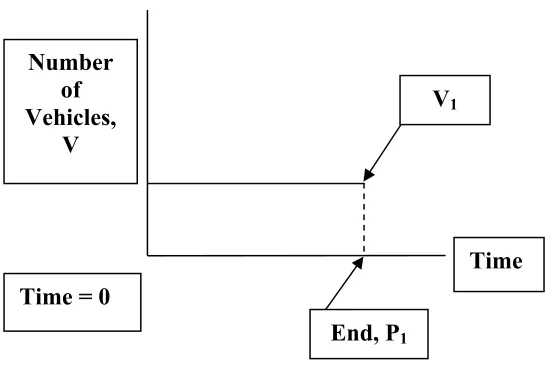
The first time period ends at that time at which a stopped bus would start again, but
no more vehicles could be processed past the stop bar because the signal had turned red.
This time is (g – BT – (L + h)) which leads to the assumption that BT + L + h < g. A
Figure 1: Diagram of Time Period One (P1)
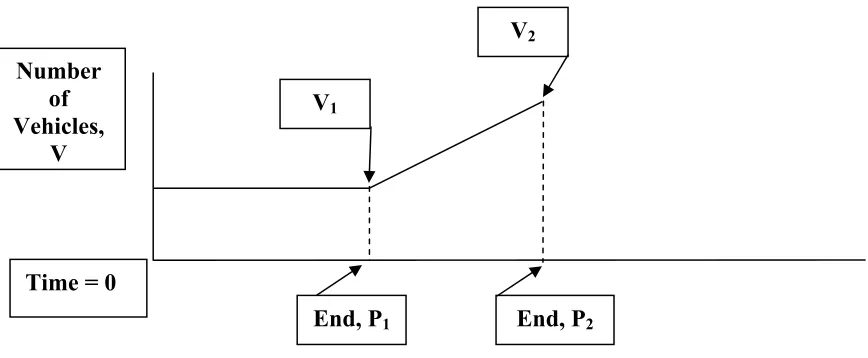
The second time period (P2) begins with the bus passing the stop bar at some point in
time greater than the value of (g – BT – (L + h)), or the end of P1. During P2, the storage
spaces behind the bus are filled so no more vehicles are processed by the travel lane, and the
bus does not start moving soon enough to allow vehicles to get beyond the stop bar because
the signal turns red. The number of vehicles that can be processed during a green phase
when a bus stops during P2 increases linearly during P2 from the number processed during P1
to the number processed during time period three, P3 (g/h, see below). The average number
of vehicles (V2) processed when a bus stops during P2 can be computed as:
V2 = (V1+ V3) / 2 =
(g/h – BT/h + St/(1-Prt) – (L + h)/h + g/h) / 2
P2 holds from the end of P1 at (g – BT – (L + h)), until the bus stop is no longer an issue to
the vehicles in the travel lane. This occurs at the time (g – (St * h)/(1 - Prt)). At that time and
for the rest of the effective green period, the storage spaces behind the stopped bus will not
fill up. Thus, the calculation of the length of P2 is as follows:
Number of Vehicles,
V
End, P1
Time = 0
V1
P2 = End of P2 – End of P1 = g – ((St * h)/(1 – Prt)) - (g – BT – (L + h)) =
BT – (St * h)/(1 – Prt) + L + h
A diagram of V2 and P2 is presented in Figure 2.
Figure 2: Diagram of Time Period Two (P2)
This leads to another assumption that BT + L + h > (St*h)/(1-Prt). During time period three
(P3), the bus stops so late in the green phase that the storage spaces are not filled before the
signal turns red.
With the bus stop no longer an issue, the number of vehicles that can be processed in
P3 by the travel lane is simply the ideal value of g/h. With the limit of the three distinct time
periods equal to the value of the effective green time, the length of P3 is calculated by
subtracting the beginning of P3 from the effective green time, g, as follows:
P3 = End of P3 – End of P2 = g - (g + (St * h)/(1 – Prt)) = (St * h)/(1 – Prt)
Number of Vehicles,
V
End, P1 End, P2
Time = 0
V1
With all time periods derived, the equation to obtain the average number of vehicles
processed during a green phase (VT) with a bus stop is as follows:
VT = (1 / g) * (V1 * P1 + V2 * P2 + V3 * P3)
In the preceding equation, P1, P2, P3, and g are calculated in seconds. Graphically, these
three distinct time periods are shown in Figure 3:
Figure 3: Diagram of All Three Time Periods
For example, if an effective green time of 40 seconds, a blockage time of 20 seconds, a
vehicle headway and lost time of 2 seconds each, a proportion of right turns at 0.50 (50%),
and 4 storage spaces are allowed behind a stopped bus, the average number of vehicles
expected for that cycle is computed as follows:
V1 * P1 = (40/2 - 20/2 + 4/(1-0.50) – (2+2)/2)*(40-20-2-2)
= (20 – 10 +8 – 2)*(40 – 20 – 4) = 256 veh-sec
Number of Vehicles,
V
Time
End, P1 End, P2
Time = 0
End, P3
V1
V1 * P1 = (g/h – BT/h + St/(1-Prt) – (L + h)/h + g/h)*(BT – (St * h)/(1 – Prt) + L + h)
= ((40/2 – 20/2 + 4/(1-0.50) – ((2+2)/2) + 40/2) * (20 – (4*2)/(1-0.50) + 2 + 2)
= ((40 – 10 + 8 – 2)/2)*(20 – 16 + 4) = 144 veh-sec
V3 * P3 = (g/h)*((St * h)/(1 – Prt)) = 40/2 * ((4*2)/(1-0.50))
= 20 * 16 = 320 veh-sec
VT =(1 / g) * V1 * P1 + V2 * P2 + V3 * P3
VT =40 * (256 + 144 + 320) = 18 vehicles per cycle containing a bus
With the average number of vehicles calculated, to obtain the saturation flow rate adjustment
for that cycle, the average number of vehicles (VT) is divided by the ideal number of vehicles
that can be processed by the intersection, g/h, which are 20 vehicles for this example.
Therefore, the adjustment factor is 18/20 or 0.90. This adjustment factor accompanied by an
adjustment factor for any cycles in an hour of analysis that does not contain a bus stop will
Chapter 5: Simulation Approach and Results
This chapter will address the process involved in creating and performing the
simulation runs that provide the data used to validate the equations derived in the last
chapter. The research relied upon CORSIM v. 5.1, a microscopic, stochastic simulation
package developed by the Federal Highway Administration (FHWA). With its established
track record, the ability to obtain and analyze results quickly, the ease in estimating
parameters, the ability to control the surrounding parameters, the ability to view simulations
in TRAFVU, and its ability to avoid the logistical difficulties that are encountered in
performing field experiments, the CORSIM simulation package was a good choice for this
research. Appropriate steps to ensure that CORSIM provides credible estimates of the
impact of bus stops on the saturation flow rate were followed.
When a traffic signal indication turns green, a separation between vehicles, or
headway, is introduced, measured in terms of seconds between consecutive vehicles crossing
the stop bar. If a consistent headway and a continuous green signal indication are observed
for a specified time period, e.g., a one-hour time period, a maximum theoretical flow rate is
expected. Any interruption in the green time will result in a capacity reduction. (4)
Method of Analysis
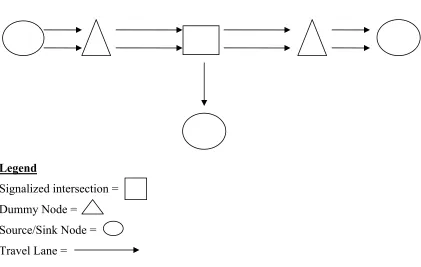
The research used CORSIM to model a saturated roadway network with one isolated,
pre-timed signalized intersection (Figure 4). Typical values regarding traffic signal timing
and roadway operations were assumed when needed. The entry number of vehicles per hour
reflect a saturated traffic condition. Efforts were made to view the simulations in TRAFVU
as well as examining the CORSIM output to verify the existence of a saturated flow
condition for each case simulated.
Legend
Signalized intersection = Dummy Node =
Source/Sink Node = Travel Lane =
Figure 4: Simulated CORISM Network
Each case simulated had two travel lanes: an exclusive through lane (CORSIM Lane
2) and a combination through-right turn lane (CORSIM Lane 1) that contained the curbside
bus stop. After the simulation runs were performed, data regarding the vehicle discharge for
the combination through-right turn lane was retrieved. By applying the amount of effective
green time and its proportion of the 60-minute simulation time period against the vehicle
is calculated. The discharge value for the combination lane already accounts for the effects
of the proportion of right-turns as well as the effects of the bus stops. For Lane 2, using the
proportion of the time period that is the effective green time and to the
discharge value, we can obtain a saturation flow rate. The inverse of this saturation flow rate
(3600 seconds / ideal flow rate) is calculated to obtain the headway per vehicle. Since Lane
2 did not contain any turn lanes, turning vehicles, or heavy vehicles and with all the
remaining details of Lane 2 having adjustment factors equal to 1.00, this calculated flow rate
value is referred to as the ‘ideal’ saturation flow rate per lane for each case.
The research consisted of two basic experiments – far-side and near-side bus stops.
For the far-side bus stop experiment, each simulation run was composed of a 60-minute time
period that is preceded by a warm-up (equilibrium) period not to exceed fifteen minutes. The
selection of a 60-minute time simplifies the subsequent calculations and allowed the
simulations to achieve stable operations. To obtain the saturation flow rate, output
referencing the vehicle discharge per lane, the average queue per lane, and the number of
buses serviced during the time period is utilized. Though additional performance data are
found in the CORSIM output, this research will only rely on select output that is used to
directly calculate the saturation flow rate.
In the experimental design, CORSIM requires the selected simulation time period be
evenly divisible by the traffic signal cycle length. If this situation does not exist, CORSIM
will revise the cycle length to a value that satisfies this constraint. To avoid any artificial
the 2000 HCM (pg. 16-160) suggests that to produce statistically significant values, a
minimum of fifteen complete signal cycles should be observed. Though CORSIM has the
ability to model actuated traffic signals, since each simulation contained a traffic volume that
sustained saturated conditions, actuated signals would behave like pre-timed traffic signals
anyway. Therefore, with each simulation having a 60-minute (3,600-second) time period, a
fixed cycle length of either 100 or 150 seconds that results in 24 to 36 complete signal cycles
per hour was used.
If a left-turn maneuver were introduced, to obtain any significant data, an opposing
traffic volume would need to be introduced into the simulation, thereby complicating the
research greatly. Therefore, with only traffic volumes simulated in a one-way direction, no
left-turning vehicles or maneuvers are included in this research. The remaining design
details listed below remained constant for all models. These values were also selected to
minimize any additional adjustment of the saturation flow rate:
a 90-degree intersection
free flow speed of 30 miles per hour
yellow and all red time of 4 seconds and 0 seconds, respectively lost time of 2 seconds
0% grade
Far-Side Bus Stop
Cases 1 – 12 modeled a basic roadway network with no buses with cases 13 to 17
modeling the far-side bus stop. With the high number of cases, only two repetitions of each
case were needed to provide adequate sample sizes. The two repetitions will use a different
set of random number seeds that were chosen from a spreadsheet of 8-digit random numbers
lane and a combination through-right turn lane and one pre-timed, signalized intersection.
The number of vehicles per hour necessary to sustain a saturated flow condition was selected
from a range of 1,000 to 2,500 vehicles per hour (vph). A 150-second signal cycle length
was selected that results in 24 complete signal cycles per simulation time period. Noting that
the effect of the far-side stop depends on the portion of the green phase in which the bus
arrives at the stop, four levels of effective green time (40, 60, 80, and 100 seconds) were
used. Three levels of right-turn percentage (0%, 12.5%, and 25% of the approach volume)
were selected. According to Chapter 16 of the HCM, the bus blockage factor measures the
effect of bus stops that occur within a 250-foot distance of the stop line. Therefore, bus stop
locations approximately 100 feet and 250 feet downstream of the stop line were modeled.
We could not make the bus stop any closer to the stop bar without the bus blocking part of
the cross street, which is not allowed in CORSIM. With the variability of the effective green
time and the restrictions on the far side analytical equation noted previously, only two levels
of bus dwell time (15 and 30 seconds) were modeled. Using a bus headway of 5 minutes
allows each bus and bus stop to remain independent of the preceding and proceeding one.
36
1 2 3 14a 14b 14c 14d 14e 14f 14g 14h 14i 14j 14k 14l
Right Turn % By Approach (veh) 0 12.5 25 0 12.5 25 0 12.5 25 0 12.5 25 0 12.5 25
Dwell Time (sec) 0 0 0 15 15 15 30 30 30 15 15 15 30 30 30
Bus Headway (minutes) 0 0 0 5 5 5 5 5 5 5 5 5 5 5 5
Bus Stop Distance from Stop Bar (feet) 0 0 0 100 100 100 100 100 100 250 250 250 250 250 250 Vehicles per hour (vph) 1000 1000 1000 1000 1000 1000 1000 1000 1000 1000 1000 1000 1000 1000 1000
60-Second Effective Green Case
4 5 6 15a 15b 15c 15d 15e 15f 15g 15h 15i 15j 15k 15l
Right Turn % By Approach (veh) 0 12.5 25 0 12.5 25 0 12.5 25 0 12.5 25 0 12.5 25
Dwell Time (sec) 0 0 0 15 15 15 30 30 30 15 15 15 30 30 30
Bus Headway (minutes) 0 0 0 5 5 5 5 5 5 5 5 5 5 5 5
Bus Stop Distance from Stop Bar (feet) 0 0 0 100 100 100 100 100 100 250 250 250 250 250 250 Vehicles per hour (vph) 1500 1500 1500 1500 1500 1500 1500 1500 1500 1500 1500 1500 1500 1500 1500
80-Second Effective Green Case
7 8 9 16a 16b 16c 16d 16e 16f 16g 16h 16i 16j 16k 16l
Right Turn % By Approach (veh) 0 12.5 25 0 12.5 25 0 12.5 25 0 12.5 25 0 12.5 25
Dwell Time (sec) 0 0 0 15 15 15 30 30 30 15 15 15 30 30 30
Bus Headway (minutes) 0 0 0 5 5 5 5 5 5 5 5 5 5 5 5
Bus Stop Distance from Stop Bar (feet) 0 0 0 100 100 100 100 100 100 250 250 250 250 250 250 Vehicles per hour (vph) 1900 1900 1900 1900 1900 1900 1900 1900 1900 1900 1900 1900 1900 1900 1900
100-Second Effective Green Case
10 11 12 17a 17b 17c 17d 17e 17f 17g 17h 17i 17j 17k 17l
Right Turn % By Approach (veh) 0 12.5 25 0 12.5 25 0 12.5 25 0 12.5 25 0 12.5 25
Dwell Time (sec) 0 0 0 15 15 15 30 30 30 15 15 15 30 30 30
Bus Headway (minutes) 0 0 0 5 5 5 5 5 5 5 5 5 5 5 5