A Review of Load Balancing and its
Challenges in Cloud Computing
Pamini Jain, Prof. Sapna Choudhary
M. Tech Research Scholar, Department of Computer Science & Engineering, Shri Ram Group of Institution,
Jabalpur, India
Assistant Professor, Head of the Department, Department of Computer Science & Engineering, Shri Ram Group of
Institution, Jabalpur, India
ABSTRACT: Load Balancing is necessary for efficient operation in distributed environments. As Cloud Computing is increasing speedily and clients are demanding more services and better results, load balancing for the Cloud has turn into a very motivating and imperative research area. Many algorithms were suggested to provide efficient mechanisms and algorithms for assigning the client’s requests to available Cloud nodes. These approaches aim to enhance the overall performance of the Cloud and provide the user more satisfying and efficient services. In this paper, we investigate the different algorithms proposed to resolve the issue of load balancing and task scheduling in Cloud Computing. We discuss and compare these algorithms to provide an overview of the latest approaches in the field.
KEYWORDS:Cloud Computing, Load Balancing, Task Scheduling, Cloud Storage, Replications.
I. INTRODUCTION
Cloud Computing became very popular in the last few years. As part of its services, it provides a flexible and easy way to keep and retrieve data and files. Especially for making large data sets and files available for the spreading number of users around the world. Handling such large data sets require several techniques to optimize and streamline operations and provide satisfactory levels of performance for the users. Therefore, it is important to research some areas in the Cloud to improve the storage utilization and the download performance for the users. One important issue associated with this field is dynamic load balancing or task scheduling. Load balancing algorithms were investigated heavily in various environments; however, with Cloud environments, some additional challenges are present and must be addressed. In Cloud Computing the main concerns involve efficiently assigning tasks to the Cloud nodes such that the effort and request processing is done as efficiently as possible [1], while being able to tolerate the various affecting constraints such as heterogeneity and high communication delays.
Load balancing algorithms are classified as static and dynamic algorithms. Static algorithms are mostly suitable for homogeneous and stable environments and can produce very good results in these environments. However, they are usually not flexible and cannot match the dynamic changes to the attributes during the execution time. Dynamic algorithms are more flexible and take into consideration different types of attributes in the system both prior to and during run-time [2]. These algorithms can adapt to changes and provide better results in heterogeneous and dynamic environments. However, as the distribution attributes become more complex and dynamic. As a result some of these algorithms could become inefficient and cause more overhead than necessary resulting in an overall degradation of the services performance.
In this paper we present a survey of the current load balancing algorithms developed specifically to suit the Cloud Computing environments. We provide an overview of these algorithms and discuss their properties. In addition, we compare these algorithms based on the following properties: the number of attributes taken into consideration, the overall network load, and time series.
137 137
issues in Cloud Computing. After that, we discuss and compare the relevant approaches in Section IV. We then conclude the paper and show possible areas of enhancement and our future plan of improving load balancing algorithms in Section V.
II. CHALLENGES IN CLOUD COMPUTING LOAD BALANCING
Before we could review the current load balancing approaches for Cloud Computing, we need to identify the main issues and challenges involved and that could affect how the algorithm would perform. Here we discuss the challenges to be addressed when attempting to propose an optimal solution to the issue of load balancing in Cloud Computing. These challenges are summarized in the following points.
A. Spatial Distribution of the Cloud Nodes
Some algorithms are designed to be efficient only for an intranet or closely located nodes where communication delays are negligible. However, it is a challenge to design a load balancing algorithm that can work for spatially distributed nodes. This is because other factors must be taken into account such as the speed of the network links among the nodes, thedistance between the client and the task processing nodes, and the distances between the nodes involved in providing the service. There is a need to develop a way to control load balancing mechanism among all the spatial distributed nodes while being able to effectively tolerate high delays [3].
B. Storage/ Replication
A full replication algorithm does not take efficient storage utilization into account. This is because the same data will be stored in all replication nodes. Full replication algorithms impose higher costs since more storage is needed. However, partial replication algorithms could save parts of the data sets in each node (with a certain level of overlap) based on each node’s capabilities such as processing power and capacity [4]. This could lead to better utilization, yet it increases the complexity of the load balancing algorithms as they attempt to take into account the availability of the data set’s parts across the different Cloud nodes.
C. Algorithm Complexity
Load balancing algorithms are preferred to be less complex in terms of implementation and operations. The higher implementation complexity would lead to a more complex process which could cause some negative performance issues. Furthermore, when the algorithms require more information and higher communication for monitoring and control, delays would cause more problems and the efficiency will drop. Therefore, load balancing algorithms must be designed in the simplest possible forms [5].
D. Point of Failure
Controlling the load balancing and collecting data about the different nodes must be designed in a way that avoids having a single point of failure in the algorithm. Some algorithms (centralized algorithms) can provide efficient and effective mechanisms for solving the load balancing in a certain pattern. However, they have the issue of one controller for the whole system. In such cases, if the controller fails, then the whole system would fail. Any Load balancing algorithm must be designed in order to overcome this challenge [6]. Distributed load balancing algorithms seem to provide a better approach, yet they are much more complex and require more coordination and control to function correctly.
III. LOAD BALANCING ALGORITHMS REVIEW
In this section we discuss the most known contributions in the literature for load balancing in Cloud Computing. We classify the load balancing algorithms into two types: static algorithms and dynamic algorithms. We first discuss the static load-balancing algorithms that have been developed for Cloud Computing. Then, we will discuss the dynamic load-balancing algorithms.
A. Static Load Balancing Algorithms
during run-time.
The proposed algorithm by Kumar [9] is an improvement version of the algorithm presented in [10]. Both algorithms are using the ants’ behavior to gather information about the cloud nodes to assign the task to a specific node. However, the algorithm in [10] has the ants synchronization issue and the author in [9] is trying to solve this by adding the feature ‘suicide’ to the ants. Both algorithms work in the following way, once a request is initiated the ants and pheromone are initiated and the ants start their forward path from the ‘head’ node. A forward movement means that the ant is moving from one overloaded node looking for the next node to check if it is
overloaded or not. Moreover, if the ant finds an underloaded node, it will continue its forward path to check the next node. If the next node is an overloaded node, the ant will use the backward movement to get to the previous node. The addition in the algorithm proposed in [9] is that the ant will commit suicide once it finds the target node, which will prevent unnecessary backward movements.
The algorithm proposed in [11] is an addition to the MapReduce algorithm [12]. MapReduce is a model which has two main tasks: It Maps tasks and Reduces tasks results. Moreover, there are three methods in this model. The three methods are part, comp and group. MapReduce first executes the part method to initiate the Mapping of tasks. At this step the request entity is partitioned into parts using the Map tasks. Then, the key of each part is saved into a hash key table and the comp method does the comparison between the parts. After that, the group method groups the parts of similar entities using the Reduce tasks. Since several Map tasks can read entities in parallel and process them, this will cause the Reduce tasks to be overloaded. Therefore, it is proposed in this paper to add one more load balancing level between the Map task and the Reduce task to decrease the overload on these tasks. The load balancing in the middle divides only the large tasks into smaller tasks and then the smaller blocks are sent to the Reduce tasks based on their availability. Junjie proposed a load balancing algorithm [13] for the private Cloud using virtual machine to physical machine mapping. The architecture of the algorithm contains a central scheduling controller and a resource monitor. The scheduling controller does all the work for calculating which resource is able to take the task and then assigning the task to that specific resource. However, the resource monitor does the job of collecting the details about the resources availability. The process of mapping tasks goes through four main phases which are: accepting the virtual machine request, then getting the resources details using the resource monitor. After that, the controller calculates the resources ability to handle tasks and the resource that gets the highest score is the one receiving the task. Finally, the client will be able to access the application.
B. Dynamic Load Balancing Algorithms
Dynamic load balancing algorithms take into account the different attributes of the nodes’ capabilities and network bandwidth. Most of these algorithms rely on a combination of knowledge based on prior gathered information about the nodes in the Cloud and run-time properties collected as the selected nodes process the task’s components. These algorithms assign the tasks and may dynamically reassign them to the nodes based on the attributes gathered and calculated. Such algorithms require constant monitoring of the nodes and task progress and are usually harder to implement. However, they are more accurate and could result in more efficient load balancing.
In [14], the goal is to find an algorithm to minimize the data duplication and redundancy. The algorithm proposed is called INS (Index Name Server) and it integrates de- duplication and access point selection optimization. There are many parameters involved in the process of calculating the optimum selection point. Some of these parameters are the Hash code of the block of data to be downloaded, the position of the server that has the target block of data, the transition quality which is calculated based on the node performance and a weight judgment chart, the maximum bandwidth of downloading from the target server and the path parameter. Another calculation is used to find out whether the connection can handle additional nodes or not (busy level). They classified the busy levels into three main categories B(a), B(b) and B(c). B(a) means that the connection is very busy and cannot handle any additional connections. B(b) means the connection is not busy and additional connections can be added. However, B(c) means that the connection is limited and further study needs to be done to know more about the connection. B(b) is also classified into three categories: B(b1) which means that INS must analyze and establish a backup, B(b2) which means the INS must send the requests to the backup nodes and B(b3) which is the highest level of efficiency required and it means that INS must reanalyze and establish new backups.
exist for that node. This is done based on a comparison of the SUM of connections of each node in the Cloud and then the task is assigned to the node with least number of connections. However, WLC does not take into consideration the capabilities of each node such as processing speed, storage capacity and bandwidth. The proposed algorithm is called ESWLC (Exponential Smooth Forecast based on Weighted Least Connection). ESWLC improves WLC by taking into account the time series and trials. That is ESWLC builds the conclusion of assigning a certain task to a node after having a number of tasks assigned to that node and getting to know the node capabilities. ESWLC builds the decision based on the experience of the node’s CPU power, memory, number of connections and the amount of disk space currently being used. ESWLC then predicts which node is to be selected based on exponential smoothing.
The algorithm proposed in [17] is a dual direction downloading algorithm from FTP servers (DDFTP). The algorithm presented can be also implemented for Cloud Computing load balancing. DDFTP works by splitting a file of size m into m/2 partitions. Then, each server node starts processing the task assigned for it based on a certain pattern. For example, one server will start from block 0 and keeps downloading incrementally while another server starts from block m and keeps downloading in a decremental order. As a result, both servers will work independently, but will end up downloading the whole file to the client in the best possible time given the performance and properties of both servers. Thus, when the two servers download two consecutive blocks, the task is considered as finished and other tasks can be assigned to the servers. The algorithm reduces the network communication needed between the client and nodes and therefore reduces the network overhead. Moreover, attributes such as network load, node load, network speed are automatically taken into consideration, while no run-time monitoring of the nodes is required.
The paper in [18] proposes an algorithm called Load Balancing Min-Min (LBMM). LBMM has a three level load balancing framework. It uses the Opportunistic Load Balancing algorithm (OLB) [19]. OLB is a static load balancing algorithm that has the goal of keeping each node in the cloud busy. However, OLB does not consider the execution time of the node. This might cause the tasks to be processed in a slower manner and will cause some bottlenecks since requests might be pending waiting for nodes to be free. LBMM improves OLB by adding a three layered architecture to the algorithm. The first level of the LBMM architecture is the request manager which is responsible for receiving the task and assigning it to one service manager in the second level of LBMM. When the service manager receives the request, it divides it into subtasks to speed up processing that request. A service manager would also assign the subtask to a service node which is responsible for executing the task. The service manager assigns the tasks to the service node based on different attributes such as the remaining CPU space (node availability), remaining memory and the transmission rate.
IV.DISCUSSION AND COMPARISON
In this section we discuss the different algorithms that were discussed in Section III. We also compare these algorithms based on the challenges discussed in Section II.
As discussed earlier, the different approaches offer specific solutions for load balancing that suit some situations but not others. The static algorithms are usually very efficient in terms of overhead as they do not need to monitor the resources during run-time. Therefore, they would work very well in a stable environment where operational properties do not change over time and loads are generally uniform and constant. The synamic algorithms on the other hand offer a much better solution that could adjust the load dynamically at run-time based on the observed properties of the resources at run time. However, this feature leads to high overhead on the system as constant monitoring and control will add more traffic and may cause more delays. Some newly proposed dynamic load balancing algorithms tries to avoid this overhead by utilizing novel task distribution models.
Scheduling Scheduling Scheduling
Scheduling Factor Findings Environment
Algorithm Method Parameter
Resource-Aware-
1. It is used to Grid
Scheduling Batch Mode Make Span Grouped task
RSDC (RELIABLE 1. It is used to
SCHEDULING reduce processing
Cloud
DISTRIBUTED IN Batch Mode processing time Grouped task time.
environment
CLOUD 2. It is efficient for
COMPUTING) load balancing.
An Optimal Model Batch Mode Quality of Service,An array of 1. High QoS Cloud
for Priority based Service request
workflow
instances 2.High throughput environment
Service Scheduling time
Policy for Cloud Computing
A Priority based Dependency mode Priority to each An array of job 1. Less finish time Cloud
Job Scheduling queue queue environment
Algorithm in
Cloud
Computing
Extended
Max-Min Batch Mode Load balancing,
Grouped
Task 1.It is used for Cloud
Scheduling Using finish time efficient load environment
Petri Net and Load balancing.
Balancing
2. Petrin net is
used
to remove
limitation of max-
min algorithm.
An
Optimi
stic Dependency mode Quality of service,
Single
Job with 1The Qos Cloud
Differentiated Jo
b Maximum profit
multiple
user requirements of theenvironment
Scheduling
System cloud computing
for
Cl ou
d user and the
Computing maximum profits
of the cloud
computing service
provider are
achieved.
Improved
Cost-Based Batch mode Cost, Performance
Unschedul
ed task 1.Measures bothCloud
Algorithm for Ta
sk group resourcecost and environment
Scheduling
computation
2. Improves the
computation
/communication
ratio
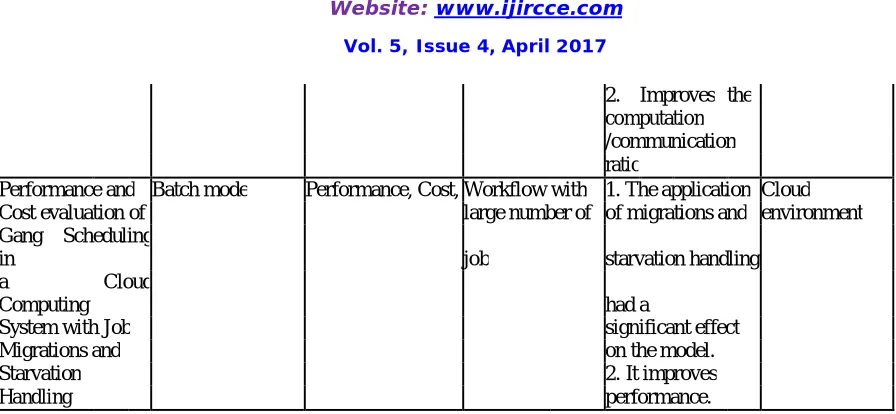
Performance and Batch mode Performance, Cost, Workflow with 1. The application Cloud
Cost evaluation of large number of of migrations and environment
Gang Scheduling
in job starvation handling
a Cloud
Computing had a
System with Job significant effect
Migrations and on the model.
Starvation 2. It improves
Handling performance.
Table I shows a comparison among the reviewed algorithms.
V.CONCLUSION AND FUTURE WORK
In this paper, we surveyed multiple algorithms for load balancing for Cloud Computing. We discussed the challenges that must be addressed to provide the most suitable and efficient load balancing algorithms. We also discussed the advantages and disadvantages of these algorithms. Then, we compared the existing algorithms based on the challenges we discussed. Our research on priority based scheduling algorithm [20] concentrates on efficient load balancing and provides us with the basis to further improve it and reach more efficient load balancing and better resource utilization. The current design of scheduling algorithm can tolerate high delays, handle heterogeneous resources, efficiently adjust to dynamic operational conditions, offer efficient task distribution, and provide minimum node idle time. However, it relies on full replication of the files on multiple sites, which wastes storage resources. Therefore, as our future work, we are planning to improve scheduling algorithm to make it more suitable for Cloud environments and more efficient in terms of storage utilization
REFERENCES
[1] Randles, M., D. Lamb and A. Taleb-Bendiab, “A Comparative Study into Distributed Load Balancing Algorithms for Cloud Computing,” in
Proc. IEEE 24th International Conference on Advanced Information Networking and Applications Workshops (WAINA), Perth, Australia, April
2010.
[2] Rimal, B. Prasad, E. Choi and I. Lumb, "A taxonomy and survey of cloud computing systems." In proc. 5th International Joint Conference on INC, IMS and IDC, IEEE, 2009.
[3] Buyya R., R. Ranjan and RN. Calheiros, “InterCloud: Utility-oriented federation of cloud computing environments for scaling of application services,” in proc. 10th International Conference on Algorithms and Architectures for Parallel Processing (ICA3PP), Busan, South Korea, 2010. [4] Foster, I., Y. Zhao, I. Raicu and S. Lu, “Cloud Computing and Grid Computing 360-degree compared,” in proc. Grid Computing Environments Workshop, pp: 99-106, 2008.
[5] Grosu, D., A.T. Chronopoulos and M. Leung, "Cooperative load balancing in distributed systems," in Concurrency and Computation: Practice and Experience, Vol. 20, No. 16, pp: 1953-1976, 2008.
[6] Ranjan, R., L. Zhao, X. Wu, A. Liu, A. Quiroz and M. Parashar, "Peer- to-peer cloud provisioning: Service discovery and load-balancing," in Cloud Computing - Principles, Systems and Applications, pp: 195-217, 2010.
[7] Radojevic, B. and M. Zagar, "Analysis of issues with load balancing algorithms in hosted (cloud) environments." In proc.34th International Convention on MIPRO, IEEE, 2011.
[8] Sotomayor, B., RS. Montero, IM. Llorente, and I. Foster, "Virtual infrastructure management in private and hybrid clouds," in IEEE Internet Computing, Vol. 13, No. 5, pp: 14-22, 2009.
[9] Nishant, K. P. Sharma, V. Krishna, C. Gupta, KP. Singh, N. Nitin and R. Rastogi, "Load Balancing of Nodes in Cloud Using Ant Colony
Optimization." In proc. 14th International Conference on Computer Modelling and Simulation (UKSim), IEEE, pp: 3-8, March 2012.
[10] Zhang, Z. and X. Zhang, "A load balancing mechanism based on ant colony and complex network theory in open cloud computing
[11] Kolb, L., A. Thor, and E. Rahm, E, "Load Balancing for MapReduce- based Entity Resolution," in proc. 28th International Conference on Data Engineering (ICDE), IEEE, pp: 618-629, 2012.
[12] Gunarathne, T., T-L. Wu, J. Qiu and G. Fox, "MapReduce in the Clouds for Science," in proc. 2nd International Conference on Cloud Computing Technology and Science (CloudCom), IEEE, pp:565-572, November/December 2010.
[13] Ni, J., Y. Huang, Z. Luan, J. Zhang and D. Qian, "Virtual machine mapping policy based on load balancing in private cloud environment," in proc. International Conference on Cloud and Service Computing (CSC), IEEE, pp: 292-295, December 2011.
[14] , T-Y., W-T. Lee, Y-S. Lin, Y-S. Lin, H-L. Chan and J-S. Huang, "Dynamic load balancing mechanism based on cloud storage" in
proc.Computing, Communications and Applications Conference (ComComAp), IEEE, pp:102-106, January 2012.
[15] Ren, X., R. Lin and H. Zou, "A dynamic load balancing strategy for cloud computing platform based on exponential smoothing forecast" in proc. International Conference on. Cloud Computing and Intelligent Systems (CCIS), IEEE, pp: 220-224, September 2011.
[16] Lee, R. and B. Jeng, "Load-balancing tactics in cloud," in proc. International Conference on Cyber-Enabled Distributed Computing and Knowledge Discovery (CyberC), IEEE, pp:447-454, October 2011.
[17] Al-Jaroodi, J. and N. Mohamed. "DDFTP: Dual-Direction FTP," in proc. 11th IEEE/ACM International Symposium on Cluster, Cloud and Grid Computing (CCGrid), IEEE, pp:504-503, May 2011.
[18] Wang, S-C., K-Q. Yan, W-P. Liao and S-S. Wang, "Towards a load balancing in a three-level cloud computing network," in proc. 3rd International Conference on. Computer Science and Information Technology (ICCSIT), IEEE, Vol. 1, pp:108-113, July 2010.
[19] Sang, A., X. Wang, M. Madihian and RD. Gitlin, "Coordinated load balancing, handoff/cell-site selection, and scheduling in multi-cell packet data systems," in Wireless Networks, Vol. 14, No. 1, pp: 103- 120, January 2008.