Audrey Jaeger.)
In today’s difficult economic times, it behooves every program to be prepared to defend its worth. In the higher education arena, evidence of the attainment of our goals for student learning and development are best attained through the assessment of learning and development. Advising is a useful learning, development and retention tool that many in higher education recognize as useful for the undergraduate student population. Much has been written about successful advising and satisfaction with advising services, but how does an adviser address student’s learning and development for the funding and worth of the advising program? Beginning the discussion about establishing a
standardized set of outcomes for advising is the goal of this research, to see what each of the constituents expects from the process of advising. Once expectations are established, the discussion about deliberately focused and articulated outcomes can occur, leading the way for assessment of these to be undertaken.
by
Kerith M. Bowman
A dissertation submitted to the Graduate Faculty of North Carolina State University
in partial fulfillment of the requirements for the degree of
Doctor of Education
Higher Education Administration
Raleigh, North Carolina October 27, 2009
APPROVED BY:
_______________________________ ______________________________
Audrey Jaeger Susan Bracken
Committee Chair
________________________________ ________________________________
Dedication
Biography
Keri Bowman works on a team of professional advisers as the Associate Director in the Office of Advising Support, Information and Services. She has worked in higher education for more than 10 years and loves the atmosphere and energy that surround college campuses. She earned her Master of Science degree in Higher Education from North Carolina State University and continued on to finish the Doctor of Education in the same program.
Acknowledgements Special thanks to:
o My husband, Keith, and daughter, Bella, for cheering me on,
understanding my “homework” days, and for giving me the motivation to finish.
o My Director and friend, Roxanna McGraw, for her never ceasing encouragement and support. I really could not have done this without your reviews, your thoughts, and your help.
o My family for their prayers, encouragement, and understanding.
o My colleagues and friends (Erin, Mindy, Betsy, Mary, and Martha) for putting up with my distraction and delirium for the last couple of months.
o My committee chair, Dr. Jaeger, who worked through pneumonia to help me finish.
Table of Contents
List of Figures ... ix
I. Chapter One: Introduction ...1
Background of the Problem……… ...3
Problem of the Research……… ...7
Purpose of the Research ………...10
Research Questions………...11
Significance of the Study ...12
Limitations of the Study………...13
Summary of the Introduction……… ...14
II. Chapter Two: Literature Review….………...16
History of Academic Advising……… ...17
Theories and Models of Academic Advising ………...24
Developmental versus prescriptive advising ...24
Organizational Models………...25
Assessment ………...29
Definition of Key Terms and Connection to Advising...30
Purposes of Assessment...31
Importance of Assessment ...35
Cognitive Developmental Theories of College Aged Students ...37
Perry’s Theory of Intellectual and Ethical Development ...39
Women’s Ways of Knowing………...41
Model of Epistemological Reflection ...44
Reflective Judgment Model……… ...46
Relevance to Academic Advising……… ...48
Learning Theory...51
Kolb’s Theory of Experiential Learning...52
Gardner’s Multiple Intelligences ...54
Bloom’s Taxonomy of Educational Objectives ...58
Linking the Theories to Advising ...59
III. Chapter Three: Methodology……….………....62
Research Design...62
Qualitative Paradigm……… ...62
Interpretive Instrumental Case Design...63
Interpretive Design………...63
Role of Researcher……… ...67
Subjectivity……… ...68
Positionality……… ...70
Conceptual Framework………...72
Data Collection……… ...73
Site Selection……… ...73
Participant Selection……… ...76
Interviews………...78
Document Analysis………...80
Data Analysis……… ...81
Data Handling……… ...84
Strengths and Limitations……… ...85
Quality of the Research Process ...86
Trustworthiness………...86
Credibility……… ...88
Ethics………...90
Effects on Participants ...90
Confidentiality and Anonymity ...92
Data Display……….………...92
Summary of Chapter……… ...93
IV. Chapter Four: Findings of the Study………….……… ...95
Method……….……….. ...95
Data ……….………...96
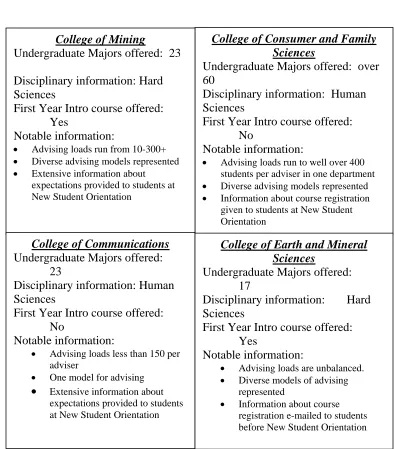
Case Profiles……….……….. ...97
Case I: College of Mining……….………...97
Case II: College of Consumer and Family Sciences…………...101
Case III: College of Communications………….…………...103
Case IV: College of Earth and Mineral Sciences…………...104
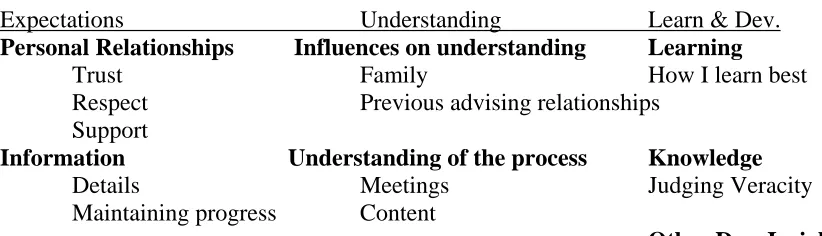
What do students expect from the advising process? ...106
Personal Relationships ...107
Trust ...107
Respect...109
Support...110
Information ...112
Details……….……… ...112
Maintaining Progress……….……… ...114
How does students’ understanding of the process affect their expectations?...116
Influences on understanding ...116
Family……….……….. ...116
Previous advising relationships...117
Meetings...119
Content...120
Effect on expectations……….………...121
How does students’ understanding of developmental level and learning style affect expectations? ...122
Learning ...122
Knowledge ...124
Other developmental insights ...125
Effect on expectations...125
What do advisers expect from the advising process? ...126
Personal relationship...127
Roles ...129
Student role ...129
Adviser role...130
How does advisers’ understanding of the process affect their expectations? ...131
Influences on understanding ...132
Understanding of the process...134
Meetings...134
Content...135
Effects on expectations ...137
How does advisers’ understanding of development and learning style affect expectations?...139
Learning ...139
Development ...141
Developmental vs. Prescriptive ...141
Awareness ...141
Effect on expectations...142
What are administrators’ expectations for the advising process? ...144
Relationship ...144
Information ...146
Does the administrators’ understanding of the process appear to affect expectations? ...148
Influences on understanding ...148
Understanding of the process...151
Roles ...151
Administration ...151
Effects on expectations ...152
Does administrators’ understanding of developmental and learning theory appear to affect expectations? ……… ...154
Learning……….………. ...154
Development ...155
Effects on expectations ...157
V. Chapter Five: Discussion and Implications ...159
What do undergraduate students, advisers and administrators expect from the academic advising process? ...159
Personal Relationships ...159
Information ...161
Roles ...164
Discussion ...165
How does their understanding of the process affect their expectations? ...170
Family ...170
Previous Relationships...171
Understanding of the process: Meeting ...173
Understanding of the process: Content ...174
Roles and Administration ...176
Discussion ...177
How do the developmental and learning theories outlined appear to be a part of the expectations for the advising process?...181
How I learn best ...182
Knowledge and verifying quality...184
Other Developmental Insights ...185
Knowledge of Learning Styles...186
Awareness of Development ...188
Definitions of Learning Styles ...189
Administrator Understanding of Development...190
Discussion ...191
Implications for Practice and Policy ...196
Implications for Theory ...204
Implications for Future Research...206
Conclusions...208
VI. References...210
VII. Appendices...225
VIII. Appendix A (Interview guides) ...226
List of Figures
Figure 1: Case Outlines ……….…...98
Figure 2: Student Categories and Themes by Question……..…...106
Figure 3: Adviser Categories and Themes by Question……… ...126
Chapter One: Introduction
Academic advising and assessment are two areas that have steadily been gaining importance in the higher education arena. Academic advising is growing as a retention effort and assessment as a method of proving education’s goals and outcomes are actually being met. Along with an increased importance placed on accountability and assessment in higher education (Bresciani, 2006, Maki, 2004; Peterson & Augustine, 2000; Shavelson & Huang, 2003, Lingenfelter, 2003, U.S. Board of Education, 2006), there has also been an additional importance placed on helping students learn, grow, and graduate through both curricular and co-curricular services (Bresciani, Zelna, & Anderson, 2004; McMurtrie, 2000; Keeling, 2004, 2006, U.S. Board of Education, 2006).
Assessment of student learning from the advising process as a whole is
underrepresented in the literature, as this is a relatively new topic (Lynch, 2000). Previously, student learning was assessed in the classroom. This left programming outside of the
classroom, academic and cocurricular, lacking in data to support its benefits to student learning and growth (Schuh, Upcraft & Assoc., 2001). An increase in the understanding of how the various cocurricular components of higher education contribute to the learning, growth, retention, and graduation of the student holds these other components to the task of assessing their affects on student learning and developmental growth (Schuh, Upcraft & Assoc., 2001).
2003, Burke & Minassians, 2002, Shavelson & Huang, 2003). This wide range of students represent a wide range of abilities, interests, and backgrounds. Each of these differences makes the job of higher education more complex, as needs are different, different methods to enhance and establish learning and development must be employed. Evidence of student learning is one way that this accountability can be addressed—by producing an assessment process that documents both the intended learning outcomes and the results of the
interventions implemented. If the student intends to gain something out of college other than career marketability, what better way to show that higher education is providing what is promised than to demonstrate student learning? Additionally, assessment of learning and development across campus in co-curricular arenas allows the academic side of higher education freedom not to be the only producers of learning. This would illustrate an across campus culture of a learning centered institution (Bresciani, 2006, p.21). Additionally, this assessment of learning in different areas of an institution helps to legitimize the need for and benefits of such programming both for the student’s learning and the institution’s
accountability measures (Bresciani, Zelna & Anderson, 2004, Schuh, Upcraft, & Assoc., 2001).
Assessment of advising and other non-classroom programming has in the past consisted of a series of satisfaction based self report surveys (Bresciani, Zelna & Anderson, 2004, Lynch, 2000, Grites, 2000). Many times questions represented the amount of
a teaching process, one that promotes learning and developmental growth. This advising as teaching premise was neither present in the intentions of advising process, nor in the
assessment of what was occurring at the time (Habley, 2000).
Recent literature exemplifies the advising process as one that facilitates more learning than is implied through the traditional prescriptive process of fulfillment of requirements for graduation (Creamer, 2000; Frost, 2000; Broadbridge, 1996; Hurt, 2007; Vander Schee, 2007). Trends in advising literature are illustrating the role of advising as a more
developmental teaching process than a simple meeting in which prescribed coursework is outlined and signatures granted (Creamer & Creamer, 1994, Creamer, 2000). Advising is now being equated more with teaching, and the trend in higher education is moving toward assessing student learning. Therefore, it is time to assess advising through the same type of outcomes that reflect learning and development (Creamer, 2000; Hurt, 2007).
Background of Problem
Definitions of academic advising have been as diverse as the students that higher education serves (NACADA, 2003). Many still feel that advising is solely framed by
developmental advising takes longer and has further demands (Dickson & Thayer, 1993 as cited in Grites, 2000).
The professional aspect of advising developed as the demands on faculty time have increased and the needs of the students have also increased. The resulting lack of faculty time precipitated the emergence of professional advisers. These are staff members who do not hold faculty positions and focus their time on advising (Tuttle, 2000). These advisers currently are required to have graduate level training with many specializing in student learning and development (Tuttle, 2000). This graduate level training in student development fields precipitated the phenomenon of developmental advising.
In developmental advising, the process is recognized as a format for facilitating growth of a student— it should help to develop the student cognitively and behaviorally (Creamer, 2000)—not solely helping the student to sign up for the correct coursework to lead to graduation, but to help the student explore what interests and skills she or he holds and to what career and studies these skills and interests lend themselves best (Broadbridge, 1996; Frost, 2000). Developmental advising, in contrast with prescriptive advising, is the type of advising that looks at the student holistically and adds a responsibility for the adviser to foster genuine thought provoking interaction during advising sessions (Creamer, 2000). Because these professional advisers act solely as advisers, the premise is that they will have the time to utilize their understanding of students’ developmental stages during their contacts with the students.
(Crookston, 1972). They will progress along the continua and be more able to think for themselves and will be more confident in their abilities to locate resources needed to find answers. Developmental advising considers the relationship one of mutual learning, where both the adviser and the student learn from each other (Crookston, 1972). Additionally, the student shares a responsibility and commitment to the learning process that is undertaken during the advising process (Crookston, 1972). Ideally, the student and the adviser together will facilitate growth, both through academic learning and through various cognitive
developmental stages yielding a more confident, self-assured student whose ability to formulate knowledge and judge resources is enhanced. Ideally, the student and adviser expect to share responsibility for the relationship and dissemination of information as Lowe & Toney (2000) have found. To address the concerns that Smith & Allen have found (2006) of students needing information, relationship cannot be the only concern with developmental advising.
and finally, it necessitates the assessment of the intended teaching and learning from this advising process.
Assessment in higher education is generally completed to help understand what the student learned from the program or academic function studied. Assessment should be linked to the mission of the program, to the goals of the program and finally to learning outcomes that the program has established from the beginning (Bresciani, Zelna and
Anderson, 2004). The focus on student learning or development outcomes is at the center of the intention behind assessment in higher education.
Assessment of student learning has been growing in importance in higher education for the past several years. In an era of accountability and shrinking budgets (Lingenfelter, 2003), assessment results that indicate increased student learning helps to secure a program’s funding and necessity to the campus environment and student population. It is difficult to ensure that higher education is working without illustrating that student learning takes place. Additionally, assessment can be formative, allowing for improvements in the content or methods while the program is in progress, instead of waiting until the end to prove that learning outcomes were not attained.
standpoint is illustrated in recent literature (Schuh, Upcraft & Associates, 2001; Bresciani, 2006; Bresciani, Zelna & Anderson, 2004).
Unfortunately, academic advising is not one of these functions that has established and recognized learning and development outcomes. Traditionally, evaluation of adviser success was on the basis of student satisfaction, not student learning or development. There was not actual recognition of learning to take place when advising was seen as more
prescriptive. However, now that the responsibility for learning through developmental advising is becoming recognized as more appropriate, there is a need to develop measurable learning and development outcomes for academic advising.
Problem of the Research
The problem that this research addresses is that academic advising has yet to establish recognized measurable learning and development outcomes for advising processes and programs. In this way, the advising programs have fallen behind their counterparts in the academy. Most all accredited academic programs have some type of established student learning outcomes. The need for this research is twofold: first, in order for students to learn and develop the most from the advising process, it would be beneficial to establish
standardized advising goals and outcomes so that students and advisers hold the same expectations for what will occur and be produced from the advising the process. To
process. An effort needs to be made to ensure that there is not a disconnect between what a student expects from the advising process and what the adviser expects. Many times the roles of advisers and students in the advising process are not clear to the student.
The current literature does little to address this potential disconnect in expectations. In fact, Smith and Allen (2006) call for further study in a qualitative genre to examine the results of their quantitative findings about student preferences and expectations of the advising process. This study aims to examine the questions of what students expect of the process in addition to what advisers (Allen & Smith, 2008) and administrators expect of the process.
The second intention of the research is to start the process of establishing learning goals or outcomes that will help to legitimize academic advising as an academic profession. By standardizing and communicating the expectations of students, advisers, and
administrators into student learning outcomes for the process, adequate expectations will be held and learning will be attained. Entering into a relationship in which one party is
and disgruntle all parties involved. Through promoting an understanding of what each party in the process expects, students will ultimately gain the most from the relationship and process of advising and advisers will operate from a standard base of expectations with both of the constituents they serve, administrators and students.
What is currently available in learning outcomes for advising does not, for the most part, take into account the student perspective on what is expected, what should be learned or gained from the advising process. The student perspective, when solicited, generally has been relegated to satisfaction-based responses (Feilstein, Scoles, & Webb, 1992). This limits students’ input to the process to what makes them happy or unhappy—not an adequate contribution for the expectations placed on both the student and the process.
Without adequate academic advising, students may not choose the appropriate coursework for their interests or degree, causing longer time to graduation. Students may lose sight of the purpose behind higher education and leave school. Finally, students’ cognitive development may not reach its fullest potential, the goal being the reaching a higher ability to construct and evaluate knowledge and resources (King & Kitchener, 1994; Baxter Magolda, 1992; Perry, 1970, 1981; Belenky et al, 1997).
While it is certainly possible for a student to grow and develop without intervention, guidance through an established professional relationship is beneficial (Habley, 1981). The progression through the tasks of cognitive development can be facilitated through
1987). Students are more likely to matriculate if they have established relationships with representatives of the institution, whether they are faculty or staff (Tinto, 1987). This matriculation, time to graduation and retention rates are each separately part of the
accountability or rating factors mentioned in many of the college ranking processes. It is to everyone’s advantage to have the highest retention and graduation rates, and it is to the benefit of society to graduate individuals who have developed to their highest potential so they can exemplify and uphold the mission of the institution from which they graduated. Developmental advising processes are one step in reaching the goal of more interaction and stronger relationships between students and professionals on campus. As stated previously, developmental advising meetings consist of more than one-way communication, fostering a give and take relationship between the student and adviser. The end goal of this research is that there will be increased understanding of the process that will benefit the student first, but secondarily, will benefit the institutions through better retention.
Purpose of the Research
It aims to recognize not only the contributions that both faculty and professional advisers make through advising to both student learning and development, but also illustrate the contributions that students bring to the process. As of right now, students are largely uneducated about their role in the process, particularly upon entry to college. This makes expectations about the process precarious and often unrealistic. The specific guidelines will take into account and advocate for the students’ perspectives and expectations, permitting multiple perspectives on how to improve advising programs. It will also begin to establish legitimate and attainable student learning and development outcomes for the process that are meaningful for each constituent. The researcher hopes that appropriate student learning and developmental outcomes will emerge as a result of these recommendations.
Research questions.
In an effort to examine what learning and development outcomes are established (or not established) for the academic advising process, this research aims to answer the following questions:
What do undergraduate students, advisers, and administrators expect from the
academic advising process?
How does their understanding of the process influence their expectations?
How do the developmental and learning theories outlined appear to be a part of
expectations for the advising process?
advisers as professionals within the higher education arena, after all, who better to start with than the population who are served? By taking into account all three players’ perspectives no single perspective will be dominant, allowing for genuine and attainable and measurable student learning outcomes or goals to emerge and the overarching developmental process to be standardized, which will ensure each person knows his role.
Significance of the Study
This study will be of interest to those who are being studied, first and foremost. The university setting is one who will benefit most from this examination of what students, advisers and administrators feel are important facets of the advising process. This is not the complete extent of the significant impact this study will have, however.
This research will inform the advising profession as a whole. As the push for better
assessment of student services and learning grows, the examination of what students expect from their educations will also have to be explored. This is one step in that direction.
The examination of student learning should not take place without starting first with the very constituents who higher education seeks to serve. One cannot fully estimate what goals outcomes are necessary for student learning and development without considering the intentions of the student. It is the researcher’s intention to deliberately include all
Finally, administrators will be better able to facilitate student learning and
development by implementing policies that exhibit a better understanding of the intentions that both of the adviser and the student hold. One of the first “Assessment Essentials”
(Palomba & Banta, 1999) is to agree on goals and objectives for the learning being assessed. This research hopes to develop an agreement – or at least the first step toward an
understanding of what goals and objectives should be for academic advising—from the student, the adviser and the administrator perspectives.
Limitations of the Study
This research will be conducted at one doctoral degree granting university with high research activity in the southeastern United States. This university has several different colleges housing over 300 different degree tracks. There is considerable diversity within this university and for the purpose of keeping this study manageable; sampling of some of the different departments within the colleges will be employed. A clear picture of the overall tone of the college’s offerings and expectations for advising will be deliberately sought for each of the research questions. Further information on sampling techniques is forthcoming in Chapter Three.
The researcher is a full time professional currently employed as an advising administrator of an advising program that provides cross-curricular advising. This is a position that allows her to understand two of the three sought after perspectives,
thought process on policies and actions affecting students. Confidentiality will be ensured in an attempt to eliminate any uneasiness with questioning. The questions and subject matter are fairly innocuous, however, the possibility for discomfort is noted. Further discussion on researcher subjectivity is forthcoming in Chapter Three.
The fact that one institution provides the setting for this research is mitigated by the fact that there are several very different colleges represented. These colleges differ in advising model, philosophy, and by governing structure and funds available. These differences will allow for a full spectrum of ideas to be considered and contrasted and will not adversely affect the data gathering and analysis.
Summary of the Introduction
Advising is an integral part of the academic process for many students. The relationship established can affect the student’s time to graduation, decision to remain at the institution, or even to stay in higher education (Pascarella & Terenzini, 2005). Moreover, students’
intellectual development can be facilitated through the advising process. A better
understanding of what each participant expects from the advising process will benefit the advising relationship by identifying the expectations that each party involved holds.
gain a better understanding of how to prepare for an advising meeting particularly upon entry into higher education.
Chapter Two: Literature Review
In the previous chapter, I outlined the focus of this research. I intend to examine the expectations that students hold about the advising process, as well as those that advisers and administrators of advising hold. The questions that guide this research are:
1. What do undergraduate students, advisers, and administrators expect from the academic advising process?
2. How does their understanding of the process influence their expectations? 3. How do the developmental and learning theories outlined appear to be a part of
expectations for the advising process?
The exploration of students’ intentions for the advising process will allow inform the conversation about learning and development outcomes. Standardizing outcomes by finding common expectations of these outcomes across university and across the profession will facilitate the assessment of advising, which can help to inform areas that require
improvement. The end goal is better service to the student, a more participative and developmental advising process, which causes growth and could improve a student’s retention, matriculation, and graduation rates. Additionally, sharing the ultimate goal for higher education, better prepared, well adjusted and developed students.
In this literature review, I will give an overview of the history and definitions of
academic advising. This includes the development of academic advising as a profession and the progression of this profession necessitated by the changing needs of the student
of the assessment of learning outcomes movement as well as key theories of learning to illuminate the path toward establishing learning outcomes for academic advising. History of Academic Advising
Academic advising has changed in mission and purpose over the history of American higher education. It continues changing to this day. Society and the student population’s reflection of society have necessitated these changes. The needs that collegiate education fulfills change with the society for whom it exists. The services and curriculum of higher education and other social institutions are no different.
The need for academic advising as it is understood today began in the United States at Harvard University in the late 1800s. The president of Harvard implemented the elective system, giving students a choice in course curricula (Rudolph, 1990). This change in curriculum illustrated a change in the philosophy of higher education. A change from completely prescribed curricula to curricula with choice of electives allowed students
freedom, a new freedom that necessitated guidance about learning goals and career interests. The first academic advisers were faculty members that assumed many responsibilities (Frost, 2000; Rudolph, 1990). They served not only as academic guides, but also as moral role models, teachers, housefathers, and academic guides.
moral, and personal advisers were the precursor to the current student affairs professionals, once there was a split between student affairs and academic advising (Gordon, 1998).
Harvard implemented the elective system and other schools in the United States followed suit (Rudolph, 1990). Johns Hopkins University is another notable case. Gordon (1998), Frost (2000) and Tuttle (2000) cite that Johns Hopkins devised a deliberate system of faculty academic advising. Harvard University assigned each student a faculty member to advise him about all aspects of collegiate life, including but not limited to the choice of courses. Faculty members at Johns Hopkins were intentional about career and major curricula and assisted students with the formulation of academic schedules and course
selection; it is obvious that Johns Hopkins placed particular emphasis on the academic side of academic advising.
An example of academic advising as a blend of student affairs and academic affairs is best illustrated by Wesleyan College in 1938, (Frost, 2000) where cocurricular programming for students included exploration of vocational interest and career guidance. This
programming involved faculty, and had a focus on developing the student into a career-minded, liberally-educated professional. This model of faculty advising students is still utilized in many universities today (Johns, undated; Tuttle, 2000).
demand on faculty members to research, publish, and contribute to their fields’ knowledge bases, not to just teach, further emphasized this divide. There was less time for faculty to dedicate to cocurricular issues and personal development of students. However, an understanding of the need for such education remained (Evans et al., 1998).
As the divide between academic affairs and student affairs widened, faculty and student affairs professionals see further division in foci, changes in career directions, and job responsibilities (Evans, Forney & Guido-Dibrito, 1998). The diverse demands on faculty increase exponentially as enrollment continually increased. In addition to the larger enrollment in higher education, those enrolling are more diverse and display greater need than ever before (Frost, 2000). Finally, after World War II, the Cold War and competition increased focus on the scientific areas made research and the quest for research dollars another very important demand on faculty time (Tuttle, 2000). Linking receipt of grant money to progress toward tenure made grant writing and research more important functions of faculty jobs. Because of this importance, they devoted more time to those (Frost, 2000). This trend is still visible at many universities. Milem, Berger, and Dey (2000) indicate that faculty research time has increased since the early 1970’s. Indeed, Habley (2003) states that only 31% of all institutions recognize, compensate, or reward faculty for their academic advising responsibilities.
The increased responsibilities are problematic for all of higher education, as students’ demand for academic guidance continues to increase and time for academic advising
increased faculty workload and the apparent lack of importance assigned to academic advising for tenure and promotion, though it is reported (Allen & Smith, 2008) that administrators value the work that advisers undertake and complete and recognize that advisers should place an equal weight on advising (Ramos, 1994). These, coupled with the increasing demands and needs of students as consumers for more guidance and more
advising attention, have helped lead to the development of a professional adviser position. A professional adviser is someone who is not a faculty member, but rather a staff member for whom the majority of time is dedicated to advising students on academic, personal, and career development issues (Tuttle, 2000).
Of further influence to the development of professional adviser positions was the emerging view that the academic advising process requires attention to both the student as a whole person and to the student’s learning and development (Broadbridge, 1996; Frost, 2000). Prescriptive advising, a philosophy of advising which consists of one-way
communication directing what courses are necessary for the degree (Crookston, 1972), was losing favor and was no longer the most accepted method of academic advising. Students demanded more control, choice, and input into their educations. Advisers grew to recognize that the academic advising process was an important venue for the student to learn about herself, become more self-aware, and fulfill her goals (O’Banion, 1972). Developmental advising, a philosophy in which the adviser recognizes the shared responsibility for guidance toward the goal of not only degree attainment but also personal fulfillment and development, became more accepted with the onset of staff members who were able to dedicate the time required for the process (Crookston, 1972; O’Banion, 1972; Ender, Winston, & Miller, 1982; Frost, 2000; Tuttle, 2000). The movement toward developmental advising appears to emerge with Crookston’s and O’Banion’s (1972) articles about developmental advising and the model best suited to embody this developmental advising philosophy. The trend of writing about and emphasizing the developmental advising philosophy continued well into the 1990s, and even the millennium (Winston, Ender, & Miller, 1982; Winston, Miller, Ender, Grites and Associates, 1984; Ware & Millard, 1987; Burton & Wellington, 1998; Gordon, Habley & Associates, 2000).
viewed as more able to devote the time that developmental advising requires (Tuttle, 2000; Frost, 2000). They also have more in-depth knowledge about student development, and as many as 80% of posted academic adviser positions preferred a graduate level degree (Tuttle, 2000). Many professional advisers hold degrees in human development fields such as college student personnel, counseling, higher education or psychology. As more and more professional adviser positions are funded and put into organizational structures, the need for a common professional advocacy group begins to arise.
The National Academic Advising Association (NACADA), the professional
association for academic advising, was formed in 1979 (Frost, 2000; Gordon, 1998; Tuttle, 2000). The formation of this professional organization is significant in illustrating the recognition of professional academic adviser as a legitimate position. As an association, NACADA has consistently increased its membership since its formation, illustrating both the increasing interest in academic advising, and the formation and recognition of many diverse areas of interest in the field (Gordon, 1998). Finally, NACADA has been instrumental in promoting further education and publishing research on the various focus areas of academic advising through the NACADA Journal (Gordon, 1998; Tuttle, 2000).
of the individual, elevated advising from a clerical function to pick courses and check
progress for graduation. Because advising remained largely unevaluated at the time, scholars knew little about the effects of services on students (Frost, 1991). In spite of the lack of assessment on advising outcomes, literature does exist that cites the positive effects of both relationships between students and faculty (Pascarella and Ternzini, 2005; Tinto, 1987, Boyer, 1987) and of advising (Grites, 1977) on retention and student development.
Theories and Models of Academic Advising
In this section, I will summarize and define the differences between the two major schools of academic advising, developmental advising and prescriptive advising.
Additionally, I will define and illustrate the primary organizational models practiced in higher education currently and will compare and contrast the benefits and costs of each.
Developmental versus prescriptive advising.
Recognizing the student as a whole being that would benefit from more than what courses for which to register, coupled with the understanding of developmental stages that a student encounters, precipitated the onset of what is called developmental advising
(Broadbridge, 1996; Frost, 2000, Crookston, 1972). In this theory of advising, advising is recognized as a format for facilitating growth of a developing student, not solely helping the student to sign up for the correct coursework to lead to graduation, but helping the student explore what interests and skills she or he holds and to what career and studies these skills and interests lend themselves best (Crookston, 1972).
In previous eras, the advising function was mostly clerical; checking requirements and listing appropriate coursework that would fulfill requirements for
are participants in the educational and advising process, emphasizes the developmental advising philosophy (Frost, 2000).
Preference of increased education on student development eventually culminated in a required graduate degree to secure a position as an academic adviser. This preference of increased education helped solidify the establishment of developmental advising as a
philosophy and has helped shape academic advising into a profession in the academy (Tuttle, 2000). Developmental advising has helped develop more than students’ cognition and identity; it has also assisted with the development of a professional image for nonfaculty advisers. The ultimate goal of developmental advising is to make the student independent and aware enough to not need the adviser but to recognize the importance of utilizing available resources (Crookston, 1972; O’Banion, 1972) which coincides with the directives outlined in the Student Learning Imperative (1996) provided by the student affairs side of higher education. Student learning should be seen as a goal of educating the whole person, both academically and through personal development.
Organizational models.
houses professional advisers, are examples of decentralized advising organization (Johns, n.d.; Pardee, 2000).
Shared advising organizes is just as it implies. There are centralized services that compliment the academic units’ advising services. There are several different models that represent shared organization. In the Supplementary Model of advising, students are served by both a centralized office and by departmental advisers, either professional or faculty (Habley, as cited in Pardee, 2000, Johns, n.d.). In this model, the primary student advising responsibility rests with faculty advisers. The professional advisers in the advising center provide information, training, and guidance to advisers and preliminary and general
information to students. The dedication of professional advisers to advising only allows the departmental faculty advisers to spend more time with developmental advising tasks and mentoring on major and career and other professional issues and less time on the general administrative and technical work that can be less desirable to faculty. Often enforcement of graduation requirements and policy information are housed within and meted out from the professional advising at the supplemental center. Benefits of this model include that the student receives specialized and discipline-related attention from faculty, the faculty adviser has a specific academic policy resource at their disposal, and faculty have fewer advising responsibilities of which to keep track. Students receive specific attention for both discipline specific career related information and for policy and institution specific graduation
requirements. Additionally, development of the student can be addressed through both the professional adviser and the faculty adviser, so the student receives the benefit of
As with many of these models, without the recognition of the career and discipline and mentoring component, advising from a professional in a center and from a faculty member in the department is potentially duplicative and may be seen as cost prohibitive. Though the duplicity may not be a reality, it may need to be considered in days of tight budgets.
In the Split Model of advising, again, the responsibilities are split between a center of professional advisers and the faculty in the student’s department (Johns, n.d.; Pardee, 2000). The key difference between Supplementary and Split models is that in the split model, the advising center has a more formally defined role with the student. Early in the students’ education, the center may help with exploration of interests allowing the departmental advisers more time to serve in a focused career development and professional mentoring capacity. Many times, the Split Model has an assigned adviser and advisee relationship, with assignment of both a faculty member and a professional adviser at the same time. Generally, the professional adviser is emphasized in the early years of education, precipitating the declaration of the student’s major (Johns, n.d.; Pardee, 2000). Advantages for the student are that he or she receives both career related faculty advising and broad based developmental advising, potentially during the same time frame. Disadvantages for the institution are much the same as with the Supplementary Model and can be seen as having double the number of staff to advise students. Budgetary concerns can prohibit or limit the Split Model of
advising.
education (Johns, n.d.; Pardee, 2000). The Dual Model can have a duplication of services between faculty and professional advisers though the design is intended to allow for more career development and mentoring by faculty and developmental academic advising by the professional adviser (Johns, n.d.; Pardee, 2000). Unless the relationships and roles are clearly defined and the institution’s mission closely aligns with the personal, academic and career development of the student, the Dual Model can be cost prohibitive. Of course, the student benefits from having extra attention, more and closer relationships, and potentially more intrusive advising, which can result in additional potential for retention of the student (Astone, et. al, 1989; Backhaus, 1989; Kapraun & Coldren, 1982), arguably a benefit for both student and institution. Institutions would choose this model if the mission is to truly focus on development of careers and mentor students within their disciplines. The time allowed for faculty to mentor and guide students into careers within their disciplines is a distinct benefit of this model.
Finally, there is a model called the Total Intake Model (Johns, n.d.; Pardee, 2000). In this model, all students are taken in and advised in an advising center. When they have decided on a major or met some criteria set by the governing body of the school, they are referred to the appropriate academic department for advising guidance. Many colleges and universities that have a general college, whose students are not required to declare a major upon admission, utilize this model. The disadvantages are that from an organizational
student are that she does not have to declare a major upon entry to the university and can, instead, explore options via general education requirements and guidance through
developmental advising via the Total Intake Model. This can be of benefit to the student in that no student will be required to declare a major until some guided introspective
developmental examination is completed. This examination can be fundamental in the selection of a major. Selection of a student’s best fit career choice can help ensure timely graduation and academic, personal and professional success. In this model, all students are advised in the same manner and with the same philosophy, insuring the same quality advising for each student at the beginning of her education.
Depending on the mission of the institution, the institution’s advising, and the availability of staff, there are different strengths and weaknesses attributed to each model. As is illustrated, each has different requirements of the university and carries different benefits to the student and the institution. Benefits of the model and type of advising to the institution and the student can be illustrated only if the outcomes intended are measured and assessed.
Assessment.
Two important definitions and distinctions must be presented at the forefront of this section: assessment and evaluation. These two terms are similar, yet have different foci. Assessment looks particularly toward outcomes, specifically learning and development outcomes that are deliberately established in the mission and goals of a program (Bresciani, Zelna, & Anderson, 2004; Schuh, Upcraft, & Assoc., 2001; Maki, 2004; Walvoord, 2004). Ideally assessment is systematically linked from institution’s mission to objectives or goals and then to measurable learning outcomes (Bresciani, Zelna, & Anderson, 2004; Schuh, Upcraft, & Assoc., 2001; Maki, 2004; Walvoord, 2004). Assessment is undertaken to determine what the student learns from the program or academic function that is being assessed. In evaluation, student learning outcomes are not necessarily the particular focus, but there is still an emphasis on improvement. Evaluation does not always depend on deliberately illustrated outcomes—particularly student learning outcomes, but one can use assessment data for evaluative purposes (Palomba & Banta, 1999). While improvement is the spirit of both evaluation and assessment, student learning is not the only imperative that evaluation can address. Evaluation is how good one did on a appraisal, not what one learned from the intervention-whether that is a class, a program or an advising session.
Definition of Key Terms and Connection to Advising
Assessment of student learning or development outcomes strives to link the institution’s mission to broad ranging goals, which are then linked to measurable, clearly defined, and predetermined outcomes of student learning or of student development (Bresciani, Zelna, and Anderson, 2004, Bresciani, 2006). Outcomes should stem from the program, course, or learning activity’s intention. Clear delineation of outcomes also helps students to know what to expect from a course or program. Student learning outcomes answer questions such as: What does the facilitator intend for the students to learn from this course? At what level should students be able to demonstrate knowledge of the material; should they recognize, recall, or demonstrate understanding of the material? (Bresciani, Zelna, and Anderson, 2004, Bresciani, 2006).
Not unlike with research, an explanation of the methods used to conduct the
assessment is of key importance in an assessment report. Good assessment should show the rigor of good research, with sound methods of data collection and analysis (Bresciani, Zelna and Anderson, 2004). Rigor of procedure helps to legitimize both the practice of assessment to faculty and the results of the inquiry. Use of results for formative decision-making
purposes allows the assessor to drive the process of improvement internally and promotes a culture of constant improvement through the use of assessment results. In institutions of higher learning, what greater aim is expected than to model the appropriate learning strategies that are desired of the students that are served?
Purposes of assessment.
conduct assessment stem from many different places, both inside an institution and outside the academy (Schuh, Upcraft & Associates, 2001; Lingenfelter, 2003).
Decision-making that stems from assessment can be a defendable way to implement change. This is the case even in an institution that resists change (Peterson and Augustine, 2000). Results gleaned from the assessment of student learning outcomes process are arguably strong evidence needed for changing the institution’s practices or programming; though this evidence may not always be heeded (Peterson and Augustine, 2000). If
assessment results reveal that a student hasn’t learned what the program intended for him to learn, decisions need to be made about how to better promote the intended learning within the scope of the programs. On the other hand, if the assessment results reveal student learning, the programs’ outcomes and objectives are being met, given the linkage between mission and objectives, the institution’s mission is therefore being upheld (Bresciani, Zelna & Anderson, 2004). If there’s a break in the above mentioned link of evidence of student learning, it can be seen by constituents, both internal and external as weakness or institutional “mission creep” (Burke and Minassians, 2002, p. 10).
There are, however, many sources of external pressure and many different reasons that make assessment a requirement (Lingenfelter, 2003). In addition to the academy’s motives for conducting assessment, there are numerous outside pressures to assess student learning and prove that learning is taking place within the institutions. Reasons for these pressures vary. Primarily, there is a general call from the federal government, particularly Secretary of Education Spelling in the Action Plan for Higher Education: Improving Accessibility, Affordability and Accountability, to attend to the success of the academy’s graduates (U.S. Board of Education, 2006). This plan states that it is higher education’s responsibility to ensure that we graduate students who are academically prepared to enter the workforce. Additionally, calls from professional organizations and employers have lead to the establishment of accreditation standards for assessment, as these bodies continue to look for evidence of the skills that students need to acquire for the profession, the need for assessment data stays in the forefront.
These reasons, and the external pressure to complete assessment, can bring about suspicion regarding the motives of those promoting assessment and how the results of this assessment will be used (Burke and Minassians, 2002). Will there be an effect on programs’ funding and viability? The intended use of results can affect more than the actual delivery of the program; it can affect the motivation to complete assessment and also the possibilities for improvement. One is far less likely to want to complete assessment if she feels her
programs’ worth is being measured or tested. If the intention behind the assessment is truly to ensure that the students are learning, not to determine funding, there may be far less resistance to assess. The reluctance to complete forced assessment is related to the external link of assessment data with funding, accreditation by outside agencies, and proof of worth (Burke and Minassians, 2002). As accreditation by professional organizations and
governmental agencies aligns itself with proof of student learning outcomes, there is greater urgency to illustrate attainment of learning outcomes. Ideally, the desire to assess should stem from an intellectual curiosity and desire to improve student experiences, and a “…way of knowing about our work…” (Maki, 2004, p.2). The idea of honing the natural curiosity of faculty to see their programs are working in the intended manner allows a certain freedom and promotes the innate culture of the academy (Maki, 2004).
higher education institutions must take into account the formative nature of assessment. This understanding will allow the assessors freedom to not feel threatened and to truly understand how their program assists students with learning and development.
Importance of assessment.
Even though there are many external pressures to assess student learning, as stated previously, the most important reason to assess student learning in programs is to determine efficacy of programs and courses and levels of learning. There is a trend within higher education to address not just the teaching of students, but their learning also (Schroeder, 2003). Additionally, assessment of student learning in programs can be both formative and summative. That is, it can be a work in progress, allowing for changes and alterations when concurrently implemented in programs and courses for the purpose of improvement in student learning. Summative assessment gives information about student learning at the conclusion of the program or course or other learning activity (Maki, 2004). Formative assessment is ongoing and can be seen as a mid-term for the learning facilitator to seek effectiveness of her or his tactics. The goal of summative assessment is to inform for effectiveness for the next iteration of the learning activity (Palomba and Banta, 1999). Constant and consistent improvement of programs can help retain students, a goal of most institutions of higher education. Furthermore, improvement of programs helps to ensure compliance with constituents outside of the academy.
government (Burke and Minassians, 2002; U.S. Board of Education, 2006). In an era of belt tightening due to lack of state funds, threats of decreased funding from the federal
government can make administrators take heed and become assessment conscious. The problem with this forced assessment to provide evidence of worth for funding is that it makes the assessor someone who may be the terminator of a program instead of the improver of the program regardless of when the assessment is conducted within the program. It can
seemingly place the facilitators of the program, course, or learning activity under a
microscope and can make the atmosphere very defensive. Therefore, it is important to try not to make decisions in a negative or punitive manner (Lingenfelter, 2003). The number and amount of programs offered are many times contingent upon funding received. The limitation of offerings because of lack of funding can affect access to the programs.
Access and accountability color the lenses through which government looks at higher education today (U.S. Board of Education, 2006). Access has to do with both admission and affordability. The government’s view of access, coupled with the current trends of students as consumers looking for the best value, leads to institutions’ attempts to keep tuition affordable in addition to trying to provide evidence of learning to potential students that employers look on students with a degree from the institution favorably enough to secure employment (US Board of Education, 2006). Additionally, accountability to constituents reflects the need of the academy to maintain standards that are put forth by both
governmental and professional organizations.
for their blessing of accreditation (Burke and Minassians, 2002; McMurtrie, 2000). Failure to meet accreditation standards, either by discipline-specific agencies or by regional
governmental accrediting agencies, can be extremely damaging, if not fatal to the institution’s reputation, marketability, and fundability.
Assessment is key in proving learning for all programs in higher education, regardless of motive for the assessment. Tangible evidence of learning is key for the continued success of academic and co-curricular programs, and academic advising is not exempt from this collective. By not knowing what our students learn or do not learn from the academic advising process, our profession does not have the ability to improve services for students. Establishment of learning and developmental outcomes for academic advising is the first step toward assessment and the ability to improve service.
Cognitive Developmental Theories of College Aged Students
There is a growing understanding that academic advising is a form of teaching at the university level (Crookston, 1972; Frost, 2000, Appleby, 2001, Hurt, 2007). According to Creamer (2000), effective advising depends on proper use of theory. Developmental
developmental theories suggest a snapshot in time whereas actual development occurs over time. Advisers and assessors of advising need to be mindful of this.
In the following section, I provide a descriptive overview of four particular theories of intellectual development: Perry; Belenky, Clinch, Goldberger and Tarule; Baxter
Magolda; and King and Kitchener. The understanding of intellectual development is critical to the practice of developmental advising. These four theories will be useful in the
understanding of the student perspective as it relates to an adviser’s ability to promote development within the advising meetings. Each of these theories informs each other and generally builds on the gaps formed from Perry’s work. Perry’s Theory of Intellectual and Ethical Development informed higher education about the ways that Caucasian, typically wealthy, academically high achieving men formed knowledge. Belenky, Clinchy,
Perry’s theory of intellectual and ethical development.
Perry was a pioneer in the research of intellectual development; many other studies were built off of his original work (Perry, 1970, 1981). Perry conducted research to examine ways students look at the world and make sense of their points of view (Perry, 1970, 1981; Evans, et al. 1998). Perry conducted his research on a limited sample of Caucasian male students at a prestigious university but many other studies have sprung from this on more diverse populations. Its impact is noteworthy if only from a heuristic perspective (Perry, 1970, 1981; Evans, et al., 1998; Love & Guthrie, 1999).
In Perry’s theory, a student transitions through nine different positions in three major categories as his perception of fact and information changes. The first of these three major categories is dualism. In dualism, a student sees information in terms of right/wrong or good/bad (Evans, et al., 1998; Love & Guthrie, 1999). There is no gray area; the information is either right or wrong. Knowledge is seen as a set of facts that are passed from an authority to the student. Questioning the integrity of the fact is not necessary; it is a given if the authority says so (Perry, 1970, 1981; Evans, et al., 1998; Love & Guthrie, 1999). Basic Duality and Full dualism are represented in this category. In basic dualism, all problems have a solution; therefore, the student's task is to learn the right solutions. In full dualism, students are aware that some authorities agree on correct answers and others do not
completely concur on one correct answer. It is the student’s job to learn the correct answers and ignore challenges to those.
than one point of view is recognized as legitimate (Perry 1970, 1981; Evans, et al., 1998; Love & Guthrie, 1999). In early multiplicity, students see that there are different types of problems, those that have solutions and those that do not have clear-cut solutions. In late multiplicity, students move to seeing that many problems do not have clear solutions. Also in this stage, the student sees that there may be more than one possible correct answer,
depending on point of view. Transitions begin to move the student toward more independent thinking and learning, and allow the student to seek potential answers from peers and other previously perceived unworthy sources. The validity of peer opinions is recognized versus the dualistic thinker’s belief of authority and the passing of knowledge.
The third major category, relativism, acknowledges the quality of evidence in supporting opinions (Perry, 1970, 1981; Evans, et al. 1998; Love & Guthrie, 1999). The quality of evidence supporting an opinion determines the quality of the opinion. In relativism, knowledge is subjective and its veracity and correctness is based on which argument for the opinion in question provides the best evidence for its legitimacy. In contextual relativism, students start to evaluate the reasons for believing in certain answers, either empathetically, asking questions such as: why do I believe this; or objectively, asking questions such as: what’s the best way to analyze this? Knowledge is looked at in relation to the context in which it is presented. Precommitment is the next stage in relativism, it is a precursor to the final stage of commitment (Perry, 1981).
have chosen. The realization that commitment is an ongoing and constantly challenging process is made.
If the goal of developmental advising is to help students progress from passively receiving information to taking an active stance on what they believe is true, then awareness of Perry’s theory will help advisers recognize stages and encourage students into other stages. Many advisers of new students will recognize dualistic thinkers by the way they prepare for an advising session. If a student enters the meeting and appears interested but waits for the direction of what to take, it may be a dualistic student. Advisers can mistake this as laziness or lacking ownership, but it may be the student’s level of thinking.
Additionally, if students question the adviser about certain suggestions that are made, it could be mistaken as obstinacy when in reality, the student is trying to gather evidence to defend the choice.
Clearly, the perspectives that traditionally aged Caucasian males at a prestigious university do not always reflect the experiences and development of the mainstream of higher education. This fact has lead other researchers to build upon Perry’s work to include more populations that also hold substantial representation throughout higher education, particularly women.
Women’s ways of knowing.
presented by the theorists may also be genderless and consist of other socially significant differences such as socioeconomic status and areas of upbringing (Love and Guthrie, 1999). With that qualifier, they presented five perspectives on how women know information through which women report they view the world.
Silence is the first perspective (Clinchy, et al, 1985; Belenky, et al, 1997; Evans, et al., 1998; Love & Guthrie, 1999). In the silence perspective, every piece of knowledge is received from an external authority. The learner recognizes no power, contribution or voice in the learning process, possibly in any other process. This perspective was not represented with in the student sample that was researched, these women were found in social service agencies (Belenky, etal 1997; Clinchy, et al 1985, Evans, et al., 1998). Received knowledge is the next perspective, which would equate with Perry’s dualism (Love and Guthrie, 1999).
In received knowledge, learning is characterized by the listening to others as experts and knowledge is gained from listening to an authority. As development progresses along this continuum, subjective knowledge is the next in the sequence. Opposite in nature from the received knowledge perspective, in subjective knowledge, the self is recognized as the owner and holder of knowledge and what the individual “knows” is more valuable than what any other can teach. In this perspective, a sense of voice begins to take hold and one
perspective. Perhaps, as growth and learning continue, the two blend into the last perspectives, making both self and others legitimate sources of knowledge.
Two final perspectives of women’s ways of knowing are procedural knowledge, consisting of using objective methods for receiving knowledge. In challenge to the previous ways of knowing, by not removing but recognizing and separating the “self” from the knowing process, known as separate knowing, the woman feels as though she is establishing truth and an objective reasonable fact. The women in this stage want a balance between self and others as sources of knowledge. Also maintained within this perspective is a method called connected knowing through which knowledge is linked and established within the bounds of personal experience. Constructed knowledge is the final of the perspectives explained in the Belenky group’s theory (1985, 1997). In this perspective, the women recognize that the truth is constructed and one cannot separate self from the perception of knowledge. This echoes the qualitative way of thinking in that everyone perceives their own facts through their own lenses.
when knowledge is constructed, it is recognized that it incorporates both the student’s and the adviser’s input, a situation for which developmental advising strives.
Model of epistemological reflection.
Baxter Magolda sought, in a longitudinal study, to expand upon these two previously outlined theories by including the recognition of gender’s effects on cognitive development to include both males and females (Baxter Magolda, 1992; Bock, 1999). This model reflects four different stages, with gender-related differences in the first three, though the similarities between genders outweigh the differences (Bock, 1999). The first stage, absolute knowing, reflects the similar perspective that knowledge is right or wrong and is handed down from an authority (Baxter Magolda, 1992; Bock, 1999; Evans et al., 1998). Within this stage,
receiving knowledge, represented by more female participants, is characterized by a lack of interaction with the authority or knowledge holder; whereas mastering knowledge,
characterized by men particularly, expects a more vocal and critical relationship with instructors or authorities.
by men and centers around debate with instructors, research and logic (Baxter Magolda, 1992; Bock, 1999; Evans et al., 1998) and less around communal representation.
Independent knowing is the stage at which the student recognizes that knowledge is mostly uncertain (Bock, 1999; Evans et al., 1998). Instructors that allow for respectful exchanges among and with students are esteemed. At this stage, interindividual learners and individual learners identify and differentiate from each other. Not surprisingly, the females prefer the more communal interindividual approach, which values both their own ideas and the ideas of others. Male students prefer the individual learning style where more attention is assigned to one’s own thinking. Finally, contextual knowing represents a way of knowing in which the individual constructs knowledge but values it only when she is able to support it with unbiased evidence. Gender related differences “merge” together in the final stage of knowing (Bock, 1999). It should be noted that Baxter Magolda found this stage evident very rarely in undergraduate level students (Baxter Magolda, 1992; Evans, et al., 1998).
As students move from being passive absolute knowers toward being more independent knowers, it will be noteworthy that students may take an interindividual approach to the advising and learning process or one that honors his or her own thoughts more. This can affect the advising process in two ways: in the interaction between the adviser and the student, and in the choice of coursework for the student to be most