Survey on Mobile Cloud Based Food Calorie
Measurement
Diptee N.Kumbhar, Seema Udgirkar
P.G. Student, Dept. of Computer Engineering, GHRCEM, Savitribai Phule Pune University, Pune, India Professor, Dept. of Computer Engineering, GHRCEM, Savitribai Phule Pune University, Pune, India
ABSTRACT: Distributed cloud computing, when integrated with smartphone capabilities, contribute to building an
efficient multimedia e-health application for mobile devices. Unfortunately, mobile devices alone do not possess the ability to run complex machine learning algorithms, which require large amounts of graphic processing and computational power. Therefore, offloading the computationally intensive part to the cloud reduces the overhead on the mobile device. The present survey gives an idea of the previous work done by several researchers on the mobile cloud based applications.
KEYWORDS: Cloud Computing, Food recognition, Segmentation, Classification.
I. INTRODUCTION
High calorie intake has a severe impact on people’s health. Studies show that a number of diseases are a result of excessive calorie intake by humans. High calorie values in food that is nutritionally poor leads to systemic inflammation, reduced insulin sensitivity, and clusters of metabolic abnormalities, including obesity, hypertension, dyslipidemia, and glucose intolerance. From these facts, we can conclude that excessive calories, when consumed through food, are harmful to the human body and need to be kept in check.
One way to keep a check on calorie intake is by using applications installed in smartphones, which can help users monitor their calorie consumption. Smartphones have become an integral part of people’s daily lives. People are dependent on smartphones for communication, shopping via mobile websites (m-commerce), and even for maintaining their health and fitness. With advancements in smartphone’s hardware capabilities, a number of new and improved sensors have been built into smartphones, further empowering developers to create applications that make efficient use of these sensor capabilities. Specifically the health and fitness applications have benefited significantly from these sensors. Fitness tracker applications on phones allow us to keep track of 2 calories burned by calculating the number of steps we have climbed, the number of miles we have run or biked, etc. However, there is still a need for applications that can assist us through a proactive approach of checking what we eat, how much to eat, and calorie intake. To run such an application, a mobile phone should have the capacity to implement complex machine learning algorithms and calorie measurement techniques.
Although advancements in smartphone hardware have equipped them to handle parallel and complex processing, there is still the problem of the physical resources of mobile devices being limited, to some extent, when applications demand intensive computations. Cloud services; address these issues by offloading a portion of the processing to the cloud and by making use of cloud resources to efficiently run such complex algorithms. Section II gives the Literature review for the Mobile Cloud Based applications.
II. RELATED WORK
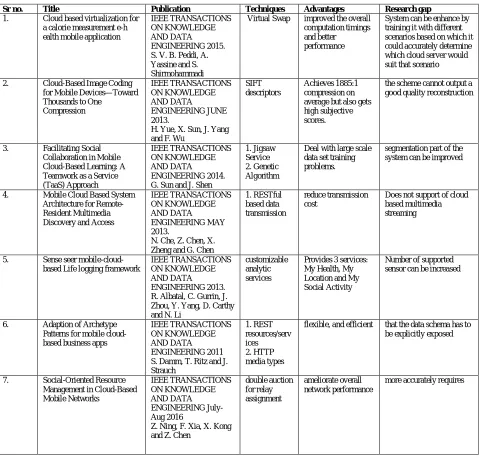
In paper [2] authors have given a cloud-based image coding scheme, in which images are described by SIFT descriptors and down sampled images. The SIFT descriptors are compressed by predicting from the corresponding SIFT descriptors extracted from the down-sampled images and transform coding. Finally, high quality and high-resolution images are reconstructed from a set of images in the cloud by the proposed description.
In paper [3] authors have developed a mobile cloud-based food calorie measurement system. Designed system gives users with easiest and smart mechanisms which let them to track their food intake and analysis of their calorie count. The food recognition technique in system uses cloud Support Vector Machine (SVM) training mechanism in a cloud computing environment with Map Reduce technique for distributed machine learning.
In paper [4] authors have developed a mobile cloud based architecture for enabling remote-resident multimedia service discovery and access. The concentration of the paper is on the security, cloud-based storage, cloud-based remote service discovery and control, RESTbased lightweight negotiation, etc. Prototype implementation shows availability and efficiency of given method.
In paper [5] authors analyzed the hurdles of developing extendible and customizable cloud-based semantic analytic service for Life logging. Also given the SenseSeer a generic mobile-cloud-based mobile Life logging system. This system supports customizable analytic services for sensing the person, understanding the semantics of life activities and the easy deployment of analytic tools and novel interfaces. At present, SenseSeer supports services in many domains, such as personal health monitoring, location tracking, lifestyle analysis and tourism focused applications.
In paper [6] authors explained developed method for a pattern based development of mobile applications. Also given the adaption of archetype patterns to the domain of (mobile) technical service. Then we translated the resulting domain specific archetypes into REST resources/services. For the development they have utilized common HTTP media types.
In paper [7] authors provides the schematics for SDN-based resource management in cloud-based mobile networks for effective network resource management. To increase network connectivity, we use a social association oriented forwarding scheme that considers the client’s social relationship and trust in the cloud. We advocate use of a deep-learning-based mechanism for describing the user experience by uniformly integrating subjective and objective factors, letting us tightly combine the increasing data dimension and complexity as the number of clients in the cloud increases.
In paper [8] authors have discussed of the transport layer for CRAN-based mobile networks has been carried out, with particular focus on TCP as one of the most widely used solutions in IP-based networks such as LTE. The theoretical analysis has then been integrated by simulations of 3 TCP configurations in popular OSs. Authors concluded that the optimization should focus on tweaking the parameters found in the iOS TCP model.
In paper [9], authors have presents a parallel SVM algorithm for scalable spam filtering. By distributing, processing and optimizing the subsets of the training data across multiple participating nodes, the distributed SVM reduces the training time significantly. Ontology based concepts are also employed to minimize the impact of accuracy degradation when distributing the training data amongst the SVM classifiers.
In this survey [10], authors examine the privacy requirements of mobile computing technologies that have the potential to transform healthcare. Such mHealth technology enables physicians to remotely monitor patients’ health and enables individuals to manage their own health more easily. Despite these advantages, privacy is essential for any personal monitoring technology. Through an extensive survey of the literature, they develop a conceptual privacy framework for mHealth, itemize the privacy properties needed in mHealth systems, and discuss the technologies that could support privacy-sensitive mHealth systems.
Table 1: Survey Table
Sr no. Title Publication Techniques Advantages Research gap
1. Cloud based virtualization for a calorie measurement e-h ealth mobile application
IEEE TRANSACTIONS ON KNOWLEDGE AND DATA ENGINEERING 2015. S. V. B. Peddi, A. Yassine and S. Shirmohammadi
Virtual Swap improved the overall computation timings and better
performance
System can be enhance by training it with different scenarios based on which it could accurately determine which cloud server would suit that scenario
2. Cloud-Based Image Coding for Mobile Devices—Toward Thousands to One
Compression IEEE TRANSACTIONS ON KNOWLEDGE AND DATA ENGINEERING JUNE 2013.
H. Yue, X. Sun, J. Yang and F. Wu
SIFT descriptors
Achieves 1885:1 compression on average but also gets high subjective scores.
the scheme cannot output a good quality reconstruction
3. Facilitating Social Collaboration in Mobile Cloud-Based Learning: A Teamwork as a Service (TaaS) Approach
IEEE TRANSACTIONS ON KNOWLEDGE AND DATA ENGINEERING 2014. G. Sun and J. Shen
1. Jigsaw Service 2. Genetic Algorithm
Deal with large scale data set training problems.
segmentation part of the system can be improved
4. Mobile Cloud Based System Architecture for Remote-Resident Multimedia Discovery and Access
IEEE TRANSACTIONS ON KNOWLEDGE AND DATA ENGINEERING MAY 2013.
N. Che, Z. Chen, X. Zheng and G. Chen
1. RESTful based data transmission
reduce transmission cost
Does not support of cloud based multimedia streaming
5. Sense seer mobile-cloud-based Life logging framework
IEEE TRANSACTIONS ON KNOWLEDGE AND DATA ENGINEERING 2013. R. Albatal, C. Gurrin, J. Zhou, Y. Yang, D. Carthy and N. Li
customizable analytic services
Provides 3 services: My Health, My Location and My Social Activity
Number of supported sensor can be increased
6. Adaption of Archetype Patterns for mobile cloud-based business apps
IEEE TRANSACTIONS ON KNOWLEDGE AND DATA ENGINEERING 2011 S. Damm, T. Ritz and J. Strauch 1. REST resources/serv ices 2. HTTP media types
flexible, and efficient that the data schema has to be explicitly exposed
7. Social-Oriented Resource Management in Cloud-Based Mobile Networks IEEE TRANSACTIONS ON KNOWLEDGE AND DATA ENGINEERING July-Aug 2016
Z. Ning, F. Xia, X. Kong and Z. Chen
double auction for relay assignment
ameliorate overall network performance
more accurately requires
III.PROPOSED WORK A SYSTEM ARCHITECTURE
Fig.1. System Architecture
The flow of proposed system is shown in above figure. The user in our system is asked to take a picture of the food with his/her smartphone before and after eating to compare the sizes of the portions before and after the food intake. The system will then process the taken images of the food to recognize different types of food, their respective portion sizes, the calorie count, and finally present the result to the user. Specifically, our system uses image segmentation to identify various ingredient portions in the food and their sizes, and uses a cloud-based Support Vector Machine (SVM) subsystem to identify what those portions are (potato, meat, chicken, etc.). Then, it uses each portion’s size to calculate its mass and, using nutritional tables, its calories and nutrition.
Here, this system take a photo of a food image for example apple and provide as a input to the server through HTTP protocol to compute calories consumption. Then segmentation process is applied where image database is used as a input in the segmentation process. Also use food database with their attributes like Id, food, calorie. At last generate text file as a output of a segmentation in which contain input, Model that is RBF (Radial Base Function) Model, Train, Text. Then apply the SVM MapReduce process filters the segmentation result and stored it in cloud. At last system compares the input image calories in text file and after intake image MapReduce results and calculate the calories consumption of a food.
IV.ALGORITHMIC DETAILS
Algorithm : SVM Algorithm 1.Input: Labelled Training dataset.
2.Output: Maximum margin hyper plane separating data points into 2 classes. 3.Get training dataset with n labelled data points.
4.Labelled data is represented as (), where is the data point is belongs to any of the class label. isp-diamensional real vector. And represent the class label either 1 or -1.
5.Generate n-1 hyper planes for n number of data points.
7. Group of points divided into two groups, one group of point have, and another has Identify Maximum margin hyper plane which has maximum distance to its nearest data point. Mathematical Representation For Algorithm:
Let {x1,…,xn}, i=1,….,n be our training vector & ∈{1,−1} be the class label of xi
Define vector y
= −1 1 1 2
The decision boundary (Hyperlane) should classify all the points. A separating hyperplane: + = 0
( ) + > 0 if yi =1
( ) + < 0 if yi =-1
Decision function f(x) =sign ( + ),x :
Test data variables: & : need to know coefficients of a plane many possible choices of & .
Select & with the maximal margin Maximal distance between + = +/− 1
Minimize ½ || || 2
Subject to ( + )≥1∀
By solving the above optimization problem we get the final class value either 1 or -1
IV. RESULT&DISCUSSION
In this section, we are evaluating the result of our proposed method. We can analyze the result on the basis of two parameters time and accuracy A number of experiments can be carried out to identify the accuracy and the performance of the mobile cloud classification.
Time:In existing system the data prosessing time is not satisfied or we can say that it is more as per the user expectations but in proposed system we can provide the user with fast data prosessing functionality.
Accuracy:In existing system the accuracy is not obtainened at the required level but in proposed system we can bust this accuracy or poor performance problem using high performance techniques or algorithm.
V. CONCLUSION
The paper represents and analyses the complete survey on various Mobile Cloud Based techniques. Food calorie measurement is the basic technique, which is useful for the user to track their health status. For Providing the benefits of the of this system to every user, we can create mobile cloud based system which provides this information on any machine. Paper also includes the researches explained developed method for a pattern based development of mobile applications.
VI.FUTURESCOPE
REFERENCES
1. S. V. B. Peddi, A. Yassine and S. Shirmohammadi, "Cloud based virtualization for a calorie measurement e-health mobile application," 2015 IEEE International Conference on Multimedia & Expo Workshops (ICMEW), Turin, 2015, pp. 1-6.
2. H. Yue, X. Sun, J. Yang and F. Wu, "Cloud-Based Image Coding for Mobile Devices—Toward Thousands to One Compression," in IEEE Transactions on Multimedia, vol. 15, no. 4, pp. 845-857, June 2013.
3. G. Sun and J. Shen, "Facilitating Social Collaboration in Mobile Cloud-Based Learning: A Teamwork as a Service (TaaS) Approach," in IEEE Transactions on Learning Technologies, vol. 7, no. 3, pp. 207-220, July-Sept. 1 2014.
4. N. Che, Z. Chen, X. Zheng and G. Chen, "Mobile Cloud Based System Architecture for Remote-Resident Multimedia Discovery and Access," 2013 10th Web Information System and Application Conference, Yangzhou, 2013, pp. 361-364.
5. R. Albatal, C. Gurrin, J. Zhou, Y. Yang, D. Carthy and N. Li, "Senseseer mobile-cloud-based Lifelogging framework," 2013 IEEE International Symposium on Technology and Society, ON, 2013, pp. 144-146.
6. S. Damm, T. Ritz and J. Strauch, "Adaption of Archetype Patterns for mobile cloud-based business apps," 2011 IEEE International Conference on Pervasive Computing and Communications Workshops (PERCOM Workshops), Seattle, WA, 2011, pp. 100-105.
7. Z. Ning, F. Xia, X. Kong and Z. Chen, "Social-Oriented Resource Management in Cloud-Based Mobile Networks," in IEEE Cloud Computing, vol. 3, no. 4, pp. 24-31, July-Aug. 2016.
8. M. Artuso and H. Christiansen, "Optimising TCP for Cloud-Based Mobile Networks," 2016 IEEE 83rd Vehicular Technology Conference (VTC Spring), Nanjing, 2016, pp. 1-5.
9. G. Caruana, M. Li and M. Qi, “A MapReduce based Parallel SVM for Large Scale Spam Filtering” , Proc. IEEE Eighth International Conference on Fuzzy Systems and Knowledge Discovery, Shanghai, China , 2011, pp.2659-2662.