Title: Quality of life in patients with gluten neuropathy; case-controlled study Authors
Panagiotis Zis, PhD ([email protected]) - Corresponding author
Ptolemaios Georgios Sarrigiannis, MD ([email protected])
Dasappaiah Ganesh Rao, DM ([email protected])
Marios Hadjivassiliou, MD ([email protected])
Affiliation: Academic Department of Neurosciences, Sheffield Teaching Hospitals
NHS Foundation Trust
Corresponding author’s contact details
Academic Department of Neurosciences, Royal Hallamshire Hospital
Glossop Rd, Sheffield, South Yorkshire S10 2JF
Running title: QoL in GN Title count: 64
Word count: 1,874 References: 20 Tables: 3
Key Words: Gluten neuropathy; coeliac disease; gluten free diet; quality of life
Abstract (238 words)
Background: Gluten neuropathy (GN) is defined as an otherwise idiopathic peripheral neuropathy in the presence of serological evidence of gluten sensitivity (positive antigliadin and/or transglutaminase or endomysium antibodies). We aimed to compare the quality of life (QoL) of GN patients with control subjects and to investigate the effect of a gluten free diet (GFD) on the QoL.
Methods: All consecutive patients with GN attending a specialist neuropathy clinic were invited to participate. Overall Neuropathy Limitations Scale (ONLS) was used to assess the severity of neuropathy. The SF-36 questionnaire was used to measure participants’ QoL. A strict GFD was defined as effectively been able to eliminate all circulating gluten sensitivity-related antibodies whilst on the diet.
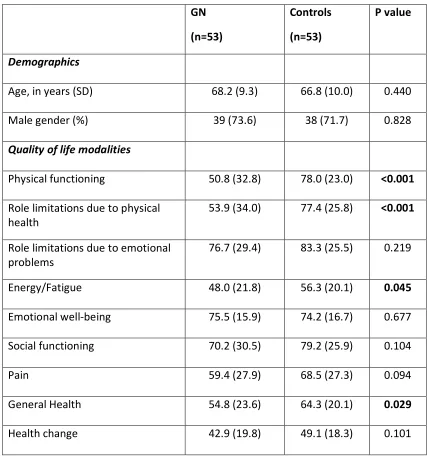
Results: Fifty-three patients with GN and 53 age and gender matched controls were recruited. Compared to controls, GN showed significantly worse scores in physical functioning, role limitations due to physical health, energy/fatigue and general health subdomains of SF-36.
After having adjusted for age, gender and disease severity, being on a strict GFD correlated with better SF-36 scores on the pain domain of the SF-36 (beta 0.317, p=0.019) and the overall health change domain of the SF-36 (beta 0.306, p=0.017).
1. Introduction
Gluten neuropathy (GN) is one of commonest neurological manifestations of gluten sensitivity [1] and it is defined as an otherwise idiopathic peripheral neuropathy [2] in the presence of serological evidence of gluten sensitivity (positive antigliadin, and/or transglutaminase or endomysium antibodies) [1, 3]. Some patients with GN have evidence of enteropathy on duodenal biopsy and are diagnosed with coeliac disease, whereas the majority of patients with GN do not have enteropathy.
The main type of gluten neuropathy is symmetrical sensorimotor axonal peripheral neuropathy [1], however sensory ganglionopathy (SG) and rarely mononeuritis multiplex (MMX) may also occur [1, 4, 5]. Gluten-free diet (GFD) has been shown to be effective in treating GN [6].
As in all chronic diseases, patients with GN are expected to have impaired quality of life (QoL) for reasons that are either directly or indirectly related to the disease. It has been shown that patients with advanced peripheral neuropathy, for example, show worse scores in questionnaires measuring QoL when compared to less impaired patients [7]. Such impairment, not only refers to motor symptoms (i.e. weakness) but also sensory and in particular pain [8 – 13]. Indirectly, however, GN might cause an additional burden of having to adhere to a strict GFD. It has been shown that the degree of difficulty in adhering to a GFD is associated with reductions in patient wellbeing and psychological distress that the dietician is critically placed to address [14].
2. Methods
2.1. Procedure and Participants
This was a cross-sectional study conducted at the Sheffield Institute of Gluten Related Diseases (SIGReD). Patients were recruited from the gluten/neurology clinic based at the Royal Hallamshire Hospital (Sheffield, UK). Individuals without a diagnosis of peripheral neuropathy participated in the study as controls.
To be enrolled, the patients had to meet the following inclusion criteria: (1) diagnosis of PN, as confirmed on nerve conduction studies, (2) serological evidence of gluten sensitivity (positive for antigliadin IgG and/or IgA with or without positivity for endomysial and transgultaminase antibodies) at diagnosis prior to commencing gluten-free diet, (3) absence of other risk factors for developing PN (i.e. diabetes, vitamin deficiencies, exposure to neurotoxic agents) (4) age equal to or greater than 18 years, (5) able to provide a written informed consent.
The study protocol was approved by the local ethics committee.
2.2. Measures
Demographic characteristics included age and gender. All patients went through extensive investigations for possible causes of PN [2]. Patients with a family history of neuropathy were excluded.
The type of neuropathy (sensorimotor length dependent PN, sensory ganglionopathy [15, 16], mononeuritis multiplex) for all patients was determined based on nerve conduction studies, which were performed by the same clinician on the day of the recruitment.
The severity of neuropathy was assessed by the overall limitations neuropathy scale (ONLS), which is a validated scale that measures limitations in the everyday activities of the upper and lower limbs [17].
Biagi score was used to document adherence to a gluten-free diet [18]. Patients with a Biagi score of equal to or above 3 were considered as being on a gluten-free diet. Furthermore, patients with negative serology at the time of recruitment were considered to be on a strict gluten free diet.
The 36-Item Short Form Survey (SF-36), a self-reported measure of health status and quality of life [19], was used to determine patient health-related quality of life. SF-36 covers nine health and QoL domains. These domains include physical functioning; role limitations due to physical health; role limitations due to emotional problems; energy/fatigue; emotional well-being; social functioning; pain; general health and health change. Each item is measured using a Likert-type scale. Scores were converted and analysed according to the marking guidelines for the SF-36, such that higher scores (out of a total of 100 for each domain) constitute better health-related quality of life in this domain.
2.3. Statistical analyses
A database was developed using the Statistical Package for Social Science (version 23.0 for Mac; SPSS). Frequencies and descriptive statistics were examined for each variable. Comparisons between patients on a gluten free diet and patients not on a gluten free diet were made using Student’s t-tests for normally distributed continuous data, Mann-Whitney’s U test for non-normally distributed and chi-square test or Fischer’s exact test for categorical data.
Where differences with a p value of lower than 0.10 were found, these variables were entered into linear regression models, with the QoL domain score being the dependent variable. All accuracy and generalization assumptions for the model were checked.
3. Results
3.1. Study population
Fifty-three patients with GN were recruited (73.6% male, mean age 68.2±9.3 years) and were age and gender matched with 53 control subjects without a history of peripheral neuropathy or gluten sensitivity. Thirty-six patients (67.9%) had a symmetrical length-dependent sensorimotor axonal PN, sixteen (30.2%) had a sensory ganglionopathy and one patient had mononeuritis multiplex (1.9%). Mean disease duration was 12.6±9.5 years (ranging from 0 to 37 years). Overall ONLS scores ranged from 1 to 7 (mean 3.1±1.8).
Not all of the patients agreed to a duodenal biopsy. Of 32 patients who underwent duodenal biopsy 9 (28.1%) had enteropathy (8 coeliac disease, 1 increased intraepithelial lymphocytes).
3.2. QoL compared to controls
GN (n=53)
Controls (n=53)
P value
Demographics
Age, in years (SD) 68.2 (9.3) 66.8 (10.0) 0.440
Male gender (%) 39 (73.6) 38 (71.7) 0.828
Quality of life modalities
Physical functioning 50.8 (32.8) 78.0 (23.0) <0.001
Role limitations due to physical health
53.9 (34.0) 77.4 (25.8) <0.001
Role limitations due to emotional problems
76.7 (29.4) 83.3 (25.5) 0.219
Energy/Fatigue 48.0 (21.8) 56.3 (20.1) 0.045
Emotional well-being 75.5 (15.9) 74.2 (16.7) 0.677
Social functioning 70.2 (30.5) 79.2 (25.9) 0.104
Pain 59.4 (27.9) 68.5 (27.3) 0.094
General Health 54.8 (23.6) 64.3 (20.1) 0.029
Health change 42.9 (19.8) 49.1 (18.3) 0.101
Table 1. Demopgraphics and quality of life parameters of patients with gluten
3.3. The role of GFD (self-reported) on QoL
Based on the self-reported adherence to GFD (Biagi score equal to or greater than 3), 31 patients (58.5%) were on a GFD. Table 2 summarizes the demographic, clinical and quality-of-life related characteristics of patients with GN reporting being on GFD versus patients with GN reporting being on a gluten containing diet. The two groups did not differ significantly in age, gender, disease duration, neuropathy severity or neuropathy type. A trend of statistically significance (p=0.094) was observed on the overall health change subdomain of the SF-36.
Gluten free diet
(n=31)
Gluten containing diet
(n=22)
P value
Demographics
Age, in years (SD) 68.6 (8.3) 67.6 (10.8) 0.702
Male gender (%) 20 (64.5) 19 (86.4) 0.115
Clinical characteristics
Disease duration, in years (SD) 13.8 (8.0) 11.0 (10.2) 0.259
Type of neuropathy 0.690
Symmetrical length dependent PN (%) 21 (67.8) 15 (68.2)
Sensory ganglionopathy (%) 9 (29.0) 7 (31.8)
Mononeuritis multiplex (%) 1 (3.2) 0 (0.0)
Neuropathy severity
Total ONLS score (SD) 3.1 (1.7) 3.2 (1.8) 0.814
Quality of life modalities
Physical functioning 53.5 (34.3) 47.0 (31.0) 0.482
Role limitations due to physical health 56.0 (32.6) 50.9 (36.5) 0.589
Role limitations due to emotional problems
79.6 (25.2) 72.7 (34.7) 0.409
Energy/Fatigue 49.2 (23.5) 46.3 (19.5) 0.640
Emotional well-being 76.5 (16.1) 74.1 (15.9) 0.599
Social functioning 70.4 (27.4) 69.9 (35.1) 0.951
Pain 63.6 (28.0) 53.5 (27.3) 0.197
General Health 56.5 (22.9) 52.7 (24.9) 0.576
Table 2. Demographic, clinical and quality-of-life related characteristics of patients
with gluten neuropathy reporting being on a gluten free diet versus patients with gluten neuropathy reporting being on a gluten containing diet.
3.4. The role of strict GFD on QoL
Twenty-two patients have managed to eliminate the antigliadin, endomysial and transglutaminase antibodies after being on GFD. This population, which accounted for 41.5% of the total GN study group and 71% of those GN patients self-reporting as being on a GFD, was considered to be on a strict GFD.
Table 3 summarizes the demographic, clinical and quality-of-life related characteristics of patients with GN being on a strict GFD versus patients with GN not being on a strict GFD. The two groups did not differ significantly in age, gender, disease duration, neuropathy severity or neuropathy type. Patients on a strict GFD had significantly higher scores (indicating better QoL) on the pain sub-domain of the SF-36 (p=0.03). A trend of statistically significance (p=0.066) was also observed on the overall health change subdomain of the SF-36.
After having adjusted for age, gender and disease severity, being on a strict GFD (serologically proven) is positive correlated with better SF-36 scores on the pain domain of the SF-36 (beta 0.317, p=0.019) and the overall health change domain of the SF-36 (beta 0.306, p=0.017).
On strict GFD
(n=22)
Not on strict GFD
(n=31)
P value
Demographics
Age, in years (SD) 69.7 (8.5) 67.2 (9.9) 0.329
Male gender (%) 14 (63.6) 25 (80.6) 0.166
Clinical characteristics
Disease duration, in years (SD) 13.9 (8.1) 11.7 (9.6) 0.385
Type of neuropathy 0.462
Symmetrical length dependent PN (%) 14 (63.6) 22 (71.0)
Sensory ganglionopathy (%) 7 (31.8) 9 (29.0)
Mononeuritis multiplex (%) 1 (4.5) 0 (0.0)
Neuropathy severity
Total ONLS score (SD) 3.2 (1.8) 3.0 (1.7) 0.695
Quality of life modalities
Physical functioning 58.4 (35.7) 45.5 (30.0) 0.160
Role limitations due to physical health 58.5 (33.9) 50.6 (34.2) 0.409
Role limitations due to emotional problems
81.8 (23.7) 73.1 (32.8) 0.293
Energy/Fatigue 50.0 (26.1) 46.6 (18.5) 0.578
Emotional well-being 76.8 (18.2) 74.5 (14.2) 0.608
Social functioning 69.6 (28.4) 70.6 (32.4) 0.916
Pain 69.2 (26.6) 52.5 (27.1) 0.030
General Health 56.4 (23.9) 53.9 (23.7) 0.708
Table 3. Demographic, clinical and quality-of-life related characteristics of patients
with gluten neuropathy being on a strict gluten free diet versus not being on a strict gluten free diet (serologically confirmed, by having eliminated the anti-gliadin antibodies).
4. Discussion
This case-controlled study demonstrates that patients with GN have significantly worse QoL compared to age and gender matched controls in the SF-36 modalities of physical functioning, role limitations due to physical health, energy/fatigue and general health. This finding adds to the existing literature that the main impact of peripheral neuropathy on patients’ QoL is on the modalities affecting their dys-functioning (i.e. impaired activities of daily living) [7]. To our knowledge, this is the first study to investigate the QoL of patients with GN.
Another novelty of the current study is examining the role of GFD on QoL. For this we conducted two separate analyses; based on what the patients report and based on the evidence of elimination of all gluten sensitivity-related antibodies.
When comparing patients who are truly strict with GFD (i.e. elimination of all circulating gluten sensitivity-related antibodies) with patients either not being on a GFD or not being strict with GFD we showed that the former have significantly better scores in the pain and the overall health change domain. This is in keeping with the current literature, which shows that patients with GN benefit from a GFD with evidence of improvement of the neuropathy [6, 20]. Moreover, this finding highlights the importance of serological monitoring in an attempt to improve adherence to GFD. Interestingly, from our cohort, 29% of patients on GFD still had positive serology.
Our results should be interpreted with some caution, given the limitations of our design. This is a cross-sectional study based on patients attending a specialized clinic, and the results may not be generalizable to other settings. Furthermore, our cohort included patients with large fiber axonal peripheral neuropathies only. Pure small fiber neuropathy associated with gluten sensitivity, is another area that merits further consideration, as it is a particularly painful condition and therefore can affect patients’ QoL.
Acknowledgements
This is a summary of independent research carried out at the NIHR Sheffield Biomedical Research Centre (Translational Neuroscience). The views expressed are those of the authors and not necessarily those of the NHS, the NIHR or the Department of Health.
Dr Zis is sincerely thankful to the Ryder Briggs Fund.
Conflict of interest
References
1. Hadjivassiliou M, Sanders DS, Grünewald RA, Woodroofe N, Boscolo S, Aeschlimann D. Gluten sensitivity: from gut to brain. Lancet Neurol. 2010 Mar;9(3):318-30.
2. Zis P, Sarrigiannis PG, Rao DG, Hewamadduma C, Hadjivassiliou M. Chronic idiopathic axonal polyneuropathy: a systematic review. J Neurol. 2016 Oct;263(10):1903-10
3. Zis P, Rao DG, Sarrigiannis PG, Aeschlimann P, Aeschlimann DP, Sanders D, Grünewald RA, Hadjivassiliou M. Transglutaminase 6 antibodies in gluten neuropathy. Dig Liver Dis. 2017 Nov;49(11):1196-1200.
4. Kelkar P, Ross MA, Murray J. Mononeuropathy multiplex associated with celiac sprue. Muscle Nerve. 1996 Feb;19(2):234-6.
5. Thawani SP, Brannagan TH 3rd, Lebwohl B, Green PH, Ludvigsson JF. Risk of Neuropathy Among 28,232 Patients With Biopsy-Verified Celiac Disease.JAMA Neurol. 2015 Jul;72(7):806-11.
6. Hadjivassiliou M, Kandler RH, Chattopadhyay AK, Davies-Jones AG, Jarratt JA, Sanders DS, Sharrack B, Grünewald RA. Dietary treatment of gluten neuropathy. Muscle Nerve. 2006 Dec;34(6):762-6.
7. Teunissen LL, Eurelings M, Notermans NC, Hop JW, van Gijn J. Quality of life in patients with axonal polyneuropathy. J Neurol. 2000 Mar;247(3):195-9.
8. Zis P, Varrassi G. Painful Peripheral Neuropathy and Cancer. Pain Ther. 2017 Dec;6(2):115-116.
9. Zis P, Paladini A, Piroli A, McHugh PC, Varrassi G, Hadjivassiliou M. Pain as a First Manifestation of Paraneoplastic Neuropathies: A Systematic Review and Meta-Analysis. Pain Ther. 2017 Dec;6(2):143-151
comprehensive review of the current literature. Pain Pract. 2012 Mar;12(3):219-51.
11. Zis P, Grünewald RA, Chaudhuri RK, Hadjivassiliou M. Peripheral neuropathy in idiopathic Parkinson's disease: A systematic review. J Neurol Sci. 2017 Jul 15;378:204-209.
12. Brozou V, Vadalouca A, Zis P. Pain in Platin-Induced Neuropathies: A Systematic Review and Meta-Analysis. Pain Ther. 2017 Dec 1. doi: 10.1007/s40122-017-0092-3.
13. Zis P, Daskalaki A, Bountouni I, Sykioti P, Varrassi G, Paladini A. Depression and chronic pain in the elderly: links and management challenges. Clin Interv Aging. 2017 Apr 21;12:709-720.
14. Barratt SM, Leeds JS, Sanders DS. Quality of life in Coeliac Disease is determined by perceived degree of difficulty adhering to a gluten-free diet, not the level of dietary adherence ultimately achieved. J Gastrointestin Liver Dis. 2011 Sep;20(3):241-5.
15. Camdessanché JP, Jousserand G, Ferraud K, Vial C, Petiot P, Honnorat J, Antoine JC. The pattern and diagnostic criteria of sensory neuronopathy: a case-control study. Brain. 2009 Jul;132(Pt 7):1723-33.
16. Zis P, Hadjivassiliou M, Sarrigiannis PG, Barker AStJE, Rao DG. Rapid neurophysiological screening for sensory ganglionopathy: a novel approach. Brain Behav. 2017 Nov 24;7(12):e00880. doi: 10.1002/brb3.880
17. Graham RC, Hughes RA. A modified peripheral neuropathy scale: the Overall Neuropathy Limitations Scale. J Neurol Neurosurg Psychiatry. 2006 Aug;77(8):973-6.
18. Biagi F, Andrealli A, Bianchi PI, Marchese A, Klersy C, Corazza GR. A gluten-free diet score to evaluate dietary compliance in patients with coeliac disease. Br J Nutr. 2009 Sep;102(6):882-7.
19. Ware JE Jr, Sherbourne CD. The MOS 36-item short-form health survey (SF-36). I. Conceptual framework and item selection. Med