Portrayals of Maturity in Australian Television Commercials: A Benchmark Study
Stream: Marketing
Format: Paper Presentation
Bronwyn Higgs and Laura Milner
Bronwyn Higgs
Lecturer in Marketing,
School of Hospitality, Tourism and Marketing, Victoria University,
PO Box 14428 Melbourne, 8001 Australia
[email protected] Phone: 6 03 9919 4379 Fax: 6 03 9919 4931
Laura Milner,
Director, Alaska Institute of Tourism School of Management
University of Alaska Fairbanks Fairbanks, AK 99775-6080 USA
Portrayals of Maturity in Australian Television Commercials: A Benchmark Study
Abstract
Although Australia’s population is ageing, there has been no research on the portrayal of maturity in advertising. The research reported in this paper presents a simple content analysis of a sample of Australian television commercials. The age profile of a sample of television commercials compared with Australian census data. In addition, the paper examines the nature of mature role portrayals in advertising. The paper concludes mature people are not only under-represented, but they are also misrepresented in television advertising.
Introduction
Age is a major demographic variable used in marketing segmentation. Consequently, marketing researchers have been very interested in age-related research. Mature segments have been described as the wealthiest cohort in history (Nelson, 2002). In Australia,
compulsory superannuation combined with robust economic conditions mean that the baby boomer generation have relatively high disposable incomes and a willingness to spend on consumer goods and services. Indeed marketers coined a new term, “grey power” to describe the spending of mature market segments (NATSEM, 2002).
In spite of their apparent disposition to spend, mature audiences often believe that they are marginalised in mainstream media (Davidson, 2005). Older audiences are among the heaviest users of newspapers, television and radio, yet they are typically under-represented in the media. Some studies suggest that the media tend to problematise aging by presenting older people as a burden on health and social services, as victims of crime and as threats to future economic prosperity of developed nations (Davidson, 2005; Vesperi, 2003).
Consumer researchers make an important distinction between chronological age and cognitive age. There is no real consensus on the chronological cut off point that defines the “elderly” or the aged. Previous research use age ranges from 45 – 65 years, although the majority seem to settle on 55 years and over. Demographic and social changes have had a profound impact on personal experiences of ageing. Advances in health and diet have contributed to general well being contributing to longevity. As a consequence, people in their fifties and sixties do not see themselves as old. In spite of changing attitudes to change, the media tends to perpetuate stereotypical images of the mature consumers.
Literature Review
There is a rich body of literature, spanning more than three decades investigating the portrayal of the elderly in media and advertising. Empirical studies of the media’s portrayal of the elderly can be found in diverse bodies of literature –including the gerontological literature, psychology, social geography as well as marketing and media studies, including journalism.
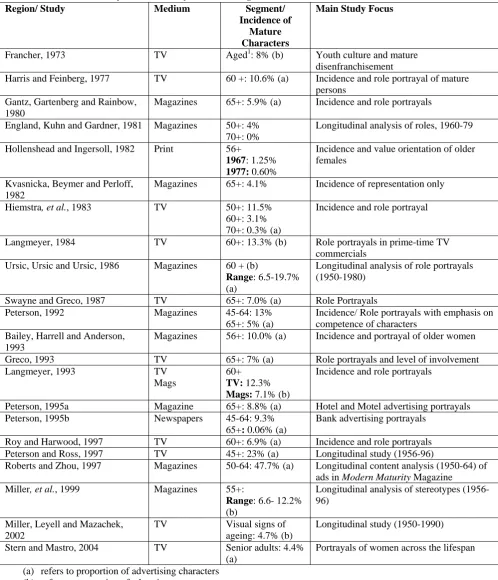
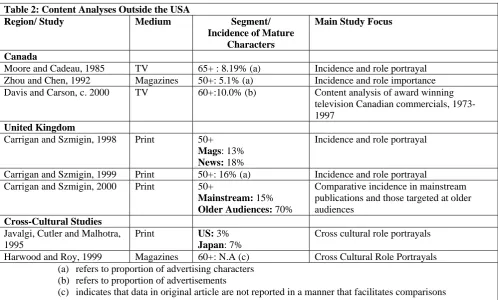
Tables 1 and 2 present a chronological/cross cultural record of content analyses carried out over the past 30 years. Due to space constraints, this summary has been confined to content analyses of advertising only. It should, however, be noted that there are more than 30
report that the degree of under-representation is more marked among older females (Ursic, Ursic and Ursic, 1986; Vesperi, 2003, p.5).
The following literature review, the most comprehensive published to date, has enabled us to identify three distinct evolutionary stages:
1. Descriptive analysis of media’s representation of mature people 2. Investigation of mature audiences’ experience of the media
3. Strategy and Policy Development for appropriate representations of maturity
Phase One: Descriptive Analysis of Representation of Mature People (1970 +)
The first phase, which emerged in the early 1970s and is of continuing scholarly interest, focussed on describing the incidence and portrayal of mature persons in both editorial and advertising content. Given that these studies focus on the communications message itself, content analysis is the most commonly used approach. (Gantz, Gartenberg and Rainbow, 1980; Lerman and Callow, 2004; Pollay, 1987; Potter and Levine-Donnerstein, 1999). However, one recent study used a social stereotyping technique drawn from the social psychology literature (Miller, Leyell and Mazachek, 2002)
These empirical studies raise two important issues. Firstly, all studies agree that mature people are seriously under-represented when compared to the population. Without exception all studies report that mature females are more seriously under-represented than mature males (Gantz, Gartenberg and Rainbow, 1980). Most studies also point out that where older
characters appear in advertising, they are relegated to minor or peripheral roles (Davis and Carson, c. 2000; Greco, 1993; Peterson, 1992; Zhou and Chen, 1992).
The second issue concerns the realistic characterization of mature persons. It has been argued that role portrayals in the media contribute to both role expectations and social learning (Gerbner, et al., 1980; Langmeyer, 1993; Pollay, 1987). Active and engaged roles are treated as positive influences while passive and disengaged roles are treated as negative (Festervand and Lumpkin, 1985; Vesperi, 2003).
On this second issue, the literature is considerably more divided. Empirical findings point to both positive and negative attributes. Several studies found relatively neutral portrayals in advertising (Greco, 1993; Hiemstra, et al., 1983). Only six of the studies included in the literature review found that older persons are positively portrayed (Balazs, 1995; Carrigan and Szmigin, 1999; Harwood and Roy, 1999; Langmeyer, 1993; Miller, et al., 1999; Roy and Harwood, 1997; Schreiber and Boyd, 1980). By far, the majority of studies have shown that that mature models were portrayed in a negative fashion (Harris and Feinberg, 1977;
Langmeyer, 1983; Peterson, 1995b; Peterson, 1992; Peterson, 1995a; Smith, 1976).
debate over positive versus negative role portrayals, some commentators have argued that even positive role portrayals are themselves a form of stereotyping and therefore unrealistic
Examples of negative roles, outlined in the literature, include: more physical/mobility problems (Carrigan and Szmigin, 1998; Peterson, 1999; Zhou and Chen, 1992), health problems (Harris and Feinberg, 1977; Hollenshead and Ingersoll, 1982; Smith, 1976), confused or agitated states (Hollenshead and Ingersoll, 1982; Swayne and Greco, 1987), sedentary or inactive postures (Roberts and Zhou, 1997; Zhou and Chen, 1992)
Strong and active (Greco, 1993; Harwood and Roy, 1999; Langmeyer, 1993; Roy and Harwood, 1997), alone or isolated (Roberts and Zhou, 1997; Zhou and Chen, 1992)
Six longitudinal studies provide some useful insights on trends in role portrayal. Ursic et al’s
(1986) study of advertising from 1950-80 found a decrease in positive roles over time. Roberts and Zhou’s (1997) dedicated analysis of advertisements appearing in Modern
Maturity magazine, also showed a decrease in positive role portrayals over the outlook period, 1956-1980. Miller et al’s study (1999) of consumer magazine advertising during the period, 1956-96 found relatively negative role portrayals. However, their later study found somewhat more positive role portrayals (Miller, Leyell and Mazachek, 2002). England, Kuhn and Gardner’s (1981) study, focussed primarily on the incidence of mature persons, found modest increases in the mean age of both men and women over the review period, 1960-79.
Collectively, these studies suggest that small incremental improvements in positive role portrayals can be observed over five decades. However, it should be noted that changes in advertising’s characterization of mature persons occurs slowly and appears to lag well behind changes to the demographic and social landscape.
Phase Two: Mature Audiences Experiences of the Media (1980+)
From the mid 1980s the literature moved into a second phase as researchers moved beyond simple descriptive analysis of message content. Instead research began to focus on mature audiences’ actual experience of the media. Covering a diverse range of issues impacting on the audiences, this literature identifies key issues as: the impact on purchasing and
information seeking behavior (Festervand and Lumpkin, 1985; Powers and Travick, 1996), consumer self-image (Korzeny and Neuendorf, 1980; Nelson and Belk-Smith, 1988; Smith, Moschis and Moore, 1984) as well as information processing activities including persuasion and recall (Healey and Ross, 2002; Langmeyer, 1984; Phillips and Stanton, 2004; Robinson, et al., 2003; Stephens, 1981; Stephens, 1982).
Particularly germane to our current study is the issue of consumer responses to mature models in advertising. Yet there is a dearth of research to illuminate this issue. In contrast,
considerable research has investigated consumers’ responses to the racial identity of advertising models (Barban and Cundiff, 1964; Bush, Gwinner and Solomon, 1974; Bush, Hair and Solomon, 1979; Cagley and Cardozo, 1970; Cohen, 1992; Fujioka, 1999; Lee, Fernandez and Martin, 2002; Muse, 1971; Schreiber and Boyd, 1980; Tolley and Goett, 1971).
Two studies suggest that mature consumers exhibit negative responses. Festervand and Lumpkin (1985) found that older audiences believe they are not accurately portrayed in advertising. Further that this belief contributes to a broader disenchantment, possibly distrust of advertising messages. (Robinson, et al., 2003) experimental study utilizing “offensive” imagery found negative impacts on purchasing intention.
Four studies on mature consumer responses found neutral through to positive impacts. Schreiber and Boyd found (Schreiber, 1980) that older audiences were generally content and believed that they were realistically portrayed. Nelson and Smith’s experimental study (1988) found that both middle aged and older consumers, irrespective of their cognitive age,
identified with mature models. More recently, (Milliman and Erffmeyer, 1990) found that older models were perceived to be more believable. Finally, (Greco, Swayne and Johnson, 1997) found no significant relationship between model age and advertising impacts.
Phase Three: Strategy and Policy Development (1990+)
The third stage, which appears to have emerged around 1990, appears to be concerned with informing public policy development. Literature in this phase considers a range of issues- from the impact of stereotypical representations, its causes as well as suggesting remedies. Clearly, the audience for such articles consists of advertisers, broadcasters, publishers and government legislators. (Carrigan and Szmigin, 2000; Davidson, 2005; Henley and Pettigrew, 2002; Milliman and Erffmeyer, 1990; N.P.O.E., 2004; Nelson and Curry, 1997; Szmigin and Carrigan, 2000).
Our literature review has identified a rich stream of empirical research on images of maturity in advertising. Yet, there are no studies focussing on the Asia-Pacific region. Specifically, there has been no Australian research documenting the presence of mature people in advertising. Instead, Australian research has been preoccupied with gender (Milner and Higgs, 2004). To some extent, the prevalence of research on gender reflects broader
Table 1 U.S. Content Analyses on Maturity in Advertising
Region/ Study Medium Segment/ Incidence of
Mature Characters
Main Study Focus
Francher, 1973 TV Aged1: 8% (b) Youth culture and mature disenfranchisement
Harris and Feinberg, 1977 TV 60 +: 10.6% (a) Incidence and role portrayal of mature persons
Gantz, Gartenberg and Rainbow, 1980
Magazines 65+: 5.9% (a) Incidence and role portrayals
England, Kuhn and Gardner, 1981 Magazines 50+: 4% 70+: 0%
Longitudinal analysis of roles, 1960-79
Hollenshead and Ingersoll, 1982 Print 56+
1967: 1.25% 1977: 0.60%
Incidence and value orientation of older females
Kvasnicka, Beymer and Perloff, 1982
Magazines 65+: 4.1% Incidence of representation only
Hiemstra, et al., 1983 TV 50+: 11.5% 60+: 3.1% 70+: 0.3% (a)
Incidence and role portrayal
Langmeyer, 1984 TV 60+: 13.3% (b) Role portrayals in prime-time TV commercials
Ursic, Ursic and Ursic, 1986 Magazines 60 + (b)
Range: 6.5-19.7% (a)
Longitudinal analysis of role portrayals (1950-1980)
Swayne and Greco, 1987 TV 65+: 7.0% (a) Role Portrayals Peterson, 1992 Magazines 45-64: 13%
65+: 5% (a)
Incidence/ Role portrayals with emphasis on competence of characters
Bailey, Harrell and Anderson, 1993
Magazines 56+: 10.0% (a) Incidence and portrayal of older women
Greco, 1993 TV 65+: 7% (a) Role portrayals and level of involvement
Langmeyer, 1993 TV
Mags
60+ TV: 12.3% Mags: 7.1% (b)
Incidence and role portrayals
Peterson, 1995a Magazine 65+: 8.8% (a) Hotel and Motel advertising portrayals Peterson, 1995b Newspapers 45-64: 9.3%
65+: 0.06% (a)
Bank advertising portrayals
Roy and Harwood, 1997 TV 60+: 6.9% (a) Incidence and role portrayals Peterson and Ross, 1997 TV 45+: 23% (a) Longitudinal study (1956-96)
Roberts and Zhou, 1997 Magazines 50-64: 47.7% (a) Longitudinal content analysis (1950-64) of ads in Modern Maturity Magazine
Miller, et al., 1999 Magazines 55+:
Range: 6.6- 12.2% (b)
Longitudinal analysis of stereotypes (1956-96)
Miller, Leyell and Mazachek, 2002
TV Visual signs of
ageing: 4.7% (b)
Longitudinal study (1950-1990)
Stern and Mastro, 2004 TV Senior adults: 4.4% (a)
Portrayals of women across the lifespan
(a) refers to proportion of advertising characters (b) refers to proportion of advertisements
For comparative purposes and wherever data permitted, frequency of representation was recalculated using characters as a base. However, in a small number of articles, the presentation of the data did not facilitate such manipulation.
1
Table 2: Content Analyses Outside the USA
Region/ Study Medium Segment/ Incidence of Mature
Characters
Main Study Focus
Canada
Moore and Cadeau, 1985 TV 65+ : 8.19% (a) Incidence and role portrayal Zhou and Chen, 1992 Magazines 50+: 5.1% (a) Incidence and role importance Davis and Carson, c. 2000 TV 60+:10.0% (b) Content analysis of award winning
television Canadian commercials, 1973-1997
United Kingdom
Carrigan and Szmigin, 1998 Print 50+ Mags: 13% News: 18%
Incidence and role portrayal
Carrigan and Szmigin, 1999 Print 50+: 16% (a) Incidence and role portrayal Carrigan and Szmigin, 2000 Print 50+
Mainstream: 15% Older Audiences: 70%
Comparative incidence in mainstream publications and those targeted at older audiences
Cross-Cultural Studies Javalgi, Cutler and Malhotra, 1995
Print US: 3% Japan: 7%
Cross cultural role portrayals
Harwood and Roy, 1999 Magazines 60+: N.A (c) Cross Cultural Role Portrayals (a) refers to proportion of advertising characters
(b) refers to proportion of advertisements
(c) indicates that data in original article are not reported in a manner that facilitates comparisons
For comparative purposes and wherever data permitted, frequency of representation was recalculated using characters as a base. However, in a small number of articles, the presentation of the data did not facilitate such manipulation.
Methodology
This study is concerned with images of maturity in advertising. Content analysis was used to analyse a sample of television advertisements. Although content analysis has been used since the 1950s, it continues to enjoy widespread currency for evaluating advertising messages (Kassarjian, 1977; Mahtani, 2000).
The protocol established by Gilly (1988) was the foundation for the current study.
Commercials broadcast during a Tuesday between the hours of 8:00 am and 4:00 pm plus a Wednesday evening between 7:00 pm and 11:00 pm during 2002 were taped to provide the sample. The highest rating Melbourne network, Channel 9, was selected. Network promotions and duplicated advertisements were discarded. This resulted in 328 usable advertisements being collected. Tables 3 and 4 summarise advertising demographics from the sample.
Adult characters were included in the analysis providing that they had either one line of dialog or a screen appearance for at least three seconds. One male and one female coder, naïve regarding the purpose of the study, assessed the commercials. Inter-rater reliability was over 90% on all dimensions; high inter-rater reliability was no doubt facilitated by the fact that the raters could replay a commercial as many times as necessary in order to ensure an accurate judgment. Consensus was used to settle coder discrepancies.
Objectives
Given the absence of empirical research on portrayals of maturity in the Australian context, the objectives of this study are twofold:
(1) To document the incidence of mature characters in television advertising; and
(2) To describe the nature of mature character role portrayals
Discussion of Findings
The sampling frame yielded 328 television commercials containing 241 adult characters. Of these, less than 14 percent of all characters were aged 50 and over. The ratio of male to female characters in the sample is similar to that of the Australian population where there are 47 males to every 50 females.
Table 3: Advertisement Demographics
Commercials (number)
Commercials per hour
Adult Characters number
Male: Female Characters
Ratio of Characters to Commercials
328 27.3 241 49:51 .73
The first objective of this study was to document the incidence of mature characters in television advertising. Table 3, which summarises these findings, indicates that more than 55 percent of characters in television commercials are aged under 35 years. Less than 14 percent of all characters are over 50 years of age. Moreover, the incidence of mature characters is considerably lower for females (less than 2 percent of all female characters) than for males (26 percent of all male characters). It is also worth noting that women aged 50-64 years are entirely absent from the advertising sample.
Table 4: Demographic Profile of TV Advertising Characters Adult Characters in Advertising Sample
Male Female Persons
Age
Count % Count % Count %
15-34 years 61 51.3 72 59 133 55.2
35-49 years 27 22.7 48 48 75 31.1
50-64 years 29 24.4 0 0 29 12.0
65 years+ 2 1.7 2 1.6 4 1.7
Total Persons aged 15+ 119 100 122 100.0 241 100.0
North America and Europe where characters aged 50 and over are significantly under-represented in television advertisements.
Table 5 Comparison of Advertising Sample with Australian Adult Population
Age (years)
Males (%) Females (%) People (15 years+)
TVCs Population TVCs Population TVCs Population
15-35 51.3 36.5 59 34.8 55.2 35.6
35-49 22.7 28.4 48 28.0 31.1 28.2
50-64 24.4 20.8 0 19.7 12.0 20.2
65 + 1.7 14.4 1.6 17.5 1.7 16.0
Total (15+) 100 100 100.0 100 100.0 100
Source: Australian Bureau of Statistics, Census 2001, Catalog 2001.0
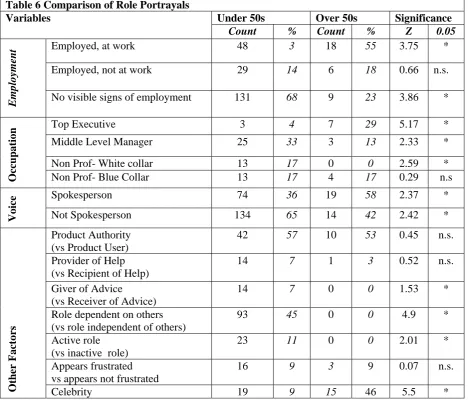
The second objective of the study was to describe the nature of role portrayals. The low numbers of mature characters in the advertising sample created some difficulties for
meaningful quantitative analysis. Consequently, a simple test of independent proportions (Z-score) was the only analysis conducted. The results are summarised in Table 6.
Quantitatively, there are statistical differences between the two age cohorts in a number of dimensions. Our study provided no evidence that older persons are depicted as isolated, debilitated, frustrated or confused. However, there were differences noted with activity. Older models were more likely to be portrayed in passive roles. Such findings are broadly consistent with those from the United States, United Kingdom and Europe.
Table 6 Comparison of Role Portrayals
Under 50s Over 50s Significance
Variables
Count % Count % Z 0.05
Employed, at work 48 3 18 55 3.75 *
Employed, not at work 29 14 6 18 0.66 n.s.
Employment No visible signs of employment 131 68 9 23 3.86 *
Top Executive 3 4 7 29 5.17 *
Middle Level Manager 25 33 3 13 2.33 *
Non Prof- White collar 13 17 0 0 2.59 *
Occupation Non Prof- Blue Collar 13 17 4 17 0.29 n.s
Spokesperson 74 36 19 58 2.37 *
Voice Not Spokesperson 134 65 14 42 2.42 *
Product Authority (vs Product User)
42 57 10 53 0.45 n.s.
Provider of Help (vs Recipient of Help)
14 7 1 3 0.52 n.s.
Giver of Advice (vs Receiver of Advice)
14 7 0 0 1.53 *
Role dependent on others (vs role independent of others)
93 45 0 0 4.9 *
Active role (vs inactive role)
23 11 0 0 2.01 *
Appears frustrated vs appears not frustrated
16 9 3 9 0.07 n.s.
Other Facto
rs
Celebrity 19 9 15 46 5.5 *
Limitations and Further Research
A major limitation of this study lies with the sampling strategy, which may have been sub-optimal. Although Gilly’s protocol is well known and widely adapted, it was originally designed for research on gender. The small number of television hours recorded failed to capture large numbers of mature characters, imposing serious limitations for quantitative analysis. A related consideration is that content analysis methodology is inherently subjective (Potter and Levine-Donnerstein, 1999).
Conclusions
References
A.B.S (Australian Bureau of Statistics), 2001. Basic Community Profiles: Census Australia, Catalog 2001.0, Canberra, Australia.
Bailey W.T., Harrell D.R. and Anderson L.E., 1993. "The Image of Middle Aged and Older Women in Magazine Advertisements",Educational Gerontology.19, 97-103.
Balazs A.L., 1995. "The Use and Image of Mature Adults in Health Care Advertising",Health Mark Quarterly.12, 3, 13-26.
Barban A.M. and Cundiff E.W., 1964. "Negro and White Response to Advertising Stimuli", Journal of Marketing Research.1, 2, 53-56.
Bush R.F., Gwinner R. F. and Solomon P.J., 1974. "White Consumer Sales Response to Black Models",Journal of Marketing.38, 2,
Bush R.F., Hair J.F. and Solomon P., 1979. "Consumers' Level of Prejudice and Response to Black Models in Advertisements",Journal of Marketing Research.16, August, 341-345. Cagley J.W. and Cardozo R.N., 1970. "White Responses to Integrated Advertising",Journal of Advertising Research.10, 2, 35-39.
Carrigan M and Szmigin I, 2000. "Advertising and Older Consumers: Image and Ageism", Business Ethics: A European Review.9, 1, January, 2000, 42-50.
Carrigan M and Szmigin I., 1999. "The Representation of Older People in Advertisements", Journal of the Market Research Society.41, 3, 311-321.
Carrigan M. and Szmigin I., 1998. "The Usage and Portrayal of Older Models in Contemporary Consumer Advertising",Journal of Marketing Practice.4, 8, 231-245. Cohen J., 1992. "White Consumer Responses to Asian Models In Advertising", Journal of Consumer Marketing",Journal of Consumer Marketing.9, 2, 17-28.
Davidson S., 2005. "A Demographic Time Bomb? The Politics of Ageing and the British Media", Political Studies Association Annual Conference.
Davis B. and Carson A., c. 2000. A Content Analysis of 25 Years of Canadian Award Winning Television Commercials.Ontario, Canada.
England A. K., Kuhn A. and Gardner T., 1981. "The Age of Men and Women in Magazine Advertisements",Journalism Quarterly.58, Autumn, 468-471.
Festervand T.A. and Lumpkin J.R., 1985. "Response of Elderly Consumers to their Portrayal by Advertisers",Current Issues in Research in Advertising.8, 3, 203-228.
Fujioka Y., 1999. "Television Portrayals and African-American Stereotypes: Examination of Television Effects when direct contact is lacking",Journal of Mass Communication
Quarterly.76, 1, 52-75.
Gantz W., Gartenberg H..M. and Rainbow C.K., 1980. "Approaching Invisibility: The
Portrayal of the Elderly in Magazine Advertisements",Journal of Communication.30, 56-60. Gerbner G., Gross G., Signorelli N. and Morgan M., 1980. "Ageing With Television: Images in Television Drama and Comparisons of Social Reality",Journal of Communication.30, 37-47.
Gilly M., 1988. "Sex Roles in Advertising: A Comparison of Television Advertisements in Australia, Mexico, and the United States",Journal of Marketing.52, 2, 75-85.
Greco A. J., Swayne L.E. and Johnson E.B., 1997. "Will Older Models Turn Shoppers Off?" International Journal of Advertising.16, 1, 27-36.
Greco A.J., 1993. "The Incidence and Portrayal of the Elderly in Television Advertising", Journal of Marketing Theory and Practice.2, 1, Winter, 15-19.
Harris A. J. and Feinberg J.F., 1977. "Television and Ageing: Is What You See What You Get?"The Gerontologist.17, October, 464-468.
Harris A. J. and Feinberg J.F., 1977. "Television and Aging: Is What You See What You Get?"The Gerontologist.17, 5, 464-468.
Harwood J. and Roy A., 1999. "The Portrayal of Older Adults in Indian and US Magazine Advertisements",Howard Journal of Communication.10, 4, 259-280,
Healey T. and Ross K., 2002. "Growing Old Invisibly: Older Viewers Talk Television", Media, Culture and Society.24, 4, 105-120.
Henley N. and Pettigrew S., 2002. "Targeting Seniors for Social Marketing Communications: Recommendations for Falls Prevention Messages", Australia New Zealand Marketing
Academy.
Hiemstra R., Goodman M., Middlemiss M. A., Vasco R and Zeigler N., 1983. "How Older Persons are Portrayed in Television Advertising: Implications for Educators",Educational Gerontology.71, 123-126.
Hollenshead C. and Ingersoll E., 1982. "Middle Aged and Older Women in Print Advertisements",Educational Gerontology.8, 25-41.
Javalgi R.G., Cutler B.D. and Malhotra N. K., 1995. "Print Advertising at the Component Level: A Cross Cultural Comparison of the United States and Japan",Journal of Business Research.34, 117-124.
Kassarjian H. H., 1977. "Content Analysis in Consumer Research",Journal of Consumer Research.4, 8-18.
Kvasnicka A. J., Beymer B. and Perloff R., 1982. "Portrayals of the Elderly in Magazine Advertisements",Journalism Quarterly.59, 656-658.
Langmeyer L., 1983. "Age Role Portrayals in Magazine Advertisements: A Content Analysis", in Marketing Theories and Concepts for an Era of Change, Summey, J. H., Viewanthan, R., Taylor, R. D. and Blynn, K. (Eds.), Southern Marketing Association, 286-289.
Langmeyer L., 1984. "Senior Citizens and Television Advertisements: A Research Note", Current Issues in Research in Advertising.7, 1, 167-178.
Langmeyer L., 1993. "Advertising Images of Mature Adults: An Update",Journal of Current Issues in Research and Advertising.15, 2, 81-91.
Lee C.K., Fernandez N. and Martin N., 2002. "Using Self-Referencing to Explain the Effectiveness of Ethnic Minority Models in Advertising",International Journal of Advertising.21, 3, 3670379.
Lerman D. and Callow M., 2004. "Content Analysis in Cross-Cultural Advertising Research: Insightful or Superficial?"International Journal of Advertising.23, 4, 507-521.
Mahtani M., 2000. Representing Minorities: Canadian Media and Minority Identities. Department of Canadian Heritage for Ethnocultural, Racial, Religious and Linguisitic Diversity,
Miller D. W., Leyell T.S. and Mazachek J., 2002. "Stereotypes of the Elderly in US
Television Commercials From the 1950s to the 1990s",Journal of Advertising History. 315-340.
Miller P.N., Miller D. W., Mckibbin E.M. and Gross G.L., 1999. "Stereotypes of the Elderly in Magazine Advertisements: 1956-1996",International Journal of Aging and Human Development.49, 4, 319- 337.
Milliman R. E. and Erffmeyer R.C., 1990. "Improving Advertisng Aimed at Seniors",Journal of Advertising Research.29, December/ January, 31-36.
Milner L. M. and Higgs B., 2004. "Gender Sex-Role Portrayals in International Television Advertising Over Time: The Australian Experience",Journal of Current Issues in Research in Advertising.26, 2, 81- 95.
Moore T. E. and Cadeau L., 1985. "The Representation of Women, The Elderly and
Minorities in Canadian Television Commercials",Canadian Journal of Behavioural Science. 17, 215-235.
Muse W.V., 1971. "Product-Related Response to Use of Black Models in Advertising", Journal of Marketing Research.8, 1, 107-109.
N.P.O.E., 2004. Age In Focus: Media and Diversity in An Ageing Society.
Nelson J. and Curry K., 1997. "Creative Strategies for Connecting With Mature Individuals", Journal of Consumer Marketing.14, 4, 310-322.
Nelson S L. and Belk-Smith R., 1988. "The Influence of Model Age on Older Consumers Reactions to Print Advertising",Current Issues in Research in Advertising.11, 1, 189-224. Peterson R. T., 1995b. "The Portrayal of Senior Citizens By Banks in Newspaper
Advertisements: A Content Analysis",Journal of Professional Services.12, 2, 95-106. Peterson R.T., 1992. "The Depiction of Senior Citizens in Magazine Advertisements: A Content Analysis",Journal of Business Ethics.11, 9, 701-707.
Peterson R.T., 1995a. "Portrayal of Seniors in Hotel and Motel Magazine Advertisements: A Content Anlaysis",Journal of Hospitality and Leisure Marketing.3, 3, 55-68.
Peterson R.T., 1999. "The Depiction of Seniors in International Tourism Magazine Advertisements: A Conent Analysis",Journal of International Hospitality, Leisure and Tourism.1, 4, 3-17.
Peterson R.T. and Ross D.T., 1997. "A Content Analysis of the Portrayal of Mature Individuals in Television Commercials",Journal of Business Ethics.16, 4, 425- 433. Phillips D.M. and Stanton J.L., 2004. "Age-related Differences in Advertising: Recall and Persuasion",Journal of Targeting, Measurement and Analysis for Marketing.13, 1, 7-20. Pollay R.W., 1987. "The Distorted Mirror: Reflections on the Unintended Consequences of Advertising",Journal of Marketing.50, April, 18-36.
Potter W. J. and Levine-Donnerstein D, 1999. "Rethinking validity and reliability in content analysis",Journal of Applied Communications Research.27, 3, 258-284.
Powers T. and Travick F., 1996. "Utlization of Information Sources by the Elderly",Journal of Hospital Marketing.10, 2, 101-116.
Roberts S.D. and Zhou N., 1997. "The 50 and Older Characters in Advertisements of Modern Maturity: Growing Older, Getting Better?"Journal of Applied Gerontology.16, 2, 208-217. Robinson T., Popovich M., Gustafson R. and Fraser C., 2003. "Older Adults Perceptions of Offensive Senior Stereotypes in Magazines Advertisements: Results of A Q Method
Analysis",Educational Gerontology.29, 6, 503-519.
Roy A. and Harwood J., 1997. "Under-represented, Postively Portrayed: Older Adults in Television Commercials",Journal of Applied Communications Research.25, February, 39-56.
Schreiber E.S., 1980. "How the Elderly Perceive Television Commercials",Journal of Communication.30, Winter, 61-70.
Smith M. C., 1976. "Portrayal of the Elderly in Prescription Drug Advertising: A Pilot Study", Gerontologist.16, 4, 329-334.
Smith R.B., Moschis G. P. and Moore R.J., 1984. "Effects of Advertising on the Elderly Consumer: An Investigation of Social Breakdown Theory", AMA Educators Proceedings. Stephens N., 1981. "Media Use and Media Attitude Change",Journal of Advertising.10, 1, 38-46.
Stephens N., 1982. "The Effectiveness of Time-Compressed Television Advertisements With Older Adults",Journal of Advertising.11, 4, 49-55.
Stern S.R. and Mastro D.E., 2004. "Gender Portrayals Across the Lifespan: A Content
Analytic Look at Broadcast Commercials",Mass Communication and Society.7, 2, 215-236. Swayne L.E. and Greco A. J., 1987. "The Portrayal of Older Americans in Television
Commercials",Journal of Advertising.15,
Szmigin I. and Carrigan M., 2000. "Does Advertising in the UK Need Older Models",Journal of Product and Brand Management.9, 2, 128-148.
Tolley S. and Goett J.T., 1971. "Reactions to Blacks in Newspaper Ads",Journal of Advertising Research.11, 2, 11-17.
Ursic A..C., Ursic M.L. and Ursic V.L., 1986. "A Longitudinal Study of the Elderly in Magazine Advertising",Journal of Consumer Research.13, 1, 131-133.
Vesperi M., 2003. "Forty Nine Plus: Shifting Images of Ageing in the Media", Reinventing Aging: Baby Boomers and Civic Engagement. 1-29.