504
SOME NUMERICAL RESULTS ON FUNCTION SPACE (FSA) ALGORITHMS
J. O. Omolehin1 K. Rauf2 A. Mabayoje3 O. T. Arowolo4 A. Lukuman5
ABSTRACT
In this work, we consider the numerical implementation of Function Space Algorithm (FSA) for the solution of quadratic continuous cost functional. It is used to solve Reaction Diffusion Control problems. It considered specifically a parabolic problem characterized by dynamics constraints and the results obtained analyzed. The cumbersome nature of the line search techniques associated with FSA was addressed by time discretization approach. It is shown that the convergence rate of FSA improves as the penalty parameter grows.
Key Words:FSA, Penalty parameter, Constraints, Convergence rate, Time Discretization
2010 Mathematics Subject Classification: 93B40, 93CXX & G 1.7
INTRODUCTION
Let us first consider the quadratic functional of the form:
Where is an 𝑛𝑥𝑛 symmetric positive definite matrix operator on the Hilbert space 𝐻. 𝛼 is a vector in 𝐻 and 𝐹0 is a constant term.
1 Mathematics and Computer Science Department, IBB University, Lapai, Nigeria
2 Mathematics Department, University of Ilorin, Ilorin, Nigeria
3
Computer Science Department, University of Ilorin, Ilorin, Nigeria
4 Mathematics and Statistics Department, Lagos State Polytechnics, Lagos State
5
Federal College of Fisheries and Marine Technology, Lagos State
,
,
2
1
,
H Ho
a
x
x
Ax
F
x
F
A
Journal of Asian Scientific Research
505
Let us also consider what is termed conjugate descent with 𝐹. With conjugate descent, it is
assumed that a sequence
𝑝𝑖 = 𝑝0, 𝑝1, … , 𝑝𝑘, ..
is available with the members of the sequence conjugate with respect to the positive definite linear
operator .
By conjugate with respect to 𝐴, we mean that
< 𝑝𝑖, 𝐴𝑝𝑖 >𝐻= ≠ 0, 𝑖𝑓 𝑖 ≠ 𝑗= 0, 𝑖𝑓 𝑖 = 𝑗
In this case, 𝐴 is assumed positive definite so < 𝑝𝑖, 𝐴𝑝𝑖>𝐻> 0.
The conventional Conjugate Gradient Method (CGM) was originally designed for the minimization of a quadratic objective functional of the form stated above.
STAGES INVOLVED IN CONJUGATE GRADIENT METHOD
Stage 1: The first element 𝑥0∈ 𝐻 of the descent sequence is guessed while the remaining members
of the sequence are computed with the aid of the following formulae:
Stage 2: 𝑝0= −𝑔0= −(𝑎 + 𝐴𝑥0)
(𝑝0 is the descent direction and 𝑔0 is the gradient of 𝐹(𝑥) when 𝑥 = 𝑥0)
Stage 3: 𝑥𝑖+1= 𝑥𝑖+ 𝛼𝑖𝑝𝑖, 𝛼𝑖 =< 𝑔𝑖, 𝑔𝑖>𝐻/< 𝑝𝑖,𝐴𝑝𝑖>𝐻
𝛼 is the step length
Stage 4: if 𝑔𝑖 for some 𝑖 terminate the sequence else, set 𝑖 = 𝑖 + 1 and go to stage 3.
The CGM has a well worked out theory with an elegant convergence profile. It has been proved that the algorithm converges, at most, in n iterations in a well posed problem and the convergence
rate is given as:
A
;
1 i i i
i
g
a
Ap
g
H i i H i i i i i i
i
g
p
g
g
g
g
p
1
1
;
1,
1
/
,
0
2
1 1
x E
M m M m
x E
n
n
506
Where m and M are smallest and spectrums of matrix A respectively
That is, for an n dimensional problem, the algorithm will converge in at most n iterations.
The CGM algorithm cannot handle quadratic cost functional of the form:
Minimise
Subject to
𝑣 = 𝑐𝑣 𝑡 + 𝑑𝑢(𝑡)
For the reason that operator A was not known explicitly in continuous cost functional, researchers
came up with different approximation – based techniques that could estimate 𝛼𝑖 that minimizes F(xi
+ αpi). (1) In this fashion, there came into being various cumbersome techniques. The most popular
among such methods is the conventional function space (CFS) algorithm, (1) to minimize the
continuous cost functional of the form:
Problem (1)
Minimise 𝑥𝑜𝛿 𝑇 𝑡 𝑄𝑥 𝑡 + 𝑢𝑇 𝑡 𝑃 𝑢 𝑡 𝑑𝑡
Subject to the dynamic constraints
𝑥 (t) =C x (t) + Du (t),
0 < t < δ (δ given); where 𝑥(t) denotes the transpose of x(t), 𝑥 (t) stands for the first derivative of x(t) with respect to t. x(t) is the n x 1 state vector, u(t) is the q x 1 control vector, C and D are n x q
constant matrices respectively, while Q and R are symmetric, positive definite, constant square matrices of dimensions n and q respectively.
The control operator A is associated with problem (1) satisfying
< 𝐴, 𝐴𝑍 > K= J x, u,μ = {xT δ
0
t Qx t + u(t)TPu(t)
+μ|| 𝑥 (t) – Cx(t) – Du(t) ||2}dt (μ> 0)
by transforming problem (1) into an unconstrained optimal control problem. Where μ is the penalty constant 𝐾 is given by K = 𝐻1[0, δ] x Lq2 [0, δ], and 𝐻1 [0, δ], denotes sobolev space of the
absolutely continuous functions x(.), square integrable over the closed interval [0, δ].
T
dt
t
bu
t
av
0
507 𝐿𝑞2 0, 𝛿 stands for the Hilbert space consisting of the equivalence classes of square integrable functions from [0, δ] into Rq, with norm denoted by ||. ||𝐸 and defined by
| | u | | = {||u||2} 1 2 𝑑𝑡
𝛿
0 and with scalar product conventionally denoted by < .,.> and defined by
<u1, u2> = < u0δ 1, u2 >E dt where ||. ||𝐸 and <. , . >𝐸 denote the norm and scalar product in
Euclidean q – dimensional space.
FUNCTION SPACE ALGORITHM
The function space algorithm is constructed to solve the optimal control problem (1):
Min J (x, u, μ) = Min {x𝑅 T(t) Px (t) + uT(t) Qu(t) } dt 0
+μ | |(x (t) – Cx(t) – Du(t) || 0T 2dt
Where C and D are constant matrices of appropriate dimensions. The steps involve in FSA is as follows:
Step 1
choose the initial values x 0 t , uo t ,
where 0 < 𝑡 < 𝑇, 𝑇 𝑖𝑠 𝑘𝑛𝑜𝑤𝑛 𝑎𝑛𝑑 𝑐𝑜𝑚𝑝𝑢𝑡𝑒 xo t = x 0 t T
o
dt
Step 2
Initialize the Counter: i = 0, and compute [∇x J ]i, ∇U J
i using formulae for
∇J = ∇X J
∇UJ
∇XJ = 2μ x t − f x(t , u t , t ] − (t ∂T∂x)T T –
∂f ∂x
T
[2μ(x s − f(x s , u(s), s)] }ds
0 < t < T
[∇uJ] = ∂I ∂u − (
∂F ∂v)
508 Step 3
Compute the current descent direction.
s x,i 𝑡 = { − ∇
𝑋 𝐽 𝑖 + 𝛽
𝑖−1𝑆 𝑋 ,𝑖−1 𝑡 , 𝑓𝑜𝑟 𝑖>0,𝑤𝑒𝑟𝑒 𝑡 ∈ 𝑜,𝑇
{− ∇ 𝑜, 𝑓𝑜𝑟 𝑖=𝑜
sx,i (t) = 𝑠 𝑥,𝑖(𝑡) 𝑡
𝑜 𝑑𝑡
s u,i(𝑡) = { − ∇
𝑈 𝐽
𝑖 + 𝛽𝑖−1𝑆𝑖−1 𝑡 𝑓𝑜𝑟 𝑖>0
{− ∇𝑈𝐽
0 , 𝑓𝑜𝑟 𝑖=𝑜
Where t [0, T ], and
𝛽𝑖−1=
|| ∇𝑥𝐽 𝑖||2 𝑑𝑡 + 𝑇
𝑜 || ∇𝑢𝐽 𝑖||2 𝑑𝑡
𝑇 𝑜 || ∇𝑥𝐽 𝑖−1||2 𝑑𝑡 +
𝑇
𝑜 || ∇𝑢𝐽 𝑖−1||2 𝑑𝑡
𝑇 𝑜
STEP 4
Find P*i
such that J (xi + Pi* sx, i, ui + P*i su,i, μ,) < J (xi + pi sX, i ui + pi su,i, μ,), p>o
STEP 5
Test for the stopping criterion of the algorithm by verifying if
S(x, u, μ) = || Ø (z) ||2
+ ( Jx )T ( Jx) + ( uJ) T ( uJ) < ε,
(Ø = 𝑥 - f)
Where ε is a chosen predetermined tolerance to indicate that the desired accuracy required for the computational programming method.
STEP 6
Set 𝑥𝑖+1(t) =𝑥 𝑖(t) +𝑝 ∗𝑖s (t) 0 <t< T
𝑢𝑖+1(t) =𝑢 𝑖(t) +𝑝 ∗𝑖s (t) 0 <t< T
STEP 7
509
To the best knowledge of the authors, no numerical work has been carried out prior to the time this
work was concluded.
NUMERICAL RESULTS ON FSA
In carrying out our numerical investigation using FSA algorithm discussed, we study computationally the convergence rate of various diffusion equation problems which are only dimensionally different from one another. Thus, when we say the dimensionality of the resulting
diffusion control problem is ℝ12 and ℝ11 it means that is α, u ∈ ℝ12 and
α, u ∈ ℝ11, respectively.
Thus, in ℝ12 and ℝ11we have problems (1) and (2) respectively as stated below:
Problem (1)
Minimize {𝛼12 𝑡 + 𝛼22 𝑡 + … + 𝛼122 𝑡 + 𝑢12 𝑡 + 𝑢22 𝑡 + … + 1
𝑜 𝑢12 2 𝑡 }𝑑𝑡
Subject to α1 (t) = -π2α1 (t) + u1 (t)
α2 (t) = -4π2α2 (t) + u2 (t)
……….
α12 (t) = -144π2α12 (t) + u12 (t)
The problem is transformed into an unconstrained problem with the introduction of a penalty constant μ and it becomes:
Min J (α, u, μ) = Min {𝛼𝑜1 12 𝑡 + 𝛼2 2 𝑡 + … + 𝛼122 𝑡 + 𝑢1 2(t) + 𝑢22 𝑡 + … + 𝑢12 2 𝑡 ] 𝑑𝑡
+ 𝜇{ { 𝛼1(𝑡) + 𝜋2𝛼1 𝑡 − 𝑢1(𝑡) 2
+ 𝛼2(𝑡) + 4𝜋2𝛼2 𝑡 − 𝑢2(𝑡) 2
+ 𝛼3(𝑡) + 9𝜋2𝛼3 𝑡 − 1
0
𝑢3(𝑡)2+…+𝛼12(𝑡)+144𝜋2𝛼12𝑡−𝑢12(𝑡)2}}dt
Also, problem in ℝ11 i.e. when α, u ℝ11, we obtain the following equivalent problem
formulation:
Problem (2)
Minimize {𝛼𝑜1 12 𝑡 + 𝛼22 𝑡 + … + 𝛼112 𝑡 + 𝑢12 𝑡 + 𝑢22 𝑡 + … +𝑢11 2 𝑡 𝑑𝑡
510
α1 (t) = -π2α1 (t) + u1 (t)
α2 (t) = -4π2α2 (t) + u2 (t)
……….
α11 (t) = -122π2α11 (t) + u11 (t)
The problem is now transformed into an unconstrained problem with the introduction of a penalty constant μ.
Min J (α, u, μ) = Min {𝛼𝑜1 12 𝑡 + 𝛼2 2 𝑡 + … + 𝛼112 𝑡 (𝛼, 𝑢)
+ 𝑢1(t) + 𝑢22 𝑡 + … + 𝑢11 2 𝑡 ] 𝑑𝑡 + 𝜇{ { 𝛼1(𝑡) + 𝜋2𝛼1 𝑡 − 𝑢1(𝑡) 2
+ 1
0
𝛼2(𝑡)+4𝜋2𝛼2𝑡−𝑢2(𝑡)2+𝛼3(𝑡)+9𝜋2𝛼3𝑡−𝑢3(𝑡)2+…+𝛼11(𝑡)+121𝜋2𝛼11𝑡−𝑢11(𝑡)2}}dt.
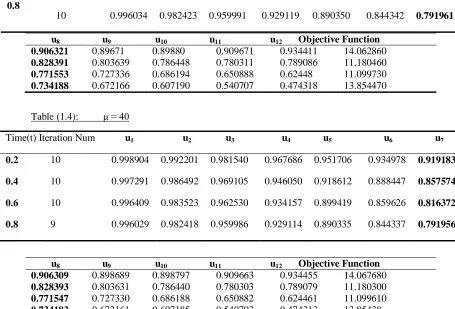
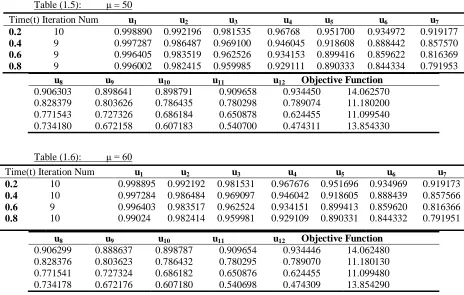
The problems in other dimensions can easily be formulated in similar manner. Meanwhile, the convergence rate for various values of penalty constants in ℝ12 is shown by Tables (1.1) – (1.6).
Table-1. FSA Algorithm in ℝ𝟏𝟐
Table (1.1): μ = 10
Time (t)Iteration Num u1 u2 u3 u4 u5 u6 u7
0.2
0.4
0.6
0.8
4
9
9
8
0.998991
0.997361
0.996464
0.996073
.992290
0.986562
0.983578
0.982462
0.981630
0.969175
0.962585
0.960030
0.967777
0.94612
0.934212
0.929157
0.951799
0.918683
0.899475
0.890379
0.935071
0.888516
0.859680
0.844381
0.919281
0.857644
0.816428
0.79200
u8 u9 u10 u11 u12 Objective Function
0.906385 0.828453 0.771602 0.734227
0.898730 0.803700 0.727384 0.672205
0.898913 0.786510 0.686244 0.607229
0.909716 0.780373 0.650937 0.540747
0.934522 0.789148 0.624517 0.474358
511
Table (1.2): μ = 20
Time (t)Iteration Num u1 u2 u3 u4 u5 u6 u7
0.2 0.4 0.6 0.8 5 8 9 10 0.998933 0.997315 0.996427 0.996044 0.992232 0.986516 0.983541 0.982433 0.981572 0.969129 0.962549 0.960001 0.967719 0.946074 0.934175 0.929128 0.951742 0.918636 0.899438 0.890350 0.935017 0.888471 0.859644 0.844352 0.919213 0.857598 0.816391 0.791971
u8 u9 u10 u11 u12 Objective Function
0.906306 0.828406 0.771565 0.734198 0.898689 0.803654 0.727347 0.672176 0.898843 0.786463 0.686207 0.607200 0.909705 0.780326 0.650901 0.540718 0.934476 0.789102 0.624480 0.474329 14.063360 11.180790 11.099970 13.854660
Table (1.3): μ = 30
Time(t) Iteration Num u1 u2 u3 u4 u5 u6 u7
0.2 0.4 0.6 0.8 4 9 10 10 0.998914 0.997299 0.996415 0.996034 0.992212 0.986500 0.983529 0.982423 0.981552 0.969113 0.962536 0.959991 0.967699 0.946058 0.934163 0.929119 0.951722 0.918620 0.899426 0.890350 0.934990 0.888455 0.859632 0.844342 0.919200 0.857582 0.816378 0.791961
u8 u9 u10 u11 u12 Objective Function
0.906321 0.828391 0.771553 0.734188 0.89671 0.803639 0.727336 0.672166 0.89880 0.786448 0.686194 0.607190 0.909671 0.780311 0.650888 0.540707 0.934411 0.789086 0.62448 0.474318 14.062860 11.180460 11.099730 13.854470
Table (1.4): μ = 40
u8 u9 u10 u11 u12 Objective Function
0.906309 0.828393 0.771547 0.734183 0.898689 0.803631 0.727330 0.672161 0.898797 0.786440 0.686188 0.607185 0.909663 0.780303 0.650882 0.540703 0.934455 0.789079 0.624461 0.474313 14.067680 11.180300 11.099610 13.85438
Time(t) Iteration Num u1 u2 u3 u4 u5 u6 u7
512
Table (1.5): μ = 50
Time(t) Iteration Num u1 u2 u3 u4 u5 u6 u7
0.2 0.4 0.6 0.8 10 9 9 9 0.998890 0.997287 0.996405 0.996002 0.992196 0.986487 0.983519 0.982415 0.981535 0.969100 0.962526 0.959985 0.96768 0.946045 0.934153 0.929111 0.951700 0.918608 0.899416 0.890333 0.934972 0.888442 0.859622 0.844334 0.919177 0.857570 0.816369 0.791953
u8 u9 u10 u11 u12 Objective Function
0.906303 0.828379 0.771543 0.734180 0.898641 0.803626 0.727326 0.672158 0.898791 0.786435 0.686184 0.607183 0.909658 0.780298 0.650878 0.540700 0.934450 0.789074 0.624455 0.474311 14.062570 11.180200 11.099540 13.854330
Table (1.6): μ = 60
Time(t) Iteration Num u1 u2 u3 u4 u5 u6 u7
0.2 0.4 0.6 0.8 10 10 9 10 0.998895 0.997284 0.996403 0.99024 0.992192 0.986484 0.983517 0.982414 0.981531 0.969097 0.962524 0.959981 0.967676 0.946042 0.934151 0.929109 0.951696 0.918605 0.899413 0.890331 0.934969 0.888439 0.859620 0.844332 0.919173 0.857566 0.816366 0.791951
u8 u9 u10 u11 u12 Objective Function
0.906299 0.828376 0.771541 0.734178 0.888637 0.803623 0.727324 0.672176 0.898787 0.786432 0.686182 0.607180 0.909654 0.780295 0.650876 0.540698 0.934446 0.789070 0.624455 0.474309 14.062480 11.180130 11.099480 13.854290
ANALYSIS OF RESULTS
If you look at the results of the tables, it is easily shown that the convergence rate of our method improves as the penalty parameter grows without bound. It is observed that the values of the
calculated objective function keep on decreasing as the penalty parameter 𝜇 grows. Part of future
research in this work is to determine the optimal value for µ.
CONCLUSION AND RECOMMENDATION FOR FUTURE WORK
It is clear that the conventional function space algorithms for solving minimization of penalized cost functional for optimal control problem characterized by linear system integral quadratic cost due to Di pillo et al (1) though falling within the framework of conjugate gradient method algorithm,
is difficult to apply computationally. For further work (2-6).
The advantage of this method is that, it can handle continuous quadratic functional which cannot be
513
REFERENCES
Di Pillo, G and Grippo, L. (1972): A Computing Algorithm for the Epsilon Method to
Identification and Optimal Control Problems, Ricerche di Automatica, Vol.3, pp.54-77.
Ibiejugba, M.A. (1985): Computational methods in optimization, Ph.D. Thesis, University of Leeds, Leeds, U.K..
Omolehin, J. O. (1986): Experiment with extended conjugate gradient method algorithm, Unpublished M. Sc. Thesis, University of Ilorin, Ilorin. , Nigeria.
Omolehin, J. O. (1991): On the control of reaction diffusion equation, Unpublished Ph.D Thesis, University of Ilorin, Ilorin, Nigeria.
Omolehin, J. O. (2005): Eigen value perturbation for gradient method, Anaele Stiintifice Ale
Universitata “Al,I.Cuza,Tomul L1,s.I.Matematical,f. Vol. 1, pp. 127-132. MR2187363
(2006h:65083) 65K10.
Russel, David, L. (1970): Optimization theory, W.A. Benjamin, Inc. New York .
APPENDIX
C OPEN 12, ’’JULU’’,ATI=’’AP’’
C THIS PROGRAME IS USED TO MINIMIZE AN
OBJECTIVE FUNCTIONAL THROUGH THE METHOD OF FUNCTION SPACE
ALGORITHM DIMENSION X(12),U(12),PAE(12),LAMDA(12),GX(12),GU(12)
DIMENSION UPGX(12),
UPGU(12),SX(12),SU(12),DOTSX(12)
DIMENSION UPDOTSX(12), PSU(12),UPSX(12),DOTX(12),UPDOTX(12)
DIMENSION UPX(12), UPU(12),BITA (12)
TIME=-0.2
ITERA=0
DO 3 I=1, 12 X(I)=0.0
U(I)=0.0
PAE(I)=0.0
LAMDA(I)=0.0
G X(I)=0.0
GU(I)=0.0
UPGX(I)=0.0
UPGU(I)=0.0
514
UPLAMDA (I)=0.0
SX(I)=0.0
SU(I)=0.0
DOT SX(I)=0.0
UPDOTSX(I)=0.0
PSU(I)=0.0
UPX(I)=0.0
UPU(I)=0.0 UPSX(I)=0.0
DOTX(I)=0.0
UPDOTX(I)=0.0 CONTINUE
AM=0.0
70 AM=AM+10.0
WRITE (12, 301)AM 301 FORMAT(70X,’’AM=’’,F15.6//////)
IF(AM.GT.(10.0))GOTO 60
TIME=0.
TIME=TIME+0.2
IF(TIME.GT.1)GOTO 70 DO 4 I=1, 2
DOTX(I)=1.0 X(1)=TIME
BITA(I)=0.0 U(I)=1.0
CONTINUE
ITERA=0
BITA(I)=0.0
515
SUMU=0.0
SUMX=0.0
C THE CONSTRUCTION OF THE GRADIENT FOLLOWS
DO 5 I=1, 2
PAE(I)=(I**2)*(3.142**2)
DI=2*AM*(PAE(I)*X(I)- U(I))
D2=2*X(I)*TIME-2*X(I)
D3=PAE(I)*2*AM*(PAE(I)*X(I)-U(I)*(TIME)-1)
GX(I)=D1-(D2+D3)
GU(I)=2*U(I)-2*AM*(PAE(I)*X(I)-U(I))
CONTINUE DO 13 I=1,2
DOTSX(I)=-GX(I)+BITA(I)*SX(I) SX(I)=DOTSX(I)*TIME
SU(I)=-GU(I)+BITA(I)*SU(I)
CONTINUE
RNI=(X(I)*SX(I))+(X(2)*SX(2))+(X(3)*SX(3))+(X(4)*SX(4))+(X(5)*SX(5))+(X(6)*SX
(6))
RN2=(X(7)*SX(7))+(X(8)*SX(8))+(X(9)*SX(9))+(X(10)*SX(10))+(X(11)*SX(11))+(X( 12)*SX(12))
RN3=(U(1)*SU(1))+(U(2)*SU(2))+(U(3)*SU(3))+(U(4)*SU(4))+(U(5)*SU(5))+(U(6)*S U(6))
RN4=(U(7)*SU(7))+(U(8)*SU(8))+(U(9)*SU(9))+(U(10)*SU(10))+(U(11)*SU(11))+(U(
12)*SU(12))
RN5=(SX(1)+(PAE(1)*SX(1))-SU(1))*(DOTX(1)+(PAE(1)*X(1))-U(1))
RN6=(SX(2)+(PAE(2)*SX(2))-SU(2))*(DOTX(2)+(PAE(2)*X(2))-U(2))
RN7=(SX(3)+(PAE(3)*SX(3))-SU(3))*(DOTX(3)+(PAE(3)*X(3))-U(3))
RN8=(SX(4)+(PAE(4)*SX(4))-SU(4))*(DOTX(4)+(PAE(4)*X(4))-U(4))
RN9=(SX(5)+(PAE(5)*SX(5))-SU(5))*(DOTX(5)+(PAE(5)*X(5))-U(5))
516
RN12=(SX(8)+(PAE(8)*SX(8))-SU(8))*(DOTX(8)+(PAE(8)*X(8))-U(8))
RN13=(SX(9)+(PAE(9)*SX(9))-SU(9))*(DOTX(9)+(PAE(9)*X(9))-U(9)) RN14=(SX(10)+(PAE(10)*SX(10))-SU(10))*(DOTX(10)+(PAE(10)*X(10))-U(10)) RN15=(SX(11)+(PAE(11)*SX(11))-SU(11))*(DOTX(11)+(PAE(11)*X(11))-U(11))
RN16=(SX(12)+(PAE(12)*SX(12))-SU(12))*(DOTX(12)+(PAE(12)*X(12))-U(12))
RD1=(SX(1)**2)+(SX(2)**2)+ (SX(3)**2)+ (SX(4)**2)+ (SX(5)**2)+ (SX(6)**2)
RD2=(SX(7)**2)+(SX(8)**2)+ (SX(9)**2)+ (SX(10)**2)+ (SX(11)**2)+
(SX(12)**2)
RD3=(SU(1)**2)+(SU(2)**2)+ (SU(3)**2)+ (SU(4)**2)+ (SU(5)**2)+ (SU(6)**2)
RD4=(SU(7)**2)+(SU(8)**2)+ (SU(9)**2)+ (SU(10)**2)+ (SU(11)**2)+
(SU(12)**2) RD5=(SX(1) +(PAE(1)*SX(1))-(SU (1)**2))
RD6=(SX(2) +(PAE(2)*SX(2))-(SU
(2)**2)) RD7=(SX(3)
+(PAE(3)*SX(3))-(SU (3)**2))
RD8=(SX(4) +(PAE(4)*SX(4))-(SU (4)**2))
RD9=(SX(5) +(PAE(5)*SX(5))-(SU (5)**2))
RD10=(SX(6) +(PAE(6)*SX(6))-(SU (6)**2))
RD11=(SX(7)
+(PAE(7)*SX(7))-(SU (7)**2)) RD12=(SX(8)
+(PAE(8)*SX(8))-(SU (8)**2))
RD13=(SX(9) +(PAE(9)*SX(9))-(SU (9)**2))
RD14=(SX(10) +(PAE(10)*SX(10))-(SU (10)**2))
RD15=(SX(11) +(PAE(11)*SX(11))-(SU (11)**2))
RD16=(SX(12) +(PAE(12)*SX(12))-(SU (12)**2))
RNT=(2*(RD1+RD2+ RD3+ RD4)+2*AM*( RN5+ RN6+ RN7+ RN8+ RN9+
RN10+ RN11+ RN12+ RN13+ RN14+ RN15+ RN16)) RMT=(2*(RD1+RD2+
RD3+ RD4)+2*AM*( RD5+ RD6+ RD7+ RD8+ RD9+ RD10+ RD11+ RD12+ RD13+ RD14+
RD15+ RD16)) ROW=RNT/RMT
IF (ITERA.GT.50)GOTO 19
C CS MEANS CONSTRAINT
SATISFACTION
C CSAT MEANS THE TOTAL CONSTRAINT SATISFACTION
CSAT=0.0
DO 6 I=1, 12
517
CSAT=CSAT+(CS(I)**2)
6 CONTINUE
C WE DECIDED TO LEAVE ALL THE WRITE STATEMENTS OUT SINCE ANY
VARIABLE NEEDED CAN EASILY BE CALCULATED DO 9 I=1, 12
BITA=((UPGX(I)**2)+(UPGU(I)**2))/((GX(I)**2)+(GU(I)**2)) UPX(I)=X(I)+ROW*SX(I)
UPU(I)=U(I)+ROW*SU(I)
9 CONTINUE
SNURM1=0.0
SNURM2=0.0 DO 7 I=1, 12
SNURM1=SNURM1+(GX(I)**2)
SNURM2=SNURM2+(GU(I)**2)
7 CONTINUE
SNOM1=SQRT (SNURM1)
SNOM2=SQRT (SNURM2)
DO 10 I=1, 12
X(I)=UPX(I)
U(I)=UPU(I)
SUMU=SUMU+(U(I)*U(I)) STOTAL=SUMU+SUMX
OB=STOTAL
10 CONTINUE
WRITE(12,112)OB,SNOMI,SNOM2
112 FORMAT(//40X,’’OB=’’,F15.6/40X,’’SNOM1=’’,F15.6/10X,’’SNOM2=’’,F15.6)
IF(SNOM1.LE.(0.01).AND. SNOM2.LE.(0.01))GOTO 19 GOTO 20
60 STOP