Volume 1
A Psychometric Study of the Child Attachment Interview: Reliability and Validity
ProQuest Number: 10010057
All rights reserved
INFORMATION TO ALL USERS
The quality of this reproduction is dependent upon the quality of the copy submitted. In the unlikely event that the author did not send a complete manuscript and there are missing pages, these will be noted. Also, if material had to be removed,
a note will indicate the deletion.
uest.
ProQuest 10010057
Published by ProQuest LLC(2016). Copyright of the Dissertation is held by the Author. All rights reserved.
This work is protected against unauthorized copying under Title 17, United States Code. Microform Edition © ProQuest LLC.
ProQuest LLC
789 East Eisenhower Parkway P.O. Box 1346
This thesis is dedicated to my dearest sister
A C K N O W T Æ D G E M E N T S
Tina, I am endlessly indebted to you, thank you.
Mary, thank you for all your support and encouragement throughout.
Thank you Dad for reading this entire thesis in the final hour.
C O N T E N T S
Acknowledgements... 2
Contents...3
Appendices...7
ABSTRACT...8
CHAPTER 1 : INTRODUCTION The Early history of Attachment Theory...10
Validity of the Strange Situation... 14
The Attachment Q-Set... 15
Measurement Reliability... 16
Construct Validity...17
Assessment in Childhood... 18
Preschooler Separation Reunion Paradigms...19
The Cassidy-Marvin System... 19
The Miami System... 20
Preschoolers Story Completion...21
Assessment around 6 years old: Reunion Behaviour... 22
The Hansburg Separation Anxiety Test... 23
Validity of Measures in the Berkeley Study... 25
The Parent Child Reunion Inventory...27
Adolescent Attachment... 28
The Adult Attachment Interview...28
Sibling Relationships...35
Attachment in Middle Childhood- The Missing Link... 35
Inter-Rater Reliability...39
Test-Retest Reliability...39
Comparisons across Secure and Insecure Classifications on the CAI Scales...39
Internal Consistency...39
Concurrent Validity...40
Discriminant Validity...40
Predictive Validity...40
CHAPTER 2: METHOD Design...41
Participants...42
Procedure...43
The CAI...43
The Coding System...44
Adult Attachment Interview...48
Wechsler Intelligence Scale Third Edition. UK (WISC) and Clinical Evaluation Of Language Fundamentals Revised (CEL-R. UK)... 50
Child Behaviour Checklist (CBCL)...52
CHAPTER 3: RESULTS
The Relationship between Demographic Data and Attachment Security...56
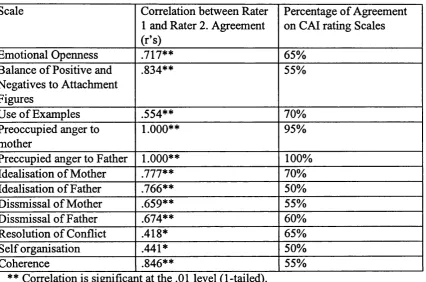
Inter-Rater Reliability... 57
Inter-Rater Reliability for Sub-Classifications...59
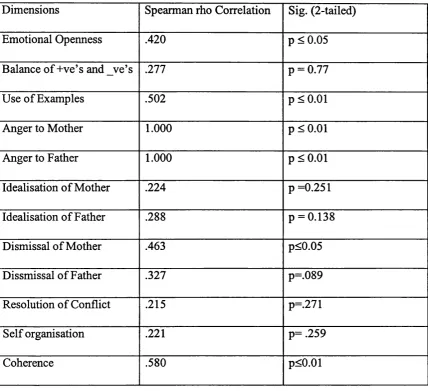
Test-Retest Reliability... 59
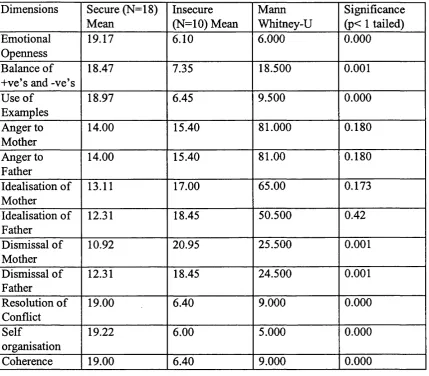
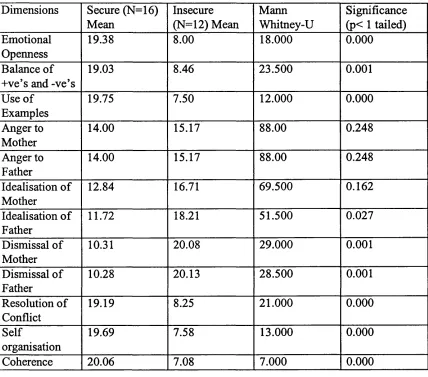
Differences between Secure and Insecure Classifications on the CAI scales...61
Internal Consistency... 64
Comparisons between Attachment Classifications on the CAI and SAT...64
Discriminant Validity... 64
Maternal and Child Attachment Security...66
CHAPTER 4. DISCUSSION Inter-rater Reliability... 68
Inter-Rater Reliability for the Scales...68
Inter-rater Reliability for the Classification...69
Inter-rater Reliability for Sub-Classifications...69
Psychometric Properties of the CAI...70
Test-Retest Reliability... 70
Intemal Consistency... 71
Discriminant V alidity... 71
Concurrent Validity... 73
Predictive Validity... 74
Possible Factors Accounting for Variability...77
Cross-Generational Patterns within Siblings... 79
Father and Sibling Relationships... 80
Themes from Mother and Child’s Interviews...81
Behavioural Analysis... 87
Ethical Considerations... 88
Methodological Limitations and Future Recommendations... 88
Implications of the Research Findings from this Study... 89
APPENDICES Appendix 1. Appendix 2. Appendix 3. Appendix 4. Appendix 5. Appendix 6. Appendix 7. Appendix 8.
Appendix 9. Appendix 10. Appendix. 11. Appendix 12.
Ethical Approval Letters to School Letter to Parents Consent from Parents Consent from Child
Child Attachment Interview
Child Attachment Interview Scoring Manual. Adult Attachment Interview Protocol
(Manual excluded due to copyrights)
Wechsler Intelligence Scale for Children-Third UK Edition Clinical Evaluation of Language Fundamentals Revised Child Behaviour Check List
ABSTRACT
The Child Attachment Interview (CAI) is being developed to explore children’s
mental representations of attachment as manifested through the content of their language
and behaviour. The attachment measure intends to bridge the gap that currently exists for
children in middle childhood (aged 8-12). This study has explored the psychometric
properties of the CAI in an effort to determine its reliability and validity. The sample
consisted of 15 mothers who had 30 children between them. The mothers were
administered the Adult Attachment Interview (AAJ) and the thirty children were
administered the CAI. A re-administration of the CAI was carried out on 28 of these
children approximately two months later in order to evaluate test-rest reliability. The
reliability of the CAI classifications proved to be high over time, suggesting a stability of
responses across time. Inter-rater reliability was also established at a high level and the
intemal test constmction was found to be very satisfactory. To examine the CAI’s
discriminant validity, the Wechsler Intelligence Scale for Children -Third Edition (WISC-
III U K ), and the Clinical Evaluation of Language Fundamentals-Revised (CELF-R u k)
were administered. Parents also completed the Child Behaviour Check List (CBCL) to
measure for clinical morbidity. Concurrent validity was assessed by observing the
correlation between the Separation Anxiety Test (SAT) and the CAI. Predictive validity
was assessed through the mother’s interview transcripts from the AAI. The CAI
classifications were found to be independent of demographic variables such as, gender,
language ability and clinical morbidity. Only a weak correlation was found between the
SAT and the CAI. However, the reliability and validity of the SAT is questionable. Clear
evidence of the predictive validity of the CAI was demonstrated by a 68% concordance
rate between mother and child interviews, which is consistent with previous research
findings. In summary, the evidence for the psychometric properties of the CAI seems
Chapter 1.
INTRODUCTION The Early History of Attachment Theory
In the 1950’s and 60’s John Bowlby, a British psychoanalyst, developed
attachment theory to account for psychopathology in personality development that could
not easily be explained by psychoanalytic theories. Attachment theory is now widely
regarded as one of the most viable, most promising theories of personality and social
development.
Unlike other theories of social behaviour, personality development and emotional
bonds, this theory has evolved through direct observations and scientific analyses of data.
Many of its propositions are now empirically testable hypotheses as a result of modifying
the theory to fit the data. Hence, the theory and the research have evolved together and
still continue to evolve.
Attachment theory integrates insights and data from four different domains:
ethology, control systems, cognitive psychology and psychoanalysis. Ethology is the
science of animal behaviour in their natural habitat. Control systems theory focuses on
how elements in a system influence each other, with hierarchies of goals and plans
determining observable responses. Cognitive psychology is the study of how people
think, how they mentally represent reality and organise their representations of it, and
how they interpret, screen, reorganise and recall information. Psychoanalysis is the study
This thesis introduces the major concepts in attachment theory and describes some
of the well established findings fi*om early research. Then it introduces the different
measurement yardsticks used for assessing attachment in infancy, pre-schoolers and in
adulthood, highlighting the measurement gap.
For the first decade of attachment research, almost all of the research focused on
infancy. There are subsequently three major methods for assessing attachments in
infancy: the naturalistic observations, the Strange Situation and the attachment Q-set.
Each will be described as they inform how the construct of attachment has become
measurable.
The goal of attachment research is to recognise and understand patterns of
behaviour and their function in real life . In addition to being naturalistic, observations
must be both longitudinal and lengthy to be maximally useful. Mary Ainsworth’s (1967)
two early studies are excellent examples of what can be done and leamt through the realm
of longitudinal naturalistic observations . Her studies in Uganda and Baltimore focused
on infant mother attachment by observing babies, toddlers and their mothers in their
homes and their child rearing practices . She recorded the occurrence and onset of
specific behaviours related to attachment. Through these observations she was able to
distinguish three groups of babies: those who were securely attached, and cried less than
others, those who were insecurely attached, and cried more than others, and those who
were not yet attached, (defined in this way because they did not respond to the mother
differently from the way they responded to other adults). Ainsworth was not only able to
describe the phases of attachment but also relate the security of the infant’s attachment to
excellence of the mother as an informant about her baby, and a rating based on interviews
that took place over a series of visits.
Guided by the observations made from theses studies Ainsworth and Wittig
(1969) developed the ‘Strange Situation’ laboratory procedure.
The laboratory situation was set up to activate the attachment system at a level not
routinely observed in the home and perhaps to dramatise individual differences in the
organisation of attachment behaviour.
The Strange Situation consists of eight episodes which are as follows: mother and
infant are introduced to a laboratory play room where they are later joined by an
unfamiliar woman; while the stranger plays with the baby, the mother leaves briefly then
later returns; a second separation ensues during which the baby is completely alone;
finally, the stranger returns, followed later by the mother. This enables observers to see
how the baby organises behaviour in relation to each, and to compare their effectiveness
in soothing the baby if he or she becomes upset. Using Ainsworth et al., (1978)
guidelines the intensity of the interactive behaviours is coded into three categories.
The A Category - Avoidant Attachment with two sub groups.
The B Category - Secure Attachment with four sub-groups.
The C Category - Resistant Attachment with two subgroups.
Babies who fall into group ‘A’ show conspicuous avoidance of proximity to, or
interaction with the mother in the reunion episodes. Those in sub-group A1 ignore the
Babies who fall into group ‘B ’ (Secure Attachment) actively seek proximity to
and contact with the mother, or at least interaction with her, especially in the reunion
episodes. Babies in sub-group B1 show strong initiative in interaction across a distance.
Babies in subgroup B2 seek proximity and contact with the mother more than B1 babies
do, but less than B3 babies do. B1 and B2 babies sometimes show some avoidant
behaviour especially in the second reunion. B3 often regarded as the most securely
attached, actively seek and maintain physical contact with the mother. B4 was initially
defined as wholly preoccupied with the mother throughout the Strange Situation but
Ainsworth remained open to clarification and partial redefinition of this category.
Babies classified into category ‘C’ show moderate or strong resistance to their
mothers. Babies in sub-category Cl show strong proximity seeking and contact
maintaining behaviour, but also show obvious resistance. Those in sub-group C2 show
conspicuous passivity towards their mothers. They are less active and seem less
competent than other babies. During the reunion episodes they are more likely to cry and
look helpless than to crawl to their parents. They demonstrate their resistance by fussing,
refusing to play with toys, resisting contact and resisting interference, but are not as
energetically fierce as babies in the Cl category. These babies were originally labelled as
anxious ambivalent by Ainsworth et al. (1978). They may also be referred to as resistant
as this is their defining characteristic (Colin, 1996).
Following on from Ainsworth and colleagues’ lead. Main and Solomon (1986)
developed the ‘D’ category which was applied to infants who appeared to have no
coherent strategies for handling separations and reunions. They identified three possible
are tentative descriptions as the researchers noted that many group ‘D’ babies do not fit
any of the three subgroups.
Validity of the Strange Situation
To be valid the Strange Situation must accurately assess the pattern of a baby’s
attachment behaviour and the pattern observed in the laboratory must have a meaningful
relation to the pattern of the baby’s behaviour in a natural setting.
Lamb and colleagues (1985) did a detailed review to examine the validity of the
Strange Situation, they concluded from their findings that the Strange Situation does
appear to have convincing levels of construct validity. That is it accurately measures what
it is supposed to measure, namely the quality of an infants attachment to a caregiver. The
Strange Situation categories have convincing external validity, both concurrent and
predictive as they measure how the baby is doing around the time of the strange situation
assessment (concurrent validity) and also measure how the child should develop later in
life (predictive validity).
However, the naturalistic observations and the Strange Situation do have
limitations. Naturalistic observations are lengthy and expensive and as a result hardly
ever conducted. The coding system for the Strange Situation is valid for a very limited
age range (eleven to eighteen months). The procedure cannot be repeated too soon
without compromising the validity of the assessment. It can also be inconvenient for
measure the degree to which the young child (twelve to thirty-six months) used the
attachment figure as a secure base across time and in different situations.
The Attachment Q-Set
The Attachment Q-set consists of 90 descriptive statements which refer to some
specific behaviour and taps one of the following constructs: security, detachment, self
efficacy, aspects of object orientation, communication skills, predominant mood,
response to physical comforting, tearfulness, anger and trust. The items use non-
evaluative terms to reduce the risk of observer bias. For example, one item says the child
actively solicits comforting when distressed.
An observer sorts the items into three piles then sub-divides those three into nine
piles ranging from the least to the most characteristics of the child, in each case. The
observer works firom outer piles towards the centre so that the final result is a unimodal
and symmetrical array of items. Each pile has a predetermined number o f behavioural
items in it so that a score can be given based on its placement. For example, each of the
five items in the first pile (the pile of statements that are least characteristic of the child),
gets a score of one. Each of the eight items in the next pile gets a score o f two, and so on.
The five items in the last pile each get a score of nine. When two or more observers use
the Q-set to describe the same child, the investigator can form a composite description of
the child by averaging the scores each observer gives for the same item. The observers
are either trained research assistants or the child’s usual caregiver, who will have been
familiarised with the procedure for sorting the items. The caregiver observes the child for
then observes for another week and provides another sort. Any Q-sort is a forced choice
procedure. High or low scores are not likely to occur by chance because a fixed number
of items must be in each pile when the sorting is done. The data fi’om a Q-sort can be
analysed in different ways. Waters and Deane (1985) recommend comparing the Q-sort
description of each subject with a criterion sort provided by experts. The purpose of the
criterion sort is to provide operational definitions of the constructs of security,
dependency and sociability.
Measurement Reliabilitv
The Attachment Q-set has several advantages compared with the Strange
Situation. It rates the degree of security on a scale; it can be repeated almost as soon, and
as often, as an investigator wishes; it can be administered almost anywhere and natural
caregivers can provide the data. In order to establish whether the measure is reliable there
is a need to demonstrate that observers can provide reliable data. Mothers, fathers and
other regular caregivers are the obvious observers as they know most about their children.
However, they may say their children’s behaviour is more desirable than it really is, and
some mothers may have a defensive preoccupation that prevents them from perceiving
their children’s behaviour accurately.
Research assistants are less likely to be biased, however they have less
opportunity to observe the child. Waters and Deane (1985) noted a high positive
Construct Validity
In order to establish the validity of the Attachment Q-set it is necessary for
researchers to demonstrate that children who get higher scores for security also get scored
as more secure on some other adequately validated measures of security of attachment.
The ultimate criterion is verification by lengthy naturalistic observations. Do parents’ Q-
set descriptions match what an objective observer would see over a period of months or is
6-8 hours of observation sufficient time to reflect the pattern of behaviour? Neither
question has been empirically addressed. The other validated measure of security of
attachment is the Strange Situation.
Researchers such as Belsky and Rovine (1990) found a very high correlation with
security scores and social desirability scores from mother’s Q-set descriptions of their
children. After adjusting statistically for social desirability, the security scores firom the
mothers Q-set were associated with Strange Situation classifications. Van Dam and Van
Ijzendoom (1988) also obtained similar results in a study of 39 toddlers. The test-retest
reliability scores for security, dependency, sociability, and social desirability firom the Q-
set were good. Other researchers such as Vaughn and Waters (1990) and Valenzuela and
Lara (cited in Main, 1990) have also found significant associations between Strange
Situation classifications and observer Q-set descriptions. Although the validity of the Q-
set has not yet been fully established, the early results on measures of validity are hopeful
Assessment in Childhood
Several promising approaches have emerged to assess patterns of attachment and
degrees of security in children who are 3-7 years old. In childhood, as in infancy, we
must rely on behaviour to make inferences about security of attachment, but behaviour
becomes more subtle and complicated with age. By the age of three years, the arrival of
language and increasing psychological development allows more complex and
appropriate ways of measuring attachment. Attachment research has sought to elucidate
attachment patterns via representational models. Bowlby (1969, 1982, 1973, 1980)
certainly introduced a number of important ideas about representational models. He
defined a representational model or working model as an individual’s conscious and
unconscious representation of the world and himself in it. The models include affective
and cognitive components that act as an appraisal system and a guide to understanding
the meaning of an event and selecting a response. Main, Kaplan and Cassidy (1995) and
Bretherton (1991) have added considerable detail to the theory of development and
effects of representational models. The measure needed should yield information about
the child’s self-reliance, defensiveness, anger and their confidence about their parents
availability and supportiveness. It should also yield information about how the child
represents his/her model of attachment relationships.
The most widely used approaches to assessing patterns of attachment in pre
schoolers and in children who are about six years old rely on the separation reunion
illuminating patterns of attachment behaviour and the underlying representational
models. Two different systems, the Cassidy-Marvin system (Cassidy et al., 1992) and the
Miami system (Crittenden, 1991) have been developed for interpreting, coding and
classifying the behavioural data from 3 and 4 year olds. In addition, Bretherton et al.
(1990) devised a system for drawing inferences about representational models of
attachment from pre-schoolers’ completions of a set of stories about separations from the
parents. The researchers who developed the system recommend supplementing reunion
data with another source of information about the security and pattern of the child’s
attachment. These and other methods of assessing security of attachment in pre-schoolers
and somewhat older children are introduced below.
Pre-schoolers: Separation-Reunion Paradigms
After much experimentation with a variety of separation reunion paradigms, most
of the researchers investigating possible methods of assessment have concluded that
Ainsworth’s Strange Situation procedure if modified, (by increasing the separation time)
does indeed present enough stress to make assessment of pre-school attachment possible.
The coding manuals for scoring and interpreting the behaviour differ noticeably as they
account for the cognitive and linguistic skills, however the assessment procedure is
almost identical.
The Cassidy-Marvin System
The first three categories in the Cassidy and Marvin system are closely analogous
The fourth category, insecure -disorganised-controlling, matches a classification Main
and Cassidy (1988) developed for the reunion behaviour of 6 year olds, many of whom
had been classified as anxious in infancy.
Cassidy et al. (1992) reported that the pre-school coding system uses ‘age
appropriate manifestations’ of proximity seeking, contact maintaining, resistance and
avoidance. To develop their system of coding and classifying the attachments of children
who are two and a half to four and a half years old, Cassidy et al. (1992) system closely
resembled the Main and Cassidy system for children who were 5 to 7 years old, which
was validated with reference to the infant Strange Situation categories. This is a
reasonable scientific approach to developing and beginning to validate assessment
systems as it is easier to study continuity and change over time. However, this approach
assumes that the same four categories are in fact useful and appropriate for classifying the
organisation of attachment at each age. To date this assumption is untested and could
possibly be incorrect. Researchers need to obtain data about whether this system for
classifying pre-school attachment produces classifications that reflect the child’s history,
correlate with the child’s current functioning, and predict the child’s future function in
ways that are congruent with attachment theory.
The Miami System
Crittenden (1991,1992a) developed the Miami system of classification. Her
States, the regulation of displays of affect, the underlying strategy, the attachment figure’s
behaviour and the dyad’s pattern of negotiation.
Validation of the Miami system came from associations between attachment
classifications based on this system and concurrent data about the same dyad in other
settings. The mother’s sensitivity to the child during the dyadic interaction and the overall
quality of child rearing were related to attachment classifications.
Both the Cassidy and Marvin system and the Miami system have produced
meaningful results in relation to other data from prior, concurrent or later assessments.
Efforts to improve each system are still ongoing.
Pre-schoolers: Story Completion
Bretherton, Ridgeway, and Casey (1990) attempted to access three year olds’
representational models by giving them a set of stories to complete about issues relevant
to attachment. The experimenter tells the child the beginning of a story and then asks the
child to show and tell him/her what happens next. The child has small family figures with
which to act out an ending to the story.
In the first story the child spills juice and the mother responds. In the second, the
child falls and hurts her knee. In the third, the child is sent upstairs to bed and then cries
out that there is a monster in the bedroom. In the fourth, the parents leave for an over
night trip, leaving a grandmother to look after the two children. In the final story, the
grandmother looks out of the window the next morning and tells the children the parents
about the attachment figure as an authority figure and as a source of comfort in times of
pain or fear about separations.
The classifications based on the story completion were compared with the
classifications of reunion behaviour using the Cassidy-Marvin criteria, the results
indicated a significant level of agreement as seventy-five per cent of the children received
concordant classifications. However, classifications of the type of insecurity were not
consistent across procedures. If both the story completions and the Q-sets were valid
measures of attachment, the security and insecurity scores should have been highly
correlated. The story completion assessment is still experimental. Bretherton et al. (1990)
suggest that extensive naturalistic observations would be valuable for validating any
method of assessing attachment in pre-schoolers.
Assessment around Six year olds: Reunion Behaviour
Main, Kaplan, and Cassidy (1985) undertook a follow-up study knovm as the Berkeley
Social Development Project. They assessed forty children near their sixth birthdays
whose attachment to both parents had already been studied in infancy. The Berkeley
researchers developed several measures based on the separation/reunion paradigms as this
is the principal source of evidence about patterns of attachment in infants in the Strange
Situation. Main and her colleagues planned an hour’s separation as they anticipated that a
separation of only a few minutes may not activate attachment behaviour.
olds behaviour as he underwent a 10 day separation from his mother. Then the parents
left for different offices.
A female examiner then interacted with the child for fifteen to twenty minutes after the
parents left. Next, she administered the Klagsbrun-Bowlby (1976) version of the
Hansburg Separation Anxiety Test (HSAT) which is described in the next section. The
child was then presented the family photo and their reaction was observed. Following
this, the child had a period of free play until the parent returned.
The principal measure for security of attachment was based on the child’s response to
being reunited with their parent. The parents returned separately and each of their
reunions was videotaped for three minutes.
The video tapes were carefully viewed repeatedly and a coding system was
developed based on the quality of the reunion behaviour. The working definition of
secure attachment was: confidence that the attachment figure was accessible and would
show warm interest in the child. The working definition of avoidance was: the masking of
anger, affection, discomfort, distress and the desire for closeness. Cassidy did most of the
viewing and reviewing whilst remaining blind to the Strange Situation classifications.
The Hansburg Separation Anxiety Test
The Hansburg Separation Anxiety Test (HSAT) is a projective test originally
developed by Hansburg (1972) for adolescents but adapted for four to seven year olds by
Klagsbrun and Bowlby (1976) and further modified Main et al. (1985) from which the
Separation Anxiety Test (SAT) was developed with the Berkeley sample of six year olds.
photographs of young children experiencing separations from their parents, one
photograph at a time. In the mildest example, the parents are saying goodnight. In three
others; one depicts the parents asking the child to play while they talk, in the second the
parents bring the child for their first day of school, and in the third the parents leave for
the weekend. The most intense scenario depicts the parents leaving for a two week trip.
The children in the pictures are approximately four to seven years old. The protagonist in
the photographs corresponds to the gender of the child being tested.
The examiner tells the child, ‘ 'Parents worry sometimes what children think when
they have to go away fo r a while ’ ’ and asks the child, "'Tell me what you think a child
your age would do when parents go away fo r a little w hiled After showing the child
each picture the examiner asks the child what the child in the picture would feel and what
the child in the picture would do.
The children’s verbal and affective responses are scored for emotional openness
which is defined by the child’s ability to imagine appropriate negative affects (loneliness,
sadness, fear, anger) and their ability to give reasons for why the child might feel this
way. The underlying assumption of the SAT is that children will project onto the child in
the picture their attachment related feelings and experiences and thus their internal
representations of attachment relationships. It was predicted that emotional openness
would reflect security of attachment.
Main et al. (1985) also developed a scale for coding the child’s expressed coping
child expresses their anger or distress. The strategic coping score for the response to this
single question was strongly correlated with security of attachment in infancy with the
Berkeley sample.
The children of the Berkeley sample were also assessed for their response to a
family photograph. Using videotapes, judges were asked to estimate the security of the
child’s feelings about his or her family. Children were rated ‘secure’ if they readily
accepted the photograph, smiled and made positive comments. They were considered
insecure if they actively turned away from the picture or refused to accept it.
There was a strong correlation between response to the family photograph and
security of attachment to the mother in infancy.
Validity of Measures in the Berkeley Study
Main et al. (1985) suggest the measures used to classify reunion behaviours and
the responses to the family photo both strongly correlated with the measures of security
of attachment to the mother in infancy. This, they suggest not only is evidence of validity
but also evidence that security of attachment is highly stable from infancy to age six in
stable middle class families. However, both measures require replication before we can
gauge their accuracy with any confidence.
The adapted HSAT was found to have a strong correlation with security of
attachment to the mother in infancy. However, it showed no relation to security of
attachment to the father in infancy.
If the various measures of security are all valid, children should get similar scores
hoped highly correlated with emotional openness in the HSAT and their responses to the
family photo. However, the rating of security with the father showed little or no
relationship with the other two measures of security. This pattern of correlation suggests
that in families where the mother is the primary caregiver, the child’s attachment to her
has much more impact on the child’s overall security than the attachment to the father
does.
Grossmann and Grossmann, (1991) replicated the format o f the Berkeley study
with a sample of six year olds from Regensburg. They also found a high correlation
between infancy ratings and ratings at age six. If attachment patterns are stable over time
this study seems to suggest that the reunion codings are measuring what they intend to
measure, the six year olds’ attachment pattern. However, the Regensburg data shed no
light on those classified into the group D Category with disorganised-controlling
behaviour.
The preliminary evidence seems to suggest that Main and Cassidy’s system for
coding has substantial validity. In these studies it appears to measure what it intends to
measure and assigns accurate classifications to most children. Main and Cassidy (1988)
also report the classification of reunion behaviours remains stable over one month in the
test- retest reliability assessments.
However, a more recent study by Shouldice and Stevenson- Hinde (1992)
assessed children aged four and a half years old both on the SAT and by a separation
the development of representational methods in order to replace direct behavioural
observation and analysis (Melhuish, 1993). The most logical approach is perhaps a multi
method assessment of attachment that embraces both representational and behavioural
analysis when studying attachment in early childhood.
It is important to consider in Main and Cassidy’s reunion paradigm that one
parent returned three minutes before the other so that the child already had three minutes
to regain comfort and to cope with tensions aroused by the first parent’s reunion. In short,
the reunion with the first parent may have influenced the child’s behaviour towards the
second parent. Future research needs to consider the differences of each parent’s
interpersonal communication and the possible influence this may have on the child.
The second consideration is that Main and Cassidy’s coding system relies solely
on the child’s behaviour to assess a pattern of attachment. Between the ages of five to
seven the dyad, not the individual, maintains the stability of interaction patterns in the
relationship. When one partner makes a change the other makes a complementary change
that maintains homeostasis. Consequently directly coding the dyad’s behaviour may be
more informative.
The Parent-Child Reunion Inventory
Based on the observed attachment behaviours observed by Main and Cassidy’s
system, Marcus (1990) developed the Parent Child Inventory to rate the degree to which
each of twenty behaviours occur at reunion. From these, rating a score for security of
attachment can be derived. Behaviour checklists can be problematic because parents may
fill out the parent child inventory and got meaningful results which were related to other
measures in his study which included interviews with the foster children, assessments
with the social workers, and the Achenbach Child Behaviour Checklist (CBCL)(1978).
The advantage of this procedure is it is fast and easy, however, more research is
obviously needed to establish its validity.
Adolescent Attachment
The attachment questions that are unique to adolescence have not yet received
much attention. The research that is available has two major limitations. First, the
population that has been studied are college students between the ages of eighteen and
nineteen. Consequently, hardly any o f them are of low intelligence and most probably
come from relatively middle-class families. The second limitation is that most of the
research to date comes from individuals’ responses to questionnaires. These range from a
probing clinical interview to a simple self-report on a single item included on a
questionnaire. More work needs to be done before any of the methods used can be
regarded as fully validated.
The Adult Attachment Interview
The first method developed specifically for assessing adults’ attachments was the
Adult Attachment Interview (AAI), a structured, fifteen question, semi-clinical interview
The subject is asked to choose five adjectives to describe what the relationship
with each parent was like during childhood. The trained interviewer makes no particular
effort to put the subject at ease as the intent is partly to ‘surprise the subconscious’ (Main,
1991). The subject is then asked for episodic memories to illustrate why he/she chose that
particular adjective to describe his/her parent. Sometimes the specific memories illustrate
the general description well, sometimes they contradict it, sometimes they are unable to
recall a specific example.
The interviewer also asks what the subject did in childhood when he/she was
upset, hurt or ill. They are asked whether they ever felt rejected or threatened by their
parents, and if so, why they now think their parents had behaved as they did. There are
also questions about separations, and about whether the subject had experienced
separation through a death in childhood or adulthood. The interviewer would ask how the
subject feels about his/her parents now and how the experiences he/she had described
have influenced his adult personality and fimctioning.
The coding for the AAI relies solely on what the subject says, not on what he/she
does. Non-verbal behaviour and voice inflections are not taken account of, as the coder
works with a printed transcript of the interview. Main and colleagues have revised the
guidelines over the years and learning to apply them takes considerable time and training.
In analysing the interview the coder examines the subjects attitude towards
attachment. The coder examines contradictions and inconsistencies carefully. The
interview is rated on nine point scales for security with respect to experiences, ideas and
feelings surrounding attachment. Security is defined largely by the overall coherence of
representational models of attachment, especially the ability to integrate both factual and
affective information from both episodic and semantic memory. Subjects classified as
secure focus easily on the questions, they can easily explain what lies behind their
responses, and appear to the coders to be truthful. Subjects that are rated as being
insecurely attached tend to show incoherence in a variety of ways such as anomalous
changes in wording, intrusions into the topic, slips of the tongue, use of metaphors or
rhetoric that is inappropriate to the context of the discourse, inability to focus on the
interview questions and outright self-contradiction. In short, the subject appears to have
difficulty accessing information related to attachment and keeping the information
organised and /or preventing it from undergoing distortion.
There are four categories for classifying adults states of mind with respect to
attachment as indicated through their responses to the AAI: secure, dismissing,
preoccupied and unresolved. Various researchers have at times substituted the terms
secure for autonomous or balanced, dismissing for detached or avoidant, preoccupied for
ambivalent or resistant.
Adults characterised as secure not only are able to give a strikingly coherent
account of their early experiences and how those experiences have affected them, they
also value the attachment relationships and recognise their importance: they tend to
believe attachments and the experience related to them influence an individual’s
personality. They easily integrate positives and negatives and are able to be objective in
Not all subjects who are rated as secure report favourable childhood experiences.
Some have had unfavourable experiences, particularly loss or rejection. However,
despite this, they appear to have thought about them, perhaps understood the reason for
them, and resolved their feelings about them.
The adults characterised as dismissing report that attachment relationships are not
important. Most show one or two striking patterns. In one pattern, the subjects report
semantic and episodic memories about their parents that contradict each other. They may
say their parents were wonderful, almost perfect but are unable to offer any supportive
evidence. The second pattern is the insistence they simply cannot remember anything
from childhood. A few dismissing adults can recall negative childhood experiences, these
individuals have a tendency to derogate and dismiss them. This may be an effective
strategy to keep attachment memories and wishes at a distance.
Individuals classified as preoccupied are still embroiled with the family of origin.
They may be still struggling to please them and emotionally dependent on them. They
often give long interview responses with entangled confusing run on sentences that may
be irrelevant or tangential to the questions asked. They also often use general terms for
example ‘that sort of thing’ or use nonsense words such as ‘dada dada dada’. In short
incoherence permeates their use of language.
The fourth category for classifying AAI responses is ‘unresolved’. These adults
have experienced losses or abuse or other traumatic events (Ainsworth and Eichberg,
1991). They oscillate between positive and negative view points and appear to be
the topic of the interview. They are also unable to organise information about their
attachment histories coherently.
In some studies, researchers have not used the ‘unresolved’ classification and
have forced classifications into one of the other three categories. This may compromise
the reliability and validity of the study.
There is substantial literature demonstrating that classifications obtained from the
Adult Attachment Interviews of parents match the classifications of their infants’ reunion
responses to them in the Ainsworth Strange Situation. According to Van IJzendoom
(1995), eighteen studies have documented a significant match. Thus the Ainsworth et al.
(1978) infant classifications. Secure, Insecure/Avoidant, and
Insecure/Ambivalent/Preoccupied correspond remarkably well to Adult Attachment
Interview classifications of their caregivers as Secure, Dismissing, and
Preoccupied/Entangled respectively.
Fortunately, however, attachment theory is not overly deterministic as there are
other factors that influence the child’s emerging model. The research to date does indicate
there is not 100% concordance rate between mother and infant attachment classifications.
Grossman and Grossman (1991) report their interviews with adults offered some
insights into what helps change an insecure model of attachment into a secure one, they
identified four factors which seem to be important: psychotherapy, illness, supportive
spouses and emotionally significant others. They suggest a serious illness may make even
More recent research by Fonagy et al. (1996), Fonagy and Target, (1997); Fonagy,
Steele, Moran, Steele and Higgitt (1991) have demonstrated that an individuaFs ability to
appreciate the mental and emotional states of others is rooted in the presence or absence
of attachment security. Therefore, the critical factor in influencing the security of
attachment is a parent’s capacity for productive reflection on ideas related to attachment
as this serves as a protective resilience -enhancing function, and reduces the likelihood of
intergenerational transmission of insecurity (Fonagy, Steele, Steele, Higgitt and Target,
1994).
Father-Child Relationships
Several investigators have explored whether the pattern of attachment in an infant
generalises from the relationship with the mother to the relationship with the father. Most
of the early studies of concordance between an infant’s Strange Situation classification
with his mother and the Strange Situation with his father failed to find any significant
association between the two (Grossman and Grossman and Wartner, 1981: Main and
Weston, 1981) suggesting infants’ attachment relationships to their mothers is
independent of their attachment relationship to their father. The baby’s behaviour in the
Strange Situation towards his mother depended on what sort of interaction he has with
her and the baby’s interaction with his father depends on what sort of interaction he has
experienced with him.
Recognising the limitations of these early studies which all used small samples.
Fox, Kimmerly and Schafer (1991) conducted a meta-analysis of the data which included
the D category had not been defined, therefore all their data was forced into the A, B or C
classification system. Despite this limitation the results are of interest. They found a
significant association between security of attachment to one parent and security of
attachment to the other, between type of insecurity with one parent and type of insecurity
with another, and between sub-category of security with one parent and sub-category of
security with the other. Basically their results suggest that babies who were secure with
their mother also tended to be secure to their father, certainly, more often than would be
expected to occur by chance. There may be several reasons to account for why some
concordance does exist between the pattern of attachment to the mother and pattern of
attachment to the father. Firstly, the individuals’ representational models of attachment
probably influences both whom a person marries and the quality of care he or she gives to
babies. Secondly, a sensitive mother can provide both modelling and scaffolding for a
less sensitive spouse or vice versa, which could increase the likelihood that the second
parent would respond sensitively to the infant. Thirdly, a second parent may take over
when the first parent is inconsistent or unresponsive which would protect the baby from
feeling rejected and buffer the effects from deficiencies and distortions in the other
parent’s care. Although the incidence of concordance is greater than would be expected
by chance the meta- analysis did indicate that very strong concordance did not exist as 1
out of 4 babies had a secure attachment to one parent but an anxious attachment to the
other. These findings seem to suggest the infants behaviour in the Strange Situation
Sibling Relationships
In this early phase of attachment research, relevant research exploring attachment
patterns between siblings is relatively minimal. There is some evidence that the relative
harmony of the securely attached child’s relationship to the parents is re-enacted by the
child’s interactions with younger siblings. Teti and Ablard, (1989) and Volling and
Belsky (1992) support these findings. They found that children with secure attachment
patterns were less conflictual during periods of joint play with their younger siblings than
anxiously attached children. Volling and Belsky (1992) also examined the different
contributions between mother and father and the effects these have on predicting siblings
interactions.
They found that children whose fathers had been observed as more facilitative and
positively affectionate in their interactions were more confident socially, than children
whose fathers were not supportive.
Attachment in Middle Childhood-The Missing Link
Obviously theorists and researchers have taken major steps towards developing
reliable and valid ways to study attachment in infants, young children and adults.
Currently innovative ways of assessing attachment in middle childhood are now
emerging in an attempt to redress the measurement gap. This project seeks to explore the
validity and reliability of a newly developed assessment tool. The Child Attachment
Interview (CAI). To date, the SAT is the best measure of attachment in middle childhood.
However, like most measures it has advantages and disadvantages. Arguably, the
give socially desirable answers; he/she is unaware of what the researcher is interested in,
therefore there is less censorship, the material is quite rich in quality because these
measures tap unconscious material, the questions permit a multiplicity of responses and
have no rules of right and wrong. The disadvantages seem to outweigh the advantages. A
fundamental flaw in the SAT is there is scant documentation on the psychometric
properties of the SAT. Furthermore, as it is a projective test it is difficult to determine the
reliability of the child’s answers as they may not truly refer to himself/herself but to
someone else such as his/her brother or a fiiend. It is also difficult to determine whether
the responses reflect how the child would like to be or how he/she truly believes he/she
is. A major disadvantage of this test is that in the 1990’s separations are commonplace in
many families, therefore it is questionable whether separation reunion paradigms depicted
in photographs actually induce a sufficiently stressful situation that triggers the child’s
representational models of attachment. Bearing in mind that in middle childhood every
child will have spent time away from home just going to school and many children may
have spent weekends with fiiends or on school trips. Furthermore, analysing the results is
largely down to the subjective interpretation of the assessor making inter-rater reliability
difficult to obtain.
The SAT does not consider the relationship between cognition, language and
attachment security. Harter (1986) suggests there is an important conceptual change at
age eight in relation to global judgements and/or in articulation skills. Whether a child is
failed to find a significant relationship between scores on the British Picture Vocabulary
Test and SAT scores. These findings seem to suggest security o f attachment is
independent of language ability.
The SAT classification system implies an integrated internal working model of
attachment for both parents. However as mentioned earlier Fox, Kimmerly and Schafer
(1991) did find that infants pattern of attachment did sometimes differ. These findings
suggest the measurement tool needs to consider whether an individual degree of security
is on a continuum or not. This will help predict what form problems are likely to take if
they emerge.
Colin, (1996) recommends attachment measures should gather information about
self reliance, defensiveness, anger, the child’s confidence about the parents availability
and supportiveness, the parents’ provision of comfort and support, dyadic communication
patterns and other clues about cognitive behavioural strategies and representational
models of the attachment relationship. This is indeed a tall order, however the CAI
attempts to consider all of the above in order to overcome the limitations of both the
semi-projective and behavioural assessment methods in this age group. Firstly, the child
is asked directly about their experiences. Secondly, control for academic competence is
considered using sub-tests from the Weschler Intelligence Scale for Children Third
Edition U.K (WISC. III. U.K). Control for expressive linguistic capacity is also
considered using the Clinical Evaluation of Language Fundamentals Revised (CELF R).
Thirdly, the CAI asks questions concerning the child’s relationship with both their mother
and father, and these are separately classified, in order not to assume an integrated
but the form of communication which taps into the child’s internal working model and
thus attachment organisation. (Oppenheim, D., and Waters, H., 1995).
This study examines the psychometric properties of the CAI in an endeavour to
establish whether it is a promising instrument for explaining the development of
children’s attachment to adults. As the CAI is a recent measure of child attachment
patterns, the psychometric properties have not yet been reported. Like the AAI, it has
been designed to preserve the depth and nuances of natural discourse and to yield insight
into formal and substantial aspects of the subjects thought processes that are related to
attachment. The CAI also offers a coding system that can be quantitatively analysed. This
project will focus on seven psychometric issues:
(1) the inter-rater reliability of the coding criteria,
(2) reliability over time and across two interviews,
(3) comparisons across secure and insecure classifications on the CAI scales,
(4) internal consistency of the scale,
(5) the concurrent validity of the CAI in relation to the SAT,
(6) the relationship to intelligence, expressive language ability and clinical profile (as
determined by the CBCL),
(7) determining whether the classifications obtained from the Adult Attachment
Interview (AAI) of the mothers match the classifications of their childrens’ interview
Inter-Rater Reliability
Inter-rater reliability is necessary to check the reliability of observations between
two raters and determine the extent to which their ratings agree. This will provide
information on how good the coding system is as a whole, and how good each individual
rater is.
Test-Retest Reliability
Firstly, as the CAI is a semi-structured interview, it is particularly important that
its reliability is tested over time (tests-retest) Therefore subjects in this study were
interviewed twice, two months apart, by the same interviewer. A period of two months
was chosen to reduce the risk that the subjects would remember some of their responses
to the first interview, thereby inflating the instruments reliability. A longer period might
have increased the risk of changing life circumstances which may influence the subjects
mental representation of attachment experiences. The primary focus therefore is to
establish the instrument’s reliability under stable conditions.
Comparisons across Secure and Insecure Classifications on the CAI Scales
It is important to determine whether there is a difference between each scale score
that defines security and insecurity of attachment to mother and father.
Internal Consistency
Internal consistency needs to be established to determine whether all the scales
Concurrent Validity
The SAT is the only available measure which attempts to measure attachment
classifications in middle childhood. Therefore, it is the only measure that can be used to
assess how well the CAI correlates with the SAT.
Discriminant Validity
The CAI may be influenced by the child’s cognitive and language abilities and or
any clinical problems they may have. The ability to use language and the ability to
manipulate mental representations are the hallmarks of intelligence. It may be possible
for children to form increasingly accurate, detailed models of attachment relationships
and to develop increasingly effective behavioural strategies for managing them. It may
also be possible for children to develop increasingly subtle psychological defences.
Predictive Validity
The crucial test for the CAI’S validity is the correspondence between parents
attachment representations as assessed by the AAI and their child’s attachment
representations. If the CAI is a valid measure, there should be a high degree of
concordance between the mother’s AAI classifications and their children’s CAI
Chapters
METHOD
The method is divided into six sections, the first section describes the
demographic details of the sample of children. The second section explains the
administration of the CAI to the children and the coding manual. The third section
describes the administration of the AAI to the mothers. The fourth section describes the
sub-tests administered from the WISC-III and the CEL-R, and describes the CBCL. The
fifth section describes the administration of the SAT. The final section describes the
intended data analyses.
Design
The CAI was initially piloted on seventeen children and these interviews provided
the basis for refining the interview protocol and for devising the CAI coding system. In
this study, the revised version of the CAI was administered to a non-clinical sample of
thirty children in their homes. The initial interviews were then coded independently by
two raters to establish inter-rater reliability. The thirty children were then re-interviewed
approximately two months later to establish the initial test-retest reliability. The Adult
Attachment Interview, (George et al., 1985) was also administered to each mother (fifteen
in total) and coded independently. The focus was on the two way classification (secure or
Participants
Ethical approval for this part of the study was obtained under the auspices of a
larger standardisation project at the Anna Freud Centre (Appendix 1).
Normally developing children were recruited through letter contact with teachers and
parents. The letters explained the nature of the project and invited their children to take
part in this study (Appendix 2 and 3). Parental and child consent forms were completed
by parents and child following the administration of all the test material (Appendix 4 and
5). Respondents included children from both inner and outer London. The sample
consists of a total of thirty children, fourteen boys and sixteen girls, whose ages range
from eight years exactly to twelve years six months. The mean age for the boys is nine
years eight months and the mean age for the girls is ten years three months. Fourteen of
the children’s parents represented social class 1 (professional and managerial); six social
class II (intermediate occupations); three social class III (skilled occupations) and five
social class IV (partly skilled occupations) two were unemployed according to the criteria
of the classification and coding index (1980). Over three-quarters of the sample (twenty-
seven) were white, all of British origin, except that three were Europeans, one child was
Asian and two were Afro-Caribbean. Twenty-two of the children were from two parent
families, five of the children had reconstituted families whereby they lived with their
biological mothers and step-fathers, however the children from these families all had
regular contact with their biological fathers. A total of three children came from one-
Procedure
The Child Attachment Interview
The Child Attachment Interview (Appendix 6) is a semi-structured interview that
is video recorded and structured entirely around the topic of attachment, principally the
child’s current relationship to their mother and father. The child is introduced to the
interview through a warm up question which asks them to talk about their family
circumstances, the next question attempts to elicit the child’s self concept by asking them
to provide three words to describe themselves and to support these words with examples.
They are also asked to describe their relationship with their parents and again provide
specific examples to illustrate their descriptions. The child is asked to recall a time when
they have felt upset or misunderstood and to describe what happens when they are ill and
hurt as well as about loss and separation. In addition, there is a question that attempts to
elicit the child’s perspective regarding parental conflict as this may have implications on
their emotional security. Another question attempts to elicit which characteristics the
child does and does not value in their parents. This question is intended to determine the
impact the parents have on the child’s identity. The interview rounds off with a question
asking the children what they would wish for when they grow up if they had three wishes.
This question is intended to neutralise any emotional issues that may have emerged from
The Coding System
(Appendix 7)
All verbal and non-verbal responses made at the time of administration were
recorded by the video-tape. Responses were scored following established guidelines
devised by Yael Shmueli-Goetz (YSG) and Adrian Datta under the supervision of Dr.
Mary Target, who is an experienced researcher in the field of childhood and adulthood
attachment). The operational criteria for coding the CAI are summarised below. (The
original coding manual can be found in Appendix 2).
Emotional openness and range of emotional terms used. This scale focuses on the
affective description rather than the behavioural expression of the child. Emotional
openness takes account of the range of feelings the child describes, the degree the child is
able to place those feelings within a relational context and the ability of the child to
express the interplay of affect, mental states and behaviour. Each scale is rated on a nine
point scale. This scale has five defined anchor points (1,3,5,7,9,). In the scale of
Emotional Openness 1 indicates low emotional openness and nine denotes high emotional
openness.
Balance of Positive and Negatives References to Attachment Figures (AF’s). This
scale is designed to measure the child’s ability to contemplate both good and bad
qualities of their attachment figures. The majority of children tend to use more positive
being able to contemplate, express, and fully elaborate upon both positive and negative
aspects of the attachment.
Use of Examples. This scale assesses the child’s ability to provide relevant and appropriate examples. If a child is unable to provide examples, prompts are used to
establish whether they are demonstrating avoidance strategies or just an inability to recall
the event. The nine point scale assigns one to the children who represent a narrative with
no examples despite frequent prompting and nine to those who represent a narrative with
at least four richly detailed and illustrative examples.
Preoccupied anger with respect to mother and Preoccupied anger with respect to father. Both scales attempt to measure the degree to which the child expresses anger that is uncontained and overwhelming when describing relationship episodes (REs). A
distinction is drawn between the expression of anger which serves to draw care taking
behaviour and aggression or violence that attacks the attachment figures and threatens
attachment relationships. This scale is rated on a nine point scale with ‘ 1 ’ for anger which
was described but not re-experienced and nine for anger which is clearly expressed and
escalation is evident to the rater.
Idealisation of attachment figures. This scale measures the extent to which the child’s representations of the AF are distorted in a positive direction. Evidence for the distortion
is identified if the child provides a generalised positive description of the attachment
figures but is unable to substantiate these with positive examples. The central question to
the rater is. “ How credible are general descriptors of A.F’s in the light of specific
examples?” This was rated on a nine point scale with one indicating no idealisation-
episodes and nine for highly idealising- positive generalised descriptions are prevalent
throughout the narrative, but not substantiated by specific examples.
Dismissal of Attachment This scale measures the extent to which the child adopts a strategy that serves to minimise the importance of AF and relationships by active
dismissal. The degree to which the child deliberately rejects or excludes the expression of
vulnerability, dependency or the need for comfort in situations that are related to stress
such as illness, physical hurt, conflicts separations and death is central to this rating. The
degree of dismissal as operationalised on this scale is dependent on the severity of the
event and the age of the child. This was rated on a nine point scale one indicates the child
values the relationship and appears comfortable expressing vulnerability in response to
separation and loss, and nine indicates the child’s affect is deliberately and systematically
excluded, and the self is presented as invulnerable.
Resolution of Conflicts within RE s This scale rates the child’s ability to recount an episode containing conflict which is subsequently resolved. Solutions may be positive,
negative or passive. The conflicts range in severity fi'om a minor disagreement to
conflicts arising firom separation and loss. This was rated on the nine point scale, one for
clearly unresolved conflicts characterised by destructive or negative responses. Nine for
very clearly resolved conflicts.
Self-Organisation. This scale attempts to assess the degree to which a child is able to initiate resolution to conflicts through being an active agent that can organise and execute
self-initiated resolutions. A score of nine indicates the child is very highly self-organised,
and resolutions to conflicts are self initiated, clearly planned and executed leading to
satisfactory outcomes.
Overall Coherence. This scale integrates information from the Idealisation, Preoccupied
anger. Dismissing and Use of Examples Scales. It attempts to gauge the overall coherence
of the child, and considers reflectiveness, spontaneity of discourse, relevance,
comprehensibility and inconsistencies. This is rated on a nine point scale with one for
highly incoherent narrative and nine for highly coherent narrative.
Behavioural Analysis notes any behavioural changes such as bodily movements in
response to stress inducing questions, anxiety, maintenance of eye contact, tone of voice,
discrepancy between behaviour in the interview and content of the narrative.
Based upon these ratings an overall classification was assigned to each interview
with respect to the child’s representation of their relationship with their mother and father
independently. The overall classification was either secure or insecure. In order to
indicate the strength of the classification, each interview received a sub-classification.
The sub-classification ratings were 1 = Very Secure 2= Secure 3= Insecure, 4 = Very
Insecure. As the quality of the relationship with each parent was rated separately it was
possible to receive a secure classification with respect to one parent and an insecure
classification with the other.
In order to be assigned a secure classification, ratings had to be five or above for
Emotional Openness^ Balance o f Positive and Negatives, Use o f Examples, the Resolution
o f Conflict, Self Organisation, Overall Coherence, and ratings had to be no more than