IJEDR1503044 International Journal of Engineering Development and Research (www.ijedr.org) 1
Detection and Recognition of Objects in a Real Time
1Akshatha N S, 2Dr. Chandrashekar M Patil
1PG Student, 2Professor
1Department of Electronics and Communication, 1VVCE, Mysore, India
________________________________________________________________________________________________________ Abstract - Object recognition is used to find the distinctive objects and also classify those objects in given images. Recognition task is done in various fields such as image processing, computer vision and also pattern recognition. The procedure of the projected approach is, first the input image is converted into gray scale image. Next the image segmentation is done by using clustering method called K-Means clustering. It gives four different cluster images and also displays the different objects presented in that four cluster images to extract the objects presented in the image. The segmentation gives more effective result by giving enhanced segmentation quality and also less computation time. Based on the intensity and texture the features of the extracted objects are extracted. The extracted features of the objects are classified using Multi-class SVM (Support Vector Machine) classification method by matching the features of the extracted objects against predefined objects which is stored in the system.
IndexTerm - Object Detection, K-Means Clustering, Object Recognition, Multi class SVM Classifier.
________________________________________________________________________________________________________
I.INTRODUCTION
Individuals see an a lot of objects in images with little effort, paying minimal notice to the way that the images of the objects may fluctuate to some degree in differing points of view, in a couple of particular sizes/scale or not withstanding when they are deciphered or rotated. Objects can even be seen when they are fairly obstructed from point of view. Despite the truth that varieties of approaches have been wanted to handle the identification issue in the midst of the latest two decades. Building computer vision systems fit for seeing applicable protests in their surroundings with exactness and quality has been a troublesome and testing task. Object detection and recognition has significant role over fast few decades in the field of computer vision, image processing and pattern recognition.
Object detection is a fundamental, yet troublesome vision errand initially began to be in 1974 by Yoram Yakimovsky, who gave programmed area of objects in advanced digital images. It is extremely discriminating part in numerous applications furthermore it is still an open issue because of complexity of object classes and images. It is utilized to locate the different objects, for example, guitars, buildings, chairs and so forth in the images or in video sequences. By virtue of scale, pose change, deformation and point of view changes of the objects pulled in consideration of the numerous specialists is really a testing zone of computer vision. The different applications of object detection in images and in video sequences like human robot communication, surveillance framework, military applications, automatic driving and driver help framework and so on.
Another research area in the computer vision and image processing field is object recognition. It is characterized as identifying and recognizing the objects by matching the objects in the image against some predefined objects which is already stored in the system. Object recognition system by means of setting up a classifier on elements that are isolated at diverse sizes of an object. Object recognition in real time images obliges local features of the image which are unaffected by clutter or partial impediment. The features are partially invariant to perspective changes, illumination, occlusion, scale changes, deformation, intra class variations and background clutter. Object recognition are utilized in numerous application fields, for high-determination satellite images, in high definition videos, image recovery, human computer association, driver assistance system and in medical imaging. For recognition, an extensive variety of classifiers have been utilized throughout the years like Support Vector Machine (SVM), Hidden Markov Model (HMM), Neural Network (NN), K-Nearest Neighbor (KNN), Gaussian Matrix Model (GMM) and also the Linear Discriminate Analysis (LDA).
IJEDR1503044 International Journal of Engineering Development and Research (www.ijedr.org) 2 Fig.1 Collected database
II.LITERATURE SURVEY
Dr. R.Muralidharan [1] proposed a K-Nearest Neighbor technique by using Eigen value which is computed from nearby and worldwide features of an image used to perceive objects from image. The feature vector is developed by combining both worldwide and nearby features. The essential details of the object are acquired by utilizing Canny’s edge detection strategy. To perceive the object in an image the K-Nearest Neighbor is applied to the feature vector. Compare with Fuzzy K-Nearest Neighbor and Back Propagation Network the K-Nearest Neighbor performs well. In the given image the recognition of single object is the restriction of the proposed technique.
Rakesh Kumar, Rajesh Kumar and Seema [2] presented a technique for RGB object recognition utilizing Fuzzy Classifier based on Gabor Wavelet feature extraction technique. The Gabor Wavelet is utilized due to their resolution and multi-orientation properties. Gabor features generally utilized as a part of image processing applications, for example, object and face recognition and also in pattern recognition applications such as fingerprint recognition, character recognition and texture segmentation etc. To start with the object image is binarized utilizing Otsu thresholding strategy. At the point the features are extracted from the object image utilizing Gabor wavelet. Based on Gaussian membership function the Fuzzy classifier is utilized for efficient object recognition.
Kavita Ahuja and Preeti Tuli [3] proposed Template matching approach utilizing Correlation and Phase Angle method for object recognition. Template matching strategy utilized for object categorization and template is nothing but sub image. The principle objective is to find the template occurrence in the image furthermore to find matches of template in that image. Correlation is utilized to measure the degree of two variables of comparing pixel values in images, for example, template and source which agrees in their general behavior yet redundant in actual value. The phase angle is an angle, where the differences in the phase are represented utilizing Phase Angle. Both Correlation and Phase Angle technique takes less time to recognize the objects in the image.
Amit Thakur, Avinash Dhole [4] presented a Grid-based color moment (GBCM) approaches for object recognition taking into account various features extracted from the image. By indicating the visual features, for example, color, texture and shape the framework permits user to perceive the desired objects from the image. When the features have been characterized and extracted, then the retrieval turns into a task for measuring the similarities between image features. At long last the objects are classified utilizing SVM (Support Vector Machine) classifier.
Y.Ramadevi, T.Sridevi, B.Poornima and B.Kalyani [5] gives an interaction between image segmentation and object recognition is examined utilizing different Edge detection strategies. Image segmentation is utilized to splitting the images into the significant regions. The Edge detection techniques utilized for image segmentation, for example, Sobel, Prewitt, Canny, Roberts and Laplacian of Gaussian (log) are utilized. The synergy between the image segmentation and object recognition are resolved utilizing Genetic algorithms, Ostu thresholding and Expectation-Maximization (EM) algorithm.
IJEDR1503044 International Journal of Engineering Development and Research (www.ijedr.org) 3
III.METHODOLOGY
Object recognition is utilized as a part of distinctive fields, for example, computer vision, pattern recognition and image processing. Lot of endeavors is given to perceive objects in the given images which are taken under various image conditions like viewpoint, illumination and occlusion. Recent technologies use many different techniques to recognize objects in images. Figure 2 illustrates the block diagram for object recognition.
Fig.2 Block Diagram for Object Recognition
Input Image: Input image are created by capturing the RGB or color image using camera called real time images. The collection of input images called dataset which contain variety of objects. For preprocessing the system reads the input image.
Pre-Processing: Preprocessing step takes place for the intensity images which are utilized to improve input image by reducing undesirable distortion furthermore by enhances the image features. In this step the given color input image is converted into gray scale image to make image which is suitable for next processing like segmentation.
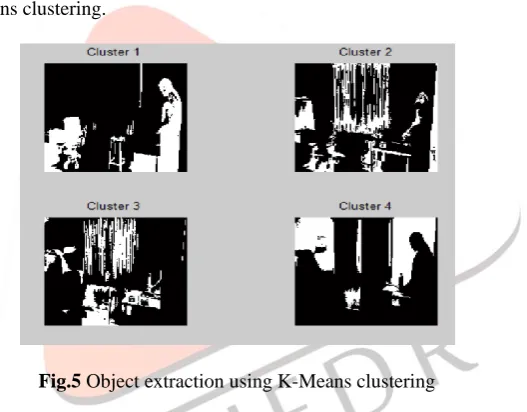
Image Segmentation: Image segmentation is the procedure of dividing the given input image into meaningful regions or parts which make images understand and analyze easily. It is additionally used to assign label to every pixel in the given image and locate objects and boundaries such as curves and lines. The feature based clustering method called K-Means clustering is utilized for image segmentation to cluster the given input image so as to detect and extract the objects presented in the input image.
K-means clustering: K-Means clustering is an unsupervised nonhierarchical partitional clustering strategy. It divides the data set into two clustered groups and subsequently every group is isolated into two sections and so on. K-means algorithm is very speedy, powerful and less complex to get it. It furthermore gives better result when information set are all that much isolated from one another. The K-means process is given below.
1. The input image is divided into K (K=4) number of clusters and select centre for each cluster. 2. For a nearest cluster centre assign every data points.
3. Calculate the Euclidean distance between each cluster and all pixels in the image. 4. Based on the minimum distance pixel is assigned to cluster.
5. If a data point lies close to its own cluster then leave the cluster where it is otherwise move that data point near to its own cluster.
6. Continue these steps till it completely goes through all those data points. Right now the clusters are said to stable along with cluster procedure going to end.
Feature Extraction: Feature extraction is considered as essential requirement used to represent the objects in the image. It is utilized to extract the features of the extracted objects by reducing the amount of the data in image which occupies more memory and time. That extracted feature includes suitable data of object in image. The intensity and texture based features are extracted from the objects in the image.
Intensity based features: The intensity features, for example, mean, variance and standard deviation are considered in feature extraction. Let us consider the image f (x, y) as a two dimensional function, h(i) is the image intensity level, Ng is
the number of gray levels in whole image and p(i) be the probability density. The intensity based features which can be extracted are,
Mean: Mean is given by
IJEDR1503044 International Journal of Engineering Development and Research (www.ijedr.org) 4 Where,
p(i) = h(i)
NxNy , i=0, 1, 2 …N-1 (2)
And
h(i) = ∑ ∑ δ(f(x, y), i)
Ng−1
y=0 Ng−1
x=0
(3)
i=0, 1, 2….N-1
f (x, y) =
[
f (0,0) f (0,1) f (0,2) … … … f (0, Ny − 1) f (1,0) f (1,1) f (0,2) … … … f (1, Ny − 1) f (0,0) f (0,1) f (0,2) … … … f (0, Ny − 1) . . . . . . . . f (Nx − 1,0) f (Nx − 1,1) … f (Nx − 1, Ny − 1)]
(4)
δ (i,j)= {1 ; 𝑖 = 𝑗0 ; 𝑖 ≠ 𝑗 (5)
Variance: The variance is given by
Variance=σ 2=∑Ng−1(𝑖 − μ)
𝑖=0 2.p (i) (6)
Standard Deviation (SD): The standard deviation is given by
SD or σ = √∑Ng−1(𝑖 − μ)
𝑖=0 2. p(i) (7)
Texture based features: Energy and entropy are the considered texture features and they are given by.
Energy (E): The energy is given by
E = ∑Ng −1𝑖=0 ∑Ng −1 𝑗=0 P(i, j)2 (8)
Entropy (En): The entropy is given by
En=− ∑Ng −1𝑖=0 ∑Ng −1 𝑗=0 P(i, j). logp(i, j)
(9)
Recognition and Classification: In this step the objects are recognized and classified by assigning specific names to the object utilizing classifier based on matching the extracted features of the object against features of the predefined object. Here the Multi class SVM classifier is utilized for recognition and classification.
IV.RESULT
The obtained result are shown and discussed below. Step 1: Input image is given to the system.
IJEDR1503044 International Journal of Engineering Development and Research (www.ijedr.org) 5 The Figure 3 illustrates the colored input image which is captured from camera is given to the system for preprocessing. Step 2: Colored input image is converted into gray scale image.
Fig.4 Gray scale image
The figure 4 illustrates the color image is converted into gray scale image for segmentation by reducing the unwanted distortion.
Step 3: Segmentation using K-Means clustering.
Fig.5 Object extraction using K-Means clustering
Figure 5 illustrates extraction of objects in the given input image using K-Means clustering, in which the input image partitioned into four clusters which will give different cluster images and displays different objects within four cluster images for extraction.
Step 4: Extracted objects from the input image.
Fig.6 Extracted Objects from cluster images
IJEDR1503044 International Journal of Engineering Development and Research (www.ijedr.org) 6 Step 5: Recognition and classification of objects using Multi class SVM classifier.
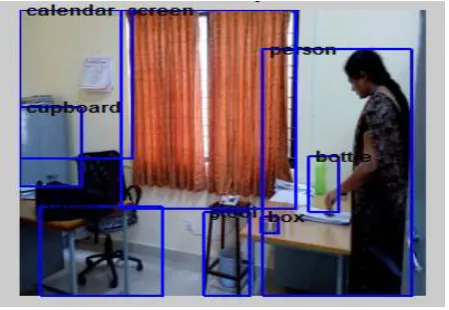
Fig.7 Object recognition and classification
Figure 7 illustrates recognition and classification of objects using Multi-Class SVM classifier by matching the extracted features of the object against features of the predefined objects.
V.CONCLUSION
The proposed work is brought with an aim to analyze the difficulty and challenges faced in the field of object detection and recognition in real time images. The implementation begins by segmenting the image utilizing a k-means clustering to extract the objects. Later the texture based and intensity based features of the extracted objects are extracted. Then the recognition procedure happens by matching a given image features against the trained image features utilizing Multi-class SVM classifier. According to the perception, the late innovation advanced in the field of object recognition as brought about high accuracy, effective furthermore less computation time compared to previous techniques. For the given database the objects in the image are trained and also attempted to recognize more than 5 objects in real time images and succeeded. In order to get best classification, the maximum features from an objects are extracted, on an average 5 features from each object are taken here. Compare to other systems it gives high performance and also performs better than other techniques in terms of both efficiency and accuracy.
VI.ACKNOWLEDGMENT
The work is supported by the renowned institution VVCE, Mysuru which provide an opportunity and platform to carry out this work. The author would like to express gratitude to the guide Dr. Chandrashekar M Patil, Professor, Department of Electronics and Communication, VVCE, Mysuru, for his constant support, encouragement and valuable guidance towards the work.
REFERENCES
[1] Dr. R. Muralidharan, “Object Recognition Using K-Nearest Neighbor Supported by Eigen Value Generated from the Features of an Image,” International Journal Of Innovative Research In Computer And Communication Engineering, Vol.2, No.8, Pp.5521-5528, August 2014.
[2] Rakesh Kumar, Rajesh Kumar and Seema, “Gabor Wavelet Based Features Extraction for RGB Objects Recognition Using Fuzzy Classifier,” International Journal of Application or Innovation in Engineering & Management, Vol.2, No.8, Pp.122-127, August 2013.
[3] Kavita Ahuja and Preeti Tuli, “Object Recognition by Template Matching Using Correlations and Phase Angle Method,” International Journal of Advanced Research in Computer and Communication Engineering, Vol.2, No.3, Pp.1368-1373, March 2013.
[4] Amit Thakur and Avinash Dhole, “Object Recognition from Image Using Grid Based Color Moments Feature Extraction Method,” International Journal of Research in Engineering and Technology, Vol.2, No.3, Pp.333-336, Mar-2013.
[5] Y.Ramadevi, T.Sridevi, B.Poornima and B.Kalyani, “Segmentation and Object Recognition Using Edge Detection Techniques,” International Journal of Computer Science & Information Technology, Vol.2, No.6, Pp.153-161, December 2010.