R E S E A R C H
Open Access
A novel pre-processing and adaptive statistical
threshold for sphere detection in MIMO
systems
Haiyan Cao
1,2, Jun Li
3*, Xin Fang
1and Xiumin Wang
3Abstract
In this paper, an efficient sphere detection (SD) scheme for multiple-input multiple-output (MIMO) systems is presented. The proposed SD scheme can substantially reduce computational complexity by introducing a
pre-processing scheme and an adaptive threshold. In particular, our proposed pre-processing scheme is based on an iterative successive interference cancelation (SIC). The proposed adaptive threshold is used to judge whether a traversed path is correct or not and obtained by analyzing the distributions of the correct and erroneous estimates which have the minimum error pattern among all the SD searching paths. Simulation results show that our proposed scheme offers a substantial complexity reduction in terms of the number of visited nodes while keeping a significantly small performance degradation compared to conventional approaches.
1 Introduction
The maximum likelihood (ML) detection is considered as an optimal solution for achieving the minimum error probability of multiple-input multiple-output (MIMO) systems. However, the ML detection, also a well-known non-deterministic polynomial-time (NP)-complete prob-lem, comes at an expense of computational complexity. To overcome this shortcoming, several suboptimal detec-tion algorithms, such as zero forcing (ZF), minimum mean-square error (MMSE), and successive interference cancelation (SIC), have been proposed. Although these algorithms have lower complexity than ML, the achiev-able performance is far below the performance of the ML receiver.
Sphere detection (SD) algorithm is a tree search strategy that can achieve a similar performance to that of ML and is widely considered to be the most promising approach for MIMO detection. It has polynomial expected com-plexity for problems with moderate size and can be effi-ciently used for moderate signal-to-noise ratios (SNRs) [1,2]. However, the expected complexity is exponential in the number of antennas and constellation size for fixed
*Correspondence: [email protected]
3College of Information Engineering, China Jiliang University, Hangzhou 310018, China
Full list of author information is available at the end of the article
SNRs [2], and it still requires a large amount of compu-tations compared to MMSE- and ZF-based algorithms, especially for high numbers of antennas and large constel-lation sizes. Hence, many efforts have been made to mod-ify the SD algorithm to further reduce the computational complexity such as the Schnorr-Euchner (SE) [3] strategy, channel matrix pre-processing (ordering scheme) [4-6], modification of the lattice representation [7], probabilistic tree pruning strategy [8], and k-best algorithm [9]. All the schemes can improve SD efficiency to some degrees while still maintaining a large amount of computations.
Motivated by all of the above, in this paper, we pro-pose an efficient ordering scheme and adaptive threshold to decrease SD complexity while keeping the system per-formance satisfactory. An ordering scheme based on SIC which the authors call sorted SIC (SSIC) ordering is pro-posed. Then, an adaptive threshold which can be seen as the extension of the threshold used in fixed-complexity SD (FSD) [10] is developed. Simulation results show that the proposed scheme combining SSIC ordering with adaptive threshold results in almost minimum complexity (in terms of the number of visited nodes) compared to other exist-ing approaches with neglected performance degradation.
Throughout this paper, the following notations are adopted. Bold uppercase and lowercase letters stand for matrices and vectors, respectively.(•)Tand(•)−1describe
the transpose and inverse of a matrix, respectively. Fur-thermore, • and |•| denote the norm and absolute operator, respectively, andE[•] is the expectation opera-tor. In addition,(•)imeans theith row for a matrix or the ith element of a vector.
2 System model and sphere detection
Consider a MIMO system withNtransmit andMreceive antennas whereM ≥ N. The input-output relationship can be expressed as
y=Hs+w, (1)
where s = (s1,s2,. . .,sN) ∈ CN is an N-dimensional transmitted complex vector whose entries si,i = 1, 2,. . .,N, are drawn from some quadrature amplitude modulation (QAM) constellation with the real and imag-inary parts being integers; y = (y1,y2,. . .,yM) ∈ CM is anM-dimensional received complex vector;H ∈ CM×N denotes theM×NMIMO channel matrix; andw∈ CN is the additive white Gaussian noise (AWGN) vector. The matrix His defined by H =[hij] for 1 ≤ i ≤ Mand 1 ≤ j ≤ N, wherehij, theith row andjth column entry of H, is assumed to be an independent and identically distributed (i.i.d.) circular symmetric complex Gaussian random variable with 0 mean and 1 variance. The tuples ofN-dimensional Gaussian noise vectorware i.i.d. circu-lar symmetric complex Gaussian random variables with 0 mean andσ2variance. Herein, the SNR at the receiver is defined as
For simplicity, the complex-valued model given in (1) is usually transformed into a real-valued model, where the dimension is doubled such asm = 2Mandn = 2N. As such, (1) can be rewritten as
of complex numbers, respectively. Since all the complex form of (1) can be written as (3), we assume that (1) is a real-valued model without loss of generality in the follow-ing. Suppose perfect channel knowledge is available at the receiver, the ML detection problem can be formulated as
sML=arg min ˆ
s∈D
y−Hˆs2, (4)
where•denotes the Euclidean norm andD =Anand Ais the signal constellation set, e.g.,A= {−3,−1, 1, 3}for 16QAM. For a generalH, this problem is known to be NP-hard. Sphere decoding solves (4) by searching only over those points that satisfy a constraint of the form
y−Hˆs2≤d02. (5)
In other words, the SD algorithm only searches the lat-tice points inside the hypersphere centered at the received vector with radiusd0instead of searching all lattice points. By applying QR decomposition toH, (5) can be written as
resent the first n and lastm−n orthonormal columns ofQ, respectively. Suppose radiusd0is sufficiently large so that the ML solution lies in the hypersphere, and let d2 = d20−QT2y2andz = QT1y = Rs+QT1w; thus, sphere decoding solves (4) by
sML=arg min
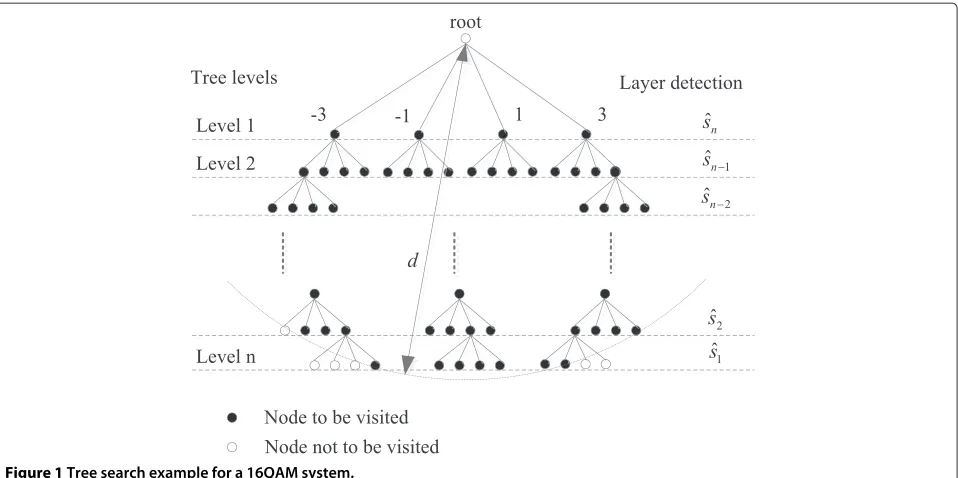
where Rij denotes the ith row and jth column tuple of matrix R. From (7), we can see thatsML can be solved recursively by following a similar fashion to that in the SIC technique. Specifically, we use a constrained tree search through multiple levels, starting from ˆsn down to ˆs1, as shown in Figure 1.
3 Proposed scheme
In this section, we propose the SSIC ordering scheme to significantly improve the ML performance using the SD algorithm. In addition, we further reduce the SD com-plexity by developing a new adaptive threshold to judge whether an estimate is correct or not, attempting to out-put the good estimate as early as possible.
3.1 Proposed pre-processing
Figure 1Tree search example for a 16QAM system.
component, which is amplified by the row norm of the pseudo-inverse of the channel matrix as
H†z=s+H†v, (8)
whereH† = HTH−1HT is the pseudo-inverse of chan-nel matrixH, andv= QT1wis an i.i.d. noise vector with the same distribution asw. Therefore, theith tuple of ZF solutions is given by
shown that each component of the ZF solution vector is detected out of various noise levels which is modified by
H†i. Motivated by the observation, we define the signal reliability:
reliability(si)=
H†zi−si
H†i , (10) wheresi ∈A. Based on (10) and due to the similar oper-ation between SD and SIC, the proposed SSIC ordering is described as follows (fori=0, 1,. . .,n−1):
1. SetH0=H,z0=z, andN = {1, 2,. . .,n}. 2. Calculate the matrixH†i, whereH†i is the
pseudo-inverse of thei th iteration channel matrixHi.
3. Calculate the ZF solution vectorszfi =
iteration received signal, and for each elementszfi j
andL is the constellation size. 4. For each element
N, is the corresponding column index of channel matrixH, and letN =N\kˆi
, where\denotes the set subtraction.
6. The columns of the channel matrix are reordered as H=hkn−1,hkn−2,. . .,hk1,hk0
.
3.2 Proposed adaptive threshold
In the tree searching, each full traversed path metric is calculated by
C=z−Rˆs2=Rs− ˆs+v2. (11)
between signal vectorsand estimated vectorsˆisK, then sandsˆdiffer atK places denoted asi1,i2,. . .,iK. In this case, the metricCnow turns to beC given by
C =Rs− ˆs+v2=
+vis a Gaussian vector with the mean
vector K
and the same covariance matrix
as v. Thus, C is the non-central chi-square-distributed random variable with n degrees of freedom denoted as χ2
Since the probability density function (PDF) of the met-ric for correct path is different from that of the metmet-ric for erroneous path, the intersection point for PDFs ofχn2 andχ2
n,γ2can be set as the optimum threshold whether an
estimate is correct or not. Among all the error patterns, the minimum one is that there exists one path which has Hamming distance 1 to the correct path, say, they differ at the site, and the corresponding column ofRexactly has the minimum norm. Therefore, we select the optimum threshold to be the intersection point for PDFs ofχn2and χn2,
γ2, which gives the minimum non-central parameter as
γmin2 = min
distance of two constellation points. Based on the non-central parameter, the threshold can be approximately linearly calculated by [10]
T=α×γ2+n×σ2, (15)
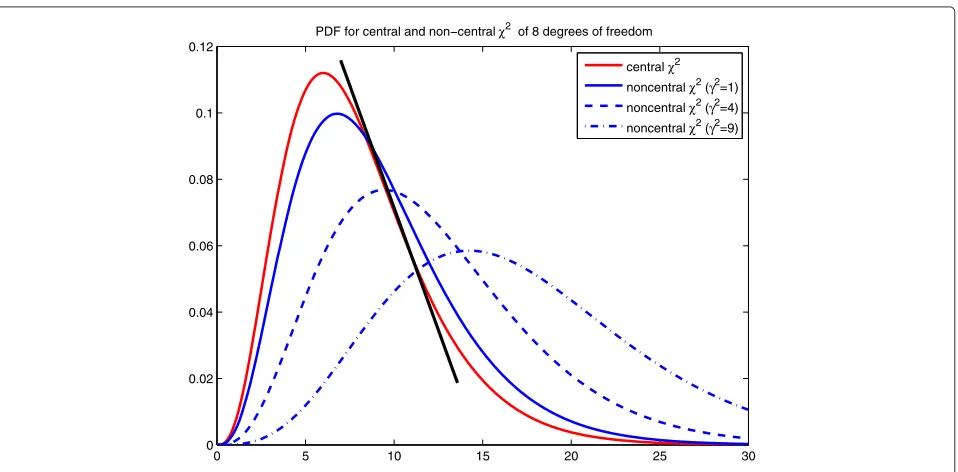
whereαis a constant coefficient depending on the degrees of freedom, which can be calculated offline by numeric computation since the intersections for PDFs of χn2and χn2,γ2 almost lie on a line if the non-central parameters are not very large, as shown in Figure 2 which indicates the PDF for central and non-central χ2 of 8 degrees of freedom. In this way,α can be obtained, for instance, as 0.3465, 0.366, and 0.4082 for the case where the degrees of freedom are 4, 8, and 16, respectively. The proposed threshold based on minimum error pattern (MEP-T) is applied when the SD searching reaches level n (leaf nodes). Based on our SSIC ordering scheme and proposed threshold, our SD search process can be described as follows:
1. Initialize radiusd→ ∞.
2. Perform SSIC precessing algorithm to reorder the columns of channel matrixH.
3. Apply QR decomposition to the reordered channel matrix, i.e.,H=QR.
4. Calculate thresholdT by (15).
0 5 10 15 20 25 30
PDF for central and non−central χ2 of 8 degrees of freedom
central χ2
0 5 10 15 20 25 30 10−6
10−5 10−4 10−3 10−2 10−1 100
SNR/dB
SER
SER performance comparison for 16QAM and 64QAM systems
SSIC with MEP−T SSIC
BSQR GB V−BLAST No ordering
6×6 16QAM
4×4 16QAM
6×6 64QAM 4×4 64QAM
Figure 3SER performance comparison for 16QAM and 64QAM systems.
5. Normally run a depth-first constrained tree search throughn levels.
6. Compute the whole accumulated metricC through n levels by (11), and compareC with threshold T. Terminate the SD decoding process and output the
solution ifC≤Tholds.
7. Otherwise, compareC with radius d. IfC≤d, update radiusd asd=Cand repeat steps from 5 to 7 until a path, which is the first one such thatC≤Tholds or has the minimum accumulated metricC, is found.
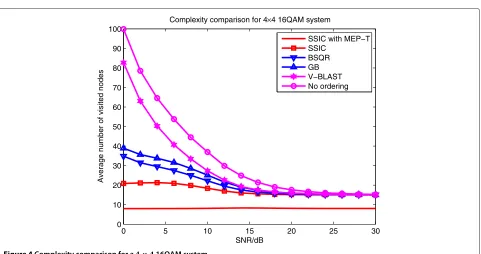
0 5 10 15 20 25 30
0 10 20 30 40 50 60 70 80 90 100
SNR/dB
Average number of visited nodes
Complexity comparison for 4×4 16QAM system
SSIC with MEP−T SSIC
BSQR GB V−BLAST No ordering
0 5 10 15 20 25 30 0
10 20 30 40 50 60 70 80 90 100
SNR/dB
Average number of visited nodes
Complexity comparison for 4×4 64QAM system
SSIC with MEP−T SSIC
BSQR GB V−BLAST No ordering
Figure 5Complexity comparison for a4×464QAM system.
4 Simulation results
In this section, we display the comparisons of system performance in terms of symbol error rate (SER) and the computational complexity in terms of the average numbers of visited nodes for 4× 4 and 6 × 6 MIMO systems with 16QAM and 64QAM modulation. As can be observed from Figure 3, SD with our SSIC ordering and MEP-T show very small SER degradation compared
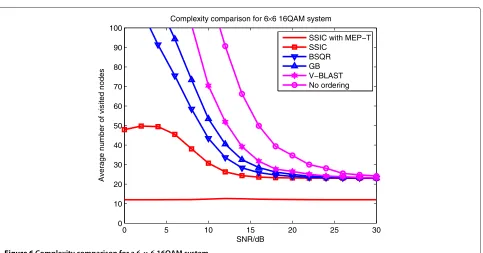
to the original SD. However, a considerable complexity reduction can be observed from Figures 4, 5, 6, and 7. It is clearly shown that our SSIC ordering itself is much more efficient than other conventional approaches such as BSQR, GB, and V-BLAST ordering. Moreover, com-bining SSIC ordering with MEP-T can further reduce the complexity and offer almost fixed complexity in average. Specifically, for SNR = 5 dB, our proposed
0 5 10 15 20 25 30
0 10 20 30 40 50 60 70 80 90 100
SNR/dB
Average number of visited nodes
Complexity comparison for 6×6 16QAM system
SSIC with MEP−T SSIC
BSQR GB V−BLAST No ordering
0 5 10 15 20 25 30 0
20 40 60 80 100 120 140 160 180 200
SNR/dB
Average number of visited nodes
Complexity comparison for 6×6 64QAM system
SSIC with MEP−T SSIC
BSQR GB V−BLAST No ordering
Figure 7Complexity comparison for a6×664QAM system.
scheme yields a little bit more than 8 visited nodes for a 4 × 4 system with 16QAM (Figure 4) and 64QAM (Figure 5) and a little more than 12 visited nodes for 6×6 16QAM (Figure 6) and 64QAM (Figure 7), whereas other approaches require at least 25 visited nodes or even higher.
Intuitively, the reason why it has such a low complex-ity in average can be investigated through the behavior of the SSIC ordering and MEP-T threshold. The SSIC order-ing leads to the case that the lattice point which has the most possible to be the solution has the higher privilege to be searched. Moreover, the threshold is set properly and can be considered that it constrains a hypersphere area in which all the lattice points (corresponding to the full path in the searching tree) are the ‘ML solution.’ Since the real ML solution has the minimum metric, it certainly lies in the area. Once any one lattice point in the area has been searched, the searching process terminates. As the SNR increases, the number of lattice points in the area goes down, and the probability of obtaining the real ML solu-tion goes larger and larger. That is why the complexity is low while having a negligible performance loss at the high-SNR region under our scheme. At the low-high-SNR region, the area contains more lattice points, which leads to an incorrect estimate with a larger probability. However, the errors given in this way do not affect the performance sig-nificantly because even the real ML solution yielded by the exhaustive search at the low-SNR region also gives the wrong estimate. Therefore, in our SSIC with MEP-T scheme, the correct and incorrect estimates are well dis-tinguished at the high-SNR region, and the complexity
reduction is preferred at the low-SNR region instead of improving a little performance while increasing enormous complexity.
5 Conclusions
In this paper, we propose an efficient SD algorithm by jointly combining the SSIC ordering scheme and the adaptive threshold MEP-T. In particular, the SSIC order-ing scheme is based on the iterative SIC and MEP-T is obtained by analyzing the PDFs of the correct and erroneous estimates, which have the minimum error pat-tern among all the SD searching paths. Simulation results show that our SSIC ordering scheme is more efficient than BSQR, GB, and V-BLAST by reducing the computa-tional complexity in terms of the number of visited nodes. More importantly, combining SSIC ordering with MEP-T can further reduce the complexity and offer almost a fixed average complexity at an expense of an unnoticeably small performance degradation compared to conventional methods.
Competing interests
The authors declare that they have no competing interests.
Acknowledgements
The authors would like to thank the Associate Editor and the reviewers for their comments and suggestions which help improve the quality and clarity of this paper. This work was supported by Zhejiang Natural Science Foundation (Y1090935) and National Natural Science Foundation of China (61379027).
Author details
1College of Communication Engineering, Hangzhou Dianzi University,
Hangzhou 310018, China.2School of Information Engineering, Hangzhou Dianzi University, Hangzhou 310018, China.3College of Information
Received: 10 May 2012 Accepted: 12 November 2013 Published: 5 December 2013
References
1. J Jalden, B Ottersten, An exponential lower bound on the expected complexity of sphere decoding, inProceedings of the IEEE International Conference on Acoustics, Speech, and Signal Processing(IEEE, Montreal, 2004), pp. 393–396
2. J Jalden, B Ottersten, On the complexity of sphere decoding in digital communications. IEEE Trans. Sig. Proc.53(4), 1474–1484 (2005) 3. CP Schnorr, M Euchner, Lattice basis reduction: improved practical
algorithms and solving subset sum problems. Math. Program.
66(2), 181–191 (1994)
4. PW Wolniansky, GJ Foschini, GD Golden, RA Valenzuela, V-BLAST: an architecture for realizing very high data-rates over the rich-scattering wireless channel, inProceedings of the URSI International Symposium on Signals, Systems, and Electronics(IEEE, Piscataway, 1998), pp. 295–300 5. Y Dai, Z Yan, Memory-constrained tree search detection and new
ordering schemes. IEEE J. Sel. Topic Sig. Process.3(6), 1026–1037 (2009) 6. R Trujillo, VM Garcia, A Vidal, S Roger, A Gonzalez, Gradient-based
ordering for MIMO decoding, inProceedings of the IEEE International Symposium on Signal Processing and Information Technology (ISSPIT) (IEEE, Ajman, 2009), pp. 5–8
7. L Azzam, E Ayanoglu, Reduced complexity sphere decoding via a reordered lattice representation. IEEE Trans. Commun.57(9), 2564–2569 (2009)
8. S Lei, C Xiong, X Zhang, D Yang, Adaptive control of surviving branches for fixed-complexity sphere decoder, inProceedings of the IEEE 71st Vehicular Technology Conference(IEEE, Taipei, 2010), pp. 1–5 9. X Wu, Y Dai, Z Yan, Y Wang, Improving the reliability of the k-best
algorithm for MIMO detection with ordering, inProceedings of the Wireless and Optical Communications Conference (WOCC)(IEEE, Shanghai, 2010), pp. 1–5
10. X Wu, J Thompson, Accelerated sphere decoding for multiple-input multiple-output systems using an adaptive statistical threshold. IET Signal Process.3(6), 433–444 (2009)
doi:10.1186/1687-1499-2013-275
Cite this article as: Cao et al.: A novel pre-processing and adaptive statistical threshold for sphere detection in MIMO systems.EURASIP Journal
on Wireless Communications and Networking20132013:275.
Submit your manuscript to a
journal and benefi t from:
7 Convenient online submission
7 Rigorous peer review
7 Immediate publication on acceptance
7 Open access: articles freely available online
7 High visibility within the fi eld
7 Retaining the copyright to your article