POLYMERIZATION THROUGH MONOMER DESIGN
Thesis by Ron Walker
In Partial Fulfillment of the Requirements for the degree of
Doctor of Philosophy
CALIFORNIA INSTITUTE OF TECHNOLOGY
Pasadena, California 2009
! 2009
Ron Walker
Acknowledgments
Confucius:“A journey of a thousand miles begins with a single step”
Upon reading this quote, my first interpretation was that Confucius was merely commenting on the simplicity as to which a journey begins. However, the more I
contemplated those words, the more I began to understand the true meaning of what Confusius was attempting to communicate. Now that I am at the end of this chapter of my life, I believe I have fully grasped what Confucius was trying to convey. He was not
simply commenting on how effortless it is to begin a journey, but instead that you take the “first step”.
As I sit here thinking about what to write and how exited I am to finally receive my PhD, I can’t help but think about all the people who have helped and guided me into taking that “first step” and all those who have encouraged me along the way. Throughout
this process, I have grown more than I ever would have imagined. I’ve also met a lot of loving and positive people, more than I could possibly thank in this acknowledgments
section, but I will do my best to try, so here it goes.
My first acknowledgement goes to God, for without him I would not be where I am today. Graduate school has the uncanny ability to stress a person beyond belief and at
the same time make you feel like you just won the lottery. It can also make you find religion. Throughout the many ups and down of earning my degree, my relationship with
God has grown closer and stronger.
Next to God, is my lovely and beautiful wife Tammie. She has been the angel by my side throughout this journey, constantly pushing me forward and sometimes even
could not have asked for a better wife and friend. No one understands me better and can cheer me up when I am down like she can. She is more than I ever wanted in someone to love and I am truly a lucky man to be her husband. She is my first, my last, my
everything.
I would also like to thank my brother Don. We’ve been walking this parallel
journey for a long time and now we must separate to move onto the next chapter of our lives. Also if it were not for my brother, I would have probably finished graduate school a year earlier. We spent a lot of time together working in the dim North Wilson parking
garage swapping an engine into his AE86 Toyota Corolla and doing various other projects. Nonetheless it was all worth it.
My parents have done nothing but encourage me to do my best throughout life. It is with there unconditional love and support that I have become the man I am today. I’ll never be able to repay or thank them enough for what they have given me. I can only
promise that I will try my very best to continue to make them proud. Also I have to give a special thanks to my little sister. Although she is five years younger than me, she has
always been there to lend an ear when needed. I know she has a bright future ahead of her and I hope to give her the same encouragement that she has given me throughout this time.
While we are on the subject of family, I must thank my wife’s family The Londons: Ra and Glo, Ats and Shavara, Willie and Latrice, Shad and Scottie, Dedrick
thankful to all of them. I would especially like to thank Ra London for buying me a brand new Intel Macbook when my old Powerbook G4 gave out on me. There is no way possible I would have made it through graduate school if it were not for his selfless and
generous gift.
Of course I cannot go on writing these acknowledgements without thanking my
advisor Bob Grubbs. What can I say about Bob that hasn’t already been said? I will be forever thankful to him for allowing me a place in his group and advising me like he has done so many. Bob has allowed me the freedom to work on a wide range of interesting
problems while teaching me to put things into a bigger perspective. His unique and positive style of advisement, constant encouragement and optimism is what made the fun
part of graduate school fun.
As a member of the Grubbs’ group I have developed a number of long and fruitful relationships with current and past members. Almost everyone who has been a part of the
Grubbs group during my stay here has helped or aided me during my graduate career. During my first tenure at Caltech as summer MURF student Oren Scherman was my
co-advisor. He was the first to teach me about polymer chemistry and the power of olefin metathesis. Special thanks to Cheol Chung, George Vougioukalakis, Donde Anderson, Erin Guidry, Greg Beutner, Brian Connel, Dan Sanders and Isaac Rutenburg who all have
mentored me in the ways of metathesis during my time as a graduate student. I would like to especially thank Jason Jordan, who was my lab mate for four years. He was always the
polymer chemistry and just life in general have helped to make my graduate experience all the more fun. I also have to give a very, very special thanks Professor Mike Page, his wife Kim and their two children Chris and Matthew. Although Professor Page decided to
spend only one year with me, it was all that was needed to develop a lifelong friendship. There have been many more that have helped me along my graduate career and I thank
them all.
There area also a few entities I must acknowledge that have made my life in graduate school pass by smoothly by affording me the opportunity to relieve all the
bottled up stress and aggression from failed experiments. Special thanks go to our flag football team TEAM JUSTICE, without this crazy group of guys I would have no way of
releasing my inner desire to lay down the hammer of justice and also for giving me a nine day, all expense paid trip to Huntington Hospital so that I could heal my level four liver laceration. I would also like to thank Paul Clark for introducing me to the greatest sport
in the world “Olympic Weightlifting”. I will miss our daily trips to the gym and our never-ending quest to become Ripped and Shredded. And last, but not least I must give a
special thanks to Ironmind’s Captains of Crush grippers. Never will there be a bottle that cannot be opened or rock that cannot be crushed. Thanks to these awesome training tools I now have the combined crushing force of 390 lbs in my hands or lets just say I have the
grip strength of ten thousands gorillas “Crushed to Dust”.
Now onto a more serious note, my time here in California as a graduate student
simply a family away from home for us, they are our family. Al and his wife Ramona, my wife’s best friend, and their three children Jordan, Ashley, and Kennedy have been our closest family here in Pasadena as well as here three sisters and their families, Regina,
Lorraine, and Lisa. We cannot count the many times and ways they’ve been there for us. Also I have to give special thanks to their very caring and loving parents Lorretta and
Conrad Johnson. They have become more than just a second mother and father to my wife and I. It is because of the Johnson`s love and support that the hardest part about leaving California will not be leaving the weather but saying goodbye to all of them. We
will always remember all the countless birthday parties and holidays we have spent with the Johnson’s and I know that even though we are moving onto the next phase of our
lives we will continue to visit our “family” and “home”.
Abstract
The focus of the research presented in this thesis deals with the synthesis and
development of functionalized polymers using ring-opening metathesis polymerization (ROMP). The approach taken in developing the polymers presented within, feature the
careful design and synthesis of a number of functionalized and unique monomers. A basic history and overview of olefin metathesis and polymer science is given in Chapter 1.
Chapters 2 and 3 describe the development of controlled polymer architectures for use as barrier materials. This work was done in collaboration with Kuraray, Inc, which is
a major manufacturer of commercial barrier materials. Also the structure-property relationships of these materials were studied to better understand how polymer architecture affects polymer properties.
Chapter 4 discusses the controlled living ROMP of highly strained trans -cyclooctene. The knowledge and understanding of solvent effects during ROMP was also
explored as a means to attenuate the rate of propagation during ROMP. Block copolymers containing polynorbornene and PCO were also synthesized and hydrogenated to form block copolymers containing blocks of linear, narrowly dispersed polyethylene.
Chapter 5 describes the development of photodegradable polymer. By incorporating photodegradable links into a polymer chain, using ROMP, the polymer
Table of Contents
Acknowledgments... iii
Abstract... viii
Chapter 1:Introduction ... 1
1.1. Introduction... 2
1.2. Ring-Opening Metathesis Polymerization... 4
References... 6
Chapter 2:Synthesis and Characterization of Regioregular Ethylene-Vinyl Alcohol Copolymers made by Ring-Opening Metathesis Polymerization from 3,5-Cycloheptene-1,3-diol... 7
Abstract ... 8
2.1. Introduction... 9
2.2. Results and Discussion ... 12
2.2.1. Monomer Design and Synthesis ... 12
2.2.2. ROMP of 6a and 6b with 2. ... 14
2.2.3. ROMP of 6a/6b with 2 and Chain Transfer Agent (CTA)... 15
2.2.4. Synthesis of monomer 7a/7b... 16
2.2.5. ROMP of 7a/7b with 2 and CTA. ... 17
2.2.6. Hydrogenation of 8. ... 18
2.2.7. Deprotection of 9.... 19
2.2.8. Barrier Testing ... 19
2.3. Conclusion ... 20
2.4. Future Work ... 20
2.5. Experimental Section ... 21
References... 26
Chapter 3:The Synthesis of Regioregular Ethylene-Vinyl Alcohol Copolymers via Ring-Opening Metathesis Polymerization from 3,4-Difunctional Cyclobutenes ... 28
Abstract ... 29
3.1. Introduction... 30
3.2. Results and Discussion ... 31
3.2.1. Monomer Design and Synthesis ... 31
3.2.2. ROMP of 4... 32
3.2.3. Synthesis of 9... 35
3.3. Conclusions... 38
3.4. Living Polymerization of Cyclic-olefins ... 39
3.5. Conclusions... 40
3.6. Experimental Section ... 41
References... 46
Chapter 4:The Controlled Living Ring-Opening Metathesis Polymerization of Trans-Cyclooctene ... 48
4.1. Introduction... 50
4.2. Results and Discussions... 53
4.2.1. ROMP of Trans-Cyclooctene ... 53
4.2.2. Reaction Time Study... 60
4.3. Concentration Study... 62
4.4. Synthesis of Linear High Density Polyethylene ... 63
4.4.1. Diblock Copolymer Syntehesis... 65
4.4.2. Synthesis of Hydrogenated Norbornene-b-Polyethylene... 65
4.4.3. Triblock PNB-b-PCO-b-PNB ... 66
4.5. Conclusions... 67
4.6. Acknowledgements... 67
4.7. Experimental Section ... 68
References... 71
Chapter 5:Synthesis of a Photodegradable Polybutadiene using Ring-Opening Metathesis Polymerization ... 74
Abstract ... 75
5.1. Introduction... 76
5.2. Results and Discussion ... 77
5.2.1. Monomer Design and Synthesis ... 77
5.2.2. ROMP of 5 with 2... 78
5.2.3. ROMP of 5 with COD ... 79
5.3. Conclusions... 81
5.4. Experimental Section ... 82
References... 86
Appendix A: Synthesis and Characterization of Stereoregular Ethylene-Vinyl Alcohol Copolymers made by Ring-Opening Metathesis Polymerization ... 87
Abstract ... 88
A.1 Introduction... 89
A.2 Results and Discussion... 92
A-2.1. Monomer design and synthesis... 92
A-2.2. ROMP of acetonide monomers with catalyst 1 ... 94
A-2.3. ROMP of acetonide monomers with catalyst 2. ... 97
A-2.4. Hydrogenation of acetonide-protected ROMP polymers. ... 98
A-2.5. Deprotection of acetonide groups... 99
A-2.6. Thermal analysis of ROMP-, hydrogenated-, and deprotected-polymers. .. 100
A.3 Conclusions... 101
A.4 Acknowledgements... 102
A.5 Experimental Section ... 103
List of Figures
Figure 1.1. Olefin metathesis mechanism and applications... 2
Figure 1.2. Reactivities of olefin metathesis catalysts. ... 3
Figure 1.3. Olefin metathesis catalysts. ... 4
Figure 1.4. Olefin metathesis transformations. ... 5
Figure 2.1. Ruthenium olefin metathesis catalysts (Cy=cyclohexyl). ... 9
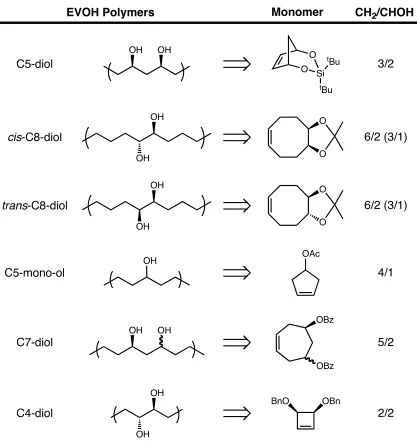
Figure 2.2. EVOH polymers developed using ROMP... 10
Figure 2.3. Molecular weight increases linearly with increasing [M]0/CTA. 7a/7b (circles, solid line), 7a/7b in toluene (4.0 M) (triangle, dashed line), 6a/6b (diamonds dash dot line). ... 18
Figure 3.1. ROMP catalyst (Cy=cyclohexyl). ... 30
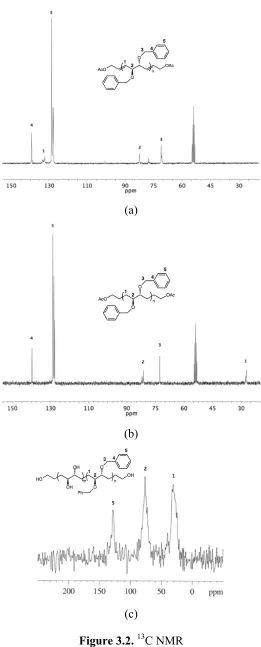
Figure 3.2. 13C NMR... 34
Figure 3.3. Linear increase in molecular with increasing [M]0/CTA. ... 36
Figure 3.4. (a)DSC/TGA data for polymer 7 obtained from Kuraray, Inc. (b)DSC/TGA data for PVA (Tm = 253 °C, Td = 250 °C)... 37
Figure 3.5. ROMP of monomers 8 and 10 with 3 carried out at 30 ºC... 40
Figure 4.1. Ruthenium Olefin Metathesis Catalysts (Cy = cyclohexyl). ... 50
Figure 4.2. Typical cyclic olefins used in ROMP... 52
Figure 4.3. GPC trace of entry 7. RI trace (solid line) and Light scattering trace (dashed line). The minor peak is attributed to competing chain transfer. ... 56
Figure 4.4. ROMP of TCO with 1 in THF (0.5 M) at room temperature with increasing equivalents of PPh3. After the addition of 5 equivalents of PPh3 no high molecular weight peak is observed... 57
Figure 4.5. ROMP of TCO with increasing PPh3:4. ... 59
Figure 4.6. Molecular weight control by varying [M]0/1. ROMP of TCO with 1 was carried out in THF (0.5 M) at room temperature for entries 15-18. The high MW point corresponding to entry 19 was conducted at 0.05 M. ... 60
Figure 4.7. GPC traces of polymerizations stopped at increasing times: 1 min in red, 5 min in blue and 10 min in green. (a) ROMP of TCO in CH2Cl2 (0.5 M) at room temperature. (b) Same as (a) except in THF. The reactions were stopped at varying time intervals with ethyl vinyl ether... 61
Figure 4.8. (a) PCO Mn=54,000 g/mol. (b) PNB Mn=10,000 g/mol. (c) HDPE from monodispersed PCO, (d) HPNB/HDPE diblock. ... 64
Figure 4.9. Polynorbornene (dashed line), PNB-b-PCO (solid line). ... 65
Figure 5.1. Ruthenium olefin metathesis catalysts. ... 77
Figure 5.2. GPC traces of polymer 7 (solid line) before and after photoirradiation (dashed line)... 81
Figure A.1. (a) ADMET of a symmetric alcohol-containing monomer to produce a regioregular EVOH copolymer. (b) ROMP of a temporarily strained, symmetric monomer to produce a regioregular EVOH material with a higher vinyl alcohol content. ... 90
Figure A.3. (a) ROMP of 9 with catalyst 1 at 55 °C, [M]0/[1]=400 at varying [M]0. (b) Molecular weight control is achieved by varying [M]0/[1] ratio. ... 95 Figure A.4. ROMP of 10 carried out at 1 M and 55 °C with catalyst 1 to produce
polymer 12; molecular weight control is achieved by varying [M]0/[1]
ratio. ... 96 Figure A.5. ROMP of 10 carried out at 1 M and 55 °C with catalyst 1 to produce
List of Schemes
Scheme 2.1. Synthesis of Monomer 6a/6b... 12
Scheme 2.2. Protection of 5a/5b. ... 13
Scheme 2.3. ROMP of monomer 6a/6b. ... 14
Scheme 2.4. ROMP of 6a/6b with CTA... 15
Scheme 2.5. Benzoate protection of 5a/5b to form 7a/7b. ... 16
Scheme 2.6. ROMP of 7a/7b with 2 and CTA. ... 17
Scheme 2.7. Hydrogenation of 8 to form 9. ... 18
Scheme 2.8. Deprotection of 9 to form 10. ... 19
Scheme 3.1. Living ROMP of Substituted Cyclobutenes with a Mo Initiator. ... 31
Scheme 3.2. ROMP of Bis(acetyloxymethyl)cyclobutene... 31
Scheme 3.3. Synthesis of monomer 4. ... 32
Scheme 3.4. ROMP, Hydrogenation, and Deprotection. ... 33
Scheme 3.5. Synthesis of monomer 9. ... 35
Scheme 3.6. ROMP of 9 with 2... 35
Scheme 4.1. ROMP of Trans-Cyclooctene. ... 54
Scheme 4.2. ROMP of TCO with excess PPh3. ... 54
Scheme 4.3. Block copolymers of Norbornene and Trans-cyclooctene. ... 65
Scheme 5.1. Mechanism of Norrish type II reaction... 76
Scheme 5.2. Synthesis of aryl ketone containing monomer 5... 78
Scheme 5.3. ROMP of 5 with 2... 78
Scheme A.1. ROMP of trans-diol 3... 91
Scheme A.2. Protection strategies for trans- and cis-cyclooctene diol monomers. ... 93
Scheme A.3. ROMP of 9 with catalyst 1 yields acetonide-protected polymer 11. ... 94
Scheme A.4. ROMP of 10 with catalyst 1 yields acetonide-protected polymer 12. ... 96
Scheme A.5. ROMP of 10 with catalyst 2 in the presence of chain transfer agent 13 to yield telechelic acetonide-protected polymer 14. ... 97
Scheme A.6. Hydrogenation of ROMP polymers by in situ diimide formation. ... 99
List of Tables
Table 2.1. ROMP of 6a/6b with 2 and CTA... 15
Table 2.2. ROMP of 7a/7b with 2 and CTA... 18
Table 2.3. Kuraray, Inc EVOH barrier testing results... 20
Table 3.1. ROMP of 4 with 2 and CTA. ... 32
Table 3.2. ROMP of 9 with 2. [M]0/2=600:1... 35
Table 3.3 ROMP of 9 with CTA... 36
Table 4.1. Polymerization of TCO in CH2Cl2 [M]0/Cat = 300:1. ... 54
Table 4.2. Polymerization of TCO with 1 and increasing PPh3... 56
Table 4.3. ROMP of TCO with 4... 58
Table 4.4. Effect of Increasing [M]0/1. ... 59
Table 4.5. Timed Study... 62
Table 4.6. Concentration Study... 63
Table 5.1. Synthesis of photodegradable polymers containing an aryl ketone. ... 78
Table A.1. ROMP of 10 at [M]0 = 1 M with 1 at 55 °C for 24 h. ... 96
Table A.2. ROMP of 10 at [M]0=1 M with 2 and CTA 13 at 55 °C for 24h,[10]/[2]=5000... 98
Chapter 1
1.1.
Introduction
The mechanism whereby atoms combine to form molecules is called the chemical
bond. It is the molecular glue that holds our world together. Chemical bonds may be
created and broken by various processes. These processes occur on a daily basis oblivious
to the naked eye. Our own bodies’ consistently form and break bonds for the purpose of
life. The art in chemistry lies in the ability and understanding of how to break and form
chemical bonds to create new molecules or modify existing ones. The understanding,
development and application of these mechanisms have lead to the discovery of many of
today’s medicines and advanced technologies.
Olefin metathesis is one such bond-forming/breaking reaction that was discovered
in the mid-1950s.1,2 It is a powerful method by which carbon-carbon double bonds
broken to form to carbon-carbon double bonds (olefins). The process of olefin metathesis
occurs when an olefin coordinates to a metal carbene catalyst, upon which a
metallocyclobutane is formed as shown in Figure 1.1.3 The metallocyclobutane can either
form a new olefin or revert to its original form. This reaction affords the possibility of a
number of applications, such as cross metathesis (CM), ring-closing metathesis (RCM),
and ring-opening cross metathesis (ROCM) as shown in Figure 1.1.1,4,5
M R R1 R2 M R
R2 R1
M R
R2
R1
R1 R2 R1
R2
R
CM
ROCM RCM
-C2H4
-C2H4
R
Since olefin metathesis is a metal mediated process, there have been numerous
studies and developments of olefin metathesis catalysts. Early research focused on the
development of homogenous well-defined early transition metal catalysts based on
titanium, tungsten, and molybdenum Figure 1.2. Although these catalysts exhibited high
activity, their selectivity for reactions with olefins is poor and they exhibit functional
group intolerance. Furthermore, they required rigorous handling conditions due to their
instability towards air. Catalysts based on late transistion metals are more tolerant of
functional and are more reactive towards olefins. In the mid 1990s, Grubbs et al. reported
a family of well-defined ruthenium-carbene olefin metathesis catalyst.6 These catalyst
showed remarkable reactivity with olefins and possessed high functional group tolerance
with a number of substrates. Since, then a wide range of ruthenium-based catalysts has
been developed. W N R' RO RO Ar Mo N R' RO RO Ar Ru PCy3 PCy3 Cl Ph Cl Ti H H
Acids Acids Acids Olefins
Alcohols, Water Alcohols, Water Alcohols, Water Acids
Aldehydes Aldehydes Aldehydes Alcohols, Water
Ketones Ketones Olefins Aldehydes
Esters, Amides Olefins Ketones Ketones
Olefins Esters, Amides Esters, Amides Esters, Amides
Titanium Tungsten Molybdenum Ruthenium
functional group tolerance
catalyst activity re a ct iv ity
Although the ruthenium catalysts are very functional group tolerant, their
activities are much lower than that of early transition metal catalysts.2,7-9 Replacement of
the phosphine ligand with an N-heterocyclic carbene to form 210, greatly increases
catalyst activity while maintaining functional group tolerance as shown in Figure 1.3.
Since this development a number of catalysts have been developed and used extensively
due to their high activities and functional group tolerance.
N N Ru PCy3 Ph Cl Cl Ru PCy3 PCy3 Cl Ph Cl N N Ru Cl O Cl N N Ru N Ph Cl Cl N Br Br
1 2 3 4
Figure 1.3. Olefin metathesis catalysts.
1.2.
Ring-Opening Metathesis Polymerization
Polymers science is field of chemistry in which these chemical bonds are linked
together to form large molecules, consisting of repeated units.11 One can envision a
polymer as a long chain and each link is a repeat unit. The chemical bonds in this chain
are the physical loops created by the interlocking of the links. There unique properties
have lead to their implementation in almost all aspects of our daily lives. From simple
plastic grocery bags to the materials used in the Space shuttle, polymers are everywhere.
As stated previously, the formation of polymers consist of the formation of
repeated chemical bonds to form a large chain. By utilizing different olefin geometries,
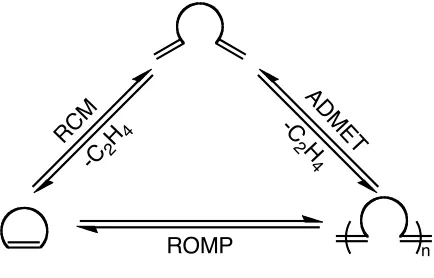
polymers may be formed using the olefin metathesis reaction as shown in Figure 1.4. At
low concentrations !,"-dienes can be used in RCM. However at high concentration the
using an olefin with a strained cyclic configuration ring-opening metathesis
polymerization (ROMP) may take place.
n ADM
ET
ROMP RCM
-C2H
4 -C2
H 4
Figure 1.4. Olefin metathesis transformations.
The basis for much of the work reported in this thesis based on the understanding
and application of ROMP. One key factor that drives ROMP is the release of ring strain.
This ring strain is inherent in typical cyclic olefins used from ROMP (figure).
Additionally, since metathesis is a reversible process, it is controlled by a thermodynamic
References
(1) Grubbs, R. H. Handbook of Metathesis; Wiley-VCH, 2003.
(2) Trnka, T. M.; Grubbs, R. H. Acc. Chem. Res.2001, 34, 18-29.
(3) Herisson, J. L.; Chauvin, Y. Makromol. Chem.1971, 141, 161.
(4) Morgan, J. P.; Morrill, C.; Grubbs, R. H. Org. Lett.2002, 4, 67-70.
(5) Connon, S. J.; Blechert, S. Angewandte Chemie International Edition 2003, 42,
1900-1923.
(6) Schwab, P.; Grubbs, R. H.; Ziller, J. W. J. Am. Chem. Soc.1996, 118, 100.
(7) Nguyen, S. T.; Grubbs, R. H.; Ziller, J. W. J. Am. Chem. Soc. 1993, 115,
9858-9859.
(8) Schwab, P.; France, M. B.; Ziller, J. W. Angewandte Chemie International
Edition1995, 34, 2039-2041.
(9) Dias, E. L.; Nguyen, S. T.; Grubbs, R. H. J. Am. Chem. Soc. 1997, 119,
3887-3897.
(10) Scholl, M.; Ding, S.; Lee, C. W.; Grubbs, R. H. Org. Lett.1999, 1, 953-956.
(11) Odian, G. Principles of Polymerization; Third Edition ed.; John Wiley & Sons,
Chapter 2
Abstract
The syntheses of regioregular as well as stereoregular ethylene vinyl alcohol
(EVOH) copolymers by ring-opening metathesis polymerization (ROMP) with ruthenium
catalysts are reported. Symmetric cycloheptene-diol monomers were protected as acetates
and benzoates to impart solubility to the monomer. Polymer molecular weights could be
easily controlled by either varying the monomer-to-catalyst ratio or by the addition of a
chain transfer agent. Hydrogenation and subsequent deprotection of the ROMP polymers
afforded the EVOH materials in good yields and the structures were confirmed by 1H
2.1.
Introduction
Ethylene-vinyl alcohol copolymers (EVOH) exhibit excellent barrier properties
towards gases and hydrocarbons.1-6 Due their robust barrier properties, they have found
utility in the food packaging, biomedical, and pharmaceutical industries.3 They are
typically synthesized through the free radical polymerization of ethylene and vinyl
acetate, followed by saponificiation.7 While free-radical polymerization is effective, it
does not allow for absolute control of the polymer architecture. These polymers usually
contain some degree of branching, along with a random distribution of alcohol
functionality along the polymer backbone.3,8 Consequently free radical polymerization
only allows the ratio of the monomers may be controlled, which is key for understanding
the structure-property relationships of these materials.
Cl Ru
PCy3 Cl N N
Ph Cl
Ru
PCy3 Cl
Ph
1 2
Cy3P
Figure 2.1. Ruthenium olefin metathesis catalysts (Cy=cyclohexyl).
The Grubbs group has developed functional-group tolerant ruthenium alkylidene
catalysts for use in a variety of olefin metathesis reactions including ring-opening
metathesis polymerization (ROMP), shown in Figure 2.1.9,10 ROMP of substituted
cyclic-olefins has been shown to produce linear polymers that incorporate polar
functional groups along the polymer backbone. Hillmyer et al. reported the ROMP of
several polar substituted cyclooctenes.11 However the asymmetry of the cyclooctenes
monomers, regioregular placement of alcohols along the polymer backbone can be
maintained along with their stereochemistry.
OH OH OH OH OH OH O O Si tBu tBu O O O O
CH2/CHOH
3/2 6/2 (3/1) 6/2 (3/1) Monomer EVOH Polymers OH OH OH OAc OBn OBz OBz OH 4/1 5/2 2/2 BnO OH C5-diol cis-C8-diol trans-C8-diol C5-mono-ol C7-diol C4-diol
Previously we have developed vinyl alcohol containing polymers for use EVOH
materials. This work was done in collaboration with Kuraray, Inc, a major manufacturer
of EVOH materials. Initial interest in EVOH materials developed using ROMP began the
synthesis and characterization of a methylene-vinyl alcohol copolymer, poly((vinyl
alcohol)2-alt-methylene) (MVOH) as seen in Figure 2.2(C5-diol).12 The final MVOH
material was determined by Kuraray, Inc to have improved barrier properties when
compared to commercial Kuraray, Inc EVOH polymers of similar CH2/CHOH ratios.
The work lead to the synthesis and characterization of cis- and trans-C8-diol
polymers containing similar regioplacement of alcohol functionalities but different
stereochemistries. It was determined that polymer bulk properties were greatly affected
by the stereochemistry of the functional groups as well as their respective barrier
properties.13 The synthesis of EVOH copolymers cis- and trans-C8-diol was previously
published (Appendix). Therefore the C7-diol polymer was next to be studied. The
cycloheptene based C7-diol polymer contains a 1,3-diol configuration similar to C5-diol.
2.2.
Results and Discussion
2.2.1. Monomer Design and Synthesis
Scheme 2.1. Synthesis of Monomer 6a/6b.
HO OH OH O OH O NaBH4 MeOH rt MCPBA CH2Cl2/H2O
NaHCO3 0 °C LiAlH4 THF rt NaCO3 MeCN 50 °C BF4 AcO OAc pyr Ac2O
phosphate buffer
PFLa HO OAc
S R
PPh3, THF
DEAD, AcOH AcO S S OAc
3 4a, 4bb 5a, 5b
6a 6b
aPFL = Pseudomonas fluorescence lipase. ba = cis, b = trans
To arrive to the target monomer, a multi-step synthesis must be carried out as
shown in Scheme 2.1.14,15 Tropone can either be synthesized from tropylium
tetrafluroborate or purchased commercially. Tropone is then reduced to
3,5-cycloheptadienol (3) with sodium borohydride. 3 is then distilled to afford 90% pure
product. Selective epoxidation of 3 with MCPBA at 0 °C gave a yield in the range of
20%-30%. In the presence of 1.2 equiv of NaHCO3, yields of 50%-60% were obtained.
After purification on silica gel, the 1H NMR showed that the product was a mixture of the
diastereomers 4a and 4b. By 1H NMR the cis:trans ratio was 40:50. This result was far
from what was obtained the literature preparation. Several attempts were made at
optimizing the epoxidation conditions in order to obtain 4a as the major product.
Temperature, addition of MCPBA, equivalents of NaHCO3 and brands of MCPBA were
all adjusted. Disappointingly the cis:trans ration never shifted significantly and the yields
stayed constant. Therefore careful chromatography with silica gel was attempted in order
explored and none yielded any diastereomer separations. Since all attempts to obtain pure
4a and 4b failed, reduction of the epoxide with LiAlH4 to afford the 5a and 5b was
carried out on the mixture of diastereomers. A yellow viscous oil was obtained in 50%
yield and 1H NMR of the also showed that both 5a and 5b were present when compared
to the literature. In the literature prep it was noted that the 5a is a white solid and 5b is a
clear oil. With this knowledge in hand attempts to crystallize the 5a were attempted and
all attempts failed. Therefore column chromatography on silica gel was attempted to
purify and separate the diasteromers. Upon adding the eluent (90%EtOAc/10%Hexanes)
to the diol mixture a white crystalline precipitate formed. 1H NMR and 13C NMR of the
white crystalline precipitate proved this to be the 5a in accordance with the literature.
However all repeated attempts to reproduce this result failed.
Scheme 2.2. Protection of 5a/5b.
O O
Si tBu tBu
HO OH
2,6 lutidine CH2Cl2 or CHCl3
Si tBu tBu
Otf Otf
pyr rt
AcO OAc AcO OAc
Ac2
70% 30%
O O
H+/acetone MeO OMe 5a, 5b
6a 6b
Several protection strategies were explored in order to selectively protect 5a.
Di-tert-butylsilanediyl bis(trifluoromethanesulfonate) was used as protecting agent but
mixture of starting material, mono protected diol and polymerized silane. Protection of
the diol using 2,2’-dimethoxy propane to arrive to the acetonide cis protected alcohol also
failed. Consequently, the mixture of diols were then protected as acetates and purified by
column chromatography to obtain the final monomer in 90% yield. The diastereomers
were also unable to be separated by column chromatograph.
2.2.2. ROMP of 6a and 6b with 2.
Scheme 2.3. ROMP of monomer 6a/6b.
AcO OAc OAc OAc
n 6a, 6b
2
Polymerizations conducted at 55 °C in the absence of solvent.
As shown in Scheme 2.3, ROMP of the monomer was carried out neat at 50 °C
with 0.1 mL solution of Grubbs second generation catalyst 2 in CH2Cl2. The reaction
stopped proceeding after just a few hours indicated by the solution of monomer and
catalyst becoming dark brown. The resulting solution did not precipitate into methanol
and had to be precipitated into -78 °C hexanes where a brown, tacky polymer was
obtained. Yield of this polymerization was on the order of 20%. Furthermore
precipitation into hexanes did not rid the final polymer of unreacted monomer.
Consequently, the yields of polymer obtained from the ROMP of 6a/6b are not absolute.
Our first thought as to the reason behind the low yield was because of some impurity in
the monomer (8% by GC). Therefore further purification of the monomer was carried
out. Careful distillation of the monomer gave 98.0% pure monomer by GC/MS with 2.0%
unknown impurity. The polymerization was then repeated with [M]0/2 ratio of 600/1.
second distillation was carried out to rid the monomer of the 2.0% unknown impurity,
leading to monomer of 99.9% purity by GC. The polymerization was once again repeated
under the same conditions. The yield increased to 90%, but interestingly the Mn was now
1.5 x 10⁵ g/mol and the PDI’s were 1.51. This result suggests that the impurity may have
been another olefin, which hindered monomer consumption or deactivated the catalysts.
The Hoveda catalyst was also used to polymerize the 98.0% pure monomer and
surprisingly the yield was 87.8% with a Mn of 1.2 x10⁵ g/mol and a PDI of 1.45.
2.2.3. ROMP of 6a/6b with 2 and Chain Transfer Agent (CTA) Scheme 2.4. ROMP of 6a/6b with CTA.
AcO OAc OAc OAc
OAc AcO n 6a, 6b OAc AcO CTA 2
Polymerizations performed at 55 °C with [M]0/2 1000:1.
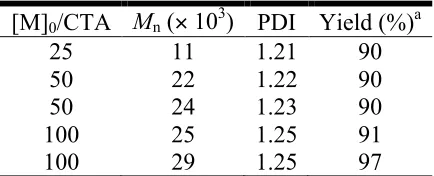
Table 2.1. ROMP of 6a/6b with 2 and CTA.
[M]0/CTA Mn (! 103) PDI Yield (%)a
25 11 1.21 90
50 22 1.22 90
50 24 1.23 90
100 25 1.25 91
100 29 1.25 97
Polymerization conducted neat at 55 ºC [M]0/2 1000:1 aIsolated yields obtained from precipitation into hexanes containing some starting material.
Molecular weight control was attempted by performing ROMP in the presence of
symmetrical chain transfer agent 1,4-diacetoxybutane (CTA). The results depicted in
Table 2.1 show the molecular weight does increase with increasing [M]0/CTA and the
PDI’s remained consistent. However when polymers were purified by precipitated into
precipitation into hexanes, both monomer and polymer precipitate, which leads to unpure
polymer containing some monomer.
The number of problems associated with the purification of the monomer and the
precipitation of the final polymer lead us to design a more easily purified monomer and
isolable polymer. From the previous monomer synthesis it seems that beginning with the
epoxidation of MCPBA the monomer was very difficult to purify and all attempts to
separate the diastereomers failed. A simpler epoxidation was then employed. The use of
peracetic was attempted to selectively epoxidize 3. Interestingly the final product yield
was increased to 80% and the cis:trans ratio was similar to the epoxidation with MCPBA.
Also the use of peracetic acid allowed ease of work up since acetic acid can be removed
under a reduced atmosphere. Purification using silica gel provided a clear oil. The
reduction of the epoxide with LiAlH4 gave 70% yield of a white solid after drying under
dynamic high vacuum unlike previously where a yellow viscous oil was obtained.
Attempts to crystallize the diol failed along with attempts to separate the diasteremers
using column chromatography.
2.2.4. Synthesis of monomer 7a/7b.
Scheme 2.5. Benzoate protection of 5a/5b to form 7a/7b.
HO OH
CH2Cl2
rt
BzO OBz
BzOCl NEt3
DMAP
5a, 5b 7a, 7b
The use of a benzoate protection group was used to form 8a and 8b in order to
simplify the purification of the finally monomer and allow precipitation of the final
separated or crystallized. However the monomer could be purified by column
chromatography.
2.2.5. ROMP of 7a/7b with 2 and CTA.
Scheme 2.6. ROMP of 7a/7b with 2 and CTA.
BzO OBz OBz OBz
OAc AcO
n 7a, 7b
OAc AcO
CTA
2
8 Polymerizations performed at 55 °C with [M]0/2 1000:1.
Polymerization of the benzoate-protected monomer as shown in Scheme 2.6 was
carried out under the same neat conditions previously described. Precipitation of the
polymer product into methanol afforded a white solid. The yields for these
polymerizations are more absolute, unlike previously observed, since there is no
monomer signal present by 1H NMR. As seen in Scheme 2.6 and Table 2.2 molecular
weight was controlled using CTA. However, the PDI’s increased to around 2.0. This is
attributed to the increased viscosity of the monomer, as it is still a liquid with almost
double the weight of the acetate-protected monomer. This increased viscosity along with
the faster gel time may have slowed monomer consumption and increased the probability
of chain transfer reactions to occur. Some reactions were carried out in toluene to counter
act this problem. When the polymerizations were conducted toluene (4.0 M), the yields
and molecular weights lower than expected. Also PDIs were increased, indicating
inefficient chain transfer. The current conclusion to this phenomenon is that the
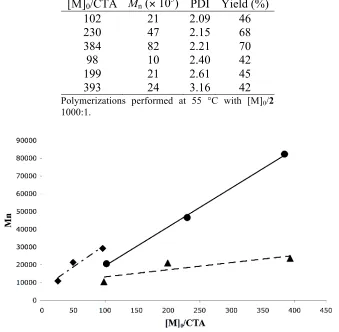
Table 2.2. ROMP of 7a/7b with 2 and CTA.
[M]0/CTA Mn (! 103) PDI Yield (%)
102 21 2.09 46
230 47 2.15 68
384 82 2.21 70
98 10 2.40 42
199 21 2.61 45
393 24 3.16 42
Polymerizations performed at 55 °C with [M]0/2 1000:1.
Figure 2.3. Molecular weight increases linearly with increasing [M]0/CTA. 7a/7b (circles, solid line), 7a/7b in toluene (4.0 M) (triangle, dashed line), 6a/6b (diamonds dash dot line).
2.2.6. Hydrogenation of 8.
Scheme 2.7. Hydrogenation of 8 to form 9.
OBz OBz
OAc
AcO Xylenes, reflux
nPr3N
OBz OBz
OAc AcO
n n
8 9
TsHNNH2
The direct formation of the diimide in situ afforded complete hydrogenation of the
olefins without removing the benzoate protecting group as shown in Scheme 2.7. The
hydrogenation reaction was carried out with 1 equiv of tri-propylamine (3 equivs per
in refluxing xylenes, hydrogenation of the ROMP polymers was complete. Saturated
polymer 9 remained soluble in organic solvents, which allowed characterization by 1H
NMR and GPC, which confirmed by the absence of olefins.
2.2.7. Deprotection of 9.
Scheme 2.8. Deprotection of 9 to form 10.
OBz OBz
OAc AcO
1%NaOH
MeOH 1,4 dioxane
rt
OH OH
OH HO
n n
9 10
Removal of the benzoate groups lead to the final EVOH copolymer 10. Removal
of the benzoates was achieved by the addition of 1% NaOH in methanol to a solution of
the polymer in 1,4-dioxane. When a ratio of 80%:20% 1,4 dioxane to MeOH was
obtained full deprotection was observed by 1H NMR within minutes. The polymer was
characterized by 1H NMR and GPC.
After obtaining the final polymer, one small scale attempt at a cis selective
epoxidation of # was attempted using V(AcAc)2 and t-Butyl hydroperoxide. This reaction
yield 30% product 70% of which was cis product by 1H NMR. These diastereomers were
also unable to be separated using column chromatograph.
2.2.8. Barrier Testing
The barrier properties of the final deprotected polymer along with the previous
ROMP EVOH polymers were tested by Kuraray, Inc and are shown in Table 2.3. At 0%
relative humidity all ROMP EVOH polymer exhibit improved barrier properties as
compared to there commercial equivalents. However, when the relative humidity is
increases their barrier performance decreases with the exception of cis-C8-diol . This
trans-1,2-diol configuration. The difference in barrier properties between the two
polymers was studied by our group.16 It was determined that cis-C8-diol was prone to
intermolecular hydrogen bonding, whereas polymer trans-C8-diol was more prone to
intramolecular hydrogen bonding. The intermolecular hydrogen bonding of the chains
make it much more difficult for oxygen and water to diffuse through the bulk material.
Table 2.3. Kuraray, Inc EVOH O2 Permeability testing results. EVOH 0% Relative Humidity > 90% Humidity
C5-diol 0.2 3.2
C7-Diol 1.0 4.5
cis-C8-diol 1.5 1.5
trans-C8-diol 2.0 6.0
units: cc x 20um x m2/day/atm
2.3.
Conclusion
EVOH copolymer was obtained with a 1,3 diol configurations. Although the
stereochemistry could not be controlled, the regio-regularity of the final EVOH
copolymer was controlled. This was due to the difficulty in separating the diastereomers
by a number of methods. Even though the monomer synthesis was synthetically
challenging obtaining the final EVOH polymer was relatively simple with
straightforward hydrogenation and quick deprotection.
2.4.
Future Work
In order to obtain stereoregular EVOH copolymer a cis monomer must be
synthesized. This will be done by epoxidation with purified MCPBA and more stringent
V(AcAc)2 conditions. If successful the selective deprotection with PFL followed by
stereo inversion with DEAD will be attempted. Scaling up this reaction to obtain
multigram amounts of polymers for full characterization including 13C NMR, DSC and
2.5.
Experimental Section
General Procedures. NMR spectra were recorded on a Varian Mercury 300 (300
MHz for 1H and 74.5 MHz for 13C). All NMR spectra were recorded in CDCl3,
DMSO-d6, or 1,4-dioxane-d8 and referenced to residual proteo species. Gel permeation
chromatography (GPC) was carried out on two PLgel 5 !m mixed-C columns (Polymer
Labs) connected in series with a DAWN EOS multi angle laser light scattering (MALLS)
detector and an Optilab DSP differential refractometer (both from Wyatt Technology).
No calibration standards were used, and dn/dc values were obtained for each injection
assuming 100% mass elution from the columns.
Materials. Toluene and CH2Cl2 were dried by passage through solvent
purification columns.17 cis-1,4-Diacetoxy-2-butene (95+%) (13) was obtained from TCI
America and degassed by an argon purge prior to use. Tropone and tropylium
tetrafluroborate used as received from Lancaster. 1,1’-carbonyldiimidazole, p-toluene
sulfonhydrazide, pyridinium p-toluene sulfonate, tripropylamine, benzoyl chloride,
triethylamine, 1,4-dioxane, xylenes, acrylonitrile, sodium hydroxide, acetic anhydride,
and 2,2’-dimethoxypropane were obtained from Aldrich and used as received. Imidazole
(99%) was obtained from EM Science and used as received. Ruthenium catalysts
(PCy2)(Cl)2Ru=CHPh (1)10 and (H2IMes)(PCy2)(Cl)2Ru=CHPh (2)9 as well as organic
compounds 3,5 cycloheptadien-1-ol (3), cis-3,4-epoxy-5-cyclohetpten-1-ol (4a), trans
-3,4-epoxy-5-cyclohetpten-1-ol (4b), cis-5-cycloheptene-1,3-diol (5a), trans
-5-cycloheptene-1,3-diol (5b), cis-1,3-diacetox-5-cycloheptene (6a) and trans
-1,3-diacetox-5-cycloheptene (6b)were all synthesized according to literature procedures.14,15
Synthesis of cis-1,3-benzoate-5-cycloheptene (7a) and
mL (2.6 equive) of benzoyl chloride, 16.0 mL (6.2 equiv) of triethylamine and 0.097 g
(4.3 mol%) of DMAP were combined in a round bottom flask at room temperature. After
24h reaction was quenched with brine and washed three times with CH2Cl2, one time
with 1 N HCl, two times with Na2CO3(sat), and once more with brine. Solution was dried
with MgSO4, filtered and concentrated. Purified with silica gel (eluent 5% EtOAc/95%
hexanes) obtained clear yellow oil; yield (80%). 1H NMR (300 MHz, CDCl3): 8 (t, 4H),
7.48 (t, 2H), 7.4 (t, 6H), 5.89 (dd, 4H), 5.25 (m, 0.5H), 5.0 (m 1H), 3.80 (m, 1H),
2.6-2.25 (br m, 5H), 2.0 (m, 3H), 1.81 (br d, 1H).
Polymerization procedure for acetate-protected monomers with catalyst 2. In
a typical experiment, a small vial was charged with 0..2002 g (0.1 mmol) of monomer 6a
and 6b and a stirbar. Under an argon atmosphere 8 mg/mL catalyst 2 solution in CH2Cl2
was prepared. 0.1 mL of the catalyst solution was then added to the monomer solution via
syringe under argon. The reaction vial was placed in a 50 °C aluminum heating block
stirring under argon for 24 h. The reaction mixture was then quenched with 0.1 mL ethyl
vinyl ether and then dissolved in 1 mL CH2Cl2 and precipitated
into 100 mL of stirring hexanes at -78 °C. A light brown precipitate was washed several
times with hexanes and dried in vacuo overnight; yield (80%). 1H NMR (300 MHz,
CDCl3): 5.35 trans 5.4 cis (two br s, 2H), 4.9 (br s, 2H), 2.2–1.6 (br m, 12H).
Polymerization procedure for acetate-protected monomers with catalyst 2
and CTA.In a typical experiment, a small vial was charged with 0..2072 g (0.1 mmol) of
monomer 6a and 6b and a stirbar. Under an argon atmosphere 8 mg/mL catalyst 2
solution in CH2Cl2 was prepared. 1.6 µL of CTA and 0.1 mL of the catalyst solution was
placed in a 50 °C aluminum heating block stirring under argon for 24 h. The reaction
mixture was then quenched with 1.0 mL CH2Cl2 and then dissolved with an additional
1.0 mL CH2Cl2 and precipitated into 100 mL of stirring hexanes at -78 °C. A light brown
precipitate was washed several times with hexanes and dried in vacuo overnight; yield
(80%). 1H NMR (300 MHz, CDCl
3): 5.35 trans 5.4 cis (two br s, 2H), 4.9 (br s, 2H), 2.2–
1.6 (br m, 12H).
Polymerization procedure for benzoate-protected monomers with catalyst 2.
In a typical experiment, a small vial was charged with 0..2032 g (0.6 mmol) of monomer
7a and 7b and a stirbar. Under an argon atmosphere 8 mg/mL catalyst 2 solution in
CH2Cl2 was prepared. 0.1 mL of the catalyst solution was then added to the monomer
solution via syringe under argon. The reaction vial was placed in a 50 °C aluminum
heating block stirring under argon for 24 h. The reaction mixture was then quenched with
0.1 mL ethyl vinyl ether and then dissolved in 1 mL CH2Cl2 and precipitated
into 100 mL of stirring ice-cold stirring MeOH. A white precipitate was washed several
times with MeOH and dried in vacuo overnight; yield (70%). 1H NMR (300 MHz,
CDCl3): 7.85 (br, 4H), 7.4 (br , 2H), 7.2 (s, 2H), 5.4 (br s, 2H), 5.15 (br s, 2H), 2.25-1.4
Polymerization procedure for benzoate-protected monomers with catalyst 2
and CTA.In a typical experiment, a small vial was charged with 0..2072 g (0.6 mmol) of
monomer 7a and 7b and a stirbar. Under an argon atmosphere 8 mg/mL catalyst 2
solution in CH2Cl2 was prepared. 1.6 µL of CTA and 0.1 mL of the catalyst solution was
then added to the monomer solution via syringe under argon. The reaction vial was
placed in a 50 °C aluminum heating block stirring under argon for 24 h. The reaction
mixture was then quenched with 1.0 mL CH2Cl2 and then dissolved with an additional
1.0 mL CH2Cl2 and precipitated into 100 mL of ice-cold stirring MeOH. A light brown
precipitate was washed several times with MeOh and dried in vacuo overnight; yield
(70%). 1H NMR (300 MHz, CDCl3): 7.85 (br, 4H), 7.4 (br , 2H), 7.2 (s, 2H), 5.4 (br s,
2H), 5.15 (br s, 2H), 2.25-1.4 (br m, 6H).
Hydrogenation procedure for benzoate-protected polymers. In a typical
experiment, an oven-dried 25 mL round bottom flask was charged with a stirbar, 96.1 mg
of polymer 8, 352.0 mg of tosylhydrazide (6.5 equiv per double bond), 0.38 mL
tri-propylamine (1 equiv per tosylhydrazide), 8.0 mL of xylenes, and a trace amount of
BHT. The mixture was degassed by pulling high vacuum on the solution for about 45 s.
Under an argon atmosphere, a flask was fitted with a reflux condenser. The reaction was
heated to reflux for 7 h. It was then cooled to room temperature and then precipitated into
50 mL of stirring ice-cold stirring MeOH. The white precipitate was washed several
times with MeOH and then dried in vacuo overnight; yield 90 mg (94%). 1H NMR (300
MHz, CDCl3): 7.85 (br, 4H)7.4 (br , 2H), 7.2 (s, 2H), 5.15 (br s, 2H), 2.25-1.4 (br m, 8H).
Deprotection of 9. In a typical experiment, a NMR tube was charged with 5 mg
10% NaOH in MeOH was added via syringe to the NMR tube. After five minutes
deprotection was complete. The reaction was precipitated into 50 mL of ice-cold stirring
pentantes. A fluffy white solid was obtained and washed with pentanes and dried under
vacuum overnight; yield 5 mg (99%). 1H NMR (300 MHz, CDCl3): 5.15 (br s, 2H),
References
(1) Banslaben, D. A.; Huynh-Tran, T. C. T.; Blanski, R. L.; Hughes, P. A.; Roberts,
W. P.; Grubbs, R. H.; Hatfield, G. R. US, 2000.
(2) Banslaben, D. A.; Huynh-Tran, T. C. T.; Blanski, R. L.; Hughes, P. A.; Roberts,
W. P.; Grubbs, R. H.; Hatfield, G. R. US, 2001.
(3) Ramakrishnan, S. Macromolecules1991, 24, 3753-3759.
(4) Banslaben, D. A.; Huynh-Tran, T. C. T.; Blanski, R. L.; Hughes, P. A.; Roberts,
W. P.; Grubbs, R. H.; Hatfield, G. R. US, 2003.
(5) Lagaron, J. M.; Gimenez, E.; Gavara, R.; Saura, J. J. Polymer 2001, 42,
9531-9540.
(6) Lopez-Rubio, A.; Lagaron, J. M.; Gimenez, E.; Cava, D.; Hernandez-Munoz, P.;
Yamamoto, T.; Gavara, R. Macromolecules2003, 36, 9467-9476.
(7) Ramakrishnan, S.; Chung, T. C. Macromolecules1990, 23, 4519-4524.
(8) Valenti, D. J.; Wagener, K. B. Macromolecules1998, 31, 2764-2773.
(9) Scholl, M.; Ding, S.; Lee, C. W.; Grubbs, R. H. Org. Lett.1999, 6, 953-956.
(10) Schwab, P.; Grubbs, R. H.; Ziller, J. W. J. Am. Chem. Soc.1996, 118, 100-110.
(11) Hillmyer, M. A.; Laredo, W. R.; Grubbs, R. H. Macromolecules1995, 28,
6311-6316.
(12) Scherman, O. A.; Kim, H. M.; Grubbs, R. H. Macromolecules 2002, 35,
5366-5371.
(13) Scherman, O. A.; Walker, R.; Grubbs, R. H. Macromolecules 2005, 38,
(14) Celestini, P.; Danieli, B.; Lesma, G.; Sacchetti; Silvani, A.; Passarella, D.; Virdis, A.
Org. Lett.2002, 4, 1367-1370.
(15) Kaku, H.; Tanaka, M.; Yoshihiko, N.; Miyashita, Y.; Suemune, H.; Sakai, K.
Tetrahedron Asymmetry1997, 8, 195-201.
(16) Scherman, O. A., California Institute of Technology, 2004.
(17) Pangborn, A. B.; Giardello, M. A.; Grubbs, R. H.; Rosen, R. K.; Timmers, F. J.
Chapter 3
The Synthesis of Regioregular Ethylene-Vinyl
Alcohol Copolymers via Ring-Opening
Abstract
Ethylene-vinyl alcohol copolymers (EVOH) exhibit excellent barrier properties
toward gases and hydrocarbons. They are typically synthesized through free radical
polymerization of ethylene and vinyl acetate. The resultant polymer is then saponified to
form the final polymer. This route does not allow for absolute control of the polymer
architecture, which is key for understanding the structure-property relationships of these
materials. The Ring-Opening Metathesis Polymerization of protected 3,4-substituted
cyclobutenediol was carried out with Grubbs second-generation catalyst in an effort to
control pendant group regioregularity and stereochemistry. Molecular weight of the
polymers were controlled by varying the monomer to chain transfer agent ratio.
Hydrogenation and subsequent deprotection of the ROMP polymer affords an EVOH
3.1.
Introduction
Studies at Kuraray have shown the 1,2-diol configuration of EVOH copolymers
derived from cis-cylcooctene-1,2-diol1 have excellent barrier properties when compared
with commercially available EVOH polymers of similar methylene:alcohol ratios. This
result prompted us to target cyclobutene-1,2-diol based monomers. The polymers
resulting from the ROMP of these monomers should have an increased alcohol content
and also retain their syn stereochemistry, similar to polycyclooctene-1,2-diol.
Ru PCy3 PCy3 Ph Cl Cl Ru PCy3 Ph Cl N N Cl Ru N Ph Cl N N Cl Br N Br
1 2 3
Figure 3.1. ROMP catalyst (Cy=cyclohexyl).
The ROMP of various substituted cyclobutenes has been well studied. Maughon
reported the living ROMP of several 3-substituted cyclobutenes with a wide range of
functionality using catalyst 1.6,7 Coordination of Lewis basic functional groups from the
polymer side chains to the metal center was also observed. This coordination leads to
lowered PDIs, but also catalyst decomposition. As the functionality was removed further
from the ring system living polymerizations of more polar functionalities were observed.
Novak et al. also showed the living polymerization of 3,4-substituted cyclobutenes
(Scheme 3.1), which were subsequently deprotected to form hydroxyl-bearing
polymers.8,9 Novak also noted that polymerization was ineffective with Grubbs catalyst 1,
Scheme 3.1. Living ROMP of Substituted Cyclobutenes with a Mo Initiator.
Mo
N
R2O
R2O
R1
i-Pr i-Pr
I - R1 = CHCME
2Ph, R2 = OCMe3 II - R1 = CHCMe
3, R2 = OCMe(CF3)2 O Ph
O Ph
O O
n
(CH3)3SiI
CH2Cl2, 24 h
OSi(CH3)3
(H3C)3SiO
n MeOH OH HO n Ph Ph
Later Fontaine et al. showed the living polymerization of more polar substituted
cyclobutene 3,4-diol (Scheme 3.2) using Grubbs catalyst 1.10 Although the PDIs were not
as narrow (PDI=1.2), it proved the polymerization of a polar-functionalized cyclobutene
diol could be conducted using well known Ru catalysts.
Scheme 3.2. ROMP of Bis(acetyloxymethyl)cyclobutene
OAc OAc 1 OAc AcO n
The previously discussed reports provided good evidence that the ROMP of
highly substituted cyclobutenes was feasible. However, there were no reports on the
ROMP of monomer containing allylic polar functionalities such as alcohols or protected
alcohols. Herein, we report the synthesis of highly functionalized polybutadiene from the
ROMP of two allylic-functionalized cyclobutenes.
3.2.
Results and Discussion
3.2.1. Monomer Design and Synthesis
There are few examples of cyclobutene diols reported in the literature, leaving
only a limited number of synthetic routes available. Previously Choi synthesized the
availably 3,4-dichlorocyclobutene and benzyl alcohol in DMF. However, repeating this
experiment gave, the observed yields that were less than 20%. Due to the exceptionally
low yield of the reaction and prohibitive cost of the starting material ($400 per 5 g) these
conditions were unattractive. Fortunately, a simply switching the solvent to THF afforded
monomer 4 in high yield (95%).
Scheme 3.3. Synthesis of monomer 4.
Cl Cl HO Ph O O Ph Ph NaH 4 THF 60 °C
3.2.2. ROMP of 4
Because monomer 4 is highly strained, it was predicted be an excellent ROMP
monomer. However, the allylic polar functionality has the potential to decrease ROMP
activity enough to prevent full monomer conversion. Therefore, ROMP was carried out
under neat conditions both at room temperature and at 55 °C, with symmetrical
1,4-diacetoxybutene as a chain transfer agent (CTA) and catalyst 2. The polymerization
afforded telechelic polymers with controllable molecular weights in high yields, as seen
in Table 3.1.
Table 3.1. ROMP of 4 with 2 and CTA.
Entry [M]0/CTA Mn (! 103) PDI Yield (%)
1 100 29 2.37 92
2 200 51 2.04 93
3 400 74 2.02 94
4 100 24 2.65 89
5 200 40 2.78 95
6 400 58 2.42 95
The resulting polymers were then hydrogenated through the direct formation of
diimide in situ (Eq. 2, Scheme 3.4). After each hydrogenation the benzyl carbons were
still present as evidenced by the 13C peak at 128ppm (Figure 3.2b). Deprotection of the
benzyl group using hydrogenation was avoided because of solubility issues. Therefore, a
solution method involving treatment with trimethylsilyliodide followed by hydrolysis
was employed.8,11-13 However, upon hydrolysis, the polymer began to precipitate from
solution preventing complete deprotection. Solid-state 13C NMR (Figure 3.2c) displayed
a peak at 128 ppm corresponding to benzyl carbons. This conclusively proved that the
polymer precipitated from solution before full deprotection was achieved.
Scheme 3.4. ROMP, Hydrogenation, and Deprotection.
O O
Ph Ph
[M]/2=1000:1 [M]/CTA=381:1 neat O O Ph Ph n OAc
AcO AcO OAc
O
O Ph
Ph
n
AcO OAc
p-TsHNNH2/nPrNH
xylenes
135 oC O
O Ph Ph n AcO OAc O O Ph Ph n AcO OAc
i. TMS-I/CHCl3
ii. 2-Propanol/H2O
rt OH
OH
n
HO OH
4 CTA 5
5 6
6 7
(1)
(2)
(a)
(b)
(c)
3.2.3. Synthesis of 9
Scheme 3.5. Synthesis of monomer 9.
O O O O O O hv Acetone 0 oC
5% NaOH (aq)
Dioxane
r.t. Pyridine
Ac2O OH
HO AcO OAc
8 9
In order to avoid the difficulty of deprotecting the benzyl groups of polymer 6, an
alternative monomer synthesis was pursued (Scheme 3.5). The carbonate-protected
monomer was synthesized by bubbling acetylene through a solution of vinlyene cabonate
in dry acetone while irradiating with UV light. Next, the carbonate group was
deprotected in an aqueous solution 5% NaOH and purified by recrystallization in ethyl
acetate. Monomer 8 was then acetate-protected to form monomer 9, which mimics the
industrial monomer. Low yields and incomplete polymerization were observed when
polymerizations were conducted in CH2Cl2, as seen in Table 3.2. When the reaction
solvent was changed to THF, the yields increased. However, the reaction was slow to
proceed. By switching solvents once again to toluene, efficient ROMP was achieved.
Scheme 3.6. ROMP of 9 with 2.
OAc AcO OAc OAc n 2
Table 3.2. ROMP of 9 with 2. [M]0/2=600:1.
Solvent Mn (! 103) Yield (%) PDI Time
CH2Cl2 383 44 1.41 4 d
THF 200 80 1.61 3 d
Polymerizations were conducted with CTA and 2 to determine if varying
[M]0/CTA could control the molecular weight. Table 3.3 depicts these results. As
[M]/CTA was increase molecular weight increased linearly as shown in Figure 3.3. After
obtaining these satisfactory results, the polymers were made on a multigram scale and
sent to Kuraray, Inc for deprotection and characterization.
Table 3.3 ROMP of 9 with CTA.
[M]0/CTA Mn (! 103) Yield (%) PDI
100 31 99 1.24
200 44 96 1.54
400 75 96 1.68
Polymerizations performed in toluene (1.0 M) at 55 °C
Figure 3.3. Linear increase in molecular with increasing [M]0/CTA.
Thermal analysis of the polymers was conducted to determine the polymer
melting and decomposition characteristics. Since polymer 7 is similar to polyvinylalcohol
(PVA), it should exhibit a high melting temperature, which is observed just before
(a)
(b)
3.3.
Conclusions
The ROMP of protected 3,4-substituted cyclobutenediol was carried out with
Grubbs second generation catalyst 2 in an effort to control pendant group regioregularity
and stereochemistry. Molecular weight of the polymers was controlled by varying the
monomer to CTA ratio. Hydrogenation and subsequent deprotection of the ROMP
polymer afforded an EVOH polymer with maximum alcohol content. Theoretically, these
materials have the potential to possess excellent barrier properties. Furthermore, we have
shown the efficient ROMP of cyclic olefins with allylic polar functionality. As of this
report, Kuraray, Inc has not yet tested the barrier properties of these C4-diol EVOH
3.4.
Living Polymerization of Cyclic-olefins
Living polymerizations are defined by their high conversions, lack irreversible of
chain transfer and chain terminating events, and monomodal dispersities.14,15 ROMP is
primarily driven by ring-strain2; both monomers 4 and 9 are highly strained cyclobutenes
making them good candidates for living ring-opening metathesis polymerization. Once
again as previously discussed the allylic polar functionality could potentially lower the
monomers’ ROMP activity and may lead to inefficient ROMP.
Another factor to consider is that the potential chelation of monomer 9 to the
metal center may or may not affect living ROMP. When initial polymerizations of
monomer 4 were conducted using catalyst 1, no polymer was observed. These results
coincide well with those observed by Novak.8,9 However, the results observed by
Fontaine suggested a living polymerization should have occurred when 4 was
polymerized using 1.10 Although Novak suggested and proved Mo catalyst are capable of
polymerizing polar functionalized cyclobutenes, catalyst 3 was not available at that time.
Catalyst 3 has been shown to initiate much faster initiating than catalyst 1, and is
also more tolerant toward functional groups. Therefore, polymerizations of 4 and 9 were
conducted using 3. Interestingly, neither monomer polymerizes in living fashion in
CH2Cl2. However, when a more coordinating solvent, such as THF, is used, the resultant
polymers are narrowly dispersed. As seen in Figure 3.5 the ROMP of both monomers
with catalyst 3 reach full conversion. Monomer 4 reaches full conversion after 3 hours,
while monomer 9 reaches full conversion after 1 hour. We assume the difference in
reaction times show sterics have a more pronounced effect on the rate of polymerization
0 20 40 60 80 100 120
0 10 20 30 40 50 60 70 80 90
Time(min)
Conversion(%)
OAc AcO
O
O Ph
Ph
Figure 3.5. ROMP of monomers 8 and 10 with 3 carried out at 30 ºC.
3.5.
Conclusions
We have demonstrated that highly strained cyclobutenes 4 and 10 can be
polymerized in a living fashion by using catalyst 3 and varying solvent. Also we have
demonstrated that functional groups can have a significant effect on the kp. Also we have