Using Proactive Evaluation to Develop a
Policy for Public Sector Training Programs
in Emotional Intelligence in Thailand
Varinthorn Boonying
B.P.H. (Sukhothai
Thammathirat University)
M.Sc. (Mahidol University)
A dissertation submitted in partial fulfilment of the requirements for the Degree of Doctor of Education, School of Education,
Faculty of Arts, Education and Human Development, Victoria University, Melbourne, Australia.
Declaration
I, Varinthorn Boonying, declare that this Doctor of Education dissertation entitled Using Proactive Evaluation to Develop a Policy for Public Sector Training Programs in Emotional Intelligence in Thailand, is no more than 60,000 words in length, exclusive of tables, figures, appendices, references and footnotes. This dissertation contains no material that has been submitted previously, in whole or in part, for the award of any other academic degree or diploma. Except where otherwise indicated, this dissertation is my own work.
Thursday, 20 March 2008
______________________________ ___________________________
Acknowledgements
I want to thank those people who have been helpful and supportive in the completion of my doctoral degree. Many people have touched my life during this time of learning and growing and I want to thank them all.
My special thanks go to my great supervisor Dr Ian M. Ling. He has been very patient and supportive of me while I lived in Melbourne. He provided me with guidance and insight into writing this dissertation. I also want to express my thanks to my co-advisor Dr Rapin Chaywimol for giving his expert guidance, Emotional Intelligence knowledge and time throughout the study.
I would especially like to thank Mr Sanor Chantra, Governor of Rayong Province, Prof. Dr Krasae Chanawongse, (the 1973 Ramon Magsaysay Award for Community Leadership), and Mr. Taweep Kvunburee, Member of the Senate, Rayong Province. They kindly participated in sharing their valued opinions on policies to improve Training Programs in Emotional Intelligence for public servants. I would also especially thank to all staff in Rayong Province, who provided most useful information via both of focus group, semi-structured interview and other data that had beneficially affect and improve the polices by using Proactive Evaluation. I would like to gratefully acknowledge the support that I received scholarship from the Royal Thai Government and my workplace, Rayong Governor’s Office to study in Melbourne. This scholarship provided me with a good opportunity for which I am grateful.
Table of Contents
Declaration ...i
Acknowledgements ...ii
Table of Contents ...iv
List of Tables ...xii
List of Figures ...xv
Abstract ...xvi
CHAPTER 1 Rationale ...1
Introduction...1
Contribution to Knowledge...4
Significance of the study...4
The Context of the Study ...5
Structure of thestudy ...6
CHAPTER 2 Review of the Literature...9
Introduction...9
Proactive Evaluation ...9
Needs assessment...11
Elements of needs assessment ...12
The social and political dimensions of needs assessment in Thailand ...12
Research synthesis ...13
Policymaking ...14
Phase 8: Sub-allocating resources...17
Phase 11: Preparing a set of major alternative policies, including some ‘Good’ ones ...18
Phase 14: Evaluating the benefits and costs of the ‘Best’ alternatives and deciding whether they are ‘Good’ or not ...18
Phase 18: Communication and feedback channels interconnecting all phases...20
Emotional Intelligence in the workplace ...21
The Learning Organisation ...25
Training and Development ...27
Diffusion of Innovation...30
Innovators ...30
Early Adopters ...31
Early Majority...31
Late Majority ...32
Laggards...32
CHAPTER 3 Research Methodology ...34
Introduction...34
General Overview ...34
Methodology...35
Phase 1: Needs Assessment ...36
Step 1: Focus group interviews with a sample of public servants ...37
Step 2: Semi-structured Interview of the Heads of Public Sectors....41
Step 3: Research Review ...42
Step 4: Determining Needs of Future Training Programs in Emotional Intelligence ...43
Phase 2: Policy formulation...45
Step 1: Developing of the draft policy of Training Programs in Emotional Intelligence training program ...45
Step 2: Testing the draft policy of Training Programs in Emotional Intelligence ...46
Triangulation and validity...46
Summary ...47
CHAPTER 4 Data Analysis Step 1: Needs Assessment ...48
Introduction...48
Focus group interviews with a sample of public servants ...49
What Emotional Intelligence training programs have you been involved in?...51
Participant responses...51
Emotional awareness of self and others...52
Modifying behaviours...53
Building esteem ...54
What are the things that you remember most strongly about this Emotional Intelligence training?...54
Learning model ...59
Managing change ...60
Personal development ...62
Shared Values ...64
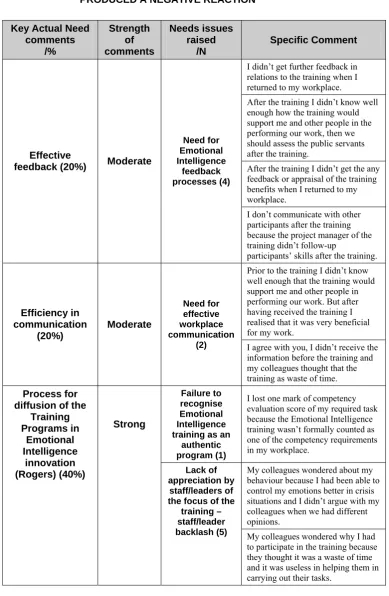
What are the things about the Emotional Intelligence training that gave you a negative reaction? ...65
Effective feedback ...65
Efficiency in communication...67
Process for diffusion of the Emotional Intelligence training innovation ...68
Support from peers and leaders regarding the innovation ...69
What do you wish had been included in the Emotional Intelligence training that you undertook? ...70
Professional development in the workplace ...71
Effective motivation techniques ...75
On-going activities...77
Effective feedback systems...78
Peer support mechanisms...79
What changes in workplace practice followed as a result of this Emotional Intelligence training?...80
Professional development in workplace ...80
Achieving shared values in the workplace...85
Personal professional development...86
Effective development in the workplace...87
What impact did the Emotional Intelligence training program have on you, personally?...88
Self-management skills...88
Ability to relate to others ...92
Application to life ...93
To what extent did you value the Emotional Intelligence training program? ...94
Personal development and performance ...94
Application...98
Resources ...99
Shared values ...100
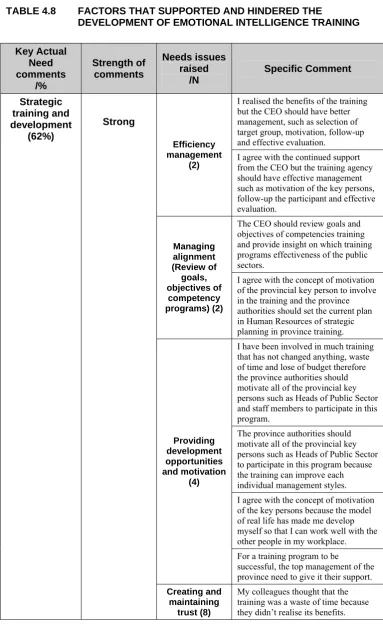
What factors have supported and hindered the development of Emotional Intelligence training?...101
Strategic training and development ...104
Organisational culture...106
Diffusion of the innovation...107
Resource allocation...108
Summary ...109
CHAPTER 5 Data Analysis Step 2: Semi-structured Interviews ...110
Introduction...110
What Emotional Intelligence training programs have you been involved in?...111
Participant responses...114
Effective learning model...114
Emotional awareness ...116
Professional development in the workplace ...117
Tell me about some of the positive outcomes of these programs ...118
Emotional Awareness ...118
Learning model ...121
Change management...122
Shared values ...125
Tell me about any negative outcomes that resulted from these programs ...125
Diffusion of the training innovation ...125
Improved communication ...127
Knowledge management...127
Strategic training and development ...128
Attitude development...130
Diffusion of the innovation...130
Effective feedback systems...135
Professional development ...136
What new issues do you think should be included in future programs?..137
Diffusion of the innovation...137
Professional development ...140
Strategic training and development ...140
What change in work place practice do you anticipate should follow as a result of any Emotional Intelligence training ...141
Changing attitudes ...141
Learning organisation ...143
Personal professional development...143
Professional development in the workplace ...144
What factors have supported or hindered the development of Emotional Intelligence training?...145
Diffusion of the innovation...146
Organisational culture...148
Resources ...149
Strategic training and development ...149
Summary ...151
CHAPTER 6 Data Analysis Step 3: Research Review of Best Practice ...153
Introduction...153
Goleman’s Emotional Intelligence ...154
Research Review of Diffusion of the Training Innovation (RRDTI) ...155
Continuity of learning...155
Developing the organisation ...161
Developing teamwork in a learning organisation ...161
Motivation of potential participants...162
Peer self-help group ...162
Having more opportunities to support amongst peers ...163
Personal focus ...164
Provide activities for prevention of lapses...164
Provide opportunities for training...165
Provide opportunities to practice ...165
Widening the circle of influence...166
Leadership values...167
Learning organisation culture ...167
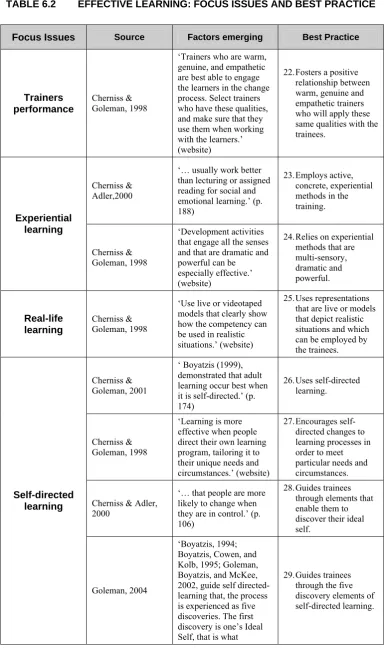
Research Review of Effective Learning (RREL) ...168
Trainers performance ...168
Real-life learning ...170
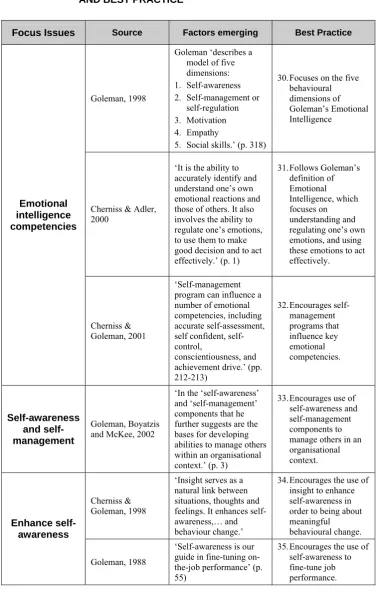
Research Review of Emotional Intelligence Competencies (RREIC)...172
Emotional intelligence competencies ...172
Self-awareness and self- management ...176
Self-regulation...177
Self-control ...177
Self-motivation ...177
Developing self-emotions and others...177
Developing of one’s thinking process...178
Personal managing style ...178
Developing social-skills...179
Behavioural change...179
Work-life balance...180
Research Review of Professional Development in the Workplace (RRPDW)...181
Applicability of training...181
Service systems development ...183
Transfer and maintenance of skills in work practice ...183
Research Review of Strategic Training and Development (RRSTD) ...184
Managing alignment ...184
Organisational role...189
Managing change ...189
Formal human resource system ...189
Performance management...190
Creating and maintaining trust...191
On-going feedback...191
Providing performance feedback ...192
Providing performance follow-up as a part of the training...192
Provision of ‘tailored’ follow-up system ...193
Building support and feedback mechanism ...193
Creating and encouraging support ...194
Support of manager management ...194
Support of powerful sponsors and good timing...194
Improving communication...195
Providing political protection and financial backing ...195
Using research for decision-making ...196
Summary ...196
CHAPTER 7 Draft PolicyFormulation...198
Introduction...198
Consideration of the Identified Needs ...200
Communication levels appropriate ...201
Feedback is appropriate and focused ...202
Learning and growth focus ...203
Life and work focus ...204
Managing change at the personal level...204
Managing change in the organisation ...205
Motivating staff appropriately ...207
Needs are determined and met equitably ...208
Resourced appropriately ...209
Developing social competence ...211
Team focused ...212
Trainers have appropriate skills and background ...213
Values are shared ...213
Workplace application is valued...214
Identification of Training Policy Needs...215
Generalised policy needs statements ...215
Scope of Training Programs in Emotional Intelligence...219
Applying Dror’s Optimal Model to the development of a draft set of Training Programs in Emotional Intelligence policy statements...225
Phase 8: Sub-allocation of resources ...228
Phase 11: Preparing alternative policies ...228
Phase 14: Evaluating the benefits and costs of the policies...228
Phase 18: Communication and feedback channels connecting all phases ...229
Drafting the Training Programs in Emotional Intelligence Policies...230
First step: initial framework...230
Second step: developing the draft policy statement...231
Summary ...232
CHAPTER 8 Final PolicyFormulation ...233
Introduction...233
Testing the Draft Policy of Training Programs in Emotional Intelligence ...233
Developing an Emotional Intelligence Leadership Culture at Senior Levels ...234
Breadth of experiences...234
Relevance of developing an Emotional Intelligence culture ...236
Skills practice...238
Time management...239
Developing Self-Directed Learning amongst Public Servants ...239
Application planning...240
Learning opportunity ...240
Relevance of developing self-directed learning...241
Providing Feedback and Support ...243
Performance management...243
Relevance of providing feedback and support...244
Skills practice...245
Strategic adviser...245
Training administration...246
Developing Social Competencies ...246
Extension of EI training...246
Relevance of developing social competencies...247
Providing Training Opportunities for public servants ...248
Relevance of providing training opportunities for public servants ...249
Selecting and employing trainers...251
Coaching focus...251
Coaching roles ...253
Relevance of selecting and employing trainers ...253
Developing a learning organisation ...254
Human resource development...255
Performance management...256
Relevance of developing a learning organisation ...256
Bringing about organisational change in Rayong Province...257
Performance management...258
Relevance of research in developing a learning organisation...259
Sharing knowledge...260
Developing a learning organisation culture ...260
Diffusion of the training innovation ...262
Relevance of developing a learning organisation culture ...262
Sharing knowledge...263
Strategic advisers ...264
Developing self and others...264
Diffusion of the training innovation ...264
Relevance of Emotional Intelligence in developing self and others...265
Training administration...266
Developing a work-life balance ...267
Disciplines of working...267
Performance management...269
Relevance of developing a work-life balance...269
Developing Improved communications...270
Diffusion of the training program innovation...270
Skills practice...271
Developing self-managing teams...272
Performance management...272
Relevance of developing self-managing teams...273
Gaining support from key personnel...274
Breadth of experience ...275
Relevance of gaining supports from key personnel...275
Developing human resource systems...277
Performance management...277
Relevance of developing human resource systems...278
Final Policy Formulation ...279
Changes to Policy 3: Providing feedback and support ...279
Changes to Rationale for Policy 3 ...280
Changes to Objectives for Policy 3...280
Changes to Policy Outcome Guidelines for Policy 3...281
Changes to Policy 7: Developing a Learning Organisation...284
Changes to Rationale for Policy 7 ...285
Changes to Objectives for Policy 7...286
Changes to Policy Outcome Guidelines for Policy 7...287
Changes to Policy 11: Developing a work-life balance...287
Changes to Rationale for Policy 11 ...288
Changes to Objectives for Policy 11...288
Changes to Policy Outcome Guidelines for Policy 11...289
Reflection...293
Summary ...293
CHAPTER 9 Discussion and Conclusion...295
Introduction...295
Discussion...296
A new approach within the Proactive Evaluation Form ...297
Needs Assessment in Proactive Evaluation Process...298
Data reduction through concept mapping ...299
The effectiveness of Proactive Evaluation in developing policies ...299
Peer review...300
Joint training programs ...300
Knowledge pooling...300
Global policymaking procedure...300
Proactive evaluation from findings to utilisation...301
Building Shared Meaning and Understanding...301
Supporting Human and Organisational Development ...302
Adoption of the training program innovation ...302
Innovators ...303
Early Adopters ...304
A personal reflection...304
A Strategic Map for using Proactive Evaluation to bring about Organisational Change...305
Implications of Proactive Evaluation for Personal Practice ...309
Recommendations for Further Action and Research ...310
References ...313
Attachment 1: Description of research study ...323
Attachment 2: Consent Form and Interview Questions ...325
Attachment 3: Participant consent form...330
Attachment 4: Senior officers consent form ...331
Attachment 5: Heads of Public Sectors consent form...332
Attachment 6: Senior Officers consent form ...333
Attachment 7: Heads of Public Sectors consent form...334
Attachment 8: Senior Officers consent form ...335
Attachment 9 ...336
Draft Policy Statement ...336
Attachment 10 ...362
List of Tables
Table 2.1 Summary of Proactive Evaluation ...11
Table 4.1 How have the Emotional Intelligence training programs affected you?...52
Table 4.2 Issues most strongly remembered about previous Emotional Intelligence training...55
Table 4.3 Issues from Emotional Intelligence training that produced a negative reaction ...66
Table 4.5 changes in workplace practice that followed as a result of Emotional Intelligence training ...81
Table 4.6 Personal impact of the Emotional Intelligence training program...89
Table 4.7 Extent to which participants valued the Emotional Intelligence training program...95
Table 4.8 Factors that supported and hindered the development of Emotional Intelligence training...102
Table 5.1 impact on a particular sector of Emotional Intelligence training ndertaken in the Province ...112
Table 5.2 positive outcomes of the programs ...119
Table 5.3 negative outcomes resulting from the programs...126
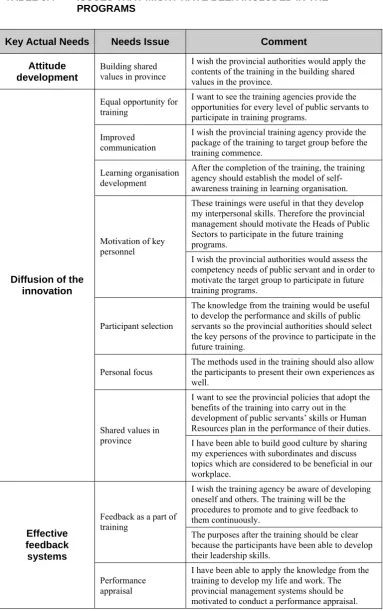
Table 5.4 Issues that might have been included in the programs ...131
Table 5.5 New issues to be included in future programs ...138
Table 5.6 changes in work place practice as a result of Emotional Intelligence training...142
Table 5.7 factors supporting or hindering the development of Emotional Intelligence training ...147
Table 6.1 Diffusion of the innovation: focus issues and best practice.156 Table 6.2 Effective learning: Focus issues and best practice...169
Table 6.3 Emotional Intelligence competencies: focus issues and best practice ...173
Table 6.5 Strategic training and development: focus issues
and best practice...185
Table 7.1 Appropriate communication levels ...201
Table 7.2 Feedback is appropriate and focused ...202
Table 7.3 Learning and growth focus ...203
Table 7.4 Life and work focus ...204
Table 7.5 Managing change at the personal level...205
Table 7.6 Managing change in the organisation ...206
Table 7.7 Motivating staff appropriately ...207
Table 7.8 Needs are determined and met equitably ...208
Table 7.9 Resourced appropriately ...209
Table 7.10 Developing personal competence ...210
Table 7.11 Developing social competence ...211
Table 7.12 Team focused ...212
Table 7.13 Trainers have appropriate skills and background ...213
Table 7.14 Values are shared ...213
Table 7.15 Workplace application is valued...214
Table 7.16 Need 3 (Learning and growth focused) & related training policy needs statement...216
Table 7.17 Derived Policy needs for a Training Policy in Emotional Intelligence...217
Table 7.18 Category and Impact of TPEIs Needs...219
Table 7.19 Training Programs in Emotional Intelligence policy needs and categories ...222
Table 7.19 Phases in the development of policies for tpeis...227
Table 7.20 Sample first step in developing policy statement ...231
Table 8.1 Emotional Intelligence Leadership Culture at Senior Levels ...235
Table 8.2 Developing Self-Directed Learning amongst Public Servants...240
Table 8.3 Providing Feedback and Support ...242
Table 8.4 Developing social competencies...247
Table 8.5 Providing Training Opportunities for public servants ...249
Table 8.7 Developing a learning organisation ...255
Table 8.8 Bringing about organisational change in Rayong Province...258
Table 8.9 Developing a learning organisation culture ...261
Table 8.10 Developing self and others...265
Table 8.11 Developing a work-life balance ...268
Table 8.12 Developing improved communications ...270
Table 8.13 Developing self-managing teams...272
Table 8.14 Gaining supports from key personnel ...274
Table 8.15 Developing human resource systems...277
Table 8.16 Key issues and concepts identified by expert panel...279
Table 8.17 Policy 3: Changes to the Rationale ...280
Table 8.18 Policy 3: Changes to the Objectives ...281
Table 8.19 Policy 3: Changes to the Policy Outcome Guidelines ...282
Table 8.20 Key issues and concepts identified by expert panel...285
Table 8.21 Policy 7: Changes to the Rationale ...285
Table 8.22 Policy 7: Changes to the Objectives ...286
Table 8.23 Key issues and concepts identified by expert panel...287
Table 8.24 Policy 11: Changes to the Rationale ...288
Table 8.25 Policy 11: Changes to the Objectives ...289
List of Figures
Figure 2.1 Goleman’s Emotional Intelligence Competencies...22 Figure 2.2 Model for promoting Emotional Intelligence-based learning in work organisations...24
Figure 2.3 Influences on transfer of learning ...29
Figure 3.1 Determining needs model ...44
Figure 4.1 Standards for determining strength of key
actual Need...51
Figure 7.1 Determining policy needs of future Training
Programs in Emotional Intelligence...199
Figure 7.2 Dror’s Alternative-Search Feedback Loops...226
Figure 9.1 A strategic map for using Proactive Evaluation
Abstract
This study focuses on the development of effective Emotional Intelligence training programs in the public sector through the development of an Emotional Intelligence training policy leading, ultimately, to the development of a regional policy for the development and operation of effective Emotional Intelligence training programs. The research is set in the context of significant change being made to the training of public servants in Rayong Province, Thailand.
The study is based on a needs assessment within the Proactive Form of Evaluation as categorised by Owen & Rogers (1999) and Owen (2006). This research was conducted in two phases: a needs assessment and the development of a training policy. The needs assessment consisted of four qualitative steps: the first, determining the actual state of training in the province by means of focus groups consisting of middle-level public servants; the second, determining that desired state of such training by means of semi-structured interviews of Heads of Public Sectors in the province; the third, identifying best practice by means of a research review; the fourth, determining the needs of an Emotional Intelligence training program by comparing the difference between the ‘desired state’ (determined by a combination of steps two and three), and the ‘actual state’ (determined by step one).
Governor of Rayong Province, a winner of the Ramon Magsaysay Award for Community Leadership, and a Member of the Senate, Rayong Province who was also a member of the CEO’s Committee of Rayong Province.
CHAPTER 1
Rationale
Introduction
Many extension programs are designed to enhance the capacity of staff to enable them to develop and sustain the competitive advantage of their organisations. Recently, the evaluation of the effectiveness of such programs has emerged as a critical issue in Thailand. Making judgements and recommendations about change in organisations is problematic. Therefore, there is a need among professionals for a new set of simple and systematic evaluation methods that are able to capture the impact of the program to bring about changes in organisations. Throughout the twentieth century, public sectors, businesses, industries, and educational institutes relied primarily on IQ (intelligence quotient) as a tool to measure the capacity of people to be able to enhance the development of the enterprise.
Chapter1 Rationale
an organisation’s reputation and status. On the other hand, when feelings are managed poorly, an organisation may suffer and fail.
Over the past ten years, administrative reform in public sectors has received increased government attention in many countries. There are several reasons for this. First, there is the concern for improving performance in public bureaucracy through modernisation of methods, techniques and procedures of work and more effective management of human resources. Second, a process of change is required within the government sector to sustain efficient market-led economies in the emerging context of globalisation. Caldwell (2006) suggests that the great social movements that have freed the human spirit and lifted people out of the material deprivation have required heroic effort by those who have imagined a better world, and done something about it. Finally, there is an increasing concern for efficient and effective delivery of key public services through decentralisation involving devolution and delegation of powers and authority to lower levels of administration, and by the modification of departmental functions.
Chapter1 Rationale
appointed and not elected, the government indicated its preference for highly centralised sub-national government.
An organisation that engages all members in active learning and provides mechanisms for the transfer and application of that knowledge requires a collective mind-shift at all levels. It has become quite clear, in both public and private sectors, that there is an emerging interest in the collection of appropriate and relevant evidence in the development of policies and programs (Owen & Rogers, 1999; Owen, 2006). In their role as employers, organisations must contribute to production, effectiveness and innovation by encouraging their employees to become active learners.
The Rayong Provincial Government, through the Rayong Governor’s Office, seeks ways of developing policy to improve the quality of service to their customers. This study aims to develop the most effective policy for an Emotional Intelligence training program approach for public servants in the province. The principal research question I wish to examine is:
What are the key policy elements required in a public sector training program designed to enhance the development of Emotional Intelligence amongst public servants in Thailand?
Four sub-questions are required to answer this question:
1. What actually happens in public sectors for development of Emotional Intelligence training?
2. What factors have supported and hindered the development of Emotional Intelligence training?
Chapter1 Rationale
4. What are the key elements to be included in a revised
Emotional Intelligence training policy for the public sector in Thailand?
Contribution to Knowledge
This research focused on the development of effective Emotional Intelligence training programs in the public sector through the development of a policy for Training Programs in Emotional Intelligence. This entailed finding the most suitable strategies to be used in Emotional Intelligence training programs for public servants in Rayong Province as well as identifying the most common problems to be overcome. The outcomes of this evaluation study should help improve knowledge about current and proposed applications of Emotional Intelligence as well as the application of evaluation techniques in the future. In addition, the knowledge gained about appropriate Emotional Intelligence training programs should be able to be applied to other organisations in Thailand and other parts of South-East Asia.
The study provides guidelines and suggestions for Heads of Public Sectors at both provincial and departmental level. The Proactive Evaluation that has been undertaken should enable more relevant policies to be developed. Moreover, these research findings should assist senior leaders and managers to understand the importance of Emotional Intelligence in organisations. Overall, this should lead to a more effective form of human resource training programs.
Significance of the study
Chapter1 Rationale
organisations that need to develop staff to enable them to lead organisations to future success. Third, in the longer term, the officers in the public sector who should be servicing customers should be better equipped to deal with them sympathetically and with greater understanding of customers’ needs and problems. Fourth, a systematic approach to Emotional Intelligence training, developed as a result of this policy, should assist staff to cope with the unprecedented challenges that should occur in organisations in the future.
The Context of the Study
At the research level, the study is particularly significant in Thailand because it applies, for the first time, the following: the Proactive Form of Program Evaluation (Owen & Rogers, 1999; Owen, 2006); a qualitative approach to Public Policymaking (Dror 1973, 1987); a systems approach to organisation development (Senge, 1990); developing education and training as instruments available to government, community and business organisations to prepare individuals for the rapidly-changing, increasingly-demanding world of work, and to improve their employability (Beckett & Hager, 2002).
Chapter1 Rationale
Structure of the
study
In order to provide an overall perspective of this study, this dissertation is divided into eight chapters as follows:
Chapter 1
In this chapter, the introduction and rationale for the study are presented. This includes an overview of the study and its context, its background and research questions, its contribution to knowledge, and its significance.
Chapter 2
In this chapter, the literature associated with the theories and application concepts used in this study are reviewed: the Proactive Form of Program Evaluation (Owen & Rogers, 1999; Owen, 2006), Public Policymaking (Dror 1973, 1987), Emotional Intelligence learning that leads to the development of learning organisations, and the diffusion of innovations such as that of Training Programs in Emotional Intelligence in Rayong Province.
Chapter 3
This chapter explains the research methodology and research design for the study. In each phase, details of the participants, and data collection and analysis methods are provided.
Chapter 4
Chapter1 Rationale
Chapter 5
This chapter reports the actual and desired needs of Training Programs in Emotional Intelligence as discussed by a sample of Heads of Public Sectors in the course of three separate semi-structured interviews. Standard qualitative data reduction procedures were used to produce a set of key actual and desired outcomes for Training Programs in Emotional Intelligence.
Chapter 6
This chapter reports the outcome of a research review of best practice for Training Programs in Emotional Intelligence. These outcomes are used to generate an initial set of desired outcomes that represent best practice for such training programs
Chapter 7
In this chapter, the policy needs of future Training Programs in Emotional Intelligence are identified at the intersection of three different sources of needs: from the focus groups, from a sample of Heads of Sectors, and from a research review. The policy needs identified are linked through Dror’s (1973, 1987) phases of his ‘Optimal Model’ of policymaking process to develop a draft policy on Training Programs in Emotional Intelligence. Draft policy guidelines for fifteen needs areas are developed by considering the resource allocations that will best meet these needs.
Chapter 8
Chapter1 Rationale
Chapter 9
CHAPTER 2
Review of the Literature
Introduction
This review informs the framework for this research by focusing on research in the field of Proactive Evaluation, policymaking, learning organisations, and the diffusion of innovations in relation to Training Programs in Emotional Intelligence. This literature review focuses, specifically, on issues related to the policy needs of these programs.
Proactive Evaluation
Guba & Lincoln (2001) consider evaluation to be one of three basic elements of disciplined inquiry – the others being research and policy analysis. In this thesis, evaluation will be considered as that form of inquiry whose focus is an evaluand (programs and an organisation (Owen, 2006)), using a particular approach (Jody et al., 2004), that results in judgements of ‘merit’ and ‘worth’ (Guba & Lincoln, 1989, p. 39).
Chapter 2 Review of the Literature
appropriate one. Employing specific approaches which belong within this Form is done on the assumption that policy and program development should be informed by the best and most appropriate evidence about the problem which the intended policy or program will address (Owen, 2006).
Proactive Evaluation is concerned with the following:
• the extent of the need among a defined population for a program in a given area of provision;
• synthesising what is known in the existing research and related literature about an identified issue or problem;
• critically reviewing ways in which an identified issue or problem has been solved through programs mounted in other locations. The key approaches employed within this Form assume that policy and program development should be informed by the best and the most appropriate evidence about the problem to be addressed. The major purpose is to provide input to support decisions about how best to develop a program in advance of the planning stage. Proactive evaluation places the evaluator as an adviser, providing evidence about what is known about policy development, what format of program is needed or how an organisation may be changed to make it more effective (Owen, 2006).
Chapter 2 Review of the Literature
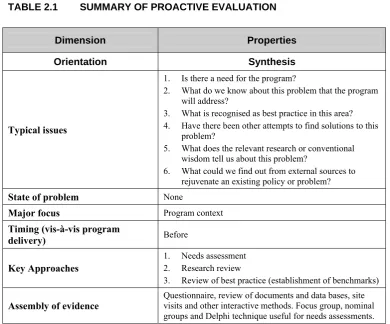
TABLE 2.1 SUMMARY OF PROACTIVE EVALUATION
Dimension Properties
Orientation Synthesis
Typical issues
1. Is there a need for the program?
2. What do we know about this problem that the program will address?
3. What is recognised as best practice in this area? 4. Have there been other attempts to find solutions to this
problem?
5. What does the relevant research or conventional wisdom tell us about this problem?
6. What could we find out from external sources to rejuvenate an existing policy or problem?
State of problem None
Major focus Program context
Timing (vis-à-vis program
delivery) Before
Key Approaches
1. Needs assessment 2. Research review
3. Review of best practice (establishment of benchmarks)
Assembly of evidence Questionnaire, review of documents and data bases, site visits and other interactive methods. Focus group, nominal groups and Delphi technique useful for needs assessments.
Needs assessment
Chapter 2 Review of the Literature
Elements of needs assessment
Owen (2006), spelling out the essential features of Proactive Evaluation, is concerned with the following five elements of needs assessment:
• the desired or ideal condition or state of affairs – what ought to be;
• the present or actual condition or state of affairs; • discrepancies between desired and actual conditions; • reasons for the discrepancies; and
• deciding which needs should be given priority for action through a treatment or program.
Roth (1990, cited in Owen, 2006), suggests that needs can be generally defined as follows:
N = D - A
where N = needs, D = desired or ideal condition, and A = present or actual condition.
The social and political dimensions of needs assessment in Thailand
Chapter 2 Review of the Literature
administration enhancing public participation can be effected by adjusting both system and management processes. If successful, it should create public confidence in setting policies, decision making, need assessment and public administration. The outcome should enable government officials to accurately and effectively understand and acquire knowledge and skills favorable to public participatory governance.
There is thus a strong social and political dimension for needs assessment determination in Thailand. To assist the focus on public participation among stakeholders, the Thai Public Sector Development Commission (http://www.opdc.go.th) has specified a plan for public participatory governance in policy development. This plan encourages the following: enlisting public participation in the work of the government within the Strategic Plan for Public Sector Development (2003-2007); setting the criteria for each government agency to have advisory systems that assist in the surveying of people’s needs especially in projects or in areas of public administration that directly affect them. The plan encourages provision of a summary of desirable performance that should be disseminated amongst the stakeholders. This positive social and political orientation towards needs assessment supports the carrying out of a needs assessment associated with the development of a policy for public sector training programs in Emotional Intelligence in Thailand.
Research synthesis
Chapter 2 Review of the Literature
The ultimate end of such a research review is to provide benchmarks of ‘best practice’. Owen (2006, p. 180) concentrates on one particular type of benchmarking: a data-driven, evidence-based model that relies on the use of evidence collected directly from the organisation. Cases of ‘best practice’ are then located and identified, and the principles documented to provide the input for developing policies or programs based on the best practice findings.
Policymaking
A policy is a general guide to action, an overarching statement which includes a goal and guiding principles for an intervention that aims to improve policies by creating, critically assessing, and communicating policy-relevant knowledge (Considine, 1994; Dunn, 1994). Policy is a guide to design, implementation and evaluation in a particular area of action (Ling & Cotter, 2002). Kahn (1969, p. 16) suggests that policies are ‘standing plans’. Policies are guides to future decision-making that are intended to shape those decisions. Decisions must be consistent with a goal, an integral part of the policy documentation. According to Ragin (1987, p. 13), decisions should focus on ‘how different conditions or causes fit together in one setting and be contrasted with how they might fit together in another setting’. Dror (1990, pp. 89-90) makes a clear distinction between the content of policy and the dynamics of process. He points out that policy development can be improved in two ways:
One, upgrading policy making processes, which in turn involves improved policy process management and redesigning organisations. And two, establishing improved grand-policies, which guide the substance of discrete policies, which in turn involves application of policy analysis to grand policies as well as process and organisation upgrading which serves policy development as a whole.
Chapter 2 Review of the Literature
stages there are eighteen sub-stages, the eighteenth of which is continuous communication and feedback channels interconnecting all phases. Metapolicymaking involves seven stages:
1. processing values; 2. processing reality; 3. processing problems; 4. developing resources;
5. designing the policymaking system;
6. allocating problems values and resources; and 7. finally determining the policymaking strategy.
Policymaking involves seven stages: 1. sub-allocating resources;
2. making and prioritizing operational goals; 3. making and prioritizing other significant values;
4. preparing a set of major alternative policies (including some ‘good’ ones);
5. predicting benefits and costs of those policies; 6. identifying the best policies in that light;
7. deciding whether the best alternatives are ‘good’ policies.
Post-policymaking involves three stages:
1. motivating the execution of the policy; 2. executing it; and
Chapter 2 Review of the Literature
The feedback elements of the model give it a dynamic feature, and Dror stresses the importance of using iterative processes. A comprehensive optimal model must include the three stages above; they are dynamically interrelated. They are a very important part of the optimal model yet, as Dror points out, they are neglected in most normative models. The model can be used to analyse, evaluate and improve the policymaking system as a dynamic system, rather than as a collection of separate policymaking units and cases.
In this dissertation it was not possible to apply all three stages because of time and space limitations. Instead, I focused only on the policymaking stage together with Phase 18 of Stage 3 which is concerned with providing communication and feedback between all phases. I was mindful that in fully implementing policies in the future it would be necessary to consider all Stages and their related Phases. For instance, I would endeavour to establish teams charged with developing a range of alternative policies that would meet established operational goals and values and choose the best one from these.
Consistent with the advice given by Dror (1973, p. 214) I focused on only four of the policymaking stages: Phase 8: Sub-allocating resources, Phase 11: Preparing a major alternative policies to meet including some ‘Good’ ones, phase 14: Evaluating the benefits and costs of the ‘Best’ alternatives and deciding whether they are ‘Good’ or not, and phase 18: Communication and feedback channels interconnecting all phases to establish a policy for Training Programs in Emotional Intelligence in Rayong Province.
Chapter 2 Review of the Literature
discussion with senior government officials; thus, the intention of Phases 9 and 10 were met, albeit incompletely. The four key policymaking phases that were addressed are discussed below. In summary, these, according to Dror (1973, p. 195) are
• Phase 8: Sub-allocating resources
• Phase 11: Preparing a set of major alternative policies, including some ‘Good’ ones;
• Phase 14: Evaluating the benefits and costs of ‘Best’ alternatives and deciding whether they are ‘Good’ or not;
• Phase 18: Communication and feedback channels interconnecting all phases.
Phase 8: Sub-allocating resources
The sub-allocation of resources in public policymaking, according to Dror (1973, Phase 8, Optimal Model) must be applied to the various phases. Phase 8 parallels that of the resources allocation phase of allocating problems, values, and resources (Phase 6). Both rational and extra-rational methods are used in this allocation; the emphasis, however, is on rational components over extra-rational components.
Chapter 2 Review of the Literature
should be considered in policymaking: knowledge, technology, power, material, people, time, assessment, information and finance.
In this phase of my research, I applied Dror’s sub-allocation of resources to a research-determined framework of policy rationales, objectives and policy guidelines in the development of a policy for Training Programs in Emotional Intelligence in Rayong Province and used Caldwell & Spinks’ framework for the sub-allocation of resources.
Phase 11: Preparing a set of major alternative policies, including some ‘Good’ ones
This phase (Dror, 1973, Phase 11, Optimal Model, pp. 178-179) applies the concept of optimality to a set of major alternative policies each of which raises interesting points. This implies that more than one ‘satisfactory’ policy is finally identified from a set of major alternative policies; a search for alternatives continues until one is found whose net benefits are considered ‘satisfactory’. The optimal model stipulates that at least one alternative should provide a net output that is not only ‘satisfactory’ but ‘good’; thus, additional resources must be mobilised in the search for a policy that is ‘good’.
In this phase, I applied the optimal model to the draft policy of Training Programs in Emotional Intelligence to a set of rationales, objectives, policy guidelines and resources that would be both ‘satisfactory’ and ‘good’ (Dror, 1973, p. 195) in acquiring capabilities and achievement of the Training Programs in Emotional Intelligence in Rayong Province.
Phase 14: Evaluating the benefits and costs of the ‘Best’ alternatives and deciding whether they are ‘Good’ or not
Chapter 2 Review of the Literature
The goodness standard of the optimal model requires the following: 1. a high probability that the society will survive in the larger sense; 2. a high probability that the policy will be politically and
economically feasible;
3. continual improvements in the net expectation of policymaking in the same unit and of new policies as compared with similar policies in the past unless the major environmental variables become worse;
4. better net expectations than in any comparable policymaking system;
5. a highly developed search for alternatives, with, at the least, extensive surveys of knowledge;
6. a pressure on policymaking to be as good as possible, by requiring checking up on policymaking phase through which the proposed alternatives have passed, and by demanding independent
simulation of some of them; and,
7. generally, making explicit, and known during all earlier
policymaking phase, those activities it will influence so that the various actors will anticipate the verdict.
Dror (1973), points out that these standards are directly relevant to optimal public policymaking: each potential coalition member decides on their own internal policymaking processes. Their decisions will depend on, among other things, how well the proposed policy compares with each individual’s ‘goodness standard,’ and on their own strategies for informing coalitions and gaining power.
Chapter 2 Review of the Literature
semi-structured interviews. To assist me in the establishment of a ‘goodness standard’ for each of the policy elements addressed in the final policy, the outcomes of the three approaches of the Proactive Form (needs assessment, semi-structured interviews, and testing the draft policy) were used in the development of the final policy of Training Programs in Emotional Intelligence .
Phase 18: Communication and feedback channels interconnecting all phases
This phase (Dror, 1973, Phase 18, Optimal Model) interconnects all phases, in terms of the conclusions and feedback resulting from it, which include:
1. immediate feedback about policy that is being executed and which is aimed at stimulating remaking of policy;
2. immediate feedback about policy that is being executed and which is aimed at stimulating changes in the way the policy is being executed; and
3. learning feedback, that is aimed at all the metapolicymaking, policymaking, and post-policymaking phases and intended to improve their future operation in the light of current experience.
Chapter 2 Review of the Literature
The Optimal Model (Dror, 1973), was valuable as it provided me with a framework that guided me through the complex process of developing a policy for Training Programs in Emotional Intelligence in Rayong Province.
Emotional Intelligence in the workplace
Daniel Goleman, a psychologist and science writer who had previously written on brain and behaviour research for the New York Times, discovered Salovey & Mayer’s original work on Emotional Intelligence (they coined the term in 1990) in the early 1990s. Inspired by their findings, he began to conduct his own research in the area and eventually wrote Emotional Intelligence (Goleman, 1995), the landmark book that familiarised both the public and private sectors with the idea of Emotional Intelligence.
Goleman’s model outlines four main Emotional Intelligence constructs. The first, self-awareness, is the ability to read one’s emotions and recognise their impact while using gut feelings to guide decisions. Self-management, the second construct, involves controlling one’s emotions and impulses and adapting to changing circumstances. The third construct, social awareness, includes the ability to sense, understand, and react to other’s emotions while comprehending social networks. Finally, relationship management, the fourth construct, entails the ability to inspire, influence, and develop others while managing conflict (Goleman, 1998).
Chapter 2 Review of the Literature
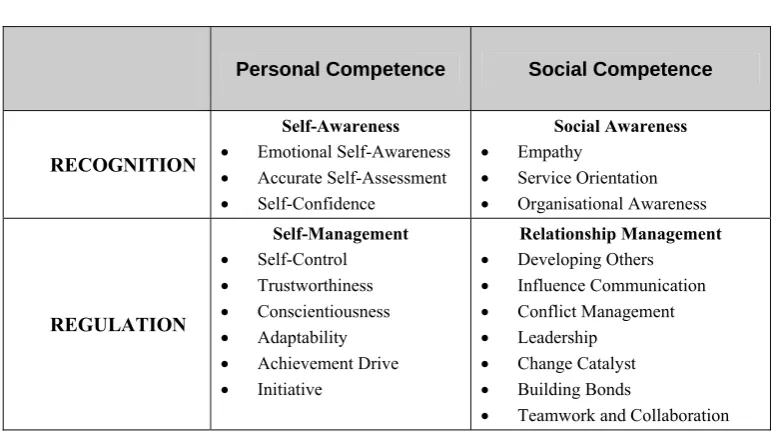
(Boyatzis et al., 1999). Figure 2.1 illustrates Cherniss & Goleman’s (2001, p. 28) conceptual model of Emotional Intelligence and corresponding emotional competencies. The constructs and competencies fall under one of four categories: the recognition of emotions in oneself or others, and the regulation of emotion in oneself or others.
Cherniss & Goleman (1998, website) have established an optimal process for developing Emotional Intelligence in organisations. They identify four phases within this process: preparation for change; training; transfer and maintenance skills; evaluation. Each phase has corresponding guidelines for achieving success. Preparation for change involves assessing the competencies which are most critical for organisational and individual effectiveness while convincing the workforce that improving their emotional step, as emotional learning and Emotional Intelligence are areas that are central to a person’s identity, and thus many may be resistant to being told they must change themselves as people. The training phase focuses on experiential learning with repeated practice, modelling, and corrective competencies will lead to desirable outcomes. Cherniss & Goleman (1998,
FIGURE 2.1 GOLEMAN’S EMOTIONAL INTELLIGENCE COMPETENCIES
Personal Competence Social Competence
RECOGNITION
Self-Awareness
• Emotional Self-Awareness
• Accurate Self-Assessment
• Self-Confidence
Social Awareness
• Empathy
• Service Orientation
• Organisational Awareness
REGULATION
Self-Management
• Self-Control
• Trustworthiness
• Conscientiousness
• Adaptability
• Achievement Drive
• Initiative
Relationship Management
• Developing Others
• Influence Communication
• Conflict Management
• Leadership
• Change Catalyst
• Building Bonds
• Teamwork and Collaboration
Chapter 2 Review of the Literature
website) point out that motivational factors might be a particular issue in this feedback. Maintenance of skills is carried out through social support and a supportive work environment along with policies and procedures which support the development of Emotional Intelligence. Finally, evaluation is conducted to determine individual satisfaction with the training as well as to establish if the training has produced meaningful changes in on-the-job behaviour.
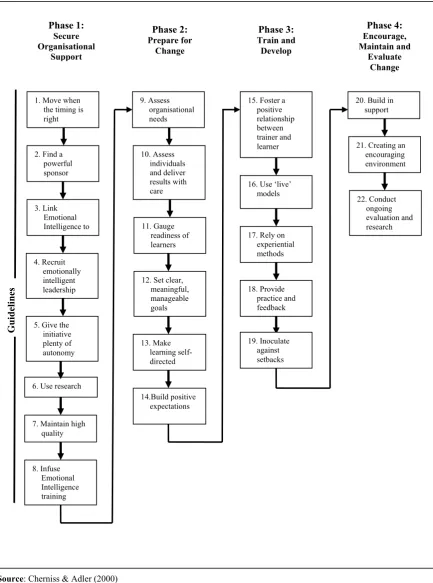
Training and development efforts designed to increase emotional and social competence must incorporate a number of elements. Cherniss & Adler (2000) have developed an optimal model for promoting Emotional Intelligence-based learning in work organisations; this model is illustrated in Figure 2.2. The model incorporates the necessary elements into a set of guidelines, arranged in the form of a flowchart. Their model synthesises research on best practice and theory from the point of view of organisational behaviour, training and development, psychotherapy, and behavioural change. It is organised in a way that can help practitioners design effective learning processes and so help individuals meet personal goals and move the organisation towards success.
The model begins with Phase 1, which is a set of guidelines for introducing social and emotional learning into an organisation with the aim of securing organisational support. This phase encompasses the tasks necessary to develop support for what may be a new and unsettling idea: promoting emotional competence in the workplace.
Chapter 2 Review of the Literature
FIGURE 2.2 MODEL FOR PROMOTING EMOTIONAL INTELLIGENCE-BASED LEARNING IN WORK ORGANISATIONS
Source: Cherniss & Adler (2000)
Phase 1: Secure Organisational Support Phase 2: Prepare for Change Phase 3: Train and Develop
1. Move when the timing is right
9. Assess organisational needs
15. Foster a positive relationship between trainer and learner
20. Build in support
2. Find a powerful sponsor 10. Assess individuals and deliver results with
care 16. Use ‘live’ models
21. Creating an encouraging environment 22. Conduct ongoing evaluation and research 17. Rely on
experiential methods 18. Provide practice and feedback 11. Gauge readiness of learners 3. Link Emotional Intelligence to 4. Recruit emotionally intelligent leadership
5. Give the initiative plenty of autonomy
12. Set clear, meaningful, manageable goals 13. Make learning self-directed 14.Build positive expectations 19. Inoculate against setbacks 8. Infuse Emotional Intelligence training 6. Use research
Chapter 2 Review of the Literature
Phase 3, the actual training and development phase, covers the change process itself. It includes the processes of previous research on behavioural change that are important in helping people to change the way in which they view the world and deal with its social and emotional demands
(Kolb et al., 1968; Zacker & Bard, 1973; Bandura, et al., 1977; Komaki et al., 1980; Marx 1982; Tannenbaum & Yukl 1992; Spencer et al., 1997 – all cited in Cherniss & Adler, 2000).
Phase 4 addresses what happens following the formal training experience. The activities of this phase are especially important for facilitating transfer, generalisation, and maintenance of change. This phase determines whether the new behaviours will become a permanent part of the person’s Emotional Intelligence repertoire or be extinguished for lack of reinforcement. This phase also involves evaluation. Given the current state of knowledge about social and emotional learning and the complexity of programs designed to promote such learning, evaluation always should be part of the process; making it an explicit part of the model recognises this fact. Goleman (2006) includes Social Intelligence in his Taxonomy of Human Ability, and recognises that ‘intelligence’ can include noncognitive abilities.
Emotional Intelligence is a recently-emerged area of study in which the focus has been on the psychological rather than practically-based training aspects. In this section, I have synthesised reviews and theory on organisational behaviour, training and development that I have associated with my study of Training Programs in Emotional Intelligence.
The Learning Organisation
Chapter 2 Review of the Literature
(1993), sees a learning organisation as an organisation skilled at creating, acquiring, and transferring knowledge, and at modifying its behaviour to reflect new knowledge and insights. Marsick & Watkins (1994) emphasise such an organisation as one that learns continuously and can transform itself. It empowers the people; encourages collaboration and team learning; promotes open dialogue; and acknowledges the interdependence of individuals, the organisation, and the community.
The term ‘organisational learning’ encompasses various non-coherent models and concepts. Some of the more popular and familiar are single and double loop learning (Argyris & Schön, 1978); experiential learning of individuals or collectives (Kolb, 1984; Dixon, 1994); and, most importantly for this thesis, a systems view of learning which is constructed in Senge’s treatise, The Fifth Discipline (Senge, 1990).
Senge (1990) identifies five disciplines that enable organisations to move toward the ideal of a learning organisation. The five disciplines are: systems thinking, personal mastery, mental models, shared vision and team learning. All five elements are concerned with a mind shift from seeing parts to seeing wholes, from seeing people as helpless reactors to seeing them as active participants in shaping their reality, from reacting to the present to creating the future.
Watkins & Marsick (1993) consider learning at four levels: individual, team, organisation, and society. They further characterise organisational learning by a change in the organisation’s capacity for innovation and new knowledge. A culture is not easily changed. Organisations must first become aware of their cultural biases, and through reflection, dialogue, and inquiry learn to become observers of their own thinking (Senge, 1990).
Chapter 2 Review of the Literature
solve the problem, and close the gap; generative learning, focuses on learning how to learn. This supports Senge’s (1990) concept of transformative learning and the practice of critical reflection, by allowing for the potential transformation of personal frames of reference to lay the foundation for a new learning culture.
Training and Development
Although the terms ‘training’ and ‘development’ are often used interchangeably, there are subtle differences between the two. Noe (2003) was one of the first to categorise types of learning experiences as either training or development. He identifies four dimensions – time, utilisation, financial resources, and risk – and applies them to the two constructs of training and development. Using these four dimensions as a guide, Noe (2003) differentiates between training and development in the following way:
Training: places emphasis on enhancing knowledge and skills fundamental to the present job.
Development: places emphasis on formal education, job experiences, relationships, and assessments of personality and abilities that will help employees prepare for the future.
Chapter 2 Review of the Literature
Traditionally, training and development has not been viewed as an activity that has been able to help all organisations in both the private and public sectors create ‘value’ and successfully deal with competitive challenges. The role of training was to focus on training program design. Today, that view has changed. Organisations that use innovative training and development practices are likely to report better financial performance than do competitors that do not use them. Training has moved from an emphasis on a one-time event to the creation of conditions for learning that can occur through collaboration, online learning, traditional classroom training, or a combination of methods. There is increased recognition that learning occurs without a formal training course. Noe (2003) points out that training and development play a key role in helping organisation meet challenges such as improving the quality of services, using high-performance work system practices. It needs knowledge and training to be delivered rapidly, where and when it is needed. Both companies and employees are concerned with developing future skills and managing careers. Companies want a work force that is motivated and productive, has up-to-date skills, and can quickly learn new skills to meet changing customer needs. Employees want to develop skills that not only are useful for their current jobs but also are congruent with their personal interests and values.
Chapter 2 Review of the Literature
FIGURE 2.3 INFLUENCES ON TRANSFER OF LEARNING
• Transfer of training is something that trainers need to consider before training in order to gain the support of managers and peers.
• It has been shown that managers’ and peers’ attitude toward transfer of training can influence trainee’s level of motivation.
• Managers can use identical theories, stimulus generalisation, and cognitive theories to apply to training design to help increase transfer of training.
• Designing effective programs is also important to learning and transfer. • Selecting appropriate training sites and trainers are keys to effective
learning.
• Organisations need to involve those who are taking part in training to increase motivation; this in-turn will increase learning and transfer of training; they are also looking toward transfer of learning and knowledge management.
• Learning organisations see training as a way to create human capital. • Companies are encouraging knowledge-sharing with employees. To
make this happen, companies need to promote employees who learn, teach, and share.
• As a result, companies need to attract and retain key employees.
Source: Noe (2003)
These factors, and the accompanying lists, will be used as a guide for me as well as trainers when it comes to designing training programs in Emotional Intelligence. This should help to ensure that the public servants concerned are ready for training, to create an appropriate learning model, and to ensure that what is learned in EI training is applied on the job. Transfer of Training, in this context, refers to trainees effectively and continually applying what they learned in EI training (knowledge, skills, behaviours, cognitive strategies) to their job.
Chapter 2 Review of the Literature
workplace (Beckett and Hager, 2002). Therefore, training can be considered as being a mechanism by which development occurs.
Diffusion of Innovation
The development and implementation of a policy for public sector training programs in Emotional Intelligence in Thailand described in this research has not previously been undertaken in Thailand. Both the approach, using a Proactive Evaluation, and the issue involved – Emotional Intelligence – are innovatory. Part of the policy, therefore, needs to be concerned with the diffusion of this innovation, particularly if the implementation is to be successful.
In his comprehensive book Diffusion of Innovation, Rogers (2003, p. 5) defines diffusion as ‘the process by which an innovation is communicated through certain channels over time among the members of a social system’. It is a special type of communication, in that the messages are concerned with new ideas; communication is regarded as ‘a process in which participants create and share information with one another in order to reach a mutual understanding’. Rogers (2003) classifies adopters (which do not include incomplete adoption and non-adoption) as follows: innovators, early adopters, early majority, late majority and laggards. Each of these categories is discussed below.
Innovators
Chapter 2 Review of the Literature
outside the social system. ‘Venturesomeness’ requires innovators to be the holders of complex technical knowledge.
Early Adopters
Compared to innovators, early adopters are more limited within the boundaries of the social system. Rogers (2003, p. 283) argues that since early adopters are more likely to hold leadership roles in the social system, other members come to them to get advice or information about the innovation. In fact, as Light (1998, p. 19) points out,
leaders play a central role at virtually every stage of the innovation process, from initiation to implementation, particularly in deploying the resources that carry innovation forward.
Thus, as role models, early adopters’ attitudes toward innovations are most important. Their subjective evaluations about the innovation reach other members of the social system through the interpersonal networks. Early adopters’ leadership in adopting the innovation decreases uncertainty about the innovation in the diffusion process. Finally, ‘early adopters put their stamp of approval on a new idea by adopting it’ (Rogers, 2003, p. 283).
Early Majority
Chapter 2 Review of the Literature
Late Majority
Like the early majority, the late majority includes the members of the social system who wait until most of their peers adopt the innovation. Although they are sceptical about the innovation and its outcomes, economic necessity and peer pressure may lead them to the adoption of the innovation. To reduce the uncertainty of the innovation, interpersonal networks of close peers should persuade the late majority to adopt it. Then, ‘the late majority feel that it is safe to adopt’ (Rogers, 2003, p. 284).
Laggards
Rogers (2003) suggests that laggards have traditional views: they are more sceptical about innovations and change agents than the late majority. As the most localised group of the social system, their interpersonal networks mainly consist of other members of the social system from the same category. Usually, they do not have a leadership role. Because of the limited resources and the lack of awareness-knowledge of innovations, they first want to make sure that the innovation works before they adopt it. Thus, laggards tend to decide after looking at whether the innovation is successfully adopted by other members of the social system in the past. Due to all these characteristics, the innovation-decision period of laggards is relatively long.
Chapter 2 Review of the Literature
idea (the less educated, less wealthy, and the like) are generally the last to adopt the innovation’ (Rogers, 2003, p. 295).
In order to encourage the diffusion of innovative processes in developing Training Programs in Emotional Intelligence in Rayong Province, I recognised the need to provide policy guidelines for these training programs in order to encourage public servants to be adopters in order to have them support organisational change in the future.
Summary
CHAPTER 3
Research Methodology
Introduction
My study was based on a needs assessment within the Proactive Form of Evaluation as categorised by Owen & Rogers (1999) and Owen (2006). The objectives of this study were to: 1) develop the most effective policy for an approach to Training Programs in Emotional Intelligence for public servants in the Rayong province; 2) outline professional development strategies required by the Rayong Provincial Government, through its Public Servants Developing Centre, to seek ways of developing policy and improving the quality of service to their customers. This chapter includes the procedures that were used in preparing the study and conducting the research.
My research sought to determine the needs of Training Programs in Emotional Intelligence in order to develop a policy for effective Training Programs in Emotional Intelligence in Rayong Province and, ultimately, for Thailand; to demonstrate the effectiveness of Proactive Evaluation in developing such policy; and to highlight the key elements that are required to facilitate attitudinal change in organisations. This study, which was exploratory, employed a number of qualitative data collection methods.