Achieving efficient Geographic routing via
Mobility based forwarding node selection schemes
in Mobile Sensor Network
Akash Amathe#1, Dr. Santosh Deshapande*2
#1
Dept of Computer Networks & Engineering, Visvesvaraya Technological University
Belagavi, Karnataka, India
*2
Department of PG studies, VTU Belagavi, Karnataka, India
Abstract—A Routing network is proposed for wireless sensor networks to deliver the information packets in a reliable and timely manner. Most existing routing protocol abuses the multipath routing to ensure both reliability and delay QoS limitations in WSNs. However, the multipath routing methodology experiences a energy cost and computation delay at each hop. The primary goal of the project is to augment the network lifetime and improve the Qos routing for both reliability and delay in WSNs. To accomplish the Qos routing by this project proposes an opportunistic information transfer at per hop communication. This plan is called Efficient QoS-aware GOR (EQGOR) protocol. It utilizes only hop prerequisites to get and keep up at a low overhead cost. In the event that the hop prerequisite can be accomplished at every hop, the end-to-end QoS necessity can likewise be met with a higher probability. EQGOR selects and prioritizes the forwarding candidate indicated by specific QoS prerequisites that are communicated as far as reliability and delay of single-hop packet advance and attains to the delicate QoS provisioning. In the event that a packet is effectively received by a percentage of the chose nodes, only the most priority need node among them is picked as the next hop forwarder. Thusly, this forwarding candidate turns into the real next-hop sender in an opportunistic manner. The forwarding methodology rehashes until the packet achieves the sink node. Changes of the end-to-end delay at increasing the reliability constraint from 0.6 to 0.99, EQGOR is less influenced by the changes of the reliability requirement and node density. Together with its shorter end-to-end delay, lower communication cost and higher delivery ratio, we conclude that compared with the multipath routing approach, all the performances are greatly improved by exploiting the GOR for QoS provisioning in WSNs. This project contributes the component is applicable for mobile sensor network. Execution of the proposed procedure is led utilizing Network Simulator to evaluate delay, throughput and energy effectiveness.
Keywords — Wireless sensor networks, multiconstrained QoS, geographic opportunistic routing.
I.INTRODUCTION
Wireless sensor network (WSNs) have been planned and created for a wide assortment of utilizations, for
battlefield, home automation, and traffic control etc. A sensor network comprises of spatially dispersed independent sensor nodes, to agreeably physical or environmental conditions. These sensor nodes for the most part work on constrained non-rechargeable battery control, and are required to last more than a while for years. Hence, a real concern is to expand the network lifetime, i.e., to improve the energy efficiency for WSNs. Since the sensor nodes typically have restricted handling speed and memory space, it is additionally obliged that the algorithm running on sensor gadgets has a low computational expense.
Giving reliable and time communication in WSNs is a challenging issue. This is on account of; the changing remote channel conditions and sensor node failure may cause network topology and integration changing over the long run. Under such conditions, to forward a packet dependably at every hop, it may require numerous retransmissions, bringing about undesirable long postpone and in addition misuse of energy. Accordingly, numerous existing works have been proposed to enhance the routing reliability and latency in WSNs with untrustworthy connections.
QoS (Quality of Service) provisioning in network point refers to its capability to convey an ensured level of service to applications. The QoS necessities can be indicated as routing execution measurements, for example, delay, throughput or jitter. For any sensor network applications, delivery delay is not decisively significant as long as the sensory information received at the sink node. However for other critical applications, like target tracking and emergency alarm, timely deliverance and reliability of sensory information are critical in the accomplishment of the mission. For this situation, both QoS routing the end-to-end delay and reliability assurances turns into one of the critical exploration issues in WSNs.
II.PROBLEM STATEMENT
A WSN comprises a large number of densely deployed sensing devices to sense the occurrence of an event. The sensor nodes are required to report their measurements to the sink. In existing QoS aware routing mainly focus on one QoS requirement, either delay or reliability. For mission-critical applications, not only the end-to end delay constraint should be met, but also certain packet delivery reliability is expected to be guaranteed. Therefore, in this situation, it achieve the more Qos requirements, proposed work achieves the QoS requirements for both reliability and delay at hop by hop requirements. However, if the hop requirement can be achieved at each hop, the end-to-end QoS requirement can also be met with a higher probability.
III.THE PROPOSED WORK
The proposed protocol an Efficient QoS-aware GOR (EQGOR) algorithm is to guarantee better execution of the network. The proposed QoS prerequisite is to ensure both reliability and delay QoS limitations in WSNs. EQGOR attains to the Qos routing by end-to-end QoS prerequisites into the hop necessities [8]. In the event that the hop prerequisite can be attained to at every hop, the end-to-end QoS necessity can also be met with a higher probability. At the point when source node has an information packet to send to the sink node by means of multihop communication, it chooses the forwarding competitor set taking into account its nearby learning of accessible neighbours. Moreover, the vast majority of the forwarding candidates, every node dependably choose the ideal next hop taking into account the hop Qos necessities.
The hop QoS prerequisites of delay and reliability quality will be adaptively balanced by real accumulated delay and packet advance over going before connections. It accomplishes the two prerequisites, for example,
1) Increasing the single-hop packet rate can relax both the hop QoS requirements, in this way the end-to-end delay and reliability QoS prerequisites are more probable ensured as the packet is progressed toward the destination;
2) Although expanding the quantity of forwarding candidates would bring about higher reliability quality, considering the energy imperative of sensor gadgets, it is required to include less forwarding candidates to spare energy cost in WSNs.
Thus the network lifetime gets expanded by attaining to energy proficient forwarding candidates choice. Along these lines, this forwarding candidates turns into the genuine next-hop sender in an opportunistic manner. The forwarding methodology repeats until the packet achieves the sink node.
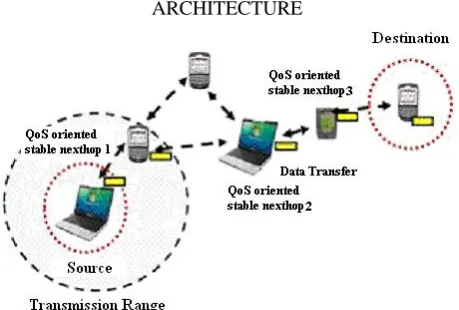
ARCHITECTURE
Fig 1. Data transfer from source to destination.
BLOCK DIAGRAM
Fig 2. Block diagram for the proposed system.
Modules Description:
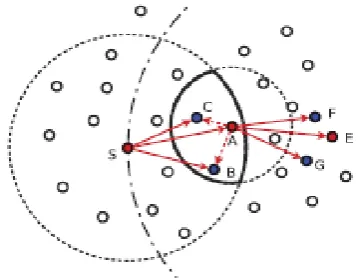
1)Greedy Perimeter Stateless Routing (GPSR):
Accordingly, a forwarding node can make a locally ideal, greedy decision in picking a packet's next hop.
Fig 3. Greedy Perimeter Stateless Routing.
In particular, if a node knows its radio neighbour’s positions, the by regional standards ideal decision of next hop is the neighbour geologically nearest to the packet's destination. Forwarding in this administration takes after progressively closer geographic hops, until the destination is reached.
2) Selection of Forwarding Candidates:
The nodes situated in the forwarding area would find the opportunity to be reinforcement nodes. The forwarding area is determined by the sender and the following hop node. A node situated in the forwarding region fulfils the accompanying two conditions: 1) it makes positive advancement toward the destination; and 2) its separation to the following hop node should not surpass a large portion of the transmission scope of a remote node (i.e., R=2) so that in a perfect world all the forwarding candidates can get notification from each other. Forwarding candidates should accomplish QoS prerequisites, for example, reliability quality and delay.
3) Selection of nexthop by Prioritization of Forwarding Candidates:
The need of forwarding candidate is chosen by its packet speed. Packet velocity is in light of single hop packet progress. Single hop packet advancement is in light of the contrast between the separation to the destination from forwarding candidate and separation to the source node from destination.
Fig 4. Selection of nexthop by Prioritization of Forwarding Candidates.
The packet reception ratio (PRR) data on every connection can be acquired by numbering of the lost test messages or information packets. Need is taking into account the result of SPP and PRR.
Product = SPP * PRR
Higher need forwarding candidate is chosen as next hop and information is transmitted through it and staying higher need forwarding candidate are allotted as reinforcement nodes. Number forwarding candidates are restricted to decrease energy utilization.
4) Mobility based forwarding node selection:
Proposed arrangement is connected only for static sensor network which is not pertinent for mobile sensor network. Despite the fact that Distance based determination of next hop and forwarding nodes choice yields less delay, it has high probability of connection detachment that prompts packet misfortune. To beat this issue stability based next hop and forwarding nodes choice is contributed in which node having high stability (low mobility) is chosen for forwarding candidates and next hop. It guarantees the reliability quality of information deliver under the mobile nature of wireless sensor network and decreasing the packet misfortune and expanding the throughput.
Fig 5. Mobility based forwarding node selection.
5) Performance Evaluation: 5.1) Energy Consumption
It is the measure of energy consumed by the sensors for the information transmission over the network.
Energy Consumption = Sum of energy consumed by each sensor
5.2) End-to-End Delay
End-to-End delay is the time taken for a packet to achieve the destination from the source node.
End to End delay (s) = ∑ (Delay for each data packet)/Total number of delivered data packets
5.3) Throughput
Throughput is the measure of information successfully received at the destination.
Throughput (bits/s) = Received data/Duration of transmission
SIMULATION MODEL
SIMULATOR Network Simulator 2
NUMBER OF NODES Random
INTERFACE TYPE Phy/WirelessPhy
MAC TYPE 802.11
QUEUE TYPE Droptail/Priority Queue
QUEUE LENGTH 50 Packets
ANTENNA TYPE Omni Antenna
PROPAGATION TYPE TwoRay Ground
ROUTING PROTOCOL AODV
TRANSPORT AGENT UDP
APPLICATION AGENT CBR
TRANSMISSION POWER 1.0watts
RECEPTION POWER 0.5watts
SENSE POWER 0.3watts
IDLE POWER 0.0watts
INITIAL ENERGY 100Joules
SIMULATION TIME 50seconds
IV RESULTS AND DISCUSSIONS EQGOR improves efficiency of QOS routing. It achieves the reliability thereby increasing
throughput and reduces the delay.
Increasing the single-hop packet speed can relax both the hop QoS requirements, thus the end-to-end delay and reliability QoS requirements are more likely guaranteed as the packet is progressed toward the destination.
Increasing the number of forwarding candidates would result in higher reliability, considering the energy constraint of sensor devices, it is expected to involve less forwarding candidates to save energy cost in WSNs.
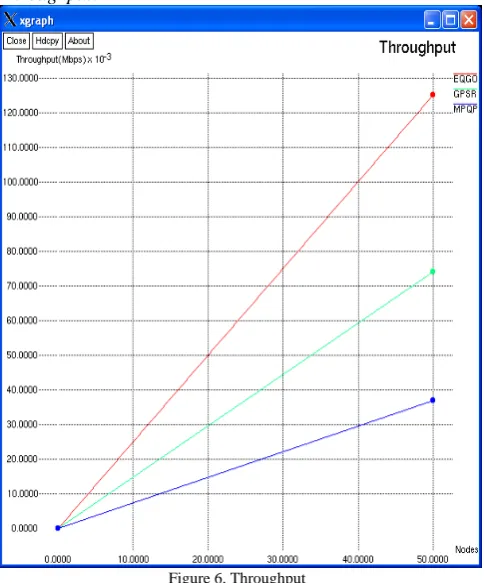
PDR is the proportion to the total amount of packets reached the receiver and amount of packet sent by source. The following figure 6 shows that the throughput of the proposed protocol EQGOR is better when compared to GPSR and MPQP.
Computation Values of EQGOR, GPSR and MPQP Techniques Analysed by Considering Some Nodes in Wireless Sensor Network:
Table 1. Evaluation Results
PERFORMANCE ANALYSIS: Throughput:
Figure 6. Throughput
End to End Delay:
Figure 7. End to End Delay
Energy Consumption:
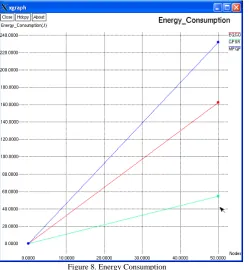
Figure 8. Energy Consumption
The Energy Consumption depends on the amount of energy consumed by the sensors for the data transmission over the network. The following figure 8 shows that the energy consumption of proposed protocol EQGOR is higher when compared to GPSR and lower when compared to MPQP.
VCONCLUSION
Proposed protocol abuses the geographic opportunistic routing (GOR) for multi constrained QoS provisioning in WSNs, which is more suitable than the multipath routing methodology. Existing GOR protocol can't be straight forwardly connected to the QoS provisioning in WSNs. Since the processing ought to delay of a GOR protocol to be likewise considered in WSNs. The issue of proficient GOR for multi constrained QoS provisioning (EGQP) is settled in WSNs. The EGQP issue is defined as a multi objective multi constraint optimization issue and the properties of EGQP's different destinations are analyzed. Based on the analysis and perceptions, an Efficient QoS-aware GOR (EQGOR) algorithm is proposed for QoS provisioning in WSNs.
EQGOR accomplishes a good balance between these numerous goals, and has a low time complexity, which is particularly customized for WSNs considering the asset limit of sensor devices. Far reaching assessments are directed to study the performance of the proposed EQGOR. Exploiting the GOR for QoS provisioning in WSNs the Changes of the end-to-end delay at increasing the reliability constraint from 0.6 to 0.99, Evaluation results exhibited its viability for QoS provisioning in WSNs. By contributing mobility based forwarding node selection, proposed protocol is fortified to apply in mobile sensor network also.
REFERENCES
[1] J. Niu, L. Cheng, Y. Gu, L. Shu, and S.K. Das, ‘‘R3E: Reliable Reactive Routing Enhancement for Wireless Sensor Networks,’’ IEEE Trans. Ind. Informat., vol. 10, no. 1, pp. 784-794, Feb. 2014. [2] T Shiva Prakash, K R Venugopal, S S Iyengar, “Link-Reliability
Based Two-Hop Routing for Wireless Sensor Networks”.
[3] Saeed Rasouli Heikalabad, Hossein Rasouli, Farhad Nematy and Naeim Rahmani, “QEMPAR: QoS and Energy Aware Multi-Path Routing Algorithm for Real-Time Applications in Wireless Sensor Networks”.
[4] B. Blum, T. He, S. Son, and J. Stankovic. “IGF: A state-free robust communication protocol for wireless sensor networks”. Tech. Rep., Department of Computer Science, University of Virginia, USA, 2003.
[5] M. Zorzi and R. Rao. “Geographic random forwarding (GeRaF) for ad hoc and sensor networks: energy and latency performance”, in IEEE Transactions on Mobile Computing, vol. 2, no. 4, pp. 349- 365, 2003.
[6] Y. Kim, R. Govindan, B. Karp and S. Shenker. “Geographic routing made practical”, in Proceedings of the 2nd Conference on Symposium on Networked Networks Design and Implementation, pp. 217-230, Berkeley, CA, USA, May 2005.
[7] Long Cheng∗†, Jiannong Cao, Canfeng Chen, Jian Ma§ and Sajal K. Das “Exploiting Geographic Opportunistic Routing for Soft QoS Provisioning in Wireless Sensor Networks”.
[8] Asad Amir Pirzada and Chris McDonald, “Trusted Greedy Perimeter Stateless Routing”
[9] Emad Felemban, Student Member, IEEE, Chang-Gun Lee, Member, “MMSPEED: Multipath Multi-SPEED Protocol for QoS Guarantee Of Reliability and Timeliness in Wireless Sensor Networks” vol.5 no. 6 June 2006.