Secure Multiparty Computation with Partial Fairness
Amos Beimel∗
Department of Computer Science Ben Gurion University
Be’er Sheva, Israel
Eran Omri†
Department of Computer Science Bar Ilan University
Ramat Gan, Israel Ilan Orlov‡
Department of Computer Science Ben Gurion University
Be’er Sheva, Israel
November 23, 2010
Abstract
A protocol for computing a functionality is secure if an adversary in this protocol cannot cause more harm than in an ideal computation where parties give their inputs to a trusted party which returns the output of the functionality to all parties. In particular, in the ideal model such computation is fair – all parties get the output. Cleve (STOC 1986) proved that, in general, fairness is not possible without an honest majority. To overcome this impossibility, Gordon and Katz (Eurocrypt 2010) suggested a relaxed definition –1/p-secure computation – which guarantees partial fairness. For two parties, they construct1/p-secure protocols for functionalities for which the size of either their domain or their range is polynomial (in the security parameter). Gordon and Katz ask whether their results can be extended to multiparty protocols.
We study1/p-secure protocols in the multiparty setting for general functionalities. Our main result is constructions of1/p-secure protocols when the number of parties is constant provided that less than 2/3 of the parties are corrupt. Our protocols require that either (1) the functionality is deterministic and the size of the domain is polynomial (in the security parameter), or (2) the functionality can be randomized and the size of the range is polynomial. If the size of the domain is constant and the functionality is deterministic, then our protocol is efficient even when the number of parties isO(log logn)(wherenis the security parameter). On the negative side, we show that when the number of parties is super-constant, 1/p-secure protocols are not possible when the size of the domain is polynomial.
∗Supported by ISF grant 938/09 and by the Frankel Center for Computer Science.
†This research was generously supported by the European Research Council as part of the ERC project “LAST”.
1 Introduction
A protocol for computing a functionality is secure if an adversary in this protocol cannot cause more harm than in an ideal computation where parties give their inputs to a trusted party which returns the output of the functionality to all parties. This is formalized by requiring that for every adversary in the real world, there is an adversary in the ideal world, called simulator, such that the output of the real-world adversary and the simulator are indistinguishable in polynomial time. Such security can be achieved when there is a majority of honest parties [16]. Secure computation is fair – all parties get the output. Cleve [9] proved that, in general, fairness is not possible without an honest majority.
To overcome the impossibility of [9], Gordon and Katz [22] suggested a relaxed definition –1/p-secure computation – which guarantees partial fairness. Informally, a protocol is1/p-secure if for every adversary in the real world, there is a simulator running in the ideal world, such that the output of the real-world adversary and the simulator cannot be distinguished with probability greater than 1/p. For two parties, Gordon and Katz construct 1/p-secure protocols for functionalities whose size of either their domain or their range is polynomial (in the security parameter). They also give impossibility results when both the domain and range are super-polynomial. Gordon and Katz ask whether their results can be extended to multiparty protocols. We give positive and negative answers to this question.
Previous Results. Cleve [9] proved that any protocol for coin-tossing without an honest majority cannot be fully secure, specifically, if the protocol hasrrounds, then it is at most1/r-secure. Protocols with partial fairness, under various definitions and assumptions, have been constructed for coin-tossing [9, 10, 24, 4], for contract signing/exchanging secrets [6, 23, 12, 5, 11, 7], and for general functionalities [27, 13, 2, 17, 25, 14, 22]. We next describe the papers that are most relevant to our paper. Moran, Naor, and Segev [24] construct 2-party protocols for coin tossing that are 1/r-secure (where r is the number of rounds in the protocol). Gordon and Katz [22] define1/p-security and construct 2-party1/p-secure protocols for every functionality whose size of either the domain or the range of the functionality is polynomial. Finlay, in a previous work [4] we construct multiparty protocols for coin tossing that areO(1/r)-secure provided that the fraction of bad parties is slightly larger than half. In particular, our protocol isO(1/r)-secure when the number of parties is constant and the fraction of bad parties is less than 2/3.
Gordon et al. [20] showed that complete fairness is possible in the two party case for some functions. Gordon and Katz [19] showed similar results for the multiparty case. The characterization of the functions that can be computed with full fairness without honest majority is open. Completeness for fair computations has been studied in [21]. Specifically, they show a specific function that is complete for fair two-party computation; this function is also complete for1/p-secure two-party computation.
1.1 Our Results
Our protocols combine ideas from the protocols of Gordon and Katz [22] and our paper [4], both of which generalize the protocol of Moran, Naor, and Segev [24]. Specifically, our protocols proceed in rounds, where in each round values are given to subsets of parties. There is a special roundi?in the protocol. Prior to roundi?, the values given to a subset of parties are values that can be computed from the inputs of the parties in this subset; staring from roundi?the values are the “correct” output of the functionality. The values given to a subset are secret shared such that only if all parties in the subset cooperate they can reconstruct the value. If in some round many (corrupt) parties have aborted such that there is a majority of honest parties among the active parties, then the set of active parties reconstructs the value given to this set in the previous round.1 Similar to the protocols of [24, 22, 4], the adversary can cause harm (e.g., bias the output of the
functionality) only if it guessesi?; we show that in our protocols this probability is small and the protocols are1/p-secure. The values in our protocols are chosen similar to [22]. The mechanism to secret share the values is similar to [4], however, there are important differences in this sharing, as the sharing mechanism of [4] is not appropriate for1/p-secure computations of functionalities which depend on inputs.
To complete the picture, we prove interesting impossibility results. We show that, in general, when the number of parties is super-constant,1/p-secure protocols are not possible without honest majority when the size of the domain is polynomial. This impossibility result justifies the fact why in our protocols the number of parties is constant. We also show that, in general, when the number of parties isω(logn),1/p-secure protocols are not possible without honest majority even when the size of the domain is 2. The proof of the impossibility result is rather simple and follows from an impossibility result of [22].
Our impossibility results should be contrasted with the coin-tossing protocol of [4] which is an efficient 1/p-secure protocol even whenm(n), the number of parties, is polynomial in the security parameter and the number of bad parties ism(n)/2 +O(1). Our results show that these parameters are not possible for general1/p-secure protocols even when the size of the domain of inputs is 2.
Open Problems. In both our impossibility results the size of the range is super-polynomial. It is open if there is an efficient1/p-secure protocol when the number of parties is not constant and the size of both the domain and range is polynomial. In addition, the impossibility results do not rule out that the double-exponential dependency on the number of parties can be improved.
The protocols of [22] are private – the adversary cannot learn any information on the inputs of the honest parties (other than the information that it can learn in the ideal world of computingF). The adversary can only bias the output. Our first protocol is not private (that is, the adversary can learn extra information). However, we do not know whether the second protocol is private.2 It is open if there are general multiparty
1/p-secure protocols that are also private.
2 Preliminaries
A multi-party protocol with m parties is defined by m interactive probabilistic polynomial-time Turing machinesp1, . . . , pm. Each Turning machine, called party, has the security parameter 1nas a joint input and a private inputyj. The computation proceeds in rounds. In each round, the active parties broadcast and receive messages on a common broadcast channel. The number of rounds in the protocol is expressed as some functionr(n)in the security parameter (typically,r(n) is bounded by a polynomial). At the end of the protocol, the (honest) parties should hold a common valuew(which should be equal to an output of a predefined functionality).
1As parties can abort during this reconstruction, they actually reconstruct the value of a subset of this set.
2The problem in our protocols is that the adversary can keep one corrupted party active, thus, the adversary can get the output
In this work we consider a corrupt, static, computationally-bounded (i.e., non-uniform probabilistic polynomial-time) adversary that is allowed to corrupt some subset of parties. That is, before the beginning of the protocol, the adversary corrupts a subset of the parties and may instruct them to deviate from the protocol in an arbitrary way. The adversary has complete access to the internal state of each of the corrupted parties and fully controls the messages that they send throughout the protocol. The honest parties follow the instructions of the protocol.
The parties communicate via a synchronous network, using only a broadcast channel. The adversary is rushing, that is, in each round the adversary hears the messages broadcast by the honest parties before broadcasting the messages of the corrupted parties for this round (thus, broadcast messages of the corrupted parties can depend on the broadcast messages of the honest parties in this round).
Notation. For an integer `, define[`] = {1, . . . , `}. For a setJ ⊆ [m], define QJ = {pj :j ∈J}. An
m-party functionalityF = {fn}n∈Nis a sequence of polynomial-time computable, randomized mappings
fn : (Xn)m → Zn, whereXn = {0,1}`d(n) andZn ={0,1}`r(n) are the domain of inputs of each party and the range respectively;`d, `r:N→Nare some fixed functions. We denote the size of the domain and the range ofF byd(n)andg(n)respectively, that is,d(n) = 2`d(n)andg(n) = 2`r(n). For a randomized
mapping fn, the assignment w ← fn(x1, . . . , xm) denotes the process of computingfn with the inputs
x1, . . . , xm and with uniformly chosen random coins and assigning the output of the computation tow. If F is deterministic, we sometimes call it a function. We sometime omitnfrom functions ofn(for example, we writedinstead ofd(n)).
2.1 The Real vs. Ideal Paradigm
The security of multiparty computation protocols is defined using the real vs. ideal paradigm. In this paradigm, we consider the real-world model, in which protocols are executed. We then formulate an ideal model for executing the task. This ideal model involves a trusted party whose functionality captures the se-curity requirements from the task. Finally, we show that the real-world protocol “emulates” the ideal-world protocol: For any real-life adversaryAthere exists an ideal-model adversaryS(called simulator) such that the global output of an execution of the protocol withAin the real-world model is distributed similarly to the global output of runningS in the ideal model. In both models there arempartiesp1, . . . , pmholding a common input1nand private inputsy
1, . . . , ymrespectively, whereyj ∈Xnfor1≤j ≤m.
The Real Model. Let Π be an m-party protocol computingF. Let A be a non-uniform probabilistic polynomial time adversary that gets the input yj of each corrupted party pj and the auxiliary input aux. LetREALΠ,A(aux)(~y,1n), where~y = (y1, . . . , ym), be the random variable consisting of the view of the adversary (i.e., the inputs of the corrupted parties and the messages it got) and the output of the honest parties following an execution ofΠ.
The Ideal Model. The basic ideal model we consider is a model without abort. Specifically, there is an adversarySwhich has corrupted a subsetB of the parties. The adversaryS has some auxiliary inputaux. An ideal execution for the computingFproceeds as follows:
with uniform distribution.3
Trusted party sends outputs: The trusted party computes fn(x1, . . . , xm)with uniformly random coins and sends the output to the parties.
Outputs: The honest parties output the value sent by the trusted party, the corrupted parties output noth-ing, andSoutputs any arbitrary (probabilistic polynomial-time computable) function of its view (its inputs, the output, and the auxiliary inputaux).
Let IDEALF,S(aux)(~y,1n)be the random variable consisting of the output of the adversary S in this ideal world execution and the output of the honest parties in the execution.
2.1.1 1/p-Indistinguishability and1/p-Secure Computation
As explained in the introduction, some ideal functionalities for computingF cannot be implemented when there is no honest majority. We use1/p-secure computation, defined by [22], to capture the divergence from the ideal worlds.
Definition 2.1 (1/p-indistinguishability) A functionµ(·)isnegligibleif for every positive polynomialq(·) and all sufficiently large nit holds thatµ(n) < 1/q(n). A distribution ensembleX = {Xa,n}a∈Dn,n∈N is an infinite sequence of random variables indexed by a ∈ Dn andn ∈ N, where Dn is a domain that might depend on n. For a fixed function p(n), two distribution ensembles X = {Xa,n}a∈Dn,n∈N and
Y ={Ya,n}a∈Dn,n∈Narecomputationally1/p-indistinguishable, denotedX≈1/pY, if for every non-uniform polynomial-time algorithmDthere exists a negligible functionµ(·)such that for everynand everya∈ Dn,
¯ ¯
¯Pr[D(Xa,n) = 1]−Pr[D(Ya,n) = 1]
¯ ¯ ¯≤ 1
p(n) +µ(n).
Two distribution ensembles arecomputationally indistinguishable, denotedX≡C Y, if for everyc∈Nthey are computationally n1c -indistinguishable.
We next define the notion of 1/p-secure computation [22]. The definition uses the standard real/ideal paradigm [15, 8], except that we consider a completely fair ideal model (as typically considered in the setting of honest majority), and require only1/p-indistinguishability rather than indistinguishability.
Definition 2.2 (1/p-secure computation [22]) Letp=p(n)be a function. Anm-party protocolΠis said to1/p-securely compute a functionality F where there are at mostt(n) corrupt parties, if for every non-uniform probabilistic polynomial-time adversaryAin the real model controlling at mostt(n)parties, there exists a non-uniform probabilistic polynomial-time adversary S in the ideal model, controlling the same parties asA, such that the following two distribution ensembles are computationally1/p-indistinguishable
©
IDEALF,S(aux)(~y,1n)ªaux∈{0,1}∗,~y∈(X
n)m,n∈N
1/p
≈ ©REALΠ,A(aux)(~y,1n)ªaux∈{0,1}∗,~y∈(X
n)m,n∈N.
We next define statistical distance between two random variables and the notion of perfect1/p-secure computation, which implies the notion of1/p-secure computation.
3For the simplicity of the presentation of our protocols, we present a slightly different ideal world than the traditional one. In
Definition 2.3 (statistical distance) We define thestatistical distancebetween two random variablesAand
Bas the function
SD (A, B) = 1 2
X
α
¯ ¯
¯Pr[A=α]−Pr[B =α]
¯ ¯ ¯.
Definition 2.4 (perfect1/p-secure computation) Anm-party protocolΠ is said to perfectly1/p-secure compute a functionalityFif for every non-uniform adversaryAin the real model, there exists a polynomial-time adversary S in the ideal model such that for every n ∈ N, for every ~y ∈ (Xn)m, and for every aux∈ {0,1}∗
SD¡IDEALF,S(aux)(~y,1n),REALΠ,A(aux)(~y,1n)¢≤ 1
p(n).
Security with abort and cheat detection is defined in Appendix A. The cryptographic tools we use are described in Appendix B.
3 The Multiparty Secure Protocols
In this section we present our protocols. We start with a protocol that assumes that either the functionality is deterministic and the size of the domain is polynomial, or that the functionality is randomized and both the domain and range of the functionality are polynomial. We then present a modification of the protocol that is 1/p-secure for (possibly randomized) functionalities if the size of the range is polynomial (even if the size of the domain ofF is not polynomial). The first protocol is more efficient for deterministic functionalities with polynomial-size domain. Furthermore, the first protocol has full correctness, while in the modified protocol, correctness is only guaranteed with probability1−1/p.
Formally, we prove the following two theorems.
Theorem 1 LetF = {fn: (Xn)m →Zn} be randomized functionality where the size of domain isd(n) and the size of the range isg(n), and let p(n) be a polynomial. If enhanced trap-door permutations ex-ist, then for anym andt such that m/2 ≤ t < 2m/3, and for any polynomialp(n) there is an r(n )-round m-party 1/p(n)-secure protocol computing F tolerating up to t corrupt parties where r(n) =
p(n)·(2·d(n)m·g(n)·p(n))2t
, provided thatr(n)is bounded by a polynomial inn. IfF is deterministic, then there is ar(n)-round1/p(n)-secure protocol forr(n) =p(n)·d(n)m·2t
, provided thatr(n)is bounded by a polynomial inn.
Theorem 2 LetF ={fn: (Xn)m →Zn}be randomized functionality where the size of the rangeg(n)is polynomial innandmis constant, and letp(n)be a polynomial. If enhanced trap-door permutations exist, then fortsuch thatm/2≤t <2m/3and for any polynomialp(n)there is anr(n)-roundm-party1/p(n )-secure protocol computingF tolerating up totcorrupt parties wherer(n) =
³
(2p(n))2t+1
·g(n)2t´
.
3.1 The Protocol for Polynomial-Size Domain with a Dealer
We consider a network withmparties where at mosttof them are corrupt such thatm/2 ≤t≤2m/3. In this section we assume that there is a special trusted on-line dealer, denotedT. This dealer interacts with the parties in rounds, sending messages on private channels. We assume that the dealer knows the set of corrupt parties. In Section 3.2, we show how to remove this dealer and construct a protocol without a dealer.
In our protocol the dealer sends in each round values to subsets of parties; the protocol proceeds with the normal execution as long as at leastt+ 1of the parties are still active. If at some roundi, there are at mostt
active parties, then the active parties reconstruct the value given to them in roundi−1, output this value, and halt. Following [24], and its follow up works [22, 4], the dealer chooses at random with uniform distribution a special roundi?. Prior to this round the adversary gets no information and if the corrupt parties abort the execution prior toi?, then they cannot bias the output of the honest parties or cause any harm. After round
i?, the output of the protocol is fixed, and, also in this case the adversary cannot affect the output of the honest parties. The adversary cause harm only if it guessesi?and this happens with small probability.
We next give a verbal description of the protocol. This protocol is designed such that the dealer can be removed from it in Section 3.2. A formal description is given in Figure 1. At the beginning of the protocol each party sends its inputyj to the dealer. The corrupted parties may send any values of their choice. Let
x1, . . . , xm denote the inputs received by the dealer. If a corrupt partypj does not send its input, then the dealer setsxj to be a random value selected uniformly from Xn. In a preprocessing phase, the dealerT selects uniformly at random a special roundi? ∈[r]. The dealer computesw←f
n(x1, . . . , xm). Then, for every round1≤i < rand everyJ ⊆ {1, . . . , m}such thatm−t≤ |J| ≤t, the dealer selects an output, denotedσi
J, as follows (this output is returned by the parties inQJ ={pj :j∈J}if the protocol terminates in roundi+ 1andQJ is the set of the active parties):
CASEI:1≤i < i?. For everyj ∈ J the dealer setsxbj =xj and for everyj /∈ J it choosesxbj indepen-dently with uniform distribution from the domainXn; it computes the outputσJi ←fn(xb1, . . . ,xbm). CASEII:i?≤i≤r. The dealer setsσJi =w.
The dealerT interacts with the parties in rounds, where in roundi, for1 ≤ i ≤ r, there are of three phases:
The peeking phase. The dealer sends to the adversary all the values σi
J such that all parties inQJ are corrupted.
The abort and premature termination phase. The adversary sends toT the identities of the parties that abort in the current round. If there are less thant+ 1active parties, thenT sendsσJi−1 to the active parties, whereQJ is the set of the active parties when parties can also abort during this phase (see exact details in Figure 1). The honest parties return this output and halt.
The main phase. If at leastt+ 1parties are active,T notifies the active parties that the protocol proceeds normally.
If afterrrounds, there are at leastt+ 1active parties,T sendswto all active parties and the honest parties output this value.
Example 3.1 As an example, assume thatm = 5andt = 3. In this case the dealer computes a valueσi J for every set of size 2 or 3. Consider an execution of the protocol wherep1aborts in round4andp3andp4
abort in round100. In this case,T sendsσ99
Inputs:Each partypj holds a private inputyj ∈Xnand the joint input: the security parameter1n, the number of roundsr =r(n), and a boundton the number of corrupted parties.
Instructions for each honest party pj: (1) After receiving the “start” message, send input yj to the dealer. (2) If the premature termination step is executed withi = 1, then send its inputyj to the dealer. (3) Upon receiving outputzfrom the dealer, outputz. (Honest parties do not send any other messages throughout the protocol.)
Instructions for the (trusted) dealer:
The preprocessing phase:
1. SetD0=∅and send a“start” message to all parties.
2. Receive an input, denoted xj, from each party pj. For every pj that sends an
“abortj” message, notify all parties that partypj aborted, selectxj ∈ Xn with uniform distribution, and updateD0 =D0∪ {j}.
3. LetD=D0. If|D| ≥m−t, go to premature termination withi= 1.
4. Setw←fn(x1, . . . , xm)and selecti?∈ {1, . . . , r}with uniform distribution. 5. For each 1 ≤ i < i?, for each J ⊆ [m]\D
0 s.t. m−t ≤ |J| ≤ t: for each
j ∈ J setxbj = xj, for eachj 6∈ J select uniformly at randomxbj ∈ Xn, and set σi
J ←fn(xb1, . . . ,xbm).
6. For eachi? ≤i≤rand for eachJ ⊆[m]\D
0 s.t.m−t≤ |J| ≤t, setσJi =w. 7. Send“proceed” to all parties.
Interaction rounds: In each round1≤i≤r, interact with the parties in three phases:
• The peeking phase: For eachJ ⊆ [m]\D0 s.t. m−t ≤ |J| ≤ t, ifQJ contains only corrupt parties, send the valueσi
J to all parties inQJ.
• The abort phase: Upon receiving an“abortj” message from a party pj, notify all parties that partypj aborted (ignore all other types of messages) and updateD=
D∪ {j}. If|D| ≥m−t, go to premature termination step. • The main phase:Send“proceed” to all parties.
Premature termination step:
• Ifi = 1, then: Receive an input, denotedxj0, from each active partypj. For every partypjthat sends an“abortj” message, updateD=D∪ {j}and selectxj0∈Xn with uniform distribution. Setw0 ←f
n(x10, . . . , xm0).
• Else, ifi > 1, then: For each“abortj” message received from a partypj, update D=D∪ {j}. Setw0 =σi−1
J forJ = [m]\D. • Sendw0to each partyp
j s.t.j /∈D0and halt.
Normal termination: If the last round of the protocol is completed, sendwto to each partypj s.t.j /∈D0 .
The formal proof of the 1/p-security of the protocol appears in Appendix C. We next hint why for deterministic functionalities, any adversary can cause harm in the above protocol by at mostO(dO(1)/r),
whered=d(n)is the size of the domain of the inputs and the number of parties, i.e.,m, is constant. As in the protocols of [24, 22, 4], the adversary can only cause harm by causing the protocol to terminate in round
i?. In our protocol, if in some round there are two valuesσi
J andσJi0 that the adversary can obtain such that
σi
J 6=σJi0, then the adversary can deduce thati < i?. Furthermore, the adversary might have some auxiliary
information on the inputs of the honest parties, thus, the adversary might be able to deduce that a round is noti? even if all the values that it gets are equal. However, there are less than2tvalues that the adversary can obtain in each round (i.e., the values of subsets of thetcorrupt parties of size at leastm−t). We will show that for a roundisuch thati < i?, the probability that all these values are equal to a fixed value is 1/dO(1)for a deterministic functionf
n(for a randomized functionality this probability also depends on the size of the range). By [22, Lemma 2], the protocol isdO(1)/r-secure.
3.2 Eliminating the Dealer of the Protocol
We eliminate the trusted on-line dealer in a few steps using a few layers of secret-sharing schemes. First, we change the on-line dealer, so that, in each round i, it shares the value σi
J of each subset QJ among the parties ofQJ using a |J|-out-of-|J|secret-sharing scheme – called innersecret-sharing scheme. As in ProtocolMPCWithDr described in Figure 1, the adversary is able to obtain information onσJi only if it controls all the parties in QJ. On the other hand, the honest parties can reconstruct σiJ−1 (without the dealer), whereQJ is the set of active parties containing the honest parties. In the reconstruction, if an active (corrupt) party does not give its share, then it is removed from the set of active partiesQJ. This is possible since in the case of a premature termination an honest majority among the active parties is guaranteed (as further explained below).
Next, we convert the on-line dealer to an off-line dealer. That is, we construct a protocol in which the dealer sends only one message to each party in an initialization stage; the parties interact in rounds using a broadcast channel (without the dealer) and in each roundieach party learns its shares of theith round inner secret-sharing schemes. In each roundi, each partypj learns a share ofσiJin a|J|-out-of-|J|secret-sharing scheme, for every setQJ such thatj ∈ J andm−t ≤ |J| ≤ t(that is, it learns the share of the inner scheme). For this purpose, the dealer computes, in a preprocessing phase, the appropriate shares for the inner secret-sharing scheme. For each round, the shares of each partypj are then shared in a 2-out-of-2 secret-sharing scheme, wherepj gets one of the two shares (this share is a mask, enablingpj to privately reconstruct its shares of the appropriateσi
J although messages are sent on a broadcast channel). All other parties get shares in at-out-of-(m−1)Shamir secret-sharing scheme of the other share of the 2-out-of-2 secret-sharing. See Construction B.1 for a formal description. We call the resulting secret-sharing scheme theouterscheme.
To prevent corrupt parties from cheating, by say, sending false shares and causing reconstruction of wrong secrets, every message that a party should send during the execution of the protocol is signed in the preprocessing phase (together with the appropriate round number and with the party’s index). In addition, the dealer sends a verification key to each of the parties. To conclude, the off-line dealer gives each party the signed shares for the outer secret sharing scheme together with the verification key. A formal description of the functionality of the off-line dealer, called FunctionalityMultiShareGen, is given in Figure 2.
The protocol with the off-line dealer proceeds in rounds. In roundiof the protocol all parties broadcast their (signed) shares in the outer (t+ 1)-out-of-msecret-sharing scheme. Thereafter, each party can unmask the message it receives (with its share in the appropriate 2-out-of-2 secret-sharing scheme) to obtain its shares in the|J|-out-of-|J|inner secret-sharing of the valuesσi
Joint input: The security parameter1n, the number of rounds in the protocol r = r(n), a boundton the number of corrupted parties, and the set of indices of aborted partiesD0.
Private input: Each partypj, wherej /∈D0, has an inputxj ∈Xn.
Computing default values and signing keys
1. For everyj ∈D0, selectxjwith uniform distribution fromXn.
2. Selecti?∈[r]with uniform distribution and computew←f
n(x1, . . . , xm).
3. For each1≤i < i?, for eachJ ⊆[m]\D
0s.t. m−t≤ |J| ≤t,
(a) For eachj∈J, setxbj =xj.
(b) For eachj6∈J, select uniformly at randomxbj ∈Xn. (c) Setσi
J ←fn(xb1, . . . ,xbm).
4. For eachi? ≤i≤rand for eachJ ⊆[m]\D
0 s.t.m−t≤ |J| ≤t, setσJi =w.
5. Compute(Ksign, Kver)←Gen(1n).
Computing signed shares of the inner secret-sharing scheme
6. For eachi∈ {1, . . . , r}and for eachJ ⊆[m]\D0s.t.m−t≤ |J| ≤t,
(a) Create shares ofσi
J in a|J|-out-of-|J|secret-sharing scheme for the parties inQJ. For each partypj ∈QJ, letSi,Jj be its share ofσJi.
(b) Sign each shareSji,J: computeRi,Jj ←(Sji,J, i, J, j,Sign((Sji,J, i, J, j), Ksign)).
Computing shares of the outer secret-sharing scheme
7. For each i ∈ [r], for each J ⊆ [m]\ D0 s.t. m−t ≤ |J| ≤ t, and each j ∈ J,
shareRi,Jj using a (t+ 1)-out-of-msecret-sharing scheme with respect topj as defined in Construction B.1: compute one masking sharemaskj(Ri,Jj ) andm−1 complement shares(comp1(Rji,J), . . . ,compj−1(Ri,Jj ),compj+1(Ri,Jj ), . . . ,compm(Ri,Jj )).
Signing the messages of all parties
8. For every1 ≤ q ≤ m, compute the messagemq,i thatpq ∈ P broadcasts in round iby concatenating (1)q, (2)i, and (3) the complement sharescompq(Ri,Jj )produced in Step (7) forpq(for allJ ⊆[m]\D0 s.t. m−t≤ |J| ≤tand allj 6=q s.t. j ∈ J), and compute
Mq,i←(mq,i,Sign(mq,i, Ksign)).
Outputs:Each partypjsuch thatj /∈D0 receives
• The verification keyKver.
• The messagesMj,1, . . . , Mj,r thatpjbroadcasts during the protocol.
• pj’s private masksmaskj(Rji,J)produced in Step (7), for each1 ≤i ≤ rand each J ⊆[m]\D0s.t.m−t≤ |J| ≤tandj∈J.
other parties consider it as aborted. Ifm−t or more parties abort, the remaining parties reconstruct the value of the set that contains all of them, i.e.,σiJ−1. In the special case of premature termination already in the first round, the remaining active parties engage in a fully secure protocol (with honest majority) to computefn.
The use of the outer secret-sharing scheme with thresholdt+1plays a crucial role in eliminating the on-line dealer. On the one hand, it guarantees that an adversary, corrupting at mosttparties, cannot reconstruct the shares of roundibefore round i. On the other hand, at least m−tparties must abort to prevent the reconstruction of the outer secret-sharing scheme (this is why we cannot proceed afterm−tparties aborted). Furthermore, sincet≤2m/3, when at leastm−tcorrupt parties aborted, there is an honest majority. To see this, assume that at leastm−tcorrupt parties aborted. Thus, at mostt−(m−t) = 2t−m corrupt parties are active. There arem−thonest parties (which are obviously active), therefore, as2t−m < m−t
(sincet < 2m/3), an honest majority is achieved whenm−tparties abort. In this case we can execute a protocol with full security for the reconstruction.
Finally, we replace the off-line dealer by using a secure-with-abort and cheat-detection protocol comput-ing the functionality computed by the dealer, that is, FunctionalityMultiShareGenr. Obtaining the outputs of this computation, an adversary is unable to infer any information regarding the input of honest parties or the output of the protocol (since it getstshares of a(t+ 1)-out-of-msecret-sharing scheme). The adversary, however, can prevent the execution, at the price of at least one corrupt party being detected cheating by all other parties. In such an event, the remaining parties will start over without the detected cheating party. This goes on either until the protocol succeeds or there is an honest majority and a fully secure protocol computingfnis executed.
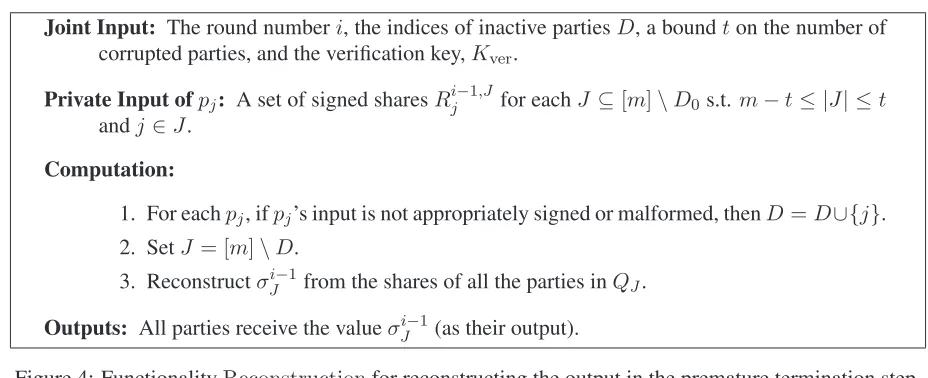
A formal description of the protocol appears in Figure 3. The reconstruction functionality used in this protocol (when at leastm−tparties aborted) appears in Figure 4. The details of how to construct a protocol secure-with-abort and cheat-detection withO(1)rounds are given in [4].
Comparison with the multiparty coin-tossing protocol of [4]. Our protocol combines ideas from the protocols of [22, 4]. However, there are some important differences between our protocol and the protocol of [4]. In the coin-tossing protocol of [4], the bits σi
J are shared using a threshold scheme where the threshold is smaller than the size of the setQJ. This means that a proper subset ofQJ containing corrupt parties can reconstructσi
J. In coin-tossing this is not a problem since there are no inputs. However, when computing functionalities with inputs, suchσi
J might reveal information on the inputs of honest parties in
QJ, and we shareσiJ with threshold|QJ|. As a result, we use more setsQJ than in [4] and the bias of the protocol is increased (put differently, to keep the same security, we need to increase the number of rounds in the protocol). For example, the protocol of [4] has small bias when there are polynomially many parties andt = m/2. Our protocol is efficient only when there are constant number of parties. As explained in Section 4, this difference is inherent as a protocol for general functionalities with polynomially many parties andt=m/2cannot have a small bias.
3.3 A1/p-Secure Protocol for Polynomial Range
Using an idea of [22], we modify our protocol such that it will have a small bias when the size of the range of the functionalityF is polynomially bounded (even ifFis randomized and has a big domain of inputs). The only modification is the way that eachσi
Jis chosen prior to roundi?: with probability1/(2p)we chooseσJi as a random value in the range offnand with probability1−1/(2p)we choose it as in Figure 2. Formally, in the model with the dealer, in the preprocessing phase ofMPCWithDrdescribed in Figure 1, we replace Step (5) with the following step:
Inputs: Each party pj holds the private input yj ∈ Xn and the joint input: the security parameter1n, the number of rounds in the protocolr=r(n), and a boundton the number of corrupted parties.
Preliminary phase:
1. D0=∅
2. If|D0|< m−t,
(a) The parties in {pj :j ∈[m]\D0}execute a secure-with-abort and cheat-detection protocol computing FunctionalityMultiShareGenr. Each honest partypj inputsyj as its input for the functionality.
(b) If a partypj aborts, that is, the output of the honest parties is “abortj”, then, set D0=D0∪ {j}, chosexj uniformly at random fromxj, and goto Step (2).
(c) Else (no party has aborted), denoteD=D0and proceed to the first round.
3. Otherwise (|D0| ≥m−t), the premature termination is executed withi= 1.
In each roundi= 1, . . . , rdo:
4. Each partypjbroadcastsMj,i(containing its shares in the outer secret-sharing scheme).
5. For everypj s.t.Ver(Mj,i, Kver) = 0or ifpj broadcasts an invalid or no message, then all parties markpj as inactive, i.e., setD=D∪ {j}. If|D| ≥m−t, premature termination is executed.
Premature termination step
6. Ifi= 1, the active parties use a multiparty secure protocol (with full security) to compute fn: Each honest party inputsyjand the input of each inactive party is chosen uniformly at random fromXn. The active parties output the result, and halt.
7. Otherwise,
(a) Each partypjreconstructsRij−1,J, the signed share of the inner secret-sharing scheme produced in Step (6) of FunctionalityMultiShareGenr, for eachJ ⊆[m]\D0 s.t.
m−t≤ |J| ≤tandj ∈J.
(b) The active parties execute a secure multiparty protocol with an honest majority to compute FunctionalityReconstruction, where the input of each partypj isRij−1,J for everyJ ⊆[m]\D0s.t.m−t≤ |J| ≤tandj∈J.
(c) The active parties output the output of this protocol, and halt.
At the end of roundr:
8. Each active partypj broadcasts the signed sharesRr,Jj for eachJsuch thatj∈J.
9. LetJ ⊆ [m]\Dbe the lexicographical first set such that all the parties inQJ broadcast properly signed sharesRr,Jj . Each active party reconstructs the valueσr
J, outputsσrJ, and halts.
Joint Input: The round numberi, the indices of inactive partiesD, a boundton the number of corrupted parties, and the verification key,Kver.
Private Input ofpj: A set of signed sharesRij−1,J for eachJ ⊆[m]\D0 s.t.m−t≤ |J| ≤t
andj∈J.
Computation:
1. For eachpj, ifpj’s input is not appropriately signed or malformed, thenD=D∪{j}. 2. SetJ = [m]\D.
3. ReconstructσiJ−1 from the shares of all the parties inQJ.
Outputs: All parties receive the valueσJi−1(as their output).
Figure 4: FunctionalityReconstructionfor reconstructing the output in the premature termination step.
– with probability1/(2p), select uniformly at randomzi
J ∈Znand setσJi =zJi.
– with the remaining probability1−1/(2p),
1. For everyj6∈Jselect uniformly at randomxbj ∈Xnand for eachj∈J, setxbj =xj. 2. Computeσi
J ←fn(xb1, . . . ,bxm).
Similarly, in the protocol without the dealer, Protocol MPCr, we replace Step (3) inMultiShareGenr (described in Figure 2) with the above step. Denote the resulting protocols with and without the dealer models byMPCWithDForRangeandMPCForRanger, respectively.
The idea why this change improves the protocol is that now the probability that all values held by the adversary are equal prior to roundi? is bigger, thus, the probability that the adversary guessesi? is smaller. This modification, however, can cause the honest parties to output a value that is not possible given their inputs, and, in general, we cannot simulate the case (which happens with probability1/(2p)) when the output is chosen with uniform distribution from the range.
4 Impossibility of
1
/p
-secure Computation with Non-Constant Number of
Parties
For deterministic functions, our protocol is efficient when the number of partiesmis constant and the size of the domain or range is polynomial (in the security parametern) or when the number of parties isO(log logn) and the size of the domain is constant. We next show that, in general, there is no efficient protocol when the number of parties ism(n) = ω(1)and the size of the domain is polynomial and whenm(n) = ω(logn) and the size of the domain of each party is 2. This is done using the following impossibility result of Gordon and Katz [22].
Theorem 3 ([22]) For every `(n) = ω(logn), there exists a deterministic 2-party functionalityF with domain and range{0,1}`(n)that cannot be1/p-securely computed forp≥2 + 1/poly(n).
We next state and prove our impossibility results.
Proof: Let`(n) =m(n)/2(for simplicity, assumem(n)is even). LetF ={fn}n∈Nbe the functionality guaranteed in Theorem 3 for`(n). Define anm(n)-party deterministic functionalityF0 ={f0
n}n∈N, where inf0
n partypj gets thejth bit of the inputs offn and the outputs offn andfn0 are equal Assume thatF0 can be1/p-securely computed by a protocolΠ0 assuming thatt(n) = m(n)/2 parties can be corrupted. This implies a1/p-secure protocolΠforF with two parties, where the first party simulates the firstt(n) parties inΠ0 and the second party simulates the lastt(n)parties. The1/p-security ofΠis implied by the fact that any adversaryA for the protocolΠ can be transformed into an adversaryA0 for Π0 controlling
m(n)/2 = t(n) parties; asA0 cannot violate the 1/p-security of Π0, the adversary A cannot violate the
1/p-security ofΠ. ¤
Theorem 5 For everym(n) =ω(1), there exists a deterministicm(n)-party functionalityF00with domain {0,1}lognthat cannot be1/p-securely computed forp≥2 + 1/poly(n)without an honest majority. Proof: Let`(m) = 0.5m(n) lognand letF ={fn}n∈Nbe the functionality guaranteed in Theorem 3 for
`(m). We divide the2`(n)bits of the inputs offnintom(n)blocks of lengthlogn. Define anm(n)-party deterministic functionalityF00 ={f00
n}n∈N, where infn00partypj gets thejth block of the inputs offnand the outputs offnandfn00are equal. As in the proof of Theorem 4, a1/p-secure protocol forF00 implies a
1/p-secure protocol forFcontradicting Theorem 3. ¤
The above impossibility results should be contrasted with the coin-tossing protocol of [4] which is an efficient1/p-secure protocol even whenm is polynomial in the security parameter and the number of bad parties ism(n)/2 +O(1). Notice that in both our impossibility results the size of the range is super-polynomial (as we consider the model where all parties get the same output). It is open if there is an efficient 1/p-secure protocol when the number of parties is not constant and the size of both the domain and range is polynomial.
References
[1] Y. Aumann and Y. Lindell. Security against covert adversaries: Efficient protocols for realistic ad-versaries. In S. Vadhan, editor,Proc. of the Fourth Theory of Cryptography Conference – TCC 2006, volume 4392 ofLecture Notes in Computer Science, pages 137–156. Springer-Verlag, 2007.
[2] D. Beaver and S. Goldwasser. Multiparty computation with faulty majority. InProc. of the 30th IEEE Symp. on Foundations of Computer Science, pages 468–473, 1989.
[3] A. Beimel, E. Omri, and I. Orlov. Protocols for multiparty coin toss with dishonest majority. Full version of [4].
[4] A. Beimel, E. Omri, and I. Orlov. Protocols for multiparty coin toss with dishonest majority. In T. Rabin, editor,Advances in Cryptology – CRYPTO 2010, volume 6223 ofLecture Notes in Computer Science, pages 538–557. Springer-Verlag, 2010.
[5] M. Ben-Or, O. Goldreich, S. Micali, and R. Rivest. A fair protocol for signing contracts. InProceedings of the 12th Colloquium on Automata, Languages and Programming, pages 43–52. Springer-Verlag, 1985.
[6] M. Blum. How to exchange (secret) keys. ACM Trans. Comput. Syst., 1(2):175–193, 1983.
[8] R. Canetti. Security and composition of multiparty cryptographic protocols. J. of Cryptology, 13(1):143–202, 2000.
[9] R. Cleve. Limits on the security of coin flips when half the processors are faulty. InProc. of the 18th STOC, pages 364–369, 1986.
[10] R. Cleve. Controlled gradual disclosure schemes for random bits and their applications. In G. Brassard, editor, Advances in Cryptology – CRYPTO ’89, volume 435 of Lecture Notes in Computer Science, pages 573–588. Springer-Verlag, 1990.
[11] I. Damg˚ard. Practical and provably secure release of a secret and exchange of signatures. J. of Cryp-tology, 8(4):201–222, 1995.
[12] S. Even, O. Goldreich, and A. Lempel. A randomized protocol for signing contracts. CACM, 28(6):637–647, 1985.
[13] Z. Galil, S. Haber, and M. Yung. Cryptographic computation: Secure fault-tolerant protocols and the public-key model. In C. Pomerance, editor,Advances in Cryptology – CRYPTO ’87, volume 293 of Lecture Notes in Computer Science, pages 135–155. Springer-Verlag, 1988.
[14] J. A. Garay, P. D. MacKenzie, M. Prabhakaran, and K. Yang. Resource fairness and composability of cryptographic protocols. In S. Halevi and T. Rabin, editors,Proc. of the Third Theory of Cryptog-raphy Conference – TCC 2006, volume 3876 ofLecture Notes in Computer Science, pages 404–428. Springer-Verlag, 2006.
[15] O. Goldreich. Foundations of Cryptography, Voume II Basic Applications. Cambridge University Press, 2004.
[16] O. Goldreich, S. Micali, and A. Wigderson. How to play any mental game. InProc. of the 19th ACM Symp. on the Theory of Computing, pages 218–229, 1987.
[17] S. Goldwasser and L. Levin. Fair computation of general functions in presence of immoral majority. In A. J. Menezes and S. A. Vanstone, editors,Advances in Cryptology – CRYPTO ’90, volume 537 of Lecture Notes in Computer Science, pages 77–93. Springer-Verlag, 1991.
[18] S. Goldwasser and Y. Lindell. Secure computation without agreement. In DISC ’02: Proceedings of the 16th International Conference on Distributed Computing, pages 17–32, London, UK, 2002. Springer-Verlag.
[19] D. Gordon and J. Katz. Complete fairness in multi-party computation without an honest majority. In Proc. of the Sixth Theory of Cryptography Conference – TCC 2009, pages 19–35, Berlin, Heidelberg, 2009. Springer-Verlag.
[20] S. D. Gordon, C. Hazay, J. Katz, and Y. Lindell. Complete fairness in secure two-party computation. InProc. of the 40th ACM Symp. on the Theory of Computing, pages 413–422, 2008.
[21] S. D. Gordon, Y. Ishai, T. Moran, R. Ostrovsky, and A. Sahai. On complete primitives for fairness. In D. Micciancio, editor,Proc. of the Seventh Theory of Cryptography Conference – TCC 2010, volume 5978 ofLecture Notes in Computer Science, pages 91–108. Springer-Verlag, 2010.
[23] M. Luby, S. Micali, and C. Rackoff. How to simultaneously exchange a secret bit by flipping a symmetrically-biased coin. In Proc. of the 24th IEEE Symp. on Foundations of Computer Science, pages 11–21, 1983.
[24] T. Moran, M. Naor, and G. Segev. An optimally fair coin toss. In Proc. of the Sixth Theory of Cryptography Conference – TCC 2009, pages 1–18, 2009.
[25] B. Pinkas. Fair secure two-party computation. In E. Biham, editor, Advances in Cryptology – EU-ROCRYPT 2003, volume 2656 ofLecture Notes in Computer Science, pages 87–105. Springer-Verlag, 2003.
[26] A. Shamir. How to share a secret. Communications of the ACM, 22:612–613, 1979.
[27] A. C. Yao. How to generate and exchange secrets. InProc. of the 27th IEEE Symp. on Foundations of Computer Science, pages 162–167, 1986.
A Security with Abort and Cheat Detection
We next present a definition of secure multiparty computation that is more stringent than standard definitions of secure computation with abort. This definition extends the definition for secure computation as given by Aumann and Lindell [1]. Roughly speaking, the definition requires that one of two events is possible: (1) The protocol terminates normally, andallparties receive their outputs, or (2) Corrupted parties deviate from the prescribed protocol; in this case the adversary obtains the outputs of the corrupted parties (but nothing else), and all honest parties are given an identity of one party that has aborted. The formal definition uses the real vs. ideal paradigm as discussed in Section 2.1. We next describe the appropriate ideal model.
Execution in the ideal model. LetB ⊆ [m]denote the set of indices of corrupted parties controlled by an adversaryA. The adversaryAreceives an auxiliary input denotedaux. An ideal execution proceeds as follows:
Send inputs to trusted party: The honest parties send their inputs to the trusted party. The corrupted parties may either send their received input, or send some other input of the same length (i.e.,xj ∈
Xn) to the trusted party, or abort (by sending a special“abortj” message). Denote byx1, . . . , xm the inputs received by the trusted party. If the trusted party receives an“abortj” message, then it sends“abortj” to all honest parties and terminates (if it received“abortj” from more than onej, then it uses the minimal suchj).
Trusted party sends outputs to adversary: The trusted party computesw ←fn(x1, . . . , xm)and sends the outputwto the adversary.
Adversary instructs the trusted party to continue or halt: Asends either a“continue” message or “abortj” to the trusted party for some corrupt party pj, i.e.,j ∈ B. If it sends a“continue” message, the trusted party sendswto all honest parties. Otherwise, if the adversary sends“abortj”, then the trusted party sends“abortj” to all honest parties.
We let IDEALCDF,S(aux)(~y,1n) and REAL
Π,A(aux)(~y,1n) be defined as in Section 2.1 (where in this
caseIDEALCDF,S(aux)(~y,1n) refers to the above execution with cheat-detection ofF). This ideal model is different from that of [15] in that in the case of an “abort”, the honest parties get output“abortj” and not a⊥symbol. This means that the honest partiesknowan identity of a corrupted party that causes the abort. This cheat-detection is achieved by most multiparty protocols, including that of [16], but not all (e.g., the protocol of [18] does not meet this requirement). Using this notation we define secure computation with abort and cheat-detection.
Definition A.1 (security-with-abort and cheat-detection) LetFandΠbe as in Definition 2.2. A protocol Πis said tosecurely computeFagainst at mostt(n)corrupt parties with abort and cheat-detection if for every non-uniform polynomial-time adversaryAin the real model controlling at mostt(n)parties, there exists a non-uniform polynomial-time adversarySin the ideal model controlling the same parties, such that
n
IDEALCDF,S(aux)(~y,1n)
o
aux∈{0,1}∗,~y∈(Xn)m,n∈N
C
≡ ©REALΠ,A(aux)(~y,1n)ªaux∈{0,1}∗,~y∈(X
n)m,n∈N.
B Cryptographic Tools
Signature Schemes. Informally, a signature on a message proves that the message was created by its presumed sender, and its content was not altered. A signature scheme is a triple(Gen,Sign,Ver)containing the key generation algorithmGen, which outputs a pair of keys, the signing keyKSand the verification key
Kv, the signing algorithmSign, and the verifying algorithmVer. We assume that it is infeasible to produce signatures without holding the signing key. For formal definition see [15].
Secret Sharing Schemes. Anα-out-of-msecret-sharing scheme is a mechanism for sharing data among a set of parties such that every set of sizeαcan reconstruct the secret, while any smaller set knows nothing about the secret. In this paper, we use two schemes: the XOR-basedm-out-of-mscheme (i.e., in this scheme
α=m) and Shamir’sα-out-of-msecret-sharing scheme [26] which is used whenα < m. In both schemes, for everyα−1parties, the shares of these parties are uniformly distributed and independent of the secret. Furthermore, given suchα−1shares and a secrets, one canefficientlycomplete them tomshares of the secrets.
In our protocols we sometimes require that a single party learns the value of a secret that is shared among all parties. Since all messages are sent over a broadcast channel, we use two layers of secret sharing to obtain the above requirements as described below.
Construction B.1 (secret sharing with respect to a certain party) Letsbe a secret taken from some finite fieldF. We sharesamongmparties with respect toa (special) partypj in anα-out-of-msecret-sharing scheme as follows:
1. Choose shares(s(1), s(2)) of the secret sin a two-out-of-two secret-sharing scheme (that is, select
s(1) ∈ Funiformly at random and computes(2) = s−s(1)). Denote these shares bymask
j(s)and comp(s), respectively.
2. Compute shares(λ(1), . . . , λ(j−1), λ(j+1), . . . , λ(m))of the secretcomp(s)in an(α−1)-out-of-(m− 1)Shamir’s secret-sharing scheme. For each`6=j, denotecomp`(s) =λ(`).
Output:
• The share of each partyp`, where`6=j, iscomp`(s). We call this share “p`’scomplementshare”. In the above scheme, we share the secretsamong the parties inP in anα-out-of-msecret-sharing scheme where only sets of sizeα that containpj can reconstruct the secret. In this construction, for everyβ < α parties, the shares of these parties are uniformly distributed and independent of the secret. Furthermore, given suchβ < αshares and a secrets, one canefficientlycomplete them tom shares of the secrets. In addition, given β shares and a secret s, one can efficientlyselect uniformly at random a vector of shares competing theβshares tomshares ofs.
C Proof of
1
/p
-Security of the Protocols with a Dealer
In this section we prove that our protocols described in Section 3 that assume an trusted dealer are perfect 1/poly-secure implementations of the ideal functionality F. We start by presenting in Appendix C.1 a simulator for Protocol MPCWithDr. In Appendix C.2, we prove the correctness of the simulation by showing the the global output in the ideal-world is distributed within1/polystatistical distance from the global output in the real-world. In Appendix C.3, we describe the required modifications to the simulator for the protocol forF that has a polynomial-size range, and argue that the modified simulation is correct.
C.1 The Simulator for ProtocolMPCWithDr
We next present a simulator ST for Protocol MPCWithDr, described in Figure 1. Let B be the set of indices of corrupted parties in the execution.
The simulatorST invokesAon the set of inputs{yj :j∈B}, the security parameter1n, and the auxil-iary inputaux, playing the role of the trusted dealer in the interaction withA.
Simulating the preprocessing phase:
1. D0 =∅.
2. The simulatorST sends a“start” message to all corrupt parties.
3. ST receives a set of inputs {xj :j∈B} thatA submits to the computation of the dealer. If A does not submit an input on behalf of pj, i.e., A sends an “abortj” message, then, the simulatorST notifies all corrupted parties that partypjaborted and updatesD0=D0∪ {j}.
4. ST sets D = D0. If |D| ≥ m−t, the simulator sets i = 1 and proceeds to simulate the
premature termination step.
5. ST selectsi? ∈ {1, . . . , r}with uniform distribution. 6. For eachi∈ {1, . . . , i?−1}and for eachJ ⊆B\D
0s.t.m−t≤ |J| ≤tdo
(a) For eachj ∈ [m], if j ∈ J, thenST setsxbj = xj, else,ST selects uniformly at random
b
xj ∈Xn. (b) ST setsσi
J ←fn(xb1, . . . ,xbm).
7. The simulatorST sends“proceed” to all corrupt parties.
Simulating interaction rounds: In each round1≤i≤r, the simulatorST interacts in three phases with the parties{pj :j ∈B\D0}, i.e., the corrupt parties which are active so far:
• The peeking phase:
– Ifi = i?, the simulatorS
T sends the set of inputs{xj :j ∈B\D0} to the trusted party
– For eachJ ⊆B\D0s.t.m−t≤ |J| ≤tdo
1. Ifi∈ {1, . . . , i?−1}, the simulatorS
T sends the valueσJi (prepared in the simulation of the preprocessing phase) to all parties inQJ (i.e., to the adversary).
2. Else, ifi ∈ {i?, . . . , r},S
T sends the valuewS to all parties inQJ (i.e., to the adver-sary).
• The abort phase:Upon receiving an“abortj” message from a partypj, 1. ST notifies all corrupted parties that partypj aborted.
2. ST updatesD=D∪ {j}.
3. If at leastm−tparties have aborted so far, that is|D|> m−t, the simulatorST proceeds to simulate the premature termination step.
• The main phase:ST sends“proceed” to all corrupt parties.
Simulating the premature termination step:
• If the premature termination step occurred in roundi= 1,
– The simulatorST receives a set of inputs{xj0 :j∈B\D}thatAsubmits to the compu-tation of the dealer.
IfAdoes not submit an input on behalf ofpj, i.e., sends an“abortj” message, then, the simulatorS notifies all corrupted parties that partypj aborted and updatesD=D∪ {j}.
– The simulatorST sends the set of inputs{xj0:j ∈B\D}to the dealer and receiveswS. • If the premature termination step occurred in round1< i < i?,
1. Upon receiving an“abortj” message from a partypj, the simulatorST updates D =
D∪ {j}.
2. The simulatorST sends the set of inputs{xj :j∈B\D}to the trusted party computing Fand receiveswS.
• (¦If the premature termination step occurred in roundi? ≤i≤r, thenS
T already haswS¦) • ST sends the valuewSto each party in{pj :j ∈B\D0}.
Simulating normal termination: If the last round of the protocol is completed, thenST sendswSto each party in{pj :j∈B\D0}.
At the end of the interaction withA, the simulator will output the sequence of messages exchanged between the simulator and the corrupted parties.
C.2 Proof of the Correctness of the Simulation forMPCWithDr
In order to prove the correctness of the simulation described in Appendix C.1, we consider the two random variables from Section 2.1, both of the form(V, C), whereV describes a possible view ofA, andCdescribes a possible output of the honest parties (i.e.,C ∈Zn). The first random variableREALMPCWithDr,A(aux)(~y,1n)
describes the real world – an execution of ProtocolMPCWithD, whereV describes the view of the adver-saryAin this execution, andCis the output of the honest parties in this execution. The second random vari-ableIDEALF,ST(aux)(~y,1n)describes the ideal world – an execution with the trusted party computingF (this trusted party is denoted byTF), whereV describes the output of the simulatorST in this execution, and
Cis the output of the honest parties in this execution. For the rest of this section, we simplify notations and denote the above two random variables byREAL = (VREAL, CREAL)andIDEAL = (VIDEAL, CIDEAL)