© 2019, IJCSMC All Rights Reserved 104 Available Online at www.ijcsmc.com
International Journal of Computer Science and Mobile Computing
A Monthly Journal of Computer Science and Information Technology
ISSN 2320–088X
IMPACT FACTOR: 6.017IJCSMC, Vol. 8, Issue. 2, February 2019, pg.104 – 115
DETECTION OF WILD ELEPHANTS USING
IMAGE PROCESSING ON RASPBERRY PI3
1
SAILESH.K;
2HARSHA VARDHAN BALINA;
3SIVAKUMAR.T;
4VIJAYA POOJITHA.P
1
Department of ECE & PSG College of Technology, INDIA 2
Department of ECE & PSG College of Technology, INDIA 3
Department of ECE & PSG College of Technology, INDIA 4
Department of ECE & PSG College of Technology, INDIA
1 [email protected]; 2 [email protected]; 3 [email protected]; 4 [email protected]
Abstract- The conservation of crop field has been a main content and a complex issue. The animals mainly elephants from the protected area [PAs] are continuously attacking the crop field over the years and the protection of this crop field has become a main concern. Wildlife intrusion in areas with high human mobility is proved to be lethal for both human beings and animals. The surveillance and tracking of the wild elephants are difficult due to their size and nature of movement. Further, identifying the species captured from camera is a critical challenge. Thus, our proposed system seeks to identify wild elephants that disturb the human life and the agricultural fields with the aid of an intelligent image processing algorithm in Raspberry pi. In our methodology, the process followed is the detection of motion in the video frame and identification of the objects in the area descriptor as the local features which describes the unique features of animal. So it detects the elephants accurately and creates the different sound via speaker like honey bees sound which mainly irritates the wild elephants and also focusing the bright focus lights on the elephants so it cannot see properly and has a more chance to stop and get back into the forest. The system also simultaneously alerts the authorized person if the elephant is detected by sending a message through IoT.
I. INTRODUCTION
Intrusion of elephants in forest border in various regions of India and across has been reported as a serious problem. Every year almost 100-300 humans and 40-50 elephants are killed during crop marauding in India. The system is proposed using raspberry pi and python.So, this project focuses on development of emergency response system to avoid this intrusion with the help of advanced image processing techniques and algorithms which will find the intrusion of elephant.
© 2019, IJCSMC All Rights Reserved 105
II. DATA ANALYSIS
Wildlife officials, in reply to an RPI petition, said that around 22 elephants were electrocuted from fences around plantations which are private in Tamil Nadu. Since 2001, a total of 1,113 wild elephants died due to all causes. Delhi-based wildlife Protection Society of India (WPSI) said that between the years 2010 and 2016 around 355 elephants died all over the country by accidental or deliberate electrocution, out of which 62 elephants died in the year 2016 alone. This is the second largest animal electrocution at 181 which is then followed by leopards and peacocks with 64 deaths for every 6 years.
In June 2016 a 15 year old elephant was electrocuted by an electric fence which was kept around a private coffee estate near Udhagamandalam, a city which borders the Mudahalli Elephant Corridor in the state. In July 2016 a four year old elephant calf was electrocuted on a farmland in the Burugur forest area nearer to the Chamarajanagar Wildlife Division where the Mudahalli Corridor connects to the Sathyamangalam Tiger Reserve.
Between the years 2013 and 2016, about 1,700 crop raiding incidents were noted along with 40 human deaths and around 300 injuries caused due to the wildlife which was reported in the kajjado district in kenya. An elephant family of 2 adults and 2 juveniles died immediately when they were struck by the tight electric fence near the plantation area in the kodagu district which is in the south India state of Karnataka. Two very rare elephants, in search of food, have died by electrocution in Aceh Timur District, on October 17, 2017.
III. EXISTING ELEPHANT HARMING SURVEILLANCE SYSTEM
There are many existing methods such as building physical barriers, use of electric fences and manual surveillance. But these methods may kill the animals or it may injure them.
A.Electric Fence Warning System
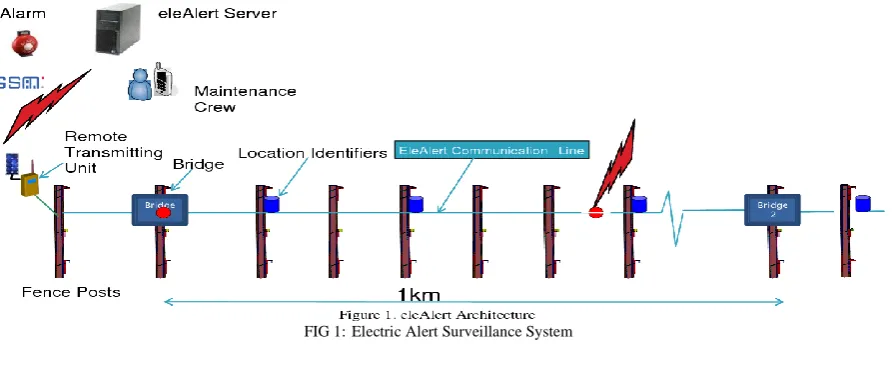
This system helps to detect the wild elephant which comes from the forest using electric fences. Electric fence elephant detection system uses a network of sensors to detect and locate damages instantly and alert communities via the mobile communications network. The method of detecting an elephant surveillance system using electric fence is illustrated below:
FIG 1:Electric Alert Surveillance System
IV. AIM OF OUR PROPOSED RESEARCH
Our proposed research helps farmers to save time and money by reducing the manual work of the farmers otherwise themselves had to provide protection to their farmlands with their constant manual supervision. The manual work done in order to keep away the animals from the crops is automated, hence such constant supervision is a thing of the past with our smart protection systems, which are capable of identifying and taking the required actions themselves without any human intervention.
V. HARDWARE ARCHITECTURE
A. Working Of Our Device And Block Diagram
The device detects the animals in real time,
With the help of camera, pictures are taken and using image processing algorithms we conclude whether the animal is present or not.
© 2019, IJCSMC All Rights Reserved 106 Fig 2: Block Diagram
B. Technical Specification And Details About The Components Used
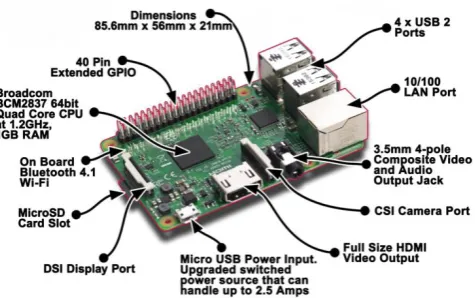
Raspberry Pi3 Model B
The Raspberry Pi is a low cost, small sized computer that plugs into a computer monitor, and uses a standard keyboard and mouse. And it contains
Broadcom BCM2837 64bit ARMv7 Quad Core Processor powered Single Board Computer running at 1.2GHz 1GB RAM
BCM43143 WiFi on board
Bluetooth Low Energy (BLE) on board 40pin extended GPIO
4 x USB 2 ports
4 pole Stereo output and Composite video port Full size HDMI
CSI camera port for connecting the Raspberry Pi camera
DSI display port for connecting the Raspberry Pi touch screen display Micro SD port for loading your operating system and storing data
Upgraded switched Micro USB power source (now supports up to 2.4 Amps)
Expected to have the same form factor has the Pi 2 Model B, however the LEDs will change position.
Fig 3:Raspberry Pi 3 Model B
Apr 9600 Voice Module
© 2019, IJCSMC All Rights Reserved 107 High-quality voice recording & playback solution
Non-volatile Flash memory technology
Total sound recording time can be varied from 32 seconds to 60 seconds by changing the value of a single resistor.
Fig 4: PIN Diagram Of APR 9600 Voice Module
Relay
Relay is an electromagnetic device which is used to isolate two circuits electrically and connect them magnetically. They are
very useful devices and allow one circuit to switch another one while they are completely separate. They are often used to interface an electronic circuit (working at a low voltage) to an electrical circuit which works at very high voltage. For example, a relay can make a 5V DC battery circuit to switch a 230V AC mains circuit. Thus a small sensor circuit can drive, say, a fan or an electric bulb. A relay switch is divided into two parts: i/p and o/p. The input side has a coil which generates magnetic field when a small voltage from an electronic circuit is applied to it. This voltage is called the operating voltage. In a relay there are three contactors: normally open (NO), normally closed (NC) and common (COM). At no input state, the COM is connected to NC. When the operating voltage is applied the relay coil gets energized and the COM changes contact to NO.
Camera And Focus Light
The camera used is 10 megapixels and has a focal length of 3.5mm and it is used to take pictures of the elephants for every 3 seconds according to the algorithm. The camera gets interfaced through the raspberry pi using USB cable. When match=0 the camera module turns ON. The camera separates the images into many pixels and converts it in grey scale so that algorithm can match the descriptors. The focus light is used to focus on the animals it is activated once the animals are detected. The relay is connected to the focus light. After the elephant is detected the relay circuit go to close loop condition and the focus light turns ON.
VI. HARDWARE IMPLEMENTATION
© 2019, IJCSMC All Rights Reserved 108
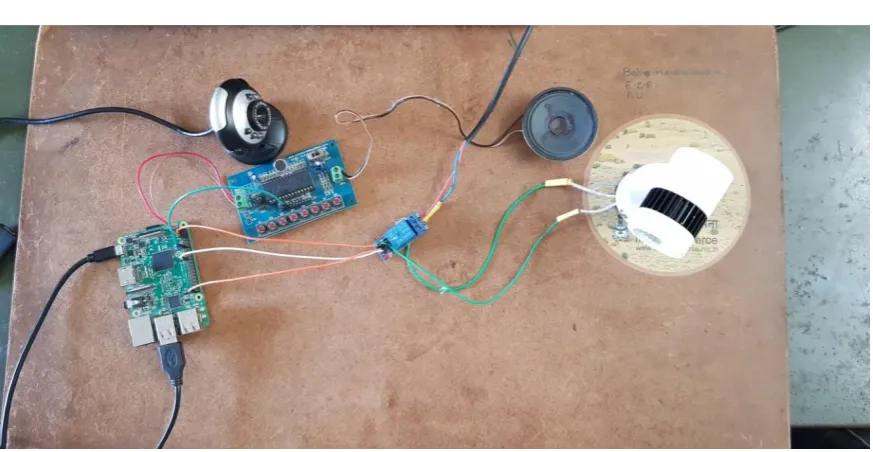
This is the connection of the hardware components which is been interlinked to each other by normal connecting wires.
A. Interfacing Relay With Raspberry Pi 3 And Focus Light
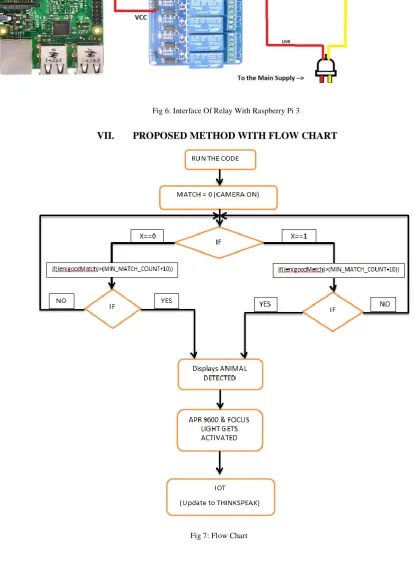
Fig 6: Interface Of Relay With Raspberry Pi 3
VII. PROPOSED METHOD WITH FLOW CHART
© 2019, IJCSMC All Rights Reserved 109
A.Working Of The Algorithm
Run the code and if match=0 encounters camera module turns ON.
Next if the camera detects the image equal to our long shot(X=0) reference image and the output is “Animal Detected”.
If not the camera will surely detects the short shot(X=1) reference image and the output is “Animal1 Detected”.
Then at the moment the camera detects the elephant with our reference image the APR9600 module and the focus light turns ON and the message is sent to the owner that elephant has detected via “Thingspeak”app(IoT).
VIII. SOFTWARE ARCHITECTURE
A. Open CV
Open CV (Open Source Computer Vision) is a library of programming functions mainly aimed at real-time computer vision. Originally developed by Intel, it was later supported by Willow Garage. The library is cross-platform and free for use under the open-sourceBSD license.
Open CV is written in C++ and its primary interface is in C++, but it still retains a less comprehensive though extensive older C interface. There are bindings in Python, Java and MATLAB/OCTAVE. The API for these interfaces can be found in the online documentation Wrappers in other languages such as C#, Perl, Ch, Haskell and Ruby have been developed to encourage adoption by a wider audience. All of the new developments and algorithms in OpenCV are now developed in the C++ interface.
B. Python
Python is an interpreted high for general-purpose programming. Created by Guido van Rossum and first released in 1991, Python has a design philosophy that emphasizes code readability, notably using significant whitespace. It provides constructs that enable clear programming on both small and large scales.
Python features a dynamic type system and automatic memory management. It supports multiple programming paradigms, including object-oriented, imperative, functional and procedural, and has a large and comprehensive standard library.
Python interpreters are available for many operating systems. CPython, the reference implementation of Python, is open source software and has a community-based development model, as do nearly all of Python's other implementations. Python and C Python are managed by the non-profit Python Software Foundation.
C. Flann Matching Algorithm
In this project Flann Matching Algorithm is used. The matching is done after identifying the key points and descriptors from both object and scene. Open CV has two matching strategies Brute force matcher and Flann matcher.
The Brute force matcher takes one descriptor from scene and it matches with the all descriptor in the object using distance calculation and the closest matched value is returned.
The Flann library contains the algorithm which takes the nearest descriptor in both object and scene and it matches. It works faster than brute force matcher.
FLANN_INDEX_KDTREE=0
flannParam=dict(algorithm=FLANN_INDEX_KDTREE,tree=5) flann=cv2.FlannBasedMatcher(flannParam,{})
This is the default algorithm for flann match.
D. Reference Image Location
This is the code for finding reference image location. roadnarrow=cv2.imread('dataset/Capture.jpg',0)
© 2019, IJCSMC All Rights Reserved 110
E. Image Colour Conversion And Matching
The below statement reads the colour conversion
ret,QueryImgBGR=cam.read()
The below command converts the colour image to gray image
QueryImg=cv2.cvtColor(QueryImgBGR,cv2.COLOR_BGR2GRAY)
The below command line allots the detector points to the image
queryKP,queryDesc=detector.detectAndCompute(QueryImg,None)
The below command line matches the found destructor with the reference image destructor using flann match algorithm
matches=flann.knnMatch(queryDesc,airportDecs,k=2)
IX. RESEARCH RESULTS
For this working model the video containing animals is played and it’s shown as the real time application.
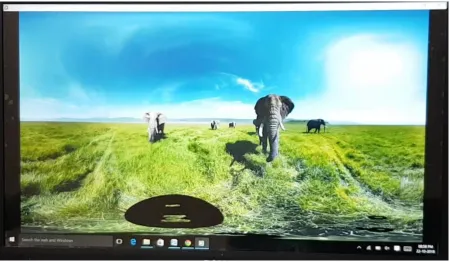
A video is played in front of the camera, where the elephant walks in from a faraway distance to near the screen. The below figure 8 depicts the animal is nearer.
© 2019, IJCSMC All Rights Reserved 111
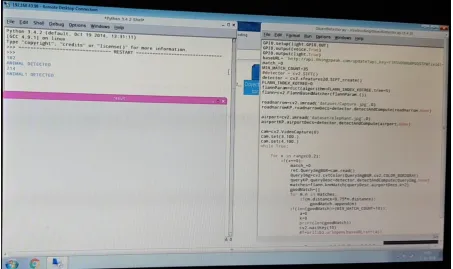
As soon as the elephant is detected from far away distance the first IF loop starts running as the matches will be less than 10, and the elephant is detected. It is shown in below figure 9.
Fig 9:Output After Animal Detection
The elephant is detected continuously for every 3 seconds as long as it moves in front of the camera and the result is obtained in the result window. It is shown in below figure 10.
© 2019, IJCSMC All Rights Reserved 112
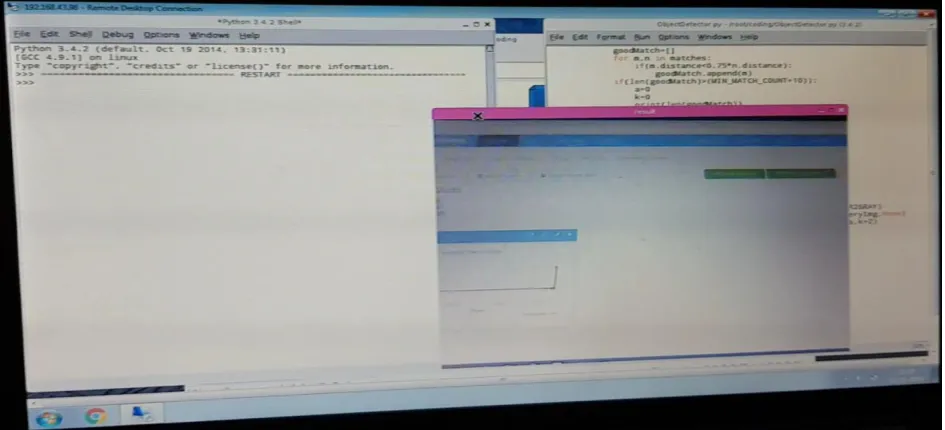
After 2 results the elephant picture is displayed in the result window, which continuously changes as long as the input is given to camera. It is shown in below figure 11.
Fig 11:Output Screen 1
This below figure 12 is the hardware connection before the camera detects the elephant and the apr9600 led is to be in red colour when it’s on and if the elephant is not detected.
© 2019, IJCSMC All Rights Reserved 113
This below figure 13 is an output when elephant is detected by the camera and along with the red colour led the blue colour led glows which represents that the elephant is detected and the speaker is activated.
Fig 13: Output Screen 3
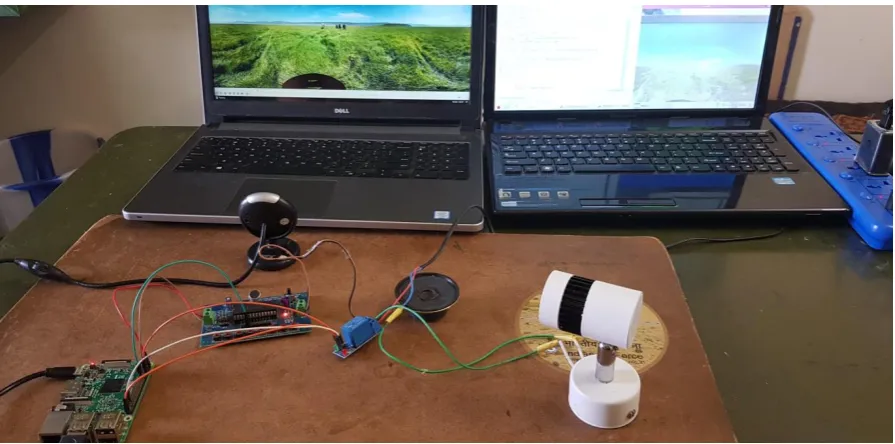
In the below figure 14 after detection of elephant both speaker and focus light is activated.
© 2019, IJCSMC All Rights Reserved 114
After the elephants are detected,the IoT Platform(Thingspeak) is updated continuously till the power supply to raspberry pi board is ON.This is shown in below figure 15.
Fig 15:IOT Platform(Thingspeak) Showing Results After The Elephant Is Detected
After the animal is detected, the ThingSpeak platform is updated with a 1 in the graph and also the time and date when the animal is detected which is show in the above figure 15. If the animal is not detected the graph remains at 0 itself which is shown in the below figure 16.
© 2019, IJCSMC All Rights Reserved 115
X. APPLICATION AND FUTURE WORK
A. Application
This device can be used and implemented on large scale near the forest areas to identify and detect the animals in real-time.
It helps in the study of moving patterns of animals.
Warning can be given beforehand for the people in the locality to safe guard themselves from the animals, and the forest department takes the needed action once the IOT platform is updated.
B. Future Work
The camera will be upgraded, such that the camera covers the 360 degrees constantly and along with the wild elephants we can detect other animals like wild pigs which is also destroying the farm lands rarely. Various sounds will be played such that the respective animals are scared off. The focus light and speakers will be updated with the driver motors to change the focus location according to the animal movement to drive them away back to the forest.
XI. CONCLUSION
Various features such as durability, affordability, prevention against damage and maintenance issues are addressed when these surveillance devices are designed. This surveillance device can contribute a lot towards the conservation of crops and securing the public in building a safe environment. Since the technology is new in India, proper awareness should be created among the public before it is implemented on a large scale. This project will help farmers in protecting their cash crops and save them from significant financial losses. It also aims to safeguard the animals from the unproductive efforts taken by the farmers and endure their safety protection for their lives and fields. This will also help them in achieving better crop yields thus leading to their economic well-being.
REFERENCES
[1] Ms. Sneha Nahatkar, Prof. Avinash Gaur, Prof. Tareek M. Pattewa “Design of a Home Embedded Surveillance System with Pyroelectric Infrared Sensor & Ultra-Low Alert Power” International Journal of Advanced Research in Electronics and Communication Engineering (IJARECE) Volume 1, Issue 3, September 2012.
[2] Padmashree S. Dhake,Sumedha S. Borde, “Embedded Surveillance System Using PIR Sensor”, International Journal of Advanced Technology in Engineering and Science, www.ijates.com Volume No.02, Issue No. 03, March 2014.
[3] Pramod P. J, S. V Srikanth, Vivek N, Mahesh U Patil, Sarat Chandra Babu N, “Intelligent Intrusion Detection System (In2DS) using Wireless Sensor Networks”, Proceedings of the 2009 IEEE International Conference on Networking, Sensing and Control, Okayama, Japan, March 26-29, 2009.
[4] Serkan Akbas1, Mehmet Akif Efe2, Suat Ozdemir, “Performance Evaluation of PIR Sensor Deployment in Critical Area Surveillance Networks”, 2014 IEEE International Conference on Distributed Computing in Sensor Systems.
[5] R. Hariprakash, S. Ananthi ,K Padmanabhan, An Economical Wireless Network Monitored Scheme for Camera Based Intrusion Detection at Unattended Sites,2011 International Conference on Computer Applications and industrial electronics. [6] Srinivasa Reddy Gudibandi M.Tech Student, JNTUA, Anantapuramu, A.P, India, Mr. M.Amarnath ,”Design of Smart Surveillance System using PIR and Ultrasonic Sensor”,International Journal & Magazine of Engineering, Technology, Management and Research,November 2015.