An efficient certificateless two-party
authenticated key agreement protocol
Debiao He 1 Sahadeo Padhye 2, Jianhua Chen 1, * 1
School of Mathematics and Statistics, Wuhan University, Wuhan, China 2
Motilal Nehru NAtional Institute of Technology, Allahabad, India *Email: [email protected]
Abstract: Due to avoiding the key escrow problem in the identity-based cryptosystem, certificateless public key cryptosystem (CLPKC) has received a significant attention. As an important part of the CLPKC, the certificateless authenticated key agreement (CLAKA) protocol also received considerable attention. Most CLAKA protocols are built from bilinear mappings on elliptic curves which need costly operations. To improve the performance, several pairing-free CLAKA protocols have been proposed. In this paper we propose a new pairing-free CLAKA protocol. Compared with the related protocols our protocol has better performance. We also show our protocol is provably secure in a very strong security model, i.e. the extended Canetti-Krawczyk (eCK) model.
Key words: Certificateless cryptography; Authenticated key agreement; Provable
security; Bilinear pairings; Elliptic curve
Classification Codes: 11T71, 94A60
1. Introduction
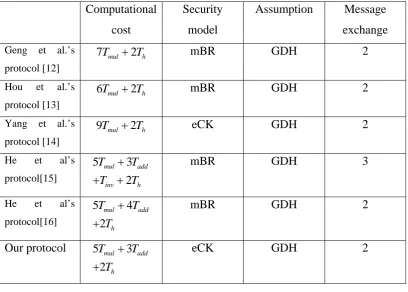
After Al-Riyami et al.’s work [3], numerous certificateless authenticated key agreement (CLAKA) protocols, using bilinear mappings on elliptic curves, have been proposed, e.g., [4–10]. However, the relative computation cost of a pairing is approximately twenty times higher than that of the scalar multiplication over elliptic curve group [11]. Therefore, CLAKA protocols without bilinear pairings would be more appealing in terms of efficiency. Recently, several CLAKA protocols without pairing have been proposed in [12-15]. Yang et al. [14] pointed out that neither Geng et al.’s protocol [14], nor Hou et al.’s protocol [13] is secure. He et al. [15] also proposed a CLAKA protocol without pairing. However, He et al.’s protocol is vulnerable to the type 1 adversary [16]. Although the latest CLAKA protocol [16] is more efficient than other protocols [12-15], it is provably secure under the mBR model [17], which is a very weak model. Yang et al. have shown that their scheme is provably secure in a very strong model-the extended Canetti-Krawczyk (eCK) model [18]. However, the user in Yang et al.’ protocol needs nine elliptic curve scalar multiplications to finish the key agreement. Moreover, the user has to verify the validity of public keys. This not only increases the burden of the user, but also reverses the thought of CLPKC. In this paper, we will propose a new pairing-free CLAKA protocol, which is provably secure in the eCK model. Besides, our protocol has better performance than the related protocols.
The remainder of this paper is organized as follows. Section 2 describes some preliminaries. In Section 3, we propose our CLAKA protocol. The security analysis of the proposed protocol is presented in Section 4. In Section 5, performance analysis is presented. Finally, in Section 6 we conclude the paper.
2. Preliminaries
2.2. Notations
In this subsection, we first introduce some notations as follows, which are used in this paper.
z p n, : two large prime numbers;
z Fp: a finite field;
z E F/ p: an elliptic curve defined on Fp;
z P: a generator of G;
z H1( )⋅ : a secure one-way hash function, where H1: {0,1}*× →G Zn*;
z H2( )⋅ : a secure one-way hash function, where
* * *
2:{0,1} {0,1} p
H × × × × × × →G G G G G Z ;
z IDi: the identity of user i;
z ( ,x Ppub): the KGC’s private/public key pair, where Ppub=xP;
z ( ,x Pi i): the user i’s secret value/public key pair, where Pi = ⋅x Pi ;
z ( ,r Ri i): a random point generated by KGC, where Ri = ⋅r Pi ;
z ( ,s Ri i): the user i ’s partial private key, where si = +ri h xi modn, 1( , )
i i i
h =H ID R ;
z ( ,t Ti i): the user i’s ephemeral private/public key pair, where Ti = ⋅t Pi ;
2.1. Background of elliptic curve group
Let the symbol E F/ p denote an elliptic curve E over a prime finite field p
F , defined by an equation
b ax x
y2 = 3+ + ,a,b∈Fp (1) and with the discriminant
3 2 4a 27b 0
Δ = + ≠ . (2) The points on E F/ p together with an extra point O called the point at infinity form a group
{( , ) : , p, ( , ) 0} { }
G= x y x y∈F E x y = ∪ O . (3)
G is a cyclic additive group in the point addition “+” defined as follows: Let ,
P Q∈G, l be the line containing P and Q (tangent line to E F/ p if P =
Q), and R, the third point of intersection of l with E F/ p. Let l′ be the line connecting R and O. Then P “+” Q is the point such that l′ intersects
/ p
E F at R and O. Scalar multiplication over E F/ p can be computed as follows:
( )
Computational Diffie-Hellman (CDH) problem: Given a generator P of G and (aP bP, ) for unknown *
, R n
a b∈ Z , the task of CDH problem is to compute abP.
For convenience, we define the function cdh as cdh(aP,bP)=abP
Decisional Diffie-Hellman (DDH) problem: Given a generator P of G and (aP bP cP, , ) for unknown a b c, , ∈R Zn*, the task of DDH problem is to decide whether the equation abP=cP holds.
Gap Diffie-Hellman (GDH) problem: Given a generator P of G , (aP bP, ) for unknown a b, ∈R Zn* and an oracle Oddhp , the task of GDH problem is to compute abP, where Oddhp is a decision oracle that on input (aP,bP,
cP), answers 1 if cdh aP bP( , )=cP; answers 0, otherwise.
The GDH assumption states that the probability of any polynomial-time algorithm to solve the GDH problem is negligible.
2.2. CLAKA protocol
A CLAKA protocol consists of six polynomial-time algorithms [2, 8]:Setup,
Partial - Private - Key - Extract , Set−Secret Value− , Set - Private - Key ,
Set−Public−Key and Key−Agreement . These algorithms are defined as
follows.
Setup: This algorithm takes security parameter k as input and returns the
system parameters paramsand master key.
Partial - Private - Key - Extract: This algorithm takes params, master key,
a user's identity IDi as inputs and returns a partial private key.
Set−Secret Value− : This algorithm takes params and a user's identity i
ID as inputs, and generates a secret value.
Set - Private - Key: This algorithm takes params, a user's partial private
key and his secret value as inputs, and outputs the full private key.
Set−Public−Key: This algorithm takes paramsand a user's secret value as
inputs, and generates a public key for the user.
Key−Agreement : This is a probabilistic polynomial-time interactive
algorithm which involves two entities A and B, if the protocol does not fail,
2.3. Security model for CLAKA protocols
In CLAKA scheme, there are two types of adversaries with different capabilities [9, 14]. The type 1 adversary A1 acts as a dishonest user while the type 2 adversary A2 acts as a malicious key generation center (KGC). A1
does not know the master key, but A1 can replace the public keys of any entity with a value of his choice. A2 knows the master key, but he cannot replace any user's public key.
Let , s i j
∏ represents the sth session which runs at party i with intended partner party j. A session ∏i js, enters an accepted state when it computes a session key s,
i j
SK . Two sessions s, i j
∏ and t, j i
∏ are called matching if they have the same session identity.
Lippold et al. [9] transformed original eCK model [18] from the traditional PKI-based setting to the CLPKC setting. The eCK model in the CLPKC setting is defined by the following game between a challenger C and an adversary
{ 1, 2} ∈
A A A . The game runs in two phases. During the first phase, the adversary A is allowed to issue the following queries in any order:
( )
Create i : On receiving such a query, C generates the public/private key
pair for participant i with identity IDi.
RevealMasterKey: C gives the master secret key to A .
,
( i js )
RevealSessionKey ∏ : If the session has not been accepted, C returns
⊥ to A . Otherwise C reveals the accepted session key to A . ( )
RevealPartialPrivateKey i : C returns participant i’s partial private key
to A .
( )
RevealSecretValue i : C returns participant i’s secret value to A .
( , )
ReplacePublicKey i pk : C replaces participant i’s public key with the
value chose by A .
,
( si j)
RevealEphemeralKey ∏ : C returns participant i’s ephemeral private key to A .
,
( i js , )
Once the adversary A decides that the first phase is over, it starts the second phase by choosing a fresh session ∏si j, and issuing a Test(∏i js, ) query, where the fresh session and test query are defined later.
The type 1 adversary A1 could get any user’s secret value, since he can replace the public key of any entity with a value of his choice. The type 2 adversary A2 could get any user’s partial private key since he has access to the master key. Then several cases do not exist in Lippold et al.’s model [9]. To get better performance, we define the definition of freshness for CLAKA scheme against two type of adversary as follows.
Definition 1 (Freshness for CLAKA Scheme against Type 1 Adversary). Let instance ∏i js, be a completed session, which is executed by an honest party i
with another honest party j. We define ∏si j, to be fresh if none of the following three conditions hold:
z The adversary A1 reveals the session key of , s i j
∏ or of its matching session (if the latter exists).
z j is engaged in ∏tj i, the session matching to ∏i js, and A1 either reveals both of i’s partial private key and s,
i j
∏ ’s ephemeral private key or both of j’s partial private key and ∏tj i, ’s ephemeral private key.
z No sessions matching to ∏i js, exist and A1 either reveals both of i’s partial private key and s,
i j
∏ ’s ephemeral private key or j’s partial private key.
Definition 2 (Freshness for CLAKA Scheme against Type 2 Adversary). Let instance ∏i js, be a completed session, which is executed by an honest party i
with another honest party j. We define ∏si j, to be fresh if none of the following three conditions hold:
z The adversary A2 reveals the session key of s, i j
∏ or of its matching session (if the latter exists).
z j is engaged in ∏tj i, the session matching to ∏si j, and A2 either reveals both of i’s secret value and ∏si j, ’s ephemeral private key or both of j’s secret value and t,
j i
z No sessions matching to , s i j
∏ exist and A2 either reveals both of i’s secret value and ∏si j, ’s ephemeral private key or j’s partial private key.
,
( s )
i j
Test ∏ : At some point, A may choose one of the oracles, say s, i j
∏ , to ask a single Test query. This oracle must be fresh. To answer the query, the oracle flips a fair coin b∈{0,1}, and returns the session key held by ∏si j, if b=0, or a random sample from the distribution of the session key if b=1.
At the end of the game, A must output a guess bit b′. A wins if and only if b′ =b. A ’s advantage to win the above game, denoted by AdvA( )k , is defined as: ( ) Pr[ ] 1
2
AdvA k = b′= −b , where k is a security parameter. Definition 3. A CLAKA scheme is said to be secure if:
(1) In the presence of a benign adversary on ∏si j, and ∏tj i, , both oracles always agree on the same session key, and this key is distributed uniformly at random.
(2) For any adversary A∈{ 1,A A2}, ( )AdvA k is negligible.
3. Our protocol
In this section, we will propose a new CLAKA protocol based on previous works [9, 14, 16]. Our protocol consists of six polynomial-time algorithms. They are described as follows.
Setup : This algorithm takes a security parameter k as an input, returns
system parameters and a master key. Given k, KGC does the following steps. 1) KGC chooses a k -bit prime p and determines the tuple {F E F G Pp, / p, , } as defined in Section 2.1.
2) KGC chooses the master private key x∈Z*n and computes the master public key Ppub=xP.
3) KGC chooses two cryptographic secure hash functions
* *
1:{0,1} n
H × →G Z and H2:{0,1}*×{0,1}*× × × × × × →G G G G G G Z*n.
Partial - Private - Key - Extract: This algorithm takes master key, a user’s identifier, system parameters as inputs, and returns the user’s ID-based private key. KGC works as follows.
1) KGC chooses a random number ri∈Zn* , computes Ri = ⋅r Pi and 1( , )
i i i
h =H ID R .
2) KGC computes si = +ri h xi modn and issues ( ,s Ri i) to the users through secret channel.
Set−Secret Value− : The user picks randomly xi∈Zn*, computes Pi = ⋅x Pi
and sets xi as his secret value.
Set - Private - Key: The user with identity IDi takes the pair ski =( , )x si i
as its private key.
Set−Public−Key : The user with identity IDi takes pki =( )Pi as its
public key.
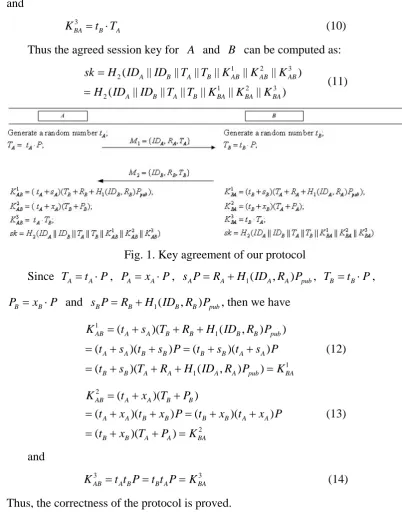
Key−Agreement: Assume that an entity A with identity IDA has private
key (skA = x sA, A) and public key pkA =(PA) and an entity B with identity B
ID has private key skB =(x sB, B) and public key pkB =(PB) want to establish a session key, they can do, as shown in Fig.1, as follows.
1) A chooses a random number tA∈Zn* and computes TA = ⋅tA P, then A sends M1 ={ID R TA, A, A} to B.
2) After receiving M1 , B chooses a random number tB∈Zn* and computes TB = ⋅tB P, then B sends M2 ={ID R TB, B, B} to A.
Then both A and B can compute the shared secrets as follows:
A computes 1
1
( )( ( , ) )
AB A A B B B B pub
K = t +s T +R +H ID R P (5) 2
( )( )
AB A A B B
K = t +x T +P (6) and
3
AB A B
K = ⋅t T (7)
B computes 1
1
( )( ( , ) )
BA B B A A A A pub
K = t +s T +R +H ID R P (8) 2
( )( )
BA B B A A
and
3
BA B A
K = ⋅t T (10) Thus the agreed session key for A and B can be computed as:
1 2 3 2
1 2 3 2
( || || || || || || ) ( || || || || || || )
A B A B AB AB AB
A B A B BA BA BA
sk H ID ID T T K K K
H ID ID T T K K K
=
= (11)
Fig. 1. Key agreement of our protocol
Since TA = ⋅tA P, PA =xA⋅P, s PA =RA+H ID R P1( A, A) pub, TB = ⋅tB P, B B
P =x ⋅P and s PB =RB +H ID R P1( B, B) pub, then we have 1
1
1 1
( )( ( , ) )
( )( ) ( )( )
( )( ( , ) )
AB A A B B B B pub
A A B B B B A A
B B A A A A pub BA
K t s T R H ID R P
t s t s P t s t s P
t s T R H ID R P K
= + + +
= + + = + +
= + + + =
(12)
2
2
( )( )
( )( ) ( )( )
( )( )
AB A A B B
A A B B B B A A
B B A A BA
K t x T P
t x t x P t x t x P
t x T P K
= + +
= + + = + +
= + + =
(13)
and
3 3
AB A B B A BA
K =t t P=t t P=K (14) Thus, the correctness of the protocol is proved.
4. Security Analysis
In this section, we will show our scheme is provably secure in eCK model. We treat H1 and H2 as two random oracles [19]. For the security, the following lemmas and theorems are provided.
Proof. From the correction analysis of our protocol in Section 3, we know if two oracles are matching, then both of them are accepted and have the same session key. The session keys are distributed uniformly since tA and tB are selected uniformly during the execution.
Lemma 2. Assuming that the GDH problem is intractable, the advantage of a type 1 adversary against our protocol is negligible.
Proof. Suppose that there is a type 1 adversary A1 who can win the game
defined in subsection 2.3 with a non-negligible advantage AdvA1( )k in polynomial-time t. Then, we will show how to use the ability of A1 to construct an algorithm C to solve the GDH problem.
Let n0 be the maximum number of sessions that any one party may have. Assume that the adversary A1 activates at most n1 distinctive honest parties. Assume that the adversary A1 activates at most n2 distinctive hash queries. Assume also that AdvA1( )k is non-negligible. Before the game starts, C tries to guess the test session and the strategy that the adversary A1 will adopt. C randomly selects two indexes I J, ∈{1,…, }n1:I ≠J, which represent the I th and the Jth distinct honest party that the adversary initially chooses. Also, C chooses S∈{1,…,n0} and determines the Test session ,
S I J
∏ , which is correct
with probability larger than 2 0 1 1
n n . Let ,
T J I
∏ be the matching session of ∏SI J, .
Since H1 and H2 are modeled as random oracles, after the adversary issues the test query, it has only three possible ways to distinguish the tested session key from a random string:
CASE 1: Forging attack: Assume that , S I J
∏ is the test session. At some point in its run, the adversary A1 queries H2 on the value (ID ID T T KI, J, I, J, IJ1 ,KIJ2,KIJ3 ) in the test session owned by I
communicating with J . Clearly, in this case A1 computes the values K1IJ, 2
IJ
K and K3IJ itself.
CASE 2: Guessing attack: A1 correctly guesses the session key.
the adversary A1 can simply learn the session key by querying the non-matching session.
Since H2 is a random oracle, the probability of guessing the output of H2 is (1 / 2 )k
O , which is negligible. The input to the key derivation function H2
includes all information that can uniquely identify the matching sessions. Since two non-matching sessions can not have the same identities and the same ephemeral public keys and H2 is modeled as a random oracle, the success probability of Key-replication attack is also negligible. Thus Guessing attack and Key-replication attack can be ruled out, and the rest of the proof is mainly devoted to the analysis of Forging attack. As the attack that the adversary A1
mounts is Forging attack, A1 can not get an advantage in winning the game against the protocol unless it queries the H2 oracle on the session key.
The rest of this section is mainly devoted to the analysis of the Forging attack. To relate the advantage of the adversary A1 against our protocol to the GDH assumption, we use a classical reduction approach. In the following, a challenger C is interested to use the adversary A1 to turn A1’s advantage in distinguishing the tested session key from a random string into an advantage in solving the GDH problem. The following two sub-cases should be considered.
CASE 1.1: No honest party owns a matching session to the Test session. CASE 1.2: The Test session has a matching session owned by another honest party.
¾ The analysis of CASE 1.1:
Since A1 is strong type 1 adversary, then he can get any users’ secret key i
x value through ReplacePublicKey query. According to Definition 1, C has the following two choices for A1’s strategy:
CASE 1.1.1: At some point, the partial private key of party I has been revealed by the adversary A1. According to Definition 1, A1 is not permitted to reveal the ephemeral private key of the Test session.
CASE 1.1.2: The partial private key of party I has never been revealed by the adversary A1. According to Definition 1, A1 may reveal the ephemeral private key of the Test session.
Let AdvCGDH( )k be the advantage that the challenger C gets in solving the GDH problem given the security parameter k . Given a GDH problem instance(U =uP,V =vP,Oddhp) and C’s task is to compute cdh U V( , )=uvP, where Oddhp is a decision oracle that on input (aP bP cP, , ), answers 1 if
( , )
cdh aP bP =cP; answers 0, otherwise. C first chooses P0∈G at random,
sets P0 as the system public key Ppub , selects the system parameter 1 2
{ p, / p, , , pub, , }
params= F E F G P P H H , and sends params to A1. Then, C
simulates the game outlined in Section 2.3 as follows. ( )
Create i : C maintains an initially empty list LC consisting of tuples of
the form ( ID s R x Pi, ,i i, ,i i ). If i=J , C chooses two random numbers *
, i i n
h x ∈Z , computes Ri = −U h Pi 0, Pi =x Pi , sets H ID R1( i, i)←hi and stores (IDi, ,⊥ R x Pi, ,i i) and (ID R hi, i, )i in LC and
1 H
L separately. Otherwise, C chooses three random numberss h xi, ,i i∈Zn*, computesRi =s Pi −h Pi pub, Pi =x Pi , sets H ID R1( i, i)←hi and stores (ID s R x Pi, ,i i, ,i i) and (ID R hi, i, )i in LC and
1 H
L separately. 1( i, i)
H ID R : C maintains an initially empty list
1 H
L which contains tuples of the form (ID R hi, i, i). If (ID Ri, i) is on the list
1 H
L , C returns hi. Otherwise,
C chooses a random number hi, stores (ID R hi, i, i) in 1 H
L and returns hi. 2( i, j, ,i j, 1, 2, 3, )
H ID ID T T Z Z Z sk : C maintains an initially empty list
2 H
L
with entries of the form (ID ID T T Z Z Z ski, j, ,i j, 1, 2, 3, ). If the tuple is in the list
2 H
L , C responds with sk. Otherwise, C responds to these queries in the following way:
z If IDi =IDJ,
C looks the list LS for entry (ID ID T Ti, j, ,i j,*). If C finds the
entry, he computes 1 1 i( j j 1( j, j)) j( i 1( i, i))
Z =Z −t T +R +H ID R −s R +H ID R .
inputted.C also checks whether Z2 and Z3 are equal by checking if the equations Z2 =(ti+x Ti)( j+Pj) and Z3 =t Ti j hold separately. If Z1 , Z2 and Z3 are correct, C stores the tuple (ID ID T T Z Z Z ski, j, ,i j, 1, 2, 3, ) into
2 H
L , where the value sk comes from LS. Otherwise, C chooses a random number sk∈{0,1}k and stores the tuple (ID ID T T Z Z Z ski, j, ,i j, 1, 2, 3, ) into
2 H
L .
z Otherwise,
C looks up the list LS for entry (ID ID T Ti, j, ,i j,*). If C finds the entry, he stores the tuple (ID ID T T Z Z Z ski, j, ,i j, 1, 2, 3, ) into
2 H
L ,
where the value sk comes from LS.
Otherwise, C chooses a random number sk∈{0,1}k and stores the tuple (ID ID T T Z Z Z ski, j, ,i j, 1, 2, 3, ) into
2 H
L .
( )
RevealPartialPrivateKey i : C answers A1’s queries as follows.
z If IDi =IDJ then C stops the simulation.
z Otherwise, C looks up the list LE and returns the corresponding partial private key si to the adversary A1.
( )
RevealSecretValue i : C looks up the table LC for entry (IDi,*,*,*,*). If
C finds the entry, he returns xi . Otherwise, C carries out the query ( )
Create i and returns the corresponding xi.
( , )
ReplacePublicKey i pk : Upon receiving the query, C looks up the table
C
L for entry (IDi,*,*,*,*). If C finds the entry, he replaces xi and Pi with i
x′ and Pi′ separately, where pk=( )Pi′ and Pi′=x Pi′ . Otherwise, C carries out Create i( ) and replaces xi and Pi with xi′ and Pi′ separately.
,
( i js )
RevealEphemeralKey ∏ : C answers A1’s queries as follows.
z If s, S, i j I J
∏ = ∏ , then C stops the simulation.
z Otherwise, C returns the stored ephemeral private key to A1.
RevealMasterKey: C stops the simulation.
,
( i js )
z If s, S, i j I J
∏ = ∏ or s, T,
i j J I
∏ = ∏ , then C stops the simulation.
z Otherwise, if C returns the session key sk to A1. ,
( t , )
i j
Send ∏ m :C maintains an initially empty list LS with entries of the form (ID ID T T ski, j, ,i j, ) and answers A1’s queries as follows.
z If , ,
t S
i j I J
∏ = ∏ , then C returns Ti =V to A1.
z Otherwise, if IDi =IDJ , he generates a random ti∈Zn , computes 1 1 i( j j 1( j, j)) j( i 1( i, i))
Z =Z −t T +R +H ID R −s R +H ID R . Then C checks
whether Z1 is correct by checking whether the oracle Oddhp outputs 1 when the tuple (Ri+H ID R P1( i, i) pub,T Zj, 2) is inputted.C also checks whether Z2 and Z3 are equal by checking whether the equations
2 (i i)( j j)
Z = t +x T +P and Z3=t Ti j hold separately. If Z1, Z2 and Z3
are correct, C stores the tuple (ID ID T T ski, j, ,i j, ) into LS, where the value sk comes from
2 H
L . Otherwise, C chooses a random number {0,1}k
sk∈ and stores the tuple (ID ID T T ski, j, ,i j, ) into LS.
z Otherwise, C replies according to the specification of the protocol. ,
( ti j)
Test ∏ :C answers A1’s queries as follows.
z If s, S, i j I J
∏ ≠ ∏ , then C stops the simulation.
z Otherwise, C generates a random number ξ∈{0,1}k and returns it to
1
A .
As the adversary A1 mounts the forging attack, if A1 succeeds, it must
have queried oracle H2 on the form
1 ( I I)( J J 1( J, J) pub) ( I I)( J )
Z = t +s T +R +H ID R P = t +s T +U ,
2 ( I I)( J J)
Z = t +x T +P and Z3=t TI J, where TI =V is the outgoing message of Test session by the simulator and TJ is the incoming message from the adversary A1. To solve cdh U V( , ), for all entries in
2 H
L , C randomly chooses one entry with the probability
2 1
n and computes
1 1 1 1
1
( ( , )) ( ( , )) ( ( , )) ( , )
J I I I I I J J J
I J J J
Z Z t T R H ID R s R H ID R
t R H ID R cdh U V
= − + + − +
The advantage of C solving GDH problem with the advantage 1
2 0 1 2
1
( ) ( )
GDH
Adv k Adv k
n n n
≥
C A . (17)
Then ( )AdvCGDH k is non-negligible since we assume that AdvA1( )k is non-negligible. This contradicts the GDH assumption.
CASE 1.1.2:
Let ( )AdvCGDH k be the advantage that the challenger C gets in solving the GDH problem given the security parameter k . Given a GDH problem instance(U =uP,V =vP,Oddhp) and C’s task is to compute cdh U V( , )=uvP, where Oddhp is a decision oracle that on input (aP bP cP, , ), answers 1 if
( , )
cdh aP bP =cP; answers 0, otherwise. C first chooses P0∈G at random,
sets P0 as the system public key Ppub , selects the system parameter 1 2
{ p, / p, , , pub, , }
params= F E F G P P H H , and sends params to A1. Then, C
simulates the game outlined in Section 2.3 as follows. Then, C simulates the game outlined in Section 2.3. During the game, C simulates A1 ’s
1( i, i)
H ID R , RevealMasterKey , ( )RevealSecretValue i ,
( , )
ReplacePublicKey i pk , ( , )
s i j
RevealSessionKey ∏ and ( , ) s i j
Test ∏ queries as that of CASE 1.1.1. C simulates other oracles as follows.
( )
Create i : C simulates the oracle in the same way as that of CASE 1.1
except for i=I . If i=I , C chooses two random numbers h xi, i∈Zn* , computes Ri = −V h Pi 0 , Pi =x Pi , sets H ID R1( i, i)←hi and stores (IDi, ,⊥ R x Pi, ,i i) and (ID R hi, i, )i in LC and
1 H
L separately. 2( i, j, ,i j, 1, 2, 3, )
H ID ID T T Z Z Z h : C simulates the oracle in the same way as
that of CASE 1.1.1 except for the form ( ID ID T T Z Z ZI, J, I, J, 1, 2, 3 ) and (ID ID T T Z Z ZJ, I, J, I, 1, 2, 3).C responds to these queries in the following way:
z If (ID ID T T Z Z Z hI, J, I, J, 1, 2, 3, ) or (ID ID T T Z Z Z hJ, I, J, I, 1, 2, 3, ) is in
2 H
L , C responds with the stored value h.
stores the new entry (ID ID T T Z Z Z hi, j, ,i j, 1, 2, 3, ) in 2 H
L . Otherwise, C compute Z1 =Z1−t Ti( j +Rj +H ID R1( j, j))−t Rj( i +H ID R1( i, i)). Then
C checks whether Z1 is correct by checking whether the oracle Oddhp outputs 1 when the tuple (Ri +H ID R P1( i, i) pub,Rj +H ID R P1( j, j) pub,Z1) is inputted.C also checks whether Z2 and Z3 are equal by checking if the equations Z2 =(ti+x Ti)( j +Pj) and Z3=t Ti j hold separately. If
1
Z , Z2 and Z3 are correct, C stores the tuple (ID ID T T Z Z Z ski, j, ,i j, 1, 2, 3, ) into
2 H
L , where the value sk comes from S
L . Otherwise, C chooses a random number sk∈{0,1}k and stores the tuple (ID ID T T Z Z Z ski, j, ,i j, 1, 2, 3, ) into
2 H
L .
( )
RevealPartialPrivateKey i : C answers A1’s queries as follows.
z If i=I or i= J, C stops the simulation.
z Otherwise, C looks up the list LC and returns the corresponding partial private key Di to the adversary A1.
,
( i js )
RevealEphemeralKey ∏ : Creturns the stored ephemeral private key to
1
A .
,
( si j, )
Send ∏ m : C simulates the oracle in the same way as that of CASE 1.1 except for the following queries:
z If ∏ = ∏si j, SI J, , C chooses ti∈Zn and returns Ti =t Pi to A1.
z If i=I and j= J(the case that i= J and j=I could be deal with similarly).
C chooses ti∈Zn and returns Ti =t Pi to A1.
C looks up the list 2 H
L for entry (ID ID T Ti, j, ,i j,*,*,*,*) (If ∏si j, is responder session, C will look up for (ID ID T Tj, i, j, ,*,*,*,*i )). If there is no such entry, C choose a random number sk∈{0,1}k and stores the new entry ( ID ID T T ski, j, ,i j, ) in LS . Otherwise, C computes
1 1 i( j j 1( j, j)) j( i 1( i, i))
Z =Z −t T +R +H ID R −t R +H ID R . Then C
outputs 1 when the tuple (Ri +H ID R P1( i, i) pub,Rj +H ID R P1( j, j) pub,Z1) is inputted.C also checks whether Z2 and Z3 are equal by checking if the equations Z2 =(ti+x Ti)( j+Pj) and Z3 =t Ti j hold separately. If all of the equations are equal, C stores (ID ID T T hi, j, ,i j, ) into LS, where
h comes from 2 H
L . Otherwise, C chooses a random number sk and stores (ID ID T T ski, j, ,i j, ) into LS.
As the adversary A1 mounts the forging attack, if A1 succeeds, it must
have queried oracle H2 on the form
1 ( I I)( J J 1( J, J) pub) ( I I)( J )
Z = t +s T +R +H ID R P = t +s T +U Z2 =(tI +xI)(TJ +PJ)
and Z3 =t TI J where TI =t PI is the outgoing message of Test session by the simulator A1. To solve cdh U V( , ), for all entries in
2 H
L , C randomly chooses one entry with the probability
2 1
n and computes
1 1 1 1
1
( ( , )) ( ( , )) ( ( , )) ( , )
I J J J J J I I I
I J J J I
Z Z t T R H ID R t R H ID R
s R H ID R s U cdh U V
= − + + − +
= + = = . (18)
We can conclude that
1 2
0 1 2 1
( ) ( )
GBCDH
Adv k Adv k
n n n
≥
C A . (19)
Then ( )AdvCGBCDH k is non-negligible since we assume that AdvA1( )k is non-negligible. This contradicts the GCDH assumption.
¾ The analysis of CASE 1.2:
In this case, the Test session ∏SI J, has a matching session owned by another honest party J. According to Definition 1, the adversary A1 has four ways to mount the attacks.
CASE 1.2.1. The adversary A1 makes ephemeral key query to both the Test session and the matching session of the Test session (The adversary does not reveal their corresponding partial private key). In this case, the proof is identical to that of CASE 1.1.2. To save space, we omit the details.
CASE 1.2.3. The adversary A1 makes queries to the ephemeral private key of the owner of Test session and its peer's partial private key. In this case, the proof is identical to that of CASE 1.1.1. To save space, we omit the details.
CASE 1.2.4. The adversary A1 learns the partial private key of both the owner of Test session and its peer. (The adversary does not reveal their corresponding ephemeral private key).
C answers H ID R1( i, i), ReplacePublicKey i pk( , ) ,RevealSecretValue i( ),
RevealMasterKey ( t, )
i j
RevealSessionKey ∏ and ( t, )
i j
Test ∏ as he does in the above case. He also answers other queries as follows.
( )
Create i : C maintains an initially empty list LC consisting of tuples of
the form ( ID s R x Pi, ,i i, ,i i ).C chooses three random numbers s h xi, ,i i∈Z*n, computes Ri =s Pi −h Pi pub , Pi =x Pi , sets H ID R1( i, i)←hi and stores (ID s R x Pi, ,i i, ,i i) and (ID R hi, i, )i in LC and
1 H
L separately. 2( i, j, ,i j, 1, 2, 3, )
H ID ID T T Z Z Z sk : C maintains an initially empty list
2 H
L
with entries of the form (ID ID T T Z Z Z ski, j, ,i j, 1, 2, 3, ). If the tuple is in the list 2
H
L , C responds with sk. Otherwise, C responds to these queries in the following way:
z C looks the list LS for entry (ID ID T Ti, j, ,i j,*). If C finds the entry, he computes
1 1 i( j j 1( j, j)) j i
Z =Z −s T +R +H ID R −s T (20)
2 2
Z =Z (21) and
2 2 i( j j) j i
Z =Z −x T +P −x T (21)
Then C checks whether Zi is correct by checking whether the oracle
ddhp
O outputs 1 when the tuple ( ,T T Zi j, i) is inputted, where i=1, 2, 3. If
1
Z , Z2 and Z3 are correct, C stores the tuple (ID ID T T Z Z Z ski, j, ,i j, 1, 2, 3, ) into
2 H
L , where the value sk comes from S
L . Otherwise, C chooses a random number {0,1}k
sk∈ and stores the tuple (ID ID T T Z Z Z ski, j, ,i j, 1, 2, 3, ) into
2 H
z Otherwise, C chooses a random number {0,1}k
sk∈ and stores the tuple (ID ID T T Z Z Z ski, j, ,i j, 1, 2, 3, ) into
2 H
L .
( )
RevealPartialPrivateKey i : C looks up the list LC and returns the
corresponding partial private key si to the adversary A1. ,
( s )
i j
RevealEphemeralKey ∏ : C answers A1’s queries as follows.
z If ∏ = ∏si j, SI J, or ∏ = ∏i js, TJ I, , then C stops the simulation.
z Otherwise, C returns the stored ephemeral private key to A1. ,
( si j, )
Send ∏ m :C maintains an initially empty list LS with entries of the form (ID ID T T ski, j, ,i j, ) and answers A1’s queries as follows.
z If ∏ = ∏si j, TI J, , C returns Ti =U to A1.
z Otherwise, if ∏ = ∏si j, TI J, , C returns Ti =V to A1.
z Otherwise, C replies according to the specification of the protocol. As the attack that adversary A1 mounts the forging attack, if A1
succeeds, it must have queried oracle H2 on the form 1 ( I I)( J J 1( J, J) pub)
Z = t +s T +R +H ID R P , Z2 =(tI +xI)(TJ +PJ) and
3 I J
Z =t T , where TI =U is the outgoing message of Test session by the simulator and TJ =V is the incoming message from the adversary A1. To solve ( , )cdh U V , for all entries in
2 H
L , C randomly chooses one entry with the probability
2 1
n and returns Z3 as the solution to cdh U V( , ).
The advantage of C solving GDH problem with the advantage 1
2 0 1 2
1
( ) ( )
GDH
Adv k Adv k
n n n
≥
C A . (22)
Then ( )AdvCGDH k is non-negligible since we assume that AdvA1( )k is non-negligible. This contradicts the GDH assumption.
We could conclude that the advantage of a type 1 adversary against our protocol is negligible if the GCDH problem is intractable.
Proof. Suppose that there is a type 2 adversary A2 who can win the game defined in subsection 2.3 with a non-negligible advantage AdvA2( )k in
polynomial-time t. Then, we will show how to use the ability of A2 to construct an algorithm C to solve the GDH problem.
Let n0 be the maximum number of sessions that any one party may have. Assume that the adversary A2 activates at most n1 distinctive honest parties. Assume that the adversary A2 activates at most n2 distinctive hash queries. Assume also that AdvA2( )k is non-negligible. Before the game starts, C tries to guess the test session and the strategy that the adversary A2 will adopt. C randomly selects two indexes I J, ∈{1,…, }n1:I ≠J, which represent the I th and the Jth distinct honest party that the adversary initially chooses. Also, C chooses S∈{1,…,n0} and determines the Test session ∏SI J, , which is correct with probability larger than 2
0 1 1
n n . Let ,
T J I
∏ be the matching session of S, I J
∏ .
Since H1 and H2 are modeled as random oracles, after the adversary issues the test query, it has only three possible ways to distinguish the tested session key from a random string:
CASE 1: Forging attack: Assume that ∏SI J, is the test session. At some point in its run, the adversary A1 queriesH2 on the
value(ID ID T T KI, J, I, J, 1IJ,KIJ2,KIJ3 ) in the test session owned by I
communicating with J. Clearly, in this case A2 computes the values K1IJ, 2
IJ
K and 3 IJ
K itself.
CASE 2: Guessing attack: A2 correctly guesses the session key. CASE 3: Key-replication attack: The adversary A2 forces a non-matching session to have the same session key with the test session. In this case, the adversary A2 can simply learn the session key by querying the non-matching session.
Through the same analysis, we know the success probability of
2
A mounts is Forging attack, A2 can not get an advantage in winning the game against the protocol unless it queries the H2 oracle on the session key.
In the following, a challenger C is interested to use the adversary A2 to turn A2’s advantage in distinguishing the tested session key from a random string into an advantage in solving the GDH problem. The following two sub-cases should be considered.
CASE 1.1: No honest party owns a matching session to the Test session. CASE 1.2: The Test session has a matching session owned by another honest party.
¾ The analysis of CASE 1.1:
Since A2 is strong type 2 adversary, then he can get any users’ partial private key since he is a malicious KGC. According to Definition 2, C has the following two choices for A2’s strategy:
CASE 1.1.1: At some point, the secret value of party I has been revealed by the adversary A2. According to Definition 2, A2 is not permitted to reveal the ephemeral private key of the Test session.
CASE 1.1.2: The secret value of party I has never been revealed by the adversary A2. According to Definition 2, A2 may reveal the ephemeral private key of the Test session.
CASE 1.1.1:
Let AdvCGDH( )k be the advantage that the challenger C gets in solving the GDH problem given the security parameter k. Given a GDH problem instance (U =uP,V =vP,Oddhp) and C’s task is to compute cdh U V( , )=uvP, where
ddhp
O is a decision oracle that on input (aP bP cP, , ), answers 1 if ( , )
cdh aP bP =cP; answers 0, otherwise. C first chooses a random number
* n
x∈Z , sets xP as the system public key Ppub, selects the system parameter 1 2
{ p, / p, , , pub, , }
params= F E F G P P H H , and sends params to A2. Then, C
simulates the game outlined in Section 2.3 as follows. ( )
Create i : C maintains an initially empty list LC consisting of tuples of
the form (ID s R x Pi, ,i i, ,i i). If i=J, C chooses two random numbers ri∈Zn*, computes Ri =r Pi , hi =H ID R1( i, i), si = +ri h xi , Pi =U and stores
computes Ri =r Pi , hi =H ID R1( i, i), si = +ri h xi , Pi =x Pi and stores (ID s R x Pi, ,i i, ,i i) in LC.
1( i, i)
H ID R : C maintains an initially empty list
1 H
L which contains tuples of the form (ID R hi, i, i). If (ID Ri, i) is on the list
1 H
L , C returns hi. Otherwise,
C chooses a random number hi, stores (ID R hi, i, i) in 1 H
L and returns hi. 2( i, j, ,i j, 1, 2, 3, )
H ID ID T T Z Z Z sk : C maintains an initially empty list
2 H
L
with entries of the form (ID ID T T Z Z Z ski, j, ,i j, 1, 2, 3, ). If the tuple is in the list 2
H
L , C responds with sk. Otherwise, C responds to these queries in the following way:
z If IDi =IDJ,
C looks the list LS for entry (ID ID T Ti, j, ,i j,*). If C finds the entry, he computes Z2 =Z2−t Ti( j+Pj)−x Pj i.
Then C checks whether Z2 is correct by checking whether the oracle Oddhp outputs 1 when the tuple (P T Zi, j, 2) is inputted.C also checks whether Z1 and Z3 are equal by checking whether the equations Z1=(ti+s Ti)( j+Rj+H ID R1( j, j)) and Z3=t Ti j hold separately. If Z1, Z2 and Z3 are correct, C stores the tuple (ID ID T T Z Z Z ski, j, ,i j, 1, 2, 3, ) into
2 H
L , where the value sk comes from LS. Otherwise, C chooses a random number sk∈{0,1}k and stores the tuple (ID ID T T Z Z Z ski, j, ,i j, 1, 2, 3, ) into
2 H
L .
z Otherwise,
C looks the list LS for entry (ID ID T Ti, j, ,i j,*). If C finds the entry, he stores the tuple (ID ID T T Z Z Z ski, j, ,i j, 1, 2, 3, ) into
2 H
L ,
where the value sk comes from LS.
Otherwise, C chooses a random number sk∈{0,1}k and stores the tuple (ID ID T T Z Z Z ski, j, ,i j, 1, 2, 3, ) into
2 H
L .
( )
RevealPartialPrivateKey i : C looks up the list LE and returns the
( )
RevealSecretValue i : C answers A2’s queries as follows.
z If IDi =IDJ, then C stops the simulation.
z Otherwise, C looks up the table LC for entry (IDi,*,*,*,*) and returns xi.
,
( ti j)
RevealEphemeralKey ∏ : C answers A2’s queries as follows.
z If s, S, i j I J
∏ = ∏ , then C stops the simulation.
z Otherwise, C returns the stored ephemeral private key to A2.
RevealMasterKey: C returns the master key x to A2.
,
( ti j)
RevealSessionKey ∏ : C answers A2’s queries as follows.
z If s, S, i j I J
∏ = ∏ or s, T,
i j I J
∏ = ∏ , then C stops the simulation.
z Otherwise, if C returns the session key sk to A2. ,
( s , )
i j
Send ∏ m :C maintains an initially empty list LS with entries of the form (ID ID T T ski, j, ,i j, ) and answers A2’s queries as follows.
z If , ,
s S
i j I J
∏ = ∏ , then C returns Ti =V to A2.
z Otherwise, if IDi =IDJ , he generates a random ti∈Zn , computes 2 2 i( j j) j i
Z =Z −t T +P −x P. Then C checks whether Z2 is correct by checking whether the oracle Oddhp outputs 1 when the tuple (P T Zi, j, 2) is inputted.C also checks whether Z1 and Z3 are equal by checking whether the equations Z1=(ti+s Ti)( j+Rj+H ID R1( j, j)) and Z3 =t Ti j
hold separately. If Z1, Z2 and Z3 are correct, C stores the tuple (ID ID T T ski, j, ,i j, ) into LS , where the value sk comes from
2 H
L .
Otherwise, C chooses a random number sk∈{0,1}k and stores the tuple (ID ID T T ski, j, ,i j, ) into LS.
z Otherwise, C replies according to the specification of the protocol. ,
( ti j)
Test ∏ :C answers A2’s queries as follows.
z If ∏ ≠ ∏ti j, SI J, , then C stops the simulation.
z Otherwise, C generates a random number ξ∈{0,1}k and returns it to 2
As the adversary A2 mounts the forging attack, if A2 succeeds, it must have queried oracle H2 on the form Z1=(tI +sI)(TJ +RJ+H ID R P1( J, J) pub) ,
2 ( I I)( J )
Z = t +x T +U and Z3 =t TI J, where TI =V is the outgoing message of Test session by the simulator and TJ is the incoming message from the adversary 2A . To solve GDH U V( , ), for all entries in
2 H
L , C randomly chooses one entry with the probability
2 1
n and computes
2 2 I( J )) 3
Z =Z −x T +U −Z (23) It is easy to verify that the equation Z2 =cdh U V( , ) holds. The advantage of
C solving GDH problem with the advantage
2 2
0 1 2 1
( ) ( )
GDH
Adv k Adv k
n n n
≥
C A . (24)
Then AdvCGDH( )k is non-negligible since we assume that AdvA2( )k is non-negligible. This contradicts the GDH assumption.
CASE 1.1.2:
C answers H ID R1( i, i), ( )RevealPartialPrivateKey i , ,
( ti j)
RevealEphemeralKey ∏ , RevealMasterKey, RevealSessionKey(∏ti j, ) and ,
( ti j)
Test ∏ as he does in CASE 3.1.3 of Lemma 3. He also answers other queries as follows.
( )
Create i : C simulates the oracle in the same way as that of CASE 1.1.1
except for i=I . If i=I, C chooses two random numbers ri∈Z*n, computes i i
R =r P, hi =H ID R1( i, i), si = +ri h xi , Pi =V and stores (ID s Ri, ,i i, ,⊥ Pi)in C
L . Otherwise, C chooses two random numbers r xi, i∈Zn*, computes i i
R =r P, hi =H ID R1( i, i), si = +ri h xi , Pi =x Pi and stores (ID s R x Pi, ,i i, ,i i) in C
L .
2( i, j, ,i j, 1, 2, 3, )
H ID ID T T Z Z Z h : C simulates the oracle in the same way as
that of CASE 1.1.1 except for the form (ID ID T T Z Z ZI, J, I, J, 1, 2, 3) and