An Optimal Key Enumeration Algorithm
and its Application to Side-Channel Attacks
Nicolas Veyrat-Charvillon?, Benoˆıt G´erard??, Mathieu Renauld? ? ?, Fran¸cois-Xavier Standaert† UCL Crypto Group, Universit´e catholique de Louvain. Place du Levant 3, B-1348, Louvain-la-Neuve, Belgium.
Abstract. Methods for enumerating cryptographic keys based on par-tial information obtained on key bytes are important tools in crypt-analysis. This paper discusses two contributions related to the practical application and algorithmic improvement of such tools.
On the one hand, we observe that modern computing platforms al-low performing very large amounts of cryptanalytic operations, approx-imately reaching 250 to 260block cipher encryptions. As a result,
cryp-tographic key sizes for such ciphers typically range between 80 and 128 bits. By contrast, the evaluation of leaking devices is generally based on distinguishers with very limited computational cost, such as Kocher’s Differential Power Analysis. We bridge the gap between these cryptana-lytic contexts and show that giving side-channel adversaries some com-puting power has major consequences for the security of leaking devices. For this purpose, we first propose a Bayesian extension of non-profiled side-channel attacks that allows us to rate key candidates in function of their respective probabilities. Next, we investigate the impact of key enumeration taking advantage of this Bayesian formulation, and quantify the resulting reduction in the data complexity of the attacks.
On the other hand, we observe that statistical cryptanalyses usually try to reduce the number and size of lists corresponding to partial informa-tion on key bytes, in order to limit the time and memory complexity of the key enumeration. Quite surprisingly, few solutions exist that allow an efficient merging of large lists of subkey candidates. We provide a new deterministic algorithm that significantly reduces the number of keys to test in a divide-and-conquer attack, at the cost of limited (practically tractable) memory requirements. It allows us to optimally enumerate key candidates from any number of (possibly redundant) lists of any size, given that the subkey information is provided as probabilities. As an illustration, we finally exhibit side-channel cryptanalysis experiments where the correct key candidate is ranked up to position 232, in which our algorithm reduces the number of keys to test offline by an average factor 25 and a factor larger than 210 in the worst observed cases, compared to previous solutions. We also suggest examples of statistical attacks in which the new deterministic algorithm would allow improved results.
?Postdoctoral researcher supported by the ERC project 280141 - CRASH. ??
Postdoctoral researcher supported by Walloon region MIPSs project.
? ? ? PhD student supported by Walloon region SCEPTIC project.
†
1
Introduction
Side-channel attacks represent an important threat to the security of crypto-graphic hardware products. As a consequence, evaluating the information leak-age of microelectronic circuits has become an important part in the certification of secure devices. Most of the tools/attacks that have been published in this purpose are based on a so-called “divide-and-conquer” approach. That is, in a first “divide” part, the evaluator/adversary recovers information about different parts of the master key, usually denoted as subkeys (as a typical example, the target can be the 16 AES key bytes). Next, a “conquer” part aims to combine the information gathered in an efficient way, in order to recover the full master key. Research over the last ten years has been intensive in the optimization of the divide part of attacks. Kocher et al.’s Differential Power Analysis (DPA) [17] and Brier et al.’s Correlation Power Analysis (CPA) [7] are notorious examples. One limitation of such approaches is their somewhat heuristic nature, as they essentially rank the subkeys according to scores that do not have a probabilistic meaning. As demonstrated by Junod in the context of linear cryptanalysis, such heuristic key ranking procedures may be suboptimal compared to Bayesian key recoveries [15]. The template attacks introduced by Chari et al. in 2002 typi-cally aims to get rid of this limitation [8]. By carefully profiling a probabilistic model for the physical leakages, such attacks offer a direct path towards Bayesian subkey testing procedures. Template attacks are optimal from an information theoretic point of view, which makes them a prime tool for the worst-case secu-rity evaluation of leaking devices [35]. However, they also correspond to strong adversarial assumptions that may not be met in practice. Namely, actual adver-saries are not always able to profile an accurate leakage model, either because of a lack of knowledge of the target devices or because of physical variability [29]. As a consequence, attacks profiling an “on-the-fly” leakage model such as the stochastic approach introduced by Schindler et al. [30] and discussed by Doget et al. [11] are an important complement to a worst-case security analysis.
In this paper, we propose to improve both the divide and the conquer parts of side-channel attacks, with two main contributions. Regarding the divide part, we start with the observation that non-profiled side-channel attacks are usually limited by their heuristic use of scores when ranking subkey candidates. As a consequence, we propose a method for non-profiled attacks that allows deriving probability mass functions for the subkey hypotheses. This tool can be viewed as a natural extension of the stochastic approach, but is also applicable to DPA and CPA. Afterwards, obtaining the probability of a full key candidate boils down to multiplying the probabilities of the corresponding subkeys. Hence, it has appli-cations both in the online analysis of an attack (e.g. in order to express the level of knowledge about a subkey) and in the combination of independent attacks (e.g. exploiting multiple points of interest in the leakage traces). More generally, expressing the information obtained through non-profiled side-channel attacks with probabilities allows us to connect them better with template attacks, where the scores are already expressed as subkey probability mass functions.
Second, and most importantly, we provide the first comprehensive investi-gation of the conquer part of side-channel attacks. For this purpose, we start from the motivation that testing several billions of key candidates on a modern computer is not far-fetched: being able to recover a master key after such a com-putation is indeed a security breach. Next, we observe that two main solutions for testing key candidates from partial information on the subkeys exist in the literature. On the one hand, Meier and Staffelbach proposed a probabilistic al-gorithm in 1991. However, it turns out that in our side-channel attack context, this solution implies significant overheads in terms of number of keys to test. On the other hand, Pan, van Woudenberg, den Hartog and Witteman described a deterministic key enumeration algorithms at SAC 2010. But large memory re-quirements prevent the application of this second solution when the number of keys to enumerate increases. For example in [24], the authors were limited to the enumeration of 216 candidates. As none of these tools is perfectly suited to our side-channel attack context, we propose a new deterministic algorithm for key enumeration that is time and memory efficient, and allows the optimal enumer-ation of full keys by decreasing order of probabilities. It takes advantage of the probability mass functions of subkeys made available through our first contribu-tion. The new algorithm can be viewed as a refinement of the SAC 2010 one, in which we reduce the memory complexity of the enumeration thanks to a recur-sive decomposition of the problem. Interestingly, and as previously observed in other cryptanalysis settings, this improvement of the key ranking strategy also has a significant impact on the data complexity of side-channel key recoveries.
In practice, and for illustration, we can output the best 232 candidates of an attack using 2gb of memory, against only 220 candidates using more than 7
gb
factor 25 and a factor larger than 210 in the worst observed cases. Summariz-ing, this work brings an interesting complement to the evaluation framework in [35]. It allows stating standard side-channel attacks as a data complexity vs. time complexity tradeoff. On the theoretical side, the proposed key enumeration algorithm leads to a proper estimation of security metrics such as high-order success rates or guessing entropy, for block cipher master keys (this estimation was previously limited to subkeys or small orders). In practice, experimental results also exhibit that considering adversaries with a reasonable computing power leads to significant improvements of standard side-channel attacks. These gains are particularly interesting if we compare them with the ones obtained by only working on the statistics in the divide part of side-channel attacks [34]. Hence, we believe that the tools introduced in this paper have an important impact for the security evaluations of leaking devices, e.g. for certification labo-ratories. In this respect, it is worth noticing the gap between the computational complexities usually considered in the evaluation of side-channel attacks and the ones considered for evaluating security against mathematical attacks [19, 26].
We finally note that the tools introduced in this paper are generic and have potential impact in other cryptanalytic settings (e.g. based on faults [2], or sta-tistical [1, 21]), although standard side-channel attacks are a very natural envi-ronment for using them. We briefly list possible applications in Section 6.
2
Background
The “standard” side-channel attacks considered in this work use a divide-and-conquer approach in which the side-channel subkey recovery phase focuses on one specific operation at a time [20]. In block ciphers like the AES, this operation is usually one 8-bit S-box in the first encryption round. We denote with pand
k the byte of the plaintext and the byte of the key (i.e. the subkey) that are used in the attack, with x = p⊕k the input value of the S-box, and with
y = S(x) the corresponding output value. The goal of a side-channel subkey recovery phase is to identify the best (and hopefully correct) subkey candidate ˆ
k from the set of all possible key hypothesesK, usingqmeasured encryptions. For each target S-box the adversary collects a data set of pairs{(pi, li)}1≤i≤q1, with pi theith plaintext byte involved in the target S-box computation, andli the corresponding leakage value. For simplicity, and because it has little impact on our following discussions, we assume unidimensional leakages. In addition, we assume leakage samples composed of a deterministic and a random part, with the deterministic part depending only on the S-box output (i.e. we use the EIS assumption introduced in [30]). The leakage samples can consequently be written as li =L(yi) =f(yi) +n, withn a Gaussian distributed noise. In general, side-channel attacks can be classified as profiled and non-profiled attacks, depending on whether the adversary can perform a training phase or not.
1
Profiled attacks, like template attacks [8], take advantage of their profiling phase to characterize the leaking device with a probabilistic model. This allows the adversary to rank the subkey hypotheses k according to their actual prob-abilities: ˆk = arg maxkPr[k|{(pi, li)}]. These probabilities can then directly be used to build a Probability Mass Function (PMF):fK(k) = Pr[k|{(pi, li)}], with
Kthe discrete random variable corresponding to the unknown subkey byte. This PMF will be needed to perform the key enumeration in Section 4.
By contrast, in the case of non-profiled attacks (e.g. DPA [17] or CPA [7]), the best subkey hypothesis is not chosen based on probabilities, but on the value produced by a statistical distinguisher (namely, a difference-of-means test for Kocher’s DPA and Pearson correlation coefficient for CPA). For these non-profiled attacks, there is thus no straightforward way to produce the PMF we need to enumerate the master keys: the distinguisher outputs a ranking of the subkey candidates, which has no probabilistic meaning.
In order to apply our key enumeration algorithm, we need a way to extract probabilities from a non-profiled attack. For this purpose, we will use a natu-ral extension of the non-profiled version of Schindler’s stochastic approach [30]. Hence, we first recall how the non-profiled stochastic attack works [11]. A stochas-tic model θ(y) is a leakage model used to approximate the leakage function: L(y) ' θ(y), where θ(y) is built from a basis g(y) = {g0(y), ...,gB−1(y)} cho-sen by the adversary (usually gi(y) are polynomials in the bits of y). Eval-uating θ(y) boils down to estimating the coefficients αi such that the vector
θ(y) = P
jαjgj(y) is a least-square approximation of the measured leakages
li. The idea of a non-profiled stochastic attack is to build|K|stochastic models
θk(y) by considering the data set{(pi, li)}under the assumption that the correct key hypothesis isk. These stochastic models are then used as a distinguisher: for a correct key hypothesis (and a relevant basis), the error between the predicted values and the actual leakage values should have a smaller standard deviation than for a wrong key hypothesis. The pseudo-code of the attack is given in Al-gorithm 1. In general, an interesting feature of such attacks is that they allow trading robustness for precision in the models, by adapting the basisg(y). That is, a simpler model with less parameters is more robust, but a more complex model can potentially more accurately approximate the real leakage function.
Algorithm 1 Non-profiled stochastic attack 1: Acquire{(pi, li)}1≤i≤q.
2: Choose a basisg(y). 3: fork∈ Kdo
4: Compute the S-box output hypothesesyi,k=S(pi⊕k).
5: Use the basisg(y), the data set and the subkey hypothesisk in order to build a stochastic modelθk.
6: Compute the error vectorek:ei,k=li−θk(yi,k).
7: Evaluate the precision of the model:σk= standard deviation(ek).
8: end for
3
Bayesian extension of non-profiled SCAs
As the straightforward application of a stochastic attack does not produce PMFs, we propose in this section to perform an additional Bayesian step after building the stochastic models. We show that this Bayesian model comparison produces probabilities, and that the criterion of maximizing the likelihood of the subkey is equivalent to minimizing the error vector standard deviation, meaning that this extension indeed ranks the subkeys in the same order as the standard non-profiled stochastic attack. As a bonus, we observe that this extension also gives us a very natural way to combine independent leakage samples in an attack.
In the Bayesian version of the non-profiled stochastic attack, we perform a Bayesian hypothesis test on subkey candidates (under the assumption that the basis used for the stochastic attack is valid). It consists in estimating the proba-bility of the observed data set assuming that they are produced from the model
θk (i.e. Pr[{(pi, li)}|θk]). Then, we use Bayes’ theorem to deduce the likelihood of the models (and thus the probabilities of the subkey hypotheses) given the data (i.e. Pr[θk|{(pi, li)}]), as described by the pseudo-code of Algorithm 2.
Algorithm 2 Bayesian non-profiled stochastic attack 1 to 8: Same as Algorithm 1.
9: Perform a Bayesian model comparison: evaluate for each subkey hypothesis the likelihood Pr[θk|{(pi, li)}] using Bayes’ theorem.
10: Choose ˆk= arg maxkPr[θk|{(pi, li)}].
We now show how to compute these probabilities, starting with the probabil-ity of observing the data set{(pi, li)} assuming it is produced by the modelθk, using the subkey hypothesisk. This probability is computed by multiplying the probabilities of each individual event (pi, li) of the data set:
Pr[{(pi, li)}|θk] = Pr[{(pi, li)}|θk, K=k],
= q Y
i=1
N(li|θk(S(pi⊕k)), σk),
whereN(x, µ, σ) is the value of the normal distribution of meanµand standard deviation σevaluated at point x. If we denote the S-box output hypotheses as
yi,k =S(pi⊕k), the previous equation can be rewritten as:
Pr[{(pi, li)}|θk] = q Y
i=1 1 √
2π σk exp−
1
2σ2k(li−θk(yi,k))
2
.
Sinceσk2=Pi=q
i=1(li−θk(yi,k))2/q(see Algorithm 1), if we use allqmeasurements, we can simplify the exponent and move all constants coefficients that do not depend onkin a normalization termZ, that is:
Then, using Bayes’ theorem, we deduce the probabilities of the subkeys from the respective likelihood values of the modelsθk given the data (in other words, we perform a Bayesian model comparison):
Pr[k|{(pi, li)}] = Pr[θk|{(pi, li)}], =Pr[{(pi, li)}|θk].Pr[θk]
Pr[{(pi, li)}]
, (Bayes’ theorem)
=P Pr[{(pi, li)}|θk].Pr[θk] k0∈KPr[{(pi, li)}|θk0].Pr[θk0]
.
Assuming a uniform prior Pr[θk]=Pr[k]=|K|1 and using Equation 1, we get:
Pr[k|{pi, li}] =
σ−kq
P k0σ−
q k0
.
From these probabilities, we can directly build the PMF required for key enu-meration. Note that these likelihood values are not exactly the same as the ones we used in template attacks. In the last case, the characterization of a device al-lows exploiting a precise estimation of the leakage distributions. By contrast, in a Bayesian non-profiled stochastic attack, they depend on the basisg(y) chosen by the adversary. Finally, the subkey hypotheses can be ranked according to the likelihood values of the corresponding model given the data, that is:
ˆ
k= arg max k
σk−q,
= arg min k
σk,
i.e. providing the same ranking as for the original non-profiled stochastic attack. Besides their use for key enumeration in the next section, an appealing property of using probabilities instead of other criteria (e.g. like a correlation coefficient) is that combining independent measurement points becomes very natural. Let us suppose that our implementation leaks information at two different times: Lt0=ft0(x)+nt0andLt1 =ft1(y)+nt1 (withntia Gaussian noise). The Bayesian
writing makes it straightforward to combine their corresponding probabilities, by multiplication and normalization. Note also that the proposed attack can additionally be seen as a generalization of DPA or CPA, by simply replacing the leakage basis by a single-bit or Hamming weight model.
4
Efficient algorithms for combining subkeys
success rate of order o corresponds to the probability that the correct key is rated among theo first candidates provided by the distinguisher. The guessing entropy corresponds to the average number of keys to test before reaching the correct one. As suggested in [24], one can also consider a guessing entropy of order o, in order to capture the fact that in practice, only a maximum number ofokeys can be tested by the evaluators. Empirical comparisons of distinguish-ers using such metrics have been performed in [34], but were limited to subkey recoveries (i.e. key bytes, typically). In the following, we consequently tackle the (most practically relevant) problem of how to efficiently estimate these metrics for master keys. In the extreme case (i.e. success rate of order 1), the solution is straightforward, as e.g. illustrated by the DPA contest [25]. We consider the general case of large lists and large orders, to carefully address the problem of the “conquer” part in a side-channel attack. The problem of extracting the rank of a correct key is equivalent to the problem of enumerating keys stated below. Key-enumeration problem.The attacker obtains PMFs corresponding to d
independent subkeys, each PMF taking n different values. The problem is to enumerate complete keys from the most probable to the least probable one.
The naive algorithm for solving this problem generates the list of all possible keys, computes the corresponding likelihood values (by multiplying subkey prob-abilities) and sorts them accordingly. It can be used only with key candidates lists of limited size. In the remainder of this section, we propose an algorithm that efficiently solves this problem and allows deterministic key-enumeration, even when the number and size of subkey lists makes the naive approach untractable.
4.1 An efficient and deterministic key-enumeration algorithm
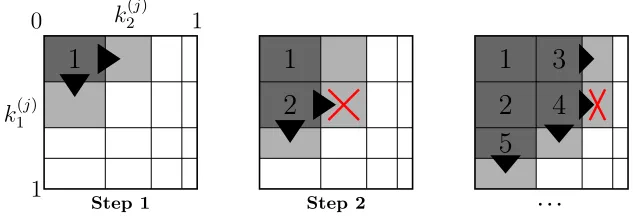
The key enumeration problem can be more readily understood as a geometric problem. We first consider the simpler bi-dimensional case (that is 2 subkeys). The key space can be identified with a compartimentalized square of length 1. The enumeration process is illustrated in Figure 1. The 4 columns (resp. rows) correspond to the four possible values of the first (resp. second) subkey, sorted by decreasing order of probability. Width and height correspond to the probability of the corresponding subkey. Let us denote by ki(j) the jth likeliest value for the ith subkey. Then, the intersection of row j
1 and column j2 is a rectangle corresponding to the key (k(j1)
1 , k (j2)
2 ) with probability equal to the area of the rectangle. Using this geometric view of the problem, an optimal key enumeration algorithm outputs compartments by decreasing order of area.
0
1
1
k
(1j)k
(2j)1
Step 1
1
2
Step 2
1
2
3
4
5
. . .
Fig. 1: Geometric representation of the proposed algorithm
Step 2. Any new candidate has to belong to the frontier set. We extract the most
likely candidate from this set and output it. It corresponds to rectangle 2 in our example.F is updated by inserting the potential successors of this candidate.
Next steps. Step 2 is repeated until the correct key is output, or if the size of
the frontier setF exceeds the available memory space.
Notice that in step 2, (k1(2), k2(1)) is a more likely candidate than (k1(2), k2(2)) by construction. Hence, (k1(2), k2(2)) should not be inserted intoF(this is represented on the figure by red crosses). There is a simple rule for handling such cases, which allows us to minimize the memory requirements of our algorithm.
Rule 1. The setF may contain at most one element in each column and row.
We explicit the process in Algorithm 3.
Algorithm 3 Optimal key-enumeration. F ←− {(k(1)1 , k
(1) 2 )}; whileF 6=∅do
(k1(i), k (j)
2 )←−most likely candidate inF;
Output(k1(i), k(2j)); F ←− F \ {(k(1i), k
(j) 2 )};
if i+ 1≤#k1and no candidate in rowi+ 1then
F ←− F ∪ {(k1(i+1), k (j) 2 )}; end if
if j+ 1≤#k2 and no candidate in columnj+ 1then
F ←− F ∪ {(k1(i), k (j+1) 2 )}; end if
end while
Generalization to multiple lists. In practice, one often has to merge together more than two lists of subkeys. Direct extensions of our algorithm to higher di-mensions lead to either suboptimal or slow roles for frontier set reduction. On the one hand, the direct transposition of Rule 1 will minimize memory, but im-plies adjacency tests in multiple dimensions, leading to unacceptable reductions of the enumeration speed. On the other hand, simplifying the rule in order to maintain a good enumeration speed implies the storage of many non-necessary candidates in the frontier set, which rapidly leads to unsustainable memory re-quirements. In order to obtain good results for more than two lists, we apply a recursive decomposition of the problem.
We only use the algorithm for merging two lists, and its outputs are used to form larger subkey lists which are in turn merged together. This way, merging
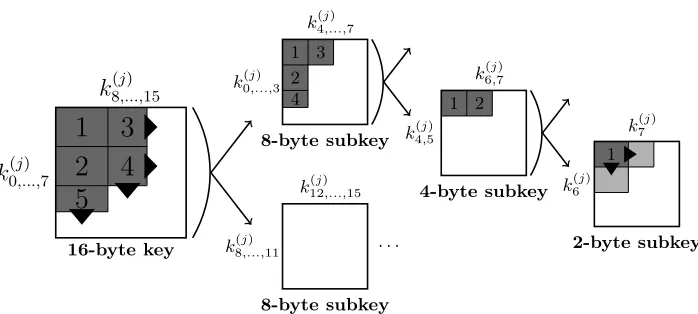
n lists is done by merging two lists n−1 times. The order of merging is such that lists merged together are of similar sizes. In the case of theaes, we obtain something similar to a binary tree. Still considering the case of the aes, we notice that enumerating 128-bit keys is done by merging two lists of size 264. Such lists cannot be generated or stored efficiently. Fortunately, we can instead generate these lists only as far as required by the key enumeration. Whenever a new subkey is inserted in the candidate set, we get it from the enumeration algorithm applied to the lower level (64-bit subkeys obtained by merging two 232 element lists), and so on. This ensures that the storage and enumeration effort are minimized.
The process is illustrated in Figure 2. Enumerating 16-byte keys consists in enumerating subkeys taken from the two 264-element lists k(j)
0,...,7 and k (j) 8,...,15, which in turn are built using four 232-element listsk(j)
0,...,3,k (j)
4,...,7, etc. This pro-cess is repeated until we reach the original 28-element subkey distributions. The recursive decomposition combined with ourlazy evaluationtechnique keep com-putations and memory requirements to a minimum and allow us to enumerate a large number of key candidates. Note that since there are only few dependen-cies between the enumeration lists, the algorithm can additionally be accelerated through parallelization.
4.2 Key rank and high-order success rate
The algorithm used here is specifically designed in order to allow an adversary to recover encryption keys when it is not ranked first. A close but simpler problem is that of estimating the rank of the correct key, which does not necessarily require to enumerate all the keys candidates ranked before: we just need to estimate how many they are. This problem occurs for example during security evaluation, where the correct key is usually known and the question is to rate the recovery effort in terms of trace acquisitions and key trials.
k
0(j,...,) 7k
8(j,...,) 151
2
3
4
5
16-byte key
k(0j,...,) 3
k4(j,...,) 7
1 2
3
4
8-byte subkey
k(8j,...,) 11
k(12j),...,15
8-byte subkey
· · · k(4j,5)
k6(j,7)
1 2
4-byte subkey k6(j)
k7(j)
1
2-byte subkey
Fig. 2: Recursive enumeration from multiple lists of key candidates. hypercube. If we imagine equipotential surfaces on candidate probability in this cube, the key rank is related directly to the number of candidates contained in the volume between the surface passing through the correct key point and the planes delimiting the hypercube. By sampling key candidates, it is possible to give higher and lower estimates of this value, thereby computing ranges for key ranks.
4.3 Comparison with previous works
removing the variance issues of the probabilistic test. Overall, the probability-driven approach tends to lead to much more tests than optimal deterministic enumeration, as will be illustrated experimentally in the next section.
In terms of complexities, it is easy to see that the probability-driven algo-rithm can output new keys in constant time and has a very small memory re-quirement. The case of our deterministic enumeration algorithm is more difficult. The use of balanced trees for the frontier set and the recursive decomposition of the problem point towards a logarithmic time complexity. However, it appears from the experiments in the next section that the algorithm enumerates keys in amortized time close to constant. Summarizing, both methods lead to a linear time complexity in the total number of key candidates that are output, with the enumeration algorithm also requiring a sub-linear amount of memory.
As previously mentioned, an enumeration algorithm similar to ours was pro-posed in a paper by Pan, van Woudenberg, den Hartog and Witteman [24]. It also enumerates key candidates in optimal order, but the reduction rule 1 is not used, nor the recursive decomposition that allows us to efficiently apply rule 1 with more than two lists. Therefore, the frontier set of their algorithm is not min-imal, and the memory requirements are much larger. In practice, since the main limitation for optimal key enumeration appears to be memory, this non-minimal version of enumeration does not allow an adversary to output a large number of key candidates. Moreover, handling a larger frontier set implies time com-plexity penalties, which makes our new algorithm faster than this previous one. Implementation results confirming these claims are given in the next section.
We note that another related problem is list decoding of convolutional codes through the Viterbi algorithm (see, e.g. [33]). However, such algorithms are gen-erally designed to output a small number of most likely candidates determined a priori, whereas we target the enumeration of 232or more master key candidates. Finally, the application of Algorithm 3 in the context of [22] may also be relevant. If keys can be generated according to an unknown distribution, this distribution can be estimated. Hence, by performing such a pre-processing phase, the deterministic algorithm can be used. The resulting enumeration avoids repe-titions and tend towards optimal as the distribution estimates become accurate.
5
Experiments
cipher and experimental setup. We carried out both template attacks with per-fect profiling (since the leakage function is known) and non-profiled Bayesian stochastic attacks assuming a basis made of the S-box output bits.
5.1 Comparing optimal and probabilistic key-enumerations
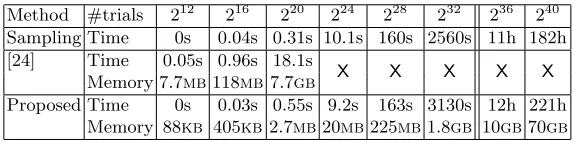
Table 1 gives some performance results for key enumeration obtained on our setup (Intel core i7 920 running a 64-bit Ubuntu 11.04 distribution), further predicted for 236 and 240 key candidates. These comparative results show that both the sampling algorithm and ours can output key candidates at essentially the same speed. The results for the enumeration algorithm described in [24] are also given. As expected, they exhibit larger memory requirements, which bounds the number of key candidates that can be enumerated and increases time com-plexity. In practice, we were limited to 220 candidates using this algorithm. By contrast, the memory requirements of our deterministic algorithm are low enough to allow us reaching 232key candidates in one hour, using less than 2gb. Predic-tions show that it is possible to reach 240 using 70gb of memory in nine days. Note that enumeration time can be improved using parallel implementations.
Method #trials 212 216 220 224 228 232 236 240 Sampling Time 0s 0.04s 0.31s 10.1s 160s 2560s 11h 182h [24] Time 0.05s 0.96s 18.1s
X X X X X
Memory 7.7mb118mb7.7gb
Proposed Time 0s 0.03s 0.55s 9.2s 163s 3130s 12h 221h Memory 88kb 405kb2.7mb20mb225mb1.8gb 10gb70gb
Table 1: Practical comparison of key-enumeration algorithms.
1 22 24 26 28
210
212
100kb 1mb 10mb 100mb
1gb
10gb
20 28 216 224 232 key rank
Overhead Memory
Fig. 3: Overhead of the probability-driven method in function of the key rank (green), and memory requirements of the deterministic enumeration (light blue).
In some cases, we also observe overheads very far from the median value (well over 1000), even when the correct key is ranked among the 4 first ones. On top of thisexpected number of trials, we have to consider that, since the probabilis-tic method follows a geometric law, the number of key trials will have a very large variance (approximately the square of expected value). This makes the probabilistic method both more costly and less reliable than our deterministic algorithm. Besides, the memory space requirement of the enumeration method also appears to follow a power law. We can see that enumerating up to 232 re-quires about 1gb of memory. Extrapolations up to 240 keys give an estimated 70gb, which is easily manageable using hard-disk drives in less than two weeks.
0.0 0.2 0.4 0.6 0.8 1.0
50 100 150 200 250
success
Optimal enumeration
0.0 0.2 0.4 0.6 0.8 1.0
50 100 150 200 250
messages success
Random sampling
5.2 Application of key-enumeration to side-channel attacks
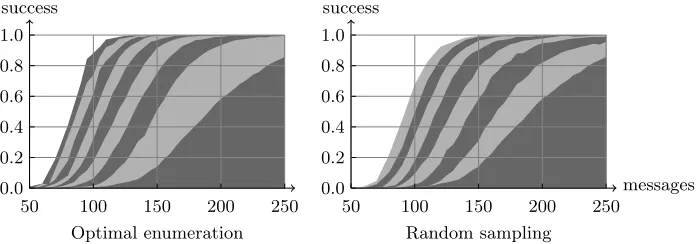
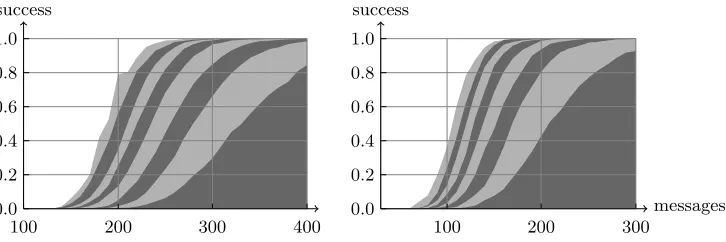
Figure 4 illustrates the success rate of different orders for a template attack, in function of the number of traces measured. The alternated light and gray zones correspond to the evolution of the success rate each time the number of tested keys is multiplied by 16. The rightmost dark gray curve is obtained by only testing the first key candidate, the first light gray curve by testing 24keys, then 28, . . . We again considered the optimal and the probabilistic enumerations, for different number of enumerated key candidates. The optimal enumeration was led up to 232 candidates, and the probabilistic method up to 228. As expected, allowing more key candidates to be tested can dramatically increase the efficiency of a key recovery. For 120 messages measured, the best key candidate is the correct one about 2% of the time, while there is a 91% chance for the correct key to be found among the first 224 candidates with the optimal enumeration algorithm (or an 84% chance with the probability driven method). In other words, increasing the number of key trials significantly improves the success rate, thereby providing a tradeoff between the data and time complexities of the attacks. As in the previous subsection, we also observe that the optimal enumeration algorithm leads to higher success rates compared to the random sampling for a given number of key trials, at the cost of additional memory requirements. Figure 5 shows a similar curve for the non-profiled variant of the stochastic attack described in Section 3, using the deterministic enumeration algorithm. It confirms the correctness of our Bayesian formulation2.
0.0 0.2 0.4 0.6 0.8 1.0
100 200 300 400
success
0.0 0.2 0.4 0.6 0.8 1.0
100 200 300
messages success
Fig. 5: Success rates of the Bayesian stochastic attack with optimal key enumer-ation. Left: 9-element linear basis. Right: 2-element Hamming weight basis.
Figure 6 provides an orthogonal view of the problem: for a given number of traces, one can increase the key success rate by enumerating more key candidates.
2
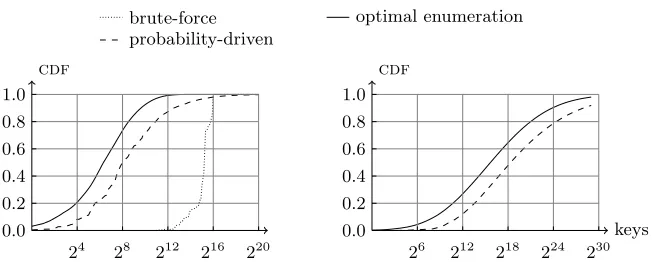
The figure shows the cumulative probability function (cdf) of key recoveries for an attack with a fixed number of traces, in function of the number of key trials. The pmfs used for this experiment are output by two template attacks. The first attack (left) targets only 2 key bytes, the second (right) targets all 16 key bytes. As expected, the cumulative probability starts from 0 and reaches 1 once a sufficient number of keys have been tested. Also, the brute force testing is only possible in the left case (i.e. when we can enumerate the full list). In general, we see that the side-channel information allows obtaining high success rates with a limited number of key trials (here, up to 230). More importantly, the figure again confirms the interest of the deterministic algorithm in terms of “number of keys to test”. Reaching a similar success rate with the probabilistic algorithm requires between 22and 24more tests, depending on the success rates.
brute-force probability-driven
optimal enumeration
0.0 0.2 0.4 0.6 0.8 1.0
24 28 212 216 220
cdf
0.0 0.2 0.4 0.6 0.8 1.0
26 212 218 224 230 keys
cdf
Fig. 6: Enumeration success rates. Left: 2 S-boxes, right: 16 S-boxes.
success rate key PMF entropy
success median
first/last success quartile
first/last success centile 216
212
28
24
0.0 0.2 0.4 0.6 0.8 1.0
50 100 150 200 250 300
messages
success key tries
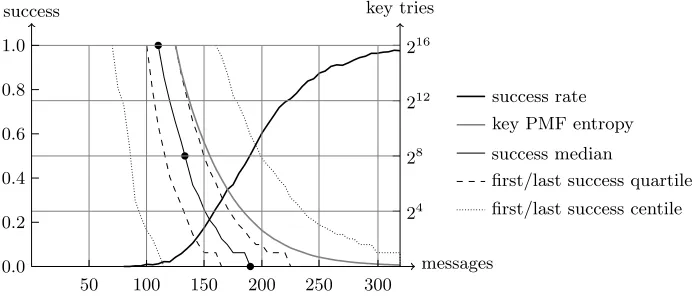
Fig. 7: Success rate for the best key candidate (thick), entropy of the key candi-dates distribution (gray), and key tries needed to reach a given success proba-bility (dotted: 1% and 99%, dashed: 25% and 75%, solid: 50%).
6
Other applications
As mentioned earlier, the interest of the proposed key-enumeration algorithm is not restricted to the context of side-channel cryptanalysis: the problem of enu-merating keys from subkey distributions may also arise in the case of multiple statistical cryptanalysis. Indeed, when considering a single statistical character-istic, one obtains a list of subkeys (typically corresponding to key bits used for a partial decryption) with their probabilities. When more characteristics are used, an attacker obtains different lists of subkeys and has to combine them.
This is the case, for instance, in multiple differential cryptanalysis [4] and multiple linear cryptanalysis [3]. Both types of cryptanalyses belong to the same family of so-called last-rounds attacks that consist in partially decrypting the available ciphertexts (e.g. by inverting few S-boxes), in order to compute some statistic related to a chosen characteristic (typically, a differential or linear ap-proximation of the target cipher). As only k key-bits are required to perform the partial decryption, one can decrypt the ciphertexts for all possible values of thisk-bit subkey, obtaining as many statistics. From them, the attacker derives the likelihood of being the correct subkey for each candidate. Using more than one characteristic directly leads to different lists of candidates and their proba-bilities. In general, the choice of characteristics is limited by the total number of key bits guessed. Indeed, if all the key bits are involved in at least one charac-teristic, recovering the full key by generating the list of candidates will be more time-consuming than exhaustive search. However, using an optimal enumeration algorithm, the set of characteristics can be split in many groups - each involving a small number of key-bits - so that generating the list of subkeys is tractable and the master key can then be enumerated from these lists.
lead-ing to attacks recoverlead-ing 32,40 and 44 key-bits. Merging the three lists obtained from these groups would dramatically increase the time and memory complexi-ties, leading to a worse attack than using only one group. Using the optimal key enumeration algorithm, we obtain an attack that outperforms the ones proposed in the original paper. A similar gain can be observed for the linear cryptanalysis of DES proposed in [12]. Here, using all the linear approximations, the number of involved key bit reaches 56 (i.e. the full-key size). Hence, authors only used a subset of approximations (32968 out of 74086) leading to a list of 242candidates. Again, the optimal enumeration algorithm allows us to extract more information from the available plaintext/ciphertext pairs, leading to a more efficient attack. Subkey-bits overlap. We note that it is unlikely that sets of key bits corresponding to different characteristics are disjoints. Hence, Algorithm 3 has to be patched to be applied to multiple statistical cryptanalyses. This can be easily done by adding a rule in successor insertion, that skips inconsistant couples of subkeys when updating the frontier set. The time overhead induced by this additional rule remains small as the proportion of overlapping bits is typically small.
7
Conclusion
This paper complements standard side-channel cryptanalysis by investigating the attack improvements obtained by adversaries with non-negligible compu-tational power. For this purpose, we first proposed an extension of non-profiled stochastic attacks that outputs probability mass functions, providing us with the likelihood values of subkey candidates. Next, we proposed a new and determin-istic key enumeration algorithm, in order to take advantage of these likelihood values. Our experiments show that this order-optimal enumeration algorithm leads to more efficient attacks than a sampling-based algorithm from Eurocrypt 1991. In particular, the probabilistic algorithm suffers from its underlying ge-ometric law, that implies an increasingly large overhead over the deterministic method (in terms of key trials), as the number of keys to enumerate increases. The deterministic method additionally allows removing the possibility of compu-tationally intensive worst cases, which makes it a particularly suitable solution for side-channel security evaluations, in which we want to derive security met-rics with high confidence. Finally, our proposal significantly reduces the memory requirements of a deterministic algorithm from SAC 2010, making it the best practical solution for enumeration of up to 240 key candidates. As a result, the solutions in this paper allow us to properly trade side-channel measurements for offline computations. They create a bridge between classical DPA and brute-force key recovery, where information extracted through side-channels is used to improve an exhaustive search. Hence, an interesting scope for further research is to compare computationally-enhanced DPA attacks with other types of more computational side-channel attacks, e.g. based on the detection of collisions.
evaluate a key candidate by partially decrypting the ciphertext and computing the probability of the leakages in the previous rounds. This probability will only be non-negligible if the ciphertext was decrypted with the correct key. Interestingly, in this particular setting, the test of one key candidate is especially expensive, making the optimal enumeration algorithm particularly relevant.
References
1. Eli Biham and Adi Shamir. Differential cryptanalysis of des-like cryptosystems. In Alfred Menezes and Scott A. Vanstone, editors,CRYPTO, volume 537 ofLecture Notes in Computer Science, pages 2–21. Springer, 1990.
2. Eli Biham and Adi Shamir. Differential fault analysis of secret key cryptosys-tems. In Burton S. Kaliski Jr., editor,CRYPTO, volume 1294 ofLecture Notes in Computer Science, pages 513–525. Springer, 1997.
3. Alex Biryukov, Christophe De Canni`ere, and Micha¨el Quisquater. On multiple linear approximations. In Matthew K. Franklin, editor,CRYPTO, volume 3152 of
Lecture Notes in Computer Science, pages 1–22. Springer, 2004.
4. C´eline Blondeau and Benoˆıt G´erard. Multiple differential cryptanalysis: Theory and practice. In Antoine Joux, editor, FSE, volume 6733 of Lecture Notes in Computer Science, pages 35–54. Springer, 2011.
5. Andrey Bogdanov. Improved side-channel collision attacks on aes. In Carlisle M. Adams, Ali Miri, and Michael J. Wiener, editors,Selected Areas in Cryptography, volume 4876 ofLecture Notes in Computer Science, pages 84–95. Springer, 2007. 6. Andrey Bogdanov, Ilya Kizhvatov, and Andrei Pyshkin. Algebraic methods in
side-channel collision attacks and practical collision detection. In Dipanwita Roy Chowdhury, Vincent Rijmen, and Abhijit Das, editors,INDOCRYPT, volume 5365 ofLecture Notes in Computer Science, pages 251–265. Springer, 2008.
7. Eric Brier, Christophe Clavier, and Francis Olivier. Correlation power analysis with a leakage model. In Joye and Quisquater [14], pages 16–29.
8. Suresh Chari, Josyula R. Rao, and Pankaj Rohatgi. Template attacks. In Burton S. Kaliski Jr., C¸ etin Kaya Ko¸c, and Christof Paar, editors,CHES, volume 2523 of
Lecture Notes in Computer Science, pages 13–28. Springer, 2002.
9. Baudoin Collard, Fran¸cois-Xavier Standaert, and Jean-Jacques Quisquater. Im-proved and multiple linear cryptanalysis of reduced round serpent. In Dingyi Pei, Moti Yung, Dongdai Lin, and Chuankun Wu, editors, Inscrypt, volume 4990 of
Lecture Notes in Computer Science, pages 51–65. Springer, 2007.
10. Marcus Dichtl. A new method of black box power analysis and a fast algorithm for optimal key search. Proceedings of COSADE 2011, February 2011. Darmstadt, Germany.
11. Julien Doget, Emmanuel Prouff, Matthieu Rivain, and Fran¸cois-Xavier Standaert. Univariate side channel attacks and leakage modeling. Journal of Cryptographic Engineering, 2011. To appear.
12. Benoˆıt G´erard and Jean-Pierre Tillich. On linear cryptanalysis with many linear approximations. In Matthew G. Parker, editor,IMA Int. Conf., volume 5921 of
Lecture Notes in Computer Science, pages 112–132. Springer, 2009.
14. Marc Joye and Jean-Jacques Quisquater, editors. Cryptographic Hardware and Embedded Systems - CHES 2004: 6th International Workshop Cambridge, MA, USA, August 11-13, 2004. Proceedings, volume 3156 ofLecture Notes in Computer Science. Springer, 2004.
15. Pascal Junod. On the optimality of linear, differential, and sequential distinguish-ers. In Eli Biham, editor,EUROCRYPT, volume 2656 ofLecture Notes in Com-puter Science, pages 17–32. Springer, 2003.
16. Pascal Junod and Serge Vaudenay. Optimal key ranking procedures in a statistical cryptanalysis. In Johansson [13], pages 235–246.
17. Paul C. Kocher, Joshua Jaffe, and Benjamin Jun. Differential power analysis. In Michael J. Wiener, editor, CRYPTO, volume 1666 ofLecture Notes in Computer Science, pages 388–397. Springer, 1999.
18. Herv´e Ledig, Fr´ed´eric Muller, and Fr´ed´eric Valette. Enhancing collision attacks. In Joye and Quisquater [14], pages 176–190.
19. Arjen K. Lenstra and Eric R. Verheul. Selecting cryptographic key sizes.J. Cryp-tology, 14(4):255–293, 2001.
20. Stefan Mangard, Elisabeth Oswald, and Francois-Xavier Standaert. One for all - all for one: Unifying standard dpa attacks. Cryptology ePrint Archive, Report 2009/449, 2009. http://eprint.iacr.org/.
21. Mitsuru Matsui. Linear cryptoanalysis method for des cipher. InEUROCRYPT, pages 386–397, 1993.
22. Willi Meier and Othmar Staffelbach. Analysis of pseudo random sequence gener-ated by cellular automata. InEUROCRYPT, pages 186–199, 1991.
23. Yossef Oren, Mario Kirschbaum, Thomas Popp, and Avishai Wool. Algebraic side-channel analysis in the presence of errors. In Stefan Mangard and Fran¸cois-Xavier Standaert, editors, CHES, volume 6225 of Lecture Notes in Computer Science, pages 428–442. Springer, 2010.
24. Jing Pan, Jasper G. J. van Woudenberg, Jerry den Hartog, and Marc F. Witteman. Improving dpa by peak distribution analysis. InSelected Areas in Cryptography, pages 241–261, 2010.
25. T´el´ecom ParisTech. Dpa contest v2. http://www.dpacontest.org/v2/index.php, 2009/2010.
26. Cryptographic Key Length Recommendation. http://www.keylength.com/. 27. Mathieu Renauld and Fran¸cois-Xavier Standaert. Algebraic side-channel attacks.
In Feng Bao, Moti Yung, Dongdai Lin, and Jiwu Jing, editors,Inscrypt, volume 6151 ofLecture Notes in Computer Science, pages 393–410. Springer, 2009. 28. Mathieu Renauld, Fran¸cois-Xavier Standaert, and Nicolas Veyrat-Charvillon.
Alge-braic side-channel attacks on the aes: Why time also matters in dpa. In Christophe Clavier and Kris Gaj, editors,CHES, volume 5747 ofLecture Notes in Computer Science, pages 97–111. Springer, 2009.
29. Mathieu Renauld, Fran¸cois-Xavier Standaert, Nicolas Veyrat-Charvillon, Dina Kamel, and Denis Flandre. A formal study of power variability issues and side-channel attacks for nanoscale devices. In Kenneth G. Paterson, editor, EURO-CRYPT, volume 6632 of Lecture Notes in Computer Science, pages 109–128. Springer, 2011.
30. Werner Schindler, Kerstin Lemke, and Christof Paar. A stochastic model for dif-ferential side channel cryptanalysis. In Josyula R. Rao and Berk Sunar, editors,
31. Kai Schramm, Gregor Leander, Patrick Felke, and Christof Paar. A collision-attack on aes: Combining side channel- and differential-attack. In Joye and Quisquater [14], pages 163–175.
32. Kai Schramm, Thomas J. Wollinger, and Christof Paar. A new class of collision attacks and its application to des. In Johansson [13], pages 206–222.
33. Nambirajan Seshadri and Carl-Eric W. Sundberg. List viterbi decoding algorithms with applications. IEEE Transactions on Communications, 42(2/3/4):313–323, 1994.
34. Fran¸cois-Xavier Standaert, Benedikt Gierlichs, and Ingrid Verbauwhede. Partition vs. comparison side-channel distinguishers: An empirical evaluation of statistical tests for univariate side-channel attacks against two unprotected cmos devices. In Pil Joong Lee and Jung Hee Cheon, editors,ICISC, volume 5461 ofLecture Notes in Computer Science, pages 253–267. Springer, 2008.