International Journal of Research
eISSN: 2348-6848 & pISSN:
2348-795X Vol-5 Special Issue-13
International Conference on Innovation and Research in
Engineering, Science & Technology
Held on 23rd & 24th February 2018, Organized by Tulsiramji Gaikwad Patil College of Engineering & Technology, Nagpur,
441108, Maharastra, India.
Analytical Study on Seismic Response Control
of Multistory RC Building Frame Using
Various Types of Bracing Systems
Nikhil A.Sherje
1, Manish Chudare
21
M-Tech Research Scholar (Structure), Civil Engineering Department, Tulsiramji Gaikwad-Patil
College of Engineering and Technology, Mohgaon, Nagpur, MH.
[email protected]
2
Asst. Professor Civil Engineering Department, Tulsiramji Gaikwad-Patil College of Engineering and
Technology, Mohgaon, Nagpur, MH.
[email protected]
Abstract:
Seismic design relies on inelastic deformation through hysteretic behavior. During severe earthquakes the structural system undergoes extensive damage that result in high cost of repair. Research these days has elevated and surpassed common human instinct. One such research that backed structural systems to sustain tremors of earthquake is metallic braces. These components are predominantly the lateral force resisting system in any building structure. The installation of braces within a structure system will magnetize substantial part of destruction while the parent elements persist elastically with inferior inelastic deformation. Dissipation of seismic energy occurs through inelastic yielding and buckling of bracing member in tension and compression respectively. In the present work structured in a reinforced concrete G+7 storied moment resisting frame building which modeled using (Software for Analysis and Design) SAP-2000. The building modeled in accordance with the provisions prescribed by IS:1893 2012 part I. Three patterns of bracing will be fabricated on the peripheral frame of erection, where pattern being X, V and Inverted V. Both types of non linear analysis i.e. dynamic time history (NTH) .Results for NTH will described in the form of storey displacement, storey drift, shear force, bending moment and energy dissipated by frame and bracing.
Keywords
Bracing, SAP-2000, Pushover analysis, Non linear Time history analysis.
1.
Introduction
1.1 General
A seismic design is based upon combination of strength and ductility. For small, frequent seismic
disturbances, the structure is expected to remain in the elastic range with all stress well below the yield level. However it is not reasonable to expect that the traditional structure will respond elastically when subjected to major earthquake. Instead the design engineer relies upon the inherent ductility of the building structure to prevent catastrophic failure while accepting certain level of structural and non structural damage. Ultimately, with these approaches, the structure is designed to resist an equivalent static load and results have been reasonably successful. Even an approximate accounting for lateral effects will almost certainly improve building survivability. However, by considering the actual dynamic nature of environmental disturbances, more improvements were made in the design procedures.
1.2 Modern Structural Protective System
The modern structural protective system is categorized into three major categories: Seismic Isolation System, Passive Energy Dissipation Devices and Semi Active and Active Energy Dissipation Devices. These energy dissipation devices When gets installed inside any structure curtails response due to the seismicity of earthquake ground motion. All these devices have their advantages and disadvantages but prove to be effective in improving response of structure.
1.2.1 Seismic Isolation System
International Journal of Research
eISSN: 2348-6848 & pISSN:
2348-795X Vol-5 Special Issue-13
International Conference on Innovation and Research in
Engineering, Science & Technology
Held on 23rd & 24th February 2018, Organized by Tulsiramji Gaikwad Patil College of Engineering & Technology, Nagpur,
441108, Maharastra, India.
Friction Pendulum Systems and Sliding Bearings with Restoring Forces.[22]
1.2.2 Active and Semi-Active Control
System
On the other hand there are semi-active and active control systems. Semi-active and active structural control is an area of structural protection in which the motion of a structure is controlled or modified by means of the action of a control system through some external energy supply. The technology is now at the stage where actual systems have been designed, fabricated and installed in full-scale structures. Some of the existing active an semi-active control devices are Active Bracing Systems, Active Mass Dampers, Variable Stiffness and Damping Systems Smart Materials.[22]
1.2.3 Passive Energy Dissipation Devices
While all these technologies are likely to have an increasingly important role in structural design, the scope of the present monograph is limited to a discussion of passive energy dissipation systems. Research and development of passive energy dissipation devices for structural applications have roughly a 25-year history. In recent years, serious efforts have been undertaken to develop the concept of energy dissipation or supplemental damping into a workable technology, and a number of these devices have been installed in structures throughout the world. Because of the added damping force that passive device provides, their distribution over the height of the building is critical towards reducing vibration and preventing large structural damage. [22]
1.2.3.1 Metallic Damper
One such passive energy dissipation device is a Metallic Damper. Metallic dampers are one of the most effective mechanisms available for the dissipation of energy, input to a structure during an earthquake, is through the inelastic deformation of metallic substances. This metallic damper is also called as a metallic fuse or structural fuse. The concept behind this device comes from the fuse of an electric circuit. What happens in an electric circuit is that excess of electric current flows through a circuit the electric fuse wire break down by self-sacrificing itself thereby protecting the electric appliances. Examples of metallic dampers that have received significant attention in recent years include the X-shaped and triangular plate dampers. Force-deformation characteristics. Since this overall response is intimately linked with the cyclic stress-strain behavior of the metal, it is beneficial at this point to briefly review the typical inelastic stress-strain response of structural steel. [22]
1.2.3.2
Bracing
as
Passive
Energy
Dissipation Devices
Besides these devices different type of bracing system could be thought upon to dissipate the seismic energy through the structure functioning unlike the metallic damper. These bracings are essentially made of mild steel. These bracings also dissipate energy through their inelastic yielding capabilities. There are mainly two type of bracing system that exist they are concentric type and eccentric type of bracing system. Different type of bracing system that attained the focus of the structural designers includes X bracing system, V bracing system, Inverted V bracing system and K bracing system which are a part of concentric bracing system.
2.
Modeling and Analysis of Frame
From literature surveyed it is concluded that using bracing element is very economical way to reduce seismic weight of any type of building structure. Shear wall also help in curtailing the lateral force effect due to ground motion but it add on to a greater seismic weight. So using bracing and metallic damper as fuse element improves the performance of building during earthquake thereby reducing the seismic weight. So in the present work for evaluating the concept of metallic fuse a G+7 storey reinforced concrete (RC) moment resisting frame situated in zone IV is modeled. Concentric type bracing metallic X-plate damper (XPD) imparted to structure is modeled as fuse element. Concentric bracing includes three different pattern of bracing where there are varying numbers of plates in XPD. Both type of analysis nonlinear dynamic time history analysis (NTH) and nonlinear static procedure (NSP) is carried out using SAP-2000 version 4.2. Pushover or nonlinear static analysis is performed as per the guidelines provided by federal emergency and management agency (FEMA) - 356 and applied technical council (ATC) - 40.
2.1. Modeling of Building Frame
Metallic fuse is the easiest and simplest way of reducing response of building. To verify the concept of metallic fuse bracing system and metallic plate damper are considered as variables. This has resulted analysis of seven models. The details of the models is as follows
Model In - G7RCFWOSED: G+7 storey Reinforced Concrete Frame Without Supplemental Energy Dissipating Device
International Journal of Research
eISSN: 2348-6848 & pISSN:
2348-795X Vol-5 Special Issue-13
International Conference on Innovation and Research in
Engineering, Science & Technology
Held on 23rd & 24th February 2018, Organized by Tulsiramji Gaikwad Patil College of Engineering & Technology, Nagpur,
441108, Maharastra, India.
Model III - G7RCFWVBS: G+ 7 storey Reinforced Concrete Frame with V Bracing System.
Model IV - G7RCFWIVBS: G+ 7 storey Reinforced Concrete Frame with IV Bracing System. Model V- G7RCFW10XPD: G+ 7 storey Reinforced Concrete Frame with 10 X Plate Damper. Model VI - G7RCFW15XPD: G+ 7 storey Reinforced Concrete Frame with 15 X Plate Damper. Model VII - G7RCFW20XPD: G+ 7 storey Reinforced Concrete Frame with 20 X Plate Damper.
2.1. Details of the Models
2.2.1. Column and Beam Sizes for Modeling of Building
Table 3.1 Column and Beam Sizes for Modeling of Building
Sr.
No. Element Notation Size (mm)
1 Column C1 350 X 400
C2 450 X 500
2 Beam B1 300 X 350
B2 350 X 400
2.2.2 Assumed Data for Models
Building = G + 7 Storey
Slab Thickness = 150 mm
Live Load = 3 kN/m2
Floor Finish = 1 kN/m2
Concrete Grade = M20
Concrete Density = 25 kN/m3
Steel Grade = Fe415
Steel Density = 7850 kN/m3 Earthquake Used = North Ridge, Imperial Valley and Loma Prieta Earthquake.
2.2.3. Description of Bracing
Section Used = ISMB125 Material Used = Mild Steel
2.2.4. Mechanism of X Plate Damper
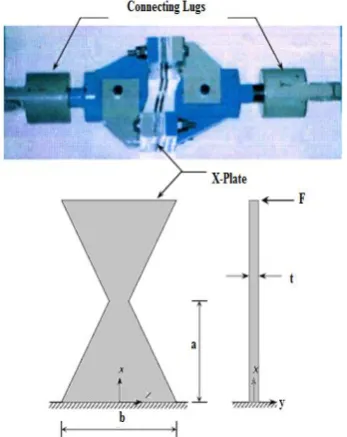
plate dampers consist of one or multiple X-shaped steel plates, each plate having a double curvature and arranged in parallel; this number of plate depends upon required amount of energy to be dissipates in the given system. Material used for manufacturing of X-plate may possibly be any metal which allow large deformation such as mild steel, although sometimes lead or more exotic metal alloy are employed. In order to reduce the response of structure by dissipating the input seismic energy such damper can be used with an appropriate supporting system, intrinsically in building structure combination of bracing and XPDs can be used and such assembly is known as device-brace assembly. They can sustain many cycles of stable yielding deformation, resulting in high level of energy
dissipation or damping. The aim behind the use of X-shape of damper is it will have a constant strain variation over its height, thus ensuring that yielding occur simultaneously and uniformly over the full height of the damper. XPDs allow it to behave nonlinearly but restrict behavior of the structure up to the linear elastic range [27]. A view of XPD and its set up is depicted in Figure 3.6
Figure 3.6 Actual Setup and X Plate Damper
2.2.5. Properties of XPD
Height of triangular portion (a) = 40mm Breadth of triangular portion (b) = 60mm Thickness of plate (t) = 4mm Number of X- Plates Used (n) = 10, 15, 20 Modulus of Elasticity (E) = 1.922X10⁵ N/mm2 Yield Stress (y) = 235 N/mm2
A series of experimental tests were conducted at Bhabha Atomic Research Center (BARC) and IIT Bombay to study the behavior of these XPDs by Bakre et al. [27] also studied the behavior of XPDs and observed the subsequent results (i) it exhibits smoothly nonlinear hysteretic loops under plastic deformation; (ii) it can sustain a large number of yielding reversals; (iii) there is no significant stiffness or strength degradation and (iv) it can accurately modeled by Wen’s hysteretic model or as a bilinear elasto-plastic material. A typical XPD with holding device used in the present work.
International Journal of Research
eISSN: 2348-6848 & pISSN:
2348-795X Vol-5 Special Issue-13
International Conference on Innovation and Research in
Engineering, Science & Technology
Held on 23rd & 24th February 2018, Organized by Tulsiramji Gaikwad Patil College of Engineering & Technology, Nagpur,
441108, Maharastra, India.
a, b and t are height, width and thickness of the XPD. Using equation 3.1, 3.2 and 3.3 properties of mild steel such as yield force, yield displacement and initial stiffness respectively of X-plate damper are calculated. These properties are required as input for the modeling.
F_y = Yield Force = (235*〖10〗^(3 )*0.06*〖(4* 〖10〗^(-3))〗^2)/(6*0.04)=0.94kN (3.1 a)
Q = Yield Displacement= (2*235* 〖10〗^3*〖0.04〗^2)/(1.922* 〖10〗^8*4* 〖10〗^(-3)
)=9.78 X 〖10〗^(-4) m (3.2 b)
K_d=Initial Stiffness= 0.94/(9.78* 〖10〗^(-4) )=961.1 kN/m (3.3 c)
2.3. Non Linear Time History Analysis
In this method of dynamic analysis, the earthquake motion is directly applied to the base of a given structure with the help of the computer program. Instantaneous stresses throughout the structure are calculated at small intervals of time for the full duration of the earthquake or the significant portion of it. The maximum stresses in any member that occurs during the earthquake can then be found by scanning the output record and the design reviewed. The actual plot of three ground motion record considered for study is shown in Figure 3.7.
The procedure to maximum stress includes the following steps:
1. The earthquake record is selected which represents the expected earthquake. The record is digitized as a series of ground accelerations at small time intervals of about 1/40 to 1/25 of a second with given levels of acceleration occurring for each interval.
2. The digitized record is applied to the building model as accelerations at the base of the structure.
3. The computer integrates the equations of motion of the multi degree of freedom system as it is subjected to increments of elastic and damping forces and gives a complete record of the acceleration, velocity, and displacement of each lumped masse.
4. The accelerations and relative displacements of the lumped masses are translated into member
stresses. The maximum values can then be found by scanning the output record. This procedure automatically includes various modes of vibration and combines their effect.
According to the code, dynamic analysis may be performed using either response spectrum method or the time history method. In either method the design base shear (VB) is compared with the base shear 𝑉𝐵 calculated using the fundamental period Ta. It suggests that when VB is less than 𝑉𝐵 all the response quantities (for example member forces, displacements, storey force, storey shear and base reactions) must be suitably scaled by multiplying with (𝑉𝐵 / VB).
2.3.1. Procedure for Non Linear Time
History Analysis
1. Define time history function for applying time histories on the models.
2. Then define a new load case of time history function.
3. Write the function name and define the load case as time history from the dropdown menu. 4. Then select the analysis type as nonlinear and
time history type as modal.
5. Load is applied to the modal in form of acceleration in X direction with predefined time history function and scale factor as one.
6. The whole procedure includes only material non linearity.
7. After defining function and load case run the analysis and access the results.
International Journal of Research
eISSN: 2348-6848 & pISSN:
2348-795X Vol-5 Special Issue-13
International Conference on Innovation and Research in
Engineering, Science & Technology
Held on 23rd & 24th February 2018, Organized by Tulsiramji Gaikwad Patil College of Engineering & Technology, Nagpur,
441108, Maharastra, India.
(b)
(c)
Figure 3.7 Input Acceleration Time History (a) Imperial Valley (b) North ridge (c) Loma Prieta
Earthquake.
3.
Results and Discussion
The main purpose of applying nonlinear dynamic time history analysis is to examine the response of modeled building structure under real earthquake ground motions. The analysis exhibits actual behavior caused due to seismic disturbances. The resulting response found from such an evaluation is very realistic in nature. Therefore the consequences of installing PED's in structure could be investigated on a factual basis. NTH is carried out by imposing three time histories on to the modeled structure which are applied in the horizontal direction and their outcomes are discussed in following points.
3.1.
Effect
of
Bracing
on
Storey
Displacement
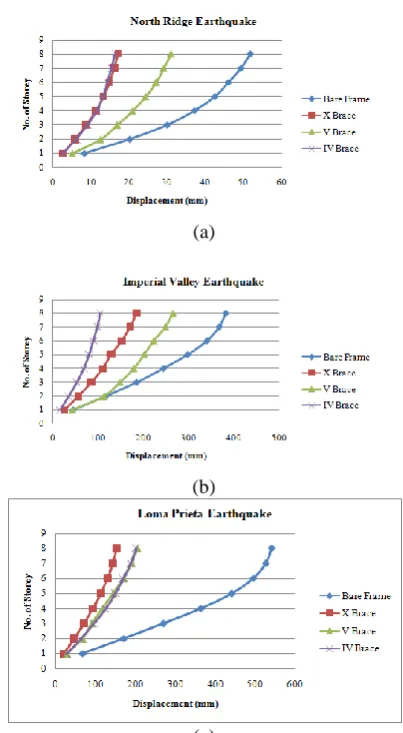
Figure 3.1. presents storey displacement occurred at various stories for different pattern of bracing. Figure compares the effect of bracing on displacement of each storey with bare frame for earthquake of three different intensities.
(a)
(b)
(c)
Figure 3.1 Displacement Comparisons for Model I, II, III and IV (a) North Ridge Earthquake (b)
Imperial Valley Earthquake (c) Loma Prieta Earthquake
Figure 3.1 it observed that, for bare frame model-I the displacement is maximum at top storey for the entire three earthquakes. But displacement is lowest in case of Northridge earthquake and increases for Imperial Valley and Loma Prieta earthquake. Same phenomenon has also occurred for models II, III, and IV. Amongst all the considered bracing patterns X and inverted V proved to very effective in reducing displacement at all the storey levels. Top storey displacement reduced by 63.35%, 44.25% and 67.85% for models II, III and IV respectively as compared to model-I. The increase in stiffness of bare frame structure due to the installation of bracing is the reason for reduction in storey level displacement.
3.2. Effect of Bracing on Storey Drift
International Journal of Research
eISSN: 2348-6848 & pISSN:
2348-795X Vol-5 Special Issue-13
International Conference on Innovation and Research in
Engineering, Science & Technology
Held on 23rd & 24th February 2018, Organized by Tulsiramji Gaikwad Patil College of Engineering & Technology, Nagpur,
441108, Maharastra, India.
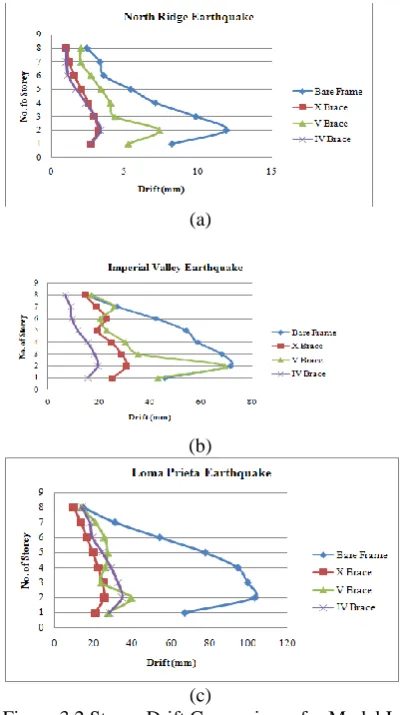
storey level for different pattern of bracing with varying intensities of earthquake.
(a)
(b)
(c)
Figure 3.2 Storey Drift Comparisons for Model I, II, III and IV (a) North Ridge Earthquake (b)
Imperial Valley Earthquake (c) Loma Prieta Earthquake
A comparative study of storey drift from Figure 4.2 reveal that, for models I, II, III and IV maximum storey drift has occurred at second storey. Storey Drift is least for North Ridge earthquake and increases for Imperial Valley and Loma Prieta earthquake. Within the considered bracing system, X and Inverted V brace system effectively decreased storey drift in comparison to V brace system. The reduction in storey drift occurred due to decrease in storey displacement. A 68.48%, 34.26% and 70.21% decrease in is observed for models II, III and IV as compared to bare frame model-I.
3.3. Effect of Bracing on Shear Force
A comparison is made between shear force values of bare frame and different configuration of bracing
utilized for three different ground motion in Figure 3.3.
(a)
(b)
(c)
Figure 3.3 Shear Force Comparisons for Model I, II, III and IV (a) North Ridge Earthquake (b)
Imperial Valley Earthquake (c) Loma Prieta Earthquake
International Journal of Research
eISSN: 2348-6848 & pISSN:
2348-795X Vol-5 Special Issue-13
International Conference on Innovation and Research in
Engineering, Science & Technology
Held on 23rd & 24th February 2018, Organized by Tulsiramji Gaikwad Patil College of Engineering & Technology, Nagpur,
441108, Maharastra, India.
3.4 Effect of Bracing on Moment
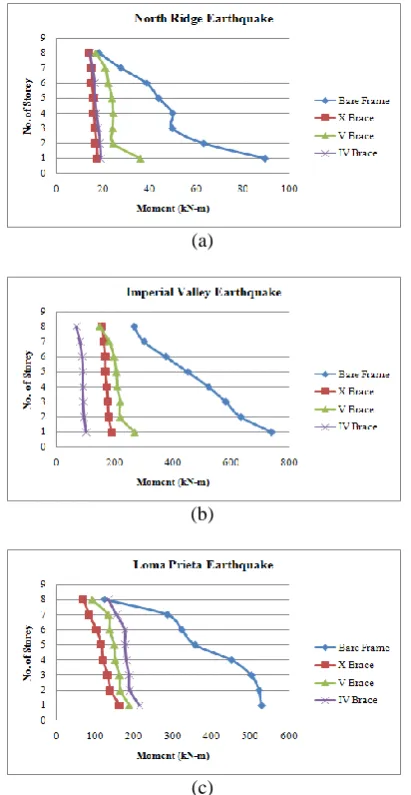
The moment value recorded at each floor level for comparative study of bracing system with bare frame considering three earthquakes is depicted in Figure 3.4.
(a)
(b)
(c)
Figure 4.4 Moment Comparison for Model I, II, III and IV (a) North Ridge Earthquake (b) Imperial Valley Earthquake (c) Loma Prieta Earthquake It is evident from Figure 4.4 that, maximum biaxial moment is observed in bottom storey column for the entire three considered earthquake. The values of moment are greater in case of Imperial Valley and Loma Prieta earthquake as compared to North Ridge earthquake. X bracing proved to be the most effective in reducing moment when compared to V and inverted V bracing configuration. Due to the partial transfer of force in brace elements shear in column reduced thereby reducing moment on columns. There was 74.81%, 62.76% and 74.85%
decrease in moment value for models I, II and III as compared to model-I.
3.5. Effect of X Plate Damper (XPD) on
Storey Displacement
Effect on storey displacement at each storey level due to variation in number of plates for three different earthquakes is presented in Figure 3.5
(a)
(b)
(c)
Figure 3.5 Displacement Comparisons for Model I, V, VI and VII (a) North Ridge Earthquake (b)
Imperial Valley Earthquake (c) Loma Prieta Earthquake
International Journal of Research
eISSN: 2348-6848 & pISSN:
2348-795X Vol-5 Special Issue-13
International Conference on Innovation and Research in
Engineering, Science & Technology
Held on 23rd & 24th February 2018, Organized by Tulsiramji Gaikwad Patil College of Engineering & Technology, Nagpur,
441108, Maharastra, India.
with twenty plates. This is because increase in number of plates increases the stiffness consequently curtailing storey displacement. 10XPD decreased top storey displacement by 11.88% in model-V, 15XPD by 17.09% in model-VI and 20XPD by 24.99%in model-VII as compared to bare frame model-I.
3.6 Effect of X Plate Damper (XPD) on
Storey Drift
(a)
(b)
(c)
Figure 3.6 Storey Drift Comparison for Model I, V, VI and VII (a) North Ridge Earthquake (b)
Imperial Valley Earthquake (c) Loma Prieta Earthquake
Maximum storey drift occurred at second storey for all earthquake under consideration is evident from Figure 4.6 for models I, V, VI and VII. Higher values of storey drift are observed for Imperial Valley and Loma Prieta earthquake whereas these get reduced for North Ridge earthquake. For every
increase of five plates there is 3% to 4% curtailment in percentage reduction in storey drift and is found to be least in case of 20XPD which occurred due to decrease in storey displacement. Reduction in storey drift for model V, VI and VII as compared to model-I is 17.22%, 20.95% and 21.54% respectively.
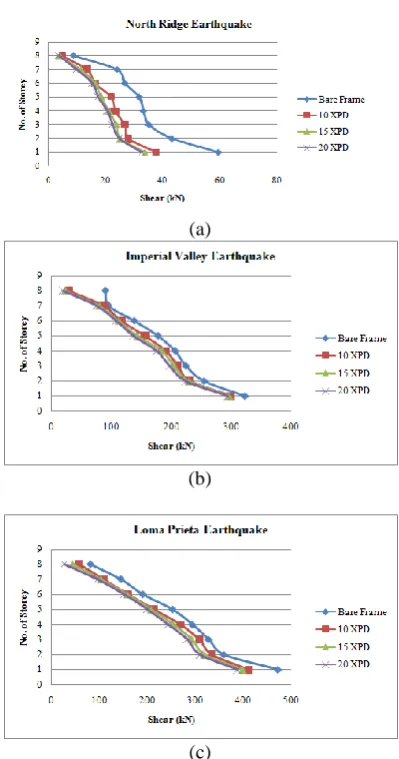
3.7. Effect of X Plate Damper on Shear
Force
Figure 3.7 depicts values of shear force at each storey level. The shear force values of bare frame are compared with 10XPD, 15XPD and 20XPD for three earthquakes.
(a)
(b)
(c)
Figure 3.7 Shear Force Comparison for Model I, V, VI and VII (a) North Ridge Earthquake (b)
Imperial Valley Earthquake (c) Loma Prieta Earthquake
International Journal of Research
eISSN: 2348-6848 & pISSN:
2348-795X Vol-5 Special Issue-13
International Conference on Innovation and Research in
Engineering, Science & Technology
Held on 23rd & 24th February 2018, Organized by Tulsiramji Gaikwad Patil College of Engineering & Technology, Nagpur,
441108, Maharastra, India.
VII. These seismic forces acting on frames are transferred from joints to the damper thus reducing shear force demand on columns for all the applied ground motions with varying number of plates. It is also observed that North Ridge earthquake had least response as compared Imperial Valley and Loma Prieta earthquake.
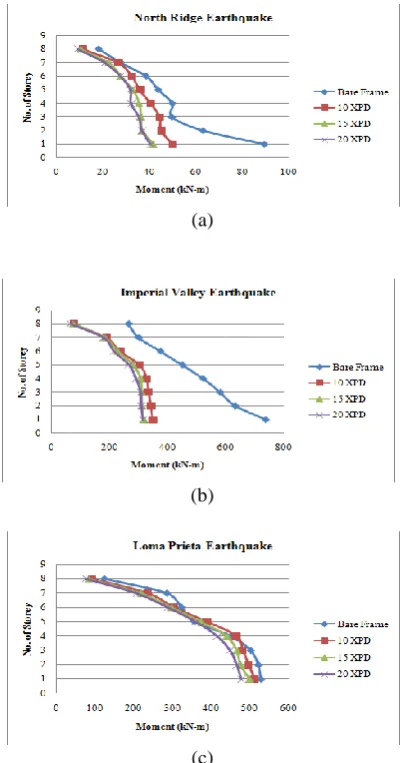
3.8 Effect of X Plate Damper on Moment
Moments induced in columns for bare frame and X-plate damper with plate variation is shown in Figure 3.8. The moment value recorded for different system is analyzed for three earthquakes.
(a)
(b)
(c)
Figure 3.8 Moment Comparison for Model I, V, VI and VII (a) North Ridge Earthquake (b) Imperial
Valley Earthquake (c) Loma Prieta Earthquake Figure 3.8 shows that moment are maximum in bottom storey column for model I, V, VI and VII. The moments on frames are reduced due to axial transfer of force in XPD thereby reducing shear force demand and consequently moments. Using 10XPD,
15XPD and 20XPD in model V, VI and VII reduced the moment value by 33.26%, 38.55% and 40.39% respectively as compared to bare frame model-I.
4.
Conclusion
Nonlinear dynamic time history analysis gives accurate results due to earthquake ground motions. Three time histories of different earthquakes are imposed on models. Based on the time history analysis of various models, following conclusions are drawn.
A significant reduction in the top storey displacement and storey drift have been observed for X, V and Inverted V bracing models II, III and IV as compared to bare frame model-I.
The maximum shear in bottom storey column and biaxial moment in columns have been reduced significantly for X, V and Inverted V bracing models as compared to bare frame model.
Reduction in the top storey displacement and storey drift is not so significant between models V, VI and VII as compared to bare frame model-I.
A minor variations in the maximum shear in bottom storey column and biaxial moment in columns have been observed in models V, VI and VII as compared to bare frame model-I.
The input energy dissipated through hysteretic behavior of metallic damper in models V, VI and VII is not significant.
X bracing system proved to the most effective system in curtailing response due to ground motions.
International Journal of Research
eISSN: 2348-6848 & pISSN:
2348-795X Vol-5 Special Issue-13
International Conference on Innovation and Research in
Engineering, Science & Technology
Held on 23rd & 24th February 2018, Organized by Tulsiramji Gaikwad Patil College of Engineering & Technology, Nagpur,
441108, Maharastra, India.
5.
References
Vargas R. and Bruneau M., “Analytical Response and Design of Buildings with Metallic Structural Fuses”, Journal of Structural Engineering, ASCE, Vol. 135, No. 4 pp. 386 - 393, 2009.
Tremblay R., Lacerte M. and Christopoulos C., “Seismic Response of Multistoried Building with Self Centering Energy Dissipative Steel Braces”, Journal of Structural Engineering, ASCE, Vol. 134, No. 1, pp.108 - 120, 2008.
Symans M.D., Charney F.A., Whittaker A.S., Constantinou M.C., Kircher C.A.,Jhonson M.W. and McNamara R.J. , "Energy Dissipation System for Seismic Application: Current Practice and Recent Development", Journal of Structural Engineering, ASCE, Vol. 134, No. 1, pp. 3 - 21, 2008
Vargas R. and Bruneau M., "Experimental Validation of the Structural Fuse Concept", 14th World Conference on Earthquake Engineering Youssef M.A., Ghaffarzadebh H. and Nehdi M. , " Seismic Performance of RC Frames with Concentric Internal Steel Brace" Engineering Structures, Elsevier Science Direct, Vol. 29, pp. 1561 - 1568, 2008
Sarno L.D. and Elnashi A.S., "Bracing System for Seismic Retrofitting of Steel Frames", Journal of Constructional Steel Research, Elsevier Science Direct, Vol. 65, pp. 452 - 465, 2009
Valente M., "Seismic Protection of RC Structure by New Dissipative Bracing System", Procedia Engineering, Elsevier Science Direct, Vol. 54, pp. 785 - 794, 2007
Moghaddam H., Hajirasouliah I. and Doostan A. , "Optimum Seismic Design of Concentrically Braced Steel Frames : Concepts and Design Procedures", Journal of Constructional Steel Research, Elsevier Science Direct, Vol. 61, pp. 151 - 166, 2005
Bahey S.E. and Bruneau M. , "Buckling Restrained Braces as Structural Fuses for the Seismic Retrofit of Reinforced Concrete Bridge Bents", Engineering Structures, Elsevier Science Direct, Vol. 33, pp. 1052 - 1061, 2011
Shen J. , Seker O. , Sutchiewcharn N and Akbas B, " Cyclic Behavior of Buckling Controlled Braces", Journal of Constructional Steel Research, Elsevier Science Direct, Vol. 121, pp. 110 - 125, 2016 Ma H. and Yam C.H. , "Modelling of Self Centering Damper and its Application in Structural Control", Journal of Constructional Steel Research, Elsevier Science Direct, Vol. 67, pp. 656 - 666, 2011
Pujari N.N. and Bakre S.V., "Optimizing Size of X-Plate Damper for Seismic Response Control of Multistoried Buildings", Fourth International Conference on Structural Stability and Dynamics.
Ferrario F. , Iori F. , Pucinotti R. and Zandonini R., "Seismic performance Assessment of Concentrically Braced Steel Frame Building with High Strength Tubular Steel Columns", Journal of Constructional Steel Research, Elsevier Science Direct, Vol. 121, pp. 427 - 440, 2016
Gabroah A. and Elfath H.A. , "Rehabilitation of Reinforced Concrete Frame Using Eccentric Steel Bracing", Engineering Structures, Elsevier Science Direct, Vol. 23, pp. 745 - 755, 2001
Gong Y., Xue Y., Xu L. and Grierson D.E. , "Energy Based Design Optimization of Steel Building Framework Using Non Linear Response History Analysis", Journal of Constructional Steel Research, Elsevier Science Direct, Vol. 68, pp. 43 - 50, 2012 Tarța G. and Pintea A., "Seismic Evaluation of Multi-Storey Moment-Resisting Steel Frames with Stiffness Irregularities Using Standard and Advanced Pushover Methods", Procedia Engineering, Elsevier Science Direct, Vol. 40, pp. 445 - 450, 2012
Ramiro V. and Bruneau M., "Analytical Response and Design of Buildings with Metallic Structural Fuses - I", Journal of Structural Engineering, ASCE, Vol. 135, pp. 386-393, 2009
Mayes R.L., Goings C., Naguib W. and Harris S., "Comparative Performance of Buckling-Restrained Braces and Moment Frames", 13th World Conference on Earthquake Engineering, 2004 Hendramawat S., Kristiawan S.A. and Basuki A., "Evaluation of the Use of Steel Bracing to Improve Seismic Performance of Reinforced Concrete Building", 2nd International Conference on Rehabilitation and Maintenance in Civil Engineering, Procedia Engineering, Elsevier Science Direct, Vol. 54, pp. 447 – 456, 2013
Maheri M.R., Kousari R. and Razazan M, "Pushover Tests on Steel X-Braced and Knee-Braced RC Frames", Engineering Structures, Elsevier Science Direct, Vol. 25, pp. 1697–1705, 2003
Yang C.S., LeonRoberto T. and Roches R.D., "Pushover Response of a Braced Frame with Suspended Zipper Struts", Journal of Structural Engineering, ASCE, Vol. 134, pp. 1619-1626, 2008 Constantinous M.C., Soong T.T. and Dargush G.F., "Passive energy Dissipation System for Structural Design and Retrofit", Multidisciplinary Center for Earthquake Engineering Research
Ghabraie K., Chanb R., Huang X. and Xie Y. M., "Shape Optimization of Metallic Yielding Devices for Passive Mitigation of Seismic Energy", Engineering Structures, Elsevier Science Direct, Vol. 32, pp. 2258-2267, 2010
International Journal of Research
eISSN: 2348-6848 & pISSN:
2348-795X Vol-5 Special Issue-13
International Conference on Innovation and Research in
Engineering, Science & Technology
Held on 23rd & 24th February 2018, Organized by Tulsiramji Gaikwad Patil College of Engineering & Technology, Nagpur,
441108, Maharastra, India.
Engineering Structures, Elsevier Science Direct, Vol. 29, pp. 224–236, 2007
Mwafy A.M. and Elnashai A.S., "Static Pushover Versus Dynamic Collapse Analysis of RC Buildings", Engineering Structures, Elsevier Science Direct, Vol. 23, pp. 407–424, 2001
Pujari N.N. and Bakre S.V., "Optimum Placement of X-Plate Damper for Seismic Response Control of Multistoried Buildings", International Journal of Earth Science and Engineering, Vol. 04, No. 06, pp. 481-485, 2011
Bakre S.V., Jangid R.S. and Reddy G.R, "Optimum X-Plate Damper for Seismic Response Control of Piping System "International Journal of Pressure Vessels and Piping, Elsevier Science Direct, Vol. 83 pp. 672 - 685, 2006
Balendra T., Sam M.T., Liaw C.Y. and Lee S.L. “Preliminary Studies into the Behavior of Knee Braced Frame Subjected to Seismic Loading", Engineering Structures, Elsevier Science Direct, Vol. 13, pp 67 - 74, 1991
Basha H.S. and Goel S.C. "Seismic Resistant Truss Moment Frames with Ductile Vierendeel Segments", Eleventh World Conference on Earthquake Engineering.
Mosalman H.A. and Sulong N.H., "Optimization of Off Center Bracing System Using Genetic Algorithm", Journal of Constructional Steel Research, Elsevier Science Direct , Vol. 67, pp. 1435–1441, 2011
Climent A.V., "An Energy-Based Method for Seismic Retrofit of Existing Frames Using Hysteretic Dampers", Soil Dynamics and Earthquake Engineering, Elsevier Science Direct, Vol. 31, pp. 1385–1396, 2011
Rahai A.R. and Alinia M.M., " Performance Evaluation and Strengthening of Concrete Structures with Composite Bracing Members", Construction and Building Materials, Elsevier Science Direct, Vol. 22, pp. 2100 – 2110, 2008
Martinez C.A., Curadelli O. and Compagnoni M.E., "Optimal Placement of Non Linear Hysteretic Damper on Planer Structures Under Seismic Excitations" Engineering Structures, Elsevier Science Direct, Vol. 65, pp. 89 - 98, 2014
ATC, “Seismic Evaluation and Retrofit of Concrete Building”, Applied Technical Council Vol. 1, No. 4, Redwood City California, 1996
FEMA, “NEHRP Guidelines for Seismic Rehabilitation of Buildings”, Developed by Building Seismic Safety Council for Federal Emergency and Management Agency No. 356, Washington D.C., 1996
IS 1893:2002, Indian Standard, “Criteria For Earthquake Resistant Design of Structures” Part I - General Provisions and Building