Available Online atwww.ijcsmc.com
International Journal of Computer Science and Mobile Computing
A Monthly Journal of Computer Science and Information Technology
ISSN 2320–088X
IMPACT FACTOR: 6.017
IJCSMC, Vol. 6, Issue. 6, June 2017, pg.22 – 26
A REVIEW ON IMAGE COMPRESSION
METHODS AND TECHNIQUES
Muskan Garg
1, Anuj Sharma
2M.Tech Scholar1, Associate Professor2
Department of Computer Science and Engineering, Om Group of Institutions1,2 [email protected]
Abstract— In this paper all basic image compression techniques have been discussed. The image compression techniques which are useful in their related areas are analyzed. Compression methods DCT and DWT recently used for image compression which gives better compression ratio. This review paper gives clear idea about basic compression techniques and method.
Keywords— MDP, KLT, SIFT, S-PCA
I. INTRODUCTION
Image compression is an application of information compression that encodes the initial image with few bits. The target of image compression is to reduce the redundancy of the image and to store or transmit information in an efficient type. Fig 1 shows the diagram of the image compression system[1]. The main goal of such system is to cut back the storage amount the maximum amount as possible, and also the decoded image displayed within the monitor are often similar to the original image as much as are often[2].
Fig. 1 Image Compression System [3]
IMAGE COMPRESSION CODING
The complete compression flow is as shown in Fig. 2.
Figure 2: Image Points Matching of figure [2]
The compression ratio is defined as follows:
Wheren1is the data rate of original image and n2 is that of the encoded bit-stream.
METHODS OF COMPRESSION
There are two methods for compression.
1. Discrete Cosine Transform (DCT)[10] 2. Discrete Wavelet Transform (DWT)[10]
DCT:
The discrete cosine transform (DCT) is a technique for changing a signal into elementary frequency elements. Like different transforms, the discrete cosine transform (DCT) tries to de correlate the image information[15]. Once decorrelate every transform coefficient are often encoded independently without losing compression efficiency.
Fig.3 Image Compression using DCT[21]
DWT:
Fig.5: Image Compression Using Wavelets [21]
II. LITERATURE REVIEW
In this thesis analysis of numerous Image compression techniques for various images is done founded on parameters, compression ratio(CR), mean square error (MSE), peak signal to noise ratio (PSNR). Our simulation results from chapter 4 shows that we can achieve higher compression ratio using Hybrid technique but loss of evidence is more. DWT gives better compression ratio without losing more information of image. Pitfall of DWT is, it necessitates more processing power. DCT overcomes this disadvantage since it needs less dispensation power, but it gives less compression ratio. DCT based standard JPEG uses blocks of image, but there are still correlation departures across blocks. Block boundaries are obvious in some cases. Blocking artifacts can be seen at low bit rates. In wavelet, there is no need to divide the image. More robust under transmission errors. It facilitates liberal transmission of the image (scalability) [1].
Lossless image compression algorithm for both the binary images and gray-scale images is developed. Lossless image compression has extensive application in medical imaging, space shooting and film industry to archive and diffuse images. To efficiently compress images, we first decompose images into a set of binary images to reduce encoding symbols. The benefits lie in four aspects. First, the progressive image broadcast is achieved by image decay. Second, the encoding alphabet is reduced to the binary alphabet which is suitable for situation quantization and adaptive arithmetic coding. Third, decomposition provides a chance to use those partial future" information of non-causal pixels to help encoding. Finally, the failure provides a straight-forward way to encode bi-level images, considering that current gray-scale image compression algorithms usually have bad presentation on bi-level images [2].
This paper was motivated by the wish of improving the efficiency of lossless image compression by refining the BCH and LZW. We providing an overview of various existing coding values lossless image compression techniques. We have proposed a high effectual algorithm which is implemented using the BCH coding approach. The experimentations were carried on collection of dataset of 20 test images. The result valuated by using compression ratio and bits per pixel. The experimental results show that the proposed algorithm progresses the compression of images associating compared with the RLE, Huffman and LZW algorithms, the proposed method average compression ratio is 1.636383, which is better than the normal lossless image compression [3].
A single sensor information obtained is limited, often cannot meet the actual needs, in calculation, different sensors have the advantage of the imaging principle and its unique, as in color, shape features, band access, spatial resolution from the features of all have their own characteristics. Registration algorithm is proposed in this paper has better strength to image noise, and can achieve sub-pixel accuracy; the registering time has also been greatly improved. In terms of image fusion, the images to be attached through wavelet transform of different resolution sub image, using a new image fusion method based on energy and correlation coefficient [4].
III. RESEARCH METHODOLOGY
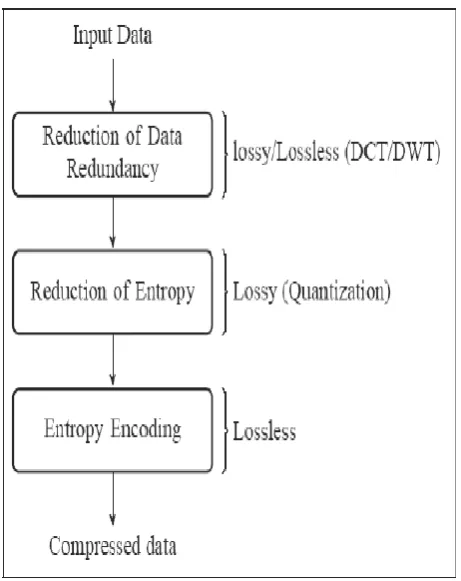
The general approach to data compression is the representation of the source in digital form with as few bits as possible. Source can be data, still images, speech, audio, video or whatever signal needs to be stored and transmitted. In general, data compression model can be divided in three phases: removal or reduction in data redundancy, reduction in entropy and entropy coding.
Fig 6: Data compression model
Research methodology of the work is below:
Compress the image using dwt for lossless compression Decompose the image using „harr‟ wavelet
Decomposes an image wavelet to level 2" and threshold values varied to get better results Quantification of image and use idwt for calculating the errors.
Calculate and comparing the CR, PSNR, SNR for different types of images.
IV. PROBLEM FORMULATION
medical imaging, space photograph, and film industry. In practice, medical images must be represented flawlessly for medical professionals to make clinical diagnosis with accuracy. Any minor distortion or errors introduced by lossy compression may lead to serious consequences to patients. In space exploration, astronomical images obtained by the satellites are often compressed and transmitted back to the earth for later processing such as object identification and feature extraction. These processing procedures may “amplify” the distortion caused by lossy compression and thus produce false results due to the distortion. In such cases, lossy compression is not appropriate because original astronomical images are very difficult and expensive to be obtained again. Finally, in film industry, lossless compression also has a huge market in archiving the films in order to save storage and meanwhile maintain the original high quality for future editing and re-compressing.
V. OBJECTIVES
Our objective is to design an efficient and effective progressive lossless image compression scheme.
Study of existing image compression techniques.
Understand and design efficient “wavelet transform” Technique.
Implement the proposed algorithm in MATLAB Tool for Redundant data removal and image compression.
To Achieve a higher PSNR value, decomposes an image wavelet to level N=2
Evaluate results.
VI. CONCLUSION
Image compression is an application of information compression that encodes the initial image with few bits. The objective of compression is to cut back the redundancy of the image and to store or transmit information in an efficient type. Compression coding is to store the image into bit-stream as compact as possible and to show the decoded image within the monitor as actual as possible. All basic compression techniques are mentioned here. To conclude all the compression techniques that are useful in their related areas. Compression methods DCT and DWT recently used for compression which provides higher compression ratio. This review paper provides clear idea about basic compression techniques and methodology.
REFERENCES
1. Archana Deshlahra, “Analysis of Image Compression Methods Based On Transform and Fractal Coding”,2013 2. Hui Zha, “Progressive Lossless Image Compression Using Image Decomposition and
3. Context Quantization, 2007
4. A. Alarabeyyat,“ Lossless Image Compression Technique Using Combination Methods”, 2012
5. Zhang Ning,“ study on image compression and fusion based on the wavelet transform technology”, 2015 6. Xiao ZhouImage Compression Based on Discrete Cosine Transform and Multistage Vector Quantization”, 2015 7. Terese Nilsson, “Custom Lossless Compression And High-Quality Lossy Compression Of White Blood Cell
Microscopy Images For Display And Machine Learning Applications”.
8. Vincent VAJNOVSZKI, “Lossless and Nearly-Lossless Image Compression Based on Combinatorial
Transforms”, 2011
9. Dongni Fan, “Guaranteed Quality Ecg Signal Compression Algorithm”, 2014
10. I. Journal, “Improved N Level Decomposition-Hybrid DCT-DWT Image Compression,” no. 6, pp. 173–175, 2014. 11. M. Singh and M. Garg, “Mixed DWT-DCT Approached Based Image Compression Technique,” vol. 3, no. 11, pp.
9107–9111, 2014.
12. I. I. Journal, “IMAGE PROCESSING USING DISCRETE,” vol. 3, no. 1, pp. 53–59, 2015.
13. A. S. Tajne, “MEDICAL IMAGES COMPRESSION USING HYBRID,” no. 3, 2015.
14. A. M. Raid, W. M. Khedr, and W. Ahmed, “Jpeg Image Compression Using Discrete Cosine Transform - A Survey,” vol. 5, no. 2, pp. 39–47, 2014.
15. R. Paper, “Images and Its Compression Techniques – A Review,” vol. 2, no. 4, pp. 71–75, 2009.
16. A. Lata and P. S. Assistant, “Review of Image Compression Techniques,” vol. 3, no. 7, pp. 461–464, 2013. 17. P. B. Khobragade and S. S. Thakare, “Image Compression Techniques- A Review,” vol. 5, no. 1, pp. 272–275,
2014.
18. J. O. F. Information, “A REVIEW ON IMAGE COMPRESSION Department of Electronics and Communication,”
pp. 281–284.
19. P. Halder, “an efficient image compression algorithm using dct- biorthogonal wavelet transform with arithmetic,” pp. 2319–2322, 2015.
20. A. Bhatt and A. K. Bhatt, “Image Compression Algorithms under JPEG with Lapped Orthogonal Transform and Discrete Cosine Transformation,” vol. 7, no. 3, pp. 6–10, 2013.
21. D. Ece, “A Review of Image Compression and Comparison of its Algorithms,” vol. 7109, pp. 22–26, 2011. 22. P. Telagarapu, V. J. Naveen, A. L. Prasanthi, and G. V. Santhi, “Image Compression Using DCT and Wavelet
![Fig. 1 Image Compression System [3]](https://thumb-us.123doks.com/thumbv2/123dok_us/1906572.1249761/1.595.174.424.560.628/fig-image-compression-system.webp)
![Figure 2: Image Points Matching of figure [2]](https://thumb-us.123doks.com/thumbv2/123dok_us/1906572.1249761/2.595.86.523.445.557/figure-image-points-matching-figure.webp)